Retail industry competitive analysis is the practice of tracking how retailers and their competitors change pricing, formats, hiring and leadership, then turning those changes into account priorities and talk tracks. For a sales team it is only useful if it tells a rep what changed, why it matters and which account to call this week.
TL;DR: Most retail competitive analysis ends as a quarterly deck that reps cannot act on. Scope the arena by segment and competitor tier, watch leading signals (executive hires, pricing shifts, job postings, go-to-market changes) instead of lagging reports, collect them continuously, and attach each signal to a named play such as stable alternative, time-to-value or fresh mandate.
Monday pipeline review. A regional retail prospect that ignored your team for six months suddenly announces curbside expansion, changes return policies, and posts three openings tied to store operations. Your reps have the account on a list somewhere, but nobody knows whether this is noise or a reason to reach out today. That gap is where retail industry competitive analysis usually breaks down.
The problem is not effort. Sales enablement, product marketing, and strategy teams often produce clean competitor decks with pricing snapshots, SWOT slides, and store screenshots. The problem is that the output rarely helps a frontline seller decide what changed, why it matters, which accounts to prioritize, and what message has a real chance of landing now.
Retail makes that gap expensive. It is a huge market, margins stay tight, and channel shifts happen fast. A pricing move, fulfillment change, executive hire, or store-format test can create a short selling window. If the insight sits in a quarterly deck, the window closes before anyone acts on it.
Good competitive work has to run closer to the field. It needs to translate market movement into account moves, rep prompts, and talk tracks your team can use this week. If you need a planning model before building that motion, this competitive analysis framework for sales teams is a useful starting point.
The teams that get results treat competitor intelligence as an operating input, not a research project. They build a system that turns raw signals into sales actions while the signal still matters.
Why Most Competitive Analysis Fails Sales Teams
The biggest mistake is assuming a good report creates good sales behavior. It doesn't.
Most traditional retail industry competitive analysis is built like a strategy assignment. It compares product lines, summarizes pricing, maps positioning, and ends with a SWOT. That can help leadership think clearly. It rarely helps a rep decide whether to send an email this morning, whether to re-open a stalled deal, or whether an account just became easier to win.
Static analysis answers the wrong question
Sales teams live on timing. A competitor changing return policies, expanding a store format, pushing heavier promotions, or hiring a new executive can create a short window where outreach becomes relevant. A static document can't keep up with that.
The sharpest framing I've seen is this: “How do I translate a competitor's real-time organizational change (e.g., a new CRO hire) into a specific, actionable account plan within 24 hours?” Most frameworks don't answer it. According to Lightspeed's discussion of retail competitor analysis, that gap contributes to a 40% lower conversion rate for sales teams using static analysis versus signal-driven intelligence.
That's the issue in one sentence. The analysis stops at observation. Sales needs action.
Practical rule: If a competitor insight can't be turned into a next step for a named account owner, it's research, not revenue support.
A lot of teams also confuse completeness with usefulness. They want every competitor, every product line, every campaign, every market nuance. Reps don't need that level of sprawl. They need a small set of meaningful triggers tied to clear plays.
If you're still using a quarterly template, it helps to revisit a stronger competitive analysis framework that puts decision-making ahead of documentation. The goal isn't to create a better archive. The goal is to create a better reason to engage buyers.
The real gap is operational
Here's what usually goes wrong on the ground:
- Marketing owns the file, sales owns the number: the analysis gets produced, but no one owns turning it into rep behavior.
- The update cycle is too slow: by the time the team reviews the deck, the market has already moved.
- Insights stay generic: “Competitor X is focused on omnichannel” sounds smart and helps nobody.
- No trigger thresholds exist: reps can't tell the difference between background noise and a real opening.
Good competitive work for sales looks different. It says, “This retailer is expanding private label, hiring in pricing operations, and running tighter promotion cycles. That suggests margin pressure and faster vendor evaluation. Here's the account list. Here's the talk track.”
That's a usable system. Everything else is shelfware.
See Salesmotion in action
Take a self-guided interactive tour — no signup required.
Scoping Your Arena for Actionable Insights
A rep pings the team after a lost deal and says, “We lost to Competitor X.” That sounds useful. It usually isn't. In retail, the actual competitive set is often wider than the name on the final slide. A retailer may choose an incumbent platform, an agency, an internal build, or a cheaper point solution and treat all of them as substitutes for the same budget.
That is why scoping comes before tracking.
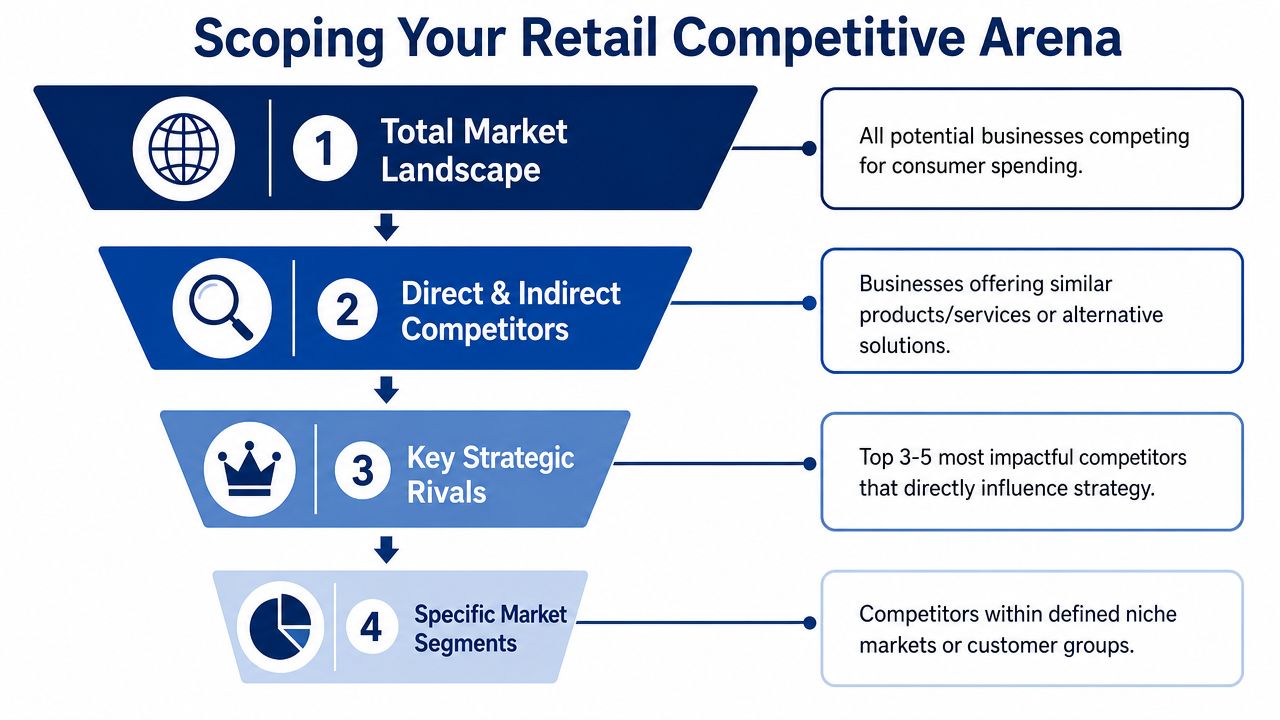
A practical retail industry competitive analysis starts with one question: which competitors can change rep behavior this quarter? Asana's competitive analysis guidance recommends setting a specific objective first, then narrowing the field to a manageable set of direct and indirect competitors. That approach holds up in the field because it forces focus before the research sprawl starts.
Use three buckets, not one long list
I sort competitors into three groups because sales teams need fast judgment, not a museum catalog.
Direct competitors show up in live deals against your team. Same buyer, same budget, same business problem.
Indirect competitors compete for the same outcome through a different route. In retail, that could be a marketplace tool, a service partner, or an internal team stitching together reporting and workflows.
Aspirational competitors influence buyer standards even when they are not in the deal. They shape what buyers expect on pricing, rollout speed, analytics, or omnichannel execution.
This matters more in retail than many teams admit. A specialty brand evaluating a vendor may compare your offer against in-house merchandising workflows. A grocery chain may benchmark you against a partner that can reduce promo waste faster, even if the product looks weaker on paper. If your arena only includes vendors that look like you, reps will miss the underlying objection pattern.
Build your competitor set around who changes buying decisions, approval speed, or budget allocation.
For newer operators, especially those selling into crowded ecommerce segments, outside-category reading can still sharpen competitive judgment. These tips for launching an online sneaker store are useful for that reason. They show how assortment, merchandising, positioning, and channel choices stack up in a real retail business.
Score competitors by commercial risk
Keep the model simple enough to survive first contact with the sales floor.
| Competitor | Tier (Direct/Indirect) | Deal Impact Score (1-5) | Market Threat Score (1-5) | Total Priority Score |
|---|---|---|---|---|
| Competitor A | Direct | 5 | 4 | 9 |
| Competitor B | Direct | 4 | 5 | 9 |
| Competitor C | Indirect | 3 | 4 | 7 |
| Competitor D | Indirect | 2 | 5 | 7 |
| Competitor E | Direct | 4 | 2 | 6 |
Two scores are usually enough at this stage.
- Deal impact score: How often does this competitor appear in active opportunities?
- Market threat score: How likely are they to shift buyer expectations, pricing pressure, or category direction?
That gives managers something they can use. A competitor with low deal volume but high market influence still belongs on the watchlist because it changes how buyers evaluate everyone else. A competitor with frequent deal overlap but weak momentum needs battlecards and objection handling, not endless strategy sessions.
This is also where segment discipline matters. Many of the broader challenges of the retail industry show up because teams lump every retailer together and call it coverage. That creates generic competitor lists and weak account planning.
Define the arena by segment
“Retail” is too broad to guide rep action. Grocery, beauty, apparel, home goods, and specialty retail all buy differently because margin structure, inventory risk, promo cadence, and store economics are different.
Analysts at MMCG Invest noted in their U.S. retail market and outlook 2025 to 2030 that food and beverage remains the largest retail segment by revenue share. That is a useful scoping reminder. A competitor that matters in food retail may be irrelevant in luxury accessories, while a pricing or inventory player that wins in specialty apparel may have little pull in grocery.
Scope your arena by segment, then by competitor tier, then by revenue risk. That is the sequence that turns competitive intelligence into account coverage, deal strategy, and rep action.

“The talking points are gold. If they're in Salesmotion, I know they're being discussed inside that business. That makes it easy to spark a real conversation, which is 90 percent of the battle.”
Andrew Giordano
VP of Global Commercial Operations, Analytic Partners
Identifying Signals That Predict Sales Opportunities
Once you know who matters, the next job is deciding what to watch. During this process, time is often wasted on lagging indicators, causing signals that help reps move first to be missed.
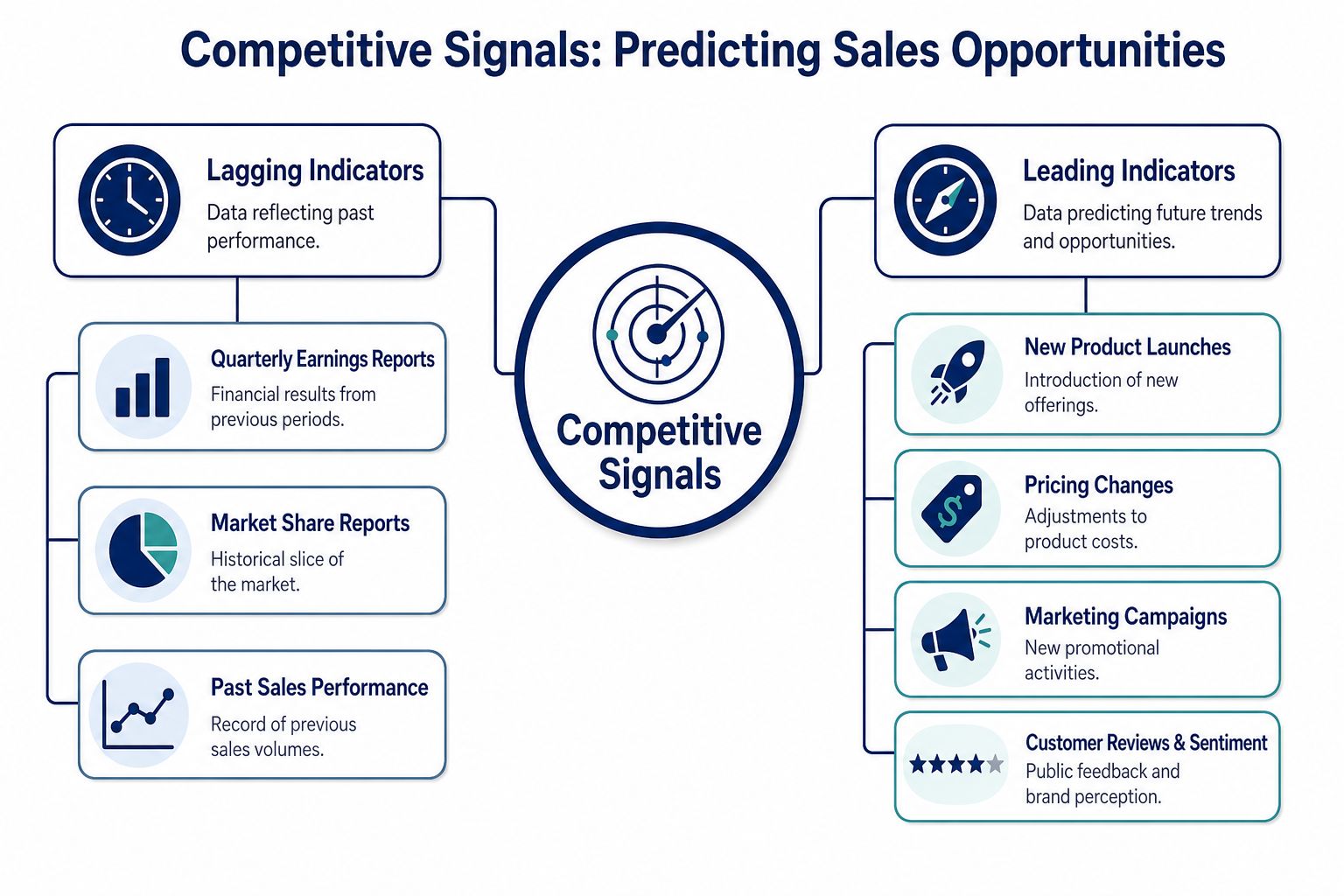
The useful distinction is simple. Lagging indicators tell you what already happened. Leading indicators hint at what a retailer is about to do.
Lagging indicators are useful, but slow
Quarterly earnings summaries, annual reports, broad market share reviews, and retrospective coverage all matter. They help leaders understand context. They are less helpful for frontline timing because the action already happened.
If a retailer reports margin pressure after a difficult period, that's important. But by the time you see it in a polished summary, the procurement conversations, pricing discussions, and budget scrutiny probably started earlier.
This is why diverse inputs matter. Daasity's analysis of retail competitive data notes that effective retail competitive analysis relies on integrating multiple data sources and focusing on metrics such as market share, pricing elasticity, and promotional effectiveness. It also notes that in 2025, competitive intelligence tools evolved to support real-time tracking of competitor pricing, inventory levels, and marketing strategies, enabling more dynamic decisions.
That's the shift. Don't just review the quarter. Track the movements that shape the quarter while they're still unfolding.
Four signal groups worth tracking
I'd organize retail signals into four groups.
Corporate signals
These are structural changes that usually indicate budget movement, strategic change, or fresh urgency.
- Executive hires: A new chief commercial officer, chief digital officer, or head of merchandising often resets priorities.
- Expansion moves: New regional presence, office growth, or business unit creation can signal upcoming systems work.
- Partnership announcements: New alliances often tell you where a retailer is trying to strengthen capability.
These matter because they often create a short period where old assumptions are up for review.
Product and pricing signals
In this situation, a lot of revenue teams can win fast.
- New launches: A competitor introduces a new offering or retail format.
- Pricing shifts: Discounting intensifies, bundles change, or premium positioning gets more aggressive.
- Inventory or assortment moves: Product availability changes can reveal operational stress or strategic repositioning.
Retailers can't protect margins on instinct. They need to monitor pricing in real time and understand customer sensitivity to those changes. If you want a good channel-specific companion read, this what are buying signals guide helps frame how observable activity maps to sales timing.
People signals
People changes often reveal capability gaps more clearly than a press release.
A burst of hiring in e-commerce operations, pricing analytics, category management, or marketplace roles suggests active investment. Job descriptions are especially useful because they expose what the business wants to build, improve, or replace.
A job post often says more than a homepage. Marketing tells you the story. Hiring tells you the work.
Go-to-market signals
Watch the message, not just the motion.
If a competitor suddenly shifts positioning toward affordability, speed, store execution, supplier collaboration, or omnichannel visibility, there's usually a reason. The same goes for new customer stories, webinar themes, partner pages, and campaign language.
For retail sellers, the best signals are the ones that narrow the “why now.” Not everything deserves action. The right signal says a retailer is entering a period of change, and change is when buyers take meetings.
Building Your Competitor Intelligence Gathering System
Competitive intelligence falls apart when it depends on heroic effort. One motivated manager can keep it alive for a month. Then the quarter gets busy, the CRM is messy, and the process fades.
The fix is boring, which is why it works. Build a repeatable system with clear sources, owners, and review rhythm.
Start with a manual baseline
There's still value in doing some of this by hand, especially early on. It teaches your team what meaningful change looks like in your category.
TruRating's retail competitor analysis article highlights the mystery shopper approach, including subscribing to competitors' mailing lists and visiting physical stores. It also notes that continuous signal monitoring, including events like new hires and funding rounds, enables 40% faster response times than traditional quarterly reviews.
That lines up with what works in practice. Your baseline collection system should include:
- Mailing list monitoring: Subscribe to competitor newsletters, promo emails, webinar invites, and product updates.
- Store and site observation: Visit physical stores where relevant. On digital properties, track navigation changes, checkout flow, merchandising emphasis, and promotional placement.
- Job board review: Watch for roles in analytics, pricing, supply chain, retail media, loyalty, and digital commerce.
- Public company materials: Review earnings commentary, investor pages, and leadership interviews when available.
- Social and review surfaces: Customer complaints, repeated praise, and comparison language are often more useful than polished ad copy.
Give each source a job
One reason teams drown in competitor data is that they don't assign purpose. Every source should answer a specific question.
Here's a simple way to structure it:
| Source | What it reveals | Best use |
|---|---|---|
| Competitor emails | Promotion cadence, product focus, seasonal priorities | Pricing and campaign timing |
| Job postings | Capability gaps, active investment areas | Early demand signals |
| Store visits | Service quality, assortment reality, execution standards | Customer experience comparisons |
| Earnings and press releases | Strategic priorities, expansion, executive messaging | Account planning context |
| Reviews and social feedback | Friction points, sentiment patterns, unmet expectations | Objection handling and messaging |
Otherwise, reps end up collecting noise. A hundred screenshots of competitor websites won't help if nobody can tell whether the company is changing direction.
Reduce the manual research tax
Manual monitoring is useful. It's also expensive in rep time.
A sales manager should be realistic about the trade-off. Hand-built tracking works best for a small target list, a focused segment, and a team disciplined enough to log what they find. Once the account universe expands, the work becomes brittle. Updates get missed. Signal quality drops. Reps revert to generic outreach because nobody trusts the freshness of the intelligence.
That's why the best systems separate collection from interpretation. Someone, or something, should gather the raw inputs continuously. Then the commercial team should review only the changes that affect prioritization, messaging, or timing.
Field note: If your reps are spending more time finding signals than using them, the system is upside down.
A workable operating rhythm is simple. Collect continuously. Review weekly as a team. Escalate major triggers the same day. Tie every trigger to accounts, owners, and a recommended motion.

“All of the vendors that I've worked with, all of the onboarding that I have had to deal with, I will say, hands down, Salesmotion was the easiest that I have had.”
Lyndsay Thomson
Head of Sales Operations, Cytel
Turning Raw Data into Actionable Sales Plays
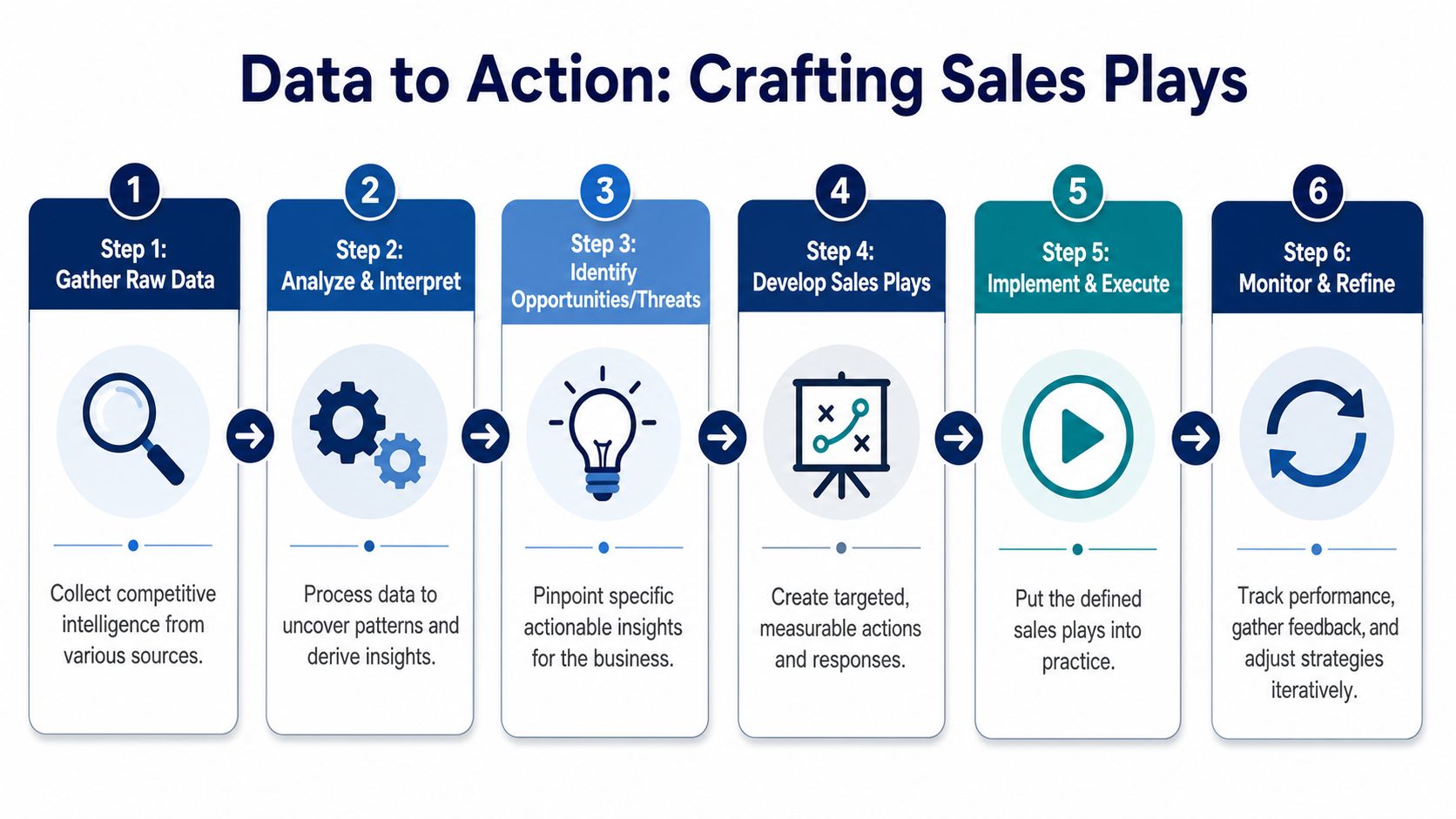
Most retail industry competitive analysis breaks down. Teams collect data, summarize it, and stop. Sales needs a decision.
The right way to think about this is an if-then playbook. If a competitor signal appears, then the team runs a predefined response. Not a brainstorm. Not an ad hoc Slack thread. A play.
Play one for pricing pressure
Retailers can't stay competitive by guessing on price. Flipflow's discussion of competitive analysis for retailers makes the point clearly: retailers need to monitor prices in real time, analyze consumer sensitivity to price changes, and connect that work directly to decisions through a defined competitive intelligence cycle.
That has an immediate sales implication.
If a competitor raises prices or tightens discounts, run the stable alternative play.
The motion looks like this:
- Pull accounts where the competitor is present or likely incumbent.
- Segment by buyer sensitivity. Procurement, finance, category leaders, and commercial operators usually care for different reasons.
- Arm reps with a message focused on predictability, margin protection, and implementation stability.
- Include a proof path. Demo, comparison call, or pricing review.
The mistake here is going too broad. Don't send a generic “we're cheaper” campaign. Use the competitor move to frame a business issue the buyer already feels.
If you sell into marketplace-heavy retail environments, this complete strategic guide for Amazon sellers is worth reading because it shows how pricing visibility, category pressure, and competitive monitoring shape action in a live commerce setting. The principle is the same even outside Amazon.
Play two for hiring-based urgency
This one gets missed constantly.
If a retailer starts hiring for a capability your product already solves, run the time-to-value play.
Example. A retailer posts for roles tied to pricing operations, reporting automation, omnichannel merchandising, or loyalty analytics. That usually means one of two things. They have a problem to solve, or they're trying to build around an existing limitation.
Your response should not mock the internal build. It should reduce the time horizon.
A good message says, “You may be investing in this capability now. If the near-term goal is faster execution while the team scales, here's how other retail operators approach that gap.”
That creates a discussion without forcing the prospect to defend their hiring plan.
Play three for new executive leadership
Executive change resets evaluation criteria.
If a retailer hires a new commercial, digital, or operations leader, run the fresh mandate play.
This works because new leaders often review inherited vendors, inherited metrics, and inherited priorities. The outreach angle isn't “Congrats on the new role.” Everyone sends that. The stronger move is to tie the role change to a plausible initiative.
For example:
- A new digital leader may care about speed, integration simplicity, and channel visibility.
- A new merchandising leader may care about assortment performance and promotional control.
- A new commercial leader may care about margin quality, forecasting confidence, and organizational alignment.
The rep's job is to connect the leadership change to a business outcome, then offer a concise point of view.
Build the response library before you need it
Many teams fail here because they wait until the signal appears and then try to invent copy, targeting, and positioning on the fly.
A better system includes:
- Named plays: stable alternative, time-to-value, fresh mandate, expansion support, win-back, displacement.
- Approved talk tracks: short, specific, and suited to stakeholder type.
- Account filters: incumbent competitor, segment, urgency, and likely buying center.
- Follow-up logic: what happens after email one, after no reply, after a positive response.
If you want to formalize this at the team level, these signal-driven sales playbooks offer a solid model for connecting signals to repeatable execution.
Raw data informs strategy. A sales play changes behavior. That's the difference that creates pipeline.
From One-Off Project to Continuous Advantage
Most companies treat competitive work like a project. They kick it off, gather information, publish a deck, and move on. That's fine if your goal is alignment for an offsite. It's weak if your goal is winning live deals in a market that keeps shifting.
Retail doesn't sit still. Buyer expectations change fast. Competitors adjust pricing, promotions, partnerships, hiring, and positioning constantly. A static review can't keep pace with that. A continuous system can.
A significant advantage comes from operational discipline. Narrow the arena. Watch the signals that predict change. Build a gathering system your team can maintain. Then translate those signals into clear plays with owners, timing, and messaging.
What good looks like in practice
A healthy system has a few visible traits:
- Managers review priority signals regularly: not every headline, only changes that affect account strategy.
- Reps know what to do with a trigger: the next action is obvious.
- Messaging gets more specific over time: outreach sounds informed, not templated.
- Prioritization improves: teams stop wasting effort on cold accounts with no reason to move.
That's how retail industry competitive analysis becomes commercially useful. It stops being a library of competitor facts and becomes a working input to pipeline generation.
The winning team usually isn't the one with the thickest competitor file. It's the one that spots change early and acts while the window is still open.
This is also more manageable than many leaders assume. You don't need perfect coverage across every retailer and every rival. You need consistent coverage on the accounts and competitors that can move your number. Once that discipline is in place, the quality of conversations changes fast. Reps show up with context. Managers coach with evidence. Buyers hear a relevant point of view instead of another generic check-in.
That's the standard worth aiming for.
Sales teams don't need more noise. They need timely signals, clear context, and outreach that answers “why now.” Salesmotion helps revenue teams do exactly that with AI agents that track target accounts continuously, surface real-world triggers, and turn them into actionable account insight and personalized outreach. If you want competitive intelligence to drive pipeline instead of sitting in a slide deck, it's worth a look.