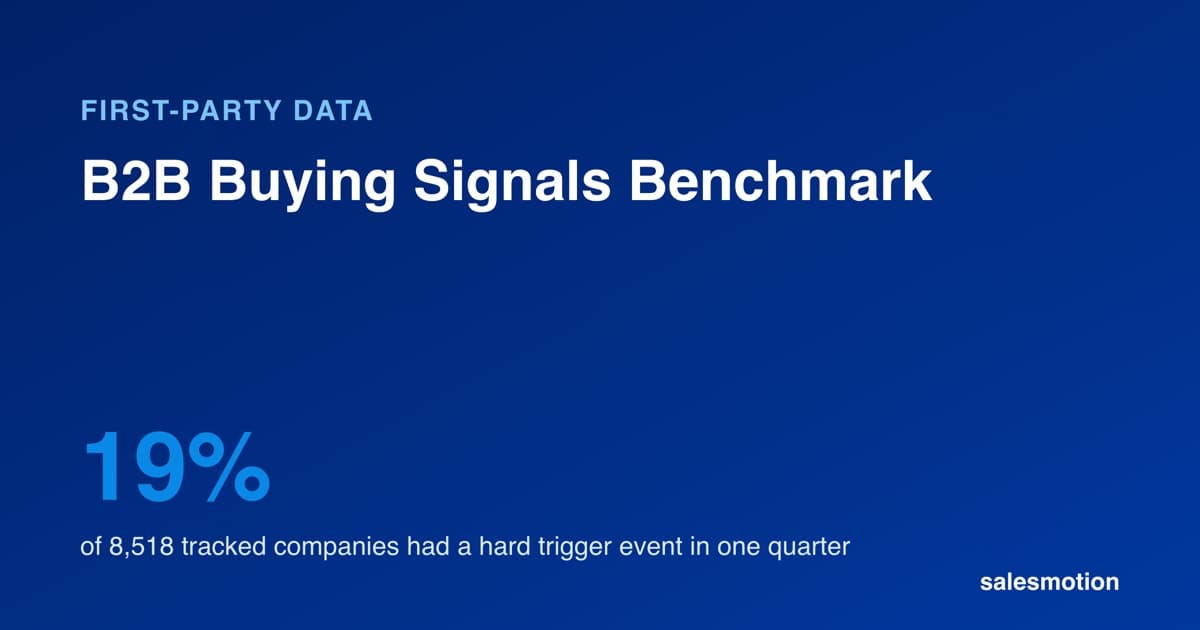
Signal-based selling is a sales approach where reps decide which accounts to contact, and when, based on observable events at those accounts: a new leader, an acquisition, a funding round, hiring for a specific team, an earnings-call priority. It replaces fixed cadences with timing. Salesmotion's benchmark of 8,518 tracked companies shows why it works and where it stops working. In one quarter, 18.7% of companies produced a hard trigger event (M&A, funding, a partnership, an expansion or a product launch) and 30.8% did when relevant hiring counts. A rep who knows which accounts those are spends the quarter on the right ones.
Key takeaways
- Definition: signal-based selling uses account events (who changed, what happened, what the company said) to choose accounts, timing and message.
- How often signals happen: in Q3 2026, 85% of 8,518 tracked companies produced at least one signal, 18.7% a hard trigger event and 30.8% a trigger or relevant hiring (benchmark).
- How fast to act: at companies with repeated triggers, the median gap between them was 10.5 days, so a signal older than two weeks has often been overtaken.
- Where it breaks: signals pick the account and the moment. They do not make a cold email land on their own; in Salesmotion's own outbound, hiring-triggered cold email drew no human replies from 459 leads.
- What to build: a short list of signal types that matter for your offer, a response window for each and one play per signal.
What Is Signal-Based Selling?
Signal-based selling means acting on evidence instead of a schedule. A traditional sequence emails an account on day 1, 3 and 7 because the cadence says so. A signal-based rep contacts the account because its new CFO named cost control as a priority on last week's earnings call, and opens with that.
| Traditional outbound | Signal-based selling | |
|---|---|---|
| Who to contact | Everyone on the list | Accounts where something just changed |
| When | The seller's cadence | Within days of the event |
| Message | Generic value proposition | Anchored to the event and its consequence |
| Data used | Firmographics and titles | Account events, engagement and intent |
| Success metric | Activity volume | Meetings and pipeline per account worked |
Three kinds of signals feed it:
- Account events (timing signals): M&A, funding, partnerships, expansions, product launches, relevant hiring, leadership changes, regulatory decisions, earnings commentary. These answer "why now". They are public, so they can be monitored for every account in a territory.
- Engagement signals: an account's own interaction with you: pricing-page visits, demo requests, event attendance, replies.
- Intent signals: third-party research activity on topics in your category. See intent data providers for how that data is collected.
Account events carry the most context, because each one tells you what changed and who owns it. They are the focus of the rest of this guide. For the full list of signal types with examples, see the buying signals guide.
Turn buying signals into booked meetings
Salesmotion surfaces leadership changes, earnings mentions, hiring surges and news events across your territory, so reps reach out when timing actually matters.
How Often Buying Signals Happen: First-Party Benchmarks
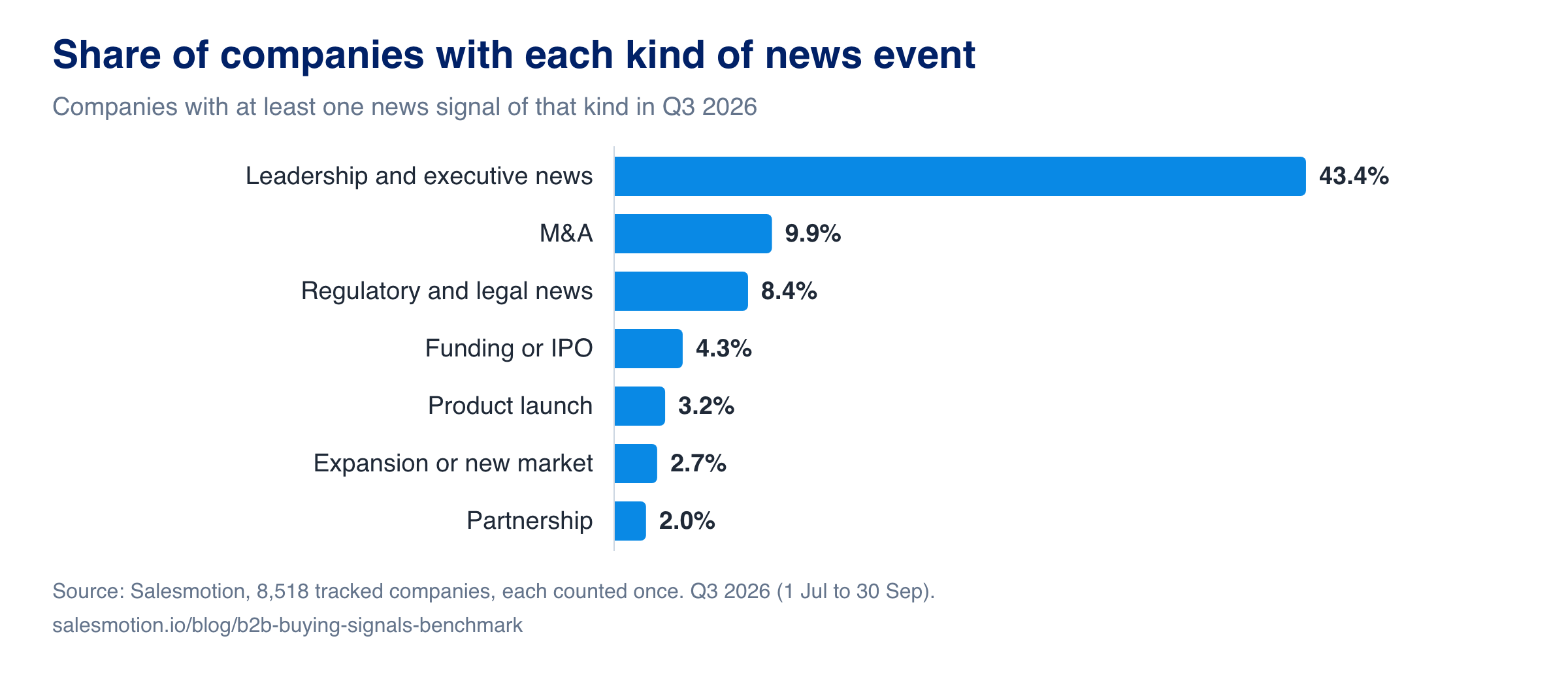
Most advice on signal-based selling skips the base rate: how many signals a rep should expect. Salesmotion measured it across 8,518 companies tracked in its customers' workspaces, each company counted once.
| Measure, Q3 2026 | Value |
|---|---|
| Companies with at least one signal of any kind | 84.6% |
| Companies with a hard trigger event (M&A, funding, partnership, expansion, product launch) | 18.7% |
| Companies with a trigger event or relevant hiring | 30.8% |
| Companies with M&A news | 9.9% |
| Companies with a funding or IPO story | 4.3% |
| Companies in leadership and executive news (about a third of it appointments or departures) | 43.4% |
| Median signals per company in the quarter | 7 |
| Median days between trigger events (companies with two or more, May to September 2026) | 10.5 |
| Share with a trigger event: 10,001+ employees vs 200 or fewer | 40% vs 8% |
Source: Salesmotion B2B Buying Signals Benchmark, October 2026. Method, definitions and the downloadable CSV are on that page.
Five conclusions for anyone running signal-based selling:
- Most of a book is quiet in any given quarter. Fewer than one in three companies gave a clear reason to call, even counting relevant hiring. Signals tell you where to spend the week; steady coverage still matters for the rest.
- Verify leadership news before acting on it. Executive news reached 43% of companies, but only about a third of it was an actual appointment or departure.
- Do not build the motion on funding alone. Under 5% of companies had a funding story in the quarter.
- Most news is context. Financial results and strategy stories outnumber trigger events. Use them for the first line of a message, not as the reason to send it.
- Small accounts are quiet. The median company with 200 or fewer employees produced one signal in the quarter. In SMB books, signals help pick the moment but cannot carry the whole pipeline.

“Automatic account profile detail I can use to manage my territory. Using Salesmotion AI to generate value statements per persona, account, etc. Using Salesmotion to give me a starting point based on new hires, or news alerts is critical.”
Adam Wainwright
Head of Revenue, Cacheflow
Response Windows by Signal
Speed matters because signals stack. At accounts that produce trigger events, the next one often arrives within two weeks, and the earlier opening is stale by then. Give each signal a response window so reps know what "act fast" means:
| Priority | Example signals | Response window | Suggested action |
|---|---|---|---|
| High | New CxO or VP hire in your buyer persona; earnings call mentioning your value area; a funding round; several signals in one week; a former champion moving to a new company | 24 to 48 hours | Personalized outreach tied to the event; multi-thread two or three stakeholders |
| Medium | Hiring surge in your buyer's department; product launch or expansion; a single content download; a conference talk on your topic | 1 to 2 weeks | A targeted touch that connects your value to their initiative |
| Low | Job postings in adjacent functions; an award or press mention; a non-competitive tech stack change | Monitor | Add to a watchlist and revisit in 30 to 60 days |
Five Signal Play Templates You Can Copy
A play is the pre-agreed response to a signal: who to contact, on which channel, with what message, and how you will know it worked. Each template below defines the trigger, how fast to act, the steps, a message frame and one metric. Adapt the timelines to your sales cycle.
| Play | Trigger | Act within | Steps | Message frame | Metric |
|---|---|---|---|---|---|
| Leadership change | A new VP, C-level executive or department head joins a target account | 7 to 14 days | Research their priorities and tools at the previous company; send one insight, no pitch; engage on LinkedIn; ask for a conversation about their priorities by day 30 | "Congratulations on joining [Company]. At [Previous Company] you [initiative]. As you look at [area], [one specific insight]." | Meeting rate within 30 days |
| Funding or growth | Funding round, IPO filing, major partnership or expansion into a new market | 14 to 21 days | Read what they said the money is for; connect your solution to that plan; multi-thread to the hiring manager and the executive who owns the funded initiative | "You just announced [event]. With [growth plan], teams in your position usually need [capability]." | Pipeline created within 60 days |
| Competitive displacement | Public signs the account is reviewing an incumbent tool: job postings naming it, review activity, an approaching renewal | 90 to 120 days before renewal | Confirm the signal; find the daily users, the manager who owns results and the budget holder; lead with the specific friction, not the competitor; offer a side-by-side proof of concept | "Teams in [role] often tell us [specific friction] slows them down. Here is how [named customer] handled it." | Win rate on signal-triggered vs other deals |
| Earnings priority | An earnings call, 10-K or strategic plan names a priority your solution serves | 7 to 14 days | Pull the exact quote; map it to your capabilities; identify who owns the initiative; quote the call in your outreach | "On the Q[X] call, [executive] said [quote]. We help teams like [customer] reach [outcome]." | Reply rate vs baseline outreach |
| Hiring surge | Several open roles in the department your solution supports | 14 to 30 days | Read the postings for skills, tools and target team size; find the hiring manager and the sponsoring executive; connect your solution to the scaling challenge | "You are hiring [X roles] for [team]. Teams growing like this usually hit [challenge]." | Meeting rate vs cold outreach |
The buying triggers guide covers ten trigger events in more depth.

“The account and contact signals are key for reaching out at important times, and the value-add messaging it creates unique to every contact helps save time and efficiency.”
Daniel Pitman
Mid-Market Account Executive, Black Swan Data
What Signals Do Not Fix
Signals pick the account and the moment. The channel and the relationship still decide whether anyone answers. Salesmotion tracked the human reply rate on its own outbound from August 2024 to October 2026, with auto-replies removed:
| Channel and angle | Human reply rate | Leads |
|---|---|---|
| LinkedIn, existing network | 11.3% | 2,198 |
| LinkedIn, people who engaged with the seller first | 9.6% | 1,051 |
| LinkedIn, cold connection request | 6.3% | 1,132 |
| Cold email, new-in-role trigger | 0.8% | 630 |
| Cold email, list with no trigger | 0.3% | 12,382 |
| Cold email, hiring trigger | 0 replies | 459 |
The trigger cohorts are small, so read them as directional. The pattern still matters: anchoring a cold email to a hiring signal did not rescue it. The full breakdown and what changed as a result are in cold outreach best practices. Use signals to choose who and when, then reach the person through the channel where they already know you, or through a message that proves you read the event.
"I'm looking more for surveillance on my accounts to pick up the stuff that I might miss." Regional sales manager, cybersecurity
How to Roll Out Signal-Based Selling
1. Start from your ICP
Signals only help on accounts that can buy. Define the firmographics, technographics and buying motion of your best customers first, so the team watches the right accounts. The ICP template walks through it.
2. Pick three or four signal types
Choose the events that change demand for your offer specifically. A sales-tooling vendor cares about new sales leaders and sales hiring; a CRO cares about Phase 1 completions and financings. Ignore the rest, or the feed turns into noise: 100 tracked companies produced about 1,500 signals in one quarter in the benchmark.
3. Write one play per signal
Use the templates above. Each play needs a trigger, a persona, a channel, a message frame and a response window.
4. Automate the monitoring, not the judgement
Nobody can check news, filings, earnings calls, podcasts and job boards for 100 accounts every day by hand. That is the part to automate. The rep's part is deciding whether a signal matters and writing a message that shows it.
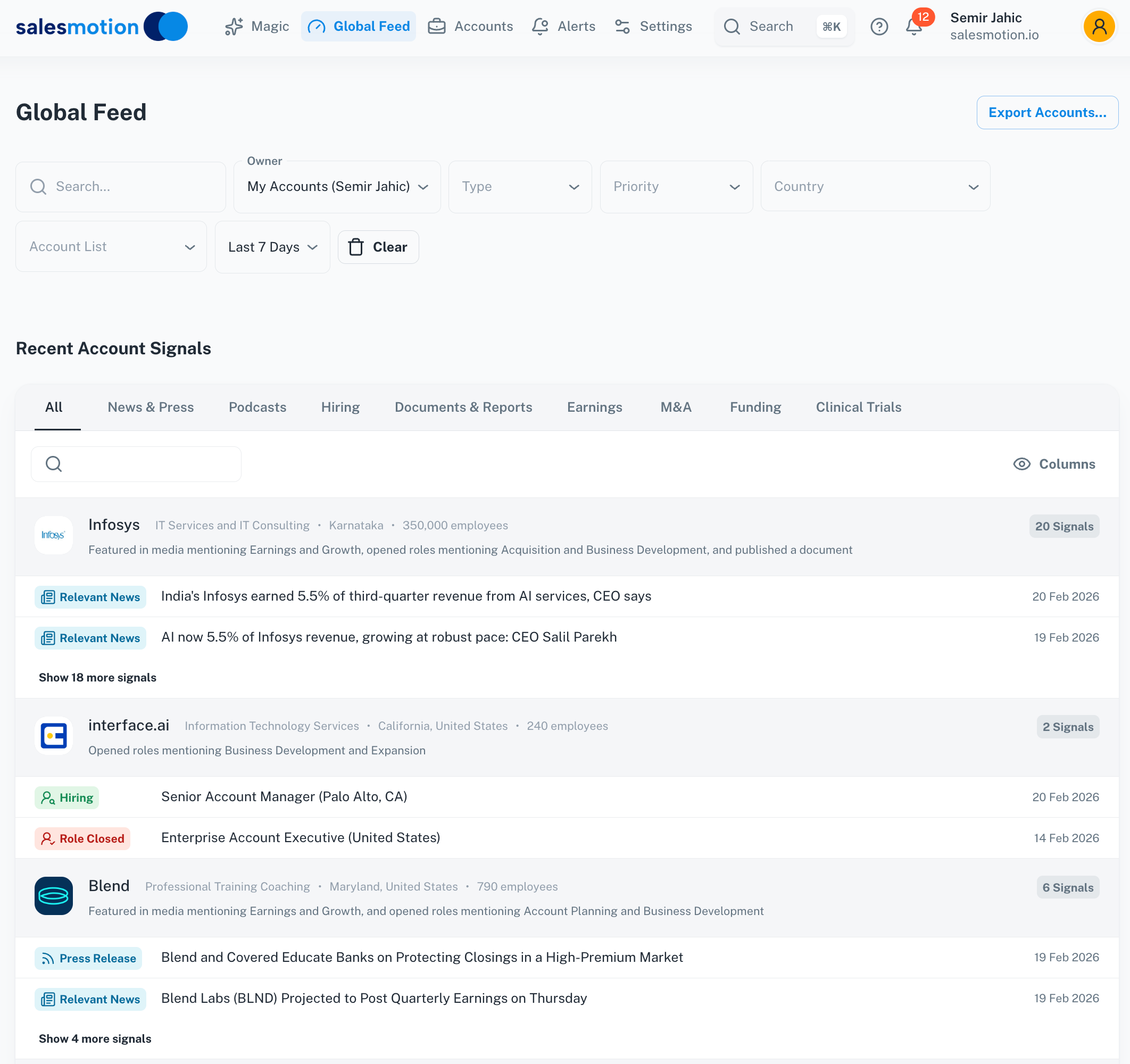 A live signal feed across a territory: earnings mentions, hiring surges and role changes, each linked to its source.
Salesmotion's Signal Agent watches 1,000+ public sources for 50+ signal types across a rep's accounts, the Research Agent turns an account into a brief, and the Outreach Agent drafts a message anchored to the event. Frontify reported a 42% increase in sales velocity, 31% shorter sales cycles, 4x growth in self-sourced revenue and a 90% reduction in research time (Thomas Meichtry, Head of Sales, North America). Cytel cut research time by 50% and consolidated five tools into one (Lyndsay Thomson, Head of Sales Operations).

“The talking points are gold. If they're in Salesmotion, I know they're being discussed inside that business. That makes it easy to spark a real conversation, which is 90 percent of the battle.”
Andrew Giordano
VP of Global Commercial Operations, Analytic Partners
5. Measure it
Track four numbers, split by signal type, so you can see which plays earn their place:
- Reply and meeting rate per play, against your non-signal outreach.
- Pipeline created per play within 60 days.
- Win rate of signal-sourced opportunities against other sources.
- Sales cycle length from first touch to signature.
Common Mistakes
- Treating every signal as equal. A leadership change in your buyer's team and a trade-show award are not the same. Rank signals before the feed goes live.
- Acting too late. A two-week-old signal has usually been overtaken by the next one at the same account.
- Expecting signals to replace relevance. The signal earns the timing; the message still has to show you understood it.
- No shared definition of a hot account. Sales and marketing need one list of signals that count, written down. The signal-based marketing playbook covers the marketing side.
- Tools that sit outside the workflow. If signals do not reach the CRM, Slack or the rep's inbox, reps fall back on old habits.
Frequently Asked Questions
What is signal-based selling?
Signal-based selling is a sales approach where reps choose which accounts to contact, when, and what to say based on observable events at those accounts, such as leadership changes, acquisitions, funding, relevant hiring and earnings-call priorities. It replaces fixed outreach cadences with timing. In Salesmotion's benchmark, 18.7% of tracked companies produced a hard trigger event (M&A, funding, partnership, expansion or product launch) in a quarter, and 85% produced at least one signal of any kind.
How many buying signals does a typical account produce?
The median company tracked in Salesmotion produced 7 signals in Q3 2026, and 85% produced at least one. Volume depends heavily on size: the median company with more than 10,000 employees produced 32 signals in the quarter, while the median company with 200 or fewer produced one.
What is the most common sales trigger event?
Among hard trigger events, M&A: 9.9% of 8,518 tracked companies had an acquisition, merger or divestiture story in a single quarter, ahead of funding or IPO (4.3%). Leadership and executive news was more common, at 43% of companies, but only about a third of it described an actual appointment or departure.
How quickly should you act on a buying signal?
High-priority signals deserve a response within 24 to 48 hours, and most trigger-based plays within one to two weeks. At companies with repeated trigger events, the median gap between them was 10.5 days, so a signal that waits two weeks has often been overtaken.
How is signal-based selling different from lead scoring?
Lead scoring ranks contacts by who they are and how they engaged with you. Signal-based selling adds what is happening at the account right now, from public events, and turns that into timing and message. The two work together: score for fit, use signals for timing.
How is signal-based selling different from account-based marketing?
Account-based marketing decides which accounts deserve focused investment. Signal-based selling decides when to engage each of them and what to say. Signals turn an ABM account list into a weekly action list.
Does signal-based selling improve cold email reply rates?
Not on its own. In Salesmotion's own outbound, cold email tied to a hiring trigger drew no human replies from 459 leads, and list-based cold email drew 0.3%. LinkedIn messages to people who already knew the sender reached 9.6% to 11.3%. Those cohorts are small and directional, but the lesson holds: signals choose the account and the moment; the channel and the relationship decide the reply.
What is a signal-driven sales playbook?
A signal-driven sales playbook is a set of plays, each started by a specific, observable event at a target account, such as a leadership change, a funding round or an earnings-call priority. Each play defines the trigger, how quickly to act, the steps in order, the message anchored to the event and the metric that shows whether it works. That replaces general guidance with a clear answer to "what do I do when this happens?"
Is signal-based selling only for enterprise sales?
No, but it works differently by segment. Large accounts produce many signals, so the work is filtering. Small accounts produce few, with the median company under 200 employees producing one signal a quarter, so signals should be combined with fit-based targeting and steady coverage.