A rep starts the day with a target account and six tabs open. CRM for history. LinkedIn for org changes. A press release for context. Slack for the latest deck. An old call recording for messaging. Then they still have to write an email that sounds specific enough to earn a reply.
That workflow is common, and it usually points to a tooling problem, not a talent problem.
Sales enablement tools earn their place when they cut the time between "something changed at this account" and "the rep sent a relevant message." Weak tools do the opposite. They bury content, split coaching from execution, and leave reps guessing which asset, talk track, or signal matters right now. Teams that want to tighten that gap usually start by fixing research and execution together. A useful example is how AI can automate sales research before outreach starts.
The better way to evaluate this category is by the primary job each tool does. Some tools handle Sales Intelligence and help reps find the why now. Some are Unified Platforms that bring content, training, and buyer engagement into one system. Some focus on Readiness, where coaching, certification, and practice matter most. Others solve Knowledge Management, which means getting the right answer to a seller in the flow of work.
That framing matters because "sales enablement" is too broad to buy against. If your real problem is slow prospecting, a content hub will not fix it. If your issue is inconsistent onboarding, a signal engine will not fix that either.
If you're also working on improving sales team outreach efforts, this is the stack decision that determines whether automation produces better messages or just more of them.
This guide follows that job-based lens, then closes with a practical buying checklist and an ROI framework so you can compare tools by outcome, not feature count.
1. Salesmotion
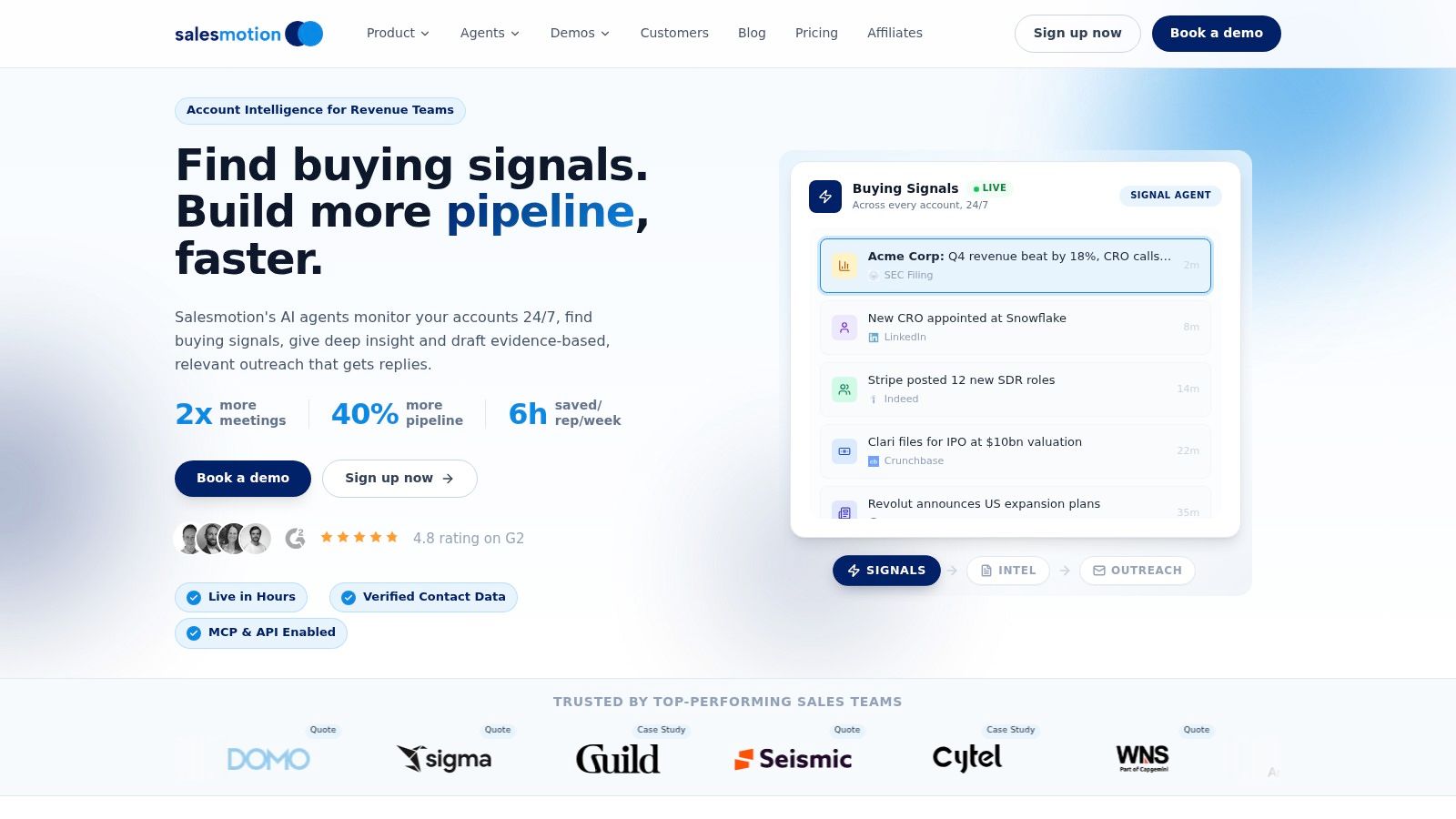
A rep opens the CRM on Monday morning, sees a target account raised a new round, posted three security roles, and had its CTO on a podcast last week. In a lot of teams, nobody turns that into a usable point of view before the first email goes out. Salesmotion is built for that gap.
In this guide's job-based framework, Salesmotion fits the Sales Intelligence category. Its role is finding the why now, then helping reps act on it. That makes it a different buy than a content hub, LMS, or coaching platform. If your sales problem starts before the meeting, this is one of the few tools here aimed at that stage.
Salesmotion centers on three AI agents: Signal, Research, and Prospector. Signal monitors public account activity across a wide set of sources and surfaces changes that may create urgency. Research turns those changes into an account brief with priorities, risks, stakeholders, and messaging angles. Prospector uses that context to draft outbound copy and route it into the systems reps already use.
The value is straightforward. Reps stop stitching together Google searches, LinkedIn checks, earnings notes, hiring pages, and scattered account history just to answer three basic questions: why this account, why now, and what should I say?
Practical rule: If reps still do account research from scratch before outreach, enablement has a coverage gap.
If you want to pressure-test that motion, this guide on automating sales research with AI for outbound teams maps closely to the operating model behind the product.
Where Salesmotion earns a spot
Salesmotion stands out when relevance is the bottleneck. It creates the difference between a generic growth-themed email and a message tied to an actual trigger event the buyer will recognize. That matters for SDR teams trying to raise reply rates, and it matters just as much for AEs working named accounts where poor timing wastes expensive coverage.
I also like the fact that it keeps the workflow close to execution. Salesforce and HubSpot support are table stakes. The more important piece is integration with engagement tools such as Outreach and Salesloft, because that is where good intelligence often dies. If reps have to leave their daily workflow to get value, adoption drops fast.
There are real trade-offs.
- Best fit: teams that need better prospecting, faster account planning, and tighter personalization at the top of the funnel
- Big strength: it consolidates signal monitoring, research, and message drafting into one motion
- Main drawback: pricing is not public, so buyers have to model ROI during the sales process
- Watch-out: signal quality depends on public digital activity, which means very private accounts may still require manual research and seller judgment
This is not the tool I would buy first for content governance, onboarding, or formal certification. I would evaluate it first when pipeline coverage is weak, outbound feels generic, and reps spend too much time researching instead of selling. In that situation, Salesmotion solves a specific enablement job that broader platforms usually leave unfinished.
Comparing 10 sales enablement platforms?
Most enablement tools sit unused. Salesmotion gets used because reps see the value in 30 seconds.
Account briefs, signals, and AI-drafted outreach in one place. From $85/mo, live in an hour, no annual contract.
2. Highspot
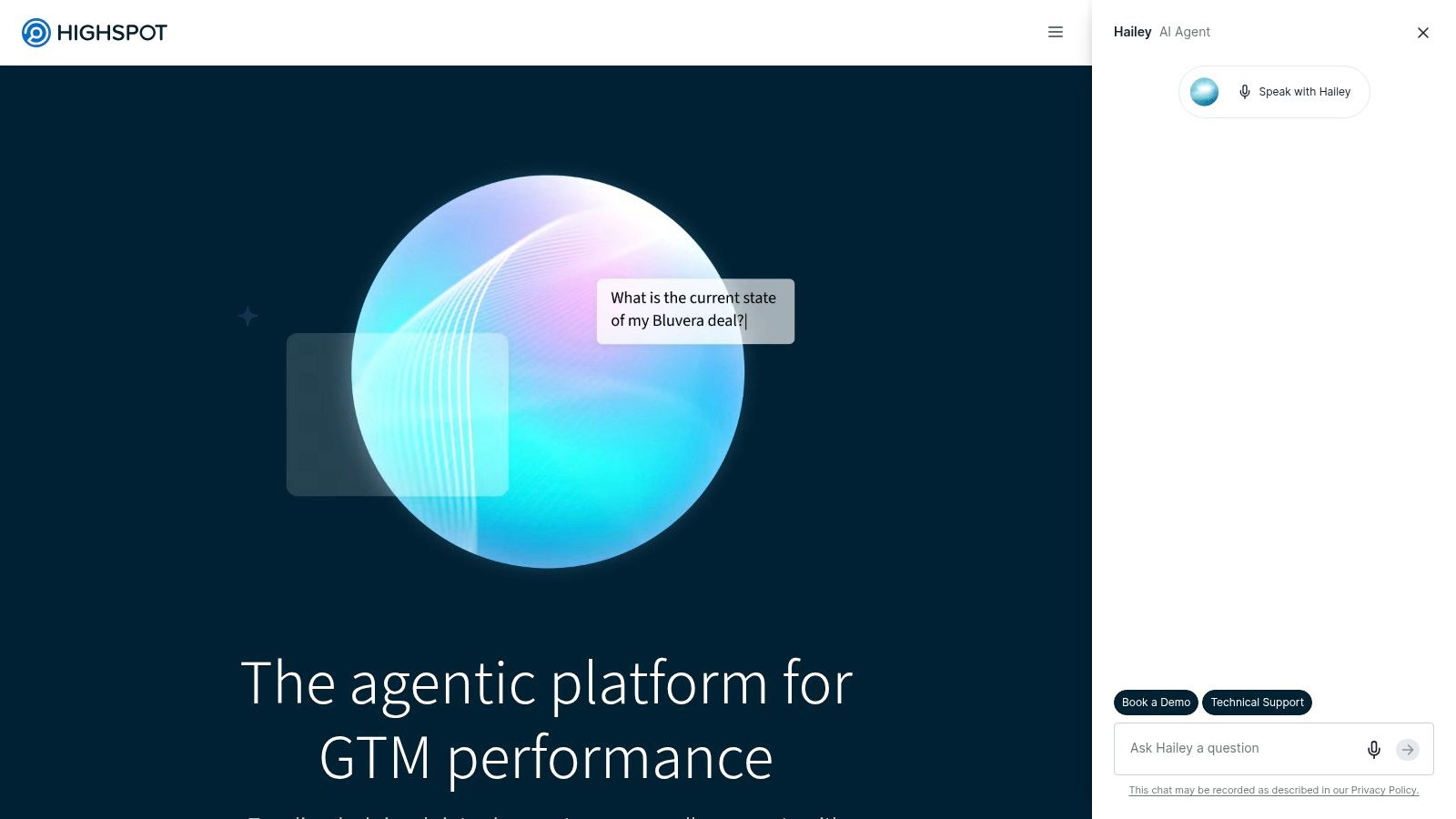
Highspot is what I recommend when a company wants one enterprise system for content, training, guidance, and buyer-facing execution. It's a unified platform in the clearest sense. You bring governance, methodology, and enablement programs into one operating layer instead of scattering them across LMS, DAM, shared drives, and playbooks in docs.
That matters because scattered systems usually kill adoption. Reps don't care which department owns the asset. They care whether they can find the right thing in the flow of a deal.
Where Highspot earns its keep
Highspot is strong at centralized content governance, structured enablement programs, analytics, and in-context guidance. Features like SmartPages and Spots are useful when you want to standardize sales plays instead of hoping managers teach them consistently. It also has deep integrations with CRM and collaboration tools, which helps reduce the usual friction of “great platform, poor daily usage.”
If you're comparing categories, Highspot sits squarely in the same strategic conversation as any modern sales enablement platform. The difference is emphasis. Highspot is stronger when your challenge is scale, governance, and enterprise-wide consistency.
Highspot tends to work best when enablement already has executive backing and at least one person who can own taxonomy, governance, and program design.
The trade-off is predictable. Highspot can do a lot, but teams usually need dedicated admin or enablement support to get full value. Without that ownership, large content libraries become cleaner than a shared drive, but not necessarily more useful.
A few reasons buyers shortlist it:
- Enterprise governance: Strong taxonomy, permissions, and content control.
- Broad coverage: Content, training, coaching, and guided plays in one environment.
- Good fit for scale: Large organizations often care more about consistency than lightweight setup.
The downside is that pricing is quote-based and rollout isn't usually casual. This isn't the tool I'd buy for a small team that just wants quick wins. It's the tool I'd buy when leadership wants to connect enablement to execution across a large sales org.
Learn more on the Highspot website.

“The account and contact signals are key for reaching out at important times, and the value-add messaging it creates unique to every contact helps save time and efficiency.”
Daniel Pitman
Mid-Market Account Executive, Black Swan Data
3. Seismic

Seismic is a broad enterprise enablement suite with a strong reputation in large, complex organizations. If Highspot often feels centered on internal enablement orchestration, Seismic often feels strongest when the business wants to connect internal enablement with external buyer engagement.
That matters for teams selling into committee-based deals, where a rep needs more than content storage. They need a controlled way to deliver content, track engagement, and keep stakeholders aligned.
Best for buyer-facing deal execution
Seismic's Digital Sales Rooms are a real differentiator for teams that want a collaborative workspace for active opportunities. Add in content automation, analytics, training, and governance, and you get a platform that can serve both marketing and sales without feeling stitched together.
In practical terms, Seismic works well when marketing cares about message control and sales leadership cares about whether buyers are engaging. That shared visibility is useful in longer, more complex cycles where deal progression depends on multiple stakeholders consuming the right material in the right order.
What I like about Seismic is its breadth with a buyer-facing thread running through it. What I'd watch is implementation complexity. Broad platforms create a temptation to switch everything on at once, and that usually slows adoption.
A sensible way to think about Seismic:
- Choose it for: Digital Sales Rooms, buyer engagement tracking, and enterprise process standardization.
- Expect: Strong governance and integrations.
- Plan for: A serious rollout, because broad capability requires clear ownership.
This is also the kind of platform where success depends less on feature count and more on operating discipline. If marketing, enablement, and sales don't agree on content lifecycle, naming, and usage expectations, Seismic won't fix that by itself.
See the product on the Seismic website.
4. Showpad
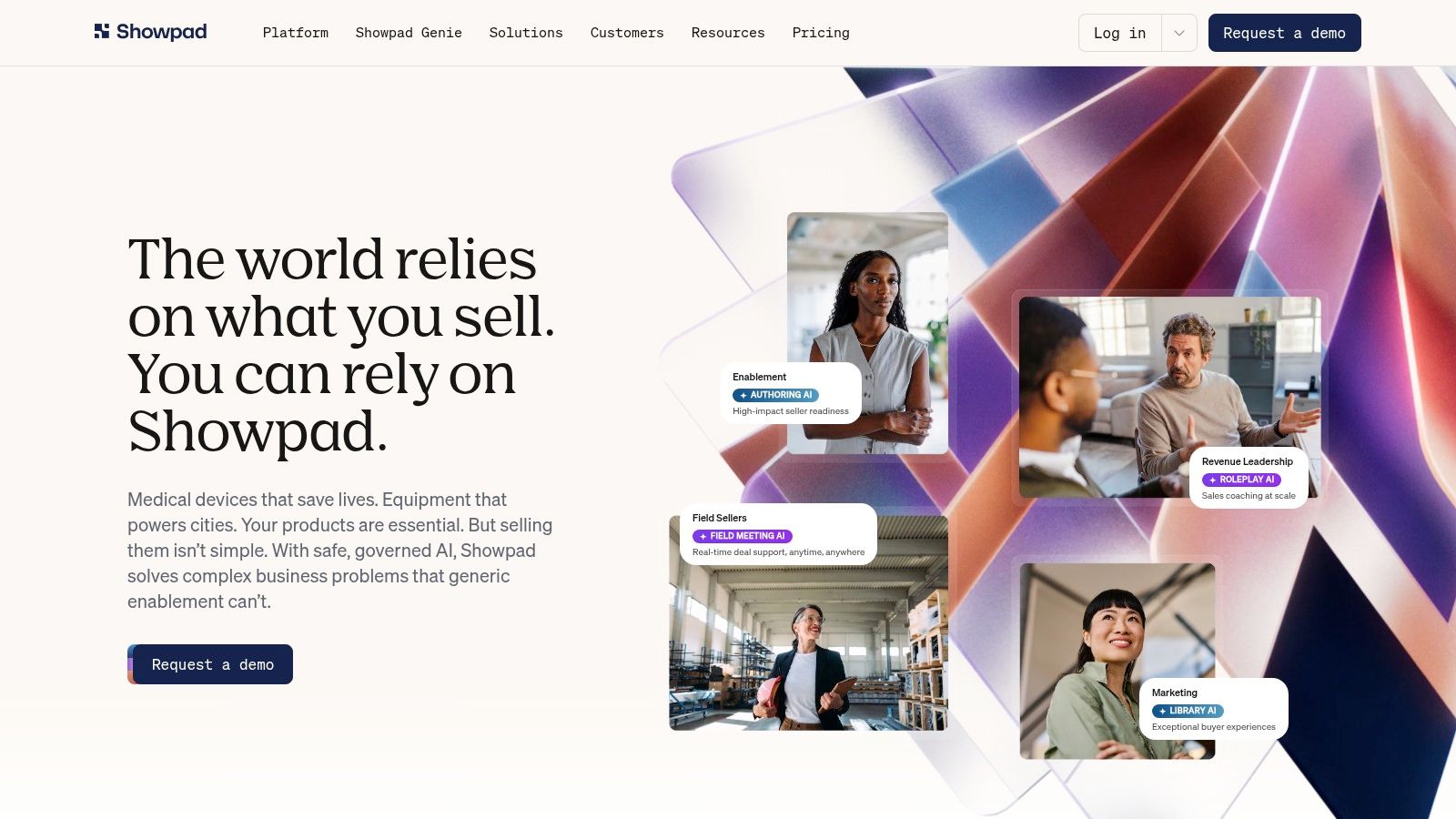
Showpad lands in a useful middle ground. It's broad enough to support content management, learning, and buyer collaboration, but it often feels more approachable than some heavyweight enterprise suites. That balance makes it attractive for teams that want one platform without turning enablement into a major systems project.
The standout feature is Shared Spaces. This gives sellers a buyer-facing workspace with mutual action plans, comments, analytics, and buyer uploads. For teams running complex deals, that's a practical way to keep the process visible without relying on long email threads and scattered attachments.
A strong option for buyer alignment
Shared Spaces are where Showpad separates itself. A seller can guide the deal, give buyers one place to review content, and keep next steps explicit. That's especially useful when several stakeholders need to weigh in and nobody wants to chase version control on attachments.
Showpad also supports structured learning paths and content governance, so it isn't just a buyer collaboration tool. It can pull double duty for onboarding and ongoing readiness while still helping reps present polished material in the field, including offline use on mobile and desktop.
If your field sellers or account teams often present in customer environments with unreliable connectivity, offline support isn't a nice extra. It's operationally important.
The trade-off is configuration. To get real value from Showpad, someone needs to define templates, governance standards, and what a good Shared Space looks like. Teams that skip that work usually end up with inconsistent buyer experiences.
Where Showpad fits best:
- Strongest use case: Buyer collaboration plus content and training in one system.
- Good for: Field teams and organizations that need mobile or offline support.
- Less ideal for: Teams that want a lightweight setup with minimal admin thinking.
You can review the platform on the Showpad website.

“All of the vendors that I've worked with, all of the onboarding that I have had to deal with, I will say, hands down, Salesmotion was the easiest that I have had.”
Lyndsay Thomson
Head of Sales Operations, Cytel
5. Mindtickle
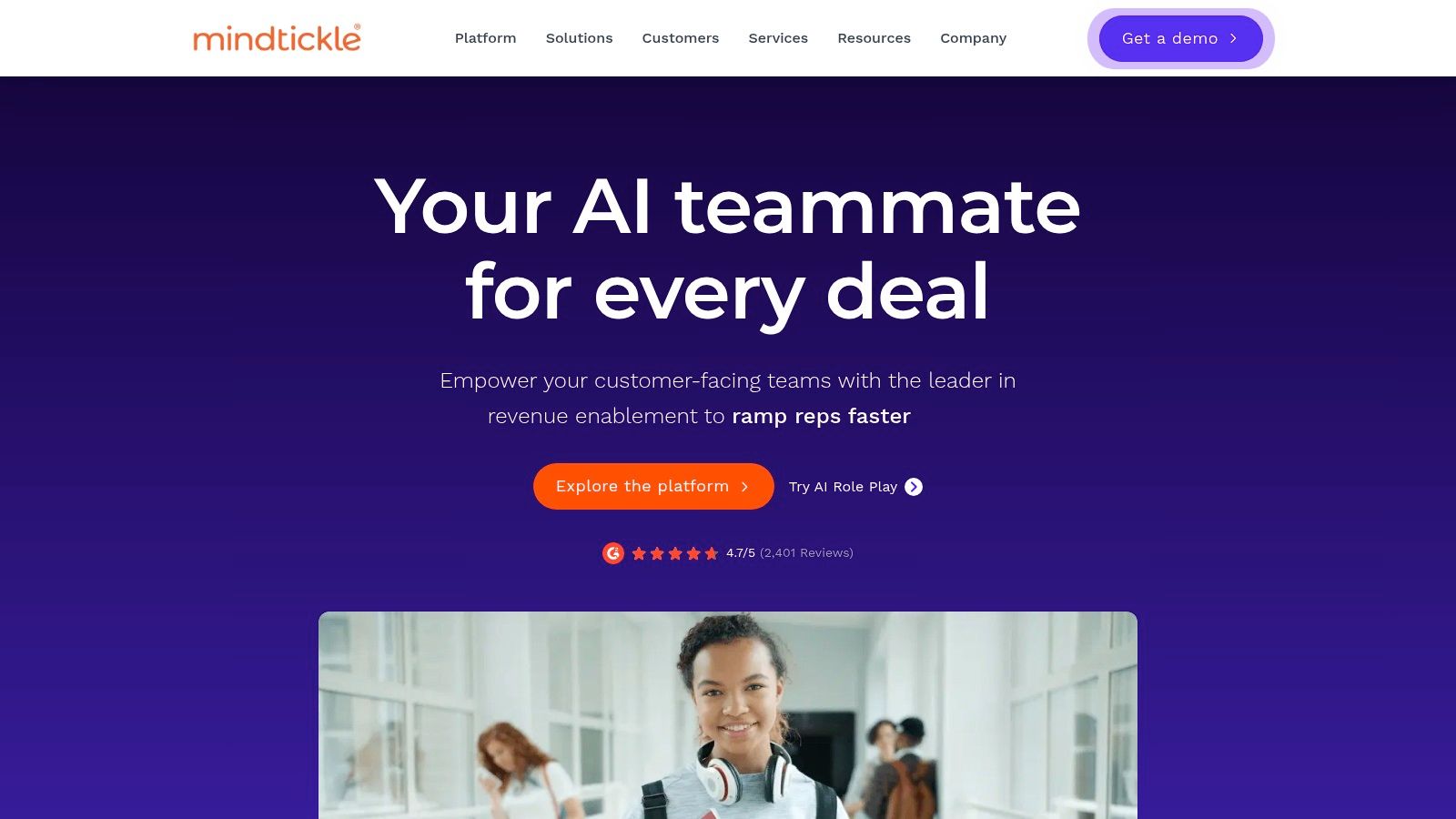
Mindtickle is the tool I'd prioritize when readiness is the problem, not content access. Some sales organizations don't need another place to store decks. They need reps to deliver the pitch better, ramp faster, and show evidence that training changed behavior.
Mindtickle was built for that job. It leans heavily into coaching, certification, simulations, micro-learning, and readiness analytics. If your managers are saying, “We have the content, but reps still can't run the conversation,” this is the kind of platform worth serious attention.
Readiness first, content second
The strongest part of Mindtickle is structured skill development. AI-driven role-plays, competency mapping, certifications, and readiness measurement make it easier to move beyond event-based training. Instead of a kickoff and some PDFs, you can run continuous practice with measurable checkpoints.
That focus aligns with broader enablement performance trends. Sellers using mobile selling tools and sales enablement solutions sell 26% more than those who do not, according to Learn to Win's sales enablement statistics roundup. The reason that number matters here is simple. Tools only pay off when they change execution in the field, and readiness platforms are directly tied to that outcome.
Mindtickle has also expanded into content experiences and Digital Sales Rooms, which helps it compete beyond training. Still, I wouldn't buy it primarily for content governance if that's your top requirement. Other platforms go deeper there.
A practical view:
- Best for: Formal onboarding, continuous coaching, and certification programs.
- Big advantage: It gives enablement leaders a way to prove whether reps are ready.
- Main limitation: It takes admin effort to design strong curricula and assessments.
If your leadership team wants enablement to improve rep behavior, not just content consumption, Mindtickle is one of the strongest sales enablement tools in this category.
Visit the Mindtickle website.
6. Allego
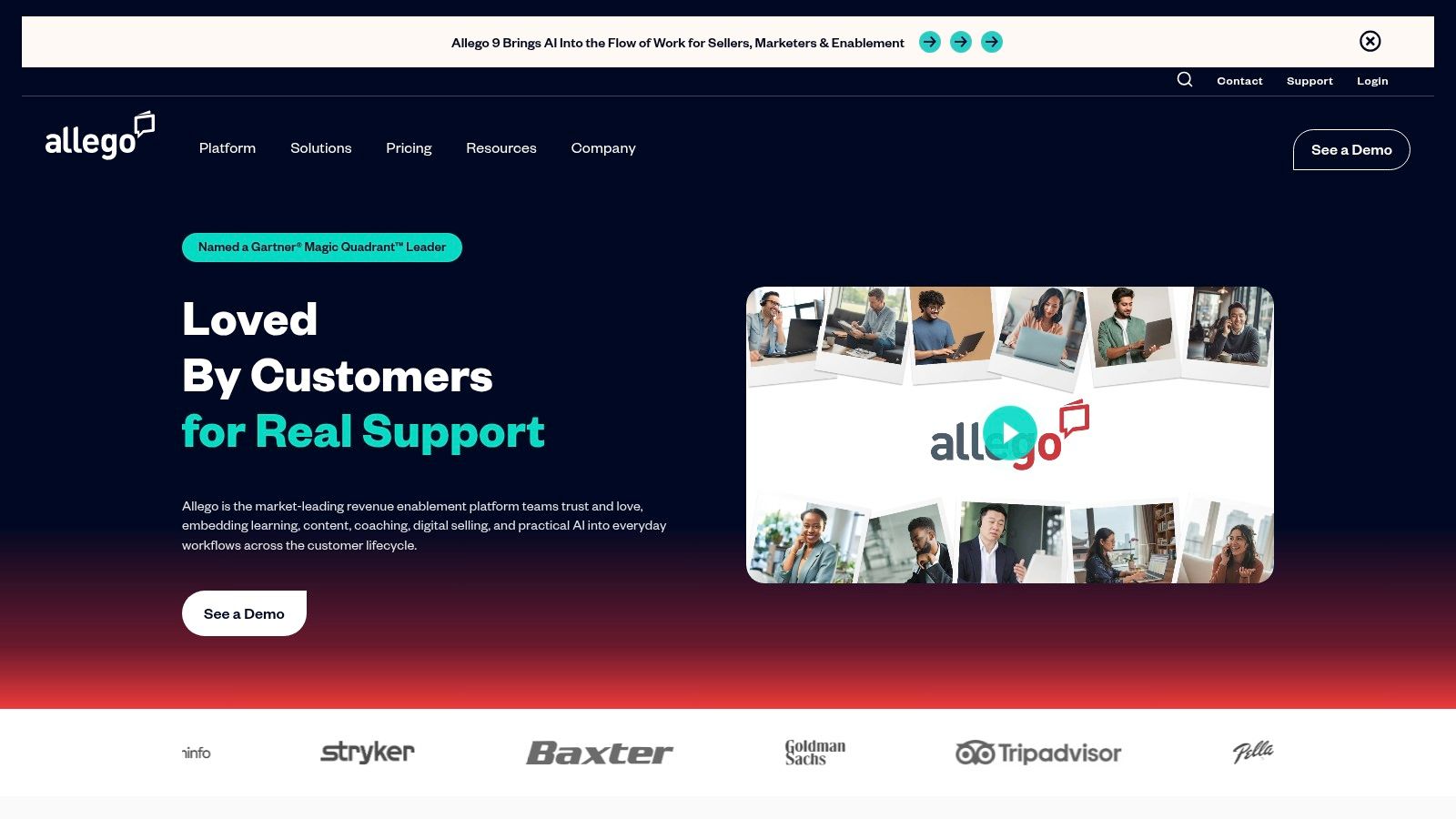
Allego is one of the more pragmatic consolidation plays in this market. It brings LMS and learning experience capabilities, coaching, reinforcement, conversation intelligence, content management, Digital Sales Rooms, and video selling into one platform. If you're trying to reduce tool sprawl without gutting enablement capability, that positioning is attractive.
I also like Allego's focus on governed AI included across the platform rather than treated as a premium add-on. That tends to matter in real budgeting conversations more than vendors admit.
The ownership question matters here
One of the most overlooked issues in sales enablement is ownership. Teams buy platforms, launch content hubs, and then struggle to connect activity to revenue. Allego's own research points to “competing company priorities” and “lack of dedicated team” as major obstacles, and 64% of revenue leaders report they cannot prove enablement ROI, according to Allego's research on who owns sales enablement.
That's why Allego makes sense for organizations that want one operating system across direct sales, partner enablement, and ongoing coaching. It can reduce fragmentation. But consolidation alone won't solve accountability. Someone still has to own programs, metrics, and adoption.
What stands out in practice:
- Useful for: Direct sales teams plus partner or channel motions.
- Strong value angle: Broad scope in one platform can reduce tech overlap.
- Planning requirement: Rollout discipline matters because the platform touches many workflows.
Allego is a good fit when leadership wants to simplify the stack and standardize enablement execution, but it still needs a clear owner and a revenue-linked scorecard.
See more on the Allego website.
7. Bigtincan
Bigtincan is often a strong fit for companies with distributed teams, partner networks, and sellers who spend a lot of time away from a desk. Its platform brings together content, readiness, coaching, analytics, and AI, with a mature mobile experience that matters more than many office-based buyers realize.
If your reps sell in the field, across regions, or through channel partners, usability on mobile isn't secondary. It's central.
Built for complexity and movement
Bigtincan handles buyer-facing content sharing, personalization, readiness modules, coaching, and conversation intelligence. It also supports partner and channel use cases, which makes it useful for organizations that need tighter consistency across indirect revenue motions.
The broader category trend supports why platforms like this are gaining ground. Cloud-based deployment is projected to account for 74% of deployment demand in 2026, according to Fortune Business Insights' sales enablement platform market analysis. For teams running distributed sales environments, cloud accessibility isn't just modern infrastructure. It's what keeps reps and partners working from the same playbook.
Where Bigtincan usually wins:
- Mobile strength: Good for field sellers who need content and guidance on the go.
- Global fit: Useful for multi-region and partner-heavy organizations.
- Platform breadth: Enough coverage to reduce the need for separate point tools.
The trade-off is interface complexity. Broad enterprise platforms can feel heavy if the rollout isn't carefully managed. I'd only recommend Bigtincan if your organization is prepared to invest in change management and clear usage standards.
You can evaluate it on the Bigtincan website.
8. Mediafly
A common enterprise problem looks like this: marketing owns the content, product marketing owns the message, sales owns the meeting, and no one can tell whether the rep used the right story at the right stage. Mediafly is built for that kind of environment.
I put it in the unified platform bucket. The value is less about storing files and more about connecting buyer-facing content, seller execution, and reporting across the systems enterprise teams already run. That matters in regulated, technical, or highly structured sales motions where consistency is part of risk control, not just brand hygiene.
Mediafly supports integrations with major CRM, marketing automation, DAM, and content systems, including Salesforce, Dynamics, SAP, HubSpot, Marketo, Adobe Experience Manager, Bynder, and SharePoint. For large teams, that integration depth can reduce the manual work that slows reps down and creates version-control problems.
The trade-off is straightforward. Mediafly usually makes more sense for organizations that already have process discipline and a clear operating model for enablement. If the underlying motion is still loose, a platform with this much structure can expose gaps faster than it fixes them. Teams evaluating enterprise platforms should ground that decision in sales enablement best practices for onboarding, coaching, and content governance, not just a feature checklist.
A few practical notes:
- Best fit: Large companies with complex, multi-stakeholder, or regulated sales cycles.
- Why buyers choose it: Strong integration coverage, value-selling support, and tighter control over how reps use content.
- What to expect: Custom pricing and an implementation that needs planning, ownership, and change management.
In enterprise sales, the hidden cost is often rep time lost switching systems and recreating context that should already be available.
Mediafly is worth evaluating if your main job is unifying content, workflows, and analytics across a complex go-to-market stack, rather than just giving reps another place to search for decks.
Visit the Mediafly website.
9. SalesHood
SalesHood is a practical mid-market choice. It focuses on onboarding, training, coaching, and content management without trying to look like the answer to every enablement problem. I respect that. A lot of teams don't need a giant enterprise suite. They need a system they can roll out quickly, budget for clearly, and effectively use.
Its public entry pricing also helps. That sounds small, but it changes how RevOps and enablement teams build a business case.
Fast time-to-value matters
SalesHood offers structured onboarding paths, templates for common enablement programs, coaching workflows, peer learning, and content insights. The package is narrower than the largest enterprise platforms, but that can be a feature, not a flaw, for teams that want focus.
It also fits well with disciplined program design. If you're building a function from the ground up, these sales enablement best practices are the right lens to use when evaluating a platform like SalesHood. You want to know whether the tool supports repeatable onboarding, reinforcement, and manager-led coaching, not just whether it has a long feature list.
SalesHood is a smart option when:
- You want clearer budgeting: Public starting prices reduce early friction.
- You need simplicity: Lighter implementation than many enterprise suites.
- You care about enablement fundamentals: Onboarding, coaching, and content in one place.
The limitation is breadth. If your organization needs advanced buyer collaboration or a mature Digital Sales Room strategy, SalesHood may need to sit alongside other tools. But if the problem is “we need a better way to onboard and coach reps without buying a heavy enterprise stack,” it deserves a spot on the shortlist.
You can review plans and product details on the SalesHood website.
10. Guru
A rep is in Slack five minutes before a customer call, asking for the latest pricing exception, the current competitor talk track, and the approved answer to a security objection. If that happens every day, the problem is not training volume. The problem is knowledge access.
Guru fits the Knowledge Management category in this guide. Its job is straightforward: give reps fast, trusted answers inside the tools they already use. That makes it different from unified enablement platforms such as Highspot or Seismic, and different from readiness tools built for coaching and skill development.
I see teams miss this distinction all the time. They buy a broad enablement suite when the immediate bottleneck is that core answers live across Slack threads, old docs, shared drives, and individual managers' heads. In that situation, a governed answer layer can produce value faster than a larger rollout.
Guru is strongest when you need verified knowledge in the flow of work. The product centers on a unified knowledge base, browser and collaboration app access, permissions-aware search, and verification workflows so subject matter experts can keep answers current. For RevOps, that matters because bad information spreads. One outdated pricing note or obsolete process doc can create avoidable discounting, approval delays, and inconsistent messaging.
It also helps clarify stack decisions. Teams comparing Guru with signal-driven platforms are often evaluating two different jobs. Guru answers "what should I say or do right now?" Sales intelligence answers "which account should I work, and why now?" This breakdown is clearer if you review these B2B sales intelligence tools for account prioritization and trigger-based outreach.
Guru makes the most sense when:
- Your main issue is findability: Reps lose time searching for approved answers.
- You want in-workflow adoption: Slack, Teams, and browser access reduce context switching.
- You already have a broader stack: Guru often fills the knowledge gap without forcing a full platform replacement.
The trade-off is scope. Guru does not try to be the system for buyer engagement, formal readiness programs, or large-scale content operations. If your buying criteria center on Digital Sales Rooms, pitch analytics, or structured onboarding paths, look elsewhere. If the job is surfacing accurate answers quickly and keeping them governed, Guru deserves a serious look.
See the platform on the Guru website.
Top 10 Sales Enablement Tools Comparison
| Product | Core focus | Key capabilities | Unique selling point | Ideal for | Pricing & time-to-value |
|---|---|---|---|---|---|
| Salesmotion | Autonomous account intelligence + AI outreach | Three agents (Research, Signal, Prospector), 1,000+ sources, Slack/email/CRM alerts, ready-to-send sequences | Proactive 24/7, citation-first insights, fast install, measurable lift (50% more meetings, up to 40% pipeline) | Sales leaders, RevOps, AEs/SDRs, CROs needing real-time triggers | No public pricing; demo-based; install minutes–days; quick time-to-value |
| Highspot | Enterprise sales enablement (content + coaching) | Content governance, AI skill gap detection, SmartPages, deep integrations | Strong adoption & analytics tying content to revenue | Large enablement teams at scale | Quote-based pricing; enterprise rollout required |
| Seismic | Enablement cloud with buyer engagement (DSRs) | Digital Sales Rooms, content automation, training & analytics | Mature buyer engagement and broad marketing+sales features | Complex organizations standardizing GTM processes | Quote-based; premium at enterprise scale |
| Showpad | Revenue effectiveness + buyer collaboration | Shared Spaces, Mutual Action Plans, content library, offline support | Buyer workspaces with mutual action plans; strong mobile | Field sellers and buyer-facing teams | Sales-led pricing; configuration affects cost |
| Mindtickle | Readiness-focused enablement & coaching | Role-play AI, Readiness Index, certifications, conversation intelligence | Best-in-class structured training and readiness analytics | Teams prioritizing measurable skill development | Sales-led pricing; admin effort for curriculums |
| Allego | Unified revenue enablement with built-in AI | LMS/LXP, coaching, convo intelligence, DSRs, channel support | AI included across platform (no costly add-ons), good channel support | Direct and channel/partner enablement programs | Quote-based; consolidation can lower TCO |
| Bigtincan | Enterprise enablement for complex/global teams | Content personalization, readiness, coaching, partner enablement, mobile | Strong mobile experience and partner/channel focus | Multi-region, partner-heavy sales orgs | Quote-based; multiple editions by module |
| Mediafly | Value-focused enablement for regulated industries | Guided selling, engagement analytics, broad CRM/MA/DAM integrations | Industry depth for regulated, complex sales cycles | SaaS, MedTech, Manufacturing, CPG with governance needs | Tailored pricing; implementation scope varies |
| SalesHood | Practical enablement for mid-market & onboarding | Structured learning paths, content management, coaching, clear plans | Transparent entry pricing and faster time-to-value | Mid-market teams seeking quicker ROI | Public entry pricing available; lighter implementation |
| Guru | AI-first knowledge platform for in-flow answers | Knowledge Agents, 100+ connectors, embedded answers (Slack/Chrome/Teams), governance | Single source of truth with verified, citation-backed answers in workflow | Teams needing verified knowledge inside existing tools | Sales-led at scale; 10-seat minimum after trial |
Final Thoughts
Quarter-end is a brutal time to discover your enablement stack is measuring the wrong things. Leadership asks whether the investment is working. The team can show completions, content views, and search activity. Reps still ask the same questions in Slack, managers still coach inconsistently, and forecast calls still surface preventable mistakes.
That usually points to a buying mistake. The team bought a category label instead of a tool for a specific job.
The practical way to choose sales enablement software is to start with the bottleneck. If the problem is finding a real trigger for outreach, look at Sales Intelligence. If the problem is keeping content, training, and field execution in one system, evaluate Unified Platforms. If new hires ramp slowly and managers struggle to coach to a standard, focus on Readiness. If reps waste time hunting for approved answers across Slack, docs, and wikis, invest in Knowledge Management.
That lens matters because product overlap is now the rule, not the exception. Many vendors now offer some mix of AI search, coaching, analytics, content management, and rep guidance. Buying on feature checklists alone creates duplicate systems, fuzzy ownership, and low adoption. Buying by job creates cleaner workflows and clearer accountability.
Measure business outcomes leaders already trust.
A useful starting point is Kompyte's guide to measuring sales enablement, which pushes measurement toward sales cycle impact instead of software usage. Articulate's overview of sales enablement KPIs also keeps the focus where it belongs: win rate, ramp time, and rep readiness are better indicators than completions or content uploads.
For many teams, four metrics are enough:
- Sales cycle length: Are reps getting to qualified next steps faster?
- Win rate: Are training, content, and deal support improving live opportunity outcomes?
- Pipeline consistency: Are sellers working the right accounts with the right message, instead of just increasing activity?
- Ramp time and readiness: Are new hires productive sooner, and can managers spot coaching gaps early?
Before signing, ask the questions that expose implementation risk:
- Who owns the system? One team needs clear responsibility for adoption, governance, and reporting.
- What job does it do first? Prospecting, onboarding, deal execution, partner enablement, or in-flow knowledge retrieval.
- Where will reps use it? CRM, Slack, browser, mobile, or a separate destination they may ignore.
- What metric proves value? Set the number before rollout.
- What tool gets retired? If nothing leaves the stack, complexity usually rises faster than value.
Enablement software should behave like revenue infrastructure. The right platform shortens ramp, improves deal execution, strengthens coaching, or gets answers in front of reps at the moment of need. If it cannot tie back to one of those outcomes, it will struggle to survive budget scrutiny.
If you're also refining your broader GTM motion, a strong LinkedIn posting strategy can complement enablement by giving sellers and leaders more relevant ways to stay visible in-market.
Salesmotion belongs in this conversation for teams with top-of-funnel friction. If reps struggle to identify the right accounts, the right timing, and the right message without hours of manual research, it serves a different job than a classic enablement suite. Start with the costliest sales friction, then choose the category built to remove it.