Most sales teams still pay a manual research tax. Reps open ten tabs, skim earnings notes, scan LinkedIn, check job boards, and try to turn scattered facts into one decent reason to reach out. Then they do it again for the next account.
TL;DR: To automate sales research with AI, define which accounts matter and which signals justify action, decide whether to build the workflow or buy a purpose-built platform, then route briefs and alerts into the CRM and Slack your reps already use. Train reps to interpret the output instead of repeating it, and measure time saved per rep before anything else. That sequence is the playbook to plan a 2027 rollout around.
That work feels productive because it looks strategic. In practice, it's inconsistent, slow, and hard to scale. One rep writes a strong account brief. Another sends a generic email because they ran out of time. A manager can't tell whether low reply rates come from bad targeting, weak messaging, or poor prep.
That's why learning how to automate sales research with AI matters now. In a 2026 survey, 57% of sales teams reported using AI for prospect research and 58% for writing outreach messages, according to Sopro's roundup of AI sales and marketing statistics. This isn't fringe behavior anymore. It's becoming standard operating procedure.
The End of the Manual Research Tax
Monday morning, a rep is building a list for the week. They open LinkedIn, the company site, press releases, job boards, earnings notes, and the CRM. Twenty minutes later, they have three scraps of context, two tabs they forgot to read, and no confidence that the account actually deserves outreach.
That is the manual research tax. It shows up in time lost, but the bigger cost is operational. Research quality changes from rep to rep, accounts get worked twice, and managers lose any clean way to inspect why one sequence converts and another stalls.
The pattern is easy to spot on real teams. SDRs and AEs research the same account separately. A rep finds a hiring signal but never logs it. Another grabs an old funding announcement and treats it like fresh news. By the time someone sends the email, the message sounds personalized on the surface and generic underneath.
What the manual tax looks like in practice
Sales managers usually see the symptoms before they trace them back to the workflow:
- Prep changes by rep: One rep walks into a call with a clear point of view. Another scans the homepage five minutes before the meeting.
- Signals slip through the cracks: A target account adds a new VP, expands into a new region, or posts a wave of relevant job openings, and nobody acts on it.
- CRM context decays: Notes stay in Slack, personal docs, or browser tabs, so the next rep starts from zero.
- Outreach falls back to templates: Without a current trigger or clear account context, reps default to broad value props that could go to anyone.
If that sounds familiar, review the real cost of manual account research. The waste is visible in slower account coverage, weaker personalization, duplicate effort, and missed timing on the few signals that matter.
One rule has held up every time I have rolled this out: if top reps are spending prime selling hours collecting public facts, the workflow is broken.
What changes when AI handles the repeatable work
The practical win is better workflow design. AI can gather public updates, summarize what changed, and package the account context in a format a rep can use fast. The rep still decides whether the signal is meaningful, whether the account is worth action, and how to frame the outreach.
That division of labor matters.
Teams get more consistent research inputs, cleaner CRM notes, and a shared standard for what counts as a useful trigger. Reps get time back for judgment, messaging, and follow-up. Managers get something they can inspect and coach against, instead of a black box of tabs and half-finished notes.
Done well, automated research does not replace sales thinking. It removes the scavenger hunt so sales thinking can happen earlier and more often.
See Salesmotion in action
Take a self-guided interactive tour — no signup required.
Laying the Foundation for Smart Automation
Most failed automation projects start with tools. They should start with workflow design.
If you automate a vague process, you get vague output faster. If you automate a noisy process, you get more noise. Good sales research automation starts with a very clear answer to two questions: which accounts matter and which signals justify action.
Expert guidance on automation design says teams should first define testable success criteria and map the happy path for standard accounts before automating. Unstructured research tasks tend to fail without a clearly defined decision flow, as explained in Hightouch's guide to automating account research.
Start with the account universe
Before you monitor anything, define the list of accounts the system should care about. Usually that means three layers:
-
ICP accounts
These fit your core profile by segment, size, geography, or operating model. -
Named accounts
Strategic targets that sales leadership already wants covered. -
Territory accounts
Accounts assigned by region, vertical, or rep ownership.
This sounds obvious, but teams often skip it. They connect tools first, ingest a flood of data, and then wonder why reps ignore alerts. Reps ignore alerts when the system watches companies they don't work with.
A better pattern is to start narrow. Pick one segment. Pick one team. Pick one clean account list. Then make the workflow work there.
For a practical example of what strong AI-driven research setup looks like, see how to use AI for account research.
Define the signals that actually matter
At this stage, sales teams either get sharp or get buried.
Not every public event is a buying signal. A new blog post may mean nothing. A burst of hiring in a function tied to your product may matter a lot. A leadership change might be critical for one motion and irrelevant for another.
Work backward from closed-won patterns and strong first meetings. Ask your top reps:
- What changed right before good conversations started?
- Which triggers create urgency in your category?
- Which signals help a rep build a point of view, not just a fact list?
- Which events should route to an SDR versus an AE versus a CSM?
Then write those down as operating rules, not ideas.
A simple signal sheet usually includes:
| Signal type | Why it matters | Who should act | Expected action |
|---|---|---|---|
| Executive changes | Can change priorities and budgets | AE or strategic SDR | Review account, identify likely initiative, tailor outreach |
| Hiring patterns | Shows investment in a function | SDR | Trigger outbound to the relevant team |
| Funding or investor updates | Can signal expansion, pressure, or new initiatives | AE | Reprioritize account and build POV |
| Product or market expansion | Suggests operational change | SDR or AE | Use in outreach and discovery prep |
Useful automation starts when your team can explain why a signal matters before the AI ever sees it.
Set success criteria before rollout
Don't define success as “the AI brief looks good.” That's too soft.
Define success in operational terms. Examples include whether the brief gives a rep enough context before a call, whether alerts arrive in the workflow reps already use, and whether managers can see that outreach was tied to a real trigger. Keep the criteria testable. If a manager can't inspect it, it's not a process yet.

“The account and contact signals are key for reaching out at important times, and the value-add messaging it creates unique to every contact helps save time and efficiency.”
Daniel Pitman
Mid-Market Account Executive, Black Swan Data
The Critical Decision Build vs Buy Your AI Engine
Once the workflow is clear, many organizations hit the same fork in the road. Build the stack yourself, or buy software built for this use case.
The DIY route usually starts with tools like Clay, Zapier, enrichment providers, prompt chains, spreadsheets, and custom scripts. That can work. For technically strong RevOps teams, it can be a smart choice. You get flexibility, control, and room to experiment.
The catch is that sales research automation isn't one workflow. It's a chain of workflows. Data comes in from different sources. Entities need to be resolved. prompts need guardrails. CRM fields need mapping. Alerts need routing. Then something changes upstream and the chain breaks.
A high-accuracy automation workflow requires a testable pipeline and a defined happy path. Building that from scratch demands significant upfront design and ongoing maintenance, which is a major reason teams choose purpose-built platforms, as discussed in this practitioner walkthrough on automation design.
Where DIY works
Build it yourself if your team can handle these realities:
- You have technical ownership: Someone will maintain prompts, integrations, and exception logic.
- Your process is unusual: You need custom scoring, special routing rules, or nonstandard data sources.
- You're willing to iterate constantly: DIY stacks rarely stay “done.”
This path is often a fit for teams that already run advanced RevOps infrastructure and don't mind trading speed for control.
Where buying wins
Buying usually makes more sense when the sales org wants fast deployment and stable output. That's especially true when the need is straightforward: monitor target accounts, synthesize context, push alerts into existing workflows, and help reps act on signals.
A purpose-built platform can remove a lot of engineering work. In the account research category, tools differ a lot in depth and setup burden, so the right move is to compare them against your workflow, not their feature pages. A useful place to frame that evaluation is this guide to evaluating AI sales tools.
One common reason teams buy instead of build is maintenance fatigue. The pilot works. Then fields change, prompts drift, sources break, and adoption drops because the system stops feeling dependable.
Don't choose based on what can be built in a demo. Choose based on what your team can operate six months later.
Build vs Buy decision framework
| Factor | Build (DIY with Clay, Zapier) | Buy (Salesmotion Platform) |
|---|---|---|
| Setup approach | Assemble multiple tools and workflows | Prebuilt workflow for account research automation |
| Flexibility | High, if your team can configure and maintain it | More standardized, with opinionated workflows |
| Engineering need | Usually ongoing | Lower operational lift |
| Maintenance | You own broken connections, prompt changes, and logic updates | Vendor handles core system maintenance |
| Speed to value | Slower at first, faster later if well managed | Faster if your use case matches the product |
| Best fit | Technical RevOps teams with custom needs | Teams that want faster rollout and less upkeep |
Purpose-built platforms typically deploy in about a day with no engineering resources, and customers regularly describe the onboarding as the easiest in their stack — Cytel's Head of Sales Operations called Salesmotion "hands down the easiest" onboarding she had experienced across vendors. The broader point stands: buying often compresses time to value because the workflow design work has already been productized.
Deploying Your Automated Research Workflow
A working system fits into the rep's day without asking them to change everything. If research automation lives in a separate tool nobody opens, adoption stalls. If it lands in the CRM, in Slack, and in pre-call prep, it starts to shape behavior.
The underlying sequence should follow a clear order. Industry guidance recommends this flow: source capture from public signals, entity enrichment, signal scoring, context synthesis, and routing the result into CRM or messaging, as outlined in GrowthEffect's overview of AI sales automation workflows.
Step one connects the system to your account source of truth
That source is often the CRM. Start there.
Pull in the account list by owner, segment, or named account status. That keeps monitoring focused on real coverage and avoids random alerts on companies nobody owns. If account ownership is messy, fix that first. Automation will magnify that mess.
A strong implementation also writes back useful outputs. That could mean an account summary field, recent signal history, or a task created when a high-priority trigger appears. The point is simple. Research shouldn't die in a side channel.
If you're thinking about API-based approaches to account intelligence and workflow integration, this overview of AI for company research with API-driven workflows is useful background.
Step two sets up signal monitoring with business logic
At this point, the system becomes useful or annoying.
Set alerts only for triggers that your team agreed matter earlier. Examples might include executive changes, investor news, expansion signals, hiring patterns, or mentions that map cleanly to your product. Then define routing rules. Strategic account alerts might go to the AE and manager. Broad territory signals might go to the SDR queue.
A simple alert should answer three questions:
- What happened
- Why it matters
- What the rep should do next
Without that third piece, alerts become another news feed.
Step three establishes repeatable research routines
The best teams don't treat AI research as optional reading. They build it into moments that already exist.
Use routines like these:
- Before every call: Rep reviews the AI brief, confirms the current initiatives, and picks one hypothesis to test in conversation.
- At the start of the week: Team reviews a signal digest to reprioritize accounts and sequence work.
- Before outbound blocks: SDRs sort accounts by fresh triggers, not by static list order.
- During account reviews: Managers inspect whether outreach tied back to real account context.
One platform that fits this operating model is Salesmotion, which runs a Research Agent for account briefs, a Signal Agent for account monitoring, and an Outreach Agent for turning those insights into outreach. The product detail matters less than the pattern. Separate the jobs cleanly. One layer gathers and synthesizes context. One watches for change. One helps reps act.
A research workflow works when the rep can move from signal to brief to action without opening five different tabs.

“All of the vendors that I've worked with, all of the onboarding that I have had to deal with, I will say, hands down, Salesmotion was the easiest that I have had.”
Lyndsay Thomson
Head of Sales Operations, Cytel
Turning AI Insights into Action by Training Your Reps
The common rollout mistake is assuming the hard part is the technology. Usually it's the behavior change.
A rep who treats the AI brief as final truth will sound robotic. A rep who ignores it will keep doing manual research and resent the tool. Good training lives in the middle. The brief is a starting point. The rep adds judgment, context, and conversation skill.
Train reps to interpret, not repeat
The fastest way to ruin AI-assisted outreach is to have reps parrot the signal back to the buyer.
Bad version: “I saw you hired a new CFO.”
Better version: “With a new finance leader in place, I'd assume reporting discipline and operational visibility are getting fresh attention. Is that showing up yet?”
That shift matters. The first line proves the rep can read. The second line proves the rep can think.
Use coaching sessions to train three habits:
- Find the main thread: What's the one change in this account that matters most right now?
- Translate signal into implication: What likely changed inside the business because of that event?
- Turn implication into a question: What can the rep ask that sounds informed but not scripted?
Give managers a review rubric
If managers want adoption, they need a simple way to inspect quality.
A practical rubric for call prep or outbound review:
| Checkpoint | What good looks like |
|---|---|
| Signal use | Rep selected a relevant trigger, not random company trivia |
| Business implication | Rep connected the trigger to a likely business priority |
| Personalization quality | Message reflects account context, not just mail merge |
| Human judgment | Rep challenged or refined the AI output where needed |
This also helps reps understand that “using AI” doesn't mean accepting every output blindly.
The AI handles the what. The rep owns the so what.
Use role-play on real accounts
Don't train on generic examples. Pull live accounts from the team's book.
Have one rep read the brief. Ask another rep to summarize the likely priority in one sentence. Then have them write the opening line of an email or the first question on a call. That exposes weak thinking fast. It also shows the team that AI research is only valuable when it changes how they speak to buyers.
The strongest reps usually do one more thing. They verify high-stakes details before sending. That habit should be part of training from day one.
Measuring What Matters The ROI of Automated Research
A VP of Sales asks a fair question five weeks into the rollout. Are reps getting better outcomes, or did we just give them another dashboard?
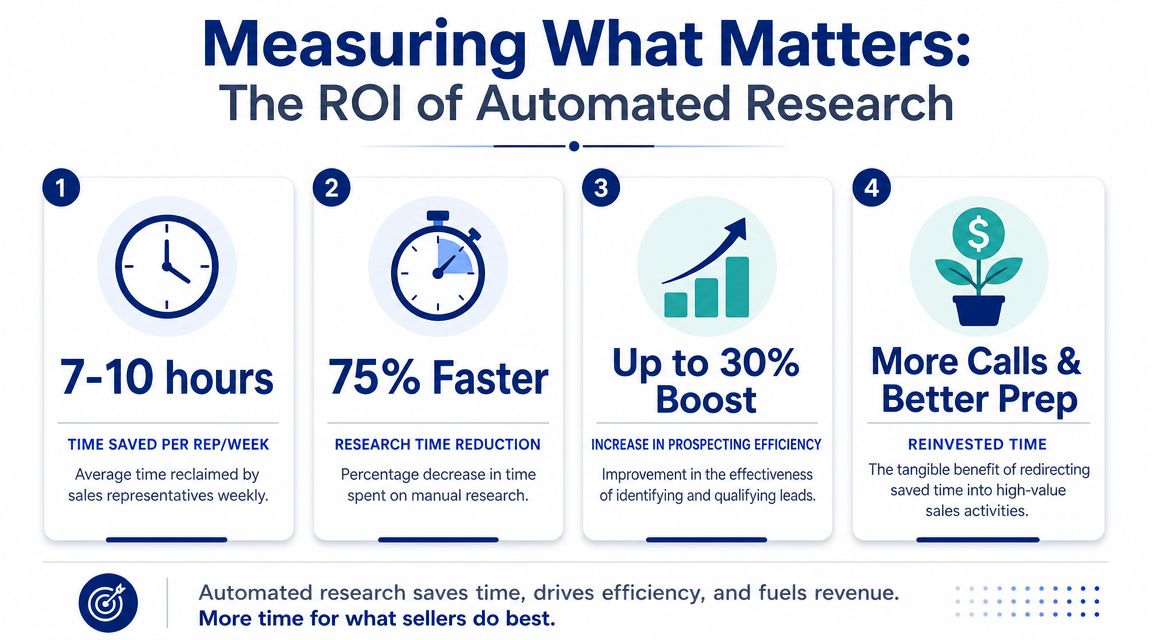
That question kills a lot of AI projects because the team measures activity instead of operating impact. The cleanest starting point is still time saved per rep, because finance, sales leadership, and frontline managers can all validate it against the current workflow. Analysts at Datagrid found that sales teams using AI agents save 2–5 hours per week per rep and can see up to 44% more productivity, according to Datagrid's AI agent statistics for sales teams.
Use the simplest ROI formula first
Start with the basic model:
Time saved per rep per week × loaded cost × 48 weeks = annual ROI
It works because it stays close to what changed operationally. Reps spend less time stitching together account context, and more time on outreach, follow-up, and live conversations. No inflated win-rate assumptions required.
A practical rollout uses the formula in this order:
-
Set a believable time-saved range
Use your pilot data if you have it. If not, use the 2 to 5 hour weekly range above as a starting assumption and pressure-test it with managers. -
Use your real loaded hourly cost
Pull this from finance or your RevOps model. Generic benchmarks weaken the case fast. -
Annualize over 48 working weeks
That keeps the model conservative enough to survive scrutiny.
For a team view, multiply the per-rep result by the number of sellers in scope. Then subtract software and implementation cost. That gives leadership a simple payback view, which is usually the number they want first.
Track workflow quality, not just output volume
Time savings gets the project approved. Quality metrics determine whether it stays in production.
The strongest scorecards focus on whether automation improved account selection, message relevance, and rep response speed. Sales managers should watch a short list:
- Qualified meetings: Are meetings coming from accounts with a clear trigger or business reason to engage?
- CRM completeness: Are reps logging cleaner summaries, next steps, and account context without manager chasing?
- Speed-to-lead or speed-to-signal: Are reps responding faster when a buying signal appears?
- Reply quality: Are prospects engaging with the specific issue raised, not sending generic “not interested” responses?
- Pipeline created: Is the team creating pipeline from the right accounts, not just increasing activity counts?
This is the trade-off teams need to manage. If the system makes it easier to send 30 percent more emails but those emails are built on weak signals, the workflow got faster without getting better. Good automation raises relevance first and volume second.
Measure before-and-after behavior at the manager level
The most credible ROI story usually comes from one team, one motion, and one clear workflow change.
For example, compare outbound account prep before and after automation for a mid-market SDR team. Before, reps spent 15 to 20 minutes per account checking funding news, hiring trends, tech stack changes, and recent leadership moves. After, they start from a brief that already ranks those signals and suggests the likely business implication. Managers can then inspect whether reps used the brief well, acted faster, and converted more of that work into qualified conversations.
That is easier to defend than abstract claims about AI transformation. It ties the spend to a specific operating change that sales leaders can see in call reviews, CRM hygiene, and pipeline inspection.
If your team wants to automate account research without building the workflow from scratch, Salesmotion is one option to evaluate. It's built around the operating model described here: monitoring target accounts, turning signals into actionable context, and pushing that context into rep workflows so managers can scale better research habits across the team.