In today's competitive B2B market, generic sales advice falls flat. Winning teams don't just sell; they anticipate needs, personalize every interaction, and operate with surgical precision. The challenge is scaling this relevance without burying reps in manual work. The solution is modern sales enablement—one that's less about static playbooks and more about dynamic, data-driven workflows that create genuine buyer value.
This guide delivers ten proven sales enablement best practices that top-performing revenue teams use right now. These are fact-based strategies and actionable steps to transform your sales motion from reactive to proactive. You'll learn how to build a powerful Point-of-View (POV) for every account, structure outreach around the "3 Whys" (Why You, Why Us, Why Now), and automate the foundational account research that makes it all possible.
Forget the fluff. These are the new rules for high-impact sales enablement, designed to give your reps the content, context, and coaching they need to close bigger deals, faster. We'll show you how to implement these strategies with real-world examples and clear tips to equip your sellers for success in any market condition.
1. Account Intelligence & Signal-Based Prioritization
Traditional selling often means reacting to leads or making cold calls based on static territories. Signal-based prioritization flips this model. It arms your sales team with real-time account intelligence, allowing them to engage proactively when an account shows clear signs of intent or change. This means continuously monitoring data signals from target accounts to identify high-value buying moments and automatically prioritize outreach.
By tracking triggers like funding announcements, executive hires, or organizational restructures, reps can move beyond generic pitches. This is the core principle behind signal-based selling. They can build a well-researched point of view (POV) and structure their outreach around what’s happening right now inside the account. This transforms the sales process from a numbers game into a strategic, context-driven conversation—a core tenet of modern sales enablement best practices.
How to Implement Signal-Based Prioritization
Getting started doesn't require a massive investment. Begin by identifying the signals most correlated with your past successes.
- Identify 3-5 Key Signals: Analyze your closed-won deals. Did many follow a funding round, a C-suite change, or a hiring spree for a specific department? Start by tracking just these high-impact events. For example, a biotech sales team might prioritize CRO outreach within 48 hours of a Series B funding announcement.
- Automate Signal Collection: Use platforms like Salesmotion, 6sense, or ZoomInfo to automatically aggregate these signals. This prevents reps from spending hours on manual research and ensures they act on timely information. Some tools can fully automate the research needed to build a POV and formulate the "3 Whys": Why you, why you now, and why with us.
- Create Actionable Alerts: Pipe these signals into dedicated Slack or Teams channels, organized by territory or account tier. This prevents information overload and directs alerts to the right rep. Pair each signal type with a pre-built talk track so reps know exactly how to connect the trigger to a customer pain point.
Key Insight: The goal isn't just to gather data; it's to connect that data to a specific action. A signal about a new Head of Engineering should immediately trigger an outreach sequence focused on developer productivity challenges, referencing the new hire as the catalyst for change.
Finally, train your team to reference their sources during discovery calls. Mentioning, "I saw you recently announced a partnership with..." or "Congratulations on the new funding round, I imagine that brings up new priorities around scaling your infrastructure..." instantly builds credibility and shows you've done your homework.
See Salesmotion in action
Take a self-guided interactive tour — no signup required.
2. Personalized Account Planning with Living Context
Static account plans, created once a quarter and rarely revisited, are a relic of a bygone sales era. The modern approach involves creating dynamic, living account plans that are automatically refreshed as new signals and intelligence emerge. This structured process ensures every member of the account team operates from the same, up-to-date strategic playbook, reflecting the current reality of the account: who the key players are, what they care about now, and the optimal timing for engagement.
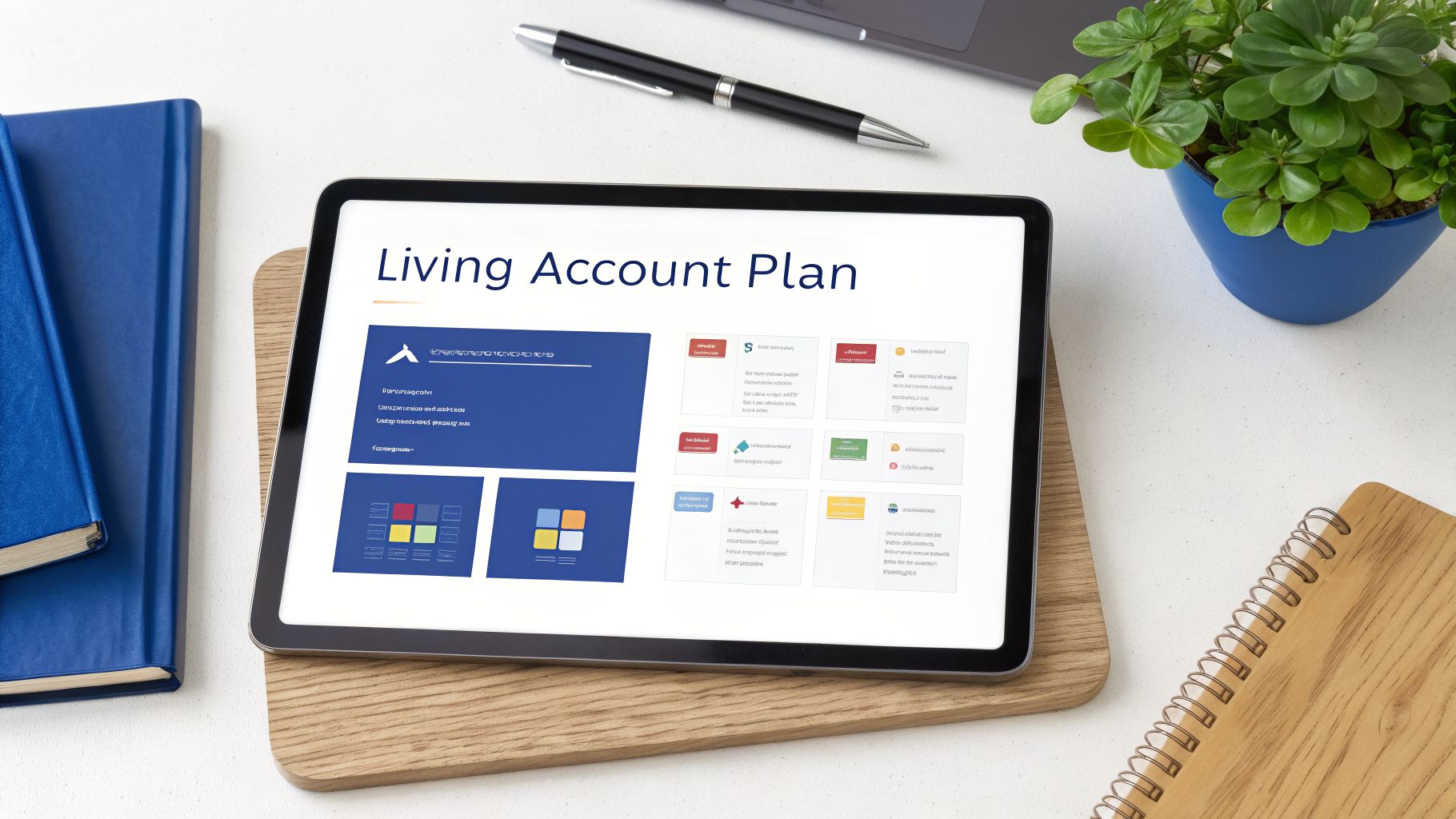
This method moves account planning from a check-the-box exercise into a core strategic activity. For example, an enterprise software seller’s plan for a target bank would automatically update when a new CISO is hired, shifting the focus to cybersecurity integration priorities. This commitment to maintaining current context is one of the most impactful sales enablement best practices for driving consistent, high-value interactions.
How to Implement Living Account Plans
Success depends on creating a repeatable, low-friction process that is deeply integrated into your sales motion. Consistency across the team is more important than perfect, customized plans.
- Standardize with a Template: Create a single, mandatory account plan template. It should include sections for key stakeholders, business objectives, current challenges, your unique value proposition, and a multi-threaded outreach strategy. This ensures uniformity and makes reviewing plans across the team much simpler.
- Automate Contextual Updates: Connect your account plans to a signal intelligence platform like Salesmotion. When a trigger event occurs, such as a target company announcing new R&D investment, the plan should automatically refresh. This allows a biotech services firm to instantly reposition its offering around clinical development bottlenecks without manual research. Some tools can even generate a point of view (POV) and the "3 Whys" (Why you? Why you now? Why with us?) automatically.
- Assign a DRI and Review Cadence: Assign a single Directly Responsible Individual (DRI) for each account plan to prevent decay. Implement a review cadence where the top 20% of accounts are reviewed monthly and all others are formally refreshed at least quarterly. Link these plans directly to CRM objects (like the Account record) to preserve historical context and make strategic evolution auditable.
Key Insight: A living account plan is not just a document; it's a system. When a managed service provider receives an alert that a target account has a new CTO, the plan shouldn't just note the change. It should trigger an immediate action to deploy a new outreach sequence focused on infrastructure modernization, replacing the old, stale cost-reduction pitch.

“Consolidation of prospect company information that I can use frequently to be way better informed when I'm doing my outbound, preparing for a meeting, or building relationships. Ease of use and Customer Support is excellent.”
Werner Schmidt
CEO & Co-Founder, Lative
3. Value-Based Outbound Messaging with Point-of-View
Generic, product-focused outbound messaging no longer cuts through the noise. A value-based approach shifts the focus from what your product does to what your customer can achieve. This method involves crafting a strong point-of-view (POV) based on deep account research, allowing your team to lead with business impact and demonstrate a clear understanding of the prospect's unique challenges and priorities before ever asking for a meeting.
This disciplined approach requires reps to connect account signals, corporate initiatives, and stakeholder pains to a relevant outcome. For example, instead of saying, "We sell an AI platform," a rep might say, "I noticed your recent funding round is earmarked for accelerating clinical trials. Similar biotech firms we work with have reduced patient enrollment time by 30% using our approach." This is one of the most critical sales enablement best practices because it builds immediate credibility and frames the conversation around value, not features.
How to Implement Value-Based Messaging
Effective POV messaging starts with structured research and ends with a message that resonates because it’s informed. This process can be made much more efficient with the right tools and a clear framework.
- Build the "3 Whys" with Effective Research: Before any outreach, train reps to perform effective account research to answer three core questions: Why you? (the specific prospect/company), Why you now? (the trigger or event), and Why with us? (the unique value you provide). This involves reviewing 10-Ks, earnings call transcripts, press releases, and job postings to build a compelling POV. Platforms like Salesmotion can fully automate this research and narrative building, saving reps hours of manual work.
- Create Stakeholder-Specific Templates: A CFO cares about different metrics than a VP of Engineering. Develop 3-4 message templates per key vertical, with variants for C-suite, functional leads, and technical buyers. For instance, a message to a new CISO after a competitor's breach should lead with incident response benchmarks, while a message to their technical lead might focus on specific integration capabilities.
- Lead with the Outcome: Structure your outreach to state the tangible business result first. Instead of "Our software automates X," try "Achieve Y by automating X." A message to a manufacturing firm that just announced a plant expansion should lead with potential gains in capacity planning or equipment ROI, not a pitch for the equipment itself.
Key Insight: Prove you’ve done your homework. The first two sentences of any cold outreach should reference a specific, verifiable event (like a funding announcement, executive hire, or market expansion). Including a link to the source, such as a press release or news article, immediately separates your message from generic spam.
4. Trigger-Based Sales Sequences & Automation
Signal-based prioritization tells you who to contact and when. Trigger-based automation takes the next step by defining how to engage them systematically. This practice involves setting up automated sales sequences that initiate or advance when a specific account signal occurs. Instead of relying on reps to manually craft one-off emails for every trigger, this system deploys pre-built, multi-touch campaigns to the right stakeholders with messaging that is perfectly aligned to that moment.
When a target account announces Series C funding, for instance, a trigger can automatically launch a three-part email sequence. The CFO might receive a message focused on ROI and scaling financial operations, while the CTO gets an email about technical architecture and reliability. This approach ensures speed, consistency, and relevance at scale, turning high-intent moments into immediate, context-aware conversations. It’s one of the most powerful sales enablement best practices for driving efficiency and revenue.
How to Implement Trigger-Based Sales Sequences
Start small by automating outreach for your highest-conviction signals, those most correlated with past wins. This builds momentum and demonstrates value quickly.
- Map Triggers to Personas and Plays: For each key signal (e.g., funding round, new executive), define the key personas involved and the specific pain point you solve for them. A new plant expansion signal should trigger a sequence to the COO about operational efficiency, while a follow-up could target the VP of Operations about execution risks.
- Build Short, High-Impact Sequences: For cold outreach, keep automated sequences brief, around 3-5 touches. The goal is to start a conversation, not overwhelm a prospect. For example, a new CRO hire could trigger a two-step sequence: one email highlighting a CRO-specific case study, followed by a LinkedIn connection request three days later.
- Automate Research and POV Creation: The most effective outreach is built on a strong point of view (POV). Use tools like Salesmotion to not only capture triggers but also fully automate the research needed to build the "3 Whys": Why you, why you now, and why with us. For a walkthrough of what this looks like in practice, see how to research any account in 5 minutes. This equips reps with a ready-made, defensible reason for their outreach, even when the initial touch is automated.
- Establish Clear Exit and Override Rules: Automation should assist, not constrain. Set clear exit criteria so that a prospect who replies, unsubscribes, or books a meeting is immediately removed from the sequence. Also, build in a manual override so reps can pause the automation and jump in with a personalized message at any time.
Key Insight: The best automation doesn't just send emails; it orchestrates a multi-channel, multi-persona engagement. It tracks which persona or message is getting the most engagement and alerts the rep, turning a cold signal into a warm, qualified opportunity.
Finally, review your sequences obsessively. Track open, reply, and meeting rates for each trigger and sequence combination. Retire underperforming campaigns monthly and reinvest your efforts into the ones that consistently generate meetings. This iterative process is central to mastering modern sales enablement.

“This is my singular place that very simply summarizes a company's top initiatives, strategies and connects them to my solution. Something I would spend hours researching manually, now it's automated.”
Derek Rosen
Director, Strategic Accounts, Guild Education
5. Sales Collateral & Talk Track Optimization Based on Buying Stage
Many sales teams operate with a one-size-fits-all library of content, forcing reps to use the same case study or pitch deck for both a new prospect and an account in the final negotiation stage. A modern approach involves mapping specific collateral, proof points, and talk tracks to each phase of the buying journey. This ensures that reps deliver the right message and asset to address the exact questions and concerns stakeholders have at that moment.
Instead of a generic pitch, reps are equipped with content designed for a specific purpose. For an enterprise SaaS sale, this might mean an industry trends report for the awareness stage, an ROI calculator for the consideration stage, and a detailed implementation timeline for the decision stage. This systematic deployment of content is a fundamental sales enablement best practice that guides buyers through their journey with precision and relevance.
How to Implement Stage-Specific Content Optimization
You can begin by auditing your existing assets and aligning them with how your customers actually buy. The goal is to build a curated, high-impact content map, not an overwhelming library.
- Audit and Tag Existing Collateral: Review your current content and tag each piece to a specific buying stage: Awareness, Consideration, or Decision/Negotiation. Don't start from scratch. Repurpose and refine what you already have before creating new assets.
- Create a ‘Top 5’ for Each Stage: Avoid content overload. Identify the five most critical assets for each phase that have proven effective in real deals. For a biotech CRO, this could be clinical trial benchmarks (Awareness), a therapeutic area-specific case study (Consideration), and a detailed resource plan (Decision).
- Embed Content in Your CRM: Integrate your content management system (like Seismic or Highspot) with your CRM. Link assets directly to deal stages in Salesforce or HubSpot so that when a rep moves a deal to "Consideration," the relevant collateral is immediately accessible on the opportunity record.
- Build from Winning Deals: Analyze your recent closed-won opportunities. What assets or talk tracks were most influential in moving the deal forward? Formalize these winning ingredients into official, stage-specific collateral for the rest of the team to use.
Key Insight: Content is useless if reps don’t know when to deploy it. Train your team not just on what the collateral contains, but on the specific buyer questions it answers. A competitive battle card is for when a prospect asks, “How are you different from X?” not for an initial discovery call.
Finally, establish a feedback loop. Create a simple process, perhaps a dedicated Slack channel or a CRM field, for reps to report which assets are most effective in the field. Use this direct feedback to refine your content strategy and ensure your sales enablement efforts are tied directly to what helps close deals.
6. Multi-Threading & Stakeholder Mapping
Relying on a single point of contact, even a strong champion, is a high-risk strategy in complex B2B sales. Multi-threading counters this by systematically identifying, mapping, and building relationships with multiple stakeholders across different functions and levels within a target account. This sales enablement best practice creates resilience and alignment by engaging everyone from the economic buyer who controls the budget to the technical evaluators and the end-users who benefit from the outcome.
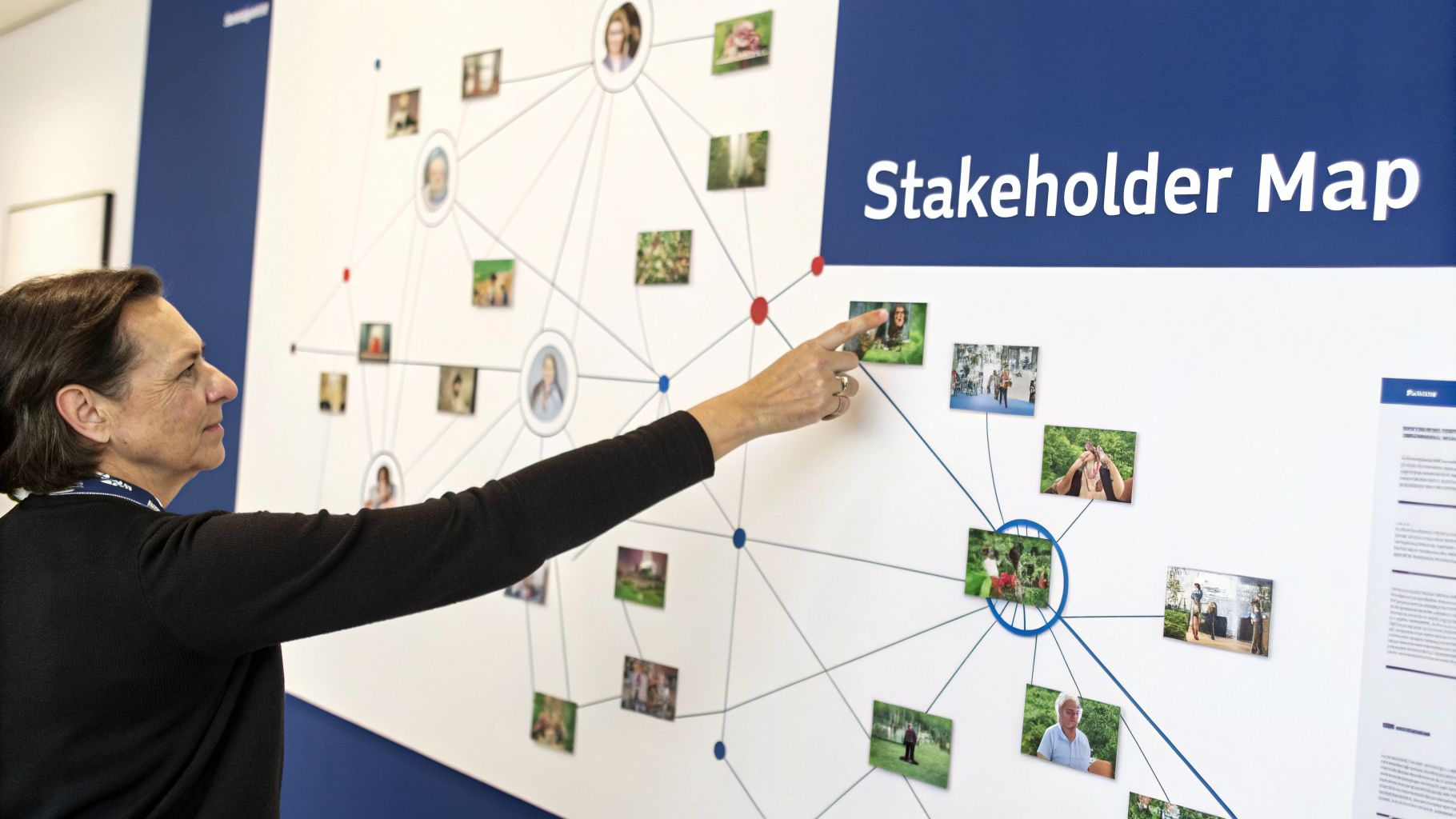
When reps multi-thread effectively, they move from a single-lane road to a multi-lane highway, creating multiple paths to a successful close. It ensures that if their primary champion leaves or gets reassigned, the deal doesn't collapse. Instead of hoping one person can sell the solution internally, this approach builds a coalition of support, addressing the unique concerns of each key player and de-risking the decision for the entire buying committee.
How to Implement Multi-Threading & Stakeholder Mapping
Begin by formalizing the process of identifying and engaging key players for every significant deal. The goal is to make stakeholder mapping a standard operating procedure, not an afterthought.
- Create a Stakeholder Map Template: Standardize a template within your CRM or a shared document. This map should outline key roles (e.g., Economic Buyer, Champion, Technical Buyer, End-User, Influencer) and require reps to identify individuals for each. For a consulting firm selling to a Fortune 500, this map would track the Chief Digital Officer (initiative owner), the CFO (budget), and the Head of a specific Business Line (end-user success).
- Prioritize by Influence, Not Just Title: Train reps to look beyond the org chart. A respected director or senior manager with deep institutional knowledge can often have more practical influence over a decision than a disconnected executive. Use your initial champion to understand these internal political dynamics by asking, "Who else’s opinion is critical for a decision like this to move forward?"
- Tailor Outreach by Persona: Enable reps with persona-specific messaging. A CFO cares about ROI and risk mitigation, while a CTO is focused on architecture, security, and integration. An MSP selling to a manufacturer must show the COO how their solution improves operational efficiency while proving to the CFO that the cost model is sound.
Key Insight: The most effective multi-threading involves building redundancy around the economic buyer. Always identify at least two individuals with access to or influence over the budget. This provides a critical backup if your primary budget sponsor changes roles or priorities.
Finally, document every stakeholder interaction in your CRM. Tracking who was contacted, what was discussed, and their sentiment is essential for accurate forecasting and seamless hand-offs if account ownership changes. This disciplined documentation is a cornerstone of professional sales execution.
7. Win/Loss Analysis & Sales Velocity Metrics
Many sales organizations rely on gut feelings or surface-level CRM notes to understand deal outcomes. A formal win/loss analysis process replaces this guesswork with a systematic review of why deals were won or lost, uncovering deep patterns in your sales motion. It involves not just asking reps but also directly interviewing buyers to get unfiltered feedback on your messaging, competitive positioning, and the overall buying experience. This is a cornerstone of effective sales enablement best practices.
By combining these qualitative insights with quantitative sales velocity data (the time it takes deals to move through the pipeline), you can pinpoint specific bottlenecks and strengths. An enterprise SaaS firm, for example, might discover that 60% of its losses are attributed to price. However, win/loss interviews could reveal the real issue is a failure to properly quantify ROI early in the sales cycle, making the price seem unjustified.
How to Implement Win/Loss Analysis
Building a repeatable process is key to extracting consistent, actionable insights. Start small and focus on creating a feedback loop that informs coaching and strategy.
- Establish a Consistent Interview Cadence: Aim to interview buyers from at least 10% of your closed deals each month, ensuring a healthy mix of both wins and losses. This provides a steady stream of fresh data to identify emerging trends before they become major problems.
- Focus on the Buying Journey: Ask open-ended questions first, like "What was the turning point in your decision-making process?" before asking about specific features. The goal is to understand their internal process, the stakeholders involved, and what made the timing right (or wrong). For instance, a biotech CRO found that 80% of its wins involved early engagement with the Chief Scientist, leading them to refocus prospecting efforts.
- Segment Your Data: Analyze findings by rep, deal size, vertical, and competitor. A pattern in one segment might not apply to another. This segmentation helps you create targeted coaching plans and adjust playbooks for different market conditions. A consulting firm used this to discover a specific competitor was winning with outcome-based pricing, prompting a revision of their own proposal strategy.
Key Insight: The most powerful feedback often comes from losses. A lost deal provides an objective, unvarnished look at your process from a buyer who chose a different path. These insights are pure gold for fixing gaps in your messaging, sales process, and competitive strategy.
Finally, create a central "why we win/why we lose" library that is accessible to the entire team. Populate it with direct quotes, key takeaways, and specific examples. Review these findings in quarterly team meetings to celebrate what's working, transparently address what isn’t, and continuously refine your sales engine.
8. Sales Manager Coaching & Deal Reviews
Effective sales enablement isn't just about arming reps with content; it's about developing their skills through direct leadership. A structured approach to sales manager coaching moves beyond administrative forecasting and transforms deal reviews into powerful learning opportunities. This practice focuses on guiding reps toward better outcomes by analyzing pipeline data, opportunity health, and rep engagement patterns to identify where deals are at risk and where specific skill development is needed.
Instead of simply asking, "Is this deal going to close?" the manager becomes a strategic partner. They help reps diagnose stalled opportunities, map out complex decision committees, and quantify business value for prospects. By shifting the focus from backward-looking accountability to forward-looking strategy, coaching becomes one of the most impactful sales enablement best practices for driving consistent revenue growth and improving rep retention.
How to Implement Manager Coaching & Deal Reviews
A successful coaching program is built on consistency and a commitment to data-informed, forward-looking conversations.
- Establish a Fixed Cadence: Consistency is crucial. Implement weekly 1:1 sessions for individual coaching and pipeline review, and bi-weekly team sessions to share best practices and celebrate wins. For instance, a manager at a consulting firm might use weekly deal reviews to spot that 40% of proposals lack business case quantification, then introduce an ROI calculator template to fix the issue.
- Coach Forward, Not Backward: Frame conversations around "what's next?" and "how do we get this done?" rather than dwelling on past mistakes. Focus on actionable next steps. If a deal is stalled, create a "deal rescue" plan together, which might involve leadership intervention or re-engaging a champion with new insights.
- Use Metrics as a Diagnostic Tool: Treat rep activity metrics (calls, emails, meetings) as a starting point for diagnosis, not just performance evaluation. If an enterprise SaaS rep has high activity but a low meeting rate, a manager can use the 1:1 to discover they aren't personalizing outreach, then coach them on building a strong point of view (POV).
Key Insight: The most effective coaching connects rep behavior to deal outcomes. A manager might notice a top performer has an 80% close rate while others are at 40%. By shadowing the top rep and documenting their discovery questions, the manager can create a playbook to lift the entire team's average.
Finally, document coaching sessions and agreed-upon actions. Follow up in the next 1:1 to ensure accountability and track progress. This creates a continuous feedback loop that reinforces positive behaviors and measurably improves sales execution across the board.
9. RevOps Alignment & Sales-Marketing Integration
Effective sales enablement breaks down the organizational silos that kill deals. Instead of sales, marketing, and operations working from separate playbooks, a Revenue Operations (RevOps) approach creates a unified structure with shared goals, metrics, and data. RevOps acts as the connective tissue, ensuring marketing’s demand generation efforts are perfectly in sync with sales capacity and that both teams are working from a single source of truth.
This structural alignment means campaigns target the right accounts with consistent messaging at the right time. RevOps owns the underlying data layer, from CRM hygiene and lead scoring to pipeline health analytics. This allows sales teams to trust the leads they receive from marketing and gives leadership a clear, end-to-end view of the entire revenue engine. This model is a cornerstone of modern sales enablement best practices because it replaces finger-pointing with shared accountability.
How to Implement RevOps Alignment
Building a RevOps function doesn't happen overnight. It starts with small, measurable steps that demonstrate value and build cross-functional trust.
- Define One Critical SLA: Start by establishing a single, clear Service Level Agreement (SLA) that bridges sales and marketing. For example, mandate a 24-hour response time for all marketing-qualified leads (MQLs). Use RevOps dashboards to track adherence and show the direct impact on MQL-to-opportunity conversion rates.
- Establish a Shared Data Schema: Agree on a minimal set of shared data points and definitions. What constitutes an "engaged account"? What is the exact criteria for each pipeline stage? Enforce this schema with validation rules in your CRM and automated data enrichment tools to ensure everyone is speaking the same language.
- Run Cross-Functional Stand-ups: Hold brief, weekly meetings focused on top-tier accounts or active campaigns. This keeps sales and marketing aligned on strategy, allows for real-time feedback, and prevents miscommunication. Discuss what's working, what's not, and what adjustments are needed for the week ahead.
- Automate Key Handoffs: Use your CRM or marketing automation platform to automate the handoff process between teams. When a lead reaches a certain score, it should be automatically assigned to the correct rep with all relevant context and history. This reduces manual errors and dramatically shortens response times.
Key Insight: True alignment isn't just about shared meetings; it's about shared data and shared consequences. When marketing's success is measured by the pipeline it helps generate, not just the volume of leads, their focus shifts to quality and a genuine partnership with sales emerges.
Finally, invest in attribution models that connect marketing touchpoints directly to closed-won revenue. When sales can see that a specific whitepaper or webinar directly influenced a deal, they begin to see marketing content as a valuable sales tool, not just top-of-funnel noise.
10. Account-Based Marketing (ABM) Orchestration & Campaigns
While traditional marketing casts a wide net, ABM uses a spear. Account-Based Marketing (ABM) is a focused growth strategy where marketing and sales collaborate to create personalized buying experiences for a select set of high-value accounts. Orchestration is the key to making this work; it's the process of aligning every piece of content, demand generation activity, and sales outreach into a coordinated campaign that speaks directly to a specific account’s needs and buying stage.
This approach shifts the focus from generating a high volume of individual leads to engaging the entire buying committee within a target account. For example, a SaaS company might run a hyper-targeted campaign for specific accounts in the finance industry, combining ads highlighting new regulatory compliance features, executive roundtables, and bespoke whitepapers. This alignment is a cornerstone of effective sales enablement best practices because it ensures that when a seller makes contact, the account is already warmed up and familiar with the company's value proposition.
How to Implement ABM Orchestration
Success with ABM starts small and scales with proven results. Begin by aligning sales and marketing on a handful of high-potential accounts.
- Select a Pilot Cohort: Choose 5-10 strategic accounts that represent your ideal customer profile. Get full buy-in from both sales and marketing leadership to dedicate resources to this pilot group. Proving the model here will justify future expansion.
- Map the Buying Committee & Messaging: For each target account, identify the key personas involved in the purchase decision. Work with sales to create messaging that is consistent across all touchpoints but tailored to each persona's specific pain points. The CFO cares about ROI, while the Head of IT cares about integration and security.
- Coordinate Multi-Channel Touches: Design a timed sequence of interactions. This could start with targeted LinkedIn ads to the buying committee, followed by a personalized email from the account executive that references the ad content, and then an invitation to a small, exclusive webinar. The goal is a seamless, unified experience.
- Measure Account-Level Impact: Shift your metrics from lead-based (MQLs, SQLs) to account-based. Track metrics like account engagement, pipeline velocity within target accounts, and, ultimately, revenue influence. This provides a true picture of ABM's contribution.
Key Insight: True ABM orchestration isn't just marketing handing off leads. It's a continuous, two-way dialogue where sales provides feedback on what messaging resonates, and marketing adjusts its campaigns in real-time to support the sales motion.
Finally, empower your reps to personalize their outreach using account intelligence. When a target account announces a new product, the seller’s outreach should connect that announcement to a specific challenge their solution can solve. This demonstrates deep relevance and elevates the conversation beyond a generic sales pitch.
10-Point Sales Enablement Comparison
| Strategy | Implementation Complexity | Resource Requirements | Expected Outcomes | Ideal Use Cases | Key Advantages |
|---|---|---|---|---|---|
| Account Intelligence & Signal-Based Prioritization | Medium–High (integrations, tuning) | Data feeds, CRM & comms integrations, analytics | Better timing; 30–40% forecast accuracy lift; faster deal cycles | Teams covering many accounts needing real-time triggers | Real-time context, automated prioritization, scalable coverage |
| Personalized Account Planning with Living Context | Medium (templates, change management) | CRM integration, account owners, signal feeds | 15–20% higher win rates; faster cycles; consistent plans | Complex enterprise accounts and multi-rep coverage | Dynamic, up-to-date account plans; faster onboarding; stakeholder alignment |
| Value-Based Outbound Messaging with Point-of-View | Low–Medium (content & training) | Content dev, signal research, rep training | Higher open/reply rates (25–45%); better meeting quality | Targeted outbound to executive or functional buyers | Outcome-led messaging, credibility, higher relevance at scale |
| Trigger-Based Sales Sequences & Automation | Medium (workflow logic, branching) | Automation platform, trigger rules, sequence design | 40–60% better contact rates; faster time-to-first-conversation | Signal-driven outreach and high-volume cadence workflows | Consistent timing, scalable automation, conditional personalization |
| Sales Collateral & Talk Track Optimization by Buying Stage | Medium–High (mapping, maintenance) | Content library, enablement tools, CRM access | 15–25% shorter cycles; 10–20% higher win rates | Deals with clear stage progression and diverse stakeholders | Stage-specific assets, stronger objection handling, coaching-ready content |
| Multi-Threading & Stakeholder Mapping | Medium (research, coordination) | Org data, mapping tools, rep time | Higher win rates (with 3+ stakeholders); reduced deal risk | Enterprise deals with committees and long sale cycles | Redundancy, political intelligence, accelerated alignment |
| Win/Loss Analysis & Sales Velocity Metrics | Medium (process + analytics) | Interview protocols, analytics tools, dedicated time | 10–20% win rate lift; 15–30% faster cycles via learned patterns | Teams seeking process improvement and evidence-based coaching | Fact-based insights, competitive intelligence, process optimization |
| Sales Manager Coaching & Deal Reviews | Low–Medium (cadence, skill-building) | Manager time, CRM data, coaching frameworks | 15–25% better win rates; reduced forecast variance | Scaling teams and reps needing skill development | Early risk detection, targeted coaching, peer learning culture |
| RevOps Alignment & Sales‑Marketing Integration | High (org change, tooling) | RevOps team, integration tooling, executive buy-in | 10–25% better lead-to-opportunity conversion; clearer ROI | Companies scaling GTM and unifying data & processes | Unified data, SLAs, coordinated campaigns and attribution |
| Account-Based Marketing (ABM) Orchestration & Campaigns | Medium–High (personalization, coordination) | ABM platform, creative, sales-marketing coordination, ad spend | Higher engagement and pipeline quality; 2–5x engagement lift | High-value strategic accounts and enterprise pursuits | Highly targeted outreach, account-level measurement, aligned plays |
From Theory to Action: Building Your Enablement Engine
We've covered a range of sales enablement best practices, from high-level strategy to the day-to-day motions that define winning teams. The journey from disconnected selling to a cohesive, high-performance revenue engine isn’t about adopting every practice overnight. It’s about strategic, incremental change. The true power of sales enablement is realized when these individual components work in concert, creating a system that is far greater than the sum of its parts.
Think of it as building a flywheel. Each practice, whether it's signal-based prioritization or structured manager coaching, adds momentum. At first, the effort is significant. But as you embed these processes into your team's DNA, the flywheel starts to spin on its own, generating predictable pipeline and sustainable growth with less friction. The core idea is to move your team from hoping for opportunities to creating them through disciplined, intelligent, and repeatable actions.
The case for enablement is that the result should not depend on who happens to be on the account. A sales operations lead at a marketing software firm told us: "everything needs to be a system like we need to surface the right information like we cannot count on one or two like star sellers"
Key Takeaways for Immediate Impact
If you're wondering where to begin, focus on the areas that represent the biggest drag on your team's productivity and effectiveness.
- Intelligence is the Foundation: Your sales team's success starts with who they talk to and why. Moving away from static lists toward dynamic, signal-based account intelligence (Practice #1) is a critical first step. It ensures your reps invest their most valuable asset, their time, on accounts with a genuine, demonstrable need.
- Automation Augments, It Doesn't Replace: The goal of automation isn't to remove the human element but to amplify it. Automating the time-consuming tasks of account research, Point of View creation, and the "3 Whys" (Practice #3) frees your sellers to do what they do best: build relationships, challenge customer thinking, and close deals. For a deeper dive on where automation fits in the sales cycle, see our guide to sales process automation.
- Process Unlocks Performance: The gap between your top performers and the rest of the team is often a process gap. Implementing structured frameworks for account planning (Practice #2), multi-threading (Practice #6), and win/loss analysis (Practice #7) makes excellence repeatable. It turns tribal knowledge into a documented, scalable methodology for success.
Your Actionable Next Steps
Making these sales enablement best practices a reality requires a deliberate approach. Don't try to boil the ocean. Instead, select one or two initiatives that will deliver the most immediate value and build from there.
- Conduct a Gap Analysis: Where is your revenue process breaking down? Are reps struggling with prospecting? Are deals stalling in the mid-funnel? Use win/loss data and rep feedback to pinpoint your most significant bottleneck.
- Pilot a Program: Choose one practice that directly addresses that bottleneck. For example, if prospecting is weak, pilot a program focused on building a strong Point of View for a small group of reps. Equip them with the right tools and training, and measure the impact on meeting-booked rates.
- Measure and Iterate: Define what success looks like before you start. Track key metrics like sales velocity, call-to-meeting conversion rates, and deal size. Use this data to prove the value of the initiative and justify broader investment. As you transition from conceptual strategies to tangible outcomes, it's also important to consider practical steps to improve operational efficiency across your entire sales function.
Ultimately, mastering these sales enablement best practices is about building a system that empowers every seller to operate like your very best. It’s about creating an environment where reps are armed with the right content, context, and coaching at the exact moment of need. This systemic approach moves your organization from being reactive to market shifts to proactively shaping buyer conversations and driving outcomes.
Ready to automate the heavy lifting of account research and point-of-view creation? Salesmotion is the enablement engine that operationalizes these best practices, providing your reps with the automated intelligence they need to win more timely and relevant conversations. See how it works at Salesmotion.