A structured value proposition process beats a feature-first pitch. In a foundational study of 29 new B2B service development projects, companies that used a structured value proposition design process produced stronger value proposition quality and better market performance, which shows this is a managerial discipline, not just messaging work. That's the part too many teams miss when they treat the proposition as copy instead of a decision-making system.
TL;DR: Value proposition development is a repeatable process, not a copywriting exercise. Start discovery from account signals, map customer jobs, pains, and gains by stakeholder, turn capabilities into claims with proof, test the message before you scale it, and build it into rep-ready assets. Then track win rate on signal-triggered outreach, time-to-first-touch, and stakeholder resonance to keep the proposition current.
A weak value proposition usually sounds polished and still gets ignored because it starts with the product, not the buyer's problem. In markets where buyers compare alternatives on functional and economic value, that's a fast way to sound interchangeable, especially when the message isn't backed by evidence or timing.
Why Most B2B Value Propositions Fail Before They Start
The most common failure is structural, not creative. Teams sit in a conference room, list features, and then turn those features into “benefits” without proving that the buyer cares, believes them, or can act on them now. The result is a statement that sounds tidy and still leaves pipeline flat.
That's exactly why the 2011 study matters. It found that the more a company used a structured value proposition design process, translating customer problems into clear benefits, testing assumptions, and refining the offer, the stronger the resulting value proposition quality and market performance became. The practical lesson is blunt, a value proposition improves when it's treated like a process, not a slogan.
Inside-out messaging sounds confident and still misses the mark
Teams often start from what they can say, not what the market can absorb. They write around features, claim differentiation in broad terms, and assume buyers will connect the dots. Buyers usually won't, especially in complex B2B cycles where multiple stakeholders bring different priorities to the table.
A more disciplined approach starts with evidence from the outside in. The 2020 conceptual review in Technological Forecasting and Social Change argued that a value proposition should define how both sides benefit from doing business together and from improving the transaction process itself, which moves the work beyond slogan writing and into business design. That framing fits modern sales because the buyer isn't only judging the product, they're judging whether the purchase is worth the effort.
If you want a good companion read, the value proposition guide by Sensoriium reinforces the same idea from a practitioner angle, keep the claim tied to a concrete customer problem and a defensible outcome.
Practical rule: if your proposition could describe three competitors with minor edits, it's not a proposition yet.
Signal-driven outreach gives the proposition a reason to exist now
The best propositions don't live in isolation. They're paired with a reason to reach out at the right moment, so the buyer understands not just what you do, but why this matters now. That's where signal-driven discovery changes the game.
When a rep sees a hiring spike, a leadership change, or a shift in guidance, the proposition stops being generic. It becomes context-specific, and context is what turns a decent message into a booked meeting. Salesmotion's internal thinking around the value gap reflects that same issue, the market doesn't reward more wording, it rewards sharper alignment between proof, timing, and stakeholder pain.
A lot of teams still call that “messaging.” It's more accurate to call it evidence packaging. The proposition has to earn its place in the conversation, not just decorate it.
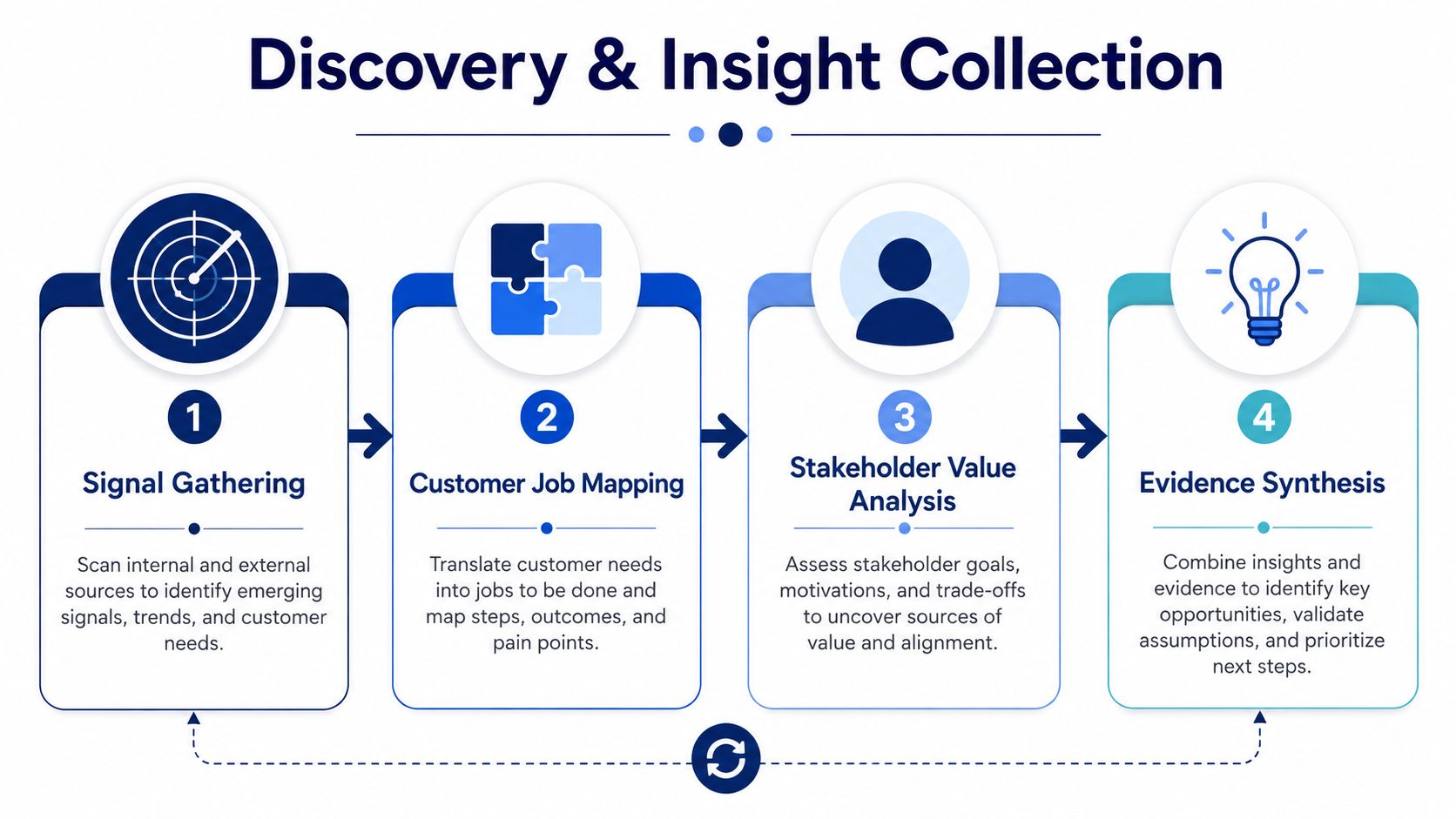
Discovery and Signal-Driven Insight Collection
Discovery fails when it's conducted from the buyer list inward. The better sequence starts with what's already changing around the account, then works backward into the pain, the job, and the stakeholder angle. That's why signal collection matters so much in modern B2B selling, it tells you where the buying context is already active.
The cleanest signals usually fall into three buckets. Strategic signals include earnings call guidance and investor updates. Operational signals include job postings and office expansions. Organizational signals include executive hires and leadership changes. Each one points to a different kind of urgency, and each one deserves a different message.
Read the signal before you write the pitch
A new CRO hire usually means priorities, reporting lines, and vendor review are in motion. A hiring wave in a target function can suggest a process bottleneck, a capacity issue, or a tool stack that's under strain. An earnings call comment about efficiency or margin pressure gives you a very different opening than a job post for a workflow specialist.
The important thing is not to treat every signal the same way. Some signals call for a fast outreach sequence, others support a longer nurture path, and some are best used to refine your account hypothesis before the first email goes out. If you skip that judgment, you end up reacting to noise instead of buying context.
Buyers don't care that a trigger happened. They care whether your message shows you understand why it matters to them.
Build the research stack before you build the sequence
Structured discovery works best when the account brief comes first, then the trigger, then the outreach. The Research Agent in Salesmotion is designed around that order, building account briefs from 1,000+ public sources and turning scattered information into a usable view of the account. The Signal Agent then monitors accounts 24/7 and alerts your team when something worth acting on happens, while the Outreach Agent turns that intelligence into personalized outreach sequences tied to the account data.
That workflow matters because it stops sales from inventing a reason to reach out. A good trigger is specific, visible, and tied to a change the buyer already cares about. If you want a practical comparison of software categories that support this kind of work, the intent data software overview is a useful reference point.
The point isn't more data. It's better timing plus better interpretation. Without both, value proposition development stays abstract.

“Salesmotion has been a game-changer for me. I used to spend 12 hours a week on prospect research, now it's down to 4. Plus I'm finding stuff I was totally missing - podcasts, news mentions, the good bits.”
George Treschi
Account Executive, FY25 President's Club, Sigma
Customer-Job Mapping and Stakeholder-by-Value Analysis
The biggest mistake in B2B messaging is writing before you know who you're writing for. A CFO, an end user, and a security lead can all sit in the same deal and still care about different risks, different evidence, and different outcomes. If your proposition tries to satisfy them with one generic sentence, it usually satisfies none of them.
A disciplined approach starts with customer jobs, pains, and gains, then maps those into gain creators and pain relievers. The stakeholder layer comes next. A stakeholder-by-value matrix forces the team to separate what each role is trying to accomplish from what the organization thinks the product does.
Use the canvas to anchor the conversation
The Value Proposition Canvas logic is useful because it breaks the work into visible parts. Customer jobs define what the buyer is trying to get done. Pains show what slows them down, raises risk, or creates friction. Gains capture what “better” looks like in their world.
From there, map each item to a product or service element that addresses it. If a feature doesn't relieve pain or create a gain the customer cares about, it doesn't belong in the proposition. That filtering step is where a lot of internal consensus falls apart, because internal teams often defend features that don't move the buyer.
Stakeholder-by-value matrix template
| Stakeholder | Primary Job to Be Done | Key Pains | Expected Gains | Your Differentiating Value |
|---|---|---|---|---|
| CFO | ||||
| End user | ||||
| Security lead |
The matrix works because it makes trade-offs visible. A CFO may want cost certainty, an end user may want ease and speed, and a security lead may want fewer exceptions and cleaner control. Those are different buying motives, not variations of the same one.
Go beyond personas and look for underserved segments
There's also a deeper question: why is the segment underserved at all? Outcome-based segmentation asks where the market is failing, along what dimensions, and to what degree. That matters because a proposition built for a segment that isn't underserved will struggle no matter how polished the copy is.
If the buyer's recurring job isn't painful enough, no amount of wording will rescue the proposition.
That's why the strongest propositions are specific. They don't just say the product is better. They prove the buyer has a recurring job current alternatives don't solve well enough, and they show which stakeholder feels that pain most sharply. If you want a practical stakeholder lens, the stakeholder mapping tools overview is a strong reference for turning role clarity into account clarity.
Benefit Articulation and Message Testing
Once the job map is clear, the next job is translating it into language buyers can use. That means turning capabilities into claims, claims into proof points, and proof points into messages that can survive a real sales conversation. A strong proposition should feel precise enough to test, not broad enough to admire.
A simple structure works better than a clever one. For [target group] who have [specific problem], [solution] enables [measurable outcome]. That format forces clarity on audience, pain, and result before anyone starts polishing wording.
Claims need proof, not adjectives
A value proposition without proof is just a claim. Credibility can come from social proof, data, certifications, testimonials, case studies, or brand reputation, but it has to exist somewhere in the conversation. If the statement can't survive scrutiny, it won't survive procurement, finance review, or a skeptical operator.
One of the most useful editing rules is simple, replace vague adjectives with concrete outcomes. “Original” becomes an outcome the buyer can recognize. “Reduces effort” becomes a clear operational result. If you can't make the language sharper, the proposition probably isn't sharp enough yet.
Compare weak and strong outreach side by side
A weak opening sounds like this. “We help modern teams streamline workflows and improve productivity.” That sentence is broad enough to apply almost anywhere, which is usually the problem.
A stronger opening sounds like this. “I noticed your team just posted for two operations analysts, which usually means the current workflow is getting stretched. We help teams reduce the manual work around account research so reps can spend more time in live conversations.” The difference isn't stylistic, it's contextual. The second version ties the value claim to a visible account event and a concrete pain.
A practical resource worth reviewing is the B2B value proposition guide, because it reinforces the same discipline, keep the claim anchored to a target group, a problem, and a believable result.
Test the message before you scale it
Testing doesn't need to be elaborate to be useful. Run small experiments, compare subject lines, and watch which framing leads to real replies and relevant conversations. If one message gets opens but no meetings, it may be interesting but not persuasive. If another gets fewer opens but better conversations, that's usually the better proposition.
Rule of thumb: remove anything that doesn't directly support the top customer jobs, pains, or gains, then see whether the segment is still large, reachable, and profitable.
That is where signal-anchored messaging tends to beat generic copy. A trigger-based email gives the buyer a reason to read the proposition in the first place, and the proof makes the claim credible enough to discuss.

“The Business Development team gets 80 to 90 percent of what they need in 15 minutes. That is a complete shift in how our reps work.”
Andrew Giordano
VP of Global Commercial Operations, Analytic Partners
Sales Enablement Assets and Workflow Integration
A validated proposition is only useful if reps can use it without searching through a deck. That's why the best teams turn it into three working assets, an account one-pager, a stakeholder-specific talk track, and a signal-triggered outreach sequence. Each asset serves a different moment in the deal.
The one-pager is the simplest. It translates the proposition into a single page that a rep can use during discovery. The talk track is more nuanced, because it changes by role. The outreach sequence is where the trigger gets operational, and the reason to reach out becomes specific enough to support a reply.

Translate the proposition into rep-ready assets
The one-pager should answer three questions fast. What problem are we solving, why does it matter now, and which proof points make the claim believable? If a rep can't use it in a live call without translating it again, it's too abstract.
The talk track should split by stakeholder. The CFO hears risk, cost, and certainty. The operational leader hears workflow, speed, and adoption. The security lead hears controls, visibility, and fit with existing systems. That's where the sales enablement framework is useful, because it treats enablement as a system, not a document.
Turn account triggers into outreach logic
The best sequences don't sound automated because the trigger is real. A hiring post can be used to point at scaling pressure. An earnings call can justify a conversation about efficiency or expansion. A leadership change can open the door to a re-evaluation of tools and priorities.
Salesmotion runs three AI agents across target accounts. The Research Agent builds deep, structured account briefs from 1,000+ public sources. The Signal Agent monitors every account 24/7 and alerts your team the moment something worth acting on happens. The Outreach Agent takes that intelligence and writes personalized, multi-step outreach sequences per contact, with every email anchored to real account data, a specific signal, a strategic initiative, or a stakeholder's priorities.
That matters because reps don't need more templates. They need an actual reason for the buyer to care right now. The difference between “I noticed your company is growing” and “I saw the hiring pattern tied to a specific operational bottleneck” is the difference between a deleted email and a reply.
Close the loop with rep feedback
The final step is operational, not strategic. Route alerts into CRM, Slack, or email, then let reps mark which messages resonated and which ones fell flat. That feedback loop is what keeps the proposition current as the market changes.
A proposition that never gets used decays fast. A proposition that gets used, reviewed, and adjusted becomes part of the revenue system.
KPIs for Measuring Value Proposition Health
Most teams measure activity and call it progress. They count emails sent, meetings booked, and sequences launched, then assume the proposition is working if volume is up. That's the wrong test. A healthy proposition shows up in better outcomes, better relevance, and better stakeholder response.
Start with the clearest comparative signal, win rate on warm, relationship-led outreach versus the average. Champify's value report puts the average win rate on opportunities with former advocates at 39%, versus under 19% for the SaaS average. That gap is the cleanest proof that timing and context matter, not just volume.
Track the right health indicators
A strong dashboard doesn't need to be complicated. It needs to show whether the proposition is getting sharper and whether the market is responding.
| KPI | What it tells you | How to use it |
|---|---|---|
| Win rate on signal-triggered outreach | Whether timing plus relevance is working | Compare to cold outreach by segment |
| Time-to-first-touch | How quickly teams act on a trigger | Shorter usually means fresher relevance |
| Message differentiation score | Whether the message sounds evidence-backed or generic | Have reps rate each message after use |
| Stakeholder resonance rate | Which role engages most with the proposition | Adjust talk tracks by buying role |
| Iteration velocity | How often the proposition gets updated | Review after new signals and deal feedback |
The most useful metric is often the one that exposes drift. If a proposition used to resonate with end users but now gets finance attention first, that tells you something changed in the buying group or in the market.
Review the proposition like a living asset
The five-phase framework from the implementation literature, value design and assessment, value quantification, value communication, value documentation, and value verification and VP review, is helpful because it treats the proposition as a cycle, not a one-time rewrite. Phase one also emphasizes resource assessment, customer and competitor research, market-segment review, and choosing the right granularity of the proposition, whether broad benefits, favorable differences, or a resonating focus.
That's the mindset that keeps the proposition honest. If the signals change, the proposition should change. If the market starts rewarding speed, effort reduction, or workflow fit more than broad differentiation, the messaging needs to reflect that.
Use the dashboard to guide the next test
A value proposition is never finished. It should improve as the market gives you new information, and the team should be willing to retire messages that no longer earn their place. If the numbers above show weak stakeholder resonance or slow iteration, the fix usually isn't louder messaging. It's better targeting, better proof, and faster use of account signals.
Review the proposition weekly if the market is moving fast, and use each review to decide what to keep, what to cut, and what to test next. That's how value proposition development becomes a revenue habit instead of a branding exercise.
Salesmotion helps revenue teams turn account signals into practical outreach, so the value proposition is tied to real buying context instead of a generic pitch. If you want to build account briefs, monitor triggers, and generate stakeholder-specific outreach from the same system, visit Salesmotion and see how the workflow fits your team.