The best stakeholder mapping tool for 2027 depends on the job. Salesmotion fits revenue teams that need the map to stay current with live account signals. Revegy, Upland Altify, PROLIFIQ, and OrgChartHub fit CRM-based account planning. Smaply fits CX and service design, Borealis and Simply Stakeholders fit regulated and community programs, and Kumu and Polinode fit network analysis.
TL;DR: A stakeholder map shows who holds influence, who has the pain, and how they are connected. This guide reviews 10 tools by job, not by feature list. The main thing to check is whether the map changes when the account changes, because a static diagram goes stale fast.
Stop Flying Blind in Your Key Accounts
You're deep in a seven figure deal. You think you know the key players, but the economic buyer is ghosting you, your champion just got re-org'd, and a new exec you've never heard of is suddenly asking questions. This isn't bad luck. It's a map problem.
Without a clear view of the stakeholder environment, who holds influence, who has the pain, and how they're all connected, you're navigating enterprise sales with a broken compass. Good stakeholder mapping tools fix that. They turn messy human dynamics into something your team can use in planning, outreach, and deal reviews.
The practical challenge is that many organizations still rely on static diagrams, spreadsheets, or one off workshop outputs. That breaks fast in real accounts. A stakeholder map needs structure, but it also needs updates. The UK Government Analysis Function recommends a scaled scoring method with three independent scorers assigning values from 1 to 10 for both power and interest, then averaging the scores and documenting any team adjustments in a recording template, while also reviewing maps regularly so they don't go stale (UK Government stakeholder mapping guidance).
That's the baseline. In sales, you also need live signals. If a buyer changes roles, a new leader joins, or an initiative shows up in public filings, your map should change with it.
This guide covers the best stakeholder mapping tools by job, not just by feature list. Some are built for revenue teams. Some are better for CX and service design. Some belong in regulated enterprise programs. If you also need a tighter operating rhythm around stakeholder communication, Fluidwave's communication guide is worth a read.
1. Salesmotion
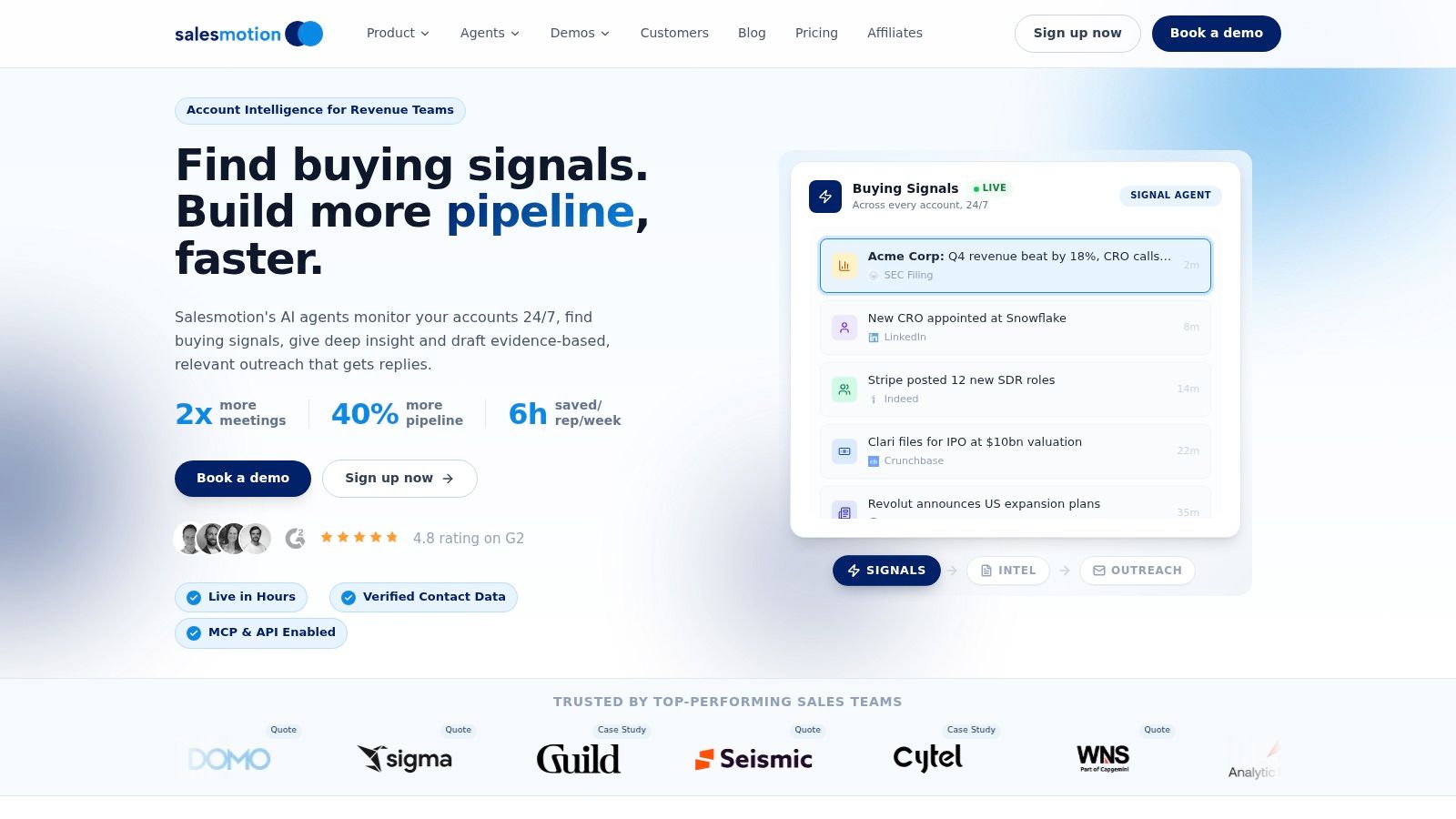
Salesmotion is the strongest option here if your problem isn't just drawing the map, but keeping it useful in live enterprise deals. That distinction matters. Plenty of stakeholder mapping tools help you visualize an account. Fewer help you notice when the account has changed and tell reps what to do next.
Salesmotion does that with three AI agents: Signal, Research, and Outreach. In practice, that means it monitors target accounts continuously, pulls account context from public sources, builds source linked briefs, and turns that context into outreach your team can send. That's a very different workflow from a static relationship map sitting in a slide deck.
Why it stands out for sales
DemandFarm's industry roundup says AI powered stakeholder mapping platforms are now used by 65% of Key Account Managers and Revenue Leaders, and teams using these tools report a 35% increase in outreach relevance because the systems synthesize inputs from 1,000+ public sources into actionable briefs (DemandFarm on stakeholder mapping tools). Salesmotion fits that operating model closely, but with a sharper execution layer around signal detection and ready to send messaging.
It earns its place as the featured pick. Reps don't need another research tab. They need a reason to act now, evidence to support that reason, and a fast path into a custom message.
Practical rule: If your map doesn't change when your account changes, it's not a strategy tool. It's documentation.
Salesmotion is also built for workflow adoption, not analyst theatre. It plugs into CRM and engagement platforms, links every insight back to its source, and reduces the usual argument about whether an AI generated insight is real.
Best fit and trade-offs
Salesmotion is best for revenue teams running complex account based motions, especially when deals involve multiple business units, changing sponsors, and layered buying committees. It's strong when your team needs signal detection, account research, and outreach in one place.
A few trade-offs are worth being honest about:
- Big strength: It's proactive. The platform doesn't wait for a rep to ask a question before it starts looking.
- Pricing: $85/mo for individuals on flexible monthly billing, with custom pricing for teams and enterprise on request.
- Operational reality: It relies heavily on public signals. If the buying motion is mostly internal and quiet, reps still need direct discovery and account coverage.
If your reps regularly struggle to identify the key power center in an account, start with Salesmotion and pair it with a repeatable stakeholder review cadence. The company's guide on how to find decision makers in a company is a useful companion to the platform itself.
You can evaluate it directly at Salesmotion.
Skip the comparison fatigue?
If you're shopping for a sales intelligence tool, here's the short version.
Salesmotion combines account intel, buying signals, verified contacts, and AI-drafted outreach in one tool. From $85/mo, live in an hour, no annual contract.
2. Kumu
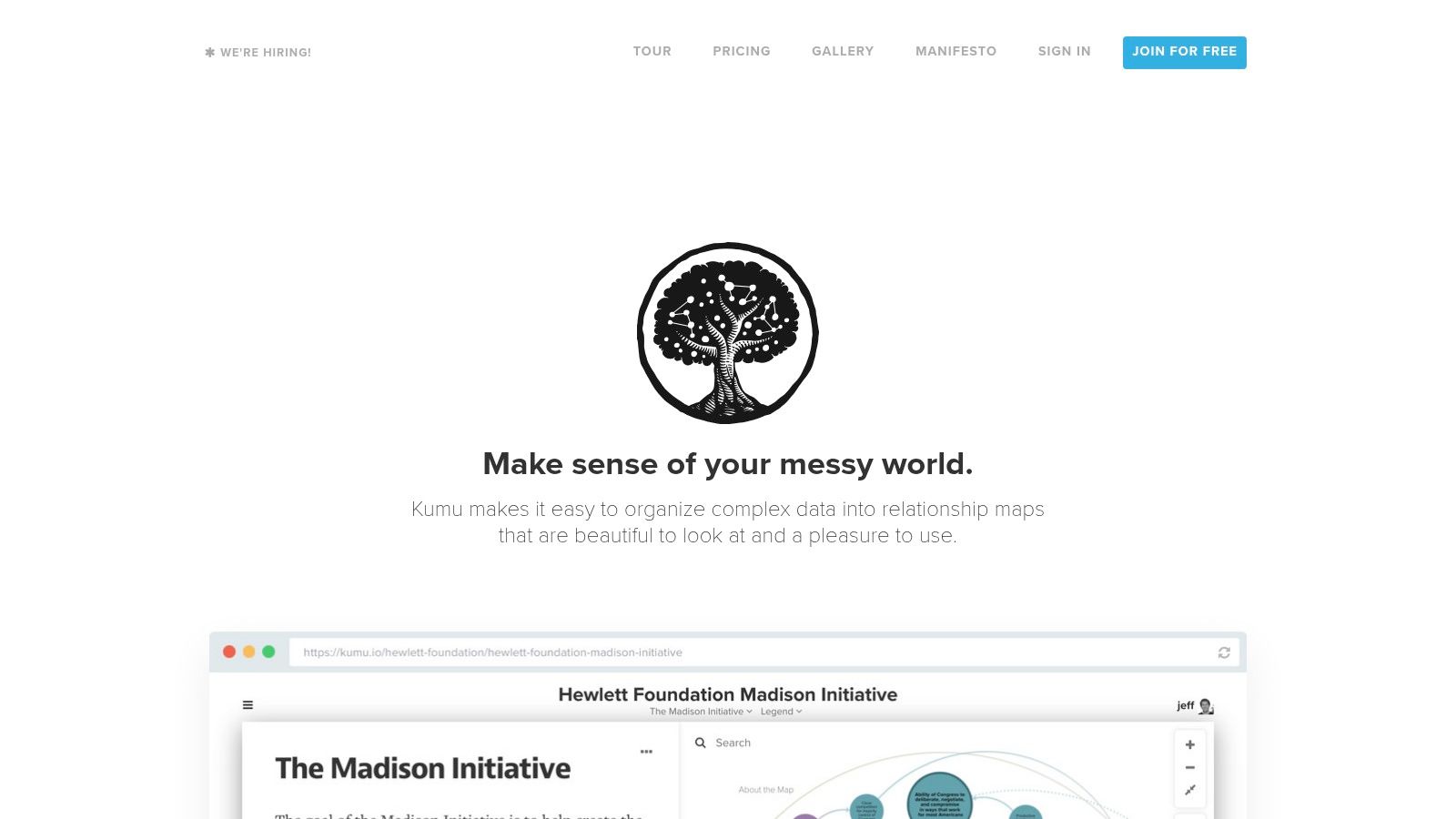
Kumu is what I'd use when the problem is network complexity. Not sales execution. Not regulated engagement tracking. Pure visibility into relationships, clusters, and system dynamics.
It's purpose built for relationship and ecosystem mapping, and that shows. You can style maps in detail, apply filters, cluster stakeholder groups, import data from spreadsheets, and share maps as embeddable assets. If your current process lives in PowerPoint, Kumu will feel like a serious upgrade.
Where Kumu works best
Kumu is especially good when your map needs to be explored, not just viewed once. That makes it useful for partnership ecosystems, cross functional programs, and accounts where influence runs sideways instead of top down. In complex international projects, researchers identified about 81 unique stakeholders on average per country, which is a good reminder that stakeholder environments can get crowded fast (international stakeholder mapping study).
That's the kind of environment where static org charts stop helping. Kumu lets you surface patterns that a basic box and line diagram hides.
The minute your team starts saying “there are too many people to map,” you need a network view, not a simpler spreadsheet.
Kumu is not a CRM, and that matters. It helps you see the relationship web, but it won't run engagement workflows, opportunity management, or account governance by itself. Organizations that get value from it typically pair it with another system of record.
Trade-offs to expect
- Best part: Excellent for living, explorable stakeholder and ecosystem maps.
- Hard part: Advanced styling and querying take real setup time.
- What it isn't: It won't replace a sales execution platform.
For revenue teams, I'd use Kumu when you need to understand the web of influence around a target account or partner ecosystem, then feed those insights into a selling workflow. If that's your use case, Salesmotion's take on relationship intelligence connects well with what Kumu makes visible.
See the platform at Kumu.

“Salesmotion is instrumental in helping me prioritize net-new accounts, understand their strategic initiatives, and cover more ground. With a lot of green-field accounts, I'm heavily leaning on the AI insights to tier my accounts and focus my time. The platform is incredibly intuitive and easy to use.”
Rob Webster
Enterprise Account Executive, Synthesia
3. Polinode
Polinode sits in a more analytical category. It's not trying to be a simple visual map builder. It's Organizational Network Analysis software, and that means it helps you uncover who influences decisions, information flow, and collaboration inside a group.
That's useful in stakeholder mapping because formal titles often mislead teams. The person who signs may not be the person who shapes the decision. Polinode helps expose that gap.
What it does better than simpler tools
Polinode supports survey data, passive data, and CSV imports to build networks. It also gives you a deep set of metrics and templated views, which makes it strong for change programs, transformation work, and cross functional initiatives where hidden influencers matter more than visible hierarchy.
If you're running a post merger integration, a large internal rollout, or a major account plan that depends on informal influence, this kind of analysis is worth the extra effort. Standard maps often overvalue authority and undervalue connection density.
A practical caution. Polinode is analyst friendly, not rep friendly. You usually need someone who understands survey design and network interpretation to get the best output. Without that, teams can produce attractive diagrams that don't change any decisions.
Who should buy it
- Strong fit: Enterprise strategy, transformation, and internal stakeholder analysis.
- Weak fit: Frontline sales teams that want a fast relationship map inside their daily workflow.
- Operational note: Security and hosting options make it viable for larger organizations with stricter requirements.
Polinode is a strong specialist product. If you want lightweight stakeholder mapping tools for day to day sales use, it's more tool than you need. If you want to find hidden influencers in a dense organization, it's one of the better options.
You can review it at Polinode.
4. Smaply
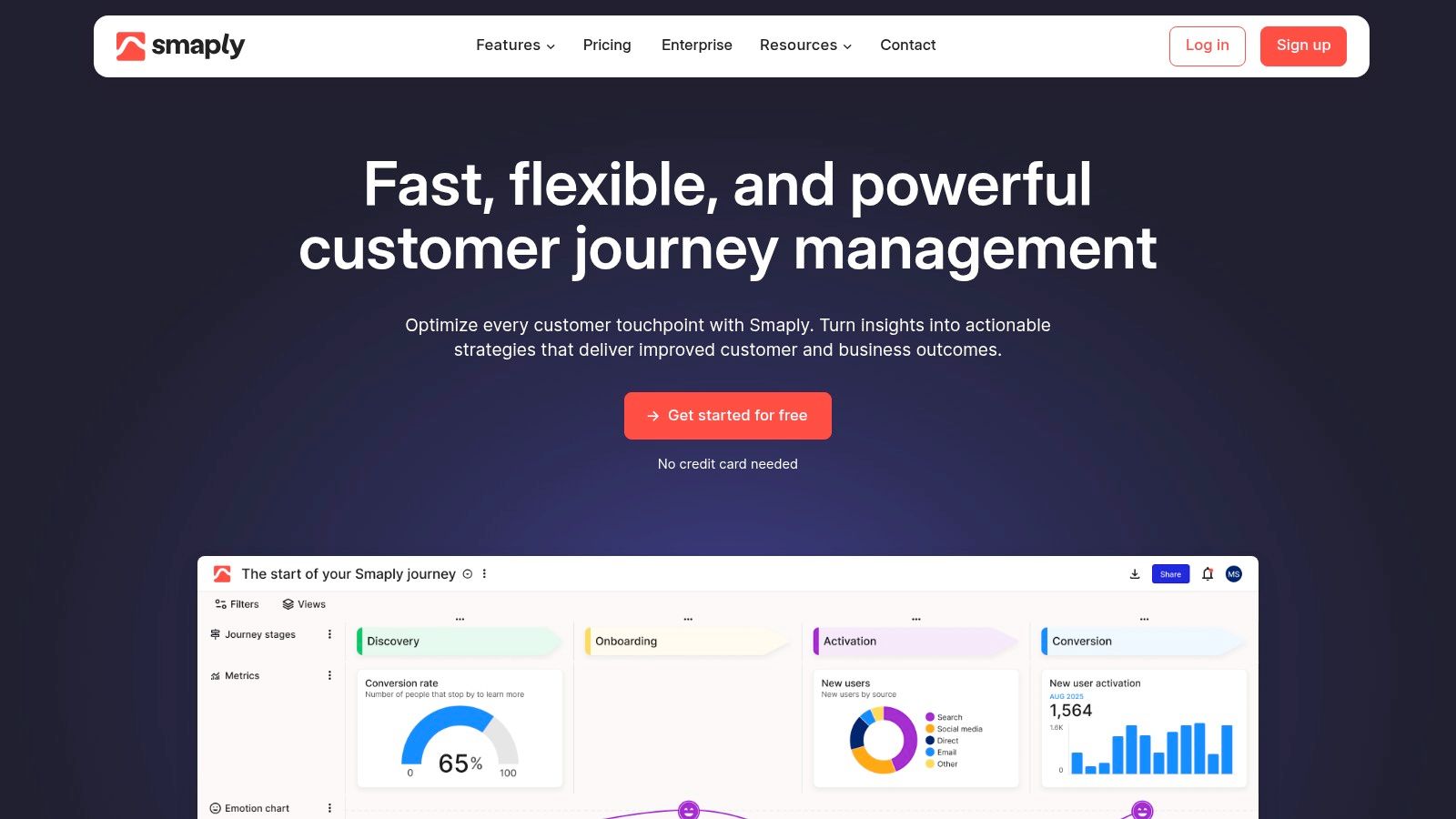
Smaply makes sense when stakeholder mapping is part of a broader CX or EX workflow. If your team already builds journey maps, personas, and service design artifacts, Smaply gives you stakeholder maps inside the same working environment.
That's its real advantage. It doesn't treat stakeholders as isolated names on a chart. It ties them back to journeys, governance, and repository level work.
Best use case
For customer experience teams, service designers, and product groups, Smaply is more practical than a sales specific mapping platform. You can create stakeholder maps alongside journey maps and personas, then share views and exports with teams that don't need full platform access.
The trade-off is specialization. If you need heavy political mapping, influence analysis across a buying committee, or live account intelligence, Smaply isn't the sharpest tool on this list. It's broader, and that's both its value and its limit.
Use Smaply when the question is “how do these stakeholders experience the process?” Use a sales or enterprise engagement tool when the question is “who can block or accelerate this deal?”
What to watch for
- Good fit: CX, EX, and service design teams that want stakeholder maps connected to journey management.
- Less ideal: Sales teams managing executive sponsors and buying committees.
- Practical upside: Good support, governance options, and enterprise security for larger programs.
Smaply is a strong operational choice for journey focused organizations. It's not trying to win the account planning category, and that's fine.
Find it at Smaply.

“The Business Development team gets 80 to 90 percent of what they need in 15 minutes. That is a complete shift in how our reps work.”
Andrew Giordano
VP of Global Commercial Operations, Analytic Partners
5. Borealis Stakeholder Engagement
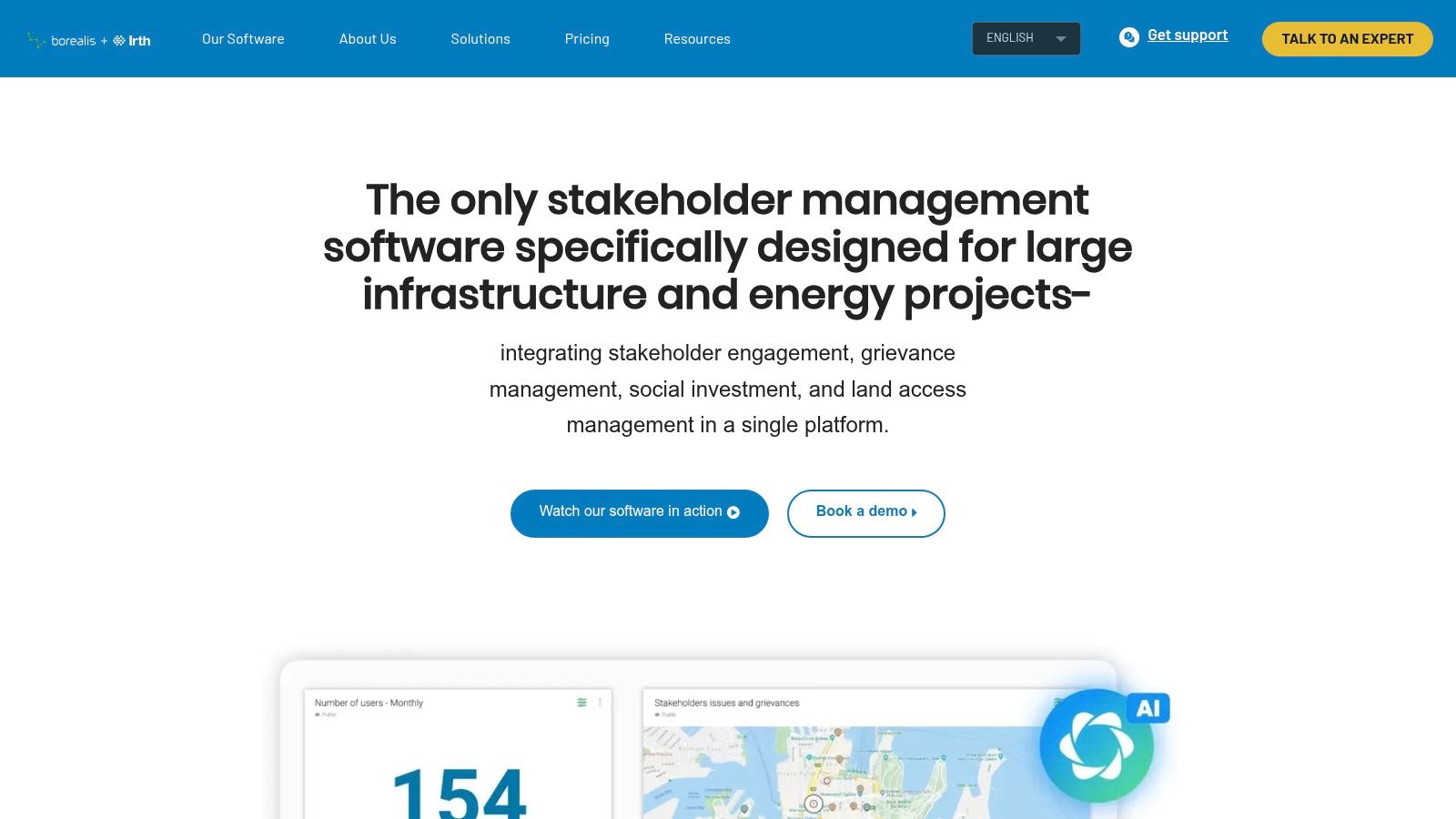
Borealis is built for environments where stakeholder management carries operational, regulatory, and reputational weight. Think energy, utilities, infrastructure, public sector, and other settings where one missed community issue can create real consequences.
This is not lightweight mapping software. It's an enterprise stakeholder relationship management platform with a centralized registry, influence mapping, dashboards, engagement logs, grievance tracking, commitment tracking, and reporting.
Why enterprise teams choose it
Borealis is useful when you need a single system to track who matters, what happened, what was promised, and what still needs follow through. Spreadsheet sprawl is the enemy in these environments, and Borealis is designed to replace it.
Its relevance to this list is the move from static mapping to dynamic triage. Borealis has pointed out a gap in mainstream stakeholder mapping guidance. Many guides still focus on static power interest views, while fast changing environments need continuous re scoring of attitude and impact so teams can spot shifts without manual re checking (Borealis on stakeholder mapping).
That matters in enterprise sales too. The software category is different, but the operating lesson is the same. A map that can't absorb change becomes a liability.
Practical fit
- Best for: Large stakeholder programs in regulated or impact heavy industries.
- Not ideal for: A mid market sales team that mainly needs buying committee visibility.
- Reality check: Implementation takes effort. This is a platform rollout, not a quick install.
If you're evaluating platforms that sit between stakeholder management and account intelligence, it also helps to understand the broader stack. Salesmotion's guide to best account research software is useful if your team is comparing program management against selling intelligence.
Visit Borealis.
6. Simply Stakeholders
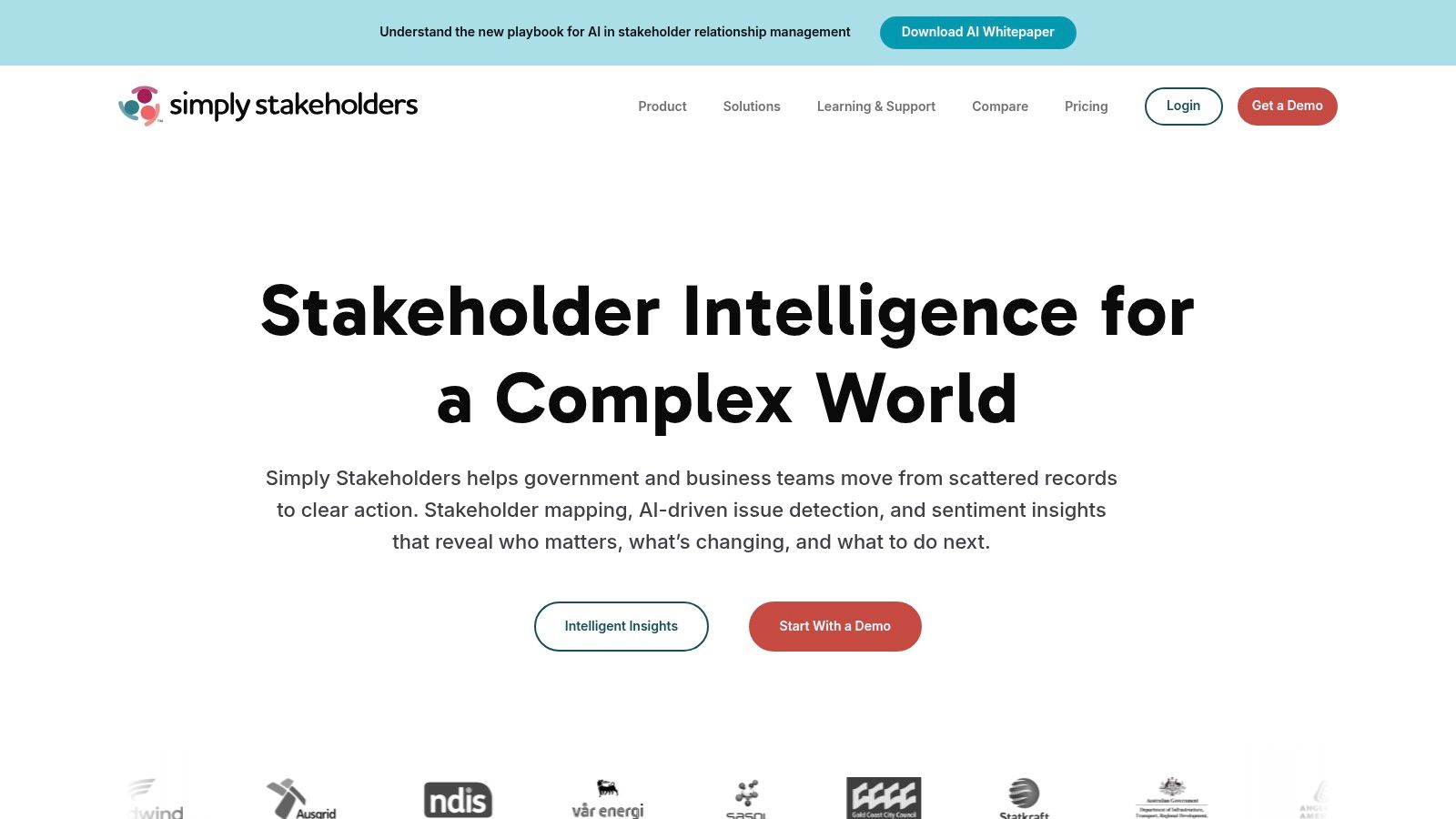
Simply Stakeholders is one of the better choices when a plain power interest matrix feels too blunt. It supports multidimensional stakeholder mapping, relationship network views, sentiment and issue analysis, communications, and GIS based geographic mapping.
That makes it useful for corporate affairs, community engagement, public sector programs, and any team dealing with stakeholder groups that can't be reduced to a simple quadrant.
The practical edge
One of the strongest arguments for Simply Stakeholders is methodological. The company says a delegated six attribute model covering Criticality, Position, Effort, Interest, Impact, and Influence can identify key stakeholder groups with 40% higher accuracy than traditional power interest grids, and reduce manual account planning time by about 2.5 hours per large account (Simply Stakeholders on stakeholder mapping).
Even if you don't adopt that model exactly, the point is sound. Complex stakeholder environments usually need more than two dimensions. That's especially true when sentiment and effort level affect the outcome as much as formal authority.
The GIS capability is another differentiator. If your team needs to understand impact zones, local sentiment, or regional risk, spatial context matters.
Where it fits and where it doesn't
- Strong fit: Corporate affairs, policy, public engagement, and field heavy programs.
- Less strong: Sales teams that need native CRM workflows and rep friendly execution.
- Big plus: It combines register, mapping, engagement, and reporting in one platform.
If you're trying to make account planning more rigorous, not just prettier, the thinking behind Simply Stakeholders aligns well with structured account planning for sales.
You can explore it at Simply Stakeholders.
7. Revegy
Revegy is built for enterprise sales teams that want relationship maps inside a broader account planning discipline. That's why it lands in a different tier from generic diagramming tools. You're not just mapping people. You're tying relationships to strategy, opportunity coverage, and account health over time.
Its Relationship Maps are part of a wider planning system that includes strategy maps, governance, and rollups across opportunities. For large pursuits, that matters.
Why sales leaders like it
Revegy works best when an organization already believes in structured account planning. If your leadership team wants inspectable plans, visible relationship coverage, and a method for strategic deal reviews, Revegy is a good fit.
It also supports time series tracking, which is more important than many teams realize. A living map is far more useful than a polished snapshot because stakeholder positions change. That lines up with broader guidance that stakeholder maps should be treated as evolving artifacts and reviewed at least every month to stay relevant (LogRocket on stakeholder mapping templates and examples).
Good account teams don't ask, “Who's on the map?” They ask, “What changed since last month?”
Trade-offs
- Best part: Strong account planning methodology tied directly to mapping.
- Hard part: Rollout and training take commitment.
- Commercial reality: Pricing is quote based and aimed at larger organizations.
Revegy is a serious sales execution platform for complex account environments. If your team just wants a quick visual of reporting lines, it's overkill. If you need governance around large, multi stakeholder pursuits, it earns the complexity.
Learn more at Revegy.
8. Upland Altify
Altify's biggest selling point is simple. It lives inside Salesforce. For many enterprise sales teams, that's the difference between a tool that gets used and a tool that becomes shelfware.
Its Relationship Map, Insight Map, and Opportunity Map let teams visualize decision makers, influence paths, and strategy without leaving the CRM. If your sellers already work in Salesforce and your managers inspect in Salesforce, that matters more than an extra visual feature.
When Altify is the right call
Altify is strong for teams running complex deals with a formal account planning motion. The native setup cuts down on context switching and helps keep maps connected to the actual pipeline record.
It's also a practical answer for companies that don't want stakeholder data scattered across slide decks, whiteboards, and separate planning tools. When relationship maps sit in the CRM, they're easier to review in deal inspection, forecast calls, and executive account reviews.
The trade-off is dependency. If Salesforce adoption is weak, Altify won't fix that by itself. It amplifies good CRM habits. It doesn't create them.
Quick take
- Best for: Salesforce centric enterprise teams.
- Main value: Relationship mapping tied to account planning inside the CRM.
- Main caution: Enterprise pricing and process maturity are usually part of the package.
Altify is less flashy than some standalone mapping tools, but for operational consistency, that's often a strength.
See Upland Altify.
9. PROLIFIQ Relationship Map and PROLIFIQ CRUSH
PROLIFIQ takes a focused approach. Relationship Map helps teams visualize buying committees and influence lines in Salesforce. CRUSH adds a fuller account planning layer with white space analysis, templates, and alignment to core Salesforce objects.
That combination makes sense for teams that want specialized stakeholder mapping tools without buying a giant planning suite.
What makes it useful
The value here is speed and fit. If Salesforce is your source of truth, PROLIFIQ keeps relationship mapping close to where reps already manage opportunities and tasks. That lowers friction.
It's also more purpose built than generic diagramming tools. Reps can work with org charts, influence relationships, and account context without moving into a design environment that was never meant for sales execution.
There are still limits. Published list pricing appears inconsistent across outside sites, so buyers should confirm details directly. And if your company isn't centered on Salesforce, the appeal drops quickly.
Good fit by team type
- Strong fit: Salesforce driven sales teams that want focused relationship and account mapping.
- Less strong: Cross CRM environments or teams needing broader enterprise stakeholder governance.
- Nice bonus: It avoids adding yet another separate interface for sellers.
If you're an agency or consulting business building services around CRM workflows, there's a related angle in grow your agency with white label CRM.
Explore PROLIFIQ.
10. OrgChartHub
OrgChartHub is the practical choice for HubSpot teams that need buying committee visibility without enterprise software overhead. It connects directly to HubSpot and lets reps build org charts per account, tag buying roles, and capture influence context inside familiar workflows.
That focus is important. A lot of SMB and mid market teams don't need an enterprise stakeholder platform. They need to know who reports to whom, who matters in the decision, and where they have coverage gaps.
Why it's a smart niche tool
OrgChartHub does one job clearly. It puts org and buying committee maps into HubSpot records and workflows so reps don't have to maintain separate diagrams elsewhere.
For HubSpot teams, that's enough. The lower friction matters more than having a long list of advanced stakeholder analysis features nobody will use. If your sales motion is straightforward but still multi threaded, OrgChartHub gives structure without slowing the team down.
The limitation is equally clear. It's HubSpot focused and mostly oriented around org and buying committee maps, not broader stakeholder program management or multidimensional public affairs work.
Simple is good when your team will actually maintain the map.
Best fit
- Best for: HubSpot based SMB and mid market sales teams.
- Not for: Enterprise stakeholder programs or cross CRM operations.
- Operational upside: Easy fit with the HubSpot ecosystem.
You can check it out at OrgChartHub.
Top 10 Stakeholder Mapping Tools Comparison
| Product | Core features | Key outcomes / USP | Best for | Pricing model |
|---|---|---|---|---|
| Salesmotion (Recommended) | 3 autonomous AI agents (Research, Signal, Outreach); 24/7 monitoring of 1,000+ public sources; source‑linked account briefs; CRM & engagement integrations; ready‑to‑send outreach | Turns real signals into prioritized, evidence‑anchored outreach; fast time‑to‑value; customers report ↑ meetings & pipeline | Revenue teams, SDRs/AEs, RevOps at SMB → Enterprise focused on pipeline growth | $85/mo for individuals. Custom pricing for teams & enterprise. |
| Kumu | Interactive stakeholder/network maps; styling, filters, clustering; embeddable maps | Living, explorable ecosystem visuals for stakeholder intelligence | Researchers, program designers, teams needing visual networks | Free public projects; paid private/pro workspaces |
| Polinode | ONA toolkit: survey/passive data imports, 30+ metrics, templated views; large‑scale networks; security/compliance | Deep network analysis to uncover influencers and information flow | Org design, consultants, large enterprises doing ONA | Tiered, quote‑based |
| Smaply | Journey maps + stakeholder maps, personas, repository, AI‑assisted creation; exports & governance | Integrates journey mapping with stakeholder governance for CX/EX programs | Service design, CX/EX teams needing end‑to‑end journey + stakeholder work | Subscription tiers; viewer limits on entry plans |
| Borealis Stakeholder Engagement | Central stakeholder registry, engagement logging, grievance/commitment tracking, dashboards, AI insights | Compliance‑grade stakeholder relationship management and reporting | Regulated industries (energy, utilities, infrastructure, public sector) | Enterprise, quote‑only |
| Simply Stakeholders | Multidimensional mapping (influence/impact), relationship health scores, email/SMS surveys, GIS mapping | Single source of truth for register, mapping, engagement and reporting | Corporate affairs, public sector, community engagement teams | Quote/plan scoping required |
| Revegy | Relationship & strategy maps, account health, time‑series tracking, AI news/updates | Integrated account planning + mapping for complex, multi‑stakeholder pursuits | Enterprise sales teams managing strategic accounts | Quote‑only (enterprise) |
| Upland Altify (Relationship Map) | Salesforce‑native Relationship/Insight/Opportunity maps; influence indicators; dynamic maps in CRM | Operationalize account strategy inside Salesforce; reduces context switching | Salesforce‑centric enterprise sales teams | Enterprise pricing, sales‑led |
| PROLIFIQ Relationship Map / CRUSH | Salesforce apps: interactive org charts, influence mapping, account plan templates, dashboards | Fast adoption for Salesforce teams; maps tied to opportunities and tasks | Salesforce users who want in‑CRM mapping & planning | Vendor pricing varies; confirm with vendor |
| OrgChartHub (for HubSpot CRM) | HubSpot‑connected org charts, buying‑role tagging, integrates maps into HubSpot records & workflows | Simple org/buying‑committee visibility embedded in HubSpot | SMB & mid‑market sales teams using HubSpot | HubSpot App Marketplace listing; pricing varies |
Your Map Is the Starting Line, Not the Finish
A stakeholder map gives your team an advantage. It replaces vague opinions with a visible strategy. You stop guessing who matters, who's blocking progress, and where your coverage is weak.
But the map itself isn't the win. The win comes from what the team does next.
That's the mistake I see most often. Teams build a polished stakeholder map during planning, present it once, and then let it age unattended while the account moves on without them. New leaders show up. Champions lose influence. Budget owners shift. Priorities change. The map stays frozen, and the deal gets harder to read.
That's why the best approach is a combination of static structure and dynamic signal intelligence. Use a formal mapping method to identify stakeholders, score influence and interest, and document why each person sits where they do. Then add a live layer that catches what the map can't predict on its own. Executive moves, hiring shifts, new initiatives, public statements, internal ownership changes. Those signals tell you when to revisit the map and change the engagement plan.
For sales teams, that usually means using two layers together:
- Static mapping layer: Relationship maps, power and interest models, buying committee views, and account plans.
- Dynamic intelligence layer: Real time signals, account research, stakeholder changes, and recommended actions.
If you're in enterprise sales, Salesmotion, Revegy, Altify, PROLIFIQ, and OrgChartHub all play in that broader operating model, but they solve different parts of it. Salesmotion is strongest when live signals and outreach are the bottleneck. Revegy and Altify are strong when formal account planning and governance matter most. PROLIFIQ and OrgChartHub are efficient when you want CRM native execution without extra sprawl.
If you're in CX or service design, Smaply is more natural because it ties stakeholders to journeys and governance. If you're in public affairs, infrastructure, or community heavy programs, Borealis and Simply Stakeholders are better aligned with sentiment, compliance, and engagement tracking. If the core problem is network complexity itself, Kumu and Polinode give you deeper ways to model relationships.
The main point is simple. Pick the tool that matches the job. Don't force a sales tool into a public engagement program. Don't force a community platform into a deal inspection workflow. And don't confuse a static picture with an operating system.
The best teams keep the map alive. They review it on a schedule. They update it when signals change. They use it in planning, reporting, and live account decisions. That's when stakeholder mapping tools stop being presentation assets and start becoming revenue assets.
If your team needs more than a static map, Salesmotion is the tool to look at first. It helps revenue teams track account changes, surface stakeholder shifts, build source linked research, and turn live signals into timely outreach without heavy setup. For complex deals where the org chart changes faster than your playbook, that's a serious advantage.