An outreach strategy is the system that decides when, why, to whom, and in what coordinated motion your team's messages go out. For teams planning next year, that means turning live business signals into a relevant reason to talk while the reason is still fresh, not running a fixed email sequence.
TL;DR: A sequence is a delivery mechanism, not a strategy. A modern outreach strategy has four parts: audience intelligence, message relevance, signal-based timing, and multi-channel orchestration. Define your ICP, map each signal to a reason to engage, build the cadence around relevance, and measure pipeline contribution, not only replies.
Most advice on outreach is behind the market.
It still treats outreach as a fixed sequence. Build a list, write a template, send five emails, hope for replies. That model ignores the part that decides whether your message lands or gets ignored. Timing.
A strong answer to what is an outreach strategy starts there, with timing. Outreach is no longer just planned communication. It's a system for turning live business context into a relevant reason to talk, while that reason is still fresh.
Your Old Outreach Strategy Is Already Outdated
Outreach is often still managed like a calendar task. A rep researches an account, drafts a note, checks LinkedIn, maybe scans a press release, then sends a message later that day or later that week. On paper, that sounds responsible. In practice, it creates delay between the moment something changes at the account and the moment your team responds.
That delay is where old outreach strategies break.
The biggest issue is signal-to-action latency. Many guides define outreach as a linear communication plan, but they miss the timing gap between a real buying trigger and the first personalized touch. That gap matters: an outreach that lands a week after the trigger reads as generic, because by then it is.
A rep sees a new CRO hire on Monday. Another account announces expansion plans on Tuesday. A competitor shows up in an earnings call on Wednesday. If your team reaches out after the account has already moved on to implementation, budgeting, or vendor discussions, your message may still be well written, but it's late.
The old model confuses activity with strategy
A sequence is not a strategy by itself. A sequence is just a delivery mechanism.
An actual strategy answers harder questions:
- Why this account now instead of next quarter
- Why this stakeholder instead of the broad team alias
- Why this message instead of the default template
- Why this channel mix based on the buyer's context
Traditional outreach fails less because reps don't work hard, and more because they work too late.
That's why teams need to rethink the common playbook you see in generic outreach best practices. The problem isn't only message quality. It's the lag between market movement and sales action.
Manual research is now a real tax
When reps manually stitch together context from LinkedIn, job boards, press releases, earnings commentary, podcasts, and company sites, they lose hours that should go into live selling conversations. That work also creates inconsistency. One rep catches the signal. Another misses it. A third sees it but can't translate it into a compelling point of view.
That's why old outreach underperforms even when the team is disciplined. The process is too slow, too manual, and too dependent on individual rep effort.
Modern outreach starts when you close that timing gap.
What a Modern Outreach Strategy Really Is
A modern outreach strategy is not a message sequence. It's an intelligent system that converts market signals into timely conversations with the right people.
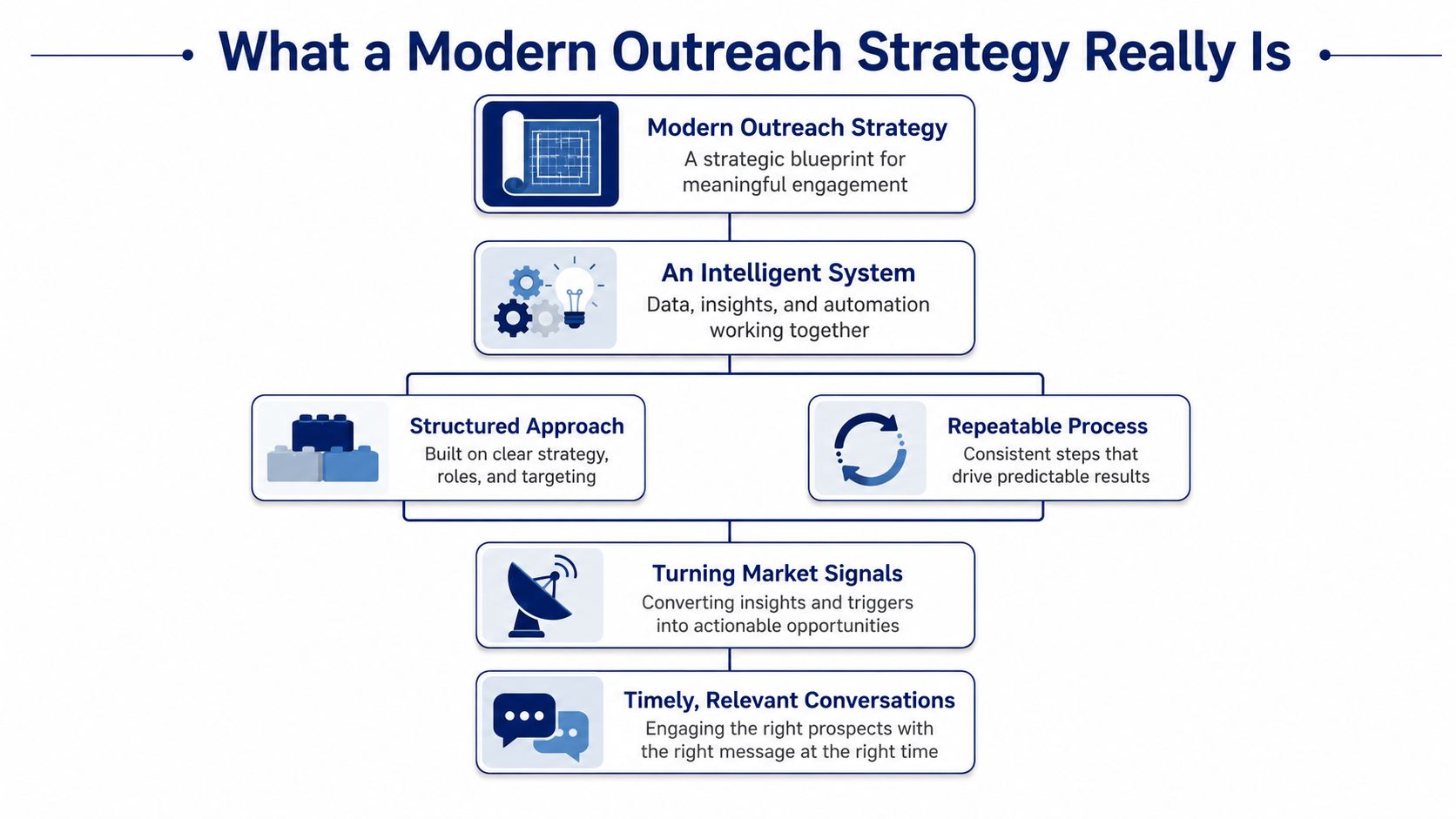
If you still define outreach as “email plus follow-ups,” you're managing tactics, not building a pipeline engine. The modern version has four working parts that depend on each other.
Audience intelligence
Start with a sharp view of who should hear from you and why. That means more than industry and headcount. It means understanding operating priorities, likely pressure points, buying roles, and what usually creates urgency inside those accounts.
A team selling into growth-stage SaaS companies, for example, shouldn't treat “VP Sales” as the whole audience definition. The relevant audience may shift depending on the signal. A hiring surge might point to RevOps or enablement. A European expansion might point to regional leadership or compliance stakeholders.
Message relevance
The message has to sound like it came from someone who understands what changed. Not someone who imported first name, company name, and job title into a sequence tool.
Here's the practical trade-off. Generic templates are easier to scale. Relevant messages are harder to ignore. That's why modern teams anchor outreach to a clear event, a visible initiative, or a stated business problem.
Signal-based timing
This is the shift. The strongest outreach answers “why now?” before it answers “who are we?”
If an account just announced a strategic move, your note should connect your point of view to that move. If nothing has changed, your outreach needs another source of relevance. Without timing, even decent personalization feels random.
Multi-channel orchestration
Buyers don't respond because you picked the magical channel. They respond when the message stays coherent across channels and arrives with enough persistence to break through.
Channel choice matters as much as persistence. In Salesmotion's own campaigns across 19,043 leads, LinkedIn messages to an existing network drew 11.3% human replies, cold LinkedIn connection requests 6.3%, and list-based cold email 0.3% (cold outreach data).
That changes the definition of strategy. Outreach is not “send an email and wait.” It's coordinated pressure applied with relevance.
| Pillar | What it means in practice | What goes wrong without it |
|---|---|---|
| Audience intelligence | Define who matters based on context | Reps target anyone with a title match |
| Message relevance | Tie outreach to a visible issue or event | Notes sound generic and self-focused |
| Signal-based timing | Reach out while urgency is still live | Team arrives after the moment passed |
| Multi-channel orchestration | Keep a consistent story across touchpoints | Each message feels disconnected |
Practical rule: If your sequence can be sent unchanged to fifty accounts, it probably isn't strategic enough.
Audience, relevance, timing, and channel behavior matter more than volume alone.
If you want a cleaner operational definition, this breakdown of what sales outreach means is useful. The important distinction is simple. Outreach tactics send messages. Outreach strategy decides when, why, to whom, and in what coordinated motion those messages should happen.

“Salesmotion is instrumental in helping me prioritize net-new accounts, understand their strategic initiatives, and cover more ground. With a lot of green-field accounts, I'm heavily leaning on the AI insights to tier my accounts and focus my time. The platform is incredibly intuitive and easy to use.”
Rob Webster
Enterprise Account Executive, Synthesia
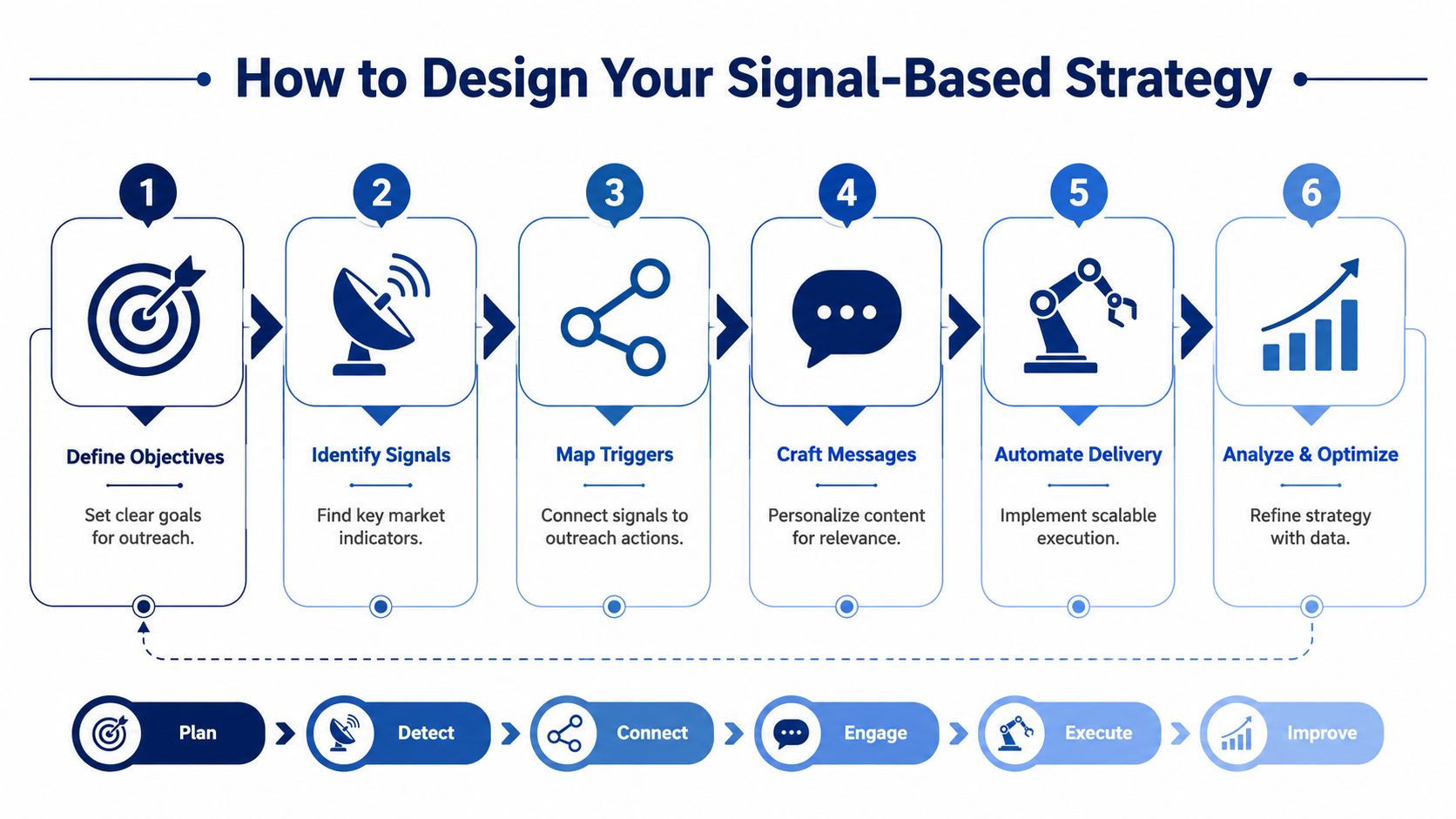
How to Design Your Signal-Based Strategy
Designing a signal-based strategy starts with discipline, not creativity. Often, teams jump to copywriting too early. They should begin with account selection, trigger mapping, and decision rules.
Start with ICP and segmentation
You can't build relevant outreach without a clear Ideal Customer Profile. Define the companies you can help best, then segment those leads by traits that affect buying behavior, such as company size, industry, pain points, and current initiatives. Atlassian's guidance on building a sales outreach strategy also recommends scoring leads on behavior, such as email opens, link clicks and form fills, alongside demographics.
That matters because not every signal means the same thing for every account. A funding announcement may be useful for one segment and irrelevant for another. A new executive hire might create urgency in one market but signal internal change management in another.
A practical setup usually includes:
- Core fit filters like industry, business model, and maturity
- Buying role mapping so you know who owns the problem
- Signal categories tied to your offer, such as hiring, expansion, executive changes, technology shifts, or investor activity
- Priority rules that separate live opportunities from background noise
If your team struggles with targeting, this guide on how to prioritize accounts for outreach is worth reviewing.
Map each signal to a reason to engage
A signal is only useful when the rep knows what to do with it.
For each trigger you track, define three things:
- What happened
- Why it matters to the account
- What conversation that should open
A new CRO hire is not just news. It often means pipeline inspection, process review, or territory change. An office expansion is not just a milestone. It may indicate hiring pressure, systems complexity, or regional go-to-market changes.
The best outreach messages don't just mention the signal. They explain why that signal changes the conversation.
That's where many teams fall short. They identify a trigger, then write a shallow opener like “Congrats on the funding.” That's not insight. It's acknowledgment.
Build the cadence around relevance, not habit
A modern cadence should reflect how buyers engage across channels. One useful reference is Prospeo's outreach framework, which lays out an 8-touch cadence over 12 days across email, social and phone.
The same guidance adds an operational rule that matters: kill underperforming channels fast. That forces teams to optimize components instead of protecting stale sequence steps.
A clean way to think about the cadence is this:
| Touch | Channel | Job to be done |
|---|---|---|
| First | Establish the signal and your point of view | |
| Second | Add context, not pressure | |
| Third | Increase familiarity and continuity | |
| Fourth | Phone | Test urgency and stakeholder fit |
| Fifth | Close with a clear reason to reply now |
Write messages that earn the next touch
Each touch should do one job. Don't cram everything into the opener. Your first note should connect the signal to a business issue. The next note can sharpen the consequence, offer a useful observation, or narrow the ask.
Keep the messages brief. Tight outreach respects the buyer's time and forces clarity on your side. If the team can't explain why the signal matters in a few sentences, they probably don't understand the account well enough yet.
Signal-Based Outreach Examples That Actually Work
Signal-based outreach works because it gives the buyer a reason to care now, not someday. That's the gap between generic prospecting and relevant prospecting.

Personalization only pays when it is specific. A first line that could go to any company in the segment reads as a template, however it was produced.
Example one, new CRO hire
Before
“Hi Sarah, I work with revenue teams to improve outbound performance. We help companies increase meetings and build more pipeline. Open to a quick chat next week?”
This message is clean, but it could go to anyone.
After
“Hi Sarah, I saw you recently stepped into the CRO role. New revenue leaders usually spend the first stretch looking at pipeline coverage, rep productivity, and where account research is slowing execution. If that's on your list, I can share how teams tighten the handoff from account signal to first outreach so reps spend less time stitching context and more time in live conversations.”
Why it works:
- It ties to an obvious transition in the business
- It references likely priorities without pretending to know internal details
- It offers a conversation, not a product pitch
Example two, Series C and European expansion
Before
“Congrats on the Series C. It looks like your company is growing fast. We help scaling companies improve sales efficiency. Interested in learning more?”
That's polite and forgettable.
After
“Congrats on the Series C and the push into Europe. Expansion usually creates pressure in two places at once. New market coverage and message consistency across regions. If your team is adding headcount while opening a new geography, it may help to tighten how reps prioritize accounts and tailor outreach when local momentum appears.”
Why it works:
- It connects the event to operating friction
- It introduces a specific commercial problem
- It sounds like a peer observation, not a campaign template
A signal becomes useful when you translate it into a consequence the buyer already feels.
Example three, competitor flagged on an earnings call
Before
“Hi James, we help companies improve competitive positioning and pipeline generation. Would you be open to a call?”
This is broad enough to vanish in the inbox.
After
“Hi James, I noticed your team called out competitive pressure in the latest earnings discussion. When that shows up publicly, sales teams usually get two immediate asks from leadership. Sharpen win themes and focus reps on accounts where the reason to engage is strongest. If helpful, I can show how teams turn those account-level signals into outreach that sounds current instead of generic.”
Why it works:
- It starts from language leadership already used
- It aligns to a known business pressure
- It gives the rep a credible reason to be in the conversation
A larger set of signal-based outreach examples can help reps train against real scenarios, but the principle stays the same. Mentioning a signal is not enough. You need to connect that signal to a business implication and then to a reason to talk.

“The Business Development team gets 80 to 90 percent of what they need in 15 minutes. That is a complete shift in how our reps work.”
Andrew Giordano
VP of Global Commercial Operations, Analytic Partners
Measuring Your Outreach Strategy for Pipeline Growth
A lot of outreach dashboards measure motion, not progress.
Open rates can tell you whether the subject line worked. Reply rates can tell you whether the message earned attention. Neither tells you by itself whether the team is creating real pipeline.
Track the four categories that matter
A better operating view is to track outreach across four categories:
- Inbox health so you can spot delivery issues before they distort performance
- Engagement to see whether messages get opens and replies
- Qualification to understand whether responses turn into real opportunities
- Conversion to measure whether outreach creates pipeline and meetings worth pursuing
Track open rates, human response rates, opportunity rates, and conversion rates together, and set targets from your own history rather than a published benchmark.
A target shouldn't become a vanity goal. It should become a diagnostic tool. If responses are high but opportunity creation is weak, the targeting may be too loose. If opportunities look solid but response is low, your message or timing probably needs work.
Add waste rate and cost per meeting
Revenue leaders also need metrics that expose inefficiency.
A useful one is waste rate, the share of outreach that gets ignored. High waste usually points to one of three problems: weak account selection, stale signals, or messaging that doesn't create urgency.
Another is cost per meeting. If your team spends heavily on tooling, list building, and rep time to generate meetings that don't convert, the outreach engine may look busy while ineffectively burning resources.
If you only track replies, you'll optimize for attention. If you track pipeline contribution, you'll optimize for revenue.
Use metrics to make replacement decisions
The practical question isn't “How did the sequence do?” It's “Which component deserves to stay?”
Measure by step, by signal type, and by segment. Some triggers create urgency. Others only create curiosity. Some message angles convert with operating leaders. Others land better with executives.
That's why good teams replace underperforming motions quickly. They don't defend them because they were hard to write.
How to Automate Your Strategy with AI Agents
Manual signal-based outreach sounds smart until you try to run it across hundreds of accounts.
Then the cracks show up. Reps miss triggers. Context gets stale. Research quality varies by person. Good account plans happen for a few high-value logos, while everyone else gets a generic sequence and a weak reason to engage.
The operational problem is consistency
A scalable outreach strategy needs the same four things every time:
- timely account intelligence
- clear signal detection
- message drafting tied to the signal
- delivery into the tools reps already use
Without automation, teams usually get one or two of those. Rarely all four at once.
A workable system covers prospecting, qualification, personalizable communication and follow-up cadence, with regular execution time and KPI tracking across reply rate, meeting rate and cost per meeting.
Where AI agents fit
AI agents become practical, not theoretical, at this stage. Tools like Clay, common sales engagement platforms, and signal monitoring workflows can help teams assemble parts of the process. One option built specifically around this workflow is Salesmotion.
Salesmotion uses three agents in sequence:
- Research Agent builds structured account briefs from public sources, including company updates, stakeholder changes, risks, and priorities.
- Signal Agent watches for triggers such as executive moves, funding, hiring, earnings commentary, and other account changes, then explains why each one matters.
- Outreach Agent turns that context into personalized email and LinkedIn drafts tied to the signal, ready for rep review.
The practical benefit isn't “AI writes emails.” Its core value is that the system shortens the time between account movement and rep action, while making account prep more consistent across the team.
Keep humans on judgment
Automation should remove manual research and message assembly. It shouldn't remove rep judgment.
Reps still need to decide whether a trigger is meaningful, whether the point of view is sharp enough, and whether the stakeholder is the right person to engage. The best setups use AI to produce context and first drafts, then let sellers refine tone, angle, and timing based on deal knowledge.
That's how you turn a strategy from a whiteboard idea into a repeatable operating system.
Conclusion Your Strategy Is a System Not a Sequence
An outreach strategy used to mean a list, a channel, and a schedule. That definition is too small for how buyers behave now.
The better answer to what is an outreach strategy is this. It's a system for detecting relevance, acting on timing, and turning live account changes into conversations that make sense to the buyer. The sequence still matters, but it sits downstream from the core work. Knowing who to contact, why now, and what business issue to connect to.
Teams that stay with the old model will keep sending polished messages that arrive late. Teams that build around signals, timing, and operational consistency will create more conversations that feel earned.
That's the shift. Less template volume. More timely relevance.
The question isn't whether your team has outreach. Every team does. The question is whether your outreach is built for the way accounts change, buyers evaluate, and revenue teams need to act.
If your team wants a practical way to turn account signals into ready-to-send outreach, Salesmotion is built for that workflow. It monitors target accounts, explains why a change matters, and helps reps move from research to action without the usual manual lag.