Most sales teams don't have an account prioritization problem. They have a discipline problem.
Reps say they're focused. Then you look at the actual account list and see a mix of big logos, old relationships, random inbound hand-raisers, and companies someone mentioned in a pipeline review. That isn't a strategy. It's a pile.
If you're serious about learning how to prioritize accounts for outreach, start with one rule: stop letting rep intuition decide where time goes. Intuition is useful in deals. It's terrible for building a repeatable account queue.
The fix is simple in principle and hard in execution. You move from gut feel to signal-driven prioritization. You define who matters, track what changed, score accounts consistently, then tell reps exactly which accounts deserve high-touch outreach now, which ones need nurturing, and which ones should stay in the background until something real happens.
TL;DR: To prioritize accounts for outreach, define your ICP and target account list, score every account on fit, buying signals and engagement, then sort the list into three tiers. Tier 1 accounts have both fit and current momentum and get personalized, trigger-based outreach now. Tier 2 gets nurture, Tier 3 gets monitoring. Review outcomes by tier and retune the model as you plan 2027 coverage.
Moving Beyond Gut-Feel Prioritization
A prospect once described their old process like this: reps were “randomly picking companies.”
That's more common than most leaders want to admit. Reps grab accounts because they know the brand, like the logo, worked a similar deal before, or think a large company must be worth the effort. None of that tells you whether the account is ready to buy.
What gut-feel looks like in the wild
You've seen these patterns:
- Big logo bias: A rep spends weeks chasing a well-known enterprise account with no visible change, no urgency, and no reason to respond now.
- Relationship bias: Someone had a conversation with a former champion two jobs ago, so the account stays on the hot list forever.
- List bias: Reps work from whatever list is easiest to access, not from a ranked view of who deserves attention.
The result is predictable. Good reps still create pipeline, but they do it inconsistently and expensively. Everyone else burns hours on accounts that look important but aren't active.
Practical rule: If a rep can't explain why an account deserves outreach now, that account isn't prioritized. It's just selected.
This is also where manual research breaks down. Leaders ask for “more strategic outreach,” but reps are expected to stitch together job changes, hiring trends, announcements, and engagement history by hand. That's slow, and it usually collapses into shallow account selection. If that sounds familiar, the hidden cost is laid out clearly in this piece on the cost of manual account research.
What changes when you use signals
Signal-driven prioritization forces a better question: why this account, why this contact, why now?
That's the operating shift. Not “is this company large enough?” Not “have we always wanted them?” Not “would it be cool to land this logo?” Those are vanity filters.
Real prioritization is built on evidence that something changed inside the account. A new executive arrives. Hiring spikes in a function your product supports. The business enters a new market. A strategic initiative appears in public. Multiple signals stack and create timing.
That's how you stop guessing.
The standard you should hold your team to
Every priority account should pass three tests:
| Test | What you're asking | Why it matters |
|---|---|---|
| Fit | Does this company match who you can actually help? | Bad-fit accounts waste cycles even when they show activity |
| Timing | Is there a credible reason they might act now? | Outreach without timing gets ignored |
| Evidence | Can the rep point to concrete signals, not opinions? | This creates consistency across the team |
If your team can't do that, they aren't prioritizing accounts. They're browsing.
See Salesmotion in action
Take a self-guided interactive tour — no signup required.
Define Your Ideal Customer and Target Accounts
Before you score anything, get clear on who belongs in the pool.
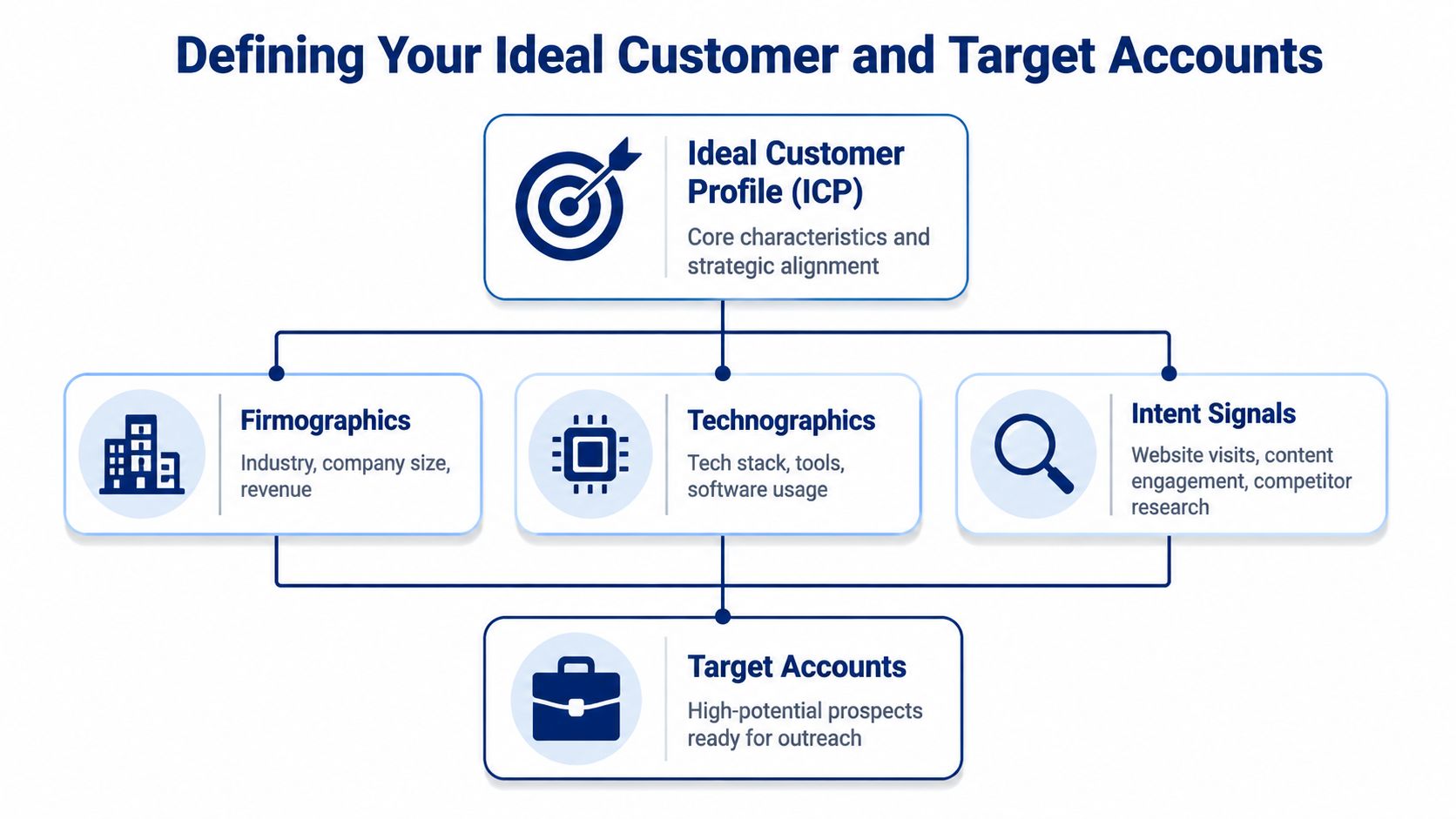
Most ICP work is too shallow. Teams stop at industry, company size, and a rough revenue band, then call it done. That gives you a broad market list, not a target account strategy. A usable ICP needs to tell reps who is worth attention before signals even enter the picture.
Build an ICP that sales can actually use
A strong ICP has layers. Start with the basics, then add context that explains strategic fit.
- Firmographics: Industry, company size, business model, geographic footprint.
- Technographics: Tools they already use, systems they may need to replace, technical environment.
- Strategic context: Growth motion, hiring posture, expansion plans, organizational complexity.
- Pain patterns: The problems your team sees repeatedly in closed-won accounts.
If you need a practical structure, use an ideal customer profile template that forces the team to define more than surface-level traits.
Use your existing customers as the starting point
A clean way to identify core target accounts is to look at your own book of business first. Demandbase recommends identifying the top 25% of accounts by revenue contribution and using the smallest account in that group as the cut-off for key-account status, with monthly updates and a quarterly review as conditions change (Demandbase on account prioritization).
That advice matters because it keeps leadership honest. Instead of arguing abstractly about “strategic accounts,” you start with accounts already proving value and build outward from there.
The best target account list usually starts with evidence from your current customers, not a fantasy list from the boardroom.
Turn ICP into a target account list
Your target account list should include three kinds of companies:
-
Current lookalikes
Accounts that resemble your strongest customers in structure, operating model, and likely need. -
Strategic fits
Companies that may not look identical on paper but face the same business problem your product solves. -
Emerging fits
Accounts moving toward your ICP because of growth, leadership change, product expansion, or market shift.
The point isn't to create a giant list. It's to create a defensible pool that reps can prioritize from.
What to exclude early
This part matters just as much as inclusion. Remove accounts that are famous, large, or personally interesting but consistently sit outside your fit criteria. That discipline protects reps from chasing prestige instead of pipeline.
Use this quick filter:
- Low fit, high curiosity: Don't prioritize.
- High fit, unclear timing: Keep in the list, but don't overinvest yet.
- High fit, repeated strategic match: Keep close and monitor.
If your ICP is vague, everything looks like a potential opportunity. That's how bad account lists get built.

“There's been a big focus on hyper personalization and relevance in our outbounding efforts. Salesmotion has been a key partner in hitting our significantly increased meeting targets. What stands out is how simple it is. Reps can log in and get valuable account insights within 30 seconds to a minute.”
Joe DeFrance
VP of Sales, Incredible Health
Build Your Signal-Based Account Scoring Model
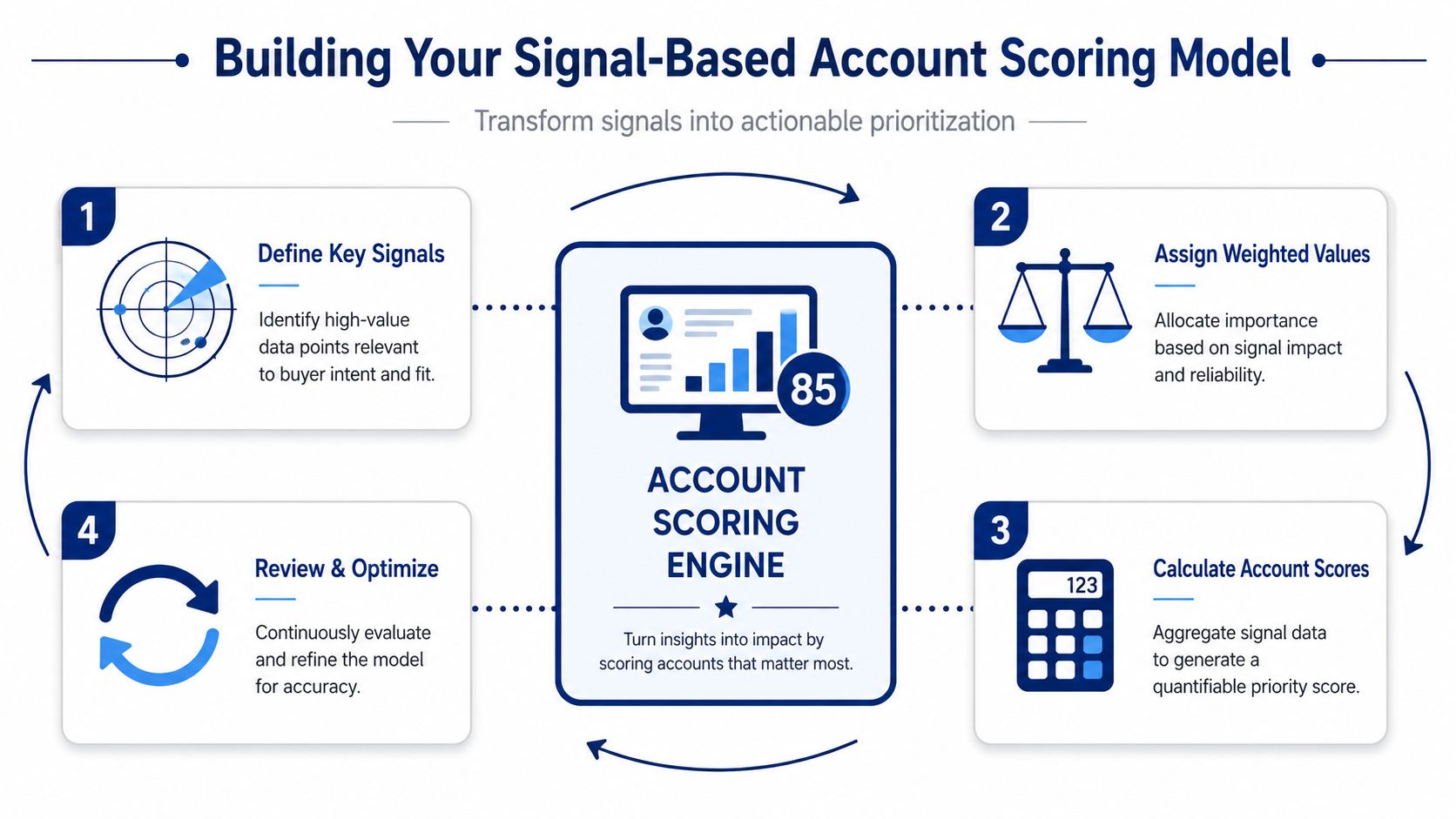
Once the target pool is clean, score it. When scoring, organizations frequently either overcomplicate the model or avoid building one entirely. Both are mistakes.
A scoring model doesn't need to be elegant. It needs to be usable. Reps should be able to look at an account score and understand what pushed it up or down.
Use three pillars and keep the weighting clear
A practical starting point is the weighted framework published by Salesmotion: 40% ICP fit, 35% buying signals, and 25% engagement, with Tier 1 capped at 15–25 accounts per rep and scores updated continuously as new signals fire (Salesmotion account prioritization framework).
That mix is right for a reason.
- ICP fit keeps the model grounded in who you should win.
- Buying signals identify timing and urgency.
- Engagement confirms that people inside the account are interacting.
If you overweight engagement, reps chase noise. If you overweight fit, they camp on static accounts. If you ignore signals, you miss timing.
For a more detailed breakdown of how to structure account-level logic, this account scoring guide is a useful operational reference.
Know which signals matter most
Not every signal deserves the same treatment. A single event can be interesting. Multiple related signals create conviction.
Here's the difference:
| Signal pattern | What it means | Priority implication |
|---|---|---|
| One isolated event | Something changed, but the reason to buy is still weak | Watch it |
| Two related signals | Momentum may be building | Investigate |
| Stacked signals across leadership, hiring, and strategy | Timing is much stronger | Move it up |
A company that hired a new CRO is worth noting. A company that hired a new CRO, expanded into a new market, and posted a wave of sales roles is different. That stack tells a story. New leader, new coverage need, active team build. That's not random activity. That's potential buying motion.
Use first-party and third-party evidence together
Good scoring models blend what the account does with you and what the account does in the market.
- First-party signals: Website visits, content consumption, reply behavior, meeting activity.
- Third-party signals: Hiring changes, leadership moves, public announcements, market expansion, procurement activity.
If you sell into public sector or regulated buying motions, external sources matter even more. A searchable government RFP database can help teams spot active buying programs that never show up in normal engagement data.
A rep should never have to choose between fit and timing. The scoring model should force both into the same view.
Make the score explainable
Many AI-driven models often fall short. A number by itself doesn't change behavior. Reps need the score and the reason.
Good scoring output should answer four questions fast:
- Why is this account ranked here?
- What changed recently?
- Which signal carries the most weight?
- What action should the rep take next?
If your model can't do that, reps won't trust it. And if they don't trust it, they'll go back to picking companies they already recognize.
One rep asked for the reason in almost the same words. An account executive at a software firm told us: "I literally want to have like a handful of accounts to go out every week. And I want reasoning why you need to go after these accounts." A short list with the why attached is the output to aim for, not a longer ranked spreadsheet.
Implement the Three-Tier Prioritization Framework
A score is only useful if it changes rep behavior. That's why you need tiers. Tiers turn abstract ranking into operating rules.
Use a simple three-tier model and enforce it hard.
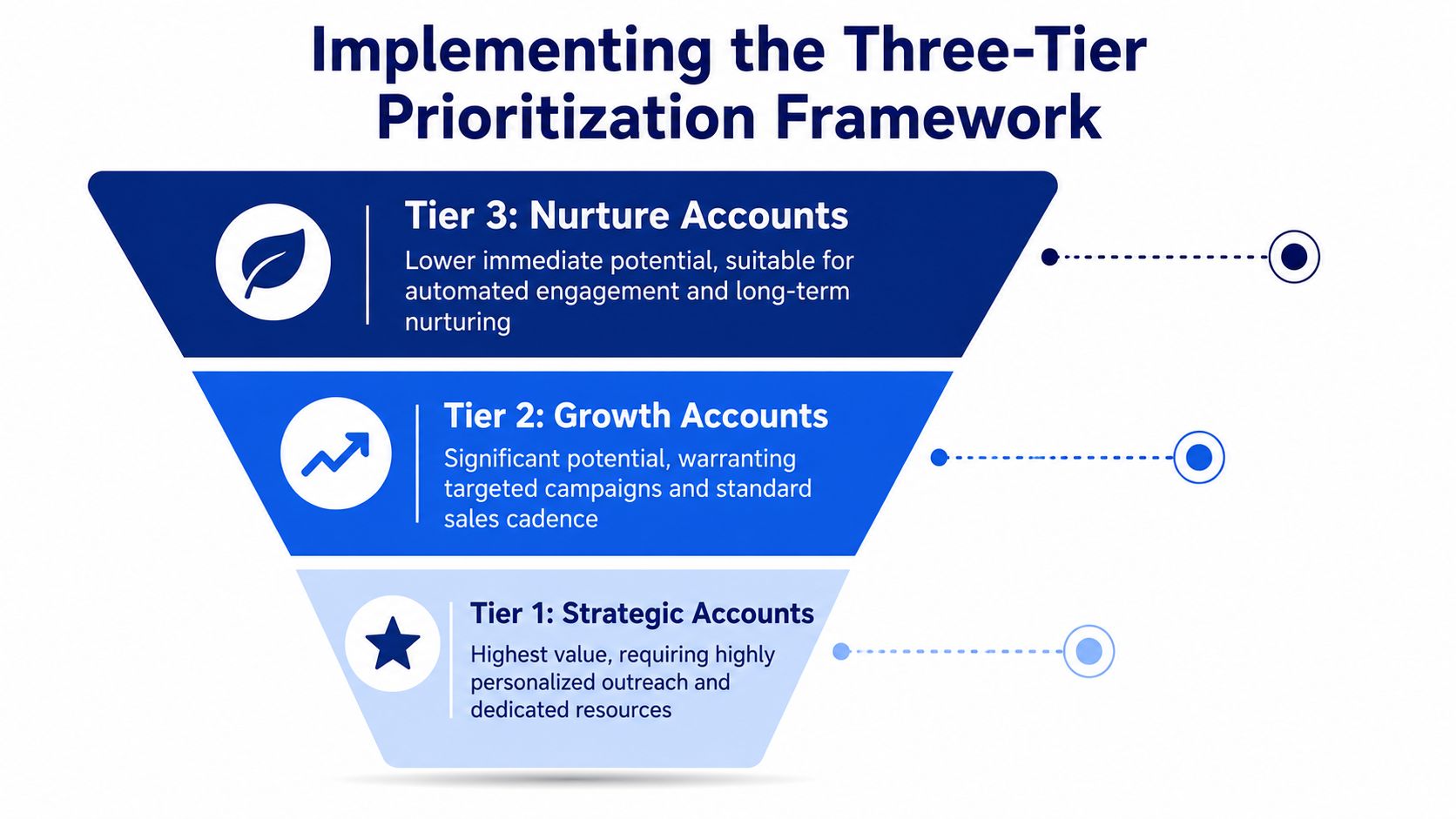
Tier 1 is for accounts with fit and current momentum
These are the accounts reps should work now. They match your ICP and show active signals that suggest a live business need.
Examples include accounts with leadership changes, strategic initiatives tied to your value, clear hiring patterns, or meaningful engagement from multiple people. These accounts deserve personalized outreach, coordinated touches, and real account planning.
Keep this tier tight. If everything is Tier 1, nothing is.
Tier 2 is for good-fit accounts without a strong why now
Many high-potential companies fit your ICP. They may be large. They may even be on every executive wishlist. But if they aren't showing credible timing signals, they should not absorb premium seller time.
This is the tier that protects you from overpursuing accounts just because they look impressive.
Big doesn't mean urgent. A Fortune 500 account with no buying signals is not a top-priority outreach target.
Tier 2 accounts stay in structured nurture and active monitoring. They're not ignored. They just haven't earned high-touch treatment yet.
Tier 3 is for monitoring only
These accounts are low fit, low signal, or both. Don't force activity here.
A lot of teams clutter the top of the funnel by pretending these accounts are “strategic long shots.” Most of them are distractions. Keep them visible. Watch for changes. Don't assign expensive human effort unless something materially shifts.
Let accounts move between tiers
This model only works if it's dynamic. Intentsify recommends validating signals against closed-won outcomes, applying signal decay, and tracking recency, frequency, and depth of engagement while combining first-party and third-party data and feeding closed-won and closed-lost outcomes back into thresholds (Intentsify on account prioritization).
That matters because stale activity shouldn't keep an account artificially hot. One contact clicking around your site last month is not the same as recent, repeated activity across a buying group.
Use these movement rules:
- Promote to Tier 1 when fit is strong and signals stack with recent activity.
- Drop to Tier 2 when the account still fits but urgency fades.
- Move to Tier 3 when fit weakens or signal activity goes cold for too long.
The big logo trap
This is the easiest mistake to fix and the one frequently repeated.
A famous company can still be a bad outreach priority. If it has no live trigger, no active engagement, and no credible initiative tied to your solution, it belongs below a lesser-known company that is clearly changing right now.
Leaders need to say that plainly. Otherwise reps hear “be strategic” and translate it into “work the biggest brands.”
What I tell sales leaders: I wish reps walked into meetings knowing their customers better, and went into the accounts where there is a need, instead of working a list alphabetically or by size.
That's how pipeline gets delayed.

“This is my singular place that very simply summarizes a company's top initiatives, strategies and connects them to my solution. Something I would spend hours researching manually, now it's automated.”
Derek Rosen
Director, Strategic Accounts, Guild Education
Activate Your Tiers with Tailored Outreach Plays
Prioritization without activation is theater.
If you rank accounts but don't change the way reps work them, you've built a dashboard, not a system. Each tier needs a distinct outreach play. Different timing, different message, different level of effort.
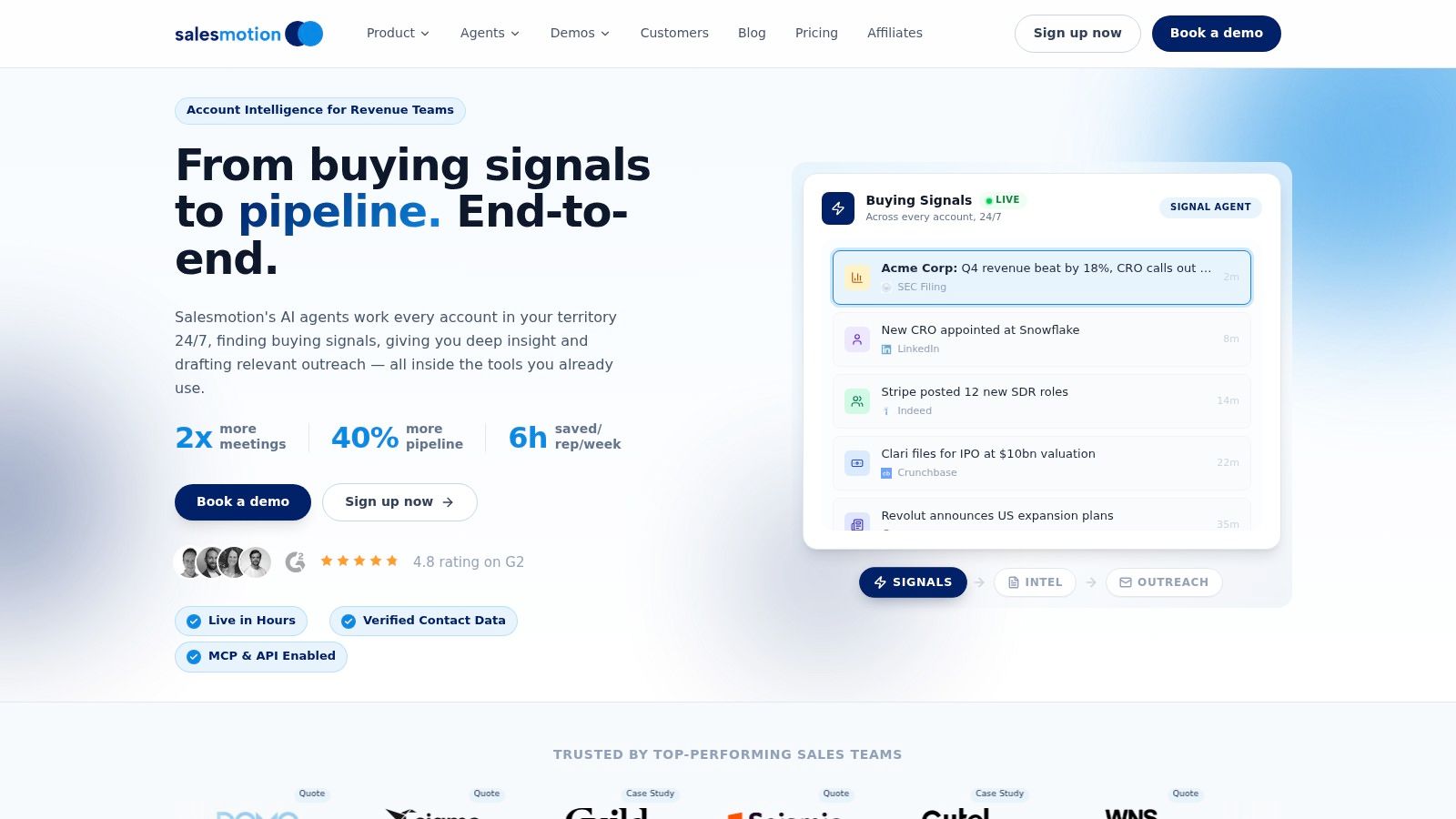
A modern workflow often needs tooling to make that practical at scale. For example, Salesmotion scores and prioritizes accounts based on real-time signals rather than static data, and its Research Agent, Signal Agent, and Outreach Agent are designed to monitor account changes and turn them into actionable outreach context.
Tier 1 outreach should be specific and fast
When an account earns Tier 1, the rep shouldn't send a generic sequence. The message should tie directly to the trigger.
If the company hired a new CRO, mention the leadership change and connect it to ramp, coverage, forecasting, or pipeline visibility. If they're expanding into a new market, speak to the operational pressure that comes with that move. If they're hiring heavily in sales, customer success, or operations, anchor the outreach there.
Use a simple pattern:
- Observation: What changed at the account
- Implication: Why that change matters operationally
- Point of view: What problem is likely emerging
- CTA: A relevant next conversation
Tier 2 outreach should create signals, not force meetings
Many teams often get impatient. They treat good-fit but low-signal accounts like delayed deals. That usually leads to generic outbound and low response.
Tier 2 needs thoughtful pressure, not volume. Use targeted content, light personalization, role-specific messaging, and periodic check-ins tied to what you know about the business. The goal is to surface a trigger or generate engagement that tells you the account is waking up.
A practical account-based outreach playbook can help teams align message, cadence, and account context without treating every account the same way.
Tier 3 should stay cheap and quiet
Tier 3 accounts do not need rep-heavy motion. Put them in low-touch nurture, monitor for meaningful changes, and leave them alone until the facts improve.
That protects rep capacity for accounts that can move.
Don't ask sellers to manufacture urgency where none exists. Ask them to respond when urgency appears.
Match effort to evidence
The operating rule is simple:
| Tier | Rep effort | Messaging style | Goal |
|---|---|---|---|
| Tier 1 | High touch | Trigger-based and personalized | Start a live conversation |
| Tier 2 | Moderate touch | Educate and test relevance | Generate a signal |
| Tier 3 | Low touch | Automated and broad | Monitor for change |
This is what separates prioritization from list management. The tier doesn't just label the account. It tells the rep how to behave.
Measure and Iterate Your Prioritization Engine
Your first scoring model won't be perfect. That's fine. It just can't be static.
The teams that get real value from account prioritization treat it like an operating system. They review what converted, what stalled, and which signals meant something. Then they adjust the model.
Track outcomes by tier and signal quality
Start with questions your revenue team can answer consistently:
- Which Tier 1 accounts created real opportunities?
- Which signals showed up most often in closed-won accounts?
- Which high-scoring accounts failed to progress?
- Where did reps spend time with no movement?
You don't need a complicated analytics stack to improve this. You need a regular review habit and clear ownership between sales, marketing, and RevOps.
Use win-loss feedback to tune the model
When a high-scoring account doesn't convert, don't shrug and move on. Ask what the model got wrong.
Maybe the signal looked strong but turned out to be irrelevant. Maybe one contact engaged but the broader buying group never formed. Maybe the account was a strong fit but had bad timing. Those distinctions matter because they tell you whether to change the weighting, the threshold, or the interpretation.
In this regard, explainability matters most. Salesforce's 2024 State of Sales report, as referenced by HockeyStack, notes that teams are increasing AI use for prioritization, but adoption is constrained by the need to trust the logic and understand why a score changed and what action it justifies (HockeyStack on account prioritization strategy).
If reps can't see why the score moved, they won't learn from it. They'll bypass it.
Balance near-term intent with long-term value
One more point. Don't let the model turn into a machine for only chasing accounts with the loudest current activity.
Some accounts deserve attention because they are strategic fits with clear future value, even if they aren't hot today. That doesn't make them Tier 1 now. It does mean leadership should keep them visible and resist overcorrecting toward only short-cycle activity.
Use the model to answer both questions:
- Who deserves outreach now?
- Who deserves monitoring because they could matter later?
That balance is what keeps the system from becoming shortsighted.
The best account prioritization engine doesn't just rank accounts. It teaches the team how to think.
If your team is still choosing accounts based on logo size, stale lists, or rep preference, it's time to tighten the system. Salesmotion helps revenue teams monitor target accounts, score real-time signals, and turn those signals into actionable outreach so reps know which accounts to work and why.