You know the scene. The meeting was supposed to be straightforward, the rep had the deck ready, the product story was tight, and everyone sounded confident in Slack an hour earlier. Then the call starts, the prospect drifts, the room asks for relevance, and the talking points that looked polished on paper suddenly feel like they belong to a different account.
That failure usually isn't about confidence. It's about signal. Most talking-point docs are built from feature lists, generic positioning, and hope, then they get pushed into live conversations where buyers only care about what's changing, why it matters now, and why this person is bringing it up. If your prep doesn't connect to a real trigger, it doesn't earn airtime.
The fix is to write talking points like a sales asset, not a writing exercise. That means anchoring every point to a verifiable account signal, a stakeholder priority, or a timely business change, then compressing it so a rep can deliver it cleanly under pressure. Done well, the document gives you a point of view the prospect hasn't already heard three times that week.
Why Most Talking Points Disappear the Moment You Hit Send
A rep once came to a pipeline review with a polished talking-points doc and a decent demo. The problem wasn't effort, it was gravity. The opener started with product language, the middle section wandered through unrelated features, and the ask softened into something nobody in the room felt compelled to answer.
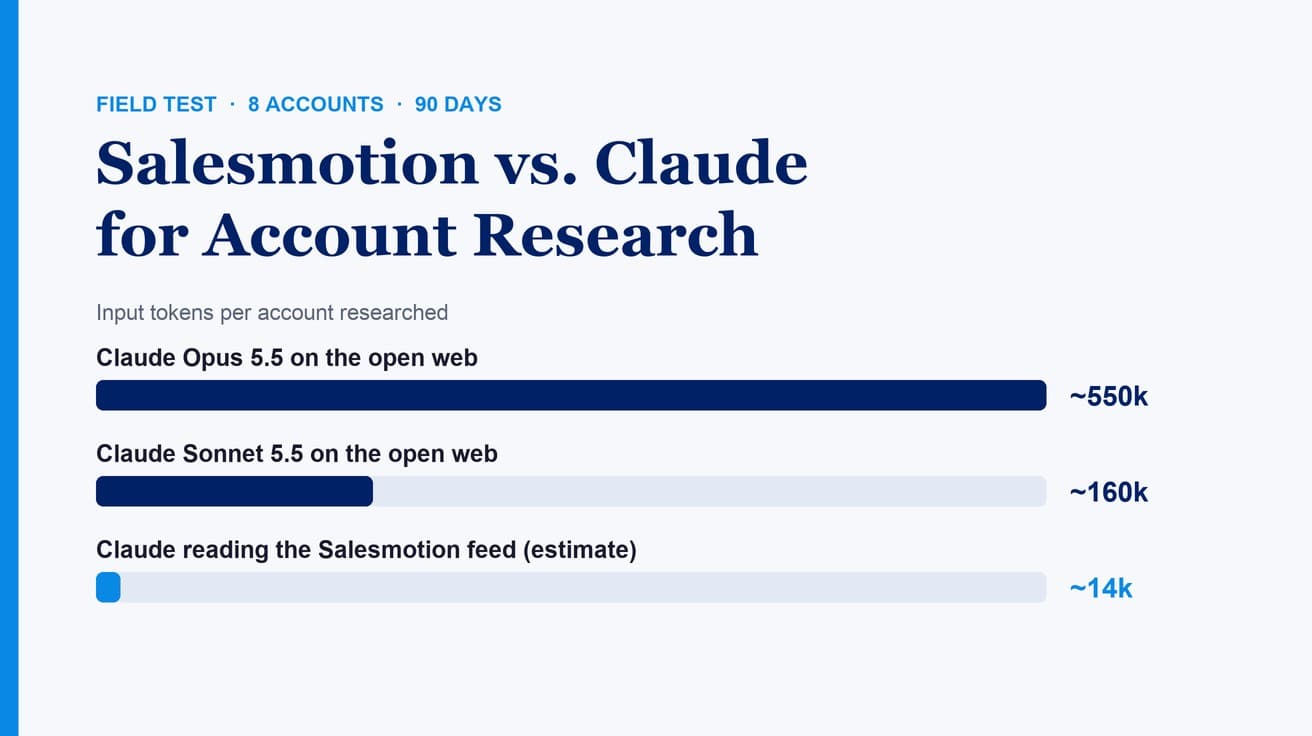
That kind of document dies fast because it doesn't answer the question in the room, why this now. If the rep has done the same account research that gets wasted in other workflows, the talking points end up sounding like a summary of the product instead of a point of view about the account. That's exactly the kind of time sink Salesmotion warns teams about in its analysis of how reps waste time on research.
What went wrong
The generic version usually has three problems. First, it leans on internal language that sounds safe but says nothing memorable. Second, it treats every prospect like a blank slate, even when the account has obvious movement. Third, it tries to cover too much, so the rep can't deliver it naturally.
Practical rule: If your first sentence could apply to ten other accounts, it's not a talking point yet.
The better version starts with a trigger, not a product. A new CRO, a funding event, an org change, a fresh hiring pattern, or a public priority shift gives the rep something concrete to say. That turns the conversation from “here's what we sell” into “here's what changed, and here's why we think it matters to you.”
The point is simple. Talking points are not a script. They're a compressed point of view that helps a seller stay relevant when the conversation gets messy, which is exactly when buyers decide whether to keep listening.
The Anatomy of Talking Points That Get Remembered
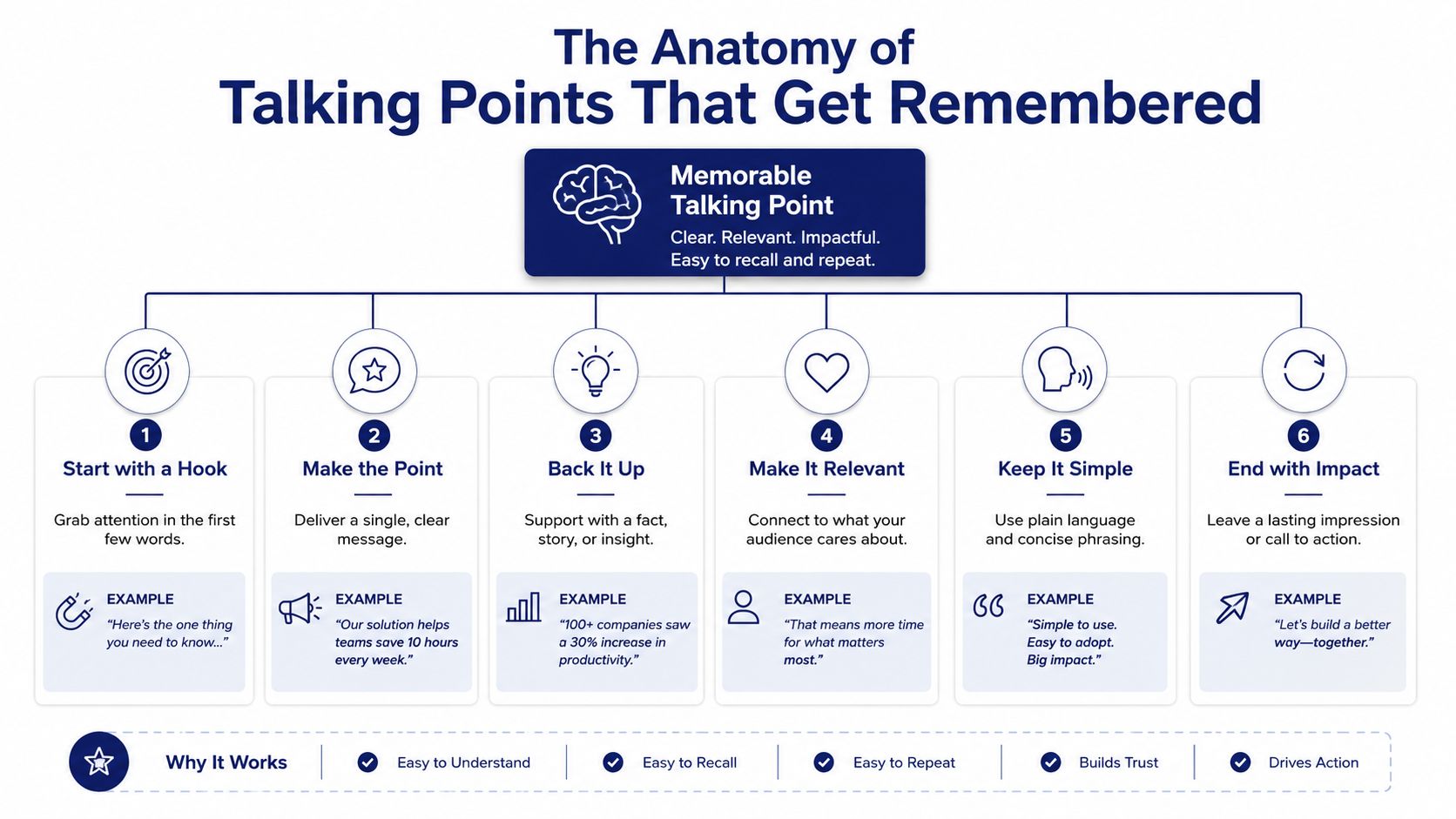
Strong talking points are short because live conversation is short. Keep to a handful of bullets, keep each bullet to a sentence, and put the one point the listener must remember first, because talking points are meant for delivery, not for reading like a memo. Listeners won't remember every word, so capture only the main point or points. If the message also needs to support a manager summary or exec readout, the same discipline applies in an executive summary for sales meetings, where every line has to earn its place quickly.
Build the shape before you write the sentences
The cleanest structure is one core message plus a small set of supporting points. That keeps the document usable in a boardroom, a pipeline review, or a cold outreach sequence without turning it into a script. A rep does not need six different angles unless the meeting itself needs that much surface area.
A bloated bullet sounds like this, “Our platform supports cross-functional alignment across stakeholder groups with flexible workflows and multiple integration options.” A usable version sounds like this, “The account has a new CRO, so the buying process is likely changing, and that creates a timely reason to talk now.”
The first one tries to sound thorough. The second one gives the speaker a line they can say out loud.
Working standard: one core message, 2 to 3 supporting points, and a first bullet that states the headline immediately.
That structure also helps managers coach faster. If a rep cannot explain the central point in one breath, the talking points probably need another round of editing. If they can, the rest of the bullets become support instead of clutter.

“Salesmotion empowers me to cultivate a great buyer experience. I'm able to challenge prospects' thinking and be a trusted consultative seller. A major part of this is Salesmotion insights.”
Austin Friesen
Account Executive, FY25 #1 President's Club, Clari
Building Talking Points From Real Account Signals
A good talking-point draft starts with a signal, not a template. The process is straightforward, but only if the account intelligence is already in front of you. Salesmotion's buying signals in B2B sales framing fits this reality well, because the hard part isn't writing polished language, it's identifying the reason the message should exist at all.
The fictional account here is easy to picture. A mid-market company just hired a new CRO and announced a Series C. That combination matters because it suggests new expectations, new urgency, and a leadership team that may be resetting priorities. The talking points should reflect that change directly.
Stage 1, capture the signal
Start with the event that changes the conversation. A new executive, a funding announcement, a hiring shift, a launch, or a public statement all give you something to anchor on. Don't pile on every news item you found, choose the one that best explains the moment.
Stage 2, frame the why now
Turn the signal into a business reason to talk. A new CRO usually means review cycles, new scorecards, and fresh scrutiny on the pipeline. You're not guessing at motive, you're connecting the visible change to a plausible sales implication.
Stage 3, draft the supporting points
Build three bullets that each answer a different question, what changed, why it matters, and what you want next. If you have access to account summaries, public updates, hiring signals, and stakeholder context, the draft gets faster because you're not starting from scratch. That's where tools that compress research, like Salesmotion's Research, Signal, and Prospector agents, matter operationally. They surface triggers, stakeholder priorities, and outreach context without making a rep stitch together notes for hours.
Stage 4, stress-test for delivery
Read it aloud. If the line sounds like internal jargon, cut it. If the bullet takes two breaths, split it or kill it. The final draft should sound like something a smart rep would say in a real meeting, not something they'd admire in a doc.
Before and After, Generic Versus Signal-Anchored Talking Points
| Element | Generic Talking Points | Signal-Anchored Talking Points |
|---|---|---|
| Opening | Starts with product capabilities and broad value statements | Opens with the account trigger, such as a new CRO or funding event |
| Main point | Tries to cover everything the platform can do | Focuses on one core message tied to the current account moment |
| Supporting detail | Uses feature-heavy bullets that sound interchangeable | Uses verifiable account facts and a clear business implication |
| Timing | Feels reusable, but not urgent | Explains why the conversation belongs in the room now |
| Close | Ends with a soft, vague next step | Ends with a stakeholder-aware ask that fits the account's reality |
The generic doc sounds safer because it says less. That's exactly why it loses in live conversation. It gives the rep language, but not a point of view.
The signal-anchored version earns its place because every line has a job. One line names the trigger, one line explains the implication, and one line asks for a next step that makes sense to the person listening. That's what gives the rep credibility.
When managers review the doc, the easiest test is brutal and useful. If a bullet doesn't help the buyer understand the moment, support a decision, or move the meeting forward, cut it.

“We have very limited bandwidth, but Salesmotion was up and running in days. The template made it easy to load our accounts and embedding it in Salesforce was simple. It was one of the easiest rollouts we've done.”
Andrew Giordano
VP of Global Commercial Operations, Analytic Partners
Ready-to-Use Templates for Outreach, Pre-Call Prep, and Exec Q&A
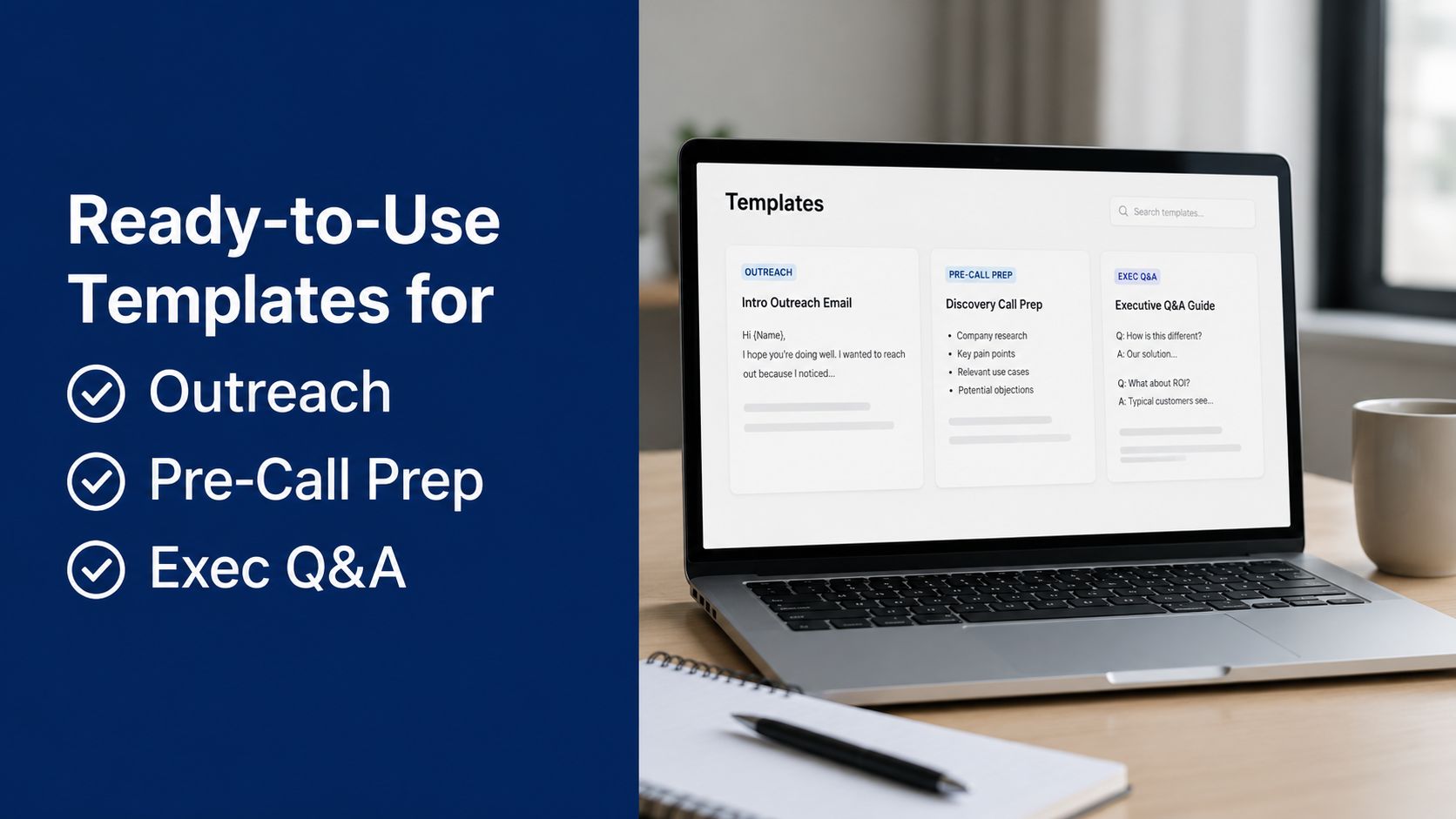
Outreach opener
- Trigger: “I saw the new CRO announcement.”
- Why it matters: “Leadership changes often reset priorities and pipeline expectations.”
- Relevant angle: “That usually creates a good time to compare how teams are aligning around the next quarter.”
- Value statement: “We help reps turn that kind of change into a clear account-specific message.”
- Next step: “Would it be useful if I sent a short version built for your team?”
That opener works because each line earns its place. It doesn't sound like a mail merge, and it doesn't pretend to know more than the rep knows.
Pre-call prep sheet
- Agenda anchor: Open with the account change, not your product story.
- Stakeholder lens: Decide who in the room cares about strategy, risk, or execution.
- Core point of view: Name the one idea you want the buyer to remember after the call.
- Supporting proof: Pull only the facts that make that idea feel credible.
- Ask: End with a next step that matches the stakeholder's role.
If you need a deeper prep routine, Salesmotion's pre-call research checklist for B2B teams is a useful companion because it forces the rep to separate signal from noise before the call starts.
Exec Q&A
Q: Why reach out now?
A: Because the leadership change creates a new planning moment.
Q: Why should we care?
A: It usually affects priorities, coordination, and timing.
Q: What do you want from us?
A: A short conversation with the person who owns the priority you're targeting.
The best templates leave room for judgment. They don't script the rep into stiffness, they give the rep a frame that can survive a real conversation.
Five Talking Point Mistakes Reps Keep Making
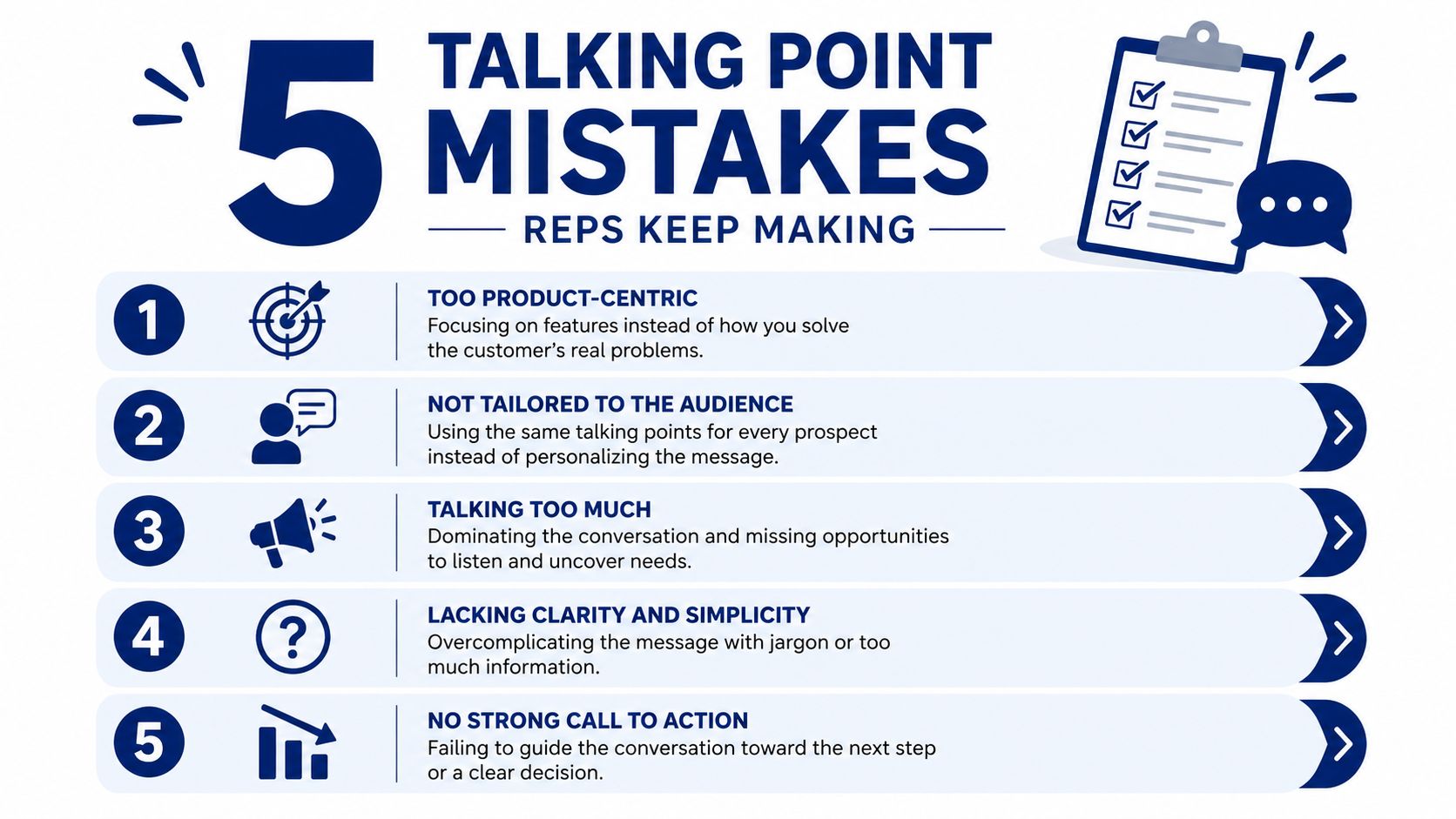
The same five errors show up over and over in pipeline reviews. The good news is that each one is visible, which means each one is fixable.
1. Bullet sprawl
If the doc keeps growing, it's probably losing focus. Cut anything that doesn't support the main message or the ask.
2. Leading with features
A feature dump feels busy, but buyers don't buy your internal architecture. Start with the trigger, then connect the feature only if it helps explain the account moment.
3. Burying the ask
A talking-points set without an explicit ask just creates a nice conversation. Put the next step where the rep can't miss it.
4. Ignoring the audience
Executives, managers, and operators care about different things. The same bullet won't land with all three, so choose the lens before you draft.
5. Skipping the read-aloud test
A line that looks elegant on screen can sound stiff in a room. Read it twice, then trim anything that makes the speaker sound like they're reciting policy language.
The simplest diagnostic is also the harshest. If the rep would hesitate while saying the bullet to a real buyer, the bullet isn't ready.
A rewrite usually helps fast. “Our platform offers flexible workflows and broad integration coverage” becomes “The account change creates a reason to review how the team is aligning around the next quarter.” The second version isn't flashier, but it is usable.
Pre-Send Checklist and Common Questions
Before you hit send, check five things. Trigger present. First bullet carries the headline. Supporting points are verifiable. Ask is explicit. The doc has been read aloud twice. If one of those is missing, the draft isn't ready.
How often should the doc change? Refresh it whenever the account signal changes or the meeting objective shifts. Stale talking points are how reps end up sounding behind the conversation.
What if multiple stakeholders want different things? Keep one core message, then tune the supporting bullets for each audience. The point is consistency with slight variation, not a different philosophy every time.
What if there's no fresh signal? Use the strongest verified account context you have, then keep the message narrower. Don't invent urgency just to make the document sound alive.
If you want a cleaner way to turn account signals into sharp, reusable talking points, Salesmotion helps teams surface the triggers, context, and stakeholder priorities that make the message worth saying. See how the Research Agent uses real account intelligence to shape better prep, better outreach, and better conversations.