
Four months ago it was Apollo buying Pocus. Today, Zoom acquires Common Room. If you're keeping score, the two best-known independent buyer signal platforms have now been absorbed into larger revenue platforms in a single year, and the market for standalone GTM intelligence just got a lot smaller.
My first reaction was the same as it was in March: congratulations, and also, called it.
TL;DR: Zoom announced a definitive agreement to acquire Common Room, the buyer intelligence platform used by Atlassian, Anthropic, Notion, and Snowflake, to extend its Zoom Revenue Accelerator platform upstream. It's the third major GTM intelligence consolidation in eight months after Clari-Salesloft and Apollo-Pocus. If you use Common Room for person-level and product-led signals, watch Zoom's roadmap closely. If you use it for account and market intelligence, natively unified alternatives exist today.
Congratulations to Linda and the Common Room Team
Before anything else: congratulations to Linda Lian and the entire Common Room team. Linda left AWS to found Common Room in 2020 with Tom Kleinpeter, Viraj Mody, and Francis Luu, and raised $52.9 million from Index Ventures, Greylock, and Madrona before the product even left stealth.
What they built matters. Common Room started as community intelligence, aggregating signals from Slack, Discord, GitHub, and social channels, and evolved into person-level buyer intelligence that GTM teams at Atlassian, Anthropic, Autodesk, Notion, Okta, and Snowflake rely on daily. They proved that fragmented digital signals could be stitched into a coherent picture of who is actually in-market. That insight is now worth a line on Zoom's balance sheet, and it was earned.
"We built Common Room to give every seller a real understanding of the person and the organization on the other side of the deal," Linda said in the announcement. That mission clearly resonated, both with customers and, now, with an acquirer.
See Salesmotion on a real account
Book a 15-minute demo and see how your team saves hours on account research.
What Zoom Announced
 Zoom announced the definitive agreement to acquire Common Room on July 2, 2026. Financial terms were not disclosed.
According to the official announcement, Zoom (NASDAQ: ZM) has entered into a definitive agreement to acquire Common Room, with the transaction expected to close in the coming weeks. Financial terms were not disclosed.
The strategic logic is spelled out in the press release. Zoom Revenue Accelerator, Zoom's conversation intelligence product, captures and analyzes sales calls to deliver coaching, deal intelligence, and forecasting. It works downstream, after the meeting is booked. Common Room works upstream: it tells reps which accounts are in-market, who the buyers are, and why to reach out before the call ever happens.
Abhisht Arora, Zoom's Chief Strategy Officer, framed it as extending "Zoom's system of action upstream, combining the richest context of how organizations engage with a real-time understanding of every buyer."
In other words, Zoom wants to own the full loop: intelligence that creates the meeting, the meeting itself, and the analysis after it. Common Room's RoomieAI agents, which handle account research, message personalization, and prospecting, become the front end of that loop.

“The account and contact signals are key for reaching out at important times, and the value-add messaging it creates unique to every contact helps save time and efficiency.”
Daniel Pitman
Mid-Market Account Executive, Black Swan Data
Zoom's Acquisition Track Record: Two Possible Futures
Zoom has done this before, and the outcomes have varied. That history is worth studying if you're a Common Room customer.
Workvivo, acquired in 2023, kept its brand, its team, and its standalone product. It even became Meta's only preferred migration partner when Workplace shut down. That's the good outcome: acquisition as acceleration.
Solvvy, acquired in 2022, took the other path. The conversational AI product was folded into Zoom Contact Center as a feature, and the standalone product disappeared. Zoom's November 2025 acquisition of BrightHire points to the same playbook: buy the capability, absorb it into the platform.
Which future gets Common Room? The press release language leans toward absorption. Common Room is described as "a natural extension of Zoom Revenue Accelerator" and the buyer intelligence that "amplifies" it. When an acquired product's job is to amplify the acquirer's existing product, roadmap priorities tend to follow the acquirer's platform, not the standalone customer base. Common Room customers who don't use Zoom Revenue Accelerator, which is most of them, should watch the first two quarters post-close carefully.
The Independent Signal Layer Is Disappearing
This is the part that should get your attention even if you've never used Common Room. Look at the last eight months of GTM technology:
- Clari + Salesloft closed their merger in December 2025, combining forecasting and sales engagement into a single revenue platform
- Apollo acquired Pocus in March 2026, absorbing PLG signal scoring into its contact database and outbound platform (our full analysis)
- Zoom acquired Common Room in July 2026, absorbing buyer intelligence into its conversation platform
The macro data says this continues. Bain & Company's 2026 M&A report found global M&A rose 40% in value to $4.9 trillion in 2025, with technology leading deal volume. McKinsey's 2026 M&A analysis concluded consolidation is accelerating specifically in software verticals where AI strengthens product differentiation.
Here's my read as a founder in this space: the acquirers are validating that buying signals and account intelligence are no longer optional. Nobody spends acquisition money on a nice-to-have. But every one of these deals also converts an independent, best-of-breed intelligence tool into a module inside someone's platform, with roadmaps set by platform strategy rather than by the intelligence problem itself.
For buyers, the practical question has changed. It's no longer "which signal tool is best?" It's "do I want my intelligence layer to be a feature of my video platform, my contact database, or my forecasting suite, or do I want it to be the product?"

“Salesmotion helps you spot signals from prospect accounts, news items / job hiring alerts etc that indicate that now is a good time to reach out with a well-crafted message.”
Rob Douglas
Director of Sales, icit business intelligence
What Common Room Customers Should Do Now
Nothing changes on day one, and there's no need to panic. But acquisitions of this kind historically involve 12-18 months of roadmap consolidation, so this is the right moment to map which Common Room capabilities your team actually depends on. They fall into three buckets, and they lead to different answers.
First-party data unification and PLG signals. If your core use case is stitching CRM, product usage, marketing, and community data into person-level identity, that's Common Room's crown jewel and the hardest thing to replace. I'll be direct: Salesmotion does not do this. We don't monitor your product analytics, your Slack community, or your GitHub stars. If this is why you bought Common Room, your best move is to watch Zoom's integration roadmap and hold them to it. It's worth noting the obvious alternative vanished too: Pocus, the other PLG signal platform, is now inside Apollo.
Account and market intelligence. If your team leaned on Common Room for account research, buying signals from the outside world, and knowing why to reach out, this is exactly the layer where natively unified platforms exist today. Salesmotion monitors 1,000+ external sources, including earnings calls, leadership changes, funding rounds, hiring patterns, and strategic initiatives, and turns them into cited account briefs and signal-anchored outreach. Here's what that looks like in practice: a target account announces a new CRO. The signal fires the same day, the account brief updates with the executive's background and the earnings commentary that explains the hire, and the rep sends outreach referencing the specific initiative within the first week of the new leader's tenure. That workflow ran on business signals, not community data, and it never touched a product analytics integration.
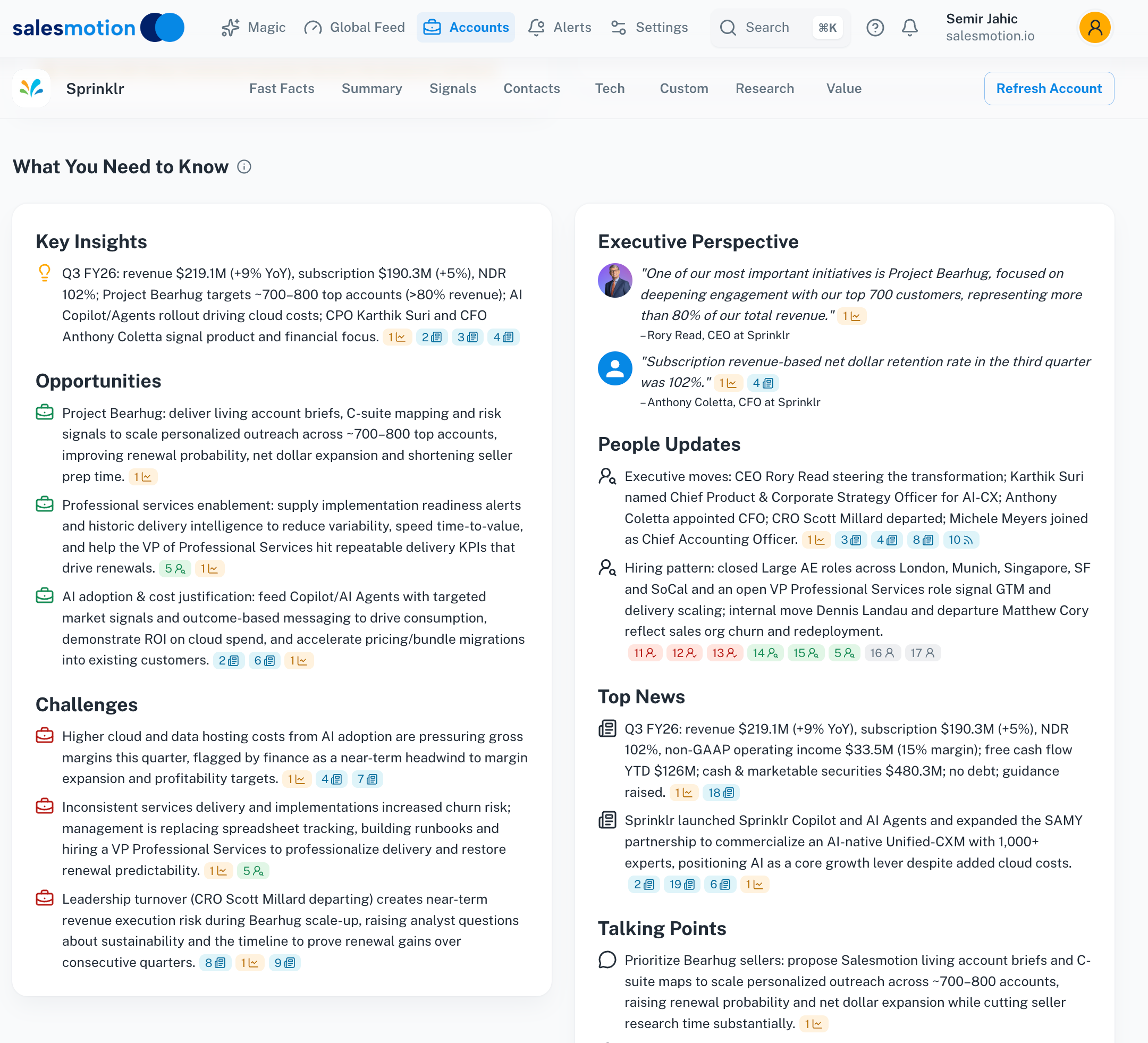 Account briefs synthesized from 1,000+ external sources: earnings, leadership moves, funding, hiring, and strategic initiatives.
Contact enrichment. Common Room bundled email and phone enrichment. If that's what you'd miss, dedicated databases like ZoomInfo, Apollo, or Clay cover it, and our Common Room alternatives guide breaks down the options by use case.
The evidence that the second bucket works without a platform merger: Frontify increased sales velocity 42% and cut research time 90%, and Analytic Partners grew qualified pipeline 40% year over year while cutting per-account research from 3 hours to 15 minutes. If your Common Room evaluation was really an account intelligence evaluation, book a demo and compare the depth directly.
Key Takeaways
- Zoom is acquiring Common Room to extend Zoom Revenue Accelerator upstream, closing the loop from buyer intelligence to conversation to forecast. The deal is expected to close within weeks; terms were not disclosed.
- Congratulations to Linda Lian and the Common Room team. Building person-level buyer intelligence into a category trusted by Atlassian, Anthropic, and Snowflake is a genuine achievement.
- This is the third major GTM intelligence consolidation in eight months, after Clari-Salesloft and Apollo-Pocus. The independent signal layer is being absorbed into platforms, and McKinsey expects software consolidation to keep accelerating.
- Zoom's track record cuts both ways: Workvivo stayed a thriving standalone product, while Solvvy was absorbed as a feature. The "natural extension of Zoom Revenue Accelerator" framing suggests Common Room leans toward the second path.
- Common Room customers should map their usage now: PLG and first-party signal unification has no drop-in replacement (and Salesmotion honestly isn't one), while account and market intelligence has mature, natively unified alternatives today.
- In a consolidating market, time to value beats roadmap promises. Merged platforms typically need 12-18 months to deliver a combined vision.
Frequently Asked Questions
Why did Zoom acquire Common Room?
Zoom acquired Common Room to add buyer intelligence to Zoom Revenue Accelerator, its conversation intelligence and revenue orchestration platform. Zoom Revenue Accelerator analyzes sales conversations after they happen; Common Room identifies which accounts are in-market and who the buyers are before the conversation. Together they cover the full revenue journey on one platform, according to the official announcement.
What happens to Common Room customers after the acquisition?
Nothing changes immediately. The transaction is expected to close in the coming weeks, and Linda Lian has said the team will continue serving customers while accelerating the roadmap with Zoom's resources. That said, platform acquisitions historically involve roadmap consolidation over 12-18 months, and the press release positions Common Room as an extension of Zoom Revenue Accelerator. Customers who don't use Zoom's revenue products should watch how the standalone product is prioritized after close.
What are the best Common Room alternatives after the Zoom acquisition?
It depends on which capability you relied on. For account and market intelligence, including buying signals from earnings calls, leadership changes, funding, and strategic initiatives, Salesmotion is the closest natively unified option, starting at $85/month with custom team pricing and unlimited users on team plans. For PLG and product usage signal scoring, the honest answer is that the independent options have consolidated: Pocus is now part of Apollo, and Common Room is joining Zoom. For contact enrichment, ZoomInfo, Apollo, and Clay are established choices. See our full Common Room alternatives guide for a breakdown.
Does Salesmotion replace Common Room?
Partially, and it's worth being precise. Salesmotion replaces the account intelligence and external buying signal side of Common Room: research briefs, signal monitoring across 1,000+ sources, and outreach anchored to real company events. It does not replace Common Room's community monitoring, product usage signals, or first-party data unification. Teams with a genuine PLG motion used both categories for different jobs; teams doing account-based selling into mid-market and enterprise typically only need the account intelligence layer.
Is GTM technology consolidating?
Yes, at a striking pace. Clari and Salesloft merged in December 2025, Apollo acquired Pocus in March 2026, and Zoom is acquiring Common Room in July 2026. Bain & Company reports global M&A rose 40% in value in 2025 with technology leading deal volume. For buyers, the practical implication is that point solutions are becoming platform modules, so evaluating a vendor now includes evaluating its likely acquirer.