Comparison
Common Room, owned by Zoom since July 2026, builds person-level buyer intelligence from first-party, product, community and intent signals; its published entry tier is Essential $2,500/mo (billed annually). Salesmotion builds account intelligence from public business events such as earnings calls, filings and leadership changes, from $85/mo on a monthly contract.
 By Semir JahicCEO & Co-Founder, SalesmotionLast reviewed
 | Feature | Common Room | Salesmotion |
|---|---|---|
| Primary Function | Buyer intelligence from first-party, product, community and intent signals | Account intelligence from public business events |
| Ownership | Owned by Zoom (acquired 17 Jul 2026) | Independent |
| Signal Sources | CRM, product, marketing and engagement data; 50+ integrations | Earnings calls, news, SEC filings, job postings and 1,000+ public sources |
| Core User | GTM teams with rich first-party signal | B2B sales reps and AEs working named accounts |
| Unit of Insight | The person and the buying committee | The account and what changed inside it |
| Pricing | Essential $2,500/mo (billed annually) | $85/mo for individuals. Custom pricing for teams & enterprise. |
| Best For | Signal-rich, product-led and inbound-heavy GTM | Enterprise account research and outbound |
| Rating (G2) | 4.5/5 | 4.8/5 |
Common Room is a buyer intelligence platform that grew out of community signals and now spans enrichment, prospecting, intent, ads and AI research. Its homepage describes it as complete buyer intelligence that turns intent into pipeline. Zoom acquired Common Room on 17 July 2026 for $266.8 million in cash, per Zoom's 10-Q, and Common Room is still sold under its own name (see our [full analysis](/blog/zoom-acquires-common-room)).
The platform captures first-party signals across CRM, product, marketing and engagement, resolves them to people and accounts with Person360, and adds a 400M+ contact directory, Prospector, AI Scoring, Buying Committee and Ads. RoomieAI covers account research, contact research and message personalization, and Common Room also offers an MCP and CLI. It connects to Salesforce, HubSpot, Slack, Outreach and 50+ other integrations.
Common Room is strongest where a company has rich first-party signal to work with: product usage, community activity and marketing engagement. Its site now lists Zoom products such as Revenue Accelerator, Auto Dialer and Forecast alongside its own, so teams already on Zoom's revenue stack get buyer intelligence and execution from one vendor.
Best for: Go-to-market teams with strong first-party, product and community signals that want person-level buyer intelligence, enrichment and prospecting in one platform
G2 rating: 4.5/5
Pricing: Common Room publishes its entry tier at $2,500/month billed annually (Essential, 5 seats, 100k contacts). Advanced and Enterprise are quote-only. There is no free tier or self-serve trial on the pricing page.
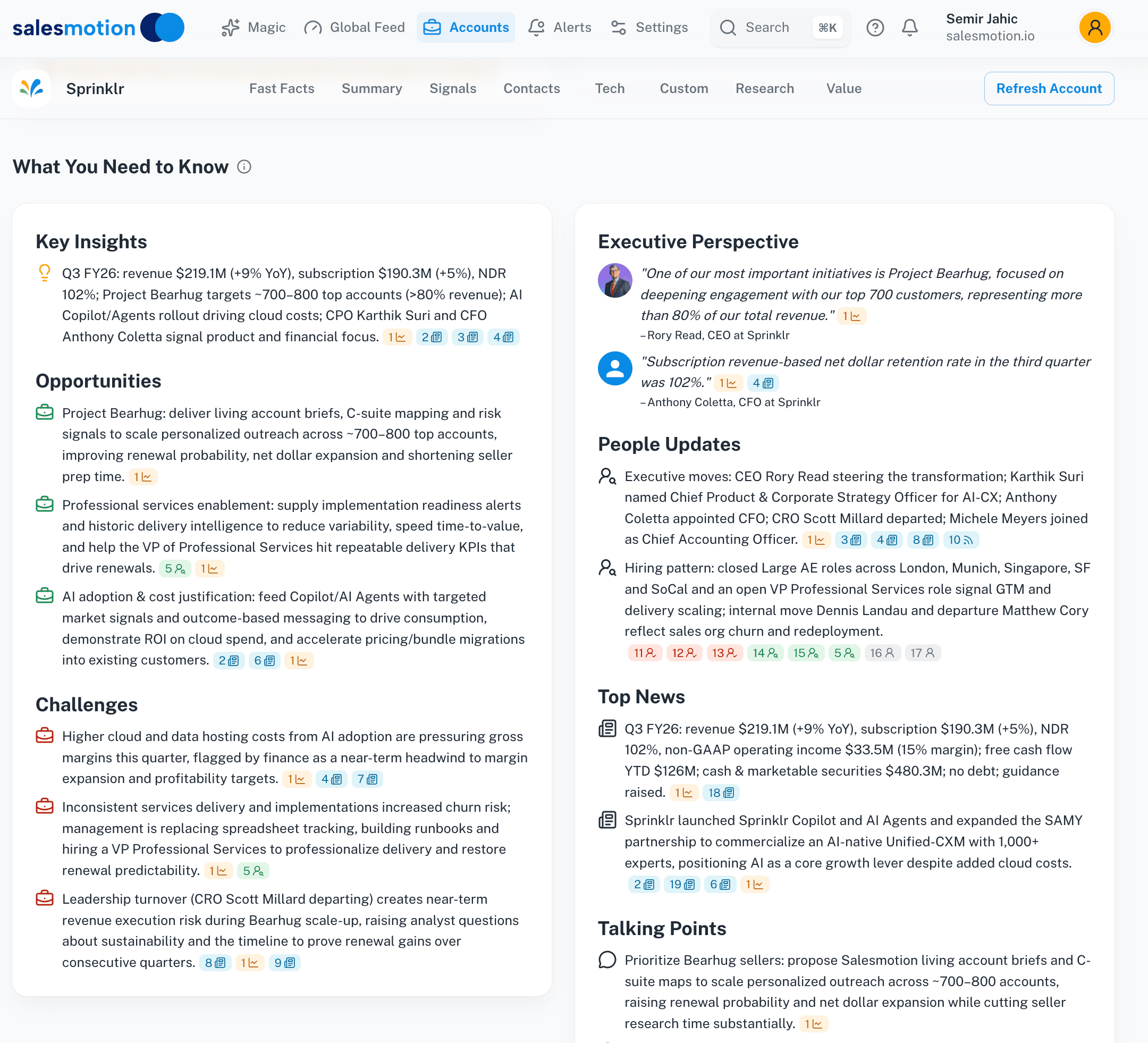
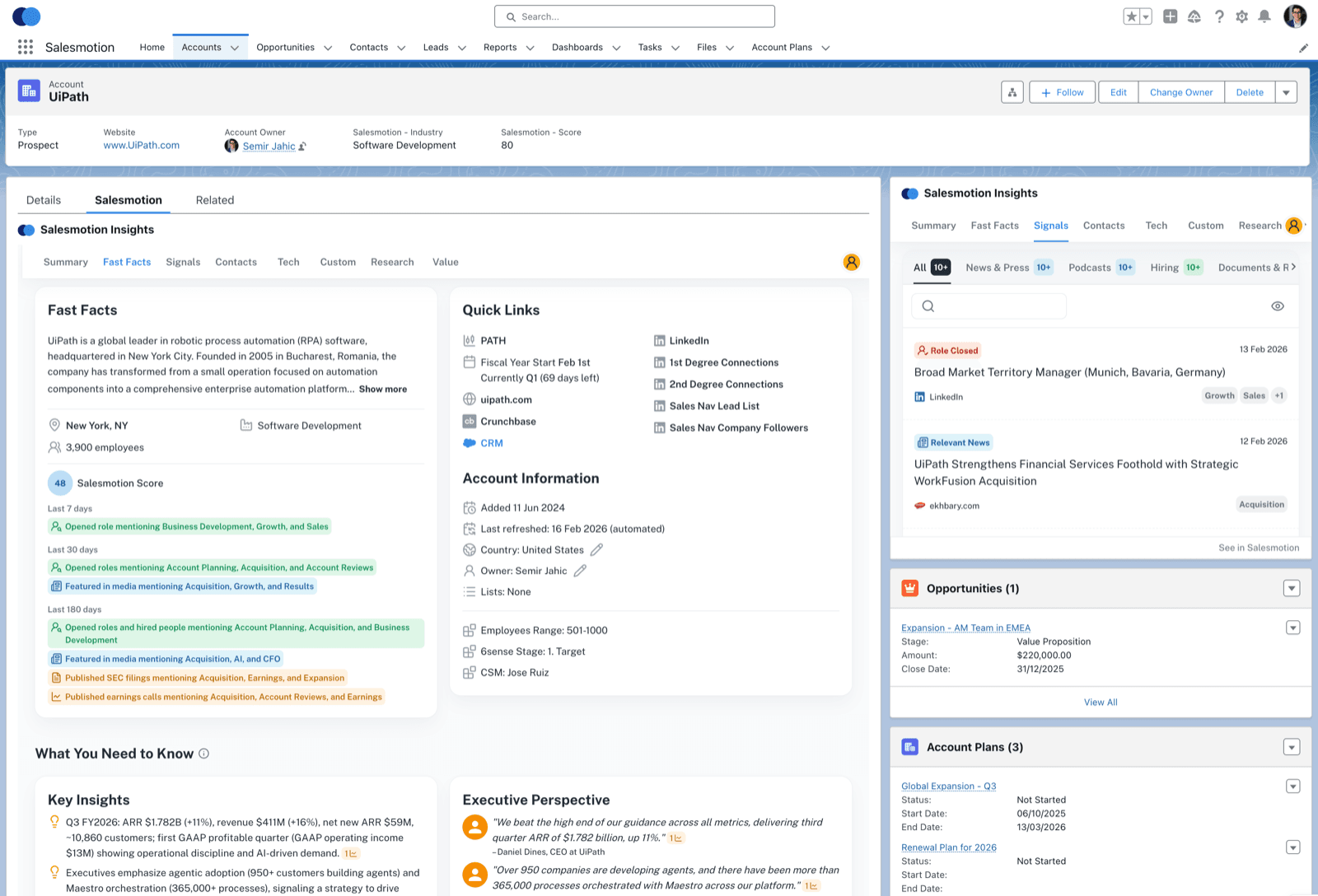
Salesmotion is an account intelligence platform that monitors over 1,000 public sources to tell B2B sales teams what is happening inside their target accounts. Where Common Room starts from your first-party and engagement signals, Salesmotion starts from public business events: earnings calls, filings, strategic initiatives, leadership changes, funding rounds and hiring.
Three AI agents do the work. The Signal Agent watches every tracked account for 50+ signal types, the Research Agent writes a cited account brief, and the Outreach Agent drafts a message tied to the event. When a signal fires, the rep knows why the account is worth contacting now and what to say.
Salesmotion is designed for sales teams selling into mid-market and enterprise accounts, where understanding the company drives the deal. It has a native Salesforce integration, a HubSpot integration, and a REST API and MCP server.
Best for: B2B sales teams that need account intelligence from public business events (earnings, leadership, strategy, funding, hiring) with cited briefs and talking points
G2 rating: 4.8/5
Pricing: $85/mo for individuals — flexible monthly billing. Custom pricing for teams and enterprise on request.
How Common Room and Salesmotion stack up across key capabilities.
| Feature | Common Room | Salesmotion |
|---|---|---|
| First-Party Signals | Core strength: CRM, product, marketing and engagement signals in one place | Works from public sources, so nothing in your product needs instrumenting |
| Public Business Events | Built around first-party, product, community and intent signals | Core strength: earnings calls, filings, leadership changes, funding and hiring |
| Account Research | RoomieAI account and contact research | Cited account briefs from 1,000+ public sources |
| Talking Points | RoomieAI message personalization and live in-call guidance | Generated from named public events, with source links |
| Contact Data | Enrichment, Prospector and a 400M+ contact directory | Verified contacts on the accounts you track |
| Person-Level Identity | Person360 identity resolution, AI Scoring and Buying Committee | Account-level signal monitoring |
| CRM Integration | Salesforce, HubSpot | Native Salesforce integration; HubSpot integration |
| AI Assistant Access | MCP and CLI | REST API and MCP server for Claude, ChatGPT and other assistants |
We held 55 sales and customer calls between August and October 2026. In 22 of them the buyer wanted to be told what changed at their accounts instead of going to look.
“I'm looking more for surveillance on my accounts to pick up the stuff that I might miss.”
“one of the things I'm always trying to figure out is the right timing”
“I just feel like we have a lack of visibility into ... what accounts are actually hot”
Common Room publishes its entry tier at $2,500/month billed annually (Essential, 5 seats, 100k contacts). Advanced and Enterprise are quote-only. There is no free tier or self-serve trial on the pricing page.
Salesmotion starts at $85/mo for individuals on a monthly contract, with custom pricing for teams and enterprise rollouts. Team pricing scales with the accounts you monitor rather than seats.
The right investment depends on your go-to-market motion. Common Room delivers the most value where first-party, product and community signals predict buying intent and you want person-level intelligence, enrichment and prospecting together. Salesmotion delivers the most value where reps sell into named accounts and need to know what changed at the company and why it matters. See Salesmotion pricing for details.
We'd rather you pick the right tool than the wrong one. Salesmotion isn't for everyone — here's when another option on this page is the smarter call.
Salesmotion gives your reps the account intelligence they need to book more meetings and close bigger deals.
No, not at the entry level. Common Room's published entry tier is Essential $2,500/mo (billed annually), with 5 seats and up to 100k contacts, and its Advanced and Enterprise tiers are quote-only. Salesmotion starts at $85/mo for individuals on a monthly contract, with custom pricing for teams. The two cover different ground, so compare them on the job you need done.
Common Room's pricing page lists three paid tiers (Essential, Advanced and Enterprise) and no free tier or self-serve trial; each plan starts with a demo request. The published entry price is Essential $2,500/mo (billed annually).
Zoom. Zoom acquired Common Room on 17 July 2026 for $266.8 million in cash, per Zoom's 10-Q. Common Room is still sold under its own name with its own pricing page, and its site lists Zoom products such as Revenue Accelerator, Auto Dialer and Forecast alongside its own. Read our full analysis of the acquisition.
Common Room builds buyer intelligence from first-party, product, community and intent signals, with RoomieAI for account and contact research. Salesmotion is built for public-source business events: earnings calls, filings, leadership changes, funding and hiring, delivered as cited account intelligence briefs. The first tells you who is engaging with you; the second tells you what is happening at the company.
Yes. If you have a product-led or inbound motion and also sell into enterprises, the two fit together: Common Room identifies engaged people and accounts from your own signals, and Salesmotion gives reps the business context to turn those accounts into conversations. If your motion is outbound into named accounts, Salesmotion alone may be enough.
Common Room's signals come mainly from your own systems and channels: CRM, product usage, marketing and community engagement, plus intent signals. Salesmotion's 50+ signal types come from public sources: earnings calls, leadership changes, funding rounds, strategic initiatives, hiring and M&A. The right choice depends on which buying signal is more predictive for your buyers. Learn more about signal-based selling.
A Signal Agent, Research Agent, and Outreach Agent — working every day so your team spends less time researching and more time closing.