When I saw the news that Pocus was joining Apollo, my first reaction was: this was inevitable.
Not because Pocus failed. Quite the opposite. Pocus proved that buying signals and revenue intelligence aren't a nice-to-have anymore. They're the foundation of modern go-to-market. And when a category gets validated that clearly, the big platforms come calling.
TL;DR: Apollo acquired Pocus to add a signal intelligence layer to its GTM execution platform. This follows the Clari-Salesloft merger and reflects a broader consolidation wave across sales technology. For sales teams, the takeaway is clear: signals, research, and outreach are converging into unified platforms, and the companies that got there first have a structural advantage.
Congratulations to Alexa, Isaac, and the Pocus Team
First things first: congratulations to Alexa Grabell, Isaac Pohl-Zaretsky, and the entire Pocus team. Building a category from scratch is one of the hardest things you can do in SaaS. Pocus didn't just build a product. They built a movement around signal-driven selling that changed how sophisticated GTM teams at Asana, Canva, and Monday.com run their revenue engines.
Alexa wrote on LinkedIn that she and Isaac started Pocus because "go-to-market teams deserved better than the legacy tools they were given." That mission resonated with hundreds of customers who took a bet on a new way of running GTM before it was obvious or proven.
The reaction on LinkedIn tells you everything. Over 800 reactions and nearly 300 comments from investors at First Round and Amplify Partners, sales leaders at Atlassian, Superhuman, and Gong, and founders across the GTM ecosystem. When your acquisition announcement looks more like a celebration than a corporate press release, you built something real.
See Salesmotion on a real account
Book a 15-minute demo and see how your team saves hours on account research.
What the Deal Actually Means
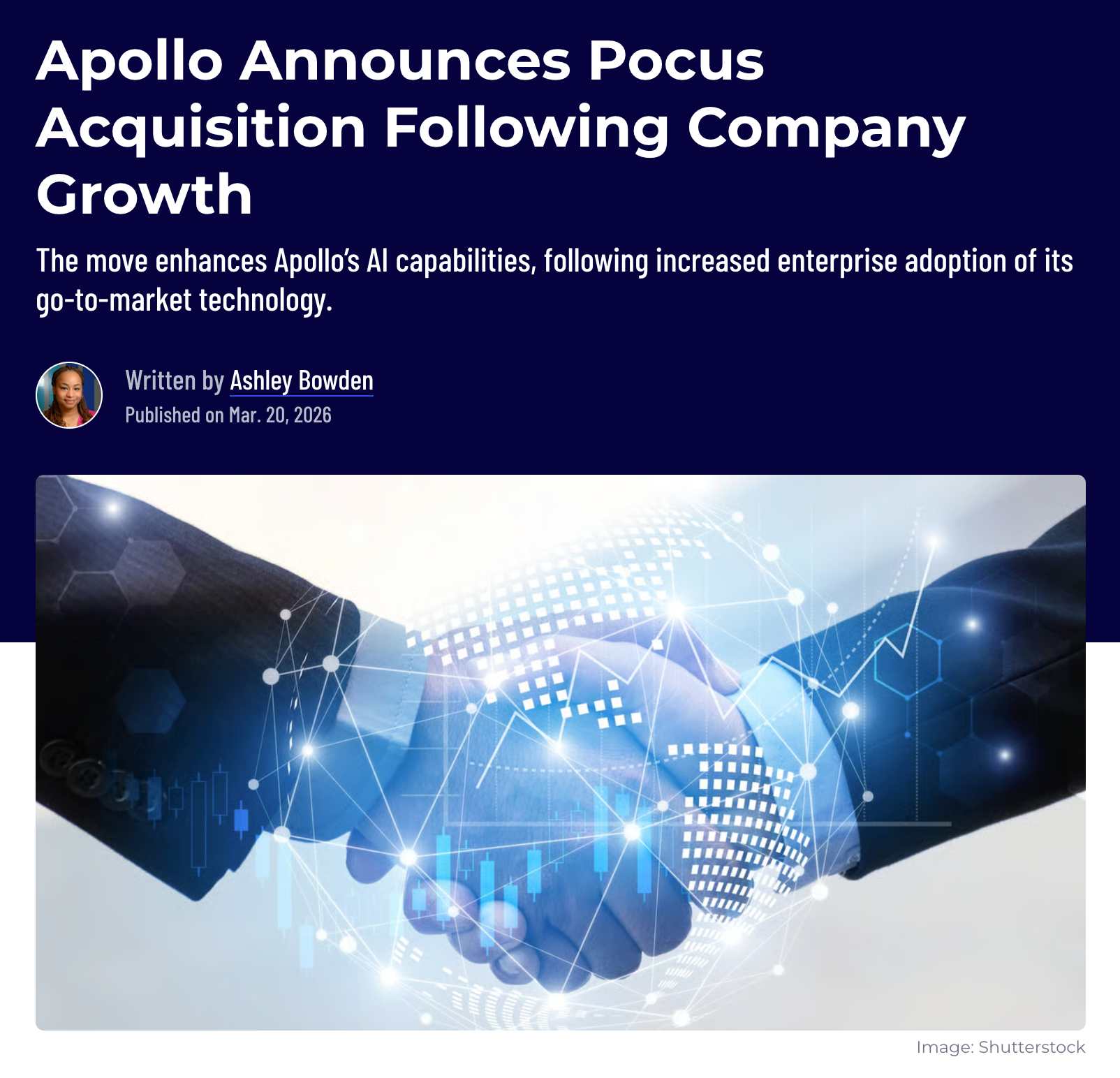 Built In covers the Apollo-Pocus acquisition, noting the deal enhances Apollo's AI capabilities following 400% enterprise growth.
According to the PR Newswire announcement, Apollo saw 400% growth in enterprise accounts over the past 12 months, with names like Anthropic and Glean joining the platform. The Next Web puts Apollo at approaching $200M in ARR. As Built In reported, "the deal expands Apollo's AI capabilities and furthers its goal of becoming a comprehensive system that can detect buying signals, prioritize accounts and guide execution."
Apollo CEO Matt Curl put it directly: "The acquisition of Pocus accelerates Apollo's vision to build the leading AI-native operating system for go-to-market teams from SMB to enterprise. Pocus is a natural complement to Apollo's platform, bringing powerful AI-driven signal intelligence, recommendations and intelligent workflows that enable teams to execute with greater precision and speed."
The strategic logic is straightforward. Apollo built one of the largest B2B contact databases (230M+ contacts) and a strong outbound execution layer with sequencing, dialing, and deal management. What it lacked was the upstream intelligence layer: the ability to tell reps not just who to call, but why and when. Pocus fills that gap with signal processing that prioritizes accounts based on real-time behavioral data rather than static firmographic lists.
Apollo will integrate Pocus' team and tech stack into its organization as it works to unlock new market opportunities. This follows a strong growth period for Apollo within the AI space. As The Next Web reported, AI adoption among Apollo's customers grew from 35% to 75% since launching its AI Assistant in beta, credit consumption doubled in under six months, and weekly active users surged 94% after the GA launch. Today Apollo powers more than 600,000 companies and 2 million users globally, with over 100,000 paying customers.

“The moment we turned on Salesmotion, it became essential. No more hours on LinkedIn or Google to figure out who we're talking to. It's just there, served up to you, so it's always 'go time.'”
Adam Wainwright
Head of Revenue, Cacheflow
A Quick Look at Apollo
For those less familiar: Apollo started as a prospecting and contact data platform. Think of it as an alternative to ZoomInfo or Lusha, but with a heavier focus on outbound execution. The platform includes a 230M+ contact database, email sequencing, an embedded dialer (domestic and international), conversational intelligence, inbound webforms and routing, and deal management.
Apollo raised a $100M Series D at a $1.6B valuation in 2023 and has grown revenue over 5x since then. The company ranked #119 on Deloitte's Fast 500 list and now powers over 600,000 companies globally. Their recent push into AI has been aggressive: they launched an AI Assistant that handles prospect research, list building, workflow configuration, and content creation. The results have been notable, with AI adoption among customers jumping from 35% to 75% in a matter of months.
What Apollo lacked, until now, was the intelligence layer that tells reps which accounts to focus on and why. That's exactly what Pocus brings.
The GTM Tech Consolidation Wave
This deal didn't happen in isolation. The go-to-market technology landscape has been fragmenting for the better part of a decade. Sales teams ended up with separate tools for contact data, intent signals, engagement, conversation intelligence, forecasting, and deal management. The average B2B sales team uses 5-10 tools just for prospecting and outreach. That fragmentation created real pain: data silos, context switching, and reps spending more time navigating tools than actually selling.
Now the pendulum is swinging hard in the other direction. I've been watching this consolidation trend accelerate, and not just from the sidelines. I spent years at Clari before starting Salesmotion, so I had a front-row seat when Clari and Salesloft announced their merger in August 2025 and closed it in December to create what they call the "first Predictive Revenue System."
The pattern across GTM tech is consistent and accelerating:
- Clari + Salesloft merged forecasting and sales engagement into a single revenue platform ($450M+ combined ARR, 2,300 employees, 5,000+ customers including Adobe, IBM, and Shopify)
- Apollo + Pocus merges contact data and outbound execution with signal intelligence and revenue orchestration
- ZoomInfo expanded into conversation intelligence (Chorus), sales engagement, and website visitor identification through acquisitions
- 6sense broadened through acquisitions of Slintel (contact data), Saleswhale (AI sales assistant), and Fortella (pipeline prediction)
- Demandbase and 6sense have both been absorbing adjacent capabilities to become full ABM operating systems
The macro numbers confirm what we're seeing. Bain & Company's 2026 M&A report found global M&A rose 40% in value to $4.9 trillion in 2025. McKinsey's 2026 M&A analysis concluded that consolidation is accelerating specifically in profitable software verticals where AI can enhance product differentiation. And PwC's technology deals outlook notes that over 80% of dealmakers expect even greater deal volume in 2026.
The message for sales technology buyers is clear: point solutions are being absorbed into platforms. The question isn't whether your tools will consolidate. It's whether you'll choose the combined platform, or pick a vendor that was built unified from the start.

“We're no longer fishing. We know who the right customers are, and we can qualify them quickly. Salesmotion has had a direct impact on pipeline quality.”
Andrew Giordano
VP of Global Commercial Operations, Analytic Partners
Why This Validates Signal-Based Selling
Pocus built their business on a core insight that has now been fully validated by this acquisition: the best time to sell to an account isn't when you decide to call. It's when the account shows you it's ready to buy.
Job changes, leadership hires, funding rounds, earnings call language, product launches, hiring patterns. These buying signals tell you which accounts are entering a buying window before a discovery call ever happens. Pocus made this accessible to PLG-first companies. Apollo will now try to bring it to their 600,000+ company user base.
This validation matters because it confirms the direction we've been building toward at Salesmotion since day one. We've always been a signal-based selling platform. We monitor over 1,000 public and private sources for buying signals, leadership changes, earnings commentary, competitive moves, and strategic initiatives, then surface those insights as actionable account intelligence that reps can act on immediately.
The difference is that we built signals, deep account research, and smart prospecting into a single plug-and-play platform from the start. No integration project. No six-month rollout. No stitching together two acquisitions and hoping the roadmap delivers.
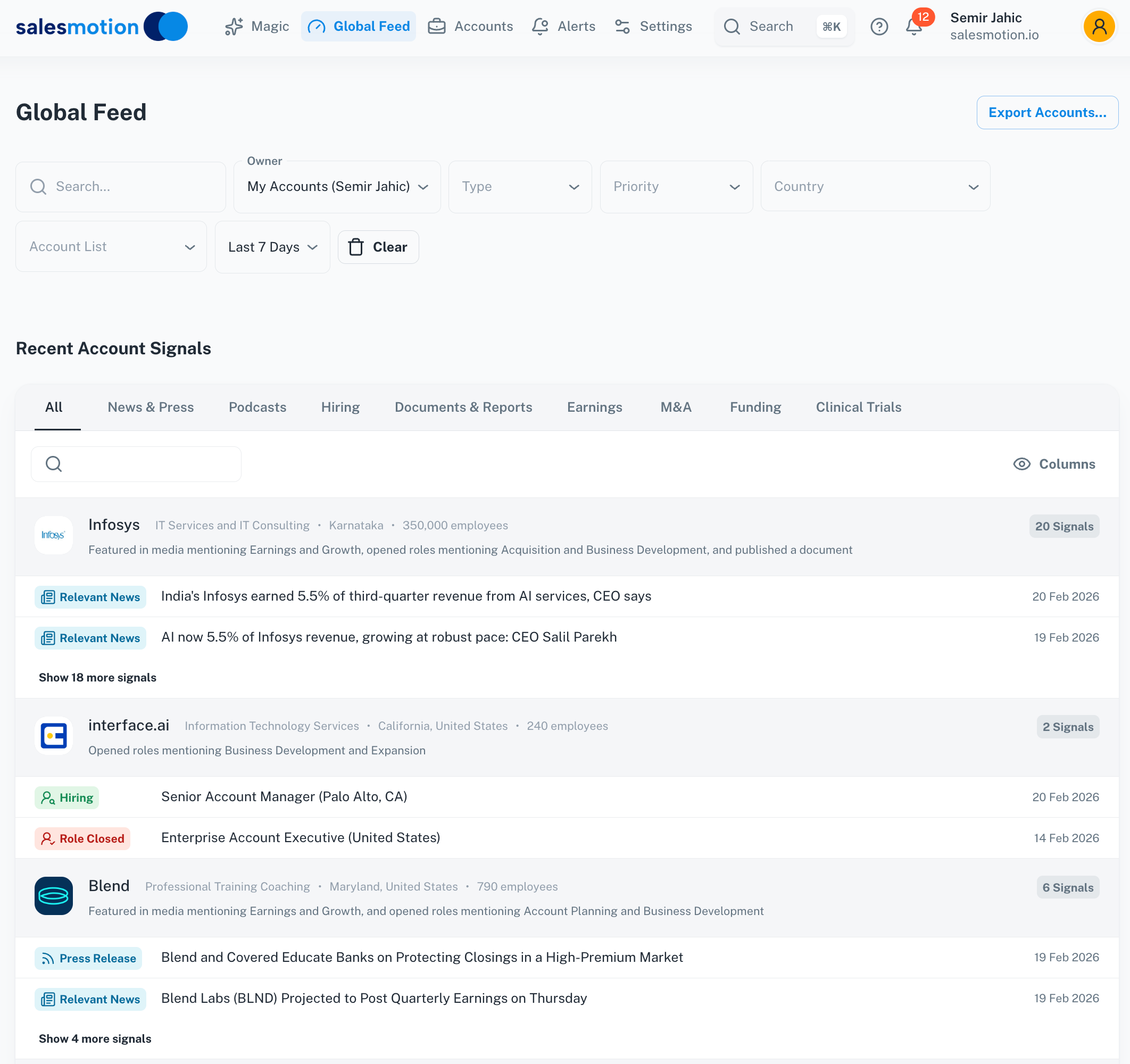 A signal feed that monitors leadership changes, earnings calls, funding rounds, hiring patterns, and more across every account in your territory.
The results speak for themselves. Frontify saw 42% higher sales velocity and their growth team booked 400% more meetings. Analytic Partners grew qualified pipeline 40% YoY and cut research time from 3 hours to 15 minutes per account. Cacheflow tripled deal sizes and went from signature to full platform utilization in 24 hours. These outcomes happened because the intelligence was immediately actionable, not locked behind an implementation timeline.
If your team is evaluating signal intelligence and doesn't want to wait for two products to merge, book a personalized demo or try the interactive demo to see what a natively unified platform looks like.
What Sales Leaders Should Watch For
The Clari-Salesloft merger created integration complexity. Forrester's analysis noted the challenge of integrating overlapping platforms, with "tough decisions on technology consolidation" ahead. Similar risks exist for Apollo and Pocus. Anytime two platforms merge, customers face uncertainty about roadmap prioritization, feature overlap, and whether their specific workflows will survive the integration.
Here's what I'd advise sales leaders evaluating their stack right now:
- Don't wait for integration promises. Merged platforms take 12-18 months to deliver on their combined vision. If you need signal intelligence and prospecting today, evaluate what's available natively.
- Test the "time to value" question. How fast can you go from signing a contract to having your team actually use the platform? Cacheflow went from signature to full platform utilization in 24 hours. That's the bar.
- Look for depth, not breadth. A 230M+ contact database sounds impressive until you realize what matters is the intelligence layer on top. Does the platform tell you WHY to call this account this week? Does it surface the earnings call quote that becomes your opening line?
- Watch what your reps actually use. The best predictor of a platform's value is adoption. If your reps are toggling between five tabs to prepare for a meeting, no amount of M&A is going to fix that workflow.
Pocus Alternatives: What Should Former Pocus Customers Evaluate?
If you're a current Pocus customer wondering what's next, here are the key alternatives to evaluate while Apollo integrates the platform. For a full breakdown, see our Pocus alternatives guide.
For signal intelligence + account research + outreach (what Pocus did, but natively unified):
- Salesmotion combines three AI agents (Signal, Research, Outreach) that monitor 1,000+ sources for buying signals, generate cited account briefs, and draft signal-anchored outreach. Starts at $85/mo for individuals; custom pricing for teams with unlimited users. Monthly contracts, live in 24 hours. See a demo.
For pure intent data (the signal layer only):
- Bombora specializes in B2B web intent data based on content consumption patterns. Strong for identifying accounts researching your category, but doesn't include account research or outreach drafting.
- 6sense offers predictive intent scoring and ABM orchestration. Quote-only pricing — Vendr reports a median annual contract of $62,440 — with 4-8 week implementation.
For contact data + outbound execution (the Apollo side):
- ZoomInfo provides the largest B2B contact database (420M+ contacts) with sales engagement tools. It publishes no list pricing; Vendr shows an average contract value of $33,500 across 1,012 anonymized deals.
- Clay offers flexible data enrichment across 150+ providers with custom workflow automation. Credit-based pricing from $185/mo on the Launch plan.
For Pocus-specific functionality (PLG signal scoring):
- Common Room tracks community and product signals for PLG motions. Good fit if your primary use case was product-led signal scoring. (Update, July 2026: Common Room is itself being acquired, this time by Zoom. See our analysis of what the Zoom acquisition means.)
The key question for former Pocus customers: do you want to wait 12-18 months for Apollo to fully integrate Pocus' capabilities, or move to a platform that already delivers signals, research, and outreach natively?
Key Takeaways
- Apollo's acquisition of Pocus validates that buying signals and revenue intelligence are now essential components of any GTM platform, not optional add-ons.
- The deal follows the Clari-Salesloft merger and a broader trend. McKinsey reports consolidation is accelerating in profitable software verticals, with over 80% of dealmakers expecting even more M&A in 2026.
- Congratulations to Alexa Grabell, Isaac Pohl-Zaretsky, and the entire Pocus team. Building a new GTM category and earning the trust of Asana, Canva, and Monday.com is a remarkable achievement.
- For sales leaders, merged platforms introduce integration risk and timeline uncertainty. Evaluate whether natively unified platforms better fit your current needs.
- Time to value matters more than feature roadmaps. Teams that can't afford to wait 12-18 months for merged products to deliver should look at what's available today.
- The long-term winners in sales technology will be platforms that combine data, intelligence, and execution without forcing customers to stitch them together.
Frequently Asked Questions
Why did Apollo acquire Pocus?
Apollo acquired Pocus to add an intelligence layer to its existing GTM execution platform. Apollo already had one of the largest B2B contact databases (230M+ contacts) and strong outbound tools, but lacked the ability to tell reps which accounts to prioritize and why. Pocus brings signal processing, behavioral data analysis, and AI-driven account prioritization, according to the official announcement. The deal also accelerates Apollo's push upmarket, where Pocus had strong enterprise traction with customers like Asana and Canva.
What does the Pocus acquisition mean for existing Pocus customers?
According to Alexa Grabell's announcement, "nothing changes in the platform" immediately. Workflows and data stay the same, and the Pocus team is joining Apollo. However, platform mergers historically involve roadmap consolidation over 12-18 months, so customers should monitor how their specific workflows and integrations are prioritized during the integration process.
Is the sales tech industry consolidating?
Yes, significantly. The Clari-Salesloft merger closed in December 2025, creating a combined $450M+ ARR platform. Apollo's acquisition of Pocus follows the same pattern. Bain & Company reports that global M&A rose 40% in value in 2025, and the technology sector led deal volume at 30% of all transactions. Buyers increasingly prefer integrated platforms over point solutions, which is driving vendors to acquire complementary capabilities.
What are the best Pocus alternatives after the Apollo acquisition?
The best alternative depends on your primary use case. For teams that used Pocus for signal intelligence, account research, and outreach, Salesmotion is the closest natively-unified replacement, combining a Signal Agent (1,000+ source monitoring), Research Agent (cited account briefs), and Outreach Agent (signal-anchored email drafts) in a single platform starting at $85/month. For pure intent data, Bombora and 6sense cover web-based buyer intent. For contact data and outbound execution (the Apollo side of the equation), ZoomInfo and Clay are established options. For PLG-specific signal scoring, Common Room tracks product and community signals. The key consideration is whether to wait for Apollo to integrate Pocus' capabilities or move to a platform that already delivers the combined workflow natively.
How does this affect the buying signals category?
The acquisition is a major validation of the buying signals and revenue intelligence category. Pocus proved that signal-driven selling works at enterprise scale with customers like Asana, Canva, and Monday.com. Apollo's willingness to acquire (rather than build) this capability signals that the market considers it essential. For sales teams, the question is no longer "should we use buying signals?" but "which platform delivers them best?"