
Alternatives

Top 5 Common Room Alternatives in 2026

Compare the best alternatives to Common Room for signal aggregation, community intelligence, and pipeline generation.

At a glance

How Common Room Alternatives Compare

Side-by-side comparison of the key capabilities that matter most.

FeatureSalesmotionPocus6senseApollo.ioUserGems
Signal Sources1,000+ sources (news, earnings, filings, tech, leadership)Product usage data + third-party signalsAnonymous web intent + proprietary dataBuilt-in database + basic signalsLinkedIn + proprietary job tracking
Community SignalsNot focused on community channelsProduct usage analyticsNot focused on community channelsNot focused on community channelsNot focused on community channels
Account IntelligenceAI-generated research briefs & talking pointsProduct usage analytics per accountPredicted buying stagesBasic firmographicsJob change context only
Person IdentificationVerified contacts with account contextUsers identified from product dataAnonymous visitor identification275M+ contact databasePast customer tracking across companies
Buying Signal DepthEarnings calls, leadership changes, funding, tech adoptionFeature adoption, usage patterns, expansion signalsAI-predicted intent scoresJob changes & funding alertsJob changes and promotions
Ease of SetupLive in minutesModerate (requires product data integration)Complex (weeks to months)Quick setup with onboardingModerate (CRM integration required)
PricingFrom $85/mo (account-based, unlimited users on team plans)Custom pricing (mid-market)$60,000-$100,000+/yearFree tier + from $49/user/monthCustom pricing (per tracked contact)

Why teams switch from Common Room

Common Room built its reputation as the leading platform for community-led growth, helping companies aggregate signals from GitHub, Slack, Discord, Twitter/X, and other digital communities to identify engaged individuals and convert them into pipeline. For developer-focused and community-driven companies, Common Room has been a game-changer for identifying warm leads based on actual engagement.

However, as teams scale beyond community-led motions, they often find Common Room's signal sources too narrow. The most common reasons teams look for alternatives include needing buying signals beyond community channels (such as earnings calls, leadership changes, and strategic initiatives), wanting deeper account intelligence rather than just person-level engagement metrics, and expanding into markets or segments where community signals are less relevant.

The best Common Room alternatives in 2026 offer broader signal coverage, deeper account intelligence, or different approaches to identifying and prioritizing target accounts. The right choice depends on how central community signals are to your go-to-market strategy and whether you need intelligence that extends beyond digital community engagement.

Detailed Breakdown

Best Common Room Alternatives

An in-depth look at each platform, including features, pricing, and limitations.

1

Salesmotion

Our Pick
G2: 4.8/5 (25 reviews)

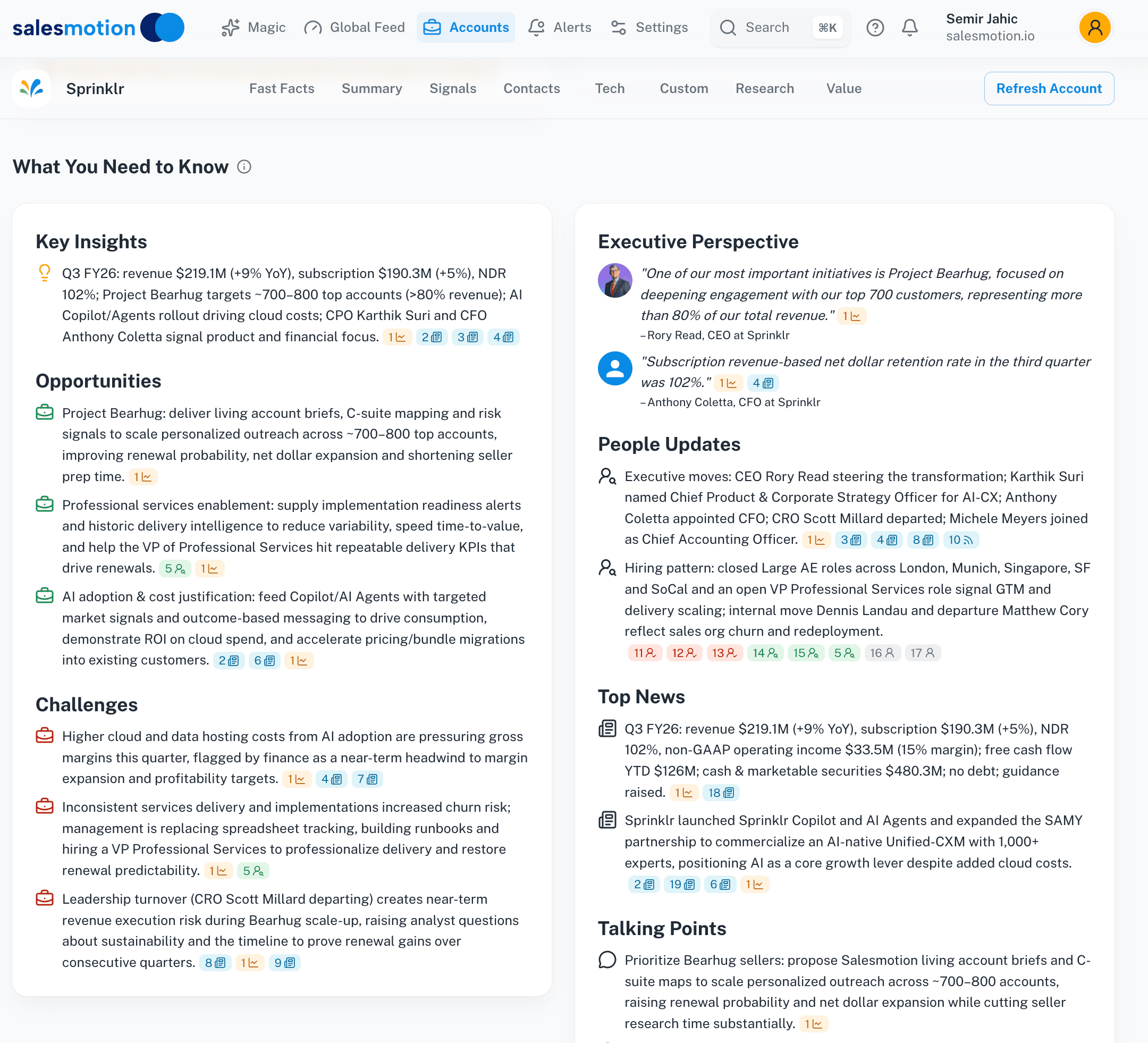
Salesmotion is the best Common Room alternative for teams that need buying signals and account intelligence that go far beyond community engagement. While Common Room aggregates signals from developer and user communities, Salesmotion monitors over 1,000 sources including earnings call transcripts, SEC filings, news coverage, leadership changes, technology adoption signals, and strategic initiative announcements.

This breadth of intelligence makes Salesmotion effective across all industries and selling motions, not just community-driven ones. Reps get AI-generated research briefs and personalized talking points that reference what a company is actually doing and investing in, which is powerful for enterprise and mid-market selling.

For teams that started with Common Room for community signals but are now selling into accounts where community engagement is limited, Salesmotion fills the intelligence gap with comprehensive account context.

Best for:Sales teams that need broad account intelligence and buying signals beyond community and social channels

Key Features

  • AI-generated account briefs from 1,000+ sources
  • Real-time monitoring of leadership changes, earnings, funding, tech adoption, and hiring
  • Personalized talking points and outreach drafts based on real company events
  • Salesforce and HubSpot integration (Enterprise plan)
  • Account-based pricing with no per-seat limits
  • Effective across all industries, not just tech/developer segments

Limitations

  • Does not monitor community channels (GitHub, Slack, Discord) for engagement signals
  • Not designed for community-led growth motions
  • No free tier available
Pricing: From $85/mo — flexible account-based pricing, unlimited users on team plans
2

Pocus

G2: 4.6/5Visit site

Pocus is the closest alternative to Common Room for product-led companies, focusing on product usage signals rather than community engagement. While Common Room tracks how individuals interact with your community, Pocus tracks how they interact with your actual product. For companies with a free trial or freemium model, product usage data is often a stronger buying signal than community engagement.

Pocus aggregates signals from product analytics tools, CRM data, and data warehouses to create scoring models that identify accounts ready to convert or expand. Its playbook builder helps reps act on these signals through structured workflows.

Best for:Product-led growth companies that want to prioritize accounts based on actual product usage rather than community signals

Key Features

  • Product usage signal aggregation and scoring
  • Playbook builder for rep workflows
  • Integration with Amplitude, Mixpanel, Segment, and other analytics tools
  • CRM and data warehouse connectors
  • AI-powered account prioritization based on product engagement
  • Custom scoring models tailored to your product data

Limitations

  • Requires a product with meaningful usage data to generate signals
  • Does not track community or social engagement like Common Room
  • No contact data or deep account research capabilities
Pricing: Custom pricing based on connected data sources and team size. Typically mid-market pricing
3

6sense

G2: 4.3/5Visit site

6sense is the enterprise alternative to Common Room for teams that want AI-predicted buying intent across their entire addressable market, not just their community. While Common Room tells you who is engaging with your community, 6sense uses anonymous web behavior and AI to predict which accounts are in-market to buy, even if they have never visited your website or joined your community.

For larger organizations that need to scale beyond community-led growth, 6sense offers a comprehensive ABM platform with advertising, web personalization, and sales intelligence. The trade-off is significantly higher cost and implementation complexity.

Best for:Enterprise organizations that need AI-predicted intent data and a full ABM platform to scale beyond community-led growth

Key Features

  • AI-predicted buying stages for target accounts
  • Anonymous web intent detection across the broader internet
  • Account-based advertising and web personalization
  • Revenue AI for pipeline forecasting
  • Contact data and enrichment
  • Integration with CRMs, MAPs, and ad platforms

Limitations

  • Very high cost compared to Common Room
  • Complex implementation requiring dedicated operations resources
  • Intent predictions can feel opaque compared to Common Room's visible engagement signals
Pricing: Custom enterprise pricing. Typically $60,000-$100,000+/year depending on feature tier
4

Apollo.io

G2: 4.8/5Visit site

Apollo.io is the most affordable and action-oriented alternative to Common Room. While it does not provide community signal aggregation, Apollo combines a 275M+ contact database with built-in email sequences, a dialer, and basic intent data. For teams that used Common Room primarily to identify contacts at target accounts and then struggled to reach them, Apollo provides both identification and engagement in one platform.

Apollo's job change alerts and funding signals provide some of the same trigger-based intelligence that Common Room offers, though without the community depth. Its free tier makes it accessible for teams testing signal-based selling approaches.

Best for:Teams that need an affordable all-in-one platform to identify, contact, and engage target accounts

Key Features

  • 275M+ contact database with global coverage
  • Built-in email sequences, dialer, and meeting scheduler
  • Job change alerts and funding signals
  • AI email writing assistant
  • Free tier with generous credits
  • Chrome extension for LinkedIn prospecting

Limitations

  • No community or social signal aggregation
  • Basic buying signals compared to Common Room's depth
  • Account intelligence limited to firmographics
Pricing: Free plan available. Basic from $49/user/month. Professional from $79/user/month. Organization from $119/user/month
5

UserGems

G2: 4.7/5Visit site

UserGems focuses on a specific type of relationship signal: job changes. While Common Room tracks broad community engagement, UserGems monitors when your customers, champions, and prospects switch companies, creating warm pipeline opportunities with 3x higher conversion rates than cold outreach.

For teams that found Common Room's community signals useful but want to complement them with a dedicated job change tracking tool, UserGems provides deeper and more automated tracking of personnel movements. It auto-creates CRM records and surfaces relationship context that Common Room does not capture.

Best for:Sales teams that want to generate warm pipeline by tracking when customers and champions move to new companies

Key Features

  • Automatic tracking of customer and prospect job changes
  • CRM auto-updates when tracked contacts move companies
  • Past customer identification at new target accounts
  • Champion tracking across your entire contact database
  • Salesforce and HubSpot native integration
  • Automated pipeline creation from job change signals

Limitations

  • Narrow focus on job changes only — no community or broader signal tracking
  • Requires a meaningful existing customer base to maximize value
  • No account research or general intelligence capabilities
Pricing: Custom pricing based on number of tracked contacts. Typically mid-market to enterprise pricing

Customer Story

How Incredible Health doubled meetings booked with a 3-day go-live

2x

more meetings booked

3 days

to go live

50%

more quarterly meetings

There's been a big focus on hyper personalization and relevance in our outbounding efforts. Salesmotion has been a key partner in hitting our significantly increased meeting targets. What stands out is how simple it is. Reps can log in and get valuable account insights within 30 seconds to a minute.

Joe DeFrance

Joe DeFrance

VP of Sales, Incredible Health

Read the full case study

Ready to see a better way to sell?

Salesmotion replaces hours of manual research with real-time account intelligence your reps can use today.

FAQ

Frequently Asked Questions

Is Common Room only useful for developer-focused companies?

Common Room works best for companies with active digital communities, which includes developer-focused companies but also extends to any organization with engaged Slack groups, Discord servers, or social media communities. However, for companies selling into traditional enterprise segments without significant community presence, alternatives like Salesmotion (which monitors 1,000+ business signal sources) or 6sense (which tracks anonymous web intent) will provide more relevant intelligence.

What is the best Common Room alternative for enterprise sales?

Salesmotion is the best alternative for enterprise sales because it provides deep, AI-powered account intelligence from over 1,000 sources, including the kind of business context (earnings calls, strategic initiatives, leadership changes) that enterprise reps need. 6sense is the best alternative if you need a full ABM platform with advertising capabilities, though at a significantly higher price point.

Can I use Common Room alongside another sales intelligence tool?

Yes, many teams pair Common Room with a broader intelligence platform. A common combination is Common Room for community-specific signals plus Salesmotion for comprehensive account intelligence from business sources. This gives reps both bottom-up community engagement data and top-down business context for each account.

How does Pocus compare to Common Room?

Pocus and Common Room both serve product-led companies but focus on different signal types. Common Room aggregates community engagement signals (GitHub, Slack, Discord, social media), while Pocus aggregates product usage signals (feature adoption, usage frequency, expansion patterns). For most PLG companies, product usage data is a stronger buying signal, but community signals provide complementary context about individual champion engagement.

Related Comparisons

Explore more head-to-head comparisons and alternatives guides.

Your reps are researching. They should be selling.

Join the top-performing sales teams using Salesmotion to build more pipeline and close more deals.

Book a demo