94% of B2B marketers and 82% of B2B companies reported active ABM programs as of 2024, according to Huble's ABM statistics roundup. That changes the conversation. Account based strategy is no longer a niche tactic for enterprise teams with large budgets. It's a core operating model for revenue teams that want tighter focus, better coordination, and more relevant outreach.
What's still missing in many ABM discussions is execution. Most guides explain how to choose accounts, define an ICP, or align sales and marketing. Fewer show how to turn live signals, like a new CRO hire, an expansion initiative, or a fresh hiring pattern, into immediate action without forcing reps to do hours of manual research first.
That execution gap is where good account based strategy either becomes pipeline or becomes shelfware.
Understanding Account Based Strategy
Account based strategy means you start with a defined set of companies you want to win, then build sales and marketing activity around those accounts. Traditional demand generation usually works the other way around. It casts a wide net, collects leads, and sorts through them later.
Account based strategy flips that model. Sales and marketing decide which accounts matter most, why they fit, and what signals indicate timing. Then the team coordinates outreach, content, and follow-up around those accounts.
How it differs from lead-first selling
In a lead-first model, a rep may get an inbound form fill from a company that looks interesting, then discover later that the account is too small, poorly aligned, or already tied up with another priority. In an account-based model, that confusion is reduced because the team already knows the target list.
Account-based selling treats each target company as a distinct market. This guide to target account selling frames the shift well. You're not trying to attract anyone who might buy. You're trying to win the right buying group inside the right company at the right moment.
A simple example helps. Say you sell revenue forecasting software:
- Lead-first approach: You run broad campaigns, collect demo requests, and hope qualified buyers rise to the top.
- Account-based approach: You identify a shortlist of SaaS companies with complex sales teams, recent executive changes, and visible planning pressure. Then you coordinate outreach to finance, RevOps, and sales leadership with account-specific messaging.
Why the model has become standard
The reason adoption is so high is straightforward. Teams got tired of wasting time on accounts that were never a fit, never ready, or never important enough to justify a high-touch motion.
Practical rule: If your team says it wants larger, more strategic deals, it can't keep treating every lead as equally valuable.
A strong account based strategy usually rests on three foundations:
- Clear ICP definition: You decide what a strong-fit account looks like before outreach starts.
- Joint execution: Sales and marketing work from the same target account list instead of separate priorities.
- Signal-driven timing: Outreach is triggered by account context, not just a cadence calendar.
That's the shift. A list of names becomes an active pipeline when the team knows who to target, what changed, and why now is the right time to engage.
See Salesmotion in action
Take a self-guided interactive tour — no signup required.
Why Revenue Teams Need Account Based Strategy
Revenue leaders rarely struggle with the idea of focus. They struggle with proving that focus will outperform volume. The business case for account based strategy is strong because it aligns effort with revenue potential instead of activity totals.
The financial upside is hard to ignore. Companies with mature ABM programs achieve 5–9x ROI, 200% larger deal sizes, and pipeline conversion improvements that substantially transform go-to-market economics, according to Revenue Memo's ABM statistics analysis.
The real reason teams make the switch
Most sales and marketing teams don't fail because they work too little. They fail because their work is spread too thin. Broad demand generation can create lots of motion, but motion isn't the same as momentum.
When a team adopts account based strategy, it usually gains three things:
| Focus area | Traditional broad motion | Account-based motion |
|---|---|---|
| Resource allocation | Spread across many leads | Concentrated on priority accounts |
| Messaging quality | Generic by necessity | Tailored to account context |
| Sales and marketing alignment | Often disconnected | Built around shared targets |
That's why sales and marketing collaboration is so central here. ABM works when both teams agree on account selection, timing, and responsibilities. Marketing can't optimize for lead volume while sales optimizes for strategic account penetration. The operating model has to match.
What leaders should track
Not every team needs the same dashboard, but a few outcomes matter more than vanity metrics:
- Deal size: Are strategic accounts producing larger opportunities?
- Pipeline conversion: Are target accounts moving forward more consistently?
- Account engagement quality: Are the right stakeholders interacting, replying, and meeting?
- Timing responsiveness: Is the team acting when account conditions change?
If you want larger deals, your process has to make space for deeper research, better coordination, and sharper timing.
A practical example: a cybersecurity company targeting large financial firms may close fewer total opportunities than a broad inbound engine, but if each target account is more qualified, more valuable, and more likely to renew or expand, the economics improve quickly. Account based strategy gives teams permission to optimize for that outcome instead of chasing raw lead counts.

“Salesmotion helps you spot signals from prospect accounts, news items / job hiring alerts etc that indicate that now is a good time to reach out with a well-crafted message.”
Rob Douglas
Director of Sales, icit business intelligence
Key Components of Account Based Strategy
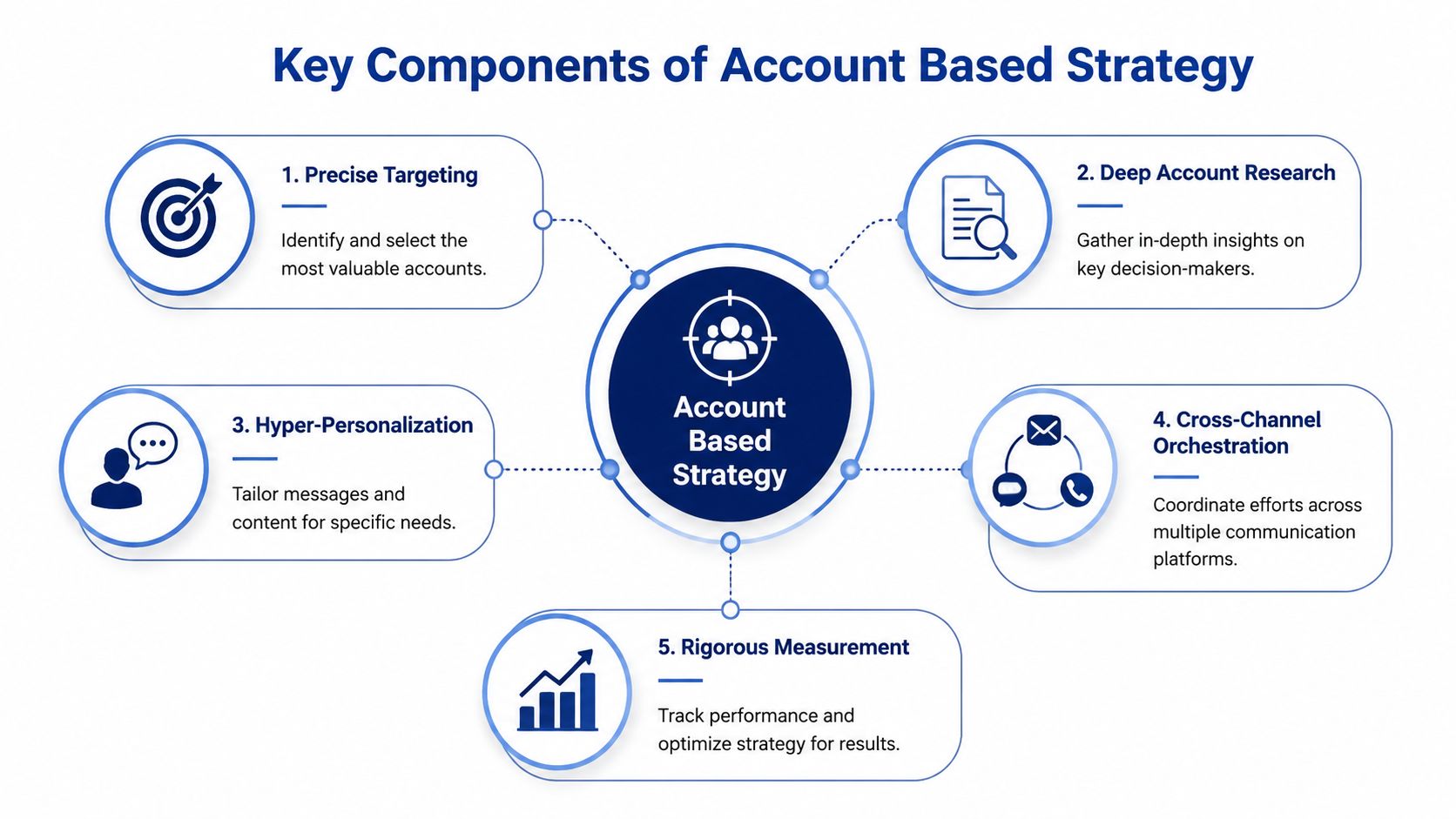
A workable account based strategy isn't a slogan. It's a system. The strongest programs tend to share five components that make execution consistent instead of heroic.
Precise targeting
Targeting starts with an ICP, but a modern one needs more than firmographics. A more useful model looks at firmographic, technographic, intentographic, and behavioral signals together. That prevents teams from building a list that looks good on paper but has no buying momentum behind it.
A practical scoring model often includes four lenses:
- Fit: Does the account match your ICP?
- Intent: Are there signs the account is researching or changing?
- Relationship: Do you already have access, history, or advocates?
- Timing: Did something happen that creates urgency?
Deep account research
Once the account makes the list, the team needs an account brief that goes beyond industry and headcount. Reps need to know what the company is trying to achieve, what changed recently, which leaders matter, and where your offer fits.
Good research usually answers questions like these:
- What strategic initiative is likely active right now?
- Which executive owns the problem you solve?
- What proof point or message will feel credible to that buyer?
- What event makes outreach timely instead of random?
Many teams frequently stall. They know research matters, but they don't have a repeatable way to produce it across dozens or hundreds of accounts. ABM at scale requires systematized research, not one-off prep.
Hyper-personalization
Personalization doesn't mean changing the first line of an email. It means connecting your message to a real business condition inside the account.
Compare these two opens:
“I noticed your team is growing and thought it might be a fit to connect.”
Versus:
“Your recent hiring pattern suggests the sales org is adding structure. That usually creates pressure on forecasting consistency and manager visibility.”
The second one gives the buyer a reason to keep reading. It sounds like someone understands the account, not just the persona.
Cross-channel orchestration
ABM isn't just email. It's coordinated contact across channels so the account experiences one coherent motion. That may include outbound email, SDR calls, LinkedIn engagement, direct mail, customized content, or executive outreach.
The key is sequencing. A rep shouldn't call with one story while marketing sends unrelated content with another.
Rigorous measurement
Measurement in account based strategy should tell you whether target accounts are progressing, not just whether content got clicks.
A practical review cadence should ask:
- Which accounts are gaining momentum?
- Where are we stuck with single-threaded engagement?
- Which signals produce meetings or replies?
- Which messages get ignored even when the account looks active?
Without that feedback loop, teams can't improve targeting or timing. They just repeat activity.
Common Challenges in Account Based Strategy
Many teams assume the hardest part of account based strategy is choosing the right accounts. In practice, the bigger challenge is operational discipline after the list is built.
The first problem is manual context gathering. Reps spend 2–3 hours manually stitching account context instead of selling, leading to weak “why now” messaging and missed timely outreach, according to Optifi's ABM guide. That time drain creates an execution bottleneck. A rep may know an account is important, but still not know what to say today.
Where programs usually break
Three failure patterns show up often.
- Signal overload: Teams monitor too many sources and can't tell what matters.
- Inconsistent planning: One rep writes strong account plans while another works from memory.
- Stale messaging: Outreach references old priorities because nobody refreshed the context.
The issue isn't lack of effort. It's lack of filtering.
How to make signals usable
A useful signal isn't just an event. It's an event tied to a point of view. “New executive joined” is noise unless your team knows why that role matters and what follow-up makes sense.
A workable filter asks four questions:
| Signal question | What the team should ask |
|---|---|
| Relevance | Does this change connect to a problem we solve? |
| Seniority | Does it involve someone who can influence budget or process? |
| Urgency | Does it create a reason to act soon? |
| Actionability | Can a rep turn it into a credible message? |
Teams don't need more alerts. They need fewer alerts with clearer implications.
A simple example: a company opening a new office may or may not matter. But if that expansion sits alongside hiring in RevOps, finance, and frontline sales management, it starts to look like a scaling motion. That's a stronger basis for outreach than the office news alone.
The fix is standardization. Define what counts as a trigger, what message angle maps to each trigger, and who owns the follow-up. That's how account based strategy stays timely without turning into constant manual research.

“Automatic account profile detail I can use to manage my territory. Using Salesmotion AI to generate value statements per persona, account, etc. Using Salesmotion to give me a starting point based on new hires, or news alerts is critical.”
Adam Wainwright
Head of Revenue, Cacheflow
Phased Roadmap for Account Based Strategy
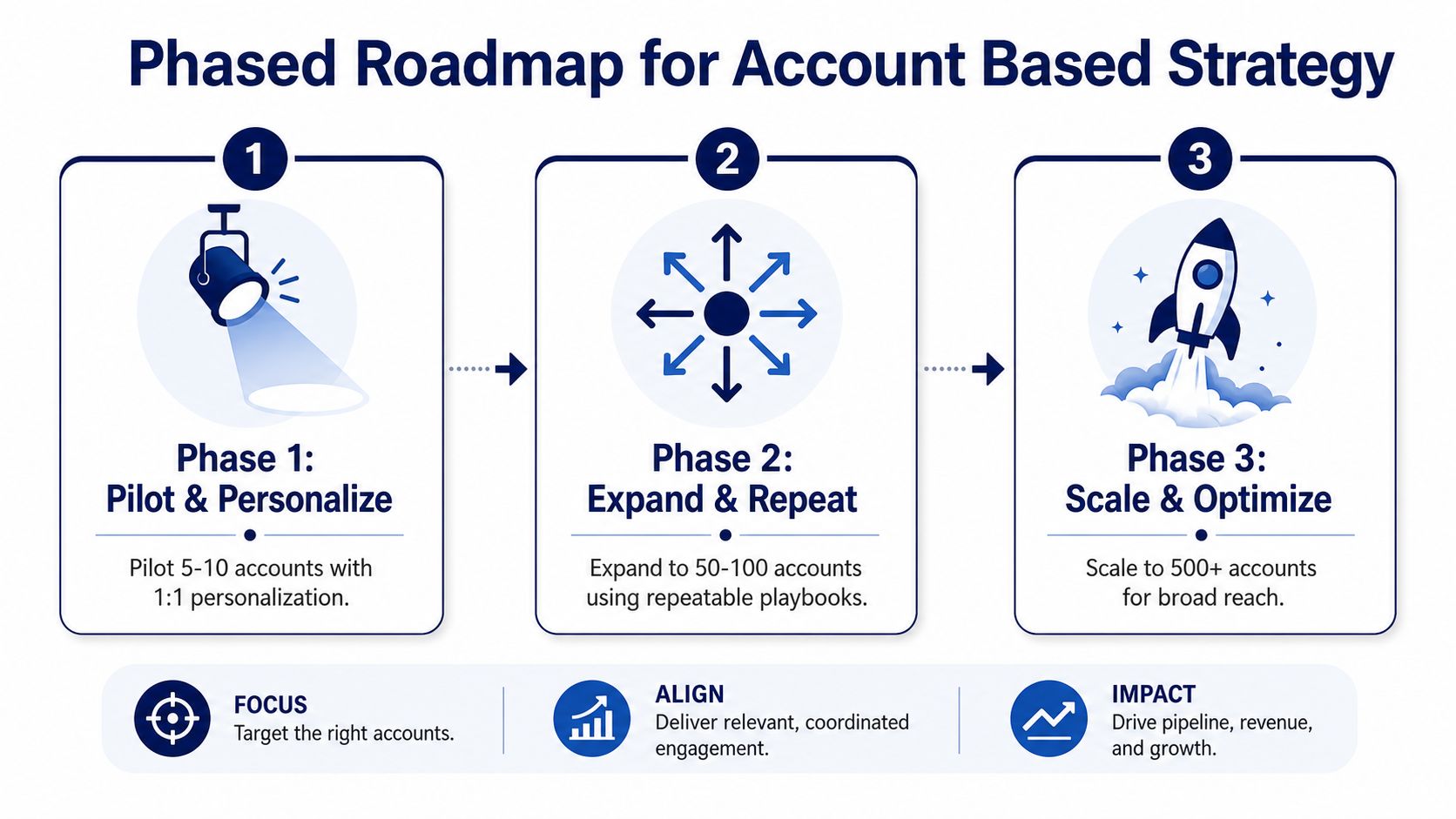
Organizations often hinder their ABM efforts by scaling prematurely. They build a large account list, launch broad campaigns, and discover too late that they haven't nailed targeting, messaging, or ownership. A phased rollout works better because it lets the team prove the motion before expanding it.
Successful programs often follow a clear progression. 1:1 pilots start with 5–10 accounts, ABM Lite expands to 50–100 accounts, and programmatic ABM scales to 500+ accounts, based on Pepper Effect's ABM framework.
Phase 1 pilot and personalize
Start small. Choose a handful of strategic accounts that clearly fit your ICP and have visible change signals. This phase is about learning, not coverage.
The team should produce a full account plan for each account. That usually includes stakeholders, business context, likely pain points, active triggers, and coordinated outreach.
A good Phase 1 checklist looks like this:
- Choose carefully: Pick accounts with clear fit and a realistic path to engagement.
- Build manually: Write custom briefs and custom messaging.
- Review weekly: Look at account movement, message quality, and stakeholder response.
- Document patterns: Capture which triggers and talk tracks resonate.
This is a strong point to use an account planning template so every rep works from the same structure.
Phase 2 expand and repeat
Once the team knows what works, it can move into a repeatable 1:few motion. Accounts are grouped by shared characteristics such as industry, operational maturity, or strategic initiative.
The emphasis changes here. You still personalize, but you stop reinventing the process every time. Instead, you create playbooks.
Examples of repeatable assets include:
- Trigger-based outreach frameworks by account type.
- Executive messaging angles by persona.
- Shared call opening lines and objection handling.
- Marketing content mapped to common account conditions.
Phase 3 scale and optimize
Programmatic ABM is where automation becomes essential. At this stage, the goal is broad coverage without generic messaging. The team needs systems that can monitor change, prioritize accounts, and route context into outreach workflows.
The move to this phase should happen only when three conditions are true:
- The ICP is stable enough to score accounts consistently.
- The team has proven messaging patterns that can be reused.
- Ownership and follow-up rules are clear.
Don't scale a messy process. Standardize it first, then automate it.
That sequence protects quality. It also helps leaders avoid the common trap of buying technology before the operating model is ready.
Real World Playbooks for Account Based Strategy
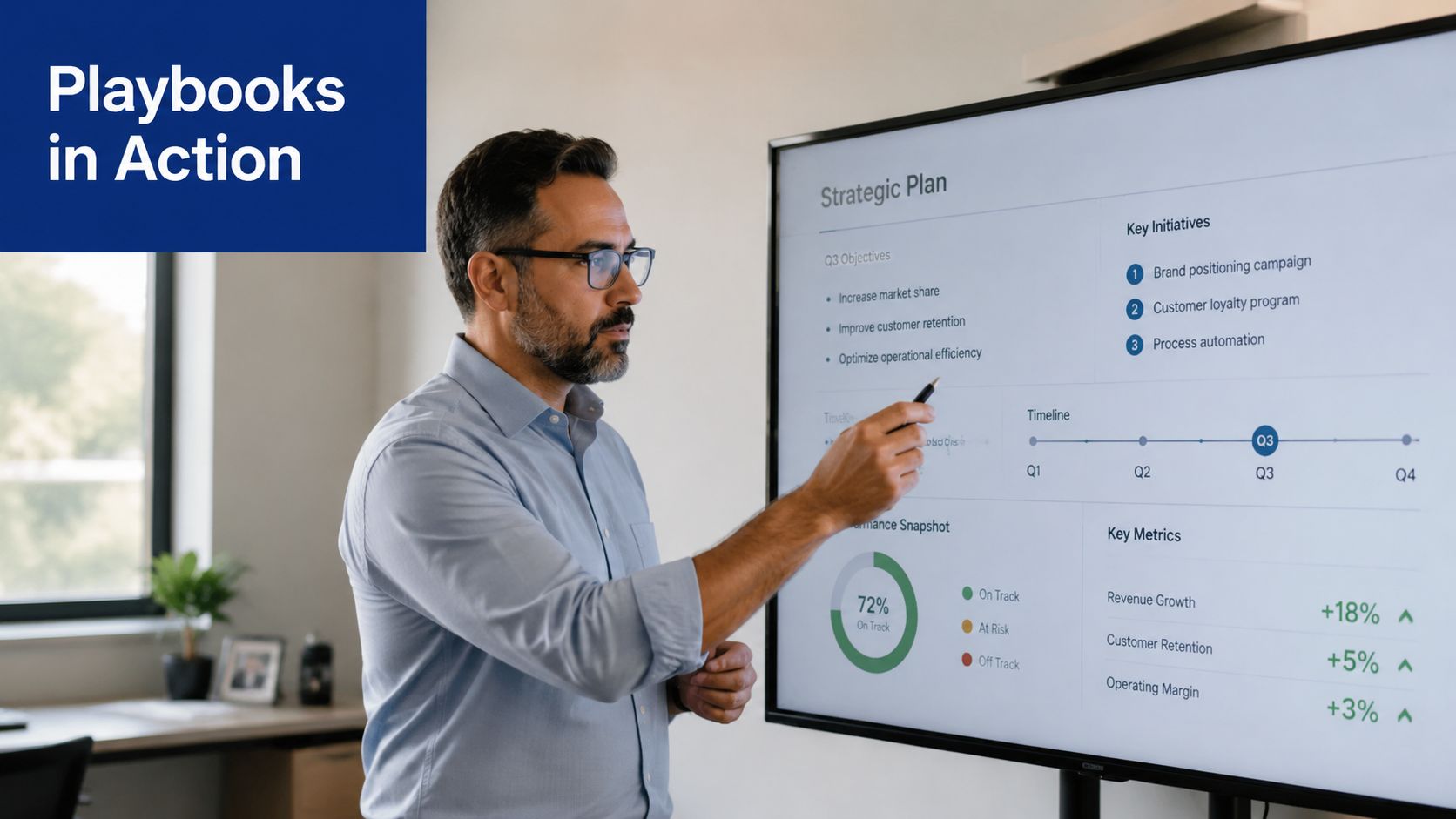
Playbooks become useful when they sound like work your team could do next week. Two examples show how this looks in practice.
A 1 to 1 play around a new CRO hire
A SaaS company on your target list hires a new CRO. That's not just a personnel change. It often signals fresh expectations around forecasting, pipeline quality, territory design, or sales process discipline.
Your AE and SDR don't need a long campaign. They need a sharp point of view.
A sample email opener could look like this:
Noticed the new CRO appointment. Leadership changes like that often come with pressure to tighten pipeline visibility and improve consistency across the sales org.
A short call opener might be:
- Rep: “I'm reaching out because new commercial leadership usually reviews where pipeline confidence breaks down. I thought it was worth comparing notes on that transition.”
- Buyer: “What made you think that's relevant for us?”
- Rep: “The timing of the hire suggests change is already underway, and teams often want a faster read on coverage and rep execution during that window.”
The decision criteria are simple. Run this play when the role is senior, the change aligns with your value proposition, and you can connect the event to a specific business issue.
A 1 to few play for a vertical cluster
Now take a group of healthcare technology companies dealing with growth and operational complexity. They may not share identical situations, but they often share enough context to support a coordinated 1:few motion.
Your playbook might include:
- Segment message: Connect your solution to operational consistency during expansion.
- Content asset: A short briefing or webinar designed for commercial scale-up challenges.
- Sales follow-up: SDR outreach that references the broader pattern, then narrows to the company's own context.
- Executive touch: A note from a sales leader to senior buyers at the highest-priority accounts.
The message should still sound specific. Instead of saying “many firms in your industry are changing,” say something like, “Teams in healthcare tech often hit process strain when growth outpaces manager visibility and coordination.”
That keeps the play relevant without pretending each account is in the exact same situation.
How Salesmotion Enables Account Based Strategy
Many ABM programs stall at the same point. The team can name the right accounts, but they still struggle to decide what changed, who should act, and how to respond without slowing everything down.
The missing piece is an operating layer that turns raw account signals into next actions. Earlier in the article, we established why account intelligence matters. The harder question is how to put it to work in a daily workflow that sales and marketing teams will readily use.
What an operational stack should do
A useful account based system works like an air traffic control layer for revenue teams. It does not replace judgment. It helps teams see which account movements matter, route them to the right people, and respond while the timing is still good.
For that to happen consistently, the stack needs to support three jobs.
| Job to be done | What the system should produce |
|---|---|
| Research accounts | Structured briefs on initiatives, stakeholders, and risks |
| Monitor change | Timely alerts on events that matter |
| Generate action | Outreach suggestions tied to actual account context |
If one of those pieces is missing, the workflow breaks. Reps go back to manual research, managers lose confidence in prioritization, and outreach quality varies from person to person.
Where Salesmotion fits
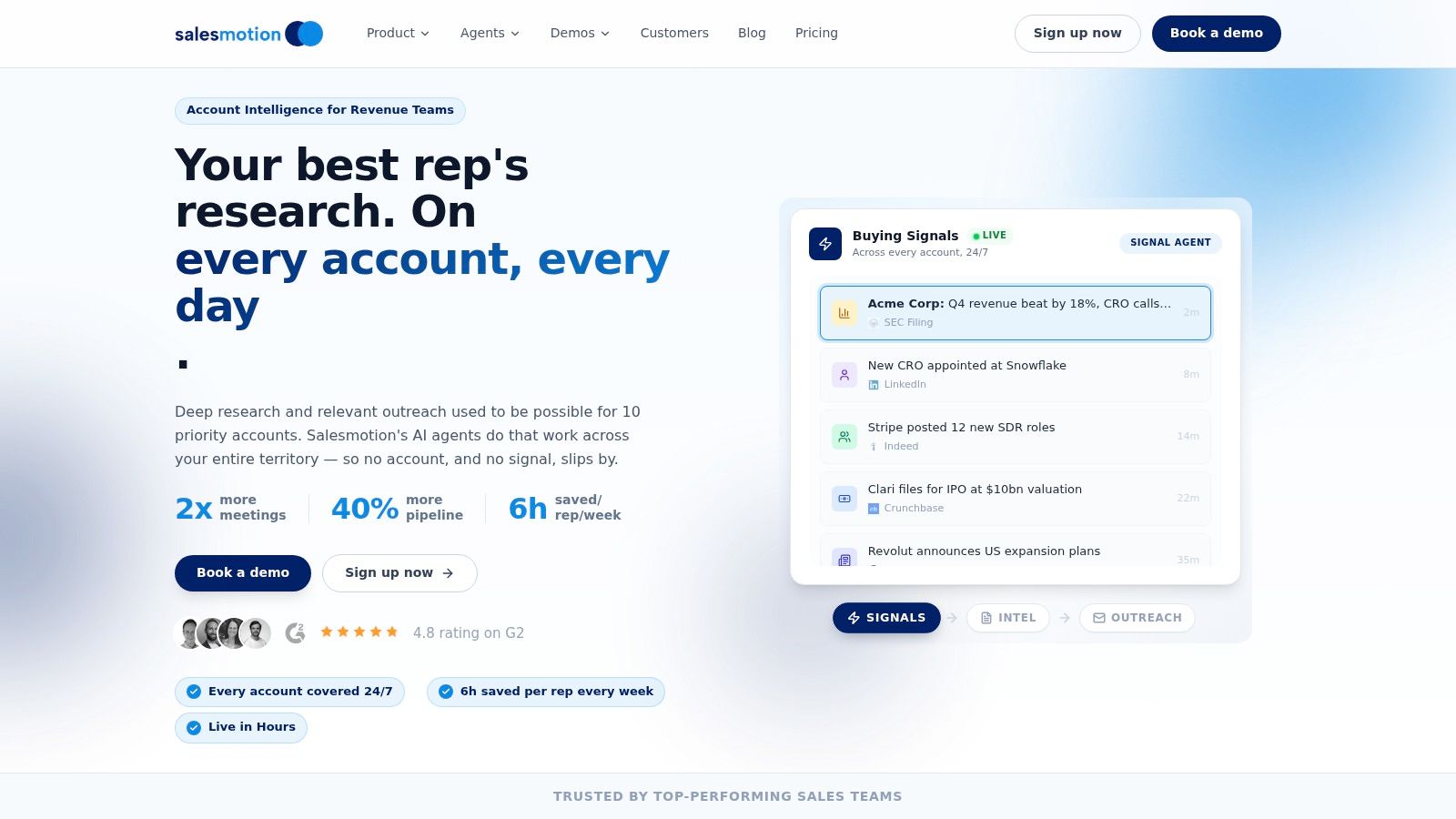
Salesmotion is built around that execution gap. It uses three AI agents that map to the work revenue teams need to do after they have chosen target accounts.
- Research Agent: Builds structured account briefs from public sources so reps can quickly understand business context, likely priorities, and relevant stakeholders.
- Signal Agent: Monitors target accounts for changes worth acting on, such as leadership moves, hiring patterns, or strategic announcements.
- Prospector Agent: Uses that context to draft personalized outreach sequences that reps can review, adjust, and send.
The practical value is the handoff between those steps. Research creates context. Signals create timing. Sequence drafts create action. That progression matters because ABM usually fails in the gaps between those activities, not in account selection alone.
A useful analogy is a relay race. One runner on its own does not win the event. The baton has to pass cleanly from research to prioritization to outreach. Salesmotion is designed to make that handoff easier to run as a repeatable process.
How this supports automated ABM workflows
This matters most for teams trying to operationalize real-time signals, not just collect them.
For example, say a target account posts a cluster of frontline manager openings after hiring a new revenue leader. A basic signal tool may surface the hiring activity. A working ABM system should go further. It should connect that event to the account brief, identify the likely stakeholders, and give the rep a draft message tied to the business issue behind the change.
That is the bridge many ABM guides skip. They explain targeting. They explain personalization. They spend less time on how a signal becomes an actual workflow inside the revenue team.
Salesmotion addresses that gap by linking signal detection to downstream action. Instead of treating research, monitoring, and outreach as separate tasks, it supports them as one motion.
Why this matters operationally
The benefit is not only speed. It is repeatability.
When every rep works from the same account brief structure, the same trigger logic, and the same signal-to-outreach process, managers can inspect quality more easily and teams can scale what works. That reduces the common ABM problem where strong execution depends on a few highly experienced reps doing extra homework.
Strong account based strategy depends on a system that helps teams notice change, interpret it correctly, and respond with context. Salesmotion supports that operating model by turning real-time account movement into a workflow the team can run.
Next Steps and Key Takeaways
Account based strategy gets results when the team treats it like an operating system, not a campaign. The goal is simple: notice meaningful account change, decide what it means, and route the next action without forcing every rep to start from scratch.
A good pilot proves that system in a controlled setting. Start small enough to inspect the work, but specific enough to learn what should trigger action and what should be ignored.
A practical first plan looks like this:
- Choose a pilot group: Select a small set of high-fit accounts where buying signals are easier to interpret.
- Define signal thresholds: Write down which events deserve outreach, which require more research, and which are just noise.
- Build one workflow: Start with a single playbook tied to one recurring trigger, such as leadership changes, hiring spikes, or new market expansion.
- Review every week: Check whether reps contacted the right stakeholders, used the signal correctly, and created conversations that matched the account context.
- Automate in layers: Add routing, alerts, and message support only after the team can execute the manual version consistently.
This progression matters.
Many teams adopt ABM at the strategy level, then get stuck at the workflow level. They know which accounts matter, but reps still waste time deciding when to act, who to contact, and how to connect the signal to a relevant message. That gap is where good programs stall.
The practical takeaway is to fix the handoff between insight and execution. If a signal enters the system, the next step should already be clear. Who owns it? What account context should they see? Which playbook applies? What outreach should happen first? Those are the questions that turn account based strategy from a planning exercise into a repeatable revenue motion.
If your team is already aligned on target accounts but still struggles with timing, prioritization, or message quality, the issue is usually execution design. Salesmotion supports that work by helping teams turn account research and real-time signals into actions reps can run.