According to 6sense’s 2025 Buyer Experience Report, 70% of the B2B buying journey happens anonymously — buyers research solutions, compare vendors, and form shortlists long before they ever contact sales. Even more striking: Forrester research, reported by Digital Commerce 360 that 92% of buyers already have a vendor in mind before their buying process formally begins. If your team isn’t detecting intent signals early, you’re already too late.
Intent-based targeting solves this. Instead of blasting outreach to accounts that match your ICP on paper, you focus exclusively on accounts showing real-time evidence they’re in-market — through web research behavior, job postings, funding events, earnings commentary, and other public signals. This guide breaks down how to build an intent-based targeting strategy that generates measurable pipeline.
Why Traditional Targeting Fails (and Intent Fixes It)
Traditional B2B targeting relies on static firmographics — company size, industry, location. The fatal flaw: timing. You reach accounts that fit your profile but have zero immediate need. The result is low engagement, wasted SDR hours, and bloated pipeline that never converts.
Intent-based targeting flips this. Instead of asking "who could buy from us?" it asks "who is looking to buy right now?"
How Intent-Based Targeting Works
Intent-based targeting operates by tracking buying signals — the digital footprints and real-world events that indicate a company is in an active buying cycle. These signals fall into two categories:
- First-party signals: Actions on your own properties (pricing page visits, demo requests, content downloads)
- Third-party / "dark funnel" signals: External events detected through monitoring — news, earnings calls, job postings, funding rounds, regulatory changes, and topic-level web research
6sense’s research shows that 95% of the time, the winning vendor is already on the buyer’s Day One shortlist, and four out of five deals are won by the "pre-contact favorite." This means intent-based targeting isn’t just about finding in-market accounts — it’s about being visible and relevant during that anonymous research phase so you make the shortlist.
For companies in specialized sectors like biotech or enterprise software, this means an alert about a clinical trial milestone or a major ARR announcement can trigger timely, relevant outreach that dramatically boosts pipeline velocity.
Shifting from Outdated Methods
The fundamental change here is moving from assumptions to evidence. Instead of guessing which accounts might be interested, you act on clear indicators that they are. You can learn more about how to identify and use these indicators in our comprehensive guide to B2B intent data. This allows your team to stop wasting valuable time on accounts that simply aren't a good fit or aren't in the market.
To make this distinction crystal clear, let's break down the core differences.
Traditional Targeting vs. Intent-Based Targeting
| Attribute | Traditional Targeting (Demographic/Firmographic) | Intent-Based Targeting (Behavioral) |
|---|---|---|
| Focus | "Who could buy?" (Based on profile) | "Who is buying now?" (Based on actions) |
| Data Type | Static (company size, industry, location) | Dynamic (web research, job postings, events) |
| Timing | Inaccurate; outreach is often premature or late | Precise; outreach aligns with the buying cycle |
| Relevance | Low; messaging is generic and broad | High; messaging is specific and contextual |
| Efficiency | Low; high volume of outreach, low engagement | High; focused effort on qualified accounts |
The table above highlights the core evolution: moving from a broad, inefficient model to one that's sharp, timely, and far more effective.
Adopting this approach delivers immediate, tangible benefits:
- Solves Weak Outreach: Every conversation is backed by a credible, timely reason to connect, eliminating the "just checking in" email.
- Improves Efficiency: Sales reps spend less time on manual research and more time engaging accounts that have already raised their hands.
- Increases Relevance: Messaging is tailored to the specific context or trigger event, making it far more impactful and likely to get a response.
Ultimately, intent-based targeting empowers your revenue teams to be more strategic. They focus their energy where it will have the greatest impact and ensure they are the first to the table when a new opportunity arises.
See real-time buying signals in action
Salesmotion tracks actual trigger events — news, earnings, hiring, funding — across your accounts. Not black-box intent scores.
How to Decode Your Buyer's Hidden Signals
To execute intent-based targeting effectively, you need to become a digital detective. It's about learning to spot the clues your future customers leave behind. These "buying signals" are the breadcrumbs that show an account is shifting from casual research to active evaluation. They provide the critical “why now?” that turns a cold email into a timely, relevant conversation.
These signals fall into two main buckets: interactions with your brand and events happening out in the public domain. You need both to get a complete picture of an account's readiness to buy. This is the big shift away from guesswork and toward precision. Instead of broadcasting to everyone, you're zeroing in on the accounts that are actually in-market.
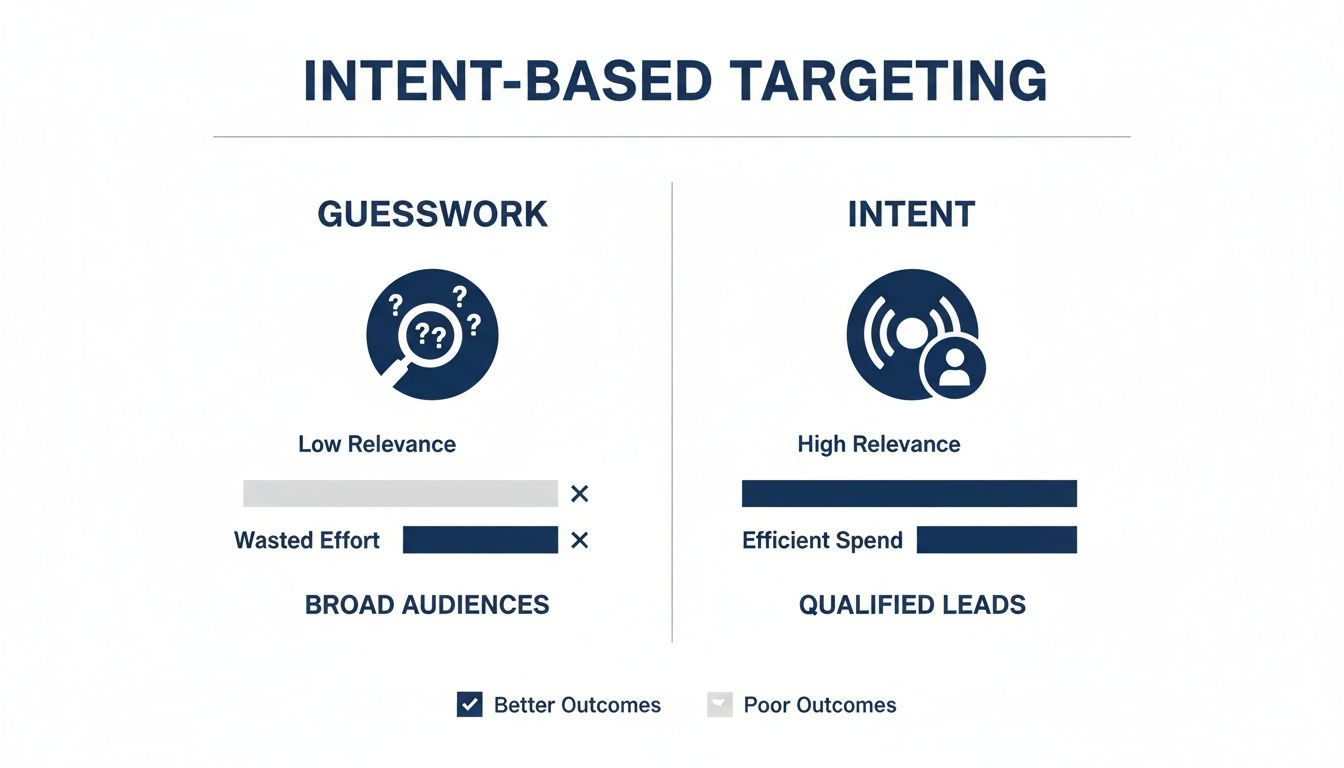
Focusing on these active signals lets you trade broad, inefficient tactics for a sonar-like approach that pinpoints exactly who needs your help, right now.
First-Party Signals: The Direct Clues
First-party signals are the most direct clues you can get. These are interactions someone has directly with your company's website, content, or product. Think of it as someone knocking on your virtual front door.
- Website Behavior: A prospect visiting your pricing page repeatedly is a classic signal. The same goes for someone spending significant time on specific feature pages or diving deep into your customer stories. It shows they're moving past casual curiosity.
- Content Downloads: When someone from a target account downloads a technical whitepaper, a detailed pricing guide, or a long-form case study, they aren't just browsing. They are actively educating themselves for a purchase, which is a much stronger signal than simply reading a top-of-funnel blog post.
- Direct Engagement: This is the loudest signal of all. When someone requests a demo, starts a free trial, or fills out a "contact sales" form, they are literally raising their hand for help. These are your hottest leads and demand immediate, thoughtful follow-up. For a deeper dive, check out our guide on what is a buying signal in sales.
The beauty of first-party signals is that you own all the data and the context. You know precisely what they looked at and when, giving you the perfect opener for a personalized conversation.
Uncovering "Dark Funnel" Signals
While first-party signals are powerful, they only show you part of the picture. The real competitive advantage comes from the "dark funnel" — all the research and buying activity that happens outside of your properties. According to 6sense, if buyers take 10 months to buy, they'll spend seven months researching anonymously. If they take 20 months, they'll research anonymously for 14 months. The ratio is consistent: 70% of the journey is invisible to vendors who only track their own website.
Forrester's 2026 B2B predictions warn that 61% of purchase influencers are already using private generative AI engines to support buying decisions — making traditional keyword-based intent tracking even less reliable, since buyers increasingly research through AI interfaces that leave no web trail.
Modern account intelligence platforms scan public sources — news, earnings calls, SEC filings, job postings, funding announcements, podcasts — to surface these hidden triggers. The difference from traditional intent data: these are verifiable events, not opaque topic scores.
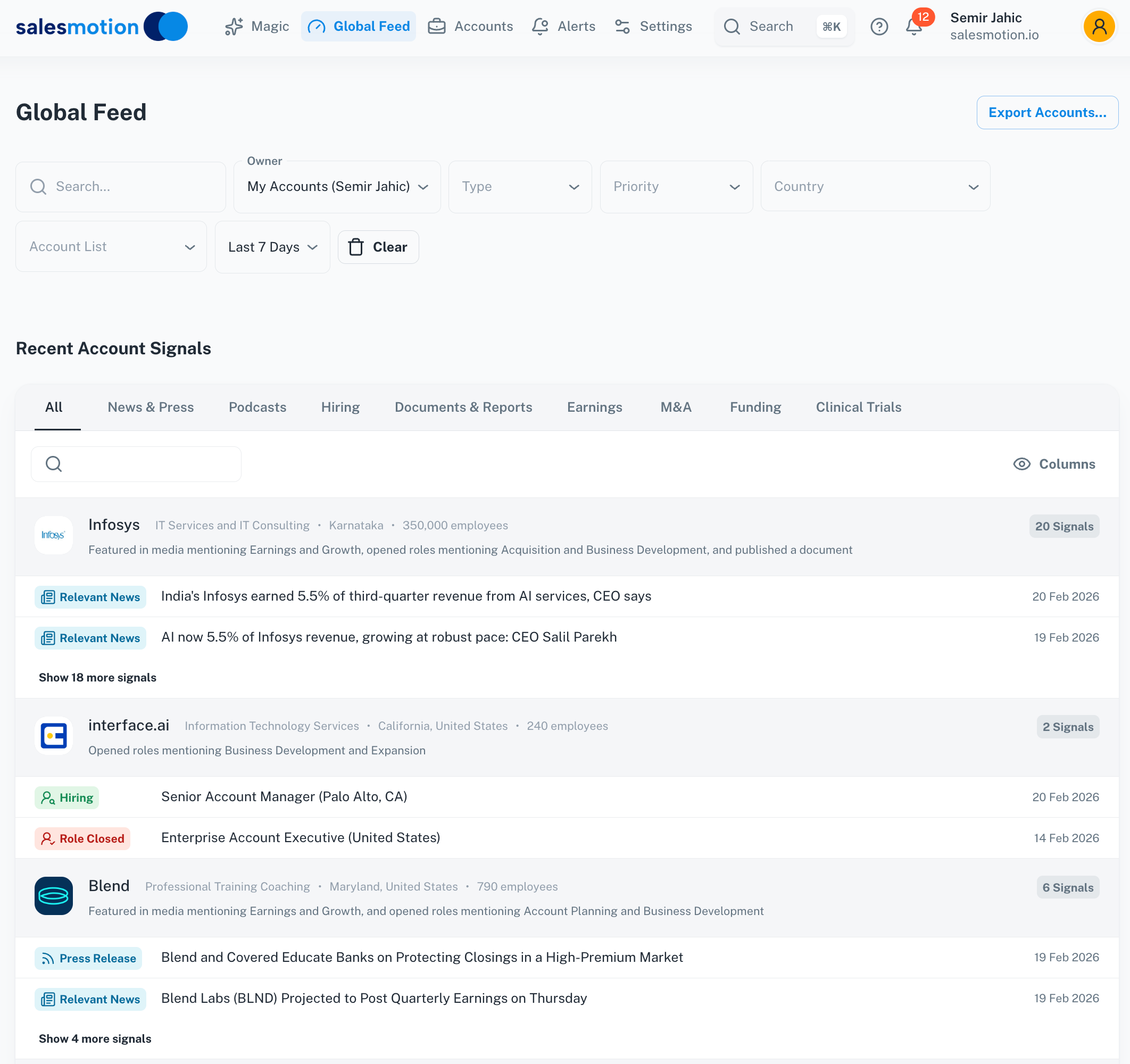 Salesmotion's Global Feed surfaces real-world trigger events — earnings calls, executive hires, funding rounds, and competitive moves — across all target accounts in real time.
Here are real-world examples of dark funnel signals in action:
- A New Leader is Hired: A company brings on a new Chief Information Security Officer (CISO). This almost always kicks off a full review of their security stack, creating a perfect window for cybersecurity vendors to get a meeting.
- A Fresh Round of Funding: A biotech firm announces they've closed a Series B round. For any contract research organization (CRO), this is a massive green light. It means the company now has the cash to push forward with clinical trials.
- A New Regulation Drops: The government announces a new rule impacting data privacy. For compliance software companies and consultants, this is a powerful trigger to engage every single company in that industry.
By tracking these external triggers—from press releases and LinkedIn updates to podcasts and industry news—you can turn the firehose of public information into a prioritized list of real sales opportunities. This is the heart of a successful intent-based targeting strategy.

“We're no longer fishing. We know who the right customers are, and we can qualify them quickly. Salesmotion has had a direct impact on pipeline quality.”
Andrew Giordano
VP of Global Commercial Operations, Analytic Partners
Turning Signals into Actionable Workflows
Knowing a potential customer is interested is only half the battle. The real value of intent-based targeting comes from turning that knowledge into swift, decisive action. This section is your playbook for building practical, automated workflows that connect the dots between a buying signal and a sales conversation.
The goal here isn't to add another complicated tool to your tech stack. It's to build a streamlined process that eliminates manual research and lets your reps focus their time on accounts that are actually showing they're ready to talk.
This is the very essence of signal-based selling.
Always-On Account Monitoring
Imagine your sales team having a 24/7 radar for every single one of their target accounts. That’s the foundation of a modern intent workflow. Instead of reps losing hours each morning digging through news sites and LinkedIn, an automated system does the heavy lifting for them.
This "always-on" monitoring system constantly tracks key signals—like a new funding announcement, a key executive hire, or a mention in the press. When a relevant signal pops up for a named account, it automatically triggers an alert.
This isn’t about just getting news updates. It's about delivering curated, actionable insights directly into the tools your team already uses, like Slack and your CRM. For example, an alert might say: "Target Account 'Innovate Corp' just hired a new CISO. This is a prime opportunity to introduce our cybersecurity solution."
This simple workflow transforms your reps from researchers into strategists. They start their day with a prioritized list of opportunities, each with a clear “why now.”
From Signal to Tailored Outreach in Minutes
Once a signal is detected, the next step is to act on it—fast and with relevance. The best workflows automate the most time-consuming parts of this process, allowing reps to prepare for a meeting in minutes or craft highly personalized outbound messages.
Here’s how this breaks down into specific, value-driven workflows:
- Meeting Prep in Minutes: An AI-generated brief automatically pulls together account context and the specific signal — key players, business pains related to the trigger, and tailored talking points. Analytic Partners saw an 85% reduction in research time after implementing this approach, with reps getting 80-90% of what they need in 15 minutes.
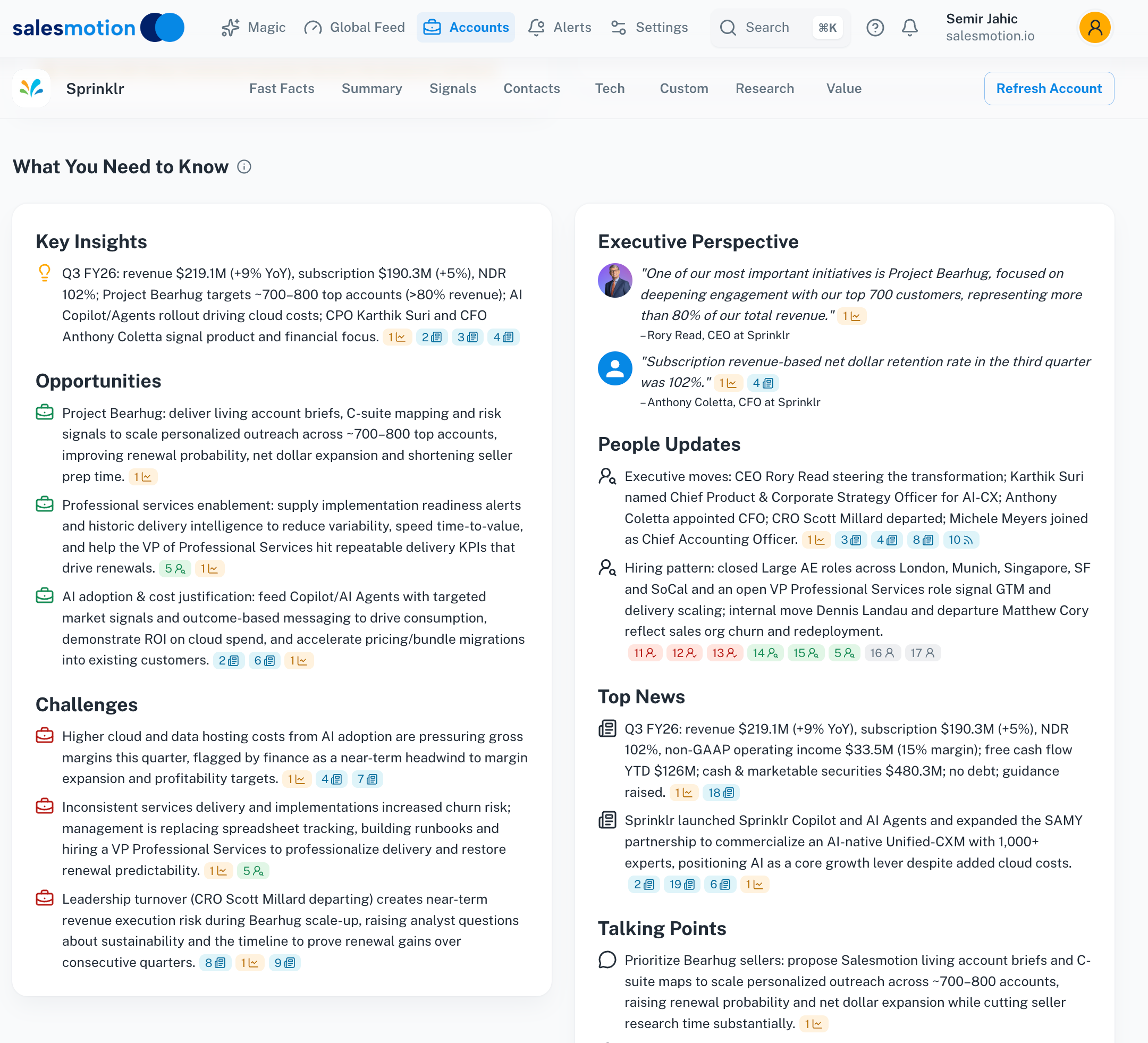 One-click account briefs: AI-generated summaries with strategic context, key initiatives, and source-backed talking points ready for outreach.
- Value-Based Outbound: Forget generic templates. Outreach is built around the specific intent signal. For example, if a company is hiring a dozen new software developers, your outreach can directly address the challenges of onboarding and scaling engineering teams.
- Trigger-Based Sequences: A powerful workflow is setting up automated sequences that launch the moment a specific signal is detected. A signal showing a competitor's customer is unhappy could automatically trigger a multi-touch sequence that highlights your key differentiators.
Once you've identified key buyer signals, integrating these insights into advanced Account-Based Marketing (ABM) strategies can further refine your targeting and engagement. These workflows ensure your team's first touchpoint is always contextual and valuable.
By building these practical workflows, you move intent-based targeting from a high-level concept to a core part of your daily sales motion. It’s about creating a system where every signal automatically becomes a clear, actionable next step for your revenue team.
Real-World Examples of Intent-Based Targeting
Theory is helpful, but seeing intent-based targeting in action is what really makes the strategy click. The true power of this approach comes from turning a real-world event into a timely, relevant sales conversation. Let's break down how this works across a few key industries.
Each scenario follows a simple but powerful framework:
- The Signal: The specific, verifiable event that points to a potential need.
- The Insight: The "so what" behind the signal—why this event actually matters to a seller.
- The Action: The precise, relevant outreach that follows.
This framework turns abstract data into a clear playbook for your revenue team.
Life Sciences and Healthcare
The life sciences sector runs on long development cycles, regulatory milestones, and large capital investments. For companies selling into this space, timing is everything. A contract research organization (CRO) can't afford to engage a biotech firm six months too early or two months too late.
Here’s how intent-based targeting creates the perfect opening:
- The Signal: A mid-stage biotech company issues a press release announcing they've successfully completed Phase II clinical trials for a new drug and have secured $75 million in Series C funding to advance to Phase III.
- The Insight: This is a massive buying signal. The funding validates their progress and gives them the cash they need to scale up for larger, more complex trials. The company now has a budget and an urgent need for a CRO partner with proven Phase III experience and capacity.
- The Action: A sales rep at a CRO immediately reaches out. Their email doesn't just say, "Congrats." It says, "Saw the great news on your successful Phase II and recent funding. As you prepare for Phase III, many teams face challenges with patient recruitment at scale. Our work with [Similar Company] helped them accelerate their timeline by 22%."
This is no longer a cold call; it's a strategic consultation based on a clear business need.
B2B SaaS and Enterprise Software
In the fast-moving world of SaaS, companies constantly evolve their tech stacks, teams, and strategies. These changes create openings for new vendors, especially when a competitor's customer shows signs of dissatisfaction or a strategic shift.
Intent-based targeting gives you a "digital sixth sense" to spot these opportunities before they become public knowledge. It’s about detecting the subtle ripples that suggest a bigger wave is coming.
Let's look at an example for a cybersecurity platform:
- The Signal: A major enterprise, known to be a flagship customer of a competing cybersecurity vendor, posts several new senior-level job descriptions on LinkedIn. The roles are for "Cloud Security Architect" and "Zero Trust Implementation Lead," and the descriptions mention building a new security framework "from the ground up."
- The Insight: This is a classic "rip and replace" signal. A company doesn't hire senior architects to build a new framework from scratch if they're happy with their current provider. They are clearly planning a major strategic pivot, and the incumbent solution is no longer meeting their needs.
- The Action: An account executive reaches out to the newly hired CISO or a relevant VP. The message is tailored: "Noticed your team is expanding its cloud security and Zero Trust expertise. We recently published a guide on migrating from legacy security models to a cloud-native framework, which might be a helpful resource for your new architects."
This approach positions the salesperson as a helpful expert, not just another vendor trying to book a demo.
IT Services and Consulting
For IT service providers and systems integrators, the biggest deals are tied to large, complex corporate projects. Winning these contracts depends on demonstrating deep competence and getting in front of decision-makers before the formal RFP process kicks off.
Consider this scenario for a global systems integrator:
- The Signal: A large manufacturing company announces in its quarterly earnings call that it has acquired a smaller, regional competitor. The CEO explicitly states that a key priority for the next 18 months is to "integrate and streamline all business-critical systems," including their separate ERP platforms.
- The Insight: This is a direct signal for a massive, multi-million-dollar integration project. The company will need a partner with deep experience in post-merger ERP consolidation, data migration, and change management. They have a defined timeline and a clear business objective.
- The Action: The sales team doesn't just send a generic capabilities deck. They craft a point of view, referencing a case study where they managed a similar post-merger integration for another industrial giant, highlighting a 30% reduction in operational costs. Their outreach goes to the CIO and Head of Operations, offering a "post-merger integration readiness workshop."
In each of these examples, the outreach is credible, timely, and valuable because it's rooted in a real event. This is the core of effective intent-based targeting: moving from guessing to knowing, and from selling to solving.

“The moment we turned on Salesmotion, it became essential. No more hours on LinkedIn or Google to figure out who we're talking to. It's just there, served up to you, so it's always 'go time.'”
Adam Wainwright
Head of Revenue, Cacheflow
How to Measure the ROI of Your Intent-Based Strategy
A solid strategy delivers results you can measure, and intent-based targeting is no different. To get leadership buy-in, you need to prove its value. This means moving past vanity metrics like clicks and impressions and focusing on the KPIs that directly connect your team's work to revenue.
You have to show not only that you're reaching the right accounts, but also how it's making your entire revenue operation faster and more efficient. The goal is to show a clear return on investment by tracking metrics that highlight speed, efficiency, and real business impact.

Beyond Vanity Metrics to Core Business Impact
Traditional marketing dashboards often get cluttered with metrics that don’t tell the whole story. A successful intent-based program, by contrast, zeroes in on the KPIs that revenue leaders genuinely care about—the ones that measure the direct impact on pipeline and sales productivity.
- Intent-to-Opportunity Velocity: How long does it take for a buying signal to turn into a qualified sales opportunity? A shorter cycle here is a direct sign that your team is acting on relevant signals faster, beating competitors to the punch.
- Preemptive Engagement Rate: This tracks how often you engage an account before they formally enter a buying process (like requesting a demo). A high rate proves you’re successfully identifying and acting on those early-stage "dark funnel" signals.
- Pipeline Coverage from Intent-Sourced Accounts: What percentage of your total sales pipeline comes from accounts that were first flagged by intent data? This directly ties your strategy to revenue creation.
These metrics draw a straight line from your intent-based activities to tangible business outcomes, making the value undeniable.
An often-overlooked but powerful metric is the reduction in rep research time. By automating signal monitoring, you can reclaim hours of manual work for each sales rep every week. That translates directly into a significant productivity gain and a hard-dollar ROI.
To truly understand the impact, you need a clear way to track these essential metrics. The table below summarizes the key performance indicators that will help you measure the success of your intent-driven efforts.
| Key Performance Indicators for Intent-Based Targeting | ||
|---|---|---|
| KPI | What It Measures | Why It Matters for Revenue Leaders |
| Intent-to-Opportunity Velocity | The time it takes for an account showing intent to become a qualified sales opportunity. | A shorter cycle means your team is faster and more efficient, engaging prospects before competitors do. |
| Preemptive Engagement Rate | The percentage of accounts engaged before they make a formal inquiry (e.g., demo request). | This proves you are successfully identifying and acting on early, "dark funnel" buying signals. |
| Pipeline Coverage from Intent-Sourced Accounts | The portion of your sales pipeline generated from accounts identified through intent data. | Directly connects your intent strategy to pipeline creation and future revenue. |
| Reduction in Rep Research Time | The decrease in time sales reps spend manually searching for account insights and signals. | A direct productivity gain that frees up reps to spend more time selling, providing a clear ROI. |
| Win Rate on Intent-Sourced Deals | The win rate for deals that originated from intent signals compared to other sources. | Demonstrates that intent-driven leads are higher quality and more likely to close. |
| Average Contract Value (ACV) | The average deal size for customers sourced through intent data versus other channels. | Shows whether intent data helps you land larger, more strategic accounts. |
By tracking this mix of speed, efficiency, and revenue-focused KPIs, you can build a comprehensive picture of how intent-based targeting is driving real growth.
Running a Controlled Test to Prove the Lift
One of the best ways to build a bulletproof business case is to run a controlled A/B test. This approach removes guesswork and gives you concrete evidence of the uplift your intent-based targeting strategy provides.
Here’s a simple framework to get you started:
- Create Two Groups: Divide a sales territory or a team of reps into two groups. Group A (the test group) will get intent-based workflows and alerts. Group B (the control group) will stick with their existing prospecting methods.
- Run for a Defined Period: Let the test run for a full sales quarter. This gives you enough time to gather meaningful data and account for longer deal cycles.
- Measure and Compare: At the end of the period, compare the performance of both groups across your key metrics.
When you analyze the results, focus on the differences in win rates, deal velocity, and average contract value between the two groups. Presenting data that shows Group A had a 15% higher win rate and a 20% shorter sales cycle provides irrefutable proof that your strategy is working. This data-driven approach is exactly how you secure buy-in and justify more investment in your program.
Building Your Intent-Based Targeting Stack
An intent-based targeting strategy needs three components: signal detection, account context, and activation. Here’s how to assemble the stack:
1. Signal Detection Layer
You need a system that monitors your target accounts for buying signals. Options range from traditional intent data providers (see our full comparison) that track topic-level web research, to account intelligence platforms that monitor real-world events like earnings calls, hiring patterns, and funding rounds.
The key decision: topic-based intent scores vs. verifiable trigger events. Topic scores tell you an account is researching "cloud security" more than usual. Trigger events tell you the account just hired a new CISO and mentioned "security transformation" on their earnings call. Both have value. Triggers are harder to fake and easier to act on.
2. Account Context Layer
Raw signals without context are noise. When a signal fires, your team needs instant access to: who the key decision-makers are, what the company’s strategic priorities are, what they said on recent earnings calls, and what your competitive position looks like.
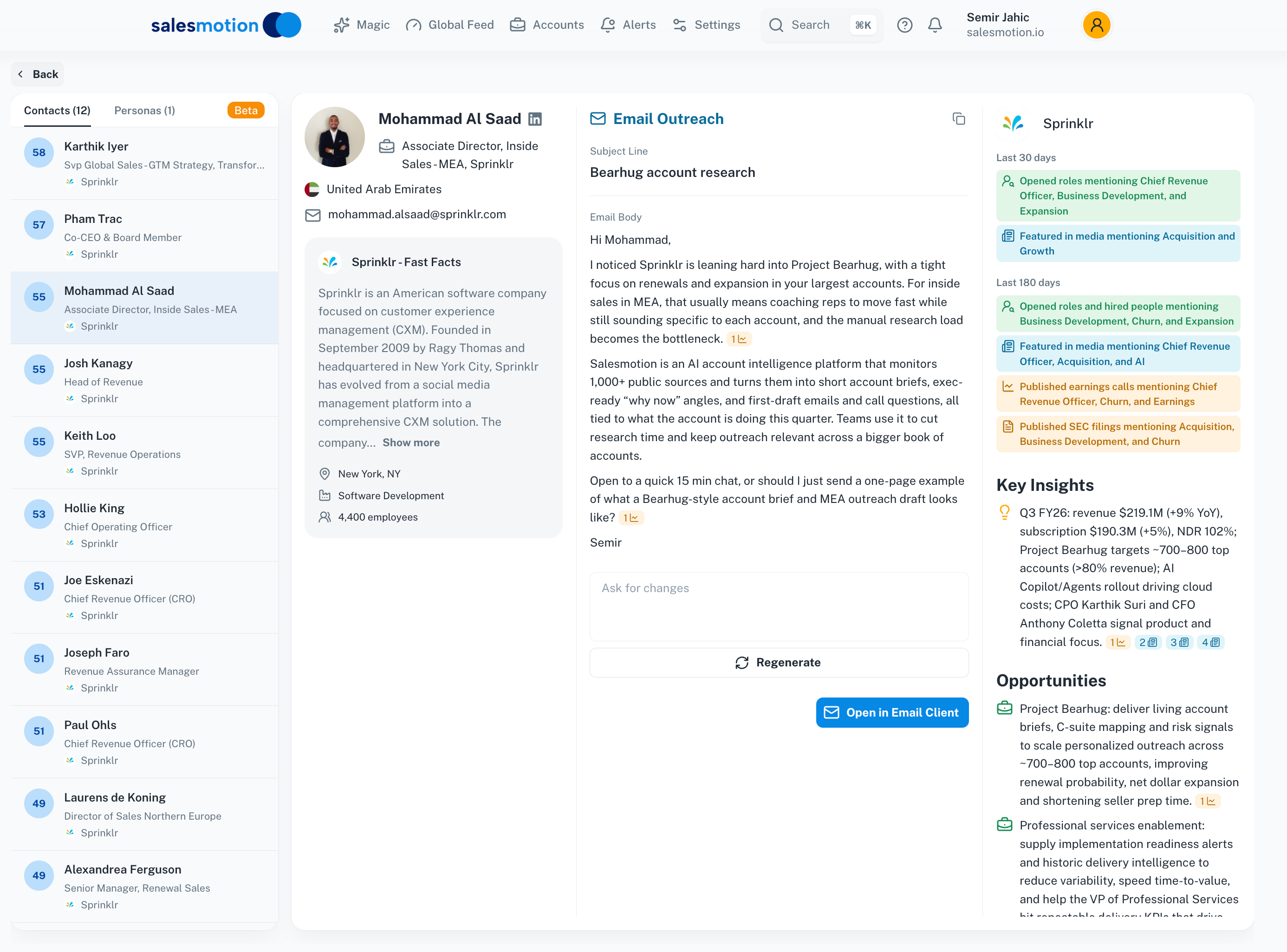 AI-generated outreach that references real account signals — not generic templates. Each message is grounded in verifiable events.
Platforms like Salesmotion automate this context layer. Instead of reps spending hours on Google and LinkedIn before every meeting, the platform aggregates signals from 1,000+ public sources and generates one-click account briefs with source-backed talking points. Cacheflow’s Head of Revenue reports: "The moment we turned on Salesmotion, it became essential. No more hours on LinkedIn or Google to figure out who we’re talking to."
3. Activation Layer
Signals and context need to flow into the tools reps already use — CRM, Slack, email sequences. The fastest path from signal to outreach wins. Key integrations to evaluate:
- CRM enrichment: Signals and account briefs pushed directly into Salesforce, HubSpot, or your CRM
- Slack/Teams alerts: Real-time notifications when target accounts show buying signals
- Email sequences: Signal-triggered outreach with personalized messaging based on the specific event
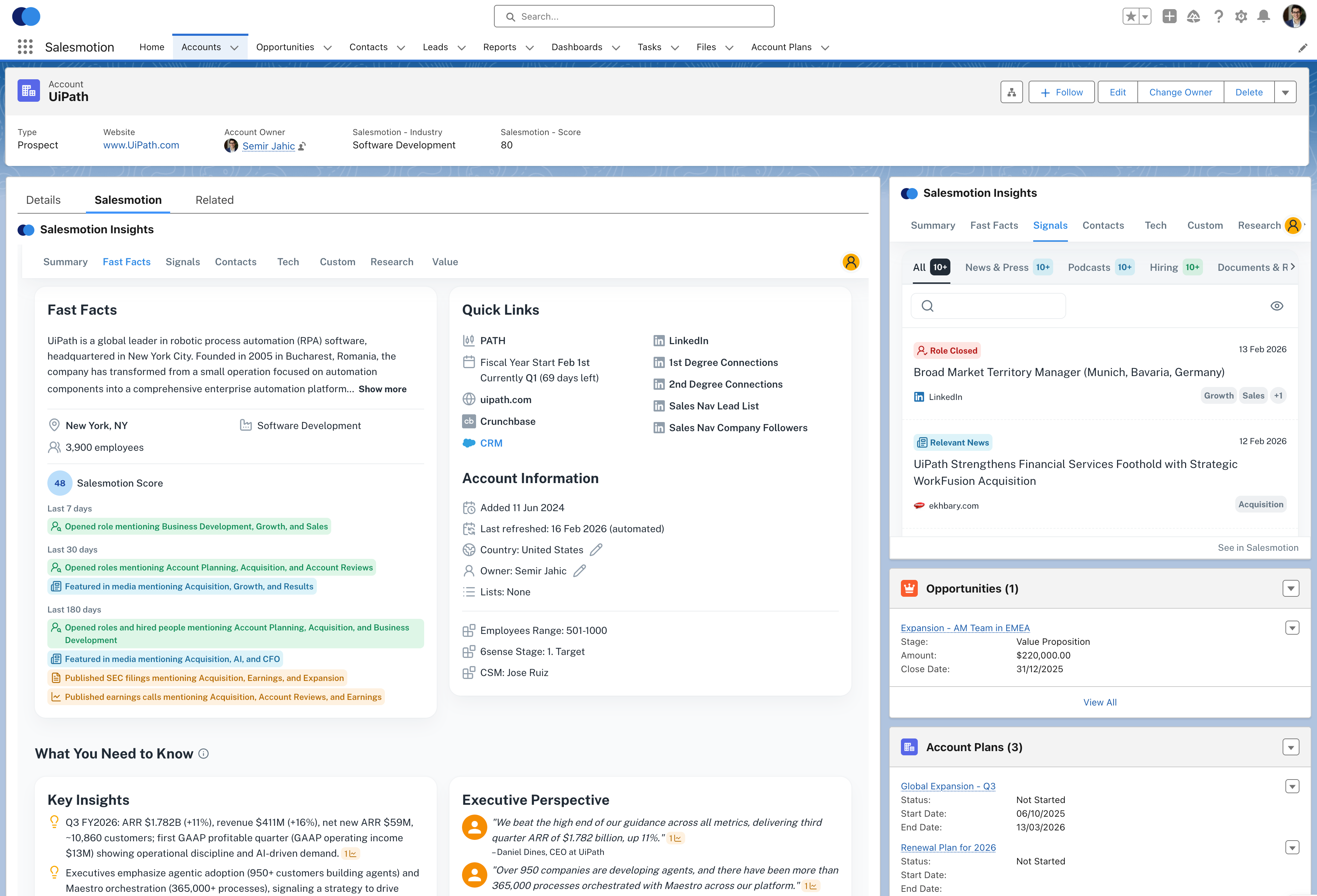 Intent-based targeting works best when signals flow directly into existing workflows — here, account intelligence embedded inside Salesforce.
Your Questions About Intent-Based Targeting, Answered
As you get ready to put an intent-driven strategy into action, a few common questions usually pop up. Here are some straightforward answers to help you move forward with confidence.
How Is This Different from Lead Scoring?
Traditional lead scoring assigns points based on static attributes — industry, company size, job title — and basic actions like an ebook download. Intent-based targeting adds timing. Instead of just asking if an account is a good fit, it asks if they are actively in-market right now.
The data backs this up: 6sense’s research shows that the pre-contact favorite wins the deal roughly 80% of the time. Lead scoring can tell you who fits your ICP. Intent-based targeting tells you who fits your ICP and is actively researching solutions — which is the only combination that justifies a rep’s time.
How Much Data Do We Really Need?
You don't need a mountain of data to get started. You just need the right data. The best approach is to start by combining your own first-party signals (like someone repeatedly visiting your pricing page or requesting a demo) with a small, focused set of third-party signals that are highly relevant to your business.
The key isn't volume; it's relevance. A single, powerful signal—like a target account hiring a new executive who you know from a past role—can be far more valuable than a thousand generic web visits.
Focus on a handful of high-impact triggers first. Prove the value, then expand from there.
What’s the Best Way to Start?
The smartest way to begin is to start small. Don't try to boil the ocean by tracking every possible signal for every single account right out of the gate. Instead, run a controlled pilot program to show a clear return on investment.
- Select a Pilot Team: Choose one of your sales pods or a small, motivated group of account executives.
- Identify Key Signals: Focus on 3-5 high-impact buying signals that scream "opportunity" for your ideal customer profile.
- Define a Workflow: Create a simple, clear process for what reps should do the moment they get a signal alert. No guesswork.
- Measure Everything: Track key metrics like intent-to-opportunity velocity and win rates for the pilot group, and compare them against a control group.
This approach proves the concept and builds the internal momentum you need for a wider rollout. It's also crucial—research shows that 71% of customers now expect personalized interactions, and this focused method is the perfect way to deliver.
Key Takeaways
- 70% of the B2B buying journey is anonymous. Buyers research solutions long before contacting vendors. Intent-based targeting surfaces that hidden activity so you can engage early.
- 92% of buyers start with a vendor in mind. Being visible during the research phase — not just when buyers fill out a form — is what gets you on the shortlist.
- Topic-based intent scores vs. trigger events: Both have value, but verifiable events (earnings calls, hires, funding) are harder to fake and easier to act on.
- The fastest path from signal to outreach wins. Embed intent data directly into CRM, Slack, and email workflows so reps can act in minutes, not days.
- Start with a controlled pilot. Select one sales pod, track 3-5 high-impact signals, and measure intent-to-opportunity velocity against a control group. Prove the lift before scaling.
- For a deep dive on choosing between intent data vendors, see our complete provider comparison with pricing breakdowns for 12 platforms.