Effective sales marketing collaboration is the engine of predictable revenue growth. It's about turning siloed departments into a unified force with shared goals, processes, and metrics. This alignment connects marketing's demand generation efforts directly with sales' closing capabilities, eliminating friction and maximizing impact.
The Real Cost of Sales and Marketing Misalignment

Before we dive into the playbook, let's talk about why this matters. The disconnect between sales and marketing isn't just an internal headache—it's a direct hit to your bottom line.
When these two teams operate in different worlds, the damage shows up everywhere: wasted budgets, missed opportunities, and stalled growth. Marketing burns cash on campaigns to generate leads, but if sales thinks they're junk or lacks the context to follow up, those leads die. The result is a leaky funnel where marketing spend vanishes before it ever turns into revenue.
Wasted Resources and Duplicated Efforts
One of the first signs of trouble is wasted effort. Marketing creates content they believe is brilliant, but if it doesn't align with the conversations sales is actually having, it goes unused.
So, what happens? Sales reps spend precious time creating their own materials. This leads to inconsistent messaging, a diluted brand voice, and a lot of duplicated work. It's not just a time-suck; it kills budgets and morale. Both teams feel their hard work goes unnoticed, which fuels the classic blame game. Marketing points to lead volume, sales complains about lead quality, and nobody wins.
"The financial impact of sales and marketing misalignment represents one of the most significant yet overlooked drains on enterprise revenue."
The Staggering Financial Drain
The numbers are staggering. Research suggests businesses lose roughly $1 trillion annually because their sales and marketing teams operate in silos. This isn't a minor operational hiccup; it’s a massive, systemic problem.
You can dig deeper into these powerful sales and marketing alignment statistics to see the full picture. It's not just about the money lost; it's about the opportunity cost of what you could achieve with true alignment.
Here's where the pain really shows up:
- Inefficient Lead Management: When lead qualification criteria aren't shared, sales wastes time on prospects who are a poor fit, while marketing’s budget is spent attracting the wrong audience.
- Conflicting Customer Messaging: A prospect hears one thing from a marketing campaign and something different from a sales rep. This erodes trust and creates a confusing buying journey.
- Poor Customer Experience: A clunky handoff from marketing to sales creates a jarring experience for the buyer. They feel like they're starting over with every interaction.
Ultimately, a lack of sales marketing collaboration is a self-imposed handicap. It creates internal friction that leads to a weaker market position, lower win rates, and slower growth. In competitive markets, you can't afford this inefficiency.
Building a business case for alignment isn't a "nice-to-have"—it's essential for survival. This guide is your playbook for bridging that gap.
See Salesmotion in action
Take a self-guided interactive tour — no signup required.
Creating a Shared Foundation for Collaboration

Real alignment isn't something you can wish for. It's built on a shared foundation that both teams create, agree on, and protect. This becomes your single source of truth—the playbook that defines how sales and marketing work together.
This isn’t about creating rigid rules that slow everyone down. It’s about building mutual accountability to end the blame game. When everyone is clear on definitions, rules of engagement, and expectations, the focus shifts from internal friction to winning customers.
Jointly Defining Your Ideal Customer
First things first: get both teams in the same room to define your Ideal Customer Profile (ICP) and buyer personas. This is the non-negotiable starting point for any meaningful sales marketing collaboration.
When this work happens in silos, marketing attracts prospects sales can’t close, and sales gets burned out chasing leads that were never a good fit. This one exercise forces a conversation that should have happened long ago. To get a head start, check out our guide with an ideal customer profile template.
A jointly-created ICP is the Rosetta Stone for your revenue teams. It translates marketing's audience data into sales' real-world conversation targets, ensuring everyone speaks the same language.
Sales brings raw, unfiltered truth from the front lines:
- Common Pains: What specific business problems are prospects trying to solve right now?
- Trigger Events: What pushes a prospect from "just looking" to "actively buying"?
- Objections: What are the recurring pushbacks and concerns that need to be addressed?
Marketing enriches this intel with hard data on firmographics, technographics, and engagement patterns. The result is a dynamic, data-backed picture of the exact accounts and people you should be obsessed with. This shared understanding ensures marketing brings in the right crowd and sales knows exactly who they’re talking to and why.
Codifying the Rules with a Service Level Agreement
Once you’ve defined who you're targeting, the next step is to define how you'll work together. This is where a Service Level Agreement (SLA) is indispensable. An SLA is a clear document outlining the specific commitments each team makes to the other.
Think of it as a collaboration contract. It replaces assumptions with a system of mutual accountability. For instance, marketing commits to delivering a certain number of qualified leads, and sales commits to following up within a specific timeframe. No more ambiguity.
A solid SLA should define:
- Lead Handoff Criteria: What exact criteria defines a Marketing Qualified Lead (MQL)? And what makes it a Sales Accepted Lead (SAL)?
- Follow-Up Timelines: How quickly must sales act on a new MQL? What is the required follow-up cadence?
- Lead Nurturing Process: What happens to leads that sales disqualifies? The SLA should map out how they are sent back to marketing for more nurturing.
This table provides a simple framework to get started.
Sample SLA Framework for Sales and Marketing
This template outlines key commitments and responsibilities for marketing and sales to ensure mutual accountability and smooth lead handoffs.
| Commitment Area | Marketing Responsibility | Sales Responsibility | Shared KPI |
|---|---|---|---|
| Lead Qualification | Deliver X Marketing Qualified Leads (MQLs) per month that meet the jointly-defined ICP criteria. | Review 100% of MQLs within 24 hours of assignment to accept or reject with a clear reason. | MQL to SAL Conversion Rate |
| Lead Follow-Up | Provide all relevant context and engagement history for each MQL within the CRM. | Initiate first contact with all Sales Accepted Leads (SALs) within 4 hours of acceptance. | Average Lead Response Time |
| Follow-Up Cadence | N/A | Attempt a minimum of 6 touches (call/email/social) over 10 business days before disqualifying a lead. | SAL to Opportunity Conversion Rate |
| Disqualified Leads | Re-enroll all sales-disqualified leads (e.g., "Not Ready") into appropriate long-term nurture campaigns. | Provide a specific, documented reason for every disqualified lead (e.g., "No Budget," "Bad Timing"). | Lead Re-Engagement Rate |
| Data Hygiene | Ensure all lead data passed to sales is accurate and enriched with key firmographic/demographic info. | Update lead/contact status and notes in the CRM in real-time after each interaction. | CRM Data Integrity Score |
This document removes the gray areas and gives you a clear framework for measuring what's working and what's not. If lead quality dips, you can point to the SLA. If follow-up is slow, the timeline provides an objective benchmark.
For companies serious about this, implementing a revenue operations team structure can be a game-changer. RevOps provides the operational backbone to enforce the SLA and ensure all revenue-generating teams are moving in sync.

“Salesmotion empowers me to cultivate a great buyer experience. I'm able to challenge prospects' thinking and be a trusted consultative seller. A major part of this is Salesmotion insights.”
Austin Friesen
Account Executive, FY25 #1 President's Club, Clari
Unifying Your Teams with Shared Revenue Goals
If you want your sales and marketing teams to act as one unit, you have to measure them that way. It’s time to ditch siloed, activity-based metrics and rally everyone around the only numbers that actually matter to the business.
Real collaboration isn't fueled by meetings; it's fueled by shared accountability for revenue.
When marketing’s success is judged by MQLs and sales is measured solely on calls made, you create friction. Marketing can hit its MQL goal by casting a wide, low-quality net, leaving sales with a pipeline full of duds.
Instead, the entire revenue engine—from the first touchpoint to the final signature—must be aligned around shared outcomes.
Moving Beyond Vanity Metrics
Let’s be honest: the old way of measuring success is broken. A high MQL count means nothing if those leads don't convert. Likewise, a flurry of sales activity is just noise if it doesn’t lead to closed business.
Unified teams focus on KPIs that reflect the health of the entire funnel, not just one piece of it. These are the metrics that force both teams to have skin in the game.
- Pipeline Generated: This is the ultimate team metric. It measures the total value of all sales opportunities created from marketing-sourced accounts, holding both teams accountable for building a healthy pipeline.
- Customer Acquisition Cost (CAC): A blended CAC forces everyone to think about efficiency. It’s a shared responsibility to acquire customers profitably.
- Deal Velocity: This tracks the average time it takes for an account to move from initial engagement to a closed deal. Improving it requires marketing to deliver high-intent leads and sales to engage them effectively.
Focusing on these revenue-centric goals shifts the conversation from "whose fault is it?" to "how can we solve this together?" You can dive deeper into this in our article on key account-based marketing metrics.
Incentivizing True Collaboration
One of the fastest ways to change behavior is to tie compensation to these shared goals. When a portion of the marketing team's bonus is linked to revenue generated from their campaigns, you'll see an immediate shift in focus from lead quantity to lead quality.
This doesn't mean you scrap individual performance metrics. Instead, you create a hybrid model.
A bonus structure that rewards both individual contributions and shared revenue outcomes is key. It encourages personal excellence while making it clear that the ultimate win is a team victory.
For example, a marketing manager's bonus might be tied 70% to a pipeline generation target and 30% to the performance of their specific campaigns. This structure motivates them to both run great programs and ensure those programs help sales succeed.
Running Data-Driven Revenue Meetings
Finally, you need a regular forum where both teams review the numbers, analyze the funnel, and strategize as one. A weekly or bi-weekly "Revenue Meeting" is the perfect place for this.
This isn’t just another status update. It's a data-driven workshop where sales and marketing leaders review the full funnel. The agenda should be consistent: review account engagement, pinpoint bottlenecks, and celebrate joint wins.
This disciplined approach creates a powerful, self-correcting system. When both teams look at the same dashboard and are measured by the same outcomes, the path to alignment becomes much clearer. The impact is undeniable; research shows that highly aligned teams drive 208% more revenue from their marketing efforts. Discover more insights about how alignment boosts profitability on lxahub.com.
Integrating Workflows with a Smart Tech Stack
A great playbook and shared goals are fantastic, but they only work when they're part of your team's daily operations. This is where your technology stack becomes the central nervous system for your sales marketing collaboration strategy.
Without the right integrations, even the best plans fall apart. Information gets trapped in silos, handoffs are fumbled, and critical context is lost. The goal isn't just to own a lot of software; it's to create a seamless flow of information that makes working together easy.
Your CRM as the Single Source of Truth
At the heart of any aligned tech stack is your Customer Relationship Management (CRM) system. Think of it as the shared brain for both sales and marketing. A robust CRM is non-negotiable; if you're looking for one, there are guides to find the best CRM for your small business.
For this to work, your CRM can't just be a rolodex for the sales team. It must be the central hub where every touchpoint, from both sides, is captured and visible.
This means:
- Marketing automation data (email opens, content downloads) flows directly into the contact record.
- Sales activity (calls, meetings, notes) is logged in the same place.
- Lead scoring and lifecycle stages are transparent and accessible to everyone.
When a sales rep can see that a prospect just downloaded a pricing guide, their entire conversation changes. It moves from a cold interruption to a timely, relevant discussion. This integration turns your CRM into a powerful collaboration tool.
Connecting Communication and Intelligence
While the CRM is your data hub, your communication tools are where real-time collaboration happens. Integrating platforms like Slack with your CRM and account intelligence tools is a game-changer.
Instead of reps constantly checking the CRM for updates, you can push critical alerts directly into their workflow. This automates the flow of crucial information. For an inside look at how your tech stack can better support your teams, check out our insights on building a modern marketing technology stack.
The magic happens when your tech stack proactively tells your teams what they need to know, when they need to know it. Automation transforms data from a passive resource into an active trigger for collaboration.
Imagine this practical scenario. Your account intelligence platform detects that a target account just announced a major expansion. A pre-configured workflow can instantly:
- Create a task in the CRM for the account owner to follow up.
- Post an alert in a dedicated Slack channel with the news and context.
- Notify the marketing team to add key stakeholders to a targeted ad campaign.
This automated response happens in minutes, not days, because the technology is connected.
Automating the Flow of Key Information
The real power of an integrated stack is turning data into action. It’s about creating trigger-based workflows that bridge the gap between a marketing signal and a sales action. This is where seamless sales marketing collaboration becomes a daily reality.
This screenshot shows how an account intelligence platform can surface critical signals for revenue teams.
The key insight here is that raw data—like a press release—is converted into an actionable trigger with clear context. This makes it easy for both sales and marketing to respond quickly and with relevance.
Here are a few more examples of workflows you can build:
- High-Intent Marketing Engagement: A contact at a target account visits your pricing page. An automated alert is sent to the account owner in Slack with a link to their CRM record, prompting immediate outreach.
- Stalled Deal Re-engagement: If a sales opportunity has been inactive for 30 days, an automated rule can add the key contacts back into a long-term marketing nurture campaign.
- Real-Time Sales Feedback: A sales rep disqualifies a lead in the CRM for "Poor Timing." This action can automatically add the contact to a "6-Month Follow-Up" marketing sequence.
By building these automated bridges between systems, you eliminate the manual work that gets in the way of alignment. Your tech stack becomes the engine that powers your collaborative playbook.

“We have very limited bandwidth, but Salesmotion was up and running in days. The template made it easy to load our accounts and embedding it in Salesforce was simple. It was one of the easiest rollouts we've done.”
Andrew Giordano
VP of Global Commercial Operations, Analytic Partners
Executing Coordinated Trigger-Based Plays
You've got the strategy, shared goals, and tech stack in place. Now it's time to turn that planning into action. This is where we move from theory to revenue by running coordinated, trigger-based plays that bring your sales and marketing alignment to life.
Forget generic outreach. The magic happens when you use real-time account intelligence to spark timely, multi-channel engagement. When both teams react to the same market signal using a pre-planned playbook, you create a powerful and relevant experience for the buyer.
From Market Signals to Coordinated Action
So, what's a "trigger"? It's any event or piece of intel that signals a potential opportunity at a target account. It’s the answer to the question, “Why reach out now?” A trigger could be anything from a funding announcement or a new exec hire to a company expansion.
The real power is unleashed when a single trigger sets off a sequence of timed actions across both sales and marketing. This process gets everyone on the same page, turning raw data into coordinated outreach that accelerates deals.
This flow chart breaks down how data from your tech stack is translated into alerts and actions for both teams.
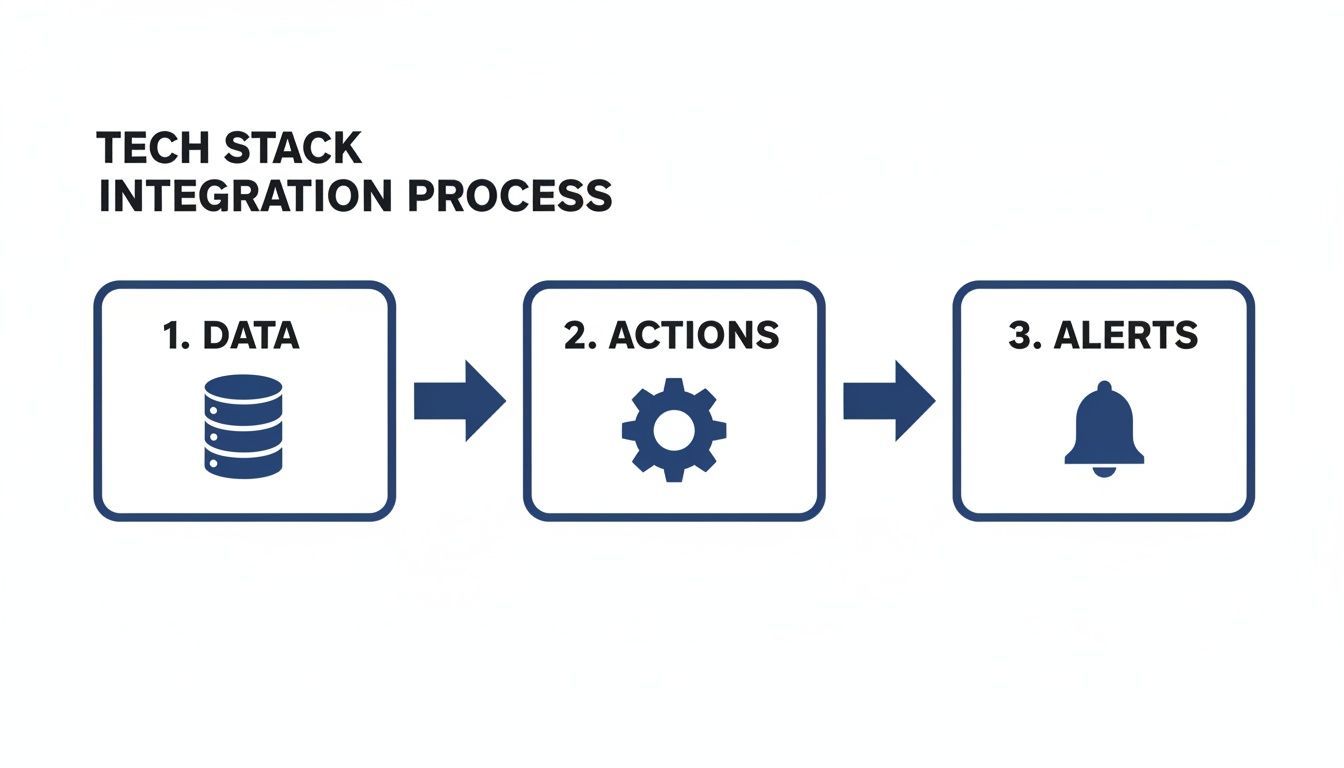
The key takeaway is the shift from passive data collection to proactive, automated alerts. These alerts become the fuel for both marketing campaigns and sales outreach, happening simultaneously.
Building Your Trigger-Based Playbook
A trigger-based playbook is your library of pre-defined workflows. It spells out exactly what marketing and sales will do when a specific signal appears. This removes the guesswork and ensures a consistent, high-quality response every time.
Let's walk through a classic scenario.
The Trigger: One of your top-tier target accounts, "Innovate Corp," just announced a $50 million Series B funding round to expand its product line and enter the European market.
Without a coordinated play, this news is just a random alert that a sales rep might miss. With a playbook, it becomes a catalyst for action.
A well-defined play turns a single market event into a multi-threaded engagement strategy. It ensures every touchpoint, from an ad to an email, is connected by the same relevant context.
The moment this trigger is detected, this coordinated sequence can kick off automatically:
- Marketing's Air Cover: The marketing team immediately adds key decision-makers at Innovate Corp to a hyper-targeted LinkedIn ad campaign. The creative, already built for this scenario, congratulates them on the funding and shows how your solution helps companies scale after a big investment.
- AE's First Touch: The Account Executive (AE) gets an instant Slack alert with the news and a pre-written email template. The AE personalizes it, referencing the funding and expansion plans, then sends a highly relevant outreach email.
- Leadership's Strategic Touch: The AE’s manager gets a prompt to reach out to a C-level executive at Innovate Corp. This higher-level touchpoint reinforces the message and shows strategic interest.
- Marketing's Nurture Sequence: At the same time, the marketing team enrolls the account's stakeholders into a nurture sequence that delivers case studies of similar companies who managed post-funding growth.
Just like that, a single piece of news transforms into a sophisticated, multi-channel engagement that surrounds the account with a consistent, timely, and valuable message. This is what modern sales and marketing alignment looks like.
For more ideas on leveraging these market signals, check out the principles of signal-based selling in our detailed guide.
Trigger-Based Collaboration Plays
Here are a few more examples of how specific account signals can trigger coordinated actions, ensuring your outreach is always timely and relevant.
| Account Signal (Trigger) | Marketing's Coordinated Action | Sales' Coordinated Action |
|---|---|---|
| New Executive Hire | Run targeted LinkedIn ads welcoming the new exec and offering relevant content for their first 90 days. | AE sends a personalized "congrats" email, referencing common challenges for new leaders in that role. |
| Competitor Mention in News | Launch a digital ad campaign highlighting your key differentiators to contacts at the target account. | SDR references the news and offers a competitive analysis or a case study of a customer who switched. |
| Negative G2 Review for Competitor | Promote content (e.g., comparison guides) to users researching alternatives. | AE reaches out to known contacts at the account, acknowledging the challenge and offering a solution-focused demo. |
| Hiring Surge in a Department | Target new hires and department heads with content about scaling teams and improving efficiency. | SDR connects with the department head, referencing their team's growth as a reason to explore new tooling. |
These plays ensure that your outreach is never cold. It’s always rooted in a specific, meaningful event. By building a library of these trigger-based plays, you empower your sales and marketing teams to operate as a single, intelligent revenue machine.
Key Takeaways
- Sales and marketing misalignment costs businesses roughly $1 trillion annually in wasted resources, duplicated efforts, and missed revenue opportunities.
- True alignment starts with a shared foundation: unified buyer personas, agreed-upon lead definitions (MQL and SQL), and a joint Service Level Agreement that holds both teams accountable.
- Trigger-based playbooks transform alignment from theory into action by defining exactly what marketing and sales will do when specific account signals, like funding rounds or executive hires, appear.
- A shared tech stack with integrated CRM, marketing automation, and account intelligence tools ensures both teams operate from the same data and can execute coordinated multi-channel campaigns.
- Regular cross-functional meetings, shared dashboards, and joint KPIs keep alignment alive and prevent teams from drifting back into siloed operations.
Frequently Asked Questions
What is sales and marketing alignment and why does it matter?
Sales and marketing alignment is the practice of unifying both teams around shared goals, processes, and metrics so they function as a single revenue engine rather than independent departments. It matters because misalignment costs businesses roughly $1 trillion annually through wasted budgets, duplicated efforts, and missed opportunities, while highly aligned teams drive up to 208% more revenue from their marketing efforts.
What is a Service Level Agreement between sales and marketing?
A Service Level Agreement (SLA) is a documented contract that defines the specific commitments each team makes to the other. For example, marketing commits to delivering a set number of qualified leads per month, and sales commits to following up within a defined timeframe. The SLA replaces assumptions with mutual accountability, covering lead qualification criteria, follow-up cadences, and what happens to disqualified leads.
How do we resolve disagreements about lead quality?
Lead quality disputes are almost always a definition problem, not a people problem. The fix starts with creating a jointly-approved, data-backed definition of what qualifies as a Marketing Qualified Lead (MQL) and a Sales Accepted Lead (SAL). Then build a CRM feedback loop where sales reps must select a specific reason when disqualifying a lead, and marketing reviews that data weekly to refine targeting and scoring.
What shared KPIs should sales and marketing teams track?
Move beyond siloed vanity metrics like MQL count or call volume and rally around revenue-centric KPIs. The most impactful shared metrics include pipeline generated (total value of opportunities from marketing-sourced accounts), Customer Acquisition Cost (CAC), and deal velocity (average time from initial engagement to closed deal). These force both teams to have skin in the game and shift conversations from blame to problem-solving.
How do trigger-based plays improve sales and marketing coordination?
Trigger-based plays are pre-defined workflows that activate when a specific account signal appears, such as a funding round or executive hire. When a trigger fires, marketing immediately launches targeted ads to key stakeholders while the AE sends a personalized outreach email referencing the event. This coordinated response ensures every touchpoint is connected by the same relevant context, turning a single piece of market intelligence into a multi-channel engagement.
Where should we start if our sales and marketing teams have never formally collaborated?
Start with one small, high-impact project rather than trying to overhaul everything at once. Defining your Ideal Customer Profile (ICP) together is the best first step because it forces both teams into the same room to combine marketing data with frontline sales insights. Once you have a shared ICP, build a pilot SLA for one lead segment and use that early win to generate momentum for broader alignment initiatives.
At Salesmotion, we turn these collaborative strategies into reality. Our AI-powered platform automates account intelligence, surfacing real-time triggers that sales and marketing can act on together. Stop guessing and start engaging with timely, relevant outreach that accelerates your pipeline. Discover how we can unify your revenue teams at https://salesmotion.io.