Most advice on abm at scale gets one thing wrong. It assumes you can take a pilot that worked for a small list of accounts, add more reps, buy more data, and repeat the motion across a larger book.
That’s usually where the program starts to break.
Manual ABM works when a strong AE or SDR can research a handful of accounts, write thoughtful outreach, and coordinate tightly with marketing. It stops working when that same team has to cover hundreds of accounts, multiple buying groups, and constant signal changes. The failure mode isn’t dramatic. Reps just revert to generic messaging, marketers fall back on broad campaigns, and leaders lose confidence because activity rises faster than account progression.
The shift that matters is operational. Scaled ABM is not “more personalization.” It’s a system that turns account intelligence into repeatable action without requiring a human to rebuild the play every time.
Why 'ABM at Scale' Requires a New Playbook
ABM absolutely works. The problem is how teams interpret the word “scale.”
According to NRich ABM statistics, 78% of ABM programs at scale drive moderate to significant pipeline growth, and 93% of companies implementing ABM report their efforts as very or extremely successful. The same source says effective ABM strategies boost pipeline conversion rates by 14%, increase account engagement by 28%, and improve MQL-to-SAL conversion rates by 25%.
Those numbers are strong. They also create a trap.
Leaders see the upside and decide to scale fast. Then they try to do it with the same operating model they used in the pilot. More manual research. More custom one-off messaging. More rep judgment. More Slack requests between sales and marketing. That approach doesn't compound. It stalls.
What breaks first
The first thing that collapses is consistency.
One rep does deep research and finds a sharp reason to reach out. Another sends a decent email based on a funding announcement. A third has no time and sends a broad sequence with a line about “helping forward-thinking teams grow.” The account list may be strategic, but the execution quality becomes random.
Then prioritization breaks. Teams collect intent data, hiring updates, executive changes, earnings mentions, and website activity, but nobody has a clear rule for what matters now. Reps end up with a feed of interesting information and no operational filter.
Practical rule: If your program depends on reps manually deciding which signals matter every day, you don't have a scaled ABM system. You have a labor-intensive pilot.
The real shift
The new playbook is built around automated intelligence, not just automation.
That distinction matters. Automation sends emails, routes leads, and updates fields. Automated intelligence decides what deserves action, explains why, and gives the team a usable next step.
For sales managers and CROs, the “so what” is simple:
- You can't scale research linearly. Rep time is too expensive.
- You can't scale personalization by hand. Quality drops before volume goals are met.
- You can't scale account coverage without signal triage. Noise overwhelms the team.
ABM at scale works when the system handles the heavy lift. It should monitor target accounts continuously, surface the few changes that matter, and give sellers enough context to act without starting from a blank page.
That’s the operational model global teams need now. Not a bigger version of the pilot. A different machine.
See Salesmotion in action
Take a self-guided interactive tour — no signup required.
Building Your Scaled ABM Strategy and Segments
The strategy has to answer one hard question early. Which accounts deserve which level of effort?
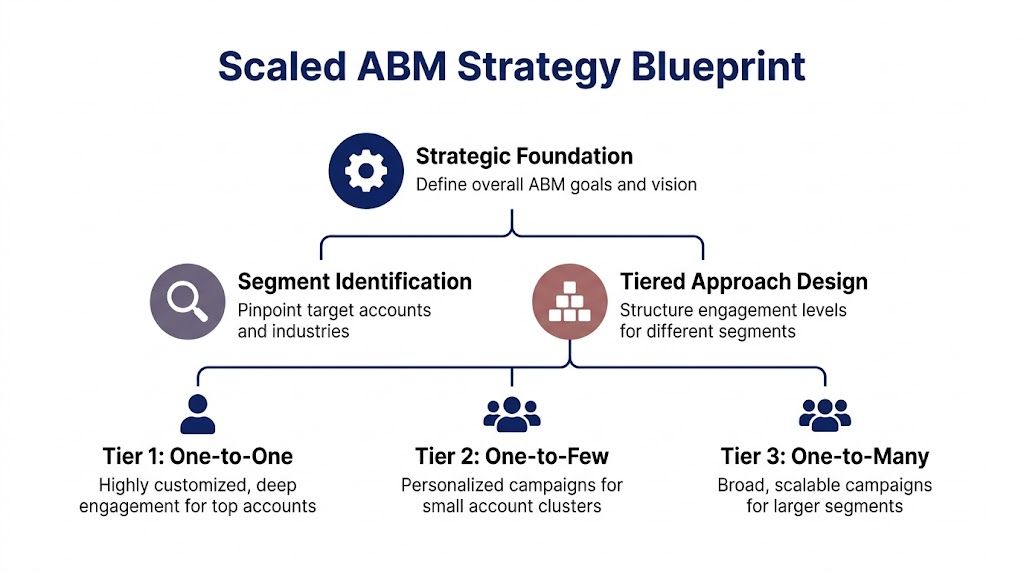
Most scaled ABM programs go sideways because leaders say they’re segmenting, but they’re really just sorting logos into a spreadsheet. A workable segmentation model defines budget, touch pattern, sales effort, content depth, and success criteria before launch.
This blueprint is the right starting point.
A practical reference for this broader planning work is this guide to high-impact SaaS marketing strategies, including ABM. It’s useful because it treats ABM as part of the revenue engine, not as an isolated campaign type.
Start with phases, not ambition
A disciplined rollout matters more than a bold launch.
ABM Agency’s breakdown on execution discipline recommends a pilot phase of 1 to 3 months for 20 to 50 accounts, then programmatic scale over 6 to 12 months for 200 to 500 accounts, and then enterprise scale after 12 months with multi-channel orchestration. The same source notes that poor sales-marketing sync is the root of 80% of program failures, and warns against over-personalization without the right technology in place. That framework is laid out in their ABM scaling methodology.
That rollout model is useful because it forces trade-offs.
If you’re still proving account selection, don't launch a broad one-to-many program. If sales still debates the target list every week, don't add more channels. If reps are writing everything from scratch, don't pretend you’re ready for programmatic scale.
Build three tiers that behave differently
A healthy segmentation model usually has three levels.
Tier 1 one-to-one
These are your highest-value accounts. They justify deep account planning, custom stakeholder mapping, and close coordination between account executives, SDRs, field marketing, and leadership.
Use this tier sparingly.
Good Tier 1 criteria often include:
- Strategic fit: Strong ICP match, expansion potential, or market influence
- Complex buying environment: Multiple stakeholders, regional decision makers, or procurement complexity
- Clear reason to invest: The deal is important enough to support deeper custom work
Tier 1 should feel bespoke. If it starts looking templated, you’re under-resourcing it.
Tier 2 one-to-few
This is the workhorse tier in abm at scale.
Group accounts by a shared pattern that changes the message meaningfully. That could be industry, business model, technology stack, geography, maturity stage, or a common business trigger. You’re not writing for one logo. You’re designing a relevant play for a cluster with enough common ground to justify modular personalization.
Examples:
- Fintech accounts hiring heavily into compliance
- SaaS companies expanding internationally
- Manufacturers modernizing data infrastructure
- Healthcare firms with visible executive turnover
Structured playbooks are paramount. The more clearly you define the segment logic, the easier it is to reuse winning motions without sounding generic.
Tier 3 one-to-many
This tier covers the broadest set of target accounts with lighter personalization and tighter operational control.
That doesn’t mean “spray and pray.” It means structured reach with signal-based prioritization. Messaging should still reflect segment realities, but the system must carry more of the load.
Use Tier 3 when:
- Account volumes are high
- Deal sizes don’t support heavy custom work
- The team needs broad market coverage without creating rep burnout
Segment on fit and motion, not just firmographics
Firmographics are a starting point. They are not enough.
A usable scaled model blends:
- Firmographic data: Industry, size, region
- Technographic data: Tools or platforms already in use
- Intent or behavioral signals: Research patterns, hiring, launches, partnerships, leadership moves
- Operational fit: Territory ownership, coverage capacity, customer expansion path
One simple test helps. Ask whether the segment leads to a distinct action. If it doesn’t, it’s not a real segment.
For teams refining that foundation, this practical overview of https://salesmotion.io/blog/account-based-marketing is useful because it frames ABM around account selection and execution discipline rather than channel tactics alone.
The point of segmentation isn't cleaner reporting. It's repeatable decisions about where human effort belongs and where the system should do the work.

“Salesmotion empowers me to cultivate a great buyer experience. I'm able to challenge prospects' thinking and be a trusted consultative seller. A major part of this is Salesmotion insights.”
Austin Friesen
Account Executive, FY25 #1 President's Club, Clari
Structuring Your Team and Governance Model
A scaled ABM program rarely fails because the campaign calendar was weak. It fails because nobody agreed on ownership once real signals started coming in.
That’s where governance matters. Not as bureaucracy, but as operating discipline.

Build a revenue team, not an ABM committee
The cleanest structure is a small cross-functional group with clear authority. In most organizations, that means leaders from sales, marketing, RevOps, and customer success.
Each function has a different job:
- Sales leadership: Owns account pursuit, rep adoption, and field execution
- Marketing leadership: Owns program design, content modules, channel orchestration, and campaign operations
- RevOps: Owns data integrity, routing rules, account scoring logic, dashboards, and process enforcement
- Customer success or account management: Adds expansion context, renewal risk, and account history for existing customers
This group doesn't need endless meetings. It needs decision rights.
If target-account ownership changes every quarter, signal routing will become political. If sales disputes the list after campaigns launch, execution slows. If marketing controls account selection without field input, reps won't trust the motion.
Decide the rules before volume arrives
Three rules need to be explicit.
Account list ownership
One person should be accountable for the final target account list, even if several teams contribute. In many companies, RevOps is the best control point because it can arbitrate data quality and territory logic without favoring one channel team.
Signal response SLA
If a meaningful account trigger appears, who acts, and how fast? The rule should be written down. Otherwise good signals sit in inboxes until they go stale.
Entry and exit criteria
Accounts shouldn't stay in a tier forever out of habit. Define what moves them up, down, in, or out. That keeps effort matched to opportunity instead of legacy assumptions.
A simple RACI that works
You don't need a giant governance deck. You need a working model.
| Activity | Sales | Marketing | RevOps | Customer Success |
|---|---|---|---|---|
| Final target account approval | A | C | R | C |
| Tier assignment logic | C | C | A/R | I |
| Signal routing rules | C | I | A/R | I |
| Play design and content modules | C | A/R | C | I |
| Rep follow-up execution | A/R | I | I | I |
| Account progression dashboard | C | C | A/R | I |
| Expansion account insight | I | I | C | A/R |
A few notes on the table:
- A means accountable
- R means responsible
- C means consulted
- I means informed
You can adapt this, but don’t leave the categories blurry.
Governance should remove friction for reps. If it creates more meetings than action, the model is too heavy.
Protect the field from process noise
Sales managers care about one thing here. Does the system help reps focus, or does it create admin?
Good governance reduces decision fatigue. Reps know which accounts matter, what qualifies as a useful signal, what follow-up standard is expected, and who to ask when territory or ownership gets messy.
Bad governance does the opposite. It floods the team with alerts, vague ownership, and competing requests from marketing and operations.
If you're reworking those broader team boundaries, this guide on sales operations org structure is a practical companion because ABM performance usually mirrors org design more than campaign creativity.
The Tech Stack for an Automated Intelligence Engine
Teams often don't have a tooling problem. They have a systems problem.
They own a CRM, a sales engagement platform, enrichment tools, ad platforms, intent feeds, and analytics. Yet reps still spend too much time stitching context together before they can send one relevant message.
That’s because the stack is often built for storage and delivery, not for interpretation.

The four layers that matter
A scalable ABM stack usually has four layers. Each one should do a distinct job.
System of record
This is your CRM. Salesforce is the common example, but the principle matters more than the product. It holds account ownership, opportunity status, contact records, and the shared definition of pipeline truth.
If the CRM is dirty, nothing above it works well.
Execution layer
Reps and marketers take action here. Salesloft, Outreach, HubSpot, Marketo, paid media platforms, and web personalization tools all sit here depending on your motion.
This layer shouldn't decide strategy. It should execute it.
Intelligence layer
This is the missing center in many ABM programs. The intelligence layer gathers account context, monitors changes, interprets relevance, and translates raw signals into actionable guidance.
Without this layer, the team gets data without clarity.
Measurement layer
BI tools, RevOps dashboards, and attribution reporting sit here. This layer tells leadership whether the program is moving accounts, not just generating activity.
Why signal overload ruins good programs
A common problem in abm at scale is not lack of data. It’s too much of it.
A key issue is contact-level precision. Bol Agency notes that 58% of marketers report only moderate engagement success, which points to the difficulty of turning account signals into useful individual outreach at scale. Their article argues that autonomous agents help close this gap by monitoring triggers like executive moves, explaining relevance, and generating personalized outreach, so teams can prioritize where momentum is building instead of manually sorting noise. That point is covered in their analysis of what changed in modern ABM.
That matches what many operators see in practice. The account may show activity, but the seller still has to answer harder questions:
- Which stakeholder should I contact now?
- What changed that makes this relevant?
- Is this a research signal, a buying signal, or just background noise?
- What should the first message say?
What an intelligence engine should do
Think less about “tools” and more about workflow compression.
A good intelligence engine should:
- Aggregate context: Pull together company updates, strategic priorities, personnel changes, market signals, and stakeholder details into one view
- Explain significance: Tell the rep why a signal matters commercially
- Map signal to contact: Suggest who inside the account is most relevant for the moment
- Trigger action: Push context into rep workflows, not into another dashboard nobody opens
- Support response: Give the seller a strong draft, call angle, or next-step recommendation
That’s the difference between a stack that creates awareness and one that creates movement.
What to avoid
Some stacks look advanced but create more work.
Watch for these patterns:
- Too many disconnected feeds: Reps shouldn't have to compare five tabs to decide whether an account is active
- Generic AI drafting: If the copy isn’t anchored to real account context, it just produces faster generic outreach
- Alert spam: More notifications do not create better timing
- No workflow delivery: If the insight doesn’t land in Slack, email, CRM, or the sales engagement platform, adoption drops
A practical benchmark for stack design is whether a rep can go from signal to usable outreach in one pass. If they still need to do manual research to understand the trigger, the system isn't finished.
For teams reevaluating architecture, https://salesmotion.io/blog/build-a-martech-stack is a helpful planning resource because it frames stack decisions around operational workflow rather than vendor accumulation.
Good ABM technology doesn't just collect account data. It reduces the number of decisions a rep has to make before acting.

“We have very limited bandwidth, but Salesmotion was up and running in days. The template made it easy to load our accounts and embedding it in Salesforce was simple. It was one of the easiest rollouts we've done.”
Andrew Giordano
VP of Global Commercial Operations, Analytic Partners
Orchestrating Personalized Plays at Scale
Here, most programs either become efficient or become fake.
By fake, I mean the team says it’s doing personalization, but the output is a standard sequence with one inserted sentence about a recent announcement. Buyers can tell the difference immediately.
Real scaled personalization comes from plays, not one-off copywriting.
Build a play library around triggers
A play is a repeatable response to a meaningful signal. It includes:
- audience
- trigger
- message angle
- channel sequence
- owner
- timing
- follow-up path
The smartest teams don’t start with “what email should we send?” They start with “what changed at the account, and what response does that justify?”
Useful trigger-based plays often include:
- New executive hire: Adapt outreach by function and likely mandate
- Funding or expansion event: Position around operational scale, efficiency, or execution risk
- Competitor mention: Open with a differentiated point of view tied to the stated initiative
- Hiring surge: Connect the pattern to an operational challenge the buyer is likely trying to solve
- Product launch or market entry: Shift messaging toward speed, coordination, or revenue capture
A practical before-and-after example
A weak version looks like this:
Hi Sarah, I saw your company is growing quickly and investing in innovation. We help teams like yours improve efficiency and drive results.
Nothing is technically wrong with that message. It’s just empty.
A stronger version starts from a real trigger and builds outward:
- Your target account names a competitor in an earnings call
- Hiring shows they’re building around that initiative
- The CRO or functional lead is the logical stakeholder
- Marketing activates matched ads around the same theme
- The rep gets a draft message tied to the signal, the initiative, and the likely business impact
That creates relevance because the play reflects context, not because the email includes a token sentence.
Why modular beats handcrafted
At scale, the answer isn't to ask reps to become mini strategists for every account.
The answer is to codify what good looks like. Build modular pieces that can adapt:
- opening angle based on signal type
- proof point by industry or segment
- stakeholder-specific pain framing
- CTA based on sales stage
- follow-up branch if no response but engagement appears
That structure keeps quality high without forcing the team to reinvent the motion for every outreach sequence.
What good orchestration looks like in the field
Snowflake provides a strong example of what AI-powered orchestration can do in practice. In its write-up on AI-driven ABM, the company reports a 2.3x lift in meetings booked for high-potential accounts, a 54% increase in click-through rates, and 38% less spending while achieving more meetings.
That matters for one reason. It shows that better targeting and personalized execution don't have to mean higher operating cost.
Sales managers should take a specific lesson from this. The goal isn’t to create more campaigns. It’s to create fewer, better plays that adapt automatically when a meaningful trigger appears.
A scalable play should let a rep respond with context in minutes, not after a half-day of research.
The handoff that matters
The final handoff is where orchestration either helps or annoys sales.
A rep should receive:
- the trigger
- why it matters
- who to contact
- a suggested point of view
- a message draft or sequence
- links to source context if they want to validate it
If the system only sends “Account spiking” or “Intent rising,” the rep still has to do the hard part. That’s not orchestration. That’s a notification.
Measuring Real ROI Beyond Vanity Metrics
Open rates, clicks, and raw activity counts can still be useful diagnostics. They are not the scorecard a CRO should use for abm at scale.
A key question is whether target accounts are moving with more speed, more depth, and better commercial quality.
What belongs on the dashboard
An executive ABM dashboard should focus on account progression.
The core views usually include:
- Account engagement: A blended view of meaningful sales and marketing interaction
- Buying committee penetration: How many relevant contacts are engaged inside each target account
- Pipeline velocity: Whether target accounts are moving through stages faster
- Influenced pipeline and revenue: Which target accounts are creating, advancing, or closing pipeline with ABM involvement
- Coverage quality: Whether the team is concentrating effort in the right accounts and segments
This is the level where ABM becomes defendable in a planning meeting.
If leadership sees only email metrics, they’ll treat the program like a campaign. If they see account movement and opportunity progression, they’ll treat it like revenue infrastructure.
A practical dashboard reference is https://salesmotion.io/blog/account-based-marketing-metrics because it aligns reporting to account-level outcomes rather than top-of-funnel noise.
Watch the hidden cost line
One of the least discussed problems in scaled ABM is cost creep.
Optif.ai highlights this clearly in its discussion of hidden cost expansion in scaled programs. The issue is that enrichment volumes, AI usage, and SDR workloads can rise faster than pipeline gains if the system isn't designed carefully. The same piece argues that real-time signal platforms can cut manual research costs by 50% to 70% through autonomous synthesis, which is important because it gives leaders a way to scale coverage without scaling manual effort at the same rate. That point is detailed in their guide to ABM scaling trade-offs.
This is the practical measurement mistake many teams make. They count software cost, but they ignore labor drag.
A better ROI conversation
Ask these questions every quarter:
| Question | Why it matters |
|---|---|
| Are target accounts progressing faster than non-target accounts? | Proves the motion is changing buying behavior, not just activity |
| Are reps spending less time researching before first outreach? | Shows whether the operating model is actually reducing labor |
| Is account coverage becoming more consistent across territories? | Reveals whether success depends on a few strong sellers or on the system |
| Are we adding tools that replace work, or just add more data? | Prevents stack bloat |
| Which plays create movement, and which only create engagement? | Protects budget from vanity optimization |
A healthy ABM program should get smarter as it scales. The addition of more accounts should not, by itself, cause it to become more expensive.
Frequently Asked Questions About Scaling ABM
The same objections come up in almost every rollout. Most are valid. They just need operational answers.
Direct answers to common rollout questions
| Question | Answer |
|---|---|
| How do I get sales to adopt a scaled ABM program? | Don't sell sales on ABM as a marketing concept. Show reps that the system gives them better timing, sharper account context, and less research work. Adoption rises when the workflow is easier than their current one. |
| Should every target account get the same level of personalization? | No. The effort has to match account value, complexity, and sales motion. A tiered model protects your team from wasting high-touch effort on accounts that don't justify it. |
| What if our total addressable market is very large? | Large TAMs make prioritization more important, not less. Start with clear segments, then use signal-based scoring to focus active effort where momentum is building. |
| Can ABM at scale work if our reps already feel overloaded? | Yes, but only if the model reduces manual work. If your rollout adds research steps, more dashboards, or more alerts, it will fail. |
| How should marketing and SDRs split responsibilities? | Marketing should build plays, channels, and content modules. SDRs should act on prioritized signals and use that context in outreach. RevOps should define the routing and measurement rules so the handoff stays clean. |
| How do we keep personalization from sounding robotic? | Anchor messaging to real account context. The strongest emails use a specific trigger, a clear point of view, and a stakeholder-relevant angle. Generic AI copy without signal grounding will sound generic fast. |
| When should we pause or redesign the program? | Pause when activity is rising but account progression isn't, when reps stop trusting the signals, or when costs are growing without a clear pipeline story. Those are operating-model issues, not campaign tweaks. |
A scaled ABM program gets easier to run once the system handles research, signal filtering, and play activation. Until then, every added account creates drag.
The teams that win don't just personalize more. They operationalize relevance.
Sales teams don't need more data. They need a faster path from account change to sales action. Salesmotion helps revenue teams do exactly that with AI agents that research target accounts, monitor real-world signals, and turn those signals into ready-to-use outreach inside the workflows reps already use.