Account-based selling (ABS) is the sales execution model behind account-based marketing (ABM). ABM decides which accounts to target and warms them through marketing channels. Account-based selling defines how reps actually work those accounts: which stakeholders to engage, what messaging to use, how to multi-thread, and when to advance the deal. The distinction matters because many teams invest heavily in ABM targeting without changing how reps sell. The result is well-targeted accounts receiving the same generic outreach they would get from a spray-and-pray motion.
TL;DR: Account-based selling concentrates sales effort on named, high-value accounts through three pillars: account selection, deep account research, and coordinated multi-threaded engagement. ABM creates awareness; ABS converts it into pipeline. Teams that add signal-driven prioritization invest the heaviest effort exactly when an account enters a buying window, preventing the most common ABS failure: equal effort across unequal accounts.
What Is Account-Based Selling?
Account-based selling is a B2B sales strategy that concentrates sales effort on a defined list of named, high-value accounts instead of broad prospect lists. Each account is treated as a market of one: researched deeply, engaged across multiple stakeholders, and advanced with messaging tied to that account's specific priorities and buying triggers.
You will also see the model called account-based sales or target account selling. The names describe the same shift: from "who can I reach?" to "what does this account need, and who decides?"
The model exists because enterprise buying changed. According to Gartner, a typical B2B buying group involves six to ten decision makers, each arriving with their own independently gathered information. A single-threaded rep working a single contact cannot win consensus from a committee that size. Account-based selling is the structured response: map the committee, engage it in parallel, and anchor every conversation to the account's actual business context.
ABS makes economic sense when deals justify the per-account investment, typically above $50K ACV with multi-stakeholder evaluations. Below that threshold, the research and personalization costs can exceed the marginal benefit over templated outreach.
See Salesmotion on a real account
Book a 15-minute demo and see how your team saves hours on account research.
Account-Based Selling vs ABM: What Is the Difference?
ABM is the marketing motion; ABS is the sales motion. Account-based marketing targets and engages specific accounts through marketing channels: targeted ads, personalized content, events, and brand awareness within the buying committee. Account-based selling is sales-led execution against those same accounts: stakeholder mapping, personalized outreach, discovery conversations, and deal progression.
The two are complements, not competitors. ABM creates awareness and engagement. ABS converts that engagement into pipeline and revenue. The programs that fail are usually the ones where marketing runs ABM against one account list while sales prospects a different one, so neither side compounds the other's work. The gap is common: a 2025 Demand Gen Report benchmark survey found that while 71% of organizations claim an account-based strategy, only 36% consider sales and marketing tightly aligned around it.
A simple ownership test: if the activity is one-to-many and brand-led (ads, content, events), it is ABM. If it is one-to-one and rep-led (outreach, discovery, multi-threading, negotiation), it is account-based selling.

“There's been a big focus on hyper personalization and relevance in our outbounding efforts. Salesmotion has been a key partner in hitting our significantly increased meeting targets. What stands out is how simple it is. Reps can log in and get valuable account insights within 30 seconds to a minute.”
Joe DeFrance
VP of Sales, Incredible Health
How Account-Based Selling Differs From Traditional Prospecting
Traditional sales prospecting works from the bottom up: cast a wide net, see who responds, and work the responders. Account-based selling works from the top down: identify specific accounts, research them deeply, and create personalized engagement strategies for each.
The differences show up in every aspect of the sales motion:
| Dimension | Traditional Prospecting | Account-Based Selling |
|---|---|---|
| Targeting | Broad lists filtered by firmographic criteria | Named account lists selected by ICP fit + signals |
| Research | Surface-level (company name, title, industry) | Deep (strategic priorities, stakeholder maps, competitive context) |
| Outreach | Templated sequences with light personalization | Custom messaging per account referencing specific events and priorities |
| Engagement | Single-threaded (one contact per account) | Multi-threaded (3-5+ stakeholders per account) |
| Measurement | Volume metrics (emails sent, calls made) | Account metrics (engagement depth, stakeholder coverage, pipeline per account) |
| Timeline | Transaction-focused (close this deal) | Relationship-focused (build long-term account value) |
The Three Pillars of Account-Based Selling
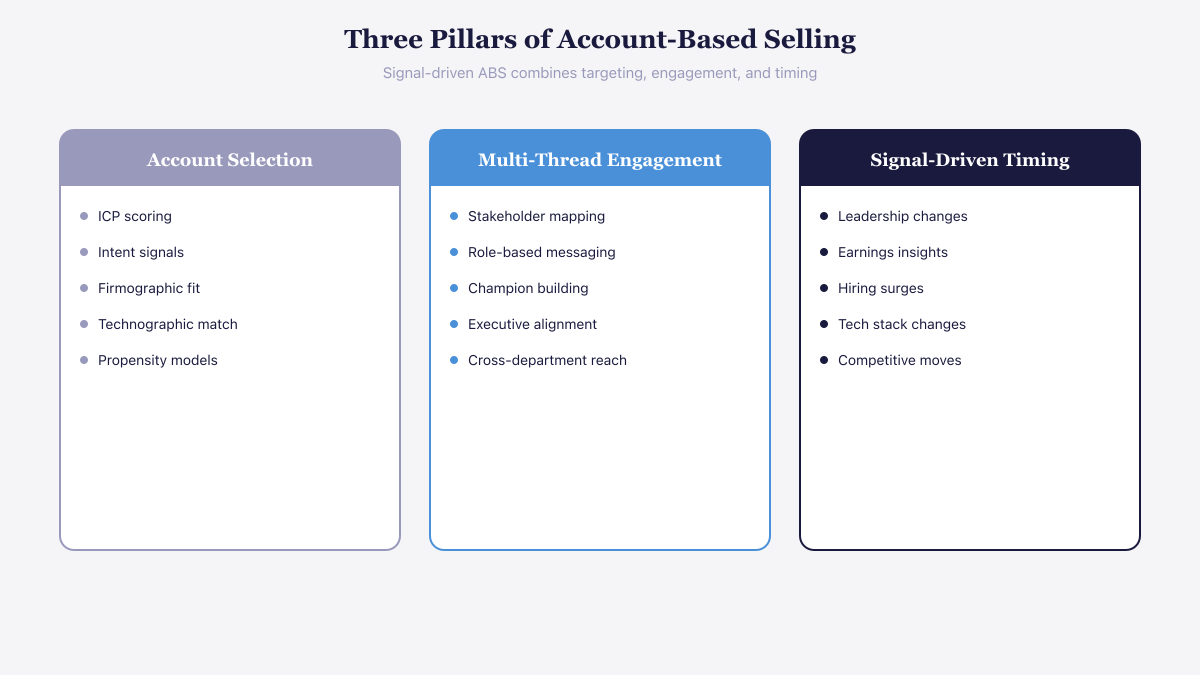 Effective ABS combines precise targeting, multi-stakeholder engagement, and signal-driven timing.
Pillar 1: Account Selection
Not every account in your CRM deserves the account-based treatment. ABS requires significant per-account investment, so the selection criteria must be rigorous.
Selection framework:
-
ICP fit score: Does the account match your ideal customer profile across firmographic, technographic, and organizational criteria? See our ICP template guide for the scoring model.
-
Signal strength: Is the account showing buying signals that indicate current or near-term buying intent? Leadership changes, funding events, hiring surges, competitive evaluations, and strategic priority shifts all indicate readiness.
-
Relationship access: Do you have existing relationships or connection paths into the account? Warm entry points dramatically improve ABS outcomes.
-
Revenue potential: Is the account's potential deal size large enough to justify the per-account investment?
Tier your selected accounts:
- Tier 1 (10-20 accounts): Highest ICP fit + active signals + relationship access. Full ABS treatment with dedicated research, custom messaging, and multi-threaded engagement.
- Tier 2 (50-100 accounts): Strong ICP fit, emerging signals. Warm nurture with signal-triggered escalation to Tier 1 treatment.
- Tier 3 (200-500 accounts): ICP fit but no current signals. Automated engagement with signal monitoring for future activation.
Pillar 2: Account Research
Research is what separates ABS from "ABM with extra steps." Deep research enables the personalized, relevant engagement that makes account-based approaches work.
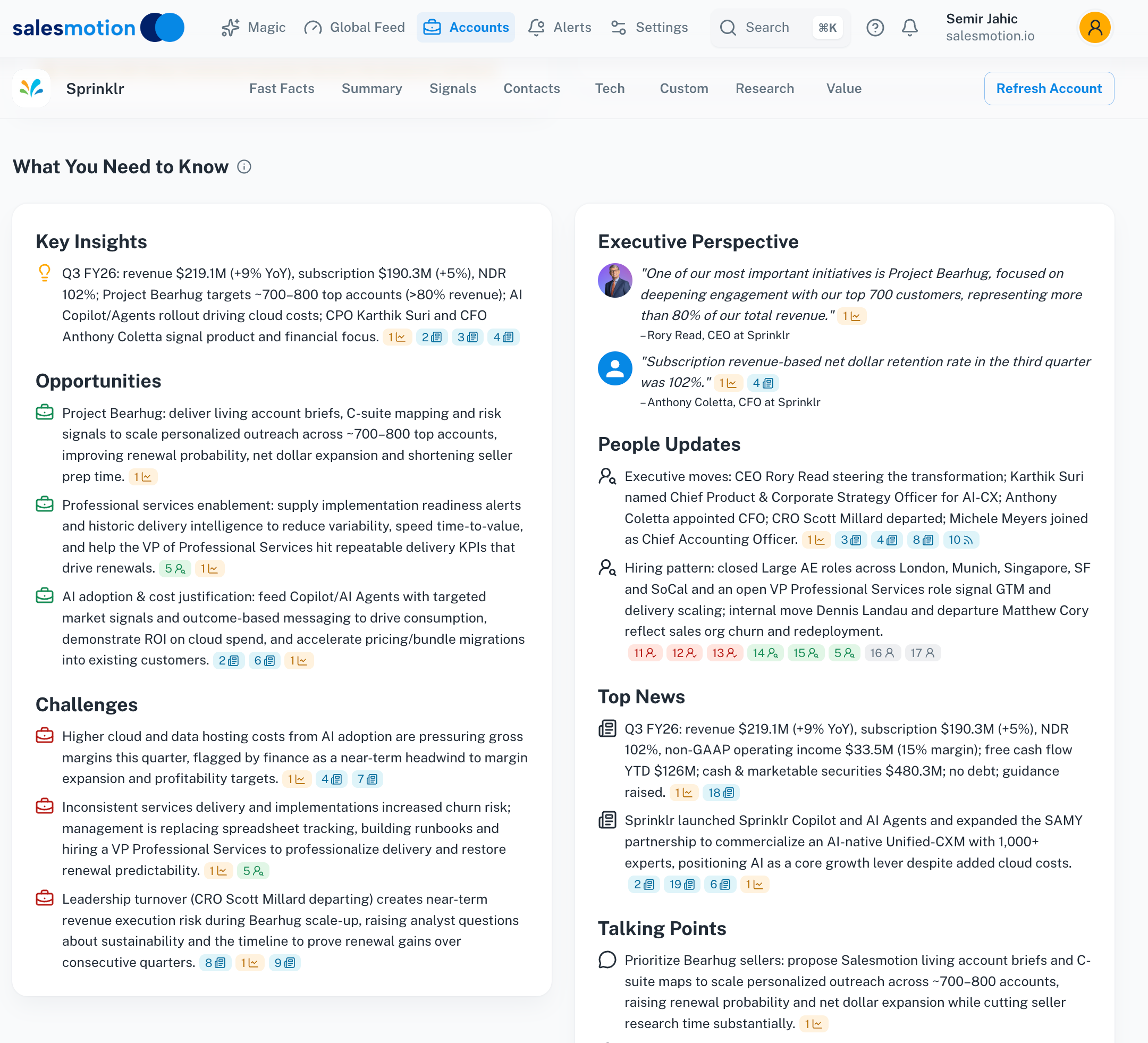 For Tier 1 accounts, Salesmotion's account summary provides the strategic context you need: key insights, executive priorities, and recent developments in one view.
For each Tier 1 account, know:
Strategic context:
- What are the company's stated priorities? (Earnings calls, annual reports, press releases)
- What major initiatives are underway? (Digital transformation, market expansion, operational efficiency)
- What challenges did leadership mention publicly?
Stakeholder map:
- Who are the likely decision-makers for your solution category?
- Who are the potential champions and blockers?
- What are their backgrounds, previous companies, and stated professional priorities?
- Who do they report to, and what are those leaders' priorities?
Competitive landscape:
- What solutions does the account currently use in your category?
- Are they in an active evaluation? What signals suggest evaluation activity?
- When do existing contracts likely renew?
Timing signals:
- Recent leadership changes in relevant departments
- Hiring patterns indicating investment in your solution's domain
- Funding events or earnings results that create budget availability
- Competitive moves or market shifts creating urgency
This research traditionally required 2-3 hours per account. Account intelligence platforms compress this to minutes by automatically aggregating information from public sources, SEC filings, news coverage, job boards, and social media into a consolidated account brief.
Pillar 3: Coordinated Engagement
ABS engagement is multi-threaded, multi-channel, and signal-timed. The goal is building relationships with multiple stakeholders simultaneously, each receiving messaging relevant to their specific role and priorities.
Multi-threading is not optional at the enterprise level. A 2025 Gartner survey found that 74% of B2B buying teams experience unhealthy conflict during the decision process, while buying groups that reach consensus are 2.5 times more likely to describe the resulting deal as high-quality. The rep who engages the whole committee, and helps it align, wins deals the single-threaded rep never sees coming apart.
The engagement model:
Week 1-2: Initial outreach (2-3 stakeholders)
- Lead with the stakeholder most likely to be a champion (typically the person whose daily work your solution most directly impacts)
- Open with a specific reference to a signal or strategic priority at the account
- Simultaneously engage a second stakeholder with role-specific messaging
- Use multiple channels: email for detailed context, LinkedIn for relationship building, phone for urgency
Week 3-4: Expand and deepen
- Add a third stakeholder (ideally at a different organizational level)
- Share content relevant to the account's specific challenges
- Reference the signal or event that triggered outreach to create continuity
Week 5-8: Build consensus
- Engage the economic buyer with ROI-focused messaging anchored to strategic priorities
- Facilitate internal advocacy by providing your champion with shareable materials
- Align messaging across all stakeholders to create a consistent value narrative
Ongoing: Monitor and respond
- Track engagement signals across all stakeholders
- Respond to new account events (additional leadership changes, competitive evaluations, budget approvals) with timely outreach
- Adjust strategy based on stakeholder response patterns
Plays that stand out. When a Tier 1 account warrants extra effort, go beyond the standard cadence: run a private workshop-style webinar built around the account's publicly stated challenges, record a short point-of-view video walking through the prospect's own website or process with genuine suggestions, or co-host an executive roundtable with a non-competing vendor that sells into the same account. These plays cost more per touch, but they position the team as invested partners before any deal exists.
For a deeper breakdown of the engagement model, see our guide to multi-threading in enterprise sales.

“It's not even just about saving time — it's about uncovering things we otherwise might not research. Salesmotion helps us connect Guild to what's already publicly important to the company.”
Derek Rosen
Director, Strategic Accounts, Guild Education
How Do You Structure an Account-Based Sales Team?
An account-based sales team is organized around shared account lists, not lead queues. The standard structure is a pod: an account executive, an SDR, and a marketing counterpart working the same named accounts, supported by RevOps for account scoring and signal routing.
Typical roles in the account-based sales model:
- Account executive: Owns 10-20 Tier 1 accounts end to end. Runs stakeholder mapping, discovery, and deal progression. The AE is the strategist, not just the closer.
- SDR/BDR: Aligned to the same account list as the AE, not a separate lead queue. Executes top-of-account outreach, books first meetings, and escalates signal-triggered plays.
- Marketing counterpart: Runs ABM air cover (ads, content, events) against the identical list, so every sales touch lands on a warmed account.
- RevOps: Owns tiering criteria, account scoring, signal routing rules, and the account-level reporting that replaces activity dashboards.
Two operating rhythms hold the model together. First, a weekly account review where the pod walks through Tier 1 accounts: new signals, stakeholder movement, next plays. Second, a quarterly re-tiering where accounts move between tiers based on signal activity and engagement, so the list reflects reality rather than last year's planning exercise.
Smaller teams can run account-based sales without the full pod. A single rep with a disciplined 10-15 account list, an automated research layer, and a weekly review habit captures most of the benefit. What does not work is declaring an account-based motion while reps still get measured on call volume.
The Signal-Driven Execution Layer
Tiering, research, and multi-threading tell you where to invest. Signals tell you when. Without a timing layer, even a well-built ABS program defaults to calendar-driven outreach: quarterly check-ins that land whenever the rep gets around to them, not when the account is ready to buy. The stakes are real: only about 5% of B2B accounts are actively buying at any given moment, and signals are how you find that 5%.
Which Signals Matter Most
Not all signals carry equal weight. Prioritize response speed by signal strength:
High-intent signals (act within 48 hours):
- New executive hire in your buyer's function (VP of Sales, CRO, CTO)
- Public RFP or competitive evaluation mention
- Earnings call language about relevant strategic initiatives
- Significant funding event or M&A activity
Medium-intent signals (act within 1-2 weeks):
- Hiring surge in relevant departments (3+ roles in 30 days)
- Technology adoption or stack changes (new CRM, new data tools)
- Product launches or market expansion announcements
Awareness signals (monitor and nurture):
- Website visits and content downloads
- Industry report mentions or analyst coverage
- Regulatory changes affecting their sector
A cluster of signals firing within a short window is a stronger indicator than any single signal. When a Tier 2 account shows two or three high- or medium-intent signals within a few weeks, escalate it to Tier 1 treatment immediately.
Here is what signal-driven execution looks like in practice:
- Trigger: A Tier 2 account announces a new CRO, and its latest earnings call flags a "go-to-market efficiency" initiative.
- Platform action: Salesmotion, which monitors 50+ signal types across leadership changes, earnings commentary, hiring patterns, funding, and competitive moves, flags the account. Its Research Agent updates the account brief with the new executive's background and the initiative context, and its Outreach Agent drafts messaging anchored to both.
- Rep action: The pod escalates the account to Tier 1 treatment. The AE engages the new CRO within the first 90 days of tenure, referencing the stated initiative, while the SDR opens threads with the RevOps lead and a line-of-business stakeholder.
- Outcome: Discovery starts with the likely pain, the key stakeholders, and the timing already known. The first meeting is a consultative conversation instead of a cold intro, and the deal enters pipeline weeks before competitors notice the change.
This is the difference between an account-based selling program that exists in a planning deck and one that runs every day. The frameworks are not new; the execution layer that makes them work at 50+ accounts per rep is.
Measuring Account-Based Selling
ABS requires different metrics than traditional prospecting. Volume metrics (emails sent, calls made) don't capture whether the account-based approach is working.
Account-level metrics:
| Metric | What It Measures | Target |
|---|---|---|
| Account engagement rate | % of Tier 1 accounts with 2+ stakeholder interactions | 60-80% within 60 days |
| Stakeholder coverage | Average contacts engaged per Tier 1 account | 3-5 stakeholders |
| Signal-to-meeting conversion | % of signal-triggered outreach that produces a meeting | 10-15% |
| Pipeline per account | Average pipeline value per Tier 1 account | Based on ACV targets |
| Account velocity | Time from first touch to qualified opportunity | Track and improve quarterly |
| Multi-thread depth | % of pipeline deals with 3+ stakeholder relationships | 70%+ for enterprise |
The metric that matters most: Pipeline created from Tier 1 accounts versus Tier 2 and Tier 3. If the per-account investment in ABS isn't producing meaningfully higher pipeline rates from Tier 1 accounts, either the account selection is wrong, the research quality is insufficient, or the engagement execution isn't differentiated enough from standard outreach.
Teams like Incredible Health increased qualified meetings by combining signal-driven account selection with the multi-threaded engagement approach that ABS requires, ensuring that high-potential accounts received differentiated treatment.
Common ABS Failures and How to Avoid Them
Equal effort across unequal accounts. The most common failure. Teams "go account-based" but spread effort evenly across 500 accounts instead of concentrating on 20. The result: slightly better outreach to 500 accounts instead of significantly better outcomes from 20 high-potential accounts.
Research once, engage forever. Account context changes. A stakeholder map from Q1 is outdated by Q3. ABS requires continuous intelligence, not one-time research. Automate signal monitoring so reps are alerted to changes rather than discovering them weeks late.
Single-channel engagement. ABS that relies only on email isn't account-based selling. It's templated emailing with better personalization. True ABS uses email, phone, LinkedIn, events, referrals, and content strategically across stakeholders and buying stages.
No sales-marketing alignment. If marketing is running ABM campaigns to one set of accounts and sales is prospecting a different set, neither team gets the benefit of coordinated engagement. Align on the same Tier 1 account list and coordinate outreach timing.
Research without action. Some teams over-index on preparation and under-index on outreach. Spending two hours researching an account and then sending a templated email wastes the entire investment. If you cannot point to a sentence in your outreach that came from your research, you did not use your research.
Stopping at the initial close. The first deal is the entry point, not the finish line. ABS teams think in account value: expand within the department, cross-sell to adjacent teams, grow the contract scope, and build executive relationships post-sale. Measure net revenue retention alongside new business; an account that grows from $50K to $200K over two years delivers more lifetime value than four one-time $50K deals.
What Tools Do You Need for Account-Based Selling?
An effective ABS stack has four layers: a CRM (Salesforce, HubSpot) as the account and pipeline foundation, an account intelligence platform for automated research and signal monitoring, a sales engagement platform for multi-channel orchestration, and LinkedIn Sales Navigator for stakeholder research.
The account intelligence layer is the highest-leverage addition for teams moving from traditional prospecting, because it removes the 2-3 hours of manual research per account that makes ABS impractical at scale. We rank and compare the full stack in our guide to the best account-based selling tools, including who each tool fits and where it falls short.
On cost: Salesmotion's individual plan is $85 per month, self-serve monthly with no annual commitment, and team plans use custom pricing with unlimited users on team plans. See the pricing page for details. Most other layers of the stack (engagement platforms, Sales Navigator) price per seat, so model the full per-rep cost before rolling out.
Key Takeaways
- Account-based selling is the sales execution framework that makes ABM targeting actionable. ABM creates awareness through marketing channels; ABS converts it into pipeline through rep-led, multi-threaded engagement.
- Buying committees of six to ten decision makers are the norm, per Gartner, and 74% of them experience unhealthy conflict. Multi-threading 3-5+ stakeholders per account is the execution standard, not a nice-to-have.
- Tier accounts rigorously: 10-20 Tier 1 (full ABS), 50-100 Tier 2 (warm nurture), 200-500 Tier 3 (automated monitoring). The most common failure is applying ABS effort evenly across too many accounts.
- Structure the account-based sales team as pods (AE + SDR + marketing) working one shared account list, with weekly account reviews and quarterly re-tiering.
- Measure account-level metrics (engagement rate, stakeholder coverage, pipeline per account) rather than activity volume. ABS success is depth, not breadth.
- Add a signal-driven execution layer. Signals tell you when a Tier 1 account enters a buying window, so the heaviest engagement lands at the moment of maximum receptivity.
Frequently Asked Questions
What is account-based selling?
Account-based selling (ABS) is a B2B sales strategy that focuses effort on specific, named target accounts rather than broad prospect lists. It involves deep account research, multi-threaded stakeholder engagement, and personalized messaging tailored to each account's specific business context and buying triggers. ABS is the sales execution counterpart to account-based marketing (ABM) and is most effective for enterprise deals with large buying committees, deal sizes above $50K, and complex evaluation processes.
What is the difference between account-based selling and ABM?
Account-based marketing (ABM) targets and engages specific accounts through marketing channels: targeted ads, personalized content, event invitations, and brand awareness within the buying committee. Account-based selling (ABS) is sales-led: stakeholder mapping, personalized outreach, discovery conversations, and deal progression. ABM creates awareness and engagement. ABS converts that engagement into pipeline and revenue. The most effective programs coordinate both against the same account list.
What is an account-based sales model?
An account-based sales model is the operating structure a team uses to run account-based selling: shared named-account lists instead of lead queues, pods of AEs, SDRs, and marketing working the same accounts, account-level metrics instead of activity metrics, and tiered effort allocation (full treatment for 10-20 Tier 1 accounts, lighter automated coverage for the rest). The model replaces "how many people did we contact?" with "how deep are we in the accounts that matter?"
How many accounts should an ABS program target?
For full ABS treatment (deep research, custom messaging, multi-threaded engagement), target 10-20 accounts per rep as Tier 1. This number is constrained by the research and personalization investment required per account. Reps can't meaningfully execute ABS for 100 accounts simultaneously. Use a tiered approach: 10-20 Tier 1 accounts with full ABS, 50-100 Tier 2 accounts with warm nurture, and 200-500 Tier 3 accounts with automated outreach and signal monitoring for escalation.
What tools do you need for account-based selling?
An effective ABS tech stack includes a CRM (Salesforce, HubSpot) as the account and pipeline management foundation, account intelligence for automated research and signal monitoring, a sales engagement platform for multi-channel outreach orchestration, and LinkedIn Sales Navigator for stakeholder research. The account intelligence layer is the most critical addition for teams moving from traditional prospecting to ABS. See our ranked guide to the best account-based selling tools for a full comparison.
How long does it take to see results from account-based selling?
Most teams see measurable pipeline impact within 3-6 months, with full revenue results taking 6-12 months. The timeline depends on your existing sales cycle length, the maturity of your ICP definition, and how quickly you can operationalize signal monitoring and research workflows. Early wins typically come from Tier 1 accounts where active signals align with strong ICP fit and existing relationship access.
What is the ROI of account-based selling?
According to the 2025 ABM Benchmark Survey by Demand Gen Report, combined ABM-ABS programs deliver an average ROI of 137%, with high-maturity organizations seeing 5-9x returns. Organizations also report larger deal sizes and faster sales cycles compared to non-account-based approaches, and the ROI compounds over time as teams expand within existing target accounts.
Can small businesses use account-based selling?
Yes, and it can be a real advantage. Small businesses cannot compete on volume, so a focused approach plays to their strengths. The core principles of selection, research, and multi-threaded engagement work regardless of company size: a small team can start with a handful of Tier 1 accounts and use creative, low-budget plays to make an outsized impact. For a pilot, start with 10-20 accounts, prove the model, then scale the list and tiering system.