Are you drowning in alerts, or driving pipeline?
That's the fundamental question behind any search for the best Zymewire competitors in life sciences. Many teams don't have a raw data problem. They have an action problem. Reps see a trial update, a funding announcement, an FDA filing, or an executive move, then stall out because nobody has translated that event into a clear sales motion.
Zymewire earned its place in the category. CB Insights identifies Zymewire as a sales-intelligence company founded in 2011 and based in Ontario, Canada, serving biotech and pharma teams in a market crowded with both healthcare-specific tools and broad GTM platforms. That context matters because your alternatives aren't just niche biotech databases. They include research platforms, news products, provider-market tools, and generic intent engines.
The market is also bigger and less visible than many teams assume. In its own 2025 analysis, Zymewire says there are nearly 8,000 stealth biotechs worldwide. If your team misses those accounts or fails to react when they move, you miss entire buying cycles.
So don't evaluate alternatives by asking who has the longest feature list. Ask a tougher question. Do you want alerts, or do you want intelligence that tells reps why the event matters and what to do next?
1. Salesmotion
Need a platform that tells reps what happened, why it affects the account, and what outreach to send next? Start with Salesmotion.
Salesmotion is built for life sciences teams that already know random alerts do not create pipeline. The platform combines three jobs that usually sit in separate tools and tabs. Its Research Agent builds structured account briefs from public sources. Its Signal Agent monitors account changes relevant to biotech and pharma selling. Its Prospector Agent turns those signals into personalized outreach your team can review and send.
That is the key distinction in this category. Zymewire and several other alternatives help you spot movement. Salesmotion is designed to close the loop from signal to action. If you are comparing a Zymewire alternative, this is the clearest option for teams that want an intelligence engine, not a data firehose.
Why it stands out
For CROs, CDMOs, clinical tech vendors, and other suppliers selling into biotech, this is more valuable than another database filter. A rep does not win because they noticed a trial update. They win because they can explain how that update changes timelines, budget pressure, vendor risk, or operational workload at the account.
Practical rule: If reps still need to open five tabs after every alert, your team bought research inputs, not a commercial workflow.
Salesmotion fits best when your account strategy is already defined and execution is the bottleneck. It is less useful as a broad list-building system. It is much more useful as an always-on monitoring and outreach layer for named accounts. Teams that depend on trial-driven timing should also look at how to find clinical trials that create real sales windows.
- Life sciences signal coverage: Tracks commercial and organizational changes tied to biotech and pharma selling.
- Clinical trial tracking: Useful when study progression creates a reason to start a conversation now.
- Regulatory monitoring: Helpful for teams selling around submission, approval, or readiness milestones.
- Pricing: Public pricing detail is not available in the verified data, so judge it on rep adoption and speed to outreach.
- Actionability: Strongest choice in this list if your priority is converting account movement into a next step your reps can execute fast.
Skip the comparison fatigue?
If you're shopping for a sales intelligence tool, here's the short version.
Salesmotion combines account intel, buying signals, verified contacts, and AI-drafted outreach in one tool. From $85/mo, live in an hour, no annual contract.
2. Citeline
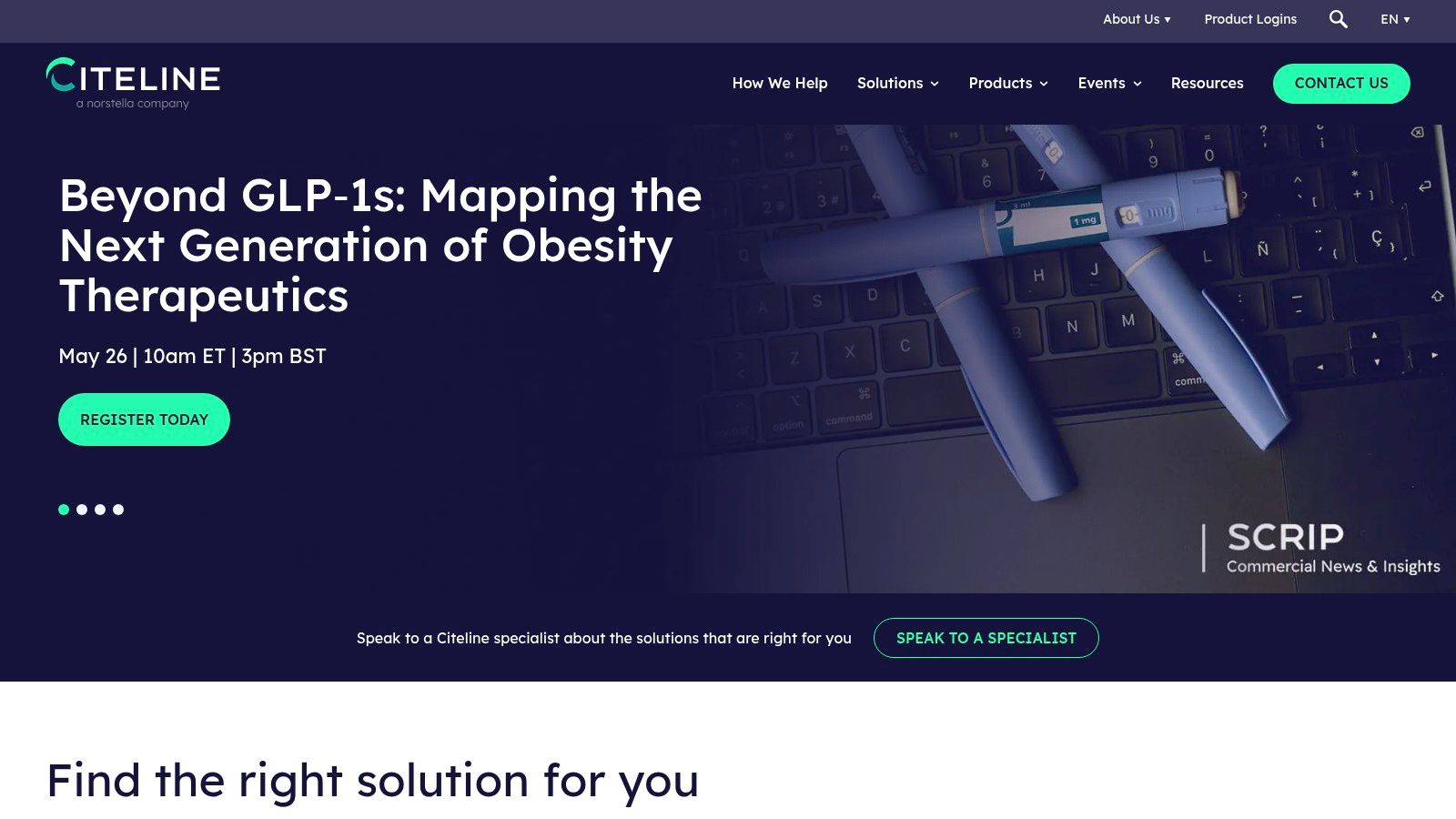
If your team sells around clinical operations, trial execution, site strategy, or investigator engagement, Citeline is one of the most credible alternatives. Many leaders turn to Citeline when they realize they need deeper trial intelligence than a prospecting tool typically provides.
Citeline is strong when your sales motion depends on understanding study movement with precision. That includes CRO business development, patient recruitment partnerships, decentralized trial vendors, and technology teams that need to time outreach around protocol changes, site activity, or development progression. If your reps need sharper timing around study milestones, this is the category of intelligence to prioritize. Sales leaders who want tighter outreach around trial events should also review practical approaches for finding clinical trials that create real sales windows.
Where it fits best
Citeline is not a sales automation platform. It's a research and workflow asset that helps teams understand what's happening in development. That distinction matters. It gives you the “what” very well, but your reps still need to convert that into commercial messaging.
This is the right call for teams that already have mature account planning and want premium clinical depth. It's the wrong call if your main problem is that reps don't know how to act on the signal once they see it.
- Life sciences signal coverage: Deep and clinically oriented.
- Clinical trial tracking: A core strength.
- Regulatory monitoring: Useful, especially when tied to broader development intelligence.
- Pricing: Commonly treated as enterprise software, and buyers should expect a premium evaluation process rather than lightweight self-serve pricing.
- Actionability: Better for intelligence gathering than direct rep execution.
Citeline helps clinical and BD teams understand the event. It doesn't automatically turn that event into an email, a call plan, or a prioritized account queue.

“The account and contact signals are key for reaching out at important times, and the value-add messaging it creates unique to every contact helps save time and efficiency.”
Daniel Pitman
Mid-Market Account Executive, Black Swan Data
3. GlobalData Pharma

GlobalData is the right choice if your commercial leaders care about broad market context more than account-by-account trigger execution. It's especially useful for teams selling complex services into pharma, where the buyer wants category knowledge, competitor context, and strategic narratives before they engage vendors.
This platform is strongest when your team needs to understand outsourcing trends, therapeutic market context, pipeline direction, deal flow, and competitive positioning in one place. If you sell high-consideration services to large sponsors, that can be valuable. Your reps can build smarter territory plans and your leadership team can shape better vertical strategy.
Best for strategy-heavy sales motions
GlobalData is less compelling for real-time prospecting. It tends to support planning, research, and market framing better than fast trigger-to-outreach motion. That's not a flaw. It's just a different job.
The practical issue is adoption. A sales team rarely needs more reports. It needs fewer unknowns before a rep reaches out. If your reps are already overloaded, a heavy research platform can become shelfware unless RevOps or strategy leaders operationalize it.
- Life sciences signal coverage: Broad across pharma market, pipeline, and business context.
- Clinical trial tracking: Present, but not usually the reason commercial teams buy it.
- Regulatory monitoring: Helpful in strategic analysis, less useful as a frontline rep trigger stream.
- Pricing: Often discussed in the market as premium enterprise software. Treat it as a larger-budget decision.
- Actionability: Better for strategic framing than daily rep action.
If you're a CRO or CDMO leader deciding between “intelligence for planning” and “intelligence for selling,” GlobalData sits firmly on the planning side.
4. Evaluate
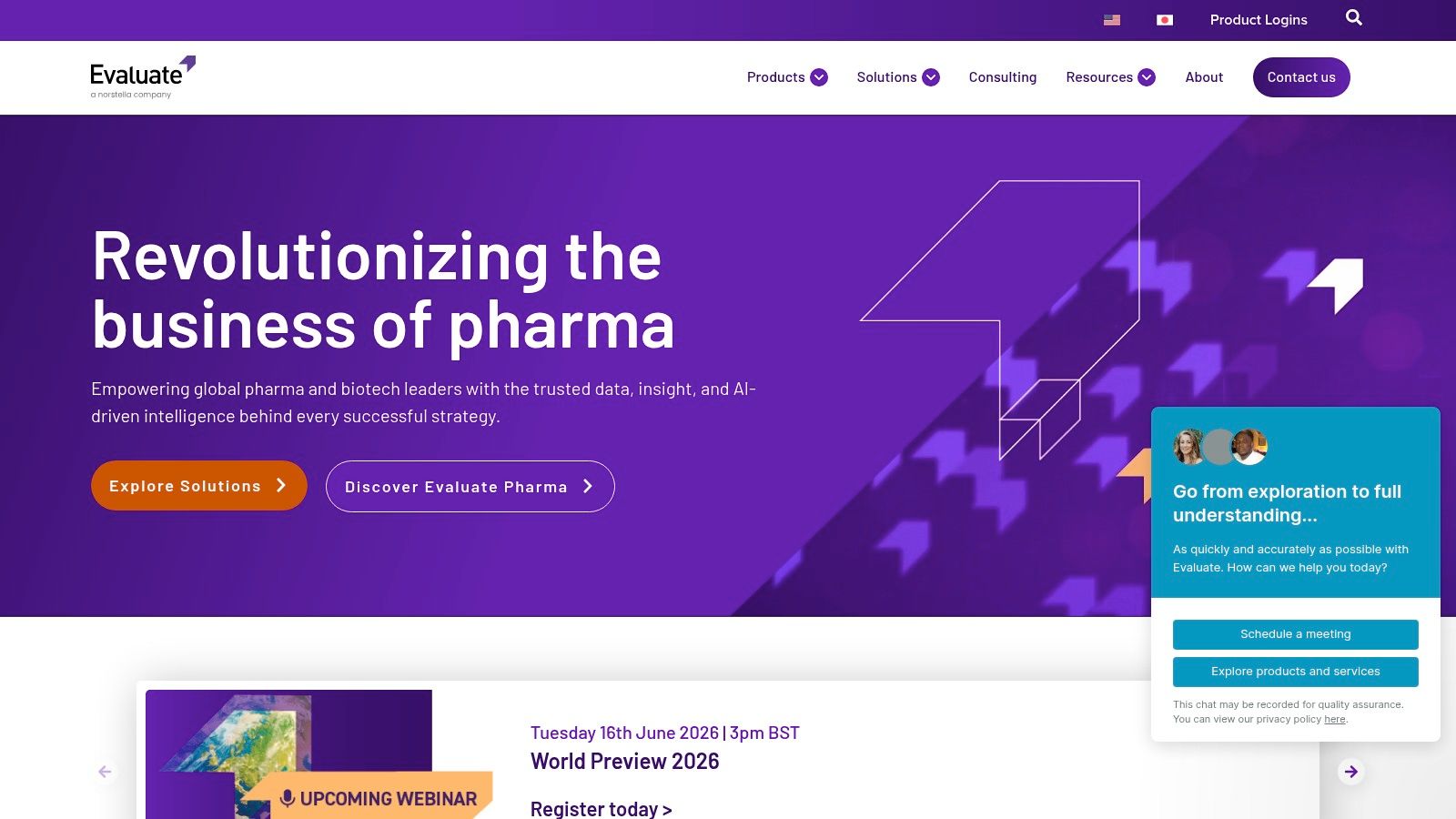
Evaluate is not a direct prospecting replacement for Zymewire. It's a strategic commercial intelligence platform. That's exactly why it can still be a smart alternative for the right buyer.
When teams use Evaluate well, they use it to strengthen executive-level conversations. It helps commercial leaders frame market attractiveness, asset significance, and the size of a commercial opportunity. If your sellers need to speak credibly with senior biopharma stakeholders, this kind of context sharpens the narrative.
Where Evaluate earns its budget
Evaluate is valuable when the sale depends on commercial sophistication. Think enterprise software, specialist services, market access support, or deals that require board-level justification on the buyer side. In those cases, “this company entered a new stage” isn't enough. Your team also needs to explain why the asset or market matters.
That said, Evaluate won't give reps a true day-to-day prospecting engine. It doesn't replace a signal platform. It complements one.
- Life sciences signal coverage: More market and asset context than frontline trigger detection.
- Clinical trial tracking: Relevant as part of broader commercial understanding.
- Regulatory monitoring: Useful in strategic analysis, not built as a rep alerting workflow.
- Pricing: Enterprise-oriented. Expect a considered procurement cycle.
- Actionability: High for strategy and executive messaging. Low for direct outbound execution.
If your reps are asking, “How big is this opportunity and why should this account care now?” Evaluate helps. If they're asking, “Who should I contact today and what do I say?” it doesn't.

“All of the vendors that I've worked with, all of the onboarding that I have had to deal with, I will say, hands down, Salesmotion was the easiest that I have had.”
Lyndsay Thomson
Head of Sales Operations, Cytel
5. Clarivate Cortellis Life Sciences Intelligence
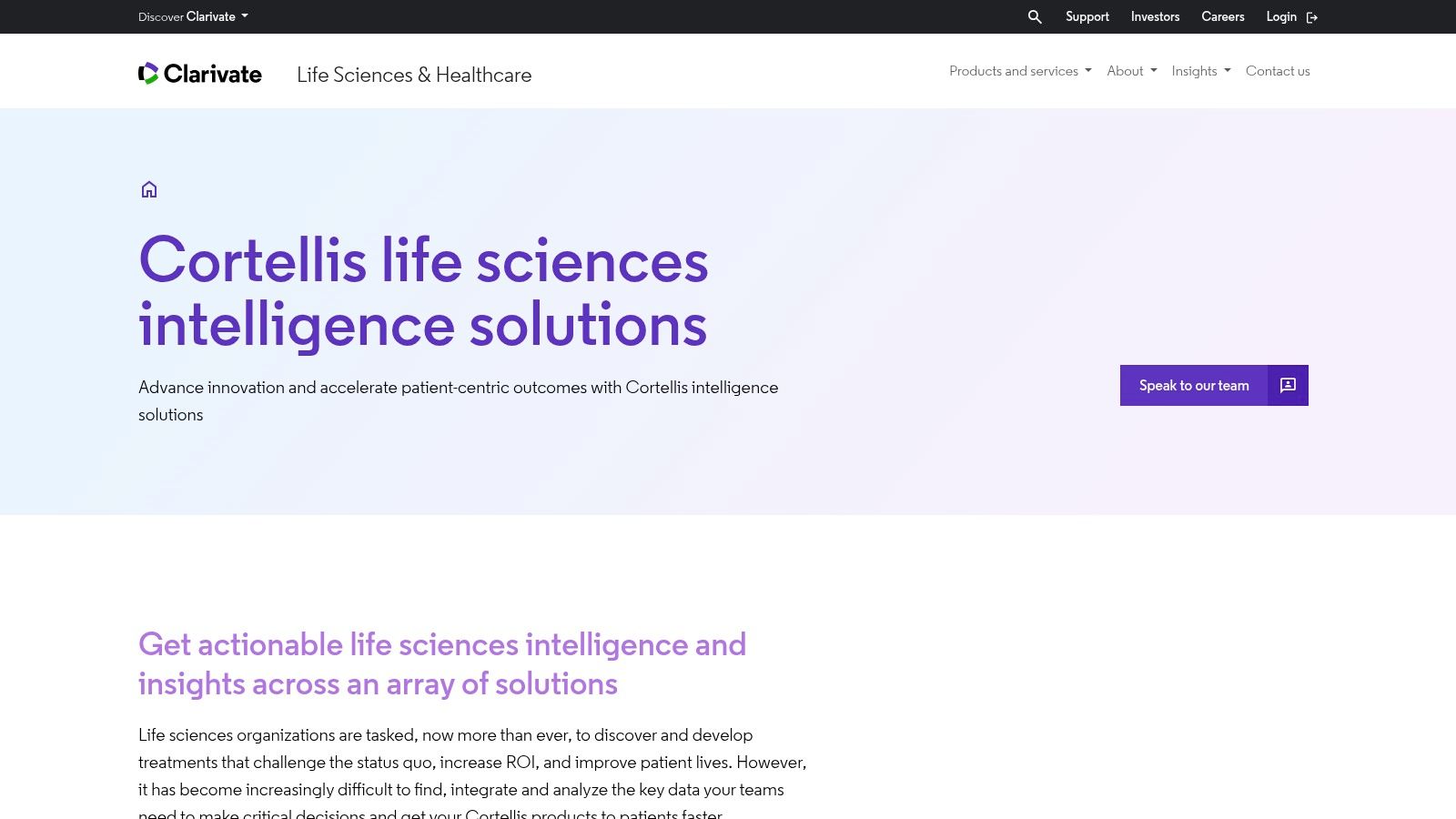
For teams that need to connect regulatory, scientific, IP, and commercial context, Clarivate Cortellis is one of the most serious options on the market. Large organizations often gravitate here because they want auditability, depth, and connected datasets across functions.
This matters if sales sits close to business development, portfolio strategy, or technical solution selling. A team selling specialized services into complex development programs may need to understand not just a trial milestone, but also the surrounding patent environment, competitive assets, and regulatory pathways.
Strongest for complex enterprise research
Cortellis is powerful, but it's not lightweight. Commercial teams that only need outreach timing and account prioritization often find it too research-heavy. The platform makes the most sense when your sellers work in long cycles, with technical buyers, and need a defensible view of the account's broader context.
If you're evaluating this path, it's worth comparing alternatives to Clarivate Life Sciences tools through a commercial lens, not just a data-depth lens. The buying question isn't whether Cortellis is rich enough. It is. The question is whether your reps will effectively use that richness in daily selling.
- Life sciences signal coverage: Broad and deep across multiple data families.
- Clinical trial tracking: Strong.
- Regulatory monitoring: One of the clearest reasons to consider it.
- Pricing: Premium and modular, so scope control matters.
- Actionability: Excellent for research, uneven for frontline sales execution.
6. Definitive Healthcare
Definitive Healthcare belongs on this list for one reason. Some life sciences teams aren't really selling into biotech pipeline organizations. They're selling into provider systems, hospitals, physician groups, and the U.S. healthcare delivery market.
If that's your motion, Definitive Healthcare is far more relevant than a biotech discovery platform. It helps commercial teams understand provider organizations, affiliations, claims-driven behavior, and market structure. That's a different kind of intelligence from Zymewire, but for many access, diagnostics, medtech, and commercial teams, it's the right kind.
Use it when your buyer sits in care delivery
This is not the tool for early-stage biotech prospecting. It won't be the best fit if your revenue depends on stealth companies, preclinical programs, or trial-phase inflection points. But if your team needs to map hospitals, target physician networks, or understand provider-side demand patterns, it's more useful than many biotech-first databases.
That's why category fit matters more than brand familiarity. The best Zymewire competitors in life sciences aren't always the closest product clones. Sometimes the best alternative is the platform aligned with your actual buyer.
- Life sciences signal coverage: Strong for healthcare delivery and provider intelligence.
- Clinical trial tracking: Not a core focus.
- Regulatory monitoring: Limited relative to development-centric platforms.
- Pricing: Typically evaluated as a commercial intelligence platform rather than an entry-level point solution.
- Actionability: High for provider targeting and territory planning, lower for biotech trigger selling.
7. PitchBook
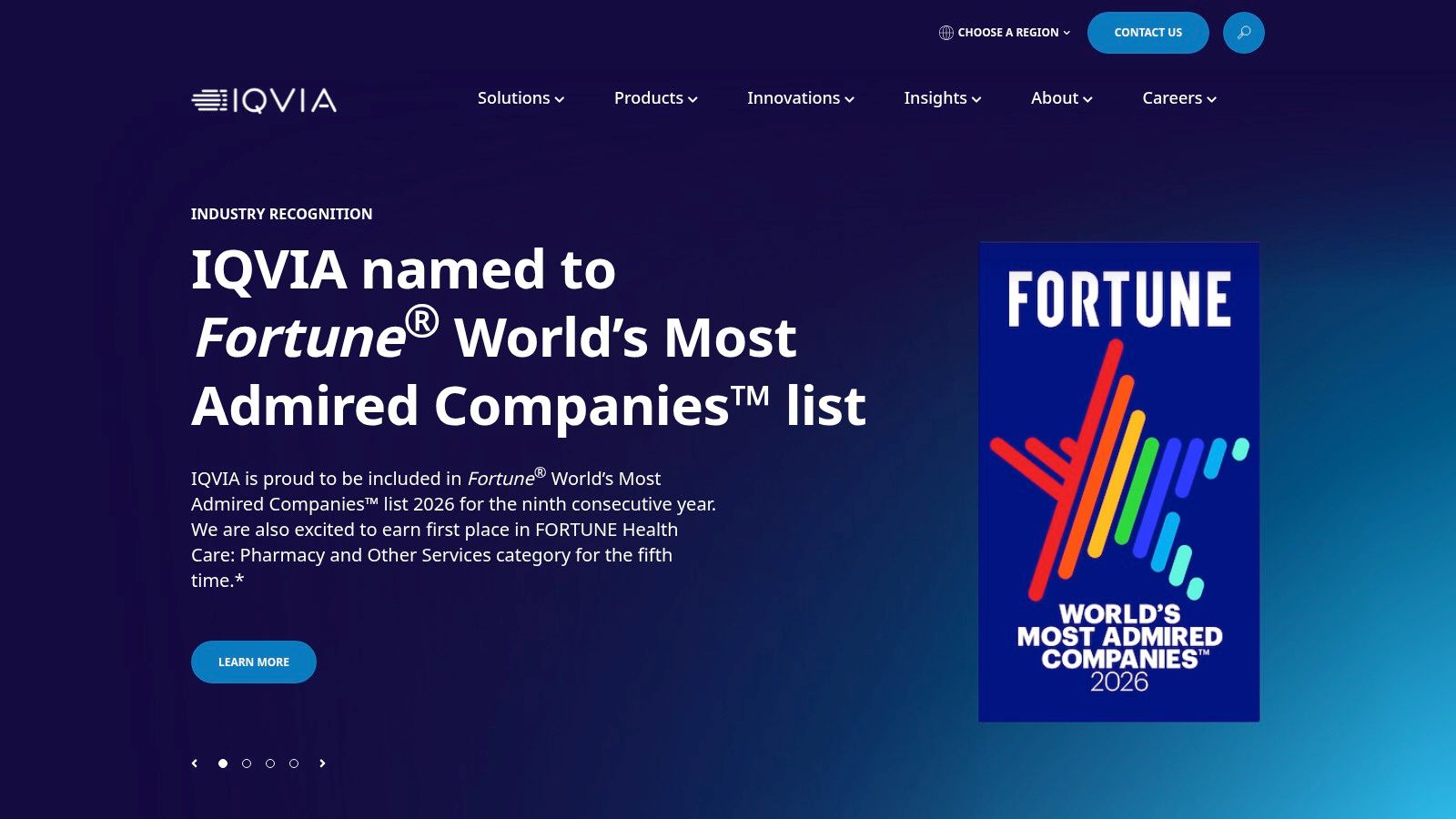
PitchBook is a strong alternative if your sales timing is driven by money. That includes fundraising, ownership changes, investor pressure, M&A activity, and leadership shifts tied to financing events.
This matters more than many life sciences leaders admit. A biotech can have scientific momentum and still be commercially frozen. Then one financing closes, a new board member arrives, or a strategic transaction changes priorities, and the account suddenly becomes reachable. PitchBook helps teams see that financial context clearly.
Best when capital events drive your outreach
PitchBook is especially useful for firms selling strategic services to venture-backed biotech and pharma companies. CROs, consultants, software providers, and specialist vendors often win because they contact an account when capital structure changes, not just when a scientific milestone hits.
Still, PitchBook is not a complete life sciences intelligence system. Its life sciences value sits inside a broader financial platform, so scientific and regulatory nuance won't match specialist tools.
- Life sciences signal coverage: Good where financing and corporate events shape buying behavior.
- Clinical trial tracking: Secondary to capital and company intelligence.
- Regulatory monitoring: Not the main reason to buy it.
- Pricing: Enterprise-oriented.
- Actionability: High for teams that sell around financing windows, lower for teams that need deep biotech operating signals.
8. News and media outlets

BioPharma Dive and publications like FiercePharma are useful. They are not, by themselves, serious Zymewire replacements for a sales organization that needs repeatable pipeline creation.
Use them for awareness. Don't confuse awareness with intelligence.
Good baseline, poor operating system
News outlets help reps stay current on major approvals, restructurings, partnerships, clinical readouts, and leadership changes. That makes them a solid layer in any team's routine. Many sales leaders rely on them because they're accessible and familiar.
But they create a manual workflow. Reps have to read the story, decide whether it matters, connect it to a target account, infer the commercial implication, choose who to contact, and write the message. That's too much handwork for a modern account book.
News is a starting point. It's not a system.
- Life sciences signal coverage: Broad headline coverage.
- Clinical trial tracking: Only as reported in articles.
- Regulatory monitoring: Visible at the news level, not in a structured workflow.
- Pricing: Often free or low-friction to access.
- Actionability: Low unless your reps are disciplined researchers and writers.
If your current “intelligence stack” is newsletters plus LinkedIn plus spreadsheets, your team doesn't have a stack. It has a scavenger hunt.
9. Generic intent data platforms
6sense and Bombora-style intent platforms can help some commercial teams, but they are not substitutes for life sciences signal intelligence. They tell you that an account may be researching a topic. They usually do not tell you what changed inside the biotech, why urgency increased, or which real-world milestone created budget pressure.
That distinction is critical. A life sciences seller needs to know more than “interest exists.” They need to know whether a program advanced, a team scaled, a trial shifted, or a regulatory event changed the buying environment. If you're comparing intent data providers to vertical-specific tools, keep that gap front and center.
Where generic intent works, and where it breaks
Generic intent platforms fit broad ABM programs. They're useful when marketing and sales run high-volume motions across many sectors and want a lightweight indicator of in-market behavior. That can support top-of-funnel prioritization.
For biotech and pharma selling, though, generic intent often lacks the specificity reps need. “Researching analytics software” is weak compared with “new clinical operations leadership was hired after a study milestone.”
- Life sciences signal coverage: Generic, not domain-specific.
- Clinical trial tracking: No.
- Regulatory monitoring: No.
- Pricing: Usually part of a broader ABM budget discussion.
- Actionability: Moderate for broad prioritization. Weak for precise life sciences outreach.
Top 9 Zymewire Competitors in Life Sciences, Feature Comparison
| Solution | Core capabilities | Target audience | Key benefit ("so what") | Ease of use & integrations | Typical price |
|---|---|---|---|---|---|
| Salesmotion | Autonomous Research, Signal & Prospector agents; synthesises 1,000+ sources; drafts personalised outreach | Revenue teams & RevOps selling into life sciences; ABM-focused sellers | Real-time "so what" context + ready-to-send, signal‑anchored outreach that shortens prep-to-send time | Low setup; Slack, email & CRM routing; continuous refresh | Quote-based team subscription; mid-market → enterprise |
| Citeline (Norstella) | Curated global trial registry (Trialtrove), site/investigator benchmarking (Sitetrove), analyst support | BD, clinical planning, large pharma & CROs | Gold‑standard trial and investigator intelligence for timing clinical outreach | Modern UIs; modular products and analyst workflows; integrations vary | Enterprise; modules often $25k+ / year |
| GlobalData Pharma | Pipeline, pricing/market access, outsourcing insights (PharmSource), analyst reports | Suppliers to sponsors (CROs/CDMOs), BD and strategy teams | End-to-end market intelligence and outsourcing demand signals | Rich datasets but often static; requires training to extract sales value | Enterprise; commonly $25k–$50k+ / year |
| Evaluate (Norstella) | Consensus forecasts, market sizing, asset comparisons, commercial forecasts | Strategy teams, corporate development, exec-level sellers | Defensible revenue forecasts and market sizing to support C‑level business cases | Analytical platform (not prospecting-focused); limited account-level signals | Premium enterprise pricing; quote-based |
| Clarivate, Cortellis | Integrated regulatory, trials, deals, IP and scientific data | Teams needing regulatory pathways linked to R&D and BD | Exceptional regulatory depth and data lineage for complex deals | Powerful but complex; research-first UX; modular pricing | Enterprise, premium; quote-based |
| Definitive Healthcare | U.S. claims, hospital/provider profiles, referral and adoption analytics | Sales into U.S. providers, hospitals, medtech & payer-facing teams | Unmatched U.S. provider visibility for territory planning and KOL targeting | User-friendly sales workflows; designed for commercial teams | Enterprise; variable pricing (U.S.-centric) |
| PitchBook | Investor, deal, ownership data; financings and M&A with growing life‑sciences links | Teams timing outreach around funding, M&A or investor-driven change | Visibility into capital events and investor pressure to time outreach | Easy-to-use platform with strong export capabilities; integrations vary | Enterprise; quote-based |
| News & Media Outlets (BioPharma Dive, FiercePharma) | Daily headlines, newsletters, breaking industry news and analysis | Anyone needing broad market awareness | Free, timely public reporting; often the first public source of major news | Manual monitoring; no account-based alerting or automation | Free |
| Generic Intent Data Platforms (6sense, Bombora) | Anonymous content-consumption signals, account intent scoring, CRM/MA integrations | Mature ABM/marketing teams looking for top-of-funnel signals | Broad in-market account signals that surface demand not yet on your list | Integrates with CRM/MA but life-sciences context is often vague; false positives | Tiered; can be costly; enterprise-oriented ## From Data to Deals Choosing Your Intelligence Engine What is slowing your team down. A lack of data, or a lack of clear next actions? Sales leaders evaluating Zymewire alternatives often chase volume first. That is the wrong filter. The key question is whether your team needs a data firehose of alerts to sort through manually, or an intelligence engine that explains why an account change matters and helps turn it into outreach before the window closes. The category breaks cleanly into four groups. Citeline, Evaluate, and Clarivate Cortellis serve research-heavy teams that need clinical, regulatory, and market detail. GlobalData and PitchBook help with market shifts, capital events, and planning. Definitive Healthcare fits provider-facing commercial motions. News outlets and generic intent platforms support awareness, but your reps still have to connect the dots themselves. The buying decision should match your sales motion, not your curiosity. Choose research platforms if your sellers can translate technical information into messaging on their own. Choose market intelligence tools if leadership needs sharper territory design and account prioritization. Choose provider-focused data if your revenue depends on hospitals, health systems, and physician groups. Choose a signal-to-action system if your core problem is execution. That means reps miss timing, struggle to personalize outreach, or waste hours stitching together context across tabs. That distinction matters most for CROs, CDMOs, life sciences software vendors, and specialist service firms. Their teams do not need another stream of raw alerts. They need account monitoring, synthesized context, and outreach support in one operating workflow. As noted earlier, Zymewire remains useful for early biotech signal detection. Its tradeoff is scope. It is stronger at surfacing events than at closing the loop from signal to recommended action and outbound execution. Make the decision based on how your team sells. If your reps already work like analysts, a research-first platform can fit. If they are asking for fewer dashboards, faster account understanding, and clearer next steps, prioritize an intelligence engine. Salesmotion fits that model because it combines research, signals, and outreach support in one workflow. That is the practical choice for teams that want fewer alerts and more conversations that turn into pipeline. |