You're probably in this pattern already. A rep gets a Zymewire alert about a funding event, an executive move, or a company entering a new phase of activity. For a moment, it feels like momentum. Then the substantive work begins. Someone has to figure out why the update matters, who inside the account is responsible for the problem, whether the timing is right, and what to say without sounding generic.
That workflow was acceptable when signal tools mainly had to answer one question: who should we watch? It's much less effective now, especially for life sciences teams covering complex books of business across biotech, pharma, CDMOs, CROs, software, services, and specialized suppliers. The bar is higher. Teams need the full loop from signal to research to contact to message.
Zymewire still deserves credit for helping define biopharma sales intelligence. But many teams looking for a Zymewire alternative aren't unhappy with the alerts themselves. They're frustrated by everything that has to happen after the alert arrives.
Why Zymewire Users Seek an Alternative
A common scenario looks like this. You see an alert tied to an account you care about. Maybe there's a leadership change or a fresh financing event. You know it could matter. But the alert alone doesn't tell the rep whether this is a procurement trigger, a strategic shift, or just noise.

The rep then opens LinkedIn, the company website, recent press releases, maybe a trial database, maybe investor materials, and usually the CRM. By the time they've pieced together enough context to send a thoughtful note, the original advantage of the alert has shrunk. If this sounds familiar, the issue usually isn't that the team lacks signals. It's that the workflow after the signal is still manual.
A BD lead at a late-phase CRO put numbers on that loop: ten to fifteen minutes per email, across a whole territory. The real problem is not finding sponsors. It is knowing when a sponsor is about to need you, before the RFP lands cold, since cold RFPs convert well below relationships shaped six to nine months early.
The ceiling many teams hit
Zymewire built real value around biopharma-specific discovery and monitoring. Its own materials describe a system that can segment target lists by 150+ data points and identify new companies as soon as they enter the market, while scanning thousands of documents every day and filtering tens of thousands of sales signals into actionable intelligence for biotech and pharma users through Zymewire's solutions materials. That's serious category expertise.
But users often outgrow signal delivery as a standalone function. They want less copy-paste work and more rep-ready context.
A lot of teams that eventually switch or add another platform do so for one of these reasons:
- Too much synthesis still sits with the rep. Alerts show movement, but not always the commercial implication.
- Stakeholder work remains fragmented. The team still has to map who matters across clinical, technical, and commercial buyers.
- Messaging quality varies by rep. Strong sellers can turn a signal into outreach. Average sellers often can't.
- Coverage feels narrow for modern account planning. Teams want a wider lens across business, financial, hiring, and market signals.
Most intelligence tools don't fail because they lack data. They fail because they stop one step too early.
That's why this isn't just a database comparison. It's a workflow question. Teams that want a broader view of why reps abandon point solutions usually recognize the same pattern described in why sales teams abandon intelligence tools.
See Salesmotion in action
Take a self-guided interactive tour — no signup required.
What Zymewire Does Well and Where It Stops
Zymewire remains a credible tool for life sciences teams that need biopharma-specific signal detection. It was built for a vertical with unusual complexity, and that matters. Generic sales data platforms often miss the nuances that biotech and pharma sellers care about.
Where Zymewire is genuinely strong
Its strongest advantage is focus. Zymewire's materials say the platform helps users track executive changes, preclinical research, and conference attendance in biotech and pharma markets. It also says the system uses human-verified AI to scan thousands of documents daily and filter tens of thousands of sales signals into something usable for business development teams, as described on its life sciences sales intelligence page.
That vertical orientation is useful when your team sells into highly specialized buyers and doesn't want a broad cross-industry database pretending to understand drug development.
Zymewire is also clearly designed around segmentation and market discovery. According to its own materials, users can work from 150+ data points, surface verified contact information, and identify new companies as they emerge. For teams doing territory buildout or targeting early-stage biopharma accounts, that's valuable.
Where the handoff becomes manual
The practical limitation is that Zymewire mostly answers the what happened question.
It tells you an event occurred. It may help you spot a company worth watching. But after that, the rep still has to determine:
- Why this matters now
- Which stakeholders are most relevant
- How the event connects to the buying motion
- What message should go out first
That distinction matters more than many comparison pages admit. A first-generation signal tool can be good at surfacing information and still leave too much revenue work undone.
Field reality: In most life sciences teams, the painful part isn't finding one interesting update. It's turning that update into a timely, credible conversation.
For some organizations, that's perfectly fine. A small, experienced BD team may prefer to do all interpretation manually. But larger teams, newer reps, and account-heavy coverage models usually need more guidance than raw signal delivery provides.

“The moment we turned on Salesmotion, it became essential. No more hours on LinkedIn or Google to figure out who we're talking to. It's just there, served up to you, so it's always 'go time.'”
Adam Wainwright
Head of Revenue, Cacheflow
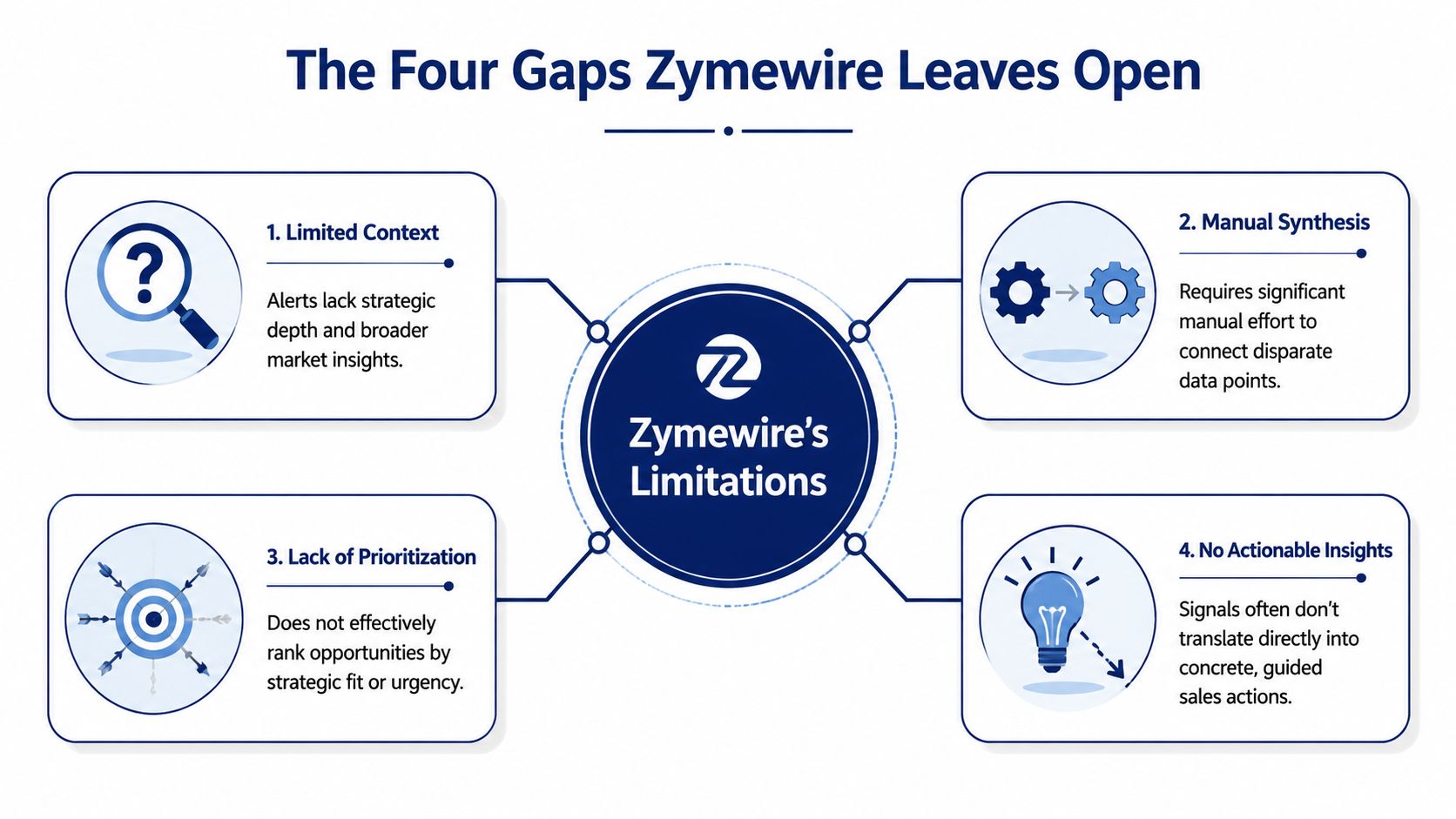
Beyond Signals The Four Gaps Zymewire Leaves Open
Those searching for a Zymewire alternative aren't saying, “I need more alerts.” They're saying, “I need fewer manual steps between the alert and the meeting.”
That's the core issue. The market gap is really about workflow fit. Many comparisons fixate on databases, while the more useful question is whether you need a vertical data source or a cross-functional intelligence workflow that gives reps the next move. That distinction matters even more in a changing market. Zymewire's own 2024 recap notes 296 newly emerging biotech companies in 2024 and APAC funding up 55.3%, which points to a more uneven, region-aware environment than a single-source prospecting model can capture on the Zymewire home page.
The Signal-to-Insight Gap
A raw alert is not an account brief.
A leadership change might be meaningful. A funding update might open a buying window. A conference appearance might suggest market activity. But the rep still has to interpret the implications, compare them against past account behavior, and decide whether this is worth immediate attention. A conference appearance is activity; a positive Phase 2 readout plus clinical-operations hiring is a signal with a clock.
Practical rule: If your reps still have to explain the alert to themselves before they can explain it to the buyer, the platform hasn't finished the job.
Many teams burn time translating fragmented information into commercial meaning. They're not researching from zero.
The Signal-to-Stakeholder Gap
Even when the signal is solid, the next obstacle is people. Who owns the initiative? Who influences vendor selection? Who just became more important because of the change?
This matters a lot in life sciences because buying groups are rarely simple. A trigger tied to manufacturing expansion may matter to operations, technical leadership, procurement, quality, and outside service providers. A trigger tied to trial progression creates a different map.
Without stakeholder context, the team often ends up with a useful event and no clear path to engagement.
The Signal-to-Message Gap
Typically, execution breaks down. The team sees the trigger, understands the rough opportunity, and still sends weak outreach because no one translated the intelligence into language a rep can effectively use.
A lot of organizations underestimate this gap. They assume that if a rep has the signal, they can write the email. Some can. Many can't do it consistently, especially across a larger team.
For readers comparing broader types of intent data, this is the distinction worth watching. Buying signals are only useful when they can be connected to a clear outreach angle.
The Signal Coverage Gap
Zymewire is strong in biopharma-specific monitoring. But many teams now want broader account intelligence than niche signal feeds alone can provide.
They want visibility into business updates that shape timing and messaging, including things like earnings commentary, regulatory disclosures, leadership interviews, job postings, company blogs, podcasts, and hiring patterns. Not every source matters equally, but together they create a much better picture of urgency and strategic direction.
The most-requested capability, and hardest to get elsewhere, is cross-account search across stacked catalyst types: which sponsors showed results activity and clinical-ops hiring and a recent raise last quarter, in one query. Without that, the pattern that results activity predicts the next study within three to six weeks stays in a rep's head.
That's the difference between a signal feed and a working intelligence layer.
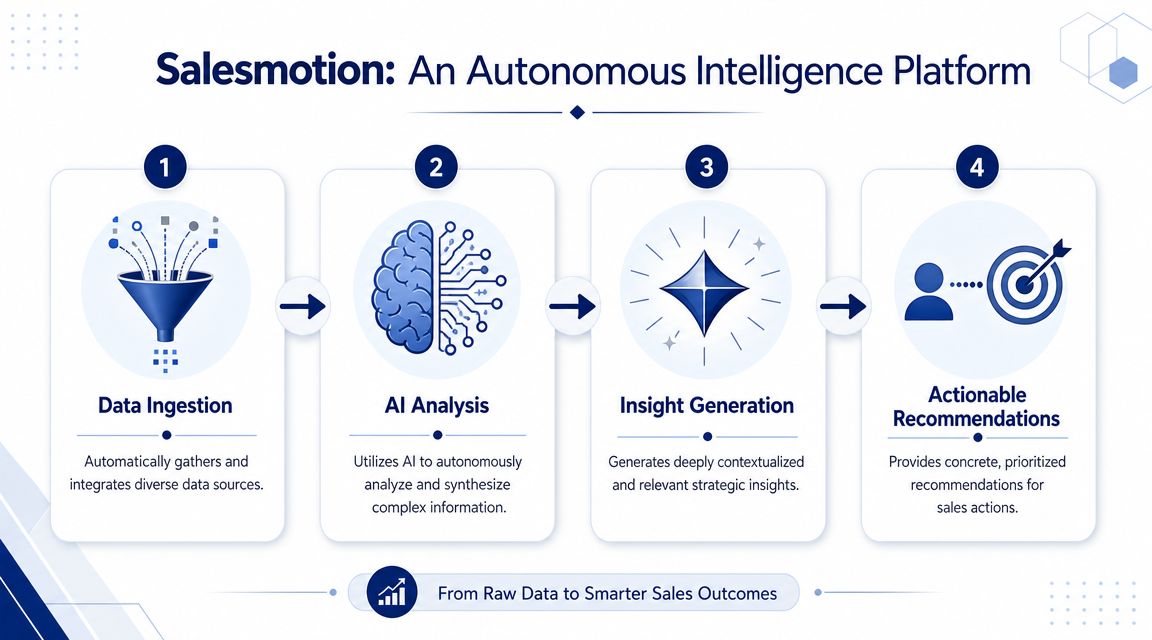
Introducing Salesmotion An Autonomous Intelligence Platform
The more useful way to evaluate alternatives is not “Which tool has more alerts?” It's “Which system gets my reps from account movement to useful action with the least manual work?”
That's where the category starts to shift from signal delivery into autonomous workflow. One option in that camp is Salesmotion, which positions itself as a Zymewire alternative built for full-stack account intelligence rather than alerting alone.
What changes in the operating model
Salesmotion's product page says the platform monitors 1,000+ real-time data sources and surfaces 50+ buying signal types, with one-click account briefs, AI-generated outreach, and native Salesforce and HubSpot integration. It lists pricing at $85/month for individuals, with team and enterprise pricing available on the Salesmotion alternatives page.
The reason that matters isn't just source count. It's the attempt to close the operational gaps that signal-only tools leave open.
Instead of handing the rep an event and asking them to do the rest, the workflow aims to connect:
- Signal detection
- Account research
- Stakeholder context
- Outreach creation
That's a different category decision than choosing one biotech database over another.
Why this resonates with larger teams
In practice, teams outgrow signal-only platforms when managers need consistency across reps. The strongest rep can take a thin alert and build a smart point of view. The rest of the team often needs a system that does more of the prep work.
That's also why some organizations don't treat the decision as a pure replacement question. In the field, teams sometimes keep a specialized source for narrow use cases and add a broader intelligence layer for account planning and outbound execution. The author brief notes that Parexel actively used both Zymewire and Salesmotion simultaneously, which is a practical example of how buyers separate signal discovery from downstream workflow needs.
The proof maps to the two pains CRO BD teams raise most: research time and reaching the right account at the right moment. Cytel cut research time 50% and five tools to one, per Lyndsay Thomson, Head of Sales Operations, and Chief Commercial Officer Jonathan Burr reports planning 30% faster and six hours saved per rep weekly. Frontify saw research time drop 90% and self-sourced revenue grow 4x, per Thomas Meichtry, Head of Sales, North America.
A signal tool tells the rep something happened. An autonomous intelligence workflow tells the rep what changed, why it matters, who to contact, and how to start the conversation.
If you want to see how that operating model is presented in product form, the clearest overview is the Salesmotion product tour.
“Automatic account profile detail I can use to manage my territory. Using Salesmotion AI to generate value statements per persona, account, etc. Using Salesmotion to give me a starting point based on new hires, or news alerts is critical.”
Adam Wainwright
Head of Revenue, Cacheflow
Zymewire vs Salesmotion A Side-by-Side Comparison
Most searches for a Zymewire alternative eventually come down to one decision. Do you want a specialized signal delivery tool, or do you want a broader intelligence workflow that equips reps to act?
Here's the cleanest way to look at it.
| Capability | Zymewire | Salesmotion |
|---|---|---|
| Core orientation | Biopharma-focused signal and company discovery | Autonomous account intelligence workflow |
| Signal handling | Surfaces biopharma-relevant events and market activity | Monitors a wider mix of account signals and connects them to action |
| Research output | Primarily event visibility and list segmentation | One-click account briefs with synthesized context |
| Stakeholder support | Verified contact information is part of the platform positioning | Workflow is designed to connect signal, account context, and outreach prep |
| Outreach activation | Rep-driven manual follow-up | AI-generated outreach tied to detected signals |
| CRM fit | Salesforce integration is part of its positioning | Native Salesforce and HubSpot integration |
| Best fit | Teams prioritizing biotech and pharma discovery and monitoring | Teams prioritizing signal-to-action execution across account books |
Signal coverage
Zymewire is purpose-built for biotech and pharma. That's useful if your main need is niche vertical monitoring, especially around market discovery and specialized biopharma developments.
Salesmotion's positioning is broader. Its product page emphasizes monitoring across a large set of real-time sources and buying signals, which makes it more suited to teams that want a wider account-intelligence picture. That difference matters if your reps need commercial, organizational, and strategic context in the same workflow.
Intelligence output
This is the biggest practical divide.
Zymewire helps teams find and monitor important developments. But the rep typically still has to determine the commercial angle. The output is useful input, not a finished action layer.
Salesmotion is built around synthesis. The value proposition is not only that it identifies movement, but that it produces account briefs and interprets the signal into rep-ready context. If you manage a team where outreach quality depends too much on individual rep skill, this difference becomes important fast.
Stakeholder mapping and contact context
Zymewire's core strength is not org-chart orchestration or multi-stakeholder guidance. It can help teams discover contacts and target accounts, but it doesn't primarily present itself as the system that resolves who matters most after a trigger.
That gap becomes obvious in more complex sales motions. A rep may know an account has moved, but still not know whether to contact clinical operations, BD, procurement, manufacturing, or the executive sponsor.
That's why many teams end up combining tools. One platform gives signal visibility. Another supports stakeholder discovery or outreach execution. Buyers evaluating stacks like this often browse broader sales intelligence comparisons because the trade-off is rarely one feature versus another. It's usually a workflow design problem.
Outreach activation
A common issue is that many evaluation checklists remain too shallow.
A platform can give you excellent information and still leave your team slow to act. If the rep must write every message from scratch, timing degrades and quality varies.
Salesmotion's positioning explicitly includes AI-generated outreach tied to account movement. Zymewire's positioning, by contrast, is stronger on identifying and organizing relevant market data than on converting it into personalized first-touch messaging.
The real comparison isn't alert quality versus alert quality. It's manual interpretation versus guided execution.
The practical takeaway
Choose Zymewire if your priority is specialized biopharma signal discovery and segmentation.
Choose a broader workflow platform if your real bottleneck starts after the alert arrives.
That's usually the truer framing for teams searching for a Zymewire alternative.
When to Consider a Zymewire Alternative
The clearest signal that you've outgrown a signal-only tool is simple. Your reps aren't struggling to find updates. They're struggling to turn updates into consistent action.
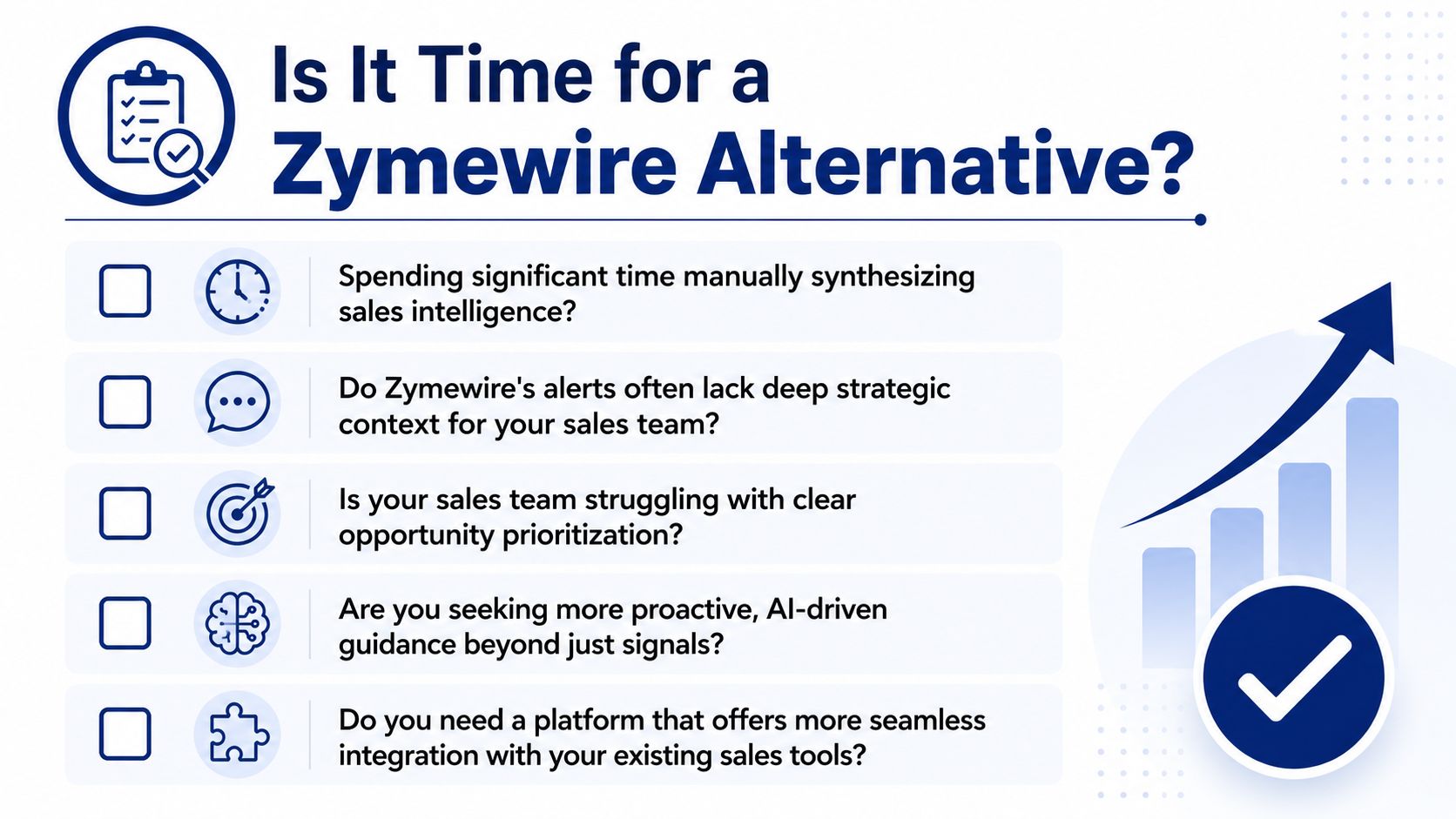
A few questions usually expose the gap quickly:
- Do alerts still trigger manual research sprints? If every meaningful signal sends the rep into LinkedIn, company sites, press releases, and CRM notes, the workflow isn't complete.
- Is stakeholder identification inconsistent? If some reps know exactly who to contact and others guess, the problem is bigger than data access.
- Does message quality vary wildly by rep? That usually means the team has information but no reliable bridge from intelligence to outreach.
- Are important account changes happening outside your current signal lens? If your team cares about hiring patterns, executive interviews, investor commentary, or broader operational clues, narrow monitoring can become a constraint.
- Do managers want a system, not heroics? If performance depends on a few reps who are unusually good at synthesis, the team needs a better operating model.
There's also a broader lesson here from adjacent AI categories. Teams increasingly evaluate tools based on whether they improve visibility alone or strengthen execution. That same dynamic shows up in topics like profound AI brand presence, where the difference between surface monitoring and actionable workflow has become a key buying criterion.
A Zymewire alternative makes sense when you no longer need just a feed of events. You need the account researched, the stakeholders clarified, and the first message mostly ready before the rep loses momentum.
The switch isn't for everyone. If your motion is pure early-stage stealth-biotech discovery, you live only in Salesforce, or you don't yet work a defined book of sponsors, Zymewire may serve you better. In one IntuitionLabs survey, 82% of sponsors used two or more full-service CROs in a year, so the relationship is rarely winner-take-all. It is a series of openings, and the CRO that shows up at the right inflection point wins more.
If your team wants to see accounts researched with full intelligence, not just alerts, take a look at Salesmotion. The useful test is straightforward: pick a few target accounts, review the output, and see whether your reps can move from signal to outreach with less manual work.