Teams are asking a fair question right now. If reps can use ChatGPT to research an account, summarize a prospect's website, draft follow-up emails, and brainstorm call angles in a few minutes, why keep paying for sales intelligence software at all?
That question usually comes up when a sales leader sees two things at once. First, reps are clearly getting value from generative AI. Second, the existing stack still feels expensive, fragmented, and underused. So the temptation is obvious: maybe ChatGPT can replace more of the workflow than vendors want to admit.
It can replace some tasks. It cannot replace the system.
That's the essential frame for ChatGPT vs sales intelligence tools. One is a flexible assistant for ad hoc work. The other is infrastructure for account coverage, signal detection, prioritization, and action across the whole book of business. If you're running a serious pipeline motion, that distinction matters more than any prompt trick.
The New Question on Every Sales Floor
A lot of revenue teams are living the same scenario. An SDR uses ChatGPT to clean up an email. An AE pastes in a prospect's earnings transcript and asks for key themes. A manager uses it to prep discovery questions before a call. Everyone gets faster at small tasks, and suddenly the old line between “AI assistant” and “sales platform” starts to blur.
That blur causes a strategic mistake. Teams start comparing a personal productivity tool with a pipeline operating system as if they were the same category. They aren't.
Why this comparison matters now
The sales intelligence category exists because teams need structured account insight, prioritization, and workflow support at scale. That's not a niche market. Grand View Research says the global sales intelligence market was valued at USD 2.95 billion in 2022 and is projected to reach USD 6.68 billion by 2030, with a 10.8% CAGR from 2023 to 2030.
That matters because budget follows operational pain. Companies don't buy sales intelligence platforms just to generate text. They buy them because reps miss signals, coverage is inconsistent, research takes too long, and outreach happens after the moment has passed.
Productivity hack or growth system
ChatGPT is useful because it lowers the friction of thinking and writing. It helps a rep go from blank page to decent draft fast. That's valuable.
Practical rule: If the work starts with “I need help with this task right now,” ChatGPT is often a good fit. If it starts with “I need the team to cover every important account without missing timing,” you're in sales intelligence territory.
That distinction gets sharper as teams scale. A single rep can live with manual prompting. A team covering named accounts, expansion targets, and multi-threaded deals can't rely on memory, copy-paste workflows, or “ask again tomorrow” as an operating model.
This is why the best buying decisions in this category aren't about AI hype. They're about deciding what should remain a rep-level tool and what has to become a managed system for growth.
Sales intelligence shopping list this long?
Skip the matrix. Salesmotion combines account intel, signals, and outreach drafts in one tool.
1,000+ public sources monitored 24/7, verified contacts with 200 credits/mo included, $85/mo. Monthly contract, no lock-in.
What ChatGPT Does Well for Sales and Where It Stops
A rep gets off a discovery call, opens ChatGPT, pastes in notes, and asks for a follow-up email, likely objections, and a few angles for the next touch. Five minutes later, they have something usable. That is a legitimate productivity gain, and it is why ChatGPT has become part of so many sales workflows so quickly.
It works best as a task tool. Give it context, a clear prompt, and a narrow job, and it usually returns something helpful.
Where ChatGPT helps reps day to day
ChatGPT is strongest after the rep has already done the hard part of gathering context and deciding what they need.
- Ad hoc research questions are a good fit. Reps can ask for a summary of a company's positioning, a breakdown of a buyer role, or likely pain points for a specific persona.
- Drafting assistance saves time. It can produce follow-up emails, call openers, objection-handling ideas, and talk tracks quickly.
- Document analysis is useful when the source material is provided. Earnings call excerpts, product pages, transcripts, RFPs, and case studies all work well.
- Brainstorming is often productive. It can suggest outreach angles, meeting prep questions, and hypotheses a rep might not generate on the first pass.
Used this way, ChatGPT is practical. It reduces blank-page time and helps reps turn scattered inputs into a first draft. For teams exploring that use case, this guide on using ChatGPT for lead generation gives a fair view of where it helps.
Where it stops in a real sales motion
The limit is not writing quality. The limit is coverage. A field test of Claude on eight accounts showed the pattern clearly: accurate, cited research that still missed 22% to 41% of the useful signals, depending on the model.
ChatGPT waits for instructions. It does not monitor target accounts while the team is asleep, detect a leadership change, connect that event to an active territory plan, and route the signal into the rep's workflow with context attached. A rep has to remember to ask, know what to ask, and come back often enough to catch the moment.
That model breaks once a team owns more than a small set of accounts.
A single rep can manage manual prompting for a handful of deals. A team covering named accounts, expansion plays, and new business across segments will run into the same problems fast. Context lives in too many places. Good prompts are not shared consistently. Research gets repeated. Timing depends on rep discipline instead of system coverage.
ChatGPT answers the question in front of the rep. It does not manage which accounts need attention right now.
It also lacks persistent account memory at the workflow level. Reps have to re-prompt, re-upload, and re-check. That is manageable during meeting prep. It is a weak operating model for pipeline generation across a book of business.
The gaps show up in day-to-day execution:
- No continuous monitoring of account changes
- No automatic detection of buying signals
- No built-in routing into CRM, Slack, or rep queues by default
- No reliable portfolio-wide coverage without manual effort
- No assurance that outputs are current, complete, or ready to send without review
That is the practical dividing line. ChatGPT helps with sales tasks. It does not run a sales intelligence motion. If the goal is better copy and faster prep, it earns a seat. If the goal is consistent coverage, timely outreach, and repeatable pipeline creation across a team, a dedicated system is still required.

“Salesmotion helps you spot signals from prospect accounts, news items / job hiring alerts etc that indicate that now is a good time to reach out with a well-crafted message.”
Rob Douglas
Director of Sales, icit business intelligence
The Purpose-Built Alternative Sales Intelligence Platforms
A real sales intelligence platform shouldn't be thought of as a research database with an AI wrapper. The useful ones do something more specific. They convert dispersed signals into a workflow your team can act on.
What these platforms are actually built to do
The core job is simple to describe and hard to do manually:
- Monitor accounts continuously.
- Detect events that matter.
- Explain why the event matters.
- Route that context into the rep's workflow.
- Support action while the trigger is still fresh.
That's a very different design brief from a chatbot.
Modern platforms pull together multiple signal types, not just firmographic data. As summarized in this overview of sales intelligence platform capabilities, the useful systems combine account data, engagement data, external activity, and workflow routing so the rep gets context and timing together.
Timing is the real gap
A lot of comparison content gets stuck on content generation. That misses the key difference.
As we've argued elsewhere, the key differentiator in sales intelligence is operational timing. The best platforms embed alerts and workflows so reps know when to act, not just what data exists. That's the gap ChatGPT can't close on its own.
A purpose-built system can watch accounts all day without being prompted. It can push updates into Slack, email, or CRM. It can keep the team aligned around the same account picture instead of forcing every rep to rebuild context from scratch.
What fills the gap
When teams buy these tools, they're usually trying to solve one or more of these problems:
- Coverage drift. Some accounts get attention, others get ignored.
- Slow trigger response. By the time a rep notices a signal, the window is colder.
- Research inconsistency. One rep does deep prep, another sends generic outreach.
- Workflow fragmentation. Useful context sits in one tool while execution happens somewhere else.
A dedicated platform earns its keep when it reduces the distance between signal and outreach.
That's why the strongest platforms aren't just “more data.” They're systems that connect detection, prioritization, and action.
Side-by-Side Comparison of Capabilities
The easiest way to think about ChatGPT vs sales intelligence tools is this: ChatGPT helps a rep complete a task. A sales intelligence platform helps a team run a motion.
Here's the practical comparison.
| Capability | ChatGPT | Sales Intelligence Platform |
|---|---|---|
| Primary role | General-purpose assistant for prompts, drafting, summarizing, and analysis | Purpose-built system for account monitoring, signal detection, prioritization, and execution support |
| How work starts | A rep asks a question or pastes in source material | The platform continuously watches target accounts and surfaces relevant changes |
| Data model | Session-based and prompt-driven | Persistent, account-level records and signals |
| Timeliness | On-demand only | Continuous monitoring with alerts and workflow triggers |
| Scalability | Fine for one-off research | Designed for coverage across a large account portfolio |
| Workflow integration | Usually copy-paste into email, docs, or CRM notes | Built to route context into CRM, Slack, email, and sales workflows |
| Output style | Often generic unless heavily guided | More context-aware because it is anchored to account data and triggers |
| Best use case | Writing help, brainstorming, summarization, document analysis | Prioritizing accounts, catching buying signals, reducing prep time, coordinating outreach |
| Main weakness | Reactive and manual | Requires implementation discipline and a clear process |
Where the two tools diverge in practice
The biggest difference is not “AI quality.” It's whether the system can operate without the rep constantly driving it.
With ChatGPT, the rep has to remember to revisit an account, pull in fresh context, ask the right follow-up question, and then translate the answer into action. That's a lot of manual orchestration.
With a purpose-built platform, the system carries more of that burden. Tools in the account intelligence category are built around the idea that insight should arrive attached to the account and the moment. If you're evaluating that layer, this review of account intelligence tools compared is a useful lens.
The operational trade-off
ChatGPT often looks cheaper because the interface is simple and the output appears immediate. But the hidden cost is manual overhead.
A rep still has to:
- Decide what to check
- Find or paste source material
- Interpret the answer
- Update records manually
- Draft the actual outreach in context
- Repeat the process across the book
A sales intelligence platform asks for more process discipline upfront, but it reduces repeated human effort. It can standardize how accounts are watched and how context is delivered.
If your team covers a handful of strategic accounts, manual prompting can work. If your team needs reliable coverage across a broad target list, it usually breaks.
That's why I don't see this as an either-or decision. ChatGPT is a useful layer inside the workflow. It just shouldn't be mistaken for the workflow itself.

“Automatic account profile detail I can use to manage my territory. Using Salesmotion AI to generate value statements per persona, account, etc. Using Salesmotion to give me a starting point based on new hires, or news alerts is critical.”
Adam Wainwright
Head of Revenue, Cacheflow
From Manual Research to Autonomous Sales Agents
The cleanest way to understand this shift is to look at how teams behave when they try to scale the manual route.
A common pattern looks like this: reps use ChatGPT for summaries, then pair it with a note repository or document workspace to store account research. For a few strategic accounts, that can work well enough. Everyone feels productive because there's visible output. Briefs get written. Email drafts improve. The team feels more prepared.
Then the account list grows.
Where reactive research fails
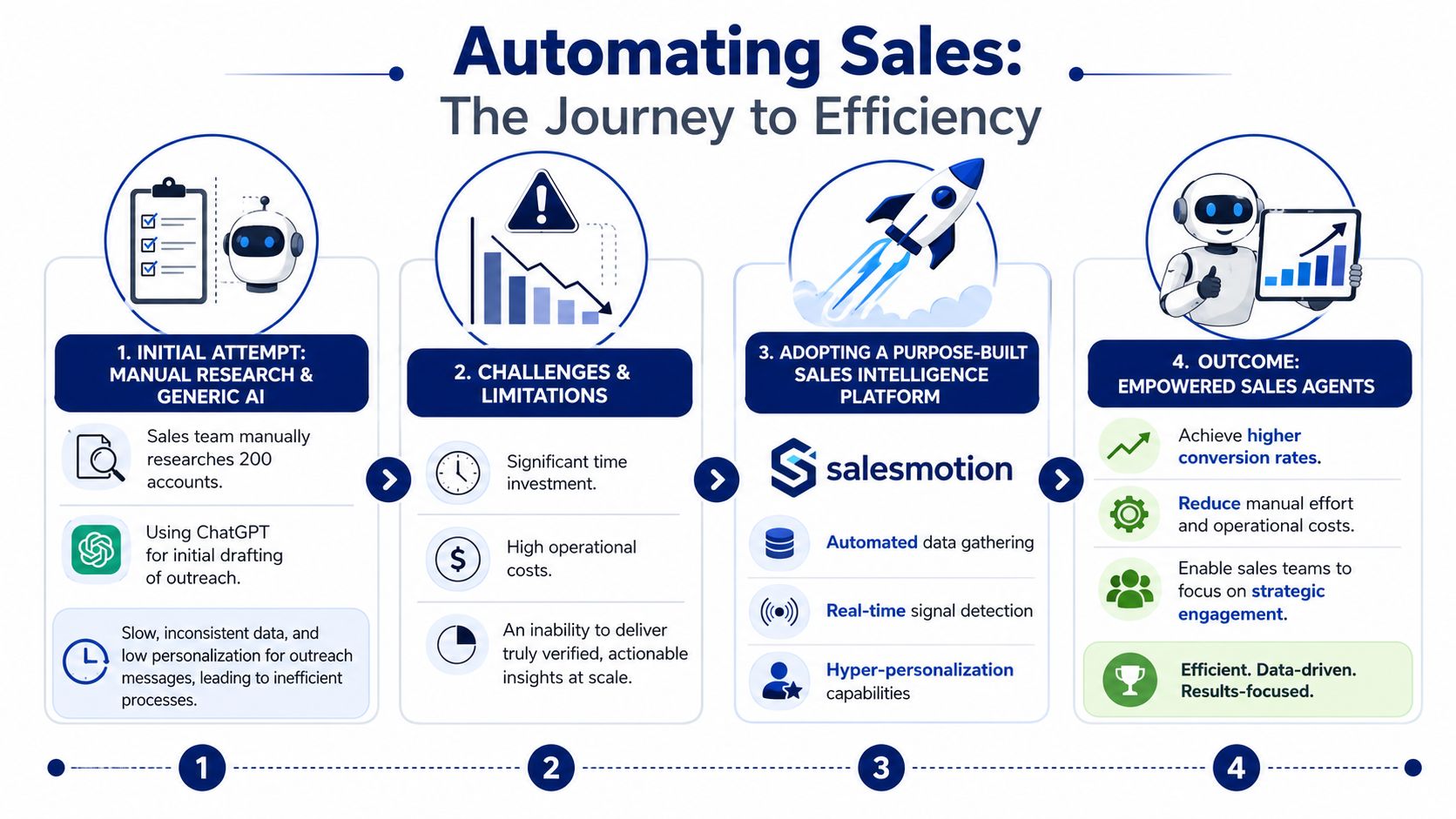
One prospect I spoke with had built a reactive workflow around ChatGPT plus Notebook LM for account research. It was workable for one-off prep. It was not workable for managing 200 accounts.
The issue wasn't that the output was bad. The issue was that the system depended on someone remembering to ask, revisit, refresh, and rewrite. At that scale, the team couldn't keep current across the portfolio. Some accounts had decent context. Others had stale notes. Trigger events slipped by because no one was actively checking at the right moment.
That's where the conversation changes from “Can AI help with research?” to “How do we stop running account coverage as a manual craft project?”
What an autonomous model changes
This is the use case for agent-based sales intelligence. Instead of asking a rep to do every step by hand, the platform divides the work into continuous jobs.
One example is Salesmotion, which uses three AI agents across target accounts:
- Research Agent builds structured account briefs from public sources and refreshes them over time.
- Signal Agent monitors accounts continuously and routes alerts into Slack, email, or CRM when something worth acting on happens.
- Prospector Agent turns the account context and trigger into personalized outreach that the rep can review and send.
That setup matters because it aligns with the actual work sellers struggle to maintain consistently: deep prep, timing awareness, and relevant messaging.
Why time-to-context matters more than more content
The key benchmark isn't whether AI can generate words. It's whether it can give the rep useful context fast enough to change behavior.
That's the jump from assistance to advantage.
Consider the difference in daily motion:
- Manual mode means the rep starts the day deciding which accounts to inspect.
- Autonomous mode means the rep starts the day with prioritized accounts, current context, and a clear reason to engage.
The goal isn't to automate the rep out of the process. It's to automate the low-value searching so the rep can spend time on judgment, conversation, and deal movement.
That's also why “generic AI plus hard work” usually plateaus. It helps smart reps do better individual work, but it doesn't create dependable account coverage across the team.
Building Your Sales Tech Stack the Right Way
Many organizations don't need to choose between banning ChatGPT and replacing the entire stack with a single platform. They need a cleaner division of labor.
Use ChatGPT for rep-level productivity
Keep ChatGPT close to the rep. It's well suited for:
- Drafting and rewriting emails, LinkedIn messages, and follow-ups
- Summarizing pasted material such as transcripts, articles, and web pages
- Brainstorming talk tracks, objections, and discovery questions
- Analyzing documents before a meeting or deal review
Those are real gains. They're immediate and easy for reps to adopt.
Use sales intelligence for team-level execution
The team-level system should handle what individual reps won't do consistently on their own:
- Monitor target accounts continuously
- Surface signal-based priorities
- Push context into CRM and communication tools
- Create a repeatable standard for account coverage
- Reduce the prep burden before outreach
Economic accountability is important. Market comparisons increasingly evaluate platforms by feature breadth and whether they combine intelligence with execution, while noting that general-purpose models like ChatGPT aren't designed for end-to-end workflow automation or signal prioritization. If you're thinking about the stack at a broader level, this piece on how to build a martech stack is a practical companion.
A simple decision test
Ask three questions.
-
Is this a task or a system need?
If it's a task, use ChatGPT. If it's a system need, don't. -
Does this depend on timing?
If catching the right moment matters, a reactive prompt workflow is usually the wrong foundation. -
Can I measure the outcome at pipeline level?
If the answer depends on rep memory and manual effort, attribution gets fuzzy fast.
The strongest setup is usually hybrid. Let reps use ChatGPT as a flexible assistant. Put a dedicated sales intelligence platform underneath the motion so account coverage, timing, and prioritization don't depend on who remembered to ask the right question that day.
Frequently Asked Questions for Revenue Leaders
Can ChatGPT replace sales intelligence software for a small team
For a very small team with a narrow target list, it can cover part of the job. It helps with research, drafting, and prep. The problem starts when the number of accounts grows or the team needs consistent monitoring. What works as a founder workflow rarely holds up as a repeatable team process.
Is the real issue data quality or workflow design
Usually both, but workflow design breaks first. Even decent research becomes hard to operationalize when reps have to prompt, copy, paste, store notes, and remember when to check again. Dedicated platforms matter because they turn information into a repeatable operating rhythm.
Could we build this ourselves with AI tools and internal automation
You can build pieces of it. Many teams do. But custom stacks often create maintenance work for RevOps and still leave gaps around signal interpretation, alert routing, and sales-ready output. The question isn't whether it's possible. It's whether maintaining that system is a better use of time than buying a purpose-built one.
Will generative AI make sales intelligence platforms less relevant
No. It's more likely to make them better. Generative AI improves summarization, drafting, and synthesis. Sales intelligence platforms become more valuable when they combine those capabilities with monitoring, prioritization, and workflow execution.
What should I watch during rollout
Watch rep behavior, not just logins. Are reps acting faster on relevant accounts? Are managers using the same account context in reviews? Are alerts producing outreach, or just more noise? Adoption sticks when the platform reduces work the team already dislikes doing manually.
If your team is using ChatGPT today, keep using it. Just assign it the right job. Use it for research questions, drafting, and quick analysis. For continuous account monitoring, trigger detection, and turning signals into pipeline across the team, use a dedicated system. Salesmotion is one option built for that operating model, with agents that track accounts, surface the “why now,” and route actionable context into rep workflows.