The best sales intelligence platform depends on the gap you need to close. For account intelligence and buying signals, the pick is Salesmotion, from $85/mo on a monthly contract. For a very large contact database it is ZoomInfo, and for contact data with sequencing built in at a published price it is Apollo.io.
TL;DR: The top three picks are Salesmotion for sales teams that need to know which accounts to work and why now (cited account briefs and 50+ signal types from 1,000+ public sources), ZoomInfo for enterprise teams that need one of the largest B2B contact and company databases, and Apollo.io for outbound teams that want contact data, sequencing and a dialer in one tool with a free plan. The other nine platforms on this list each lead a narrower lane: European contact data, relationship selling, enrichment workflows, buyer intelligence, intent data, account-based marketing and revenue intelligence.
| Tool | Best for | Starting price |
|---|---|---|
| Salesmotion | Account intelligence and buying signals | $85/mo for individuals. Custom pricing for teams & enterprise. |
| ZoomInfo | A very large contact and company database | Custom, consumption-based |
| Apollo.io | Contact data plus sequencing in one tool | Free; $49–$119/user/mo (annual) |
Sales intelligence shopping list this long?
Skip the matrix. Salesmotion combines account intel, signals, and outreach drafts in one tool.
1,000+ public sources monitored 24/7, verified contacts with 200 credits/mo included, $85/mo. Monthly contract, no lock-in.
Salesmotion is our top pick for account intelligence and signal-based selling. It monitors 1,000+ public sources for 50+ signal types and turns what it finds into cited account briefs with the talking points reps need, from $85/mo. Need a very large contact database instead? ZoomInfo is the pick. Want conversation analytics and forecasting? That is Gong's lane.
Why Trust This Guide?
I'm Semir Jahic, CEO of Salesmotion. Before this I sold at Salesforce and Clari, and I have sat on both sides of the vendor-buyer table. Salesmotion publishes this guide and sits at number 1 in the list, because sales intelligence built on account research and buying signals is the category we build for. The order of the other eleven is explained above the reviews, and each review says plainly when that tool is the better choice.
Three things back the list:
- Every price and product fact about another vendor was checked against that vendor's own site on 10 October 2026. Each review links the pricing page the figures came from.
- Third-party figures are named. Where a vendor publishes no price, the guide says so. Where Vendr's marketplace publishes a median for that vendor, it is quoted with the number of purchases behind it and labeled as Vendr's figure.
- It starts from what buyers ask. We sat in 55 sales and customer calls between August and October 2026. In 22 of them the question was not who to contact but which accounts to work this week, and when.
Two buyers in those calls put it this way:
"I just feel like we have a lack of visibility into ... what accounts are actually hot"
Sales leader, healthcare technology
"I'm looking more for surveillance on my accounts to pick up the stuff that I might miss."
Regional sales manager, cybersecurity
See the product in action
Take a self-guided tour of the Salesmotion platform — no signup required.
The 12 Best Sales Intelligence Platforms Compared
Here is the full comparison before the detailed reviews. Each row gives the platform's main use, its standout capability, its pricing as the vendor publishes it, and whether you can start free.
| Platform | Best for | Standout capability | Pricing | Free plan or trial |
|---|---|---|---|---|
| Salesmotion | Account intelligence and buying signals | Cited account briefs from 1,000+ public sources | $85/mo for individuals. Custom pricing for teams & enterprise. | No free plan; interactive demo |
| ZoomInfo | Enterprise contact database | 500M+ contacts and 100M+ companies | Custom, consumption-based | ZoomInfo Lite free tier (10 credits a month) |
| Apollo.io | Contact data plus outbound in one tool | 240M contacts with sequencing and a dialer | Free; $49–$119/user/mo (annual) | Free plan; 14-day trial on Basic and Professional |
| Cognism | Prospecting into Europe | Phone-verified mobile numbers | Custom, quote-only | Free data sample |
| LinkedIn Sales Navigator | Relationship selling | LinkedIn's network of 1+ billion members | Core $119.99/mo; Advanced $159.99/mo | Free trial on Core and Advanced for eligible members |
| Lusha | Quick contact lookup | 515M+ contacts with 26 buying signals | Free (40 credits/mo); Starter $37.45/mo, Professional $52.45/mo (annual) | Free plan (40 credits a month) |
| Clay | Enrichment workflows | Waterfall enrichment across 150+ data providers | Free; Launch $185/mo, Growth $495/mo | Free plan; 14-day trial |
| Common Room | Person-level buyer intelligence | Person360 identity resolution | Essential $2,500/mo (billed annually) | None on the pricing page; demo request |
| 6sense | ABM and predictive intent | Predictive account prioritization on Signalverse intent data | Custom, quote-only | Demo request |
| Demandbase | ABM platform | Marketing, advertising, sales and data in one package | Custom (platform fee + per-user fee) | Free tools on its site |
| Bombora | Third-party intent data | Company Surge across 25,300+ intent topics | Custom, quote-only | Quote request |
| Gong | Revenue intelligence | Revenue AI OS built on captured customer interactions | Custom (per-user licence + platform fee) | Quote request |
Clearbit, which earlier editions of this list included, is now part of HubSpot. Its enrichment ships as HubSpot data enrichment on paid HubSpot plans, so it no longer has a numbered slot here.

“The Business Development team gets 80 to 90 percent of what they need in 15 minutes. That is a complete shift in how our reps work.”
Andrew Giordano
VP of Global Commercial Operations, Analytic Partners
Detailed Platform Reviews
How the list is ordered. The order reflects fit for a sales-led B2B team choosing the intelligence tool its reps open every day. Account and signal intelligence comes first, then contact data, then enrichment and buyer-intelligence platforms, then the marketing-led and specialist layers that a sales team usually adds alongside. A lower position is not a lower rating: Gong at number 12 leads its own category, and the review says so.
1. Salesmotion
Salesmotion is an account intelligence platform built around three AI agents. The Signal Agent monitors 1,000+ public sources for 50+ signal types, such as leadership changes, funding rounds, hiring patterns and earnings commentary. The Research Agent turns what it finds into cited account briefs, so a rep can open the source behind any statement in the brief. The Outreach Agent drafts messaging grounded in that account research and pushes the drafts to lemlist, where a rep reviews them before anything is sent.
Why it is number 1 here: most platforms on this list answer who to contact. Salesmotion answers which account to work, why now and what to say, which is the question buyers raised in 22 of the 55 calls described above. It is the account intelligence and signal layer that sits alongside a contact database or sequencer, and it shows where every data point came from.
Frontify reported a 42% increase in sales velocity and a 35% higher win rate. Analytic Partners cut account research time by 85%.
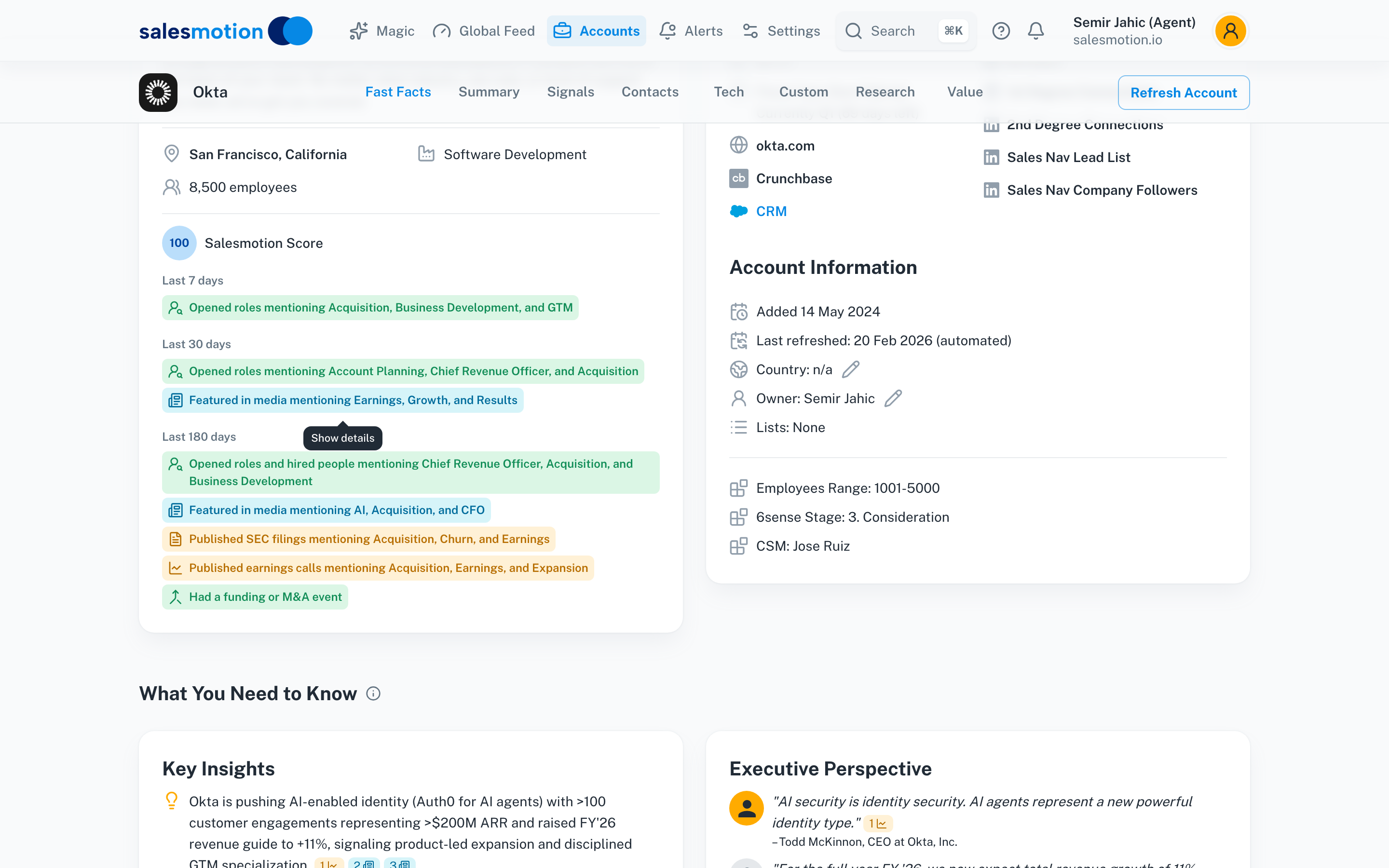 A Salesmotion account brief: key insights, executive quotes, opportunities and talking points, each traceable to its source.
Best for: Mid-market and enterprise teams that sell complex, multi-stakeholder deals where account context matters more than contact volume.
What it is strong at:
- Cited account briefs. One brief per account covering earnings commentary, leadership changes, hiring patterns, competitive moves and strategic initiatives, with the source linked.
- Signal monitoring across a whole territory. 50+ signal types from 1,000+ public sources, surfaced with the context a rep needs to act on them.
- Working where reps already work. Native Salesforce integration (managed package, one-way or bi-directional sync), a HubSpot integration, outreach drafts pushed to lemlist, a REST API, and an MCP server for Claude, ChatGPT and other assistants.
- A low-commitment start. The Individual plan is a monthly contract with no annual commitment.
Pricing: $85/mo for individuals, with custom pricing for teams and enterprise. The Individual plan covers up to 100 accounts and includes 200 contact credits a month (verified email and phone).
G2 rating: 4.8/5 on G2 (26 reviews), per G2.
Choose it if: your reps already have a way to find contacts and the missing piece is knowing which accounts are worth the effort this week, what changed there, and what to say about it. Book a 15-min walkthrough to see it on your own accounts.
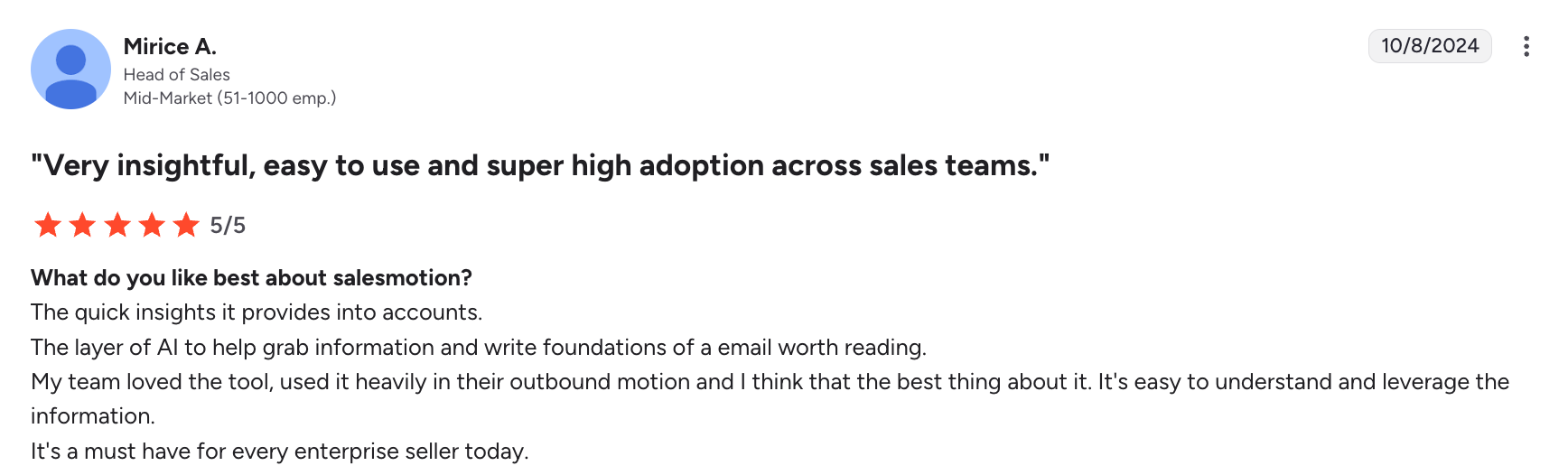 Real G2 review from an Enterprise AE.
Salesmotion's Take
After a decade in this market, the biggest shift I see is from "who to contact" to "why and when to contact them." ZoomInfo has one of the largest contact databases there is. 6sense is built on more than a decade of its own intent data. But the gap most teams describe to me is neither contacts nor intent scores. It is context: what the CEO said on the last earnings call, what initiatives the company just announced, and why your solution matters right now. That is the gap we build for.

Semir Jahic
CEO & Co-Founder, Salesmotion
2. ZoomInfo
ZoomInfo is one of the largest B2B contact and company databases, with verified data on 500M+ contacts and 100M+ companies and a team of 300+ human researchers behind it. For enterprise sales teams that need high-volume contact data from a single vendor, it is the default shortlist entry.
ZoomInfo has built a full AI layer on top of that data. ZoomInfo Copilot, which the company describes as its AI sales agent, surfaces buyer signals, assembles deal briefs and generates personalized messaging, and it connects to Salesforce, HubSpot, Outreach, Salesloft and Gong. GTM Workspace adds agents for account research, meeting prep and deal prioritization, GTM Studio runs workflows triggered by buying signals, and ZoomInfo MCP and GTM.AI open the data to developers and AI assistants.
Best for: Large sales teams that want one vendor for contacts, company data and an AI assistant on top.
What it is strong at:
- Database breadth. 500M+ contacts and 100M+ companies, including 120M+ direct-dial phone numbers.
- Human verification. 300+ human researchers work on the data.
- AI on top of the data. Copilot, GTM Workspace agents and GTM Studio workflows.
- A real free tier. ZoomInfo Lite is permanent, needs no credit card and includes 10 credits a month.
Pricing: ZoomInfo does not publish list pricing; contracts are quoted per organization. Its own pricing page states that no specific dollar amounts are published because pricing is consumption-based. Vendr reports a median contract of $33,500 a year based on 1,576 purchases, with a range of $7,233–$156,053. ZoomInfo Lite is a permanent free tier with 10 credits a month. Streaming Intent is sold as an add-on to base plans, and paid plans are annual subscriptions.
Choose it if: contact coverage is your main gap and you have the volume to justify an annual, consumption-based contract. Teams that also want cited account research often pair it with an account intelligence tool.
3. Apollo.io
Apollo.io combines a database of 240M contacts and 30M companies with built-in email sequencing, a dialer and enrichment. For teams that want prospecting and outreach in one product at a published price, it is the strongest value on this list.
Apollo now describes itself in three layers: data, intelligence and execution. Every plan, including the free one, includes intent topics (1 on Free, 6 on Basic and Professional, 12 on Organization). The product also includes AI Research, waterfall enrichment, a Chrome extension and Apollo MCP, and Apollo was named the flagship data partner for Salesforce's outbound sales agent in September 2026.
Best for: SMB and mid-market outbound teams that want contact data and sequencing in one tool.
What it is strong at:
- One product for the outbound motion. Database, sequences, dialer, enrichment and intent topics, with most of it available from the Basic tier.
- A published rate card. Self-serve plans, a permanent free plan and a 14-day trial on Basic and Professional.
- Pace of shipping. MCP, waterfall enrichment and Builder Studio all arrived in 2026.
Pricing: Apollo publishes its pricing: a free tier, then Basic at $49, Professional at $79 and Organization at $119 per seat per month on annual billing (3-seat minimum on Organization). Monthly billing is $65 and $99 on Basic and Professional; Organization is annual only. Usage is metered in credits: an email costs 1 credit, a phone number 8, and an AI Research run 1.
Choose it if: you run volume outbound and want data and execution on one bill. Teams that want continuous account monitoring with cited research add a dedicated account intelligence tool alongside it.
4. Cognism
Cognism positions itself as Europe's most trusted B2B data, and its product is built for prospecting into Europe. Its headline strength is phone-verified mobile numbers, for which Cognism claims up to 3x higher connect rates, with decision-maker data refreshed every 30 days.
Cognism is more than a contact list today. Its filters include hiring, funding and M&A, and job-change signals. The Pro package adds intent data powered by Bombora's Company Surge, and both packages include AI company research plus MCP and API access, so Cognism data can be used inside Claude, ChatGPT and other assistants. Exports go to Salesforce, HubSpot and Pipedrive.
Best for: Teams with European territories that need mobile numbers they can dial with confidence.
What it is strong at:
- Phone-verified mobiles. Verified mobile data with a stated 30-day refresh on decision-makers.
- Compliance built for Europe. A compliance-first posture, extensive Do-Not-Call coverage across Europe, and a completed SOC 2 Type II audit for 2026.
- Simple credit logic. One credit reveals one contact, and viewing a previously revealed contact costs nothing.
Pricing: Cognism does not publish list pricing; contracts are quoted per organization. Its pricing page lists Standard and Pro packages, each with 5 seats included, on a credit system where one credit reveals one contact.
Choose it if: most of your pipeline is in Europe and connect rate on mobile numbers is the number you care about. Teams selling mainly into North America usually compare it with ZoomInfo or Apollo.io.
5. LinkedIn Sales Navigator
LinkedIn Sales Navigator gives sellers first-party access to LinkedIn's network of 1+ billion members, and LinkedIn says 1.5M+ sellers use it. With 50+ advanced search filters, alerts and InMail, it is the standard tool for relationship-led selling.
Sales Navigator also has its own AI research and drafting on LinkedIn data. Account IQ delivers AI insights on target accounts, Lead IQ summarizes a lead's experience and recent activity, and Message Assist drafts outreach. Buyer Intent, on the Advanced and Advanced Plus plans, shows which companies are actively showing interest. TeamLink and Relationship Map show warm paths into an account, and alerts flag job and role changes on saved leads.
Best for: Enterprise AEs and SDRs whose selling depends on finding the right people and a warm way in.
What it is strong at:
- First-party people data. It works on LinkedIn's own member graph of 1+ billion members.
- Relationship paths. TeamLink, Relationship Explorer and Relationship Map for multi-stakeholder accounts.
- CRM reach. Integrations with Salesforce, HubSpot, Microsoft Dynamics, Oracle and 15+ CRM and sales-engagement partners.
Pricing: LinkedIn publishes Sales Navigator pricing: Core at $119.99/month or $1,079.88/year, Advanced at $159.99/month or $1,799.88/year, and Advanced Plus on request. All three plans include 50 InMail credits a month. A free trial is available on Core and Advanced for members who meet LinkedIn's eligibility rules.
Choose it if: your reps sell through relationships and need to map who is who inside an account. Most teams keep it alongside an account intelligence platform, since its signals come from LinkedIn data: job changes, buyer intent and engagement.
6. Lusha
Lusha is the most self-serve contact data tool on this list. Its database covers 515M+ verified contacts and 29M+ companies, including 165M+ emails and 117M+ direct dials, and its prices and per-reveal costs are published in full.
Lusha has added intelligence on top of lookup. It tracks 26 buying signals refreshed weekly, which it describes as dated events on named companies: funding events, hiring surges, leadership changes, headcount shifts, job changes and promotions. Deep Intelligence scores the market against your ICP, CRM and closed-won deals, and the data is available through Lusha API and Lusha MCP as well as inside Claude and ChatGPT. Integrations include Salesforce, HubSpot, Pipedrive, Zoho and monday.
Best for: Individual reps and small teams that need verified emails and direct dials without a platform commitment.
What it is strong at:
- Published self-serve pricing. A permanent free plan with 40 credits a month and clear per-reveal costs.
- Database size. 515M+ contacts by its own count, with weekly-refreshed company signals.
- Compliance depth for a contact-data vendor. ISO 27701, ISO/IEC 42001, SOC 2 Type II, and GDPR certification by ePrivacyseal.
Pricing: Lusha publishes its pricing: a free plan with 40 credits a month, then Starter at $37.45, Professional at $52.45 and Premium at $299.95 per month on annual billing ($49.90, $69.90 and $399.90 billed monthly). Scale is quote-only. An email reveal costs 1 credit and a phone number 5, and teams larger than 5 users go through Lusha's sales team.
Choose it if: you want to start finding contacts today on a free or low-cost plan. If your need is cited account research, pair Lusha with an account intelligence tool.
7. Clay
Clay takes a different approach to sales intelligence. Alongside its own people and company database, it is a data orchestration platform: you find and enrich data from 150+ providers through waterfall workflows, and you are not charged when an enrichment returns no result.
Clay shipped heavily in 2026. It now has native signals (job changes, company news and social listening on Launch and above; web intent on Growth and above), its own sequencer, Claygent research agents, and Account Agents that monitor a book of business and track what changed. Clay MCP brings those workflows into ChatGPT, Claude and Codex with budget guardrails and admin controls.
Best for: RevOps teams and GTM engineers who want to build their own data pipelines and plays.
What it is strong at:
- Multi-provider enrichment on one bill. 150+ providers reached through waterfall workflows, with no charge when an enrichment returns nothing.
- A build surface. Functions, Workflows, Account Agents and an MCP that puts the results in front of reps.
- Unlimited seats. Every plan, including Free, has unlimited users; usage is what is metered.
Pricing: Clay publishes its pricing: a free tier, Launch from $185/month and Growth from $495/month (about $167 and $446 on annual billing), then custom Enterprise on an annual commitment. Paid plans start with a 14-day trial, include unlimited seats, and meter usage in Actions and Data Credits. See our Clay pricing breakdown for details.
Choose it if: you have someone who wants to design and maintain the workflows, and you already use several data providers. Teams that want account briefs and signals ready on day one without building them usually choose a packaged account intelligence platform instead.
8. Common Room
Common Room describes itself as complete buyer intelligence that turns intent into pipeline. Its core is Person360, which resolves activity from many sources to individual people, backed by a 400M+ contact directory. Zoom completed its acquisition of Common Room on 17 July 2026, and the product is still sold under its own name.
Around that core sit Enrichment, Prospector, AI Scoring, Ads, Buying Committee and RoomieAI, and its AI capabilities cover account research, contact research and message personalization. Common Room connects to Salesforce, HubSpot, Slack, Outreach and 50+ other integrations, and offers MCP and CLI access.
Best for: Teams with rich first-party signals across CRM, product and marketing engagement that want them tied to named people.
What it is strong at:
- Person-level identity resolution. Person360 ties signals from CRM, product, marketing and engagement to the same individual.
- Breadth of first-party signal capture. 50+ integrations feeding one scored view.
- A published entry tier. Seats and contact caps are stated on the pricing page.
Pricing: Common Room publishes its entry tier at $2,500/month billed annually (Essential, 5 seats, 100k contacts). Advanced and Enterprise are quote-only. There is no free tier or self-serve trial on the pricing page.
Choose it if: your best buying signals come from your own product, CRM and marketing engagement, and you want them resolved to people your reps can contact.
9. 6sense
6sense is built on Signalverse, its own intent network, which the company says captures one trillion signals a day and draws on 13 years of proprietary intent data. On top of it sit Predictive Modeling and Account Prioritization, which tell marketing and sales teams which accounts to focus on.
The platform spans marketing and sales. It includes advertising, AI Email Agents, web deanonymization and audience building for marketers, and Sales Intelligence for sellers, with 111M+ verified business email addresses, a Sales Copilot, and RevvyAI for account research, meeting prep and sales strategy. 6sense also lists an MCP Server, and its homepage notes it was named a Leader in The Forrester Wave: Revenue Marketing Platforms for B2B, Q1 2026.
Best for: Marketing-led organizations running ABM that want sales and marketing working from one prioritized account list.
What it is strong at:
- Predictive account prioritization. Scoring built on its own Signalverse intent data.
- A full marketing-plus-sales suite. Advertising, email agents and deanonymization next to sales contact data.
- Scale of buyer data. 750M+ B2B buyer profiles captured, by its own count.
Pricing: 6sense does not publish list pricing; contracts are quoted per organization. Its pricing page lists three Sales Intelligence configurations without dollar amounts. Vendr's marketplace data reports a median annual contract value of $62,220 across 386 purchases, with a range of $11,234–$176,511. We cover this in more depth in our 6sense pricing guide.
Choose it if: you run account-based programs across marketing and sales and want predictive intent to drive both. Sales-led teams that mainly need rep-level research often pair an intent source with an account intelligence tool.
10. Demandbase
Demandbase is an account-based platform covering marketing, advertising, sales and data. Its pricing page makes a point of not splitting the product into separate marketing and sales solutions, and its products page describes combining first-party and third-party data with transparent AI.
Advertising is a first-class product at Demandbase and can be bought as a starting point on its own, as can its data solutions. For sales, the platform focuses sellers on the right accounts and buying groups. Integrations cover HubSpot, Microsoft Dynamics 365, Eloqua, Outreach, Salesloft, Google Analytics, Adobe Analytics and LinkedIn.
Best for: Enterprise marketing teams running full-funnel ABM programs with an advertising budget.
What it is strong at:
- One package for the whole go-to-market team. Marketing, advertising, sales and data sold together.
- Account-based advertising. Offered as an entry point in its own right.
- Integration surface. CRM, marketing automation, sales engagement and analytics tools.
Pricing: Demandbase does not publish list pricing; contracts are quoted per organization. Its pricing page describes a platform fee plus a flat fee per user. Vendr reports a median annual contract value of $68,591 across 187 purchases, with a range of $24,000–$164,037. Read our Demandbase pricing analysis for a detailed breakdown.
Choose it if: marketing owns the account-based program and advertising is part of it. Sales-led teams that mainly need rep-level research often pair it with an account intelligence tool.
11. Bombora
Bombora is the intent data specialist on this list. Its Company Surge product identifies which companies are consuming content on the topics you care about, using a data co-op of hundreds of publishers and brands and thousands of B2B sites. Bombora says 86% of the co-op's data is shared exclusively with it.
The scale is the point: 25,300+ intent topics, 16B+ monthly events and 5M+ company domains. Bombora data also reaches teams through other platforms. Cognism uses Company Surge for its intent data, and Bombora lists partners including The Trade Desk, Reddit, Adobe and Apollo. Alongside Company Surge it sells identity and enrichment, B2B digital audiences and campaign measurement.
Best for: Teams that want third-party intent as a standalone layer, independent of any one platform.
What it is strong at:
- The data co-op. A cooperative source with a large share of data exclusive to Bombora.
- Topic breadth. 25,300+ topics, a taxonomy the company says is continuously expanding.
- Distribution. Available directly or through partner platforms you may already use.
Pricing: Bombora does not publish list pricing; contracts are quoted per organization. Vendr reports a median annual contract value of $25,000 across 35 purchases, with a range of $13,000–$80,450.
Choose it if: you want topic-level intent to feed your own scoring, advertising or CRM workflows. Company Surge reports intent at the company level, so reps pair it with an account research tool for the context behind the score.
12. Gong
Gong leads revenue intelligence, the category next door to sales intelligence. Where the other platforms on this list bring in outside data about accounts and contacts, Gong starts from your own customer interactions. It calls its flagship the Gong Revenue AI OS and reports 5,000+ customers.
The platform now spans Gong Engage for prioritized, personalized outreach, Gong Forecast, Gong Enable, Gong Agents and the Gong Revenue Graph. Engage recommends who to contact, when to engage and what to say, pulls in signals from sources such as 6sense, G2 and LinkedIn, and uses contact data from ZoomInfo, LeadIQ and Gong Enrich. Gong announced its sales enrichment layer on 30 September 2026.
Best for: Sales organizations that want conversation analytics, forecasting and coaching on one platform.
What it is strong at:
- Conversation and revenue intelligence at scale. Every product is grounded in captured customer interactions.
- Breadth. Engagement, forecasting, enablement and agents on the same data.
- Integrations included. Gong's pricing page says you can integrate your existing tech stack for free.
Pricing: Gong does not publish list pricing; contracts are quoted per organization. Its pricing page confirms licences are priced per user with a platform fee based on the number of users supported, and that integrations are included.
Choose it if: your challenge is deal execution, forecasting and coaching more than finding and researching accounts. If account intelligence is the priority, compare the alternatives built for it.
Pricing Comparison: What You Will Actually Pay
Pricing transparency in sales intelligence varies widely. The table separates what each vendor publishes from what Vendr's marketplace reports, so a list price is never mixed with a third-party median. Where the Vendr column says "none quoted", this guide carries no third-party figure for that vendor.
| Platform | Pricing model | Published price | Vendr median (purchases) |
|---|---|---|---|
| Salesmotion | Per individual; custom for teams and enterprise | $85/mo for individuals | None quoted |
| ZoomInfo | Consumption-based, annual subscriptions | Not published | $33,500 a year (1,576) |
| Apollo.io | Per seat, credit-metered | $49 to $119 per seat per month on annual billing | None quoted |
| Cognism | Packages with seats and credits | Not published | None quoted |
| LinkedIn Sales Navigator | Per license | Core $119.99/mo; Advanced $159.99/mo | None quoted |
| Lusha | Per plan, credit-metered | Starter $37.45/mo, Professional $52.45/mo (annual) | None quoted |
| Clay | Usage-metered, unlimited seats | Launch $185/mo, Growth $495/mo | None quoted |
| Common Room | Tiered, seats included | Essential $2,500/mo (billed annually) | None quoted |
| 6sense | Quoted per organization | Not published | $62,220 a year (386) |
| Demandbase | Platform fee plus per-user fee | Not published | $68,591 a year (187) |
| Bombora | Quoted per organization | Not published | $25,000 a year (35) |
| Gong | Per-user licence plus platform fee | Not published | None quoted |
A pattern emerges: six of the twelve publish at least an entry price (Salesmotion, Apollo.io, LinkedIn Sales Navigator, Lusha, Clay and Common Room), and the tools that publish tend to be the ones a single rep or small team can buy without a sales call. The platforms built for enterprise-wide programs quote per organization. Neither model is better in itself, but a published price makes it easier to build the business case before the first call.

“We're saving about 6 hours per week per seller on account research alone. That's time they can reinvest in actually selling.”
Derek Rosen
Director, Strategic Accounts, Guild Education
What to Look for in a Sales Intelligence Platform
Before comparing vendors, get clear on what your team needs. Sales intelligence platforms fall into five capability buckets, and no single tool covers all of them equally well.
Contact and company data. The foundation: how many records, how fresh, and how accurate. Freshness matters more than raw database size, because a rep who hits two dead numbers stops trusting the tool.
Account intelligence and research automation. This goes beyond firmographics. It includes earnings call analysis, leadership changes, hiring trends, competitive moves and strategic initiatives. The test is whether a rep can get a full account brief in minutes, with sources, or has to assemble one by hand.
Intent data and buying signals. Knowing which accounts are in motion. Third-party intent shows research behavior across publisher networks. First-party signals come from your own website and content. Event-based signals, such as a new executive or a funding round, are dated and verifiable.
Outreach and engagement. Some platforms include built-in sequencing, email and dialing. Others focus on intelligence and hand off to the engagement tool you already run.
CRM integration and workflow. Intelligence that lives in a separate tab gets ignored. Check how each platform reaches Salesforce or HubSpot, and whether your AI assistants can call it through an API or MCP server.
Here is what matters most by team size:
| Team Size | Top Priority | Secondary | Watch Out For |
|---|---|---|---|
| 1-10 reps | Contact data + outreach | Basic buying signals | Paying for enterprise features you will not use |
| 10-50 reps | Account intelligence + signals | CRM integration | Tool sprawl across multiple platforms |
| 50+ reps | Signal automation + workflow | Analytics and reporting | Costs that scale faster than usage |
How to Choose: A Decision Framework
Start with your biggest gap, not the most popular tool.
If your reps spend hours researching accounts before meetings, you need account intelligence and research automation. Look for platforms that consolidate many sources into one cited brief, cutting account research from hours to minutes. That is Salesmotion's lane.
If your reps lack accurate contact data, start with a contact database: ZoomInfo for enterprise depth, Apollo.io for value with sequencing included, Cognism for Europe, Lusha for a quick self-serve start.
If your sales process is relationship-driven, LinkedIn Sales Navigator combined with an account intelligence layer gives reps both the network and the context.
If you need to stitch together multiple data sources, Clay's waterfall enrichment lets you build custom pipelines across providers, provided someone on the team owns the build.
If your strongest signals are first-party, such as product usage and marketing engagement, Common Room resolves them to named people.
If marketing runs account-based programs and wants sales on the same account list, 6sense or Demandbase covers predictive intent and advertising, and Bombora supplies third-party intent as a layer of its own.
If your challenge is deal execution and coaching, Gong shows what is happening inside deals so managers can coach on real conversations.
Most mature sales organizations end up with two or three of these. The goal is not to buy every category but to close the specific gap that is costing pipeline today.
Key Takeaways
- Sales intelligence has split into distinct categories: account intelligence, contact data, enrichment, buyer intelligence, intent and ABM, and revenue intelligence. No single platform leads all of them.
- The top three picks are Salesmotion for account intelligence and buying signals, ZoomInfo for a very large contact database, and Apollo.io for contact data with sequencing at a published price.
- Match the tool to your biggest gap. Teams short on account context need an intelligence platform. Teams short on timing need signals or intent. Teams short on contacts need a data provider.
- Pricing models differ more than prices. Apollo.io, Lusha, Clay and ZoomInfo Lite offer free plans. Salesmotion, LinkedIn Sales Navigator and Common Room publish their entry price. Cognism, 6sense, Demandbase, Bombora and Gong quote per organization.
- Treat third-party price figures as what they are. Vendr's medians for ZoomInfo, 6sense, Demandbase and Bombora describe what its buyers paid, not a list price.
- Check where the intelligence will live. A platform that reaches Salesforce, HubSpot or your AI assistant directly is the one reps will keep using.
Frequently Asked Questions
What is the best sales intelligence platform for 2027?
It depends on your primary need. For account intelligence and buying signals, Salesmotion leads with cited account briefs, 50+ signal types from 1,000+ public sources, and pricing from $85/mo on a monthly contract. For a very large contact database, ZoomInfo is the pick, with 500M+ contacts and 100M+ companies. For contact data with built-in sequencing at a published price, Apollo.io offers the best value. For European contact data, Cognism is purpose-built, and for account-based marketing with predictive intent, 6sense is the strongest choice.
What is a sales intelligence platform?
A sales intelligence platform gives sales teams outside data about the companies and people they sell to. That covers contact details, company data, account research, buying signals and intent. Some platforms focus on one layer, such as a contact database, and others on the account layer: what changed at a company, why it matters and what to say about it.
What is the difference between sales intelligence and intent data?
Sales intelligence is the broad category that includes contact data, company data, account research, signals and intent. Intent data is one sub-category: it tracks which companies are researching topics related to your product. Bombora and 6sense focus on intent specifically, while broader platforms combine it with account research, contacts and news. Think of intent as one input into a larger picture of the account.
How much does a sales intelligence platform cost?
It ranges from free to quote-only enterprise contracts. Apollo.io, Lusha, Clay and ZoomInfo Lite have free plans. Published paid prices start at $37.45 a month for Lusha Starter on annual billing, $49 per seat per month for Apollo.io Basic on annual billing, $85/mo for Salesmotion's Individual plan and $119.99 a month for LinkedIn Sales Navigator Core. ZoomInfo, 6sense, Demandbase, Bombora, Cognism and Gong do not publish list prices. For those, Vendr reports median contracts of $33,500 a year for ZoomInfo, $62,220 for 6sense, $68,591 for Demandbase and $25,000 for Bombora.
Does ZoomInfo have a free version?
Yes. ZoomInfo Lite is a permanent free tier with no credit card and no expiration, and it includes 10 credits a month. ZoomInfo's paid sales plans (ZoomInfo Professional, Copilot Advanced and Copilot Enterprise) each show a free trial option on its pricing page, and paid plans are annual subscriptions.
Should I use ZoomInfo or 6sense sales intelligence?
Choose by who owns the problem. ZoomInfo is built around its contact and company database, with Copilot adding buyer signals and messaging on top, so it suits sales teams whose gap is reaching the right people. 6sense is built around its Signalverse intent network and predictive account prioritization, with advertising and email agents for marketing, so it suits account-based programs run jointly by marketing and sales. Neither publishes list pricing: Vendr reports a median of $33,500 a year for ZoomInfo across 1,576 purchases and $62,220 for 6sense across 386 purchases.
What is the best sales intelligence tool for a small team?
For contact data and outreach, start with a free plan: Apollo.io's free tier includes 2 sequences and 1 intent topic, and Lusha's includes 40 credits a month. For account intelligence and signal-based selling, Salesmotion's Individual plan is $85/mo on a monthly contract and covers up to 100 accounts. Many small teams pair the two: one tool to find people, one to know which accounts to work and what to say. ZoomInfo's paid plans are annual subscriptions and 6sense is quoted per organization, so both suit teams ready for a larger commitment.
How do sales intelligence platforms handle data privacy and GDPR?
It varies by vendor, so check each one's published certifications. Cognism describes a compliance-first posture with extensive Do-Not-Call coverage across Europe and completed a SOC 2 Type II audit for 2026. Lusha lists ISO 27701, ISO/IEC 42001 and SOC 2 Type II, and says it is GDPR certified by ePrivacyseal. For any platform you shortlist, ask for its data processing agreement, its opt-out process and its current audit reports before you buy.