When we talk about "efficiency in sales," we're not just talking about working faster. It’s about getting more revenue with less wasted time and effort. The real goal is to get your reps laser-focused on what they do best—selling—by clearing out the administrative tasks and guesswork that bog them down.
The Hidden Costs of Sales Inefficiency
For decades, the icon of a top salesperson was the "lone wolf"—a maverick who clawed their way to the top with charisma and grit. While skill and hustle will always matter, the idea that a rep can succeed entirely on their own is a fantasy from a simpler time. Today, a new, invisible tax is crippling sales performance.

The Crushing Weight of the Manual Research Tax
Think about your best sales rep for a moment. Picture them as a world-class chef. Now, imagine asking that chef to create a five-course gourmet meal, but with a catch: they have to forage for every single ingredient themselves. They spend hours digging for vegetables, finding a butcher, and tracking down a specialty spice shop. By the time they get back to the kitchen, they’re exhausted before they even start cooking.
This is the reality for most B2B sales reps. They burn a staggering amount of their time—in some cases up to 70%—on activities that have nothing to do with selling. They’re stuck hunting for intel across financial reports, press releases, LinkedIn profiles, and endless news sites, trying to manually stitch together some context before they even pick up the phone.
This colossal waste of effort is the manual research tax. It’s the hidden cost of forcing highly paid professionals to do low-value admin work instead of talking to customers and closing deals.
Efficiency in today's market isn't about working harder; it's about eliminating the friction that stops your team from working smarter. The manual research tax is the single biggest source of that friction.
Why Preparation and Timing Are the New Sales Superpowers
The very best reps always seem to have a sixth sense for reaching out at the perfect moment. But it’s not magic—it's superior preparation. They are masters at spotting the "why now," that critical event or signal that makes their outreach timely and impossible to ignore.
The problem is, when this process is manual, it's impossible to scale. You can't build a high-performing team by hoping every rep spontaneously becomes an expert market analyst. This is where old-school sales methods break down, leaving timing and relevance up to pure luck.
True sales efficiency demands a fundamental shift in operations. It means moving from a model where reps forage for ingredients to one where they walk into a fully stocked pantry. Every piece of context they need—from a target account’s new strategic plan to a key leadership change—is already organized, validated, and ready to go.
This shift directly fuels better business outcomes:
- Slashed Administrative Burden: Reps get dozens of hours back each month, which they can pour directly into customer conversations and strategic planning.
- Radically Increased Relevance: Outreach is no longer a generic shot in the dark. It’s grounded in real, timely events that actually matter to the prospect, which dramatically lifts response rates.
- Smarter Prioritization: Teams can focus their energy on accounts showing clear intent to buy, instead of wasting time with a wide, ineffective net.
Understanding and eliminating the manual research tax is the first and most important step toward building a truly efficient sales engine. When you arm your team with the right intelligence at the right time, you can how to measure sales productivity not by the hours they clock, but by the meaningful results they deliver.
See Salesmotion in action
Take a self-guided interactive tour — no signup required.
The Four Bottlenecks That Sabotage Your Pipeline
Sales inefficiency isn't one big, obvious problem. It’s a series of small, hidden leaks that quietly drain your pipeline, stall revenue growth, and stop your core performers from reaching their potential. To build an efficient sales engine, you first have to spot these leaks in your own team.
These bottlenecks often fly under the radar, dismissed as "the cost of doing business." But exposing them is the first step toward building a more productive, predictable revenue machine. Let's break down the four biggest culprits that kill sales momentum.
1. The Manual Research Tax
The most immediate and painful bottleneck is the time your reps waste not selling. The stats paint a grim picture: on average, reps spend only 30% of their week actively selling. The rest is eaten up by admin tasks, manual research, and trying to piece together context from a dozen different tabs and tools.
This "manual research tax" is especially brutal in signal-heavy industries like financial services or manufacturing. Miss a subtle regulatory update or a competitor’s plant expansion, and your deal is dead before you even make the first call. The good news? A 2023 study found 54% of sales teams are already seeing direct efficiency gains from AI tools that eliminate this kind of manual work. You can get more stats on AI's impact on sales from our friends at Sopro.io.
Key Takeaway: The manual research tax is the hidden cost of forcing highly-paid sales professionals to act like junior analysts. Every hour they spend hunting for intel is an hour they're not closing deals.
2. A Weak "Why Now"
A weak "why now" is what happens when the research tax goes unpaid. When reps don't have a timely, credible reason for reaching out, their messaging becomes generic and self-serving. They fall back on product-focused pitches that are easy for prospects to ignore because they lack the one thing that matters: a trigger event.
Imagine an IT Services rep trying to break into a large enterprise. They could send a generic email about "digital transformation" that gets deleted in a nanosecond. But what if they knew that company just announced a cloud migration project in its latest quarterly report? That's a powerful "why now." It changes the conversation from "Let me tell you about my product" to "I saw your new initiative, and here’s how we can help you get it done faster." Without that signal, the outreach is just noise.
3. Signal Overload
The opposite problem can be just as damaging: having too much information with zero context. Here, reps are drowning in news alerts, social media chatter, and industry reports, but they have no way of knowing what actually matters. This is signal overload.
Take a sales team selling into Financial Services. They might see a flood of news about new regulatory frameworks. Which update creates a compliance risk their solution solves? Which article is just background noise? Which executive quote signals a major shift in strategy? Without a system to filter these signals, the team gets overwhelmed. They either burn time chasing dead-end leads or get stuck in analysis paralysis. Real sales efficiency is about turning raw data into actionable intelligence.
4. Poor Prioritization
This final bottleneck is the direct result of the other three. When your reps are bogged down by manual research, lack a compelling "why now," and are drowning in signals, they can't possibly prioritize their accounts effectively. They end up spreading their time and energy too thin, treating every account as if it has the same potential.
This leads to a classic sales anti-pattern: reps focus on familiar, low-value accounts while high-potential opportunities sail right by. A rep might spend a week chasing a small, unresponsive company just because it's at the top of their list, completely missing that a top-tier target just landed a massive funding round and announced plans to expand. True sales efficiency is reached when every rep knows exactly which account to focus on, why they should engage them now, and what to say.

“Salesmotion has been a game-changer for me. I used to spend 12 hours a week on prospect research, now it's down to 4. Plus I'm finding stuff I was totally missing - podcasts, news mentions, the good bits.”
George Treschi
Account Executive, FY25 President's Club, Sigma
Bridging the Gap Between Top Reps and Everyone Else
In every sales organization, there's a well-known secret: a small group of elite performers consistently drives the lion's share of revenue. This isn't just a minor difference in quota attainment; it’s a massive performance chasm that points to a core problem with efficiency in sales.
The gap between your top reps and the rest of the team is wider than you think, and it’s not just about talent—it’s about a broken system.
This disparity represents a huge, untapped opportunity. It proves excellence is possible, but it also shows that the methods top reps use intuitively—superior research, timing, and prioritization—aren't being scaled across the team. The real question isn't "Why are my top reps so good?" but rather, "How can I make their best practices a repeatable process for everyone?"
The Staggering Reality of Sales Performance
The numbers don't lie. A massive analysis of 4.2 million opportunities totaling $54 billion in revenue reveals a shocking truth: just 17% of sales reps generate a staggering 81% of all revenue. This creates an 8.9 times performance gap between the best and the average. It's a jaw-dropping statistic that should make any sales leader pause.
But it isn't just about closing more deals; it's about the quality of those deals. Top-quartile sales organizations deliver approximately 2.5 times higher gross margin per sales dollar compared to their bottom-quartile peers. That's the tangible result of smarter execution.
The goal isn't to find more "A-players." It's to build a system that elevates your entire team, turning the instinctive habits of your top performers into a scalable, automated process that benefits everyone.
This performance gap isn't a critique of your core sales team. It's proof that a better operational model is needed—one that democratizes the intelligence and timing that currently separate the best from the rest. To truly bridge this gap, leaders must focus on strategies that can genuinely improve team productivity, which starts by diagnosing bottlenecks and using the right tools.
Democratizing High Performance Through Automation
Top performers succeed because they have an almost sixth sense for spotting the perfect moment to engage an account. They master the "why now," armed with a piece of context that makes their outreach impossible to ignore. But this "sixth sense" isn't magic. It's a skill built on constant, time-consuming research and analysis.
They're the ones who manually connect the dots between a company's earnings call, a key executive change on LinkedIn, and a new project announcement. The problem is that this manual process is an art form, not a science. You can't teach it in a training session or replicate it through sheer force of will.
This is where you can systematically improve efficiency in sales. By automating the research and signal analysis that top reps currently do by hand, you give your entire sales floor the same advantage.
The Old Way vs. The Efficient Way
| Activity | Manual Workflow (The Old Way) | Salesmotion Workflow (The Efficient Way) | Outcome |
|---|---|---|---|
| Account Research | Reps spend hours reading news, scrolling LinkedIn, and digging through earnings reports. | Salesmotion automatically surfaces relevant signals and summarizes key events in real-time. | Time Saved: Hours of research cut to minutes. |
| Prioritization | Reps rely on gut feelings, stale CRM data, or simple firmographics to decide who to call. | AI scores accounts based on buying signals, identifying those in an active buying cycle. | Increased Relevance: Focus shifts to accounts that are actually ready to talk. |
| Personalization | Outreach is generic or based on a single, often outdated, data point. | Reps get specific, timely context (like an exec quote or new initiative) to make outreach hyper-relevant. | Higher Engagement: Reply rates and meeting bookings increase significantly. |
| Timing | Contact is made based on the rep's schedule, often missing the window of opportunity. | Reps are alerted the moment a trigger event occurs, enabling perfectly timed engagement. | Improved Velocity: Deals enter the pipeline faster and move with more momentum. |
Ultimately, a system like Salesmotion doesn't just make reps faster; it makes them smarter by giving them the right information at precisely the right time.
This approach transforms your team’s capabilities in a few key ways:
- Lifting the Middle: It empowers your core performers—the "B-players"—with the same timely insights that your stars uncover, helping them engage with more relevance and confidence.
- Accelerating New Hires: It dramatically shortens the ramp time for new reps by providing them with the context they need to sound credible from day one.
- Making Excellence Scalable: It turns high performance from a happy accident into a predictable, repeatable process.
When you learn how to improve sales productivity through systematic intelligence, you're not just closing a performance gap. You're building a more resilient, predictable, and powerful revenue engine where every rep has the tools to win.
Building Your Always-On Intelligence Engine
To get real efficiency in sales, you have to stop asking your reps to be part-time researchers. The goal is to deliver critical insights to them, not make them hunt for it. This means building a proactive, automated system—an always-on intelligence engine.
This isn't about buying another tool. It's an operational shift that flips the model on its head. Instead of reps searching for information, information finds the right reps at the perfect moment. The engine works 24/7, constantly monitoring your target accounts for high-value buying signals.
From Raw Data to Actionable Insights
An always-on engine does the heavy lifting of sifting through thousands of data points to find the few that actually matter. It's the difference between drinking from a firehose of random news and being handed a glass of water with exactly what you need.
This system is tuned to catch critical events like:
- Company Milestones: New funding rounds, major product launches, or a strategic partnership.
- Leadership Changes: A new C-level executive is hired or a key department is restructured.
- Regulatory and Market Shifts: New legislation hits an industry, a major competitor makes a move, or a biotech firm gets new clinical trial results.
But the real magic isn’t just finding the data. It's translating it into a clear "so what?" for your sales team. A news alert is just noise. An intelligent insight tells the rep why it matters and how to act on it.
This shift moves your team from a state of constant reaction to one of proactive preparation. It ensures that when a window of opportunity opens, your team is the first one through it, armed with the right context.
Delivering Intelligence Where Reps Already Work
One of the biggest reasons new processes fail is that they force reps out of their existing workflows. An effective intelligence engine avoids this by pushing alerts and insights directly into the tools your team already lives in—Slack, email, and your CRM.
Powerful tools are key to building an engine that feeds your sales motion, and Mastering LinkedIn Sales Navigator can amplify your B2B lead generation with its continuous insights. When you combine platforms like that with automated monitoring, they become exponentially more powerful. For a deeper look at this idea, check out our guide on what is revenue intelligence and how it drives growth.
Imagine a rep getting a real-time Slack notification about a target account. It doesn't just link to a press release. It gives a concise summary, pinpoints the key stakeholders involved, and even suggests a talking point.
Here’s a plausible example of what that AI-powered alert might look like, right in Slack:
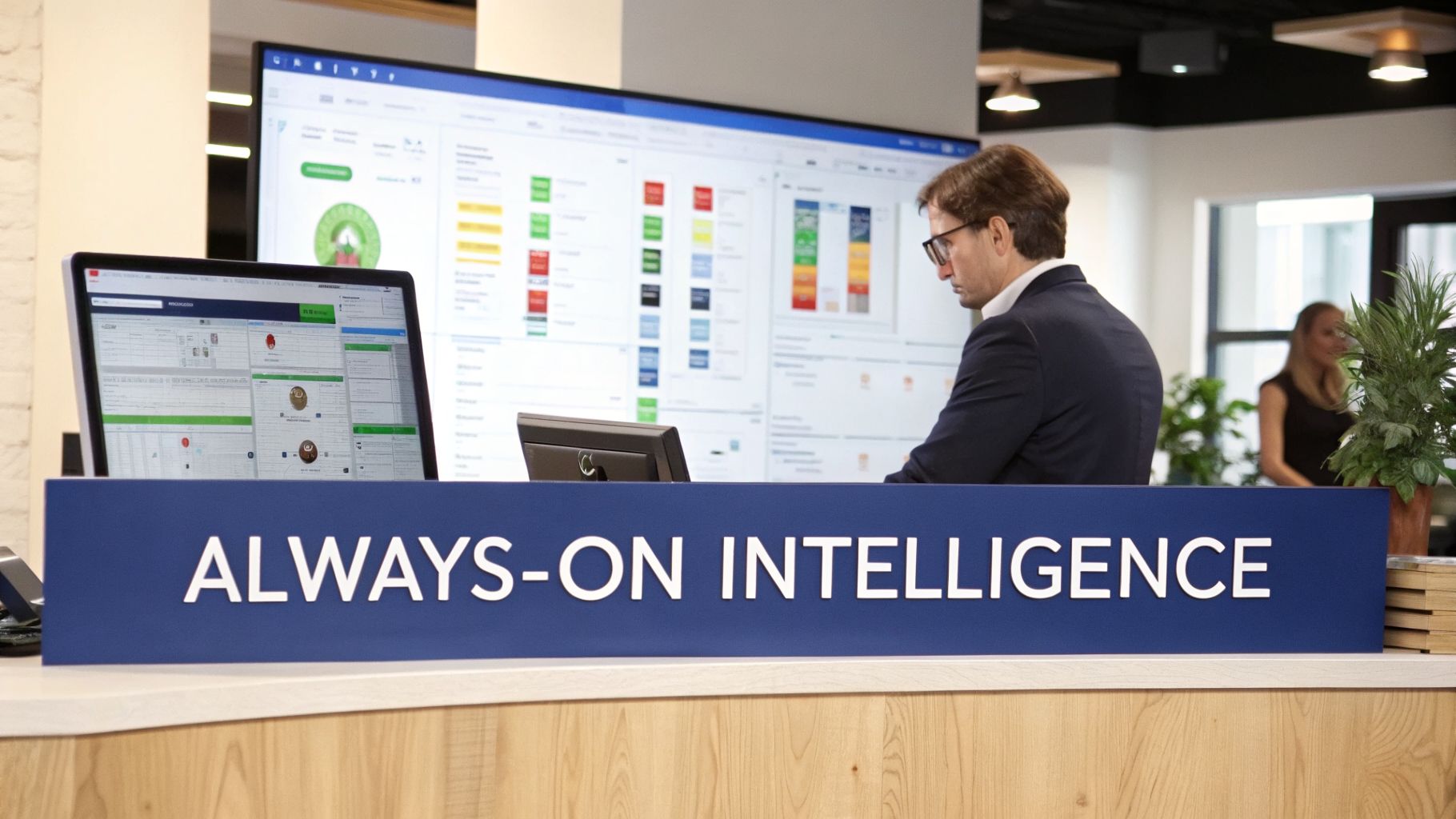
This alert gives the rep an immediate, timely reason to engage, with all the context needed to make their outreach personal and relevant. The system did the heavy lifting, turning a signal into a sales play in seconds. That’s the foundation of real efficiency in sales.

“The Business Development team gets 80 to 90 percent of what they need in 15 minutes. That is a complete shift in how our reps work.”
Andrew Giordano
VP of Global Commercial Operations, Analytic Partners
Turning Signals Into Actionable Sales Plays
Theory is great, but pipeline is built on action. An always-on intelligence engine gives you the foundation for efficiency in sales, but its real power comes from turning those insights into specific, repeatable sales plays. This is where your team stops just knowing what’s happening and starts knowing exactly what to do about it.
These workflows are designed to fit into your team's daily rhythm. They aren’t complicated new processes. Think of them as shortcuts for doing what your reps already do, just with more precision and impact.
1. Meeting Prep in Minutes
We’ve all seen it: the hour before a big call is a frantic scramble. Reps are digging for last-minute context, bouncing between LinkedIn, news sites, and their CRM, often missing the one detail that could change the conversation. Automated intelligence flips that script. It turns hours of manual prep into a few minutes of strategic review.
- Before: A rep spends 45 minutes searching for news on a target account. They find a generic article about the industry but nothing specific to the company's challenges.
- After: The rep gets a Salesmotion alert summarizing the prospect's recent earnings call. It highlights the CEO's quote about "investing in supply chain optimization." Prep is done in five minutes, and the rep now has a powerful, value-based talking point ready to go.
2. Value-Based Outbound with MEDDICC-Aligned Talking Points
Generic outbound messages are dead on arrival. What gets a response is relevant, value-based outreach. By connecting automated signals directly to a framework like MEDDICC (Metrics, Economic Buyer, Decision Criteria, Decision Process, Identify Pain, Champion), you arm reps to speak the language of business value from the very first touchpoint.
An intelligent alert doesn't just tell you, "This company got new funding." It connects that signal to a likely pain point and suggests a metric to build your conversation around.
A signal-driven "why now" is the most powerful tool for breaking through the noise. It proves you've done your homework and gives the prospect a compelling reason to listen.
Example: A CRO services firm targets biotech companies.
- Signal: A mid-sized biotech firm announces positive Phase II clinical trial results and plans to accelerate into Phase III.
- MEDDICC-Aligned Insight: Salesmotion flags this milestone. It links it to the common Pain of scaling clinical operations under tight timelines and suggests focusing on the Metric of "time to patient enrollment." It also provides talking points for engaging the new VP of Clinical Operations (Economic Buyer).
This simple connection transforms a cold call into a timely, strategic consultation. The rep isn't just selling a service; they're offering a solution to an immediate business challenge.
3. Trigger-Based Sequences that Automate the "Why Now"
Your "why now" shouldn't expire after the first email. Signals can be used to build entire sequences that feel personal and stay relevant over time. When a key trigger happens, it can automatically kick off a multi-touch sequence tailored to that specific event. This operationalizes timely follow-up, ensuring no opportunity is missed just because a rep got busy. A well-timed message based on a new signal can revive a stalled conversation or add urgency to an active one. If you want to dive deeper, you can learn more about how to identify and use buying signals in our dedicated article.
4. Dynamic Strategic Account Planning
Static account plans are obsolete the moment they’re written. They live in forgotten Google Docs and fail to reflect the fast-changing reality of your most important accounts. True efficiency in sales demands that account plans are living documents that evolve as new intelligence surfaces. With an always-on engine, account plans update dynamically. A new executive hire automatically updates the stakeholder map. A newly announced strategic initiative is added as a key opportunity. A competitor's mention in their 10-K report gets flagged as a potential risk. This ensures everyone on the account team—from the AE to the CSM—is working from the same real-time intelligence, turning account planning from a once-a-quarter chore into a continuous strategic exercise.
5. RevOps-Led Prioritization with Signal-Based Scoring
How do you make sure your sales team is focused on the accounts most likely to buy right now? Gut feelings and firmographics aren't enough. Real prioritization is data-driven, powered by real-world buying signals. Revenue Operations can use the volume and nature of signals to build a dynamic scoring model that guides the team. For example, an account with multiple high-intent signals in a short period (like a funding round, a new exec, and a product launch) gets a higher priority score. An account that has gone quiet drops in priority, freeing up reps to focus where it counts. This allows RevOps to proactively steer the sales floor, pointing reps toward the territories with the highest concentration of opportunity.
From Saving Time to Accelerating Sales Velocity
Let’s be honest: the point of sales efficiency isn't just about saving your reps a few hours. It's about what they do with that reclaimed time. The real win is accelerating revenue by reinvesting that time into activities that actually close deals, faster. This is where getting the right intelligence at the right time directly leads to shorter, more successful sales cycles.
When your team’s outreach is timely and genuinely relevant, it stands out from the flood of generic emails that swamp every executive's inbox. This isn’t about getting a quick reply—it's about earning the attention of key stakeholders and stopping good deals from stalling out.
Navigating the Modern Buying Committee
Selling today is more complicated than ever. Over the last five years, sales cycles have stretched by 22%, mostly because more people are involved in every decision. Research from Gartner shows it’s now common to see four or more buyers in 87% of deals, a reality that often pushes enterprise sales cycles past the 12-month mark in complex sectors.
But in the face of this complexity, reps who get their timing right are winning big. Data shows sellers who perfect their timing generate 19-30% higher annual revenue and see 12-23% better margins. While average win rates can hover between 21-28%, teams that embrace sales analytics and intelligence see their pipeline velocity take off. You can dig into how these metrics are shaping the industry by exploring the latest B2B sales statistics.
It proves that efficiency isn't about working harder. It’s about having the right context to engage the right person with the right message at exactly the right moment.
Efficiency’s true value is reinvestment. Every hour saved on manual research is an hour your reps can spend building relationships, multi-threading across an account, and pushing opportunities through the pipeline.
From Signals to Speed
A strong, credible "why now" is your team's most powerful asset. When a rep can ground their outreach in a real business event—a new funding round, a leadership change, or a strategic shift—they immediately elevate the conversation from a sales pitch to a strategic discussion.
This is exactly how Salesmotion's actionable process helps teams prep for outbound, execute it with precision, and plan their next move.
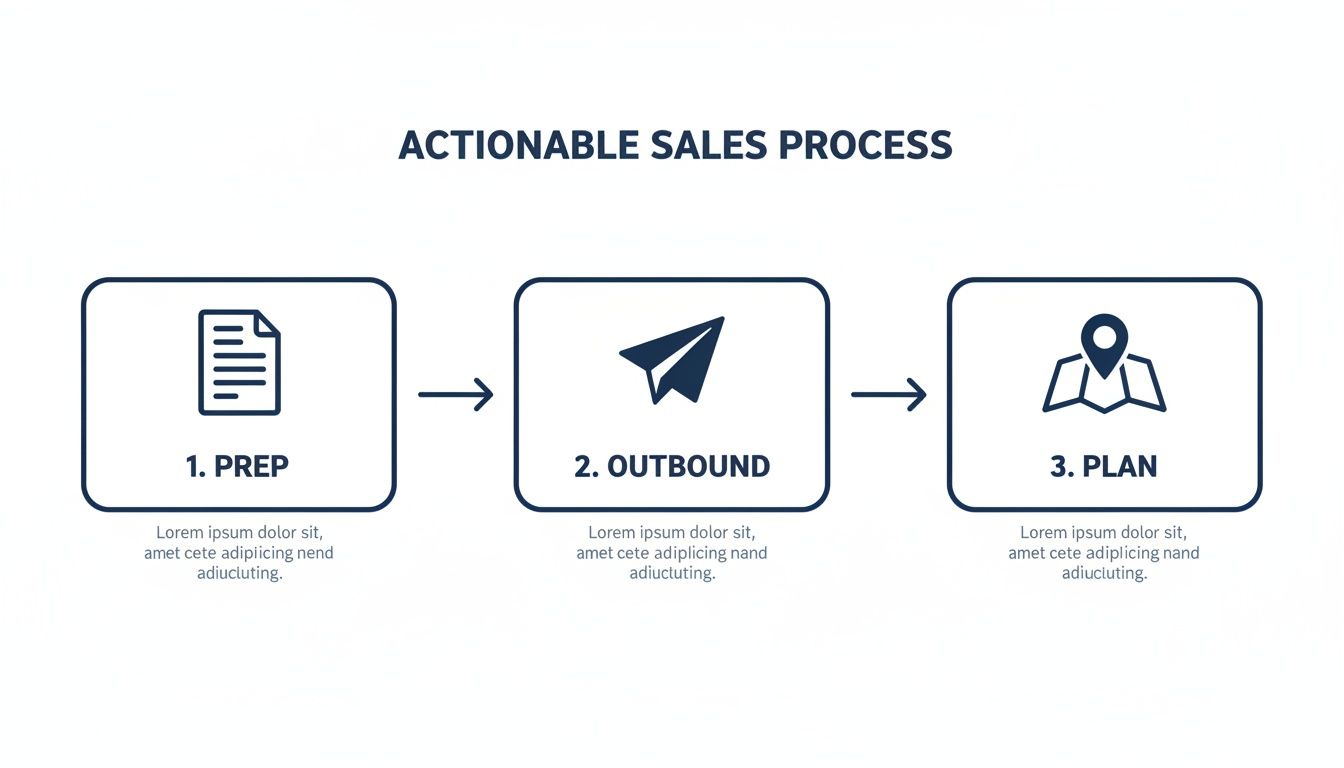
This workflow shows how automated intelligence takes the friction out of turning a signal into an action, making sure reps are always ready to engage with relevance. The result is a far more effective and efficient sales motion.
This approach gives reps the context they need to multi-thread across an organization, personalizing their message for each stakeholder. Instead of being stuck with a single point of contact, they can build a coalition of support.
- For the CFO: The conversation can be framed around the financial impact of a recent acquisition.
- For the Head of Operations: The rep can discuss how your solution addresses a newly announced efficiency drive.
- For the CIO: The pitch can align directly with the company’s new technology roadmap.
This level of tailored engagement is nearly impossible when reps are buried in manual research. By automating the intelligence-gathering, you free them up to focus on the high-value strategic conversations that build momentum and compress deal timelines.
Frequently Asked Questions About Sales Efficiency
Whenever you think about bringing in a new layer of intelligence—especially something that automates work your team does manually—a few practical questions always come up. Let's tackle some of the most common ones we hear from revenue leaders.
How Much Time Can My Team Realistically Save?
This is always the first question, and the answer is significant. Teams using AI-driven account intelligence platforms consistently report a 40-60% reduction in the time they sink into manual account research and meeting prep. We're not talking about shaving off a few minutes. This is about fundamentally changing how a rep's day is structured. Instead of spending hours digging through news and reports, they get automated briefs with key initiatives and ready-to-use talking points in minutes. That time goes right back into what they do best: building relationships and selling.
Will This Just Create More Noise For My Reps?
No, in fact, it does the exact opposite. The whole point is to cut through the noise. A modern intelligence platform sifts through thousands of potential signals—from news articles to regulatory filings—and surfaces only the handful that actually matter to your business.
The system turns a flood of raw data into crisp, actionable context with the "so what" already figured out. Reps only see triggers that give them a real, credible reason to engage, which sharpens their focus and makes them far more efficient.
Is This Difficult To Implement With Our Existing Tools?
Not at all. Modern account intelligence tools are designed to be plug-and-play. They aren't the heavy, complex systems of the past that required a massive IT project and months of integration work. These platforms are built to fit directly into the tools your sales team already lives in every day, including Slack for real-time alerts, email for pushed insights, and your CRM to automatically enrich account records. Because the insights are delivered right into their existing workflow, you get high adoption and immediate value without tearing up your current tech stack.
Ready to eliminate the manual research tax and accelerate your pipeline? See how Salesmotion turns signals into wins. Learn more at Salesmotion.io.