Picture this: your best AE just lost a deal they had been working for three months. The post-mortem reveals the prospect signed with a competitor eight weeks before your rep even got the first meeting. The decision was made before the conversation started. According to Corporate Visions research, 85% of B2B purchases go to a vendor already on the buyer's day-one shortlist. That means your team is fighting over the remaining 15%, unless you can detect buying signals early enough to get on that shortlist first.
Here is what that looks like in pipeline terms: a team of 10 reps covering 50 accounts each, acting on just three Tier 1 buying signals per week with a 25% reply rate, generates 30+ additional qualified conversations per month. At a 20% opportunity conversion rate, that is six new pipeline opportunities your team would have missed entirely without signal coverage.
This guide covers 40 specific signals across seven categories, shows you exactly how to prioritize and act on them, and provides the frameworks that separate signal-driven pipeline from pipeline built on hope.
TL;DR: Buying signals are observable events that indicate an account is entering a buying window. The best B2B teams track 35+ signal types across leadership changes, financial events, hiring patterns, digital engagement, competitive moves, technology shifts, and sales conversations. Single signals are useful. Stacked signals (two to three indicators on the same account) convert at 5 to 10x the rate of cold outreach. This guide covers every signal category with examples, prioritization frameworks, and the workflow for turning signals into pipeline.
What Are Buying Signals and Why Do They Matter?
A buying signal is any observable event, behavior, or data point that suggests a company is moving toward a purchase decision. These signals range from digital behaviors (repeated pricing page visits, content downloads) to corporate events (a new CRO hire, a funding round, an earnings call mentioning "sales transformation").
The concept is not new. Good salespeople have always tracked trigger events. What has changed is the sheer volume of signals available and the speed at which they decay. A single enterprise account might generate dozens of trackable events per quarter across job boards, SEC filings, press releases, review sites, product announcements, and your own website analytics.
Here is why this matters more in 2026 than ever before:
- Buyers are invisible longer. 6sense research shows that B2B buyers complete 70% of their purchase journey before contacting any vendor. By the time a buyer fills out your demo form, they have already built a shortlist, compared features, and formed strong preferences.
- Buying committees are larger. The average B2B deal now involves 10 to 13 decision-makers, according to Corporate Visions. More stakeholders means more signals to track and more opportunities to engage the right person at the right moment.
- Cold outreach is losing effectiveness. Generic cold emails average a 3 to 5% reply rate. Signal-personalized outreach achieves 15 to 25%, and multi-signal stacked outreach reaches 25 to 40%, according to Autobound research. The gap between signal-aware and signal-blind teams is widening every quarter.
The teams that detect and act on buying signals first do not just get more meetings. They get better meetings, shorter sales cycles, and higher win rates.
Here is the part most coverage misses. Finding the accounts is rarely the hard problem. Reps usually know who their accounts are. What they cannot see is the moment one of them changes. Too early gets a polite "not the right time." Too late and a competitor already owns the relationship. One enterprise SaaS rep described 20 to 60% of a territory as having unknown readiness, then burning four or five meetings on a prospect who was never ready. The right signal collapses that uncertainty into a date.
How Do Explicit and Implicit Signals Differ?
Before diving into specific signal types, it helps to understand the two broad categories every signal falls into.
Explicit signals are direct, unambiguous actions where a prospect openly expresses interest. Demo requests, pricing inquiries, RFP submissions, and contract questions all fall here. When someone asks "What does the Enterprise plan cost for 200 users?", there is no ambiguity. They are evaluating your solution against their budget.
Implicit signals are behavioral clues that suggest interest without a direct request. Repeat visits to your pricing page, downloading a case study, attending a product webinar, or a hiring spike in a relevant department are all implicit. A single implicit signal is noise. A cluster of three or four on the same account within a short window is a pattern that often precedes an explicit signal.
The best sales teams combine both types. Implicit signals tell you who to watch. Explicit signals tell you who to call. The 40 signals below span both categories, organized by the source of the signal rather than its directness, because that is how your team will actually detect them.
See Salesmotion on a real account
Book a 15-minute demo and see how your team saves hours on account research.
The 7 Categories of B2B Buying Signals (35+ Signals)
Not all signals are created equal. Some indicate immediate buying intent. Others suggest a longer-term opportunity worth monitoring. Here is a comprehensive breakdown of every signal type B2B teams should track, organized into seven categories.
1. Leadership and People Changes
Leadership changes are among the strongest buying signals in B2B sales. New executives almost always evaluate their team's tooling, processes, and vendor relationships within their first 90 to 120 days. A leadership change creates a natural window for new conversations.
| # | Signal | Strength | Why It Matters |
|---|---|---|---|
| 1 | Champion job change | Very High | A previous customer moves to a new company in your ICP. They already know your value and can champion adoption internally. These signals convert at 3 to 5x the rate of cold outreach. |
| 2 | New C-suite hire | High | A new CRO, CMO, CIO, or CISO appointment triggers tool evaluation. Research shows that new executives spend 70% of their budget in the first 100 days. |
| 3 | VP/Director-level appointment | High | A new VP of Sales, VP of Marketing, or Head of RevOps signals a mandate to build or rebuild. These leaders often arrive with a "first 90 days" plan that includes vendor evaluation. |
| 4 | Promotion with new budget authority | Medium-High | A contact promoted to a role with purchasing power. They know the internal landscape and are eager to prove themselves with early wins. |
| 5 | Decision-maker departure | Medium | When a key contact at a current customer leaves, it creates risk (for retention) and opportunity (their replacement needs onboarding). It also means your champion may need your solution at their new company. |
Example outreach (Champion job change): "Congratulations on the move to [Company], [Name]. At [Previous Company], your team used us to [specific outcome]. As you are getting settled, would it be worth a quick conversation about bringing that same approach to [New Company]?"
Example outreach (New executive): "I noticed you joined [Company] as [Title] last month. Leaders in your role typically evaluate [pain area] in their first quarter. Here is a two-minute look at how a similar team addressed that: [link to case study]."
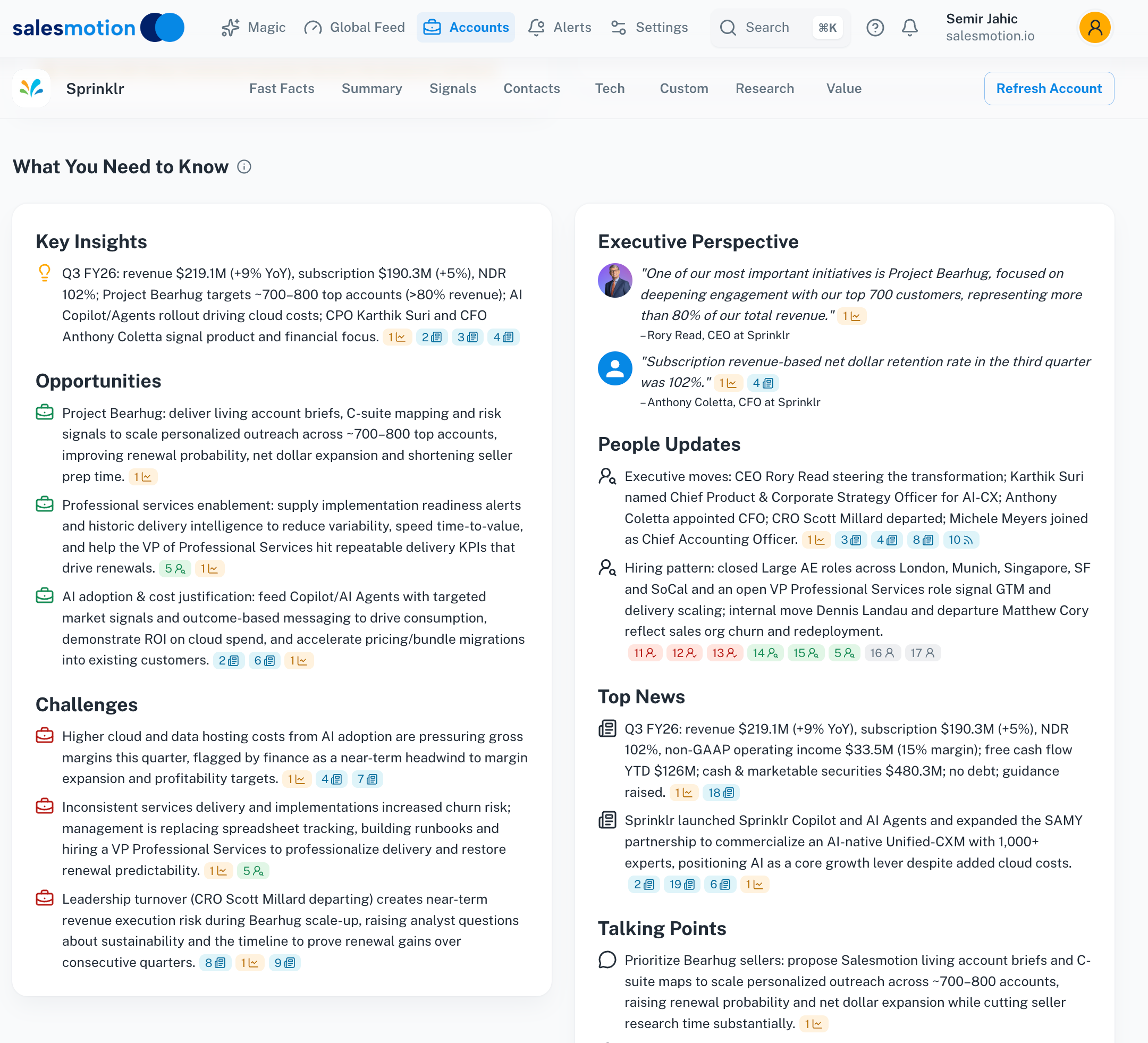 An account summary surfaces leadership changes, hiring trends, and strategic priorities in one view, so reps know exactly who moved and what is changing.
2. Financial and Corporate Events
Financial signals reveal where a company is allocating budget and what strategic priorities its leadership has committed to publicly. These signals are especially powerful for enterprise sales because they come directly from executive leadership.
| # | Signal | Strength | Why It Matters |
|---|---|---|---|
| 6 | Funding announcement | High | Venture-backed companies receiving Series A through D rounds face immediate pressure to deploy capital. Companies that reach funded prospects within 48 hours see 4x higher conversion. |
| 7 | Earnings call language | High | Public companies broadcast priorities every quarter. When a CEO says "investing in commercial excellence" or "doubling down on AI," that is a budget signal your team can act on. |
| 8 | SEC filing disclosures | Medium-High | 10-K and 10-Q filings reveal strategic risks, capital expenditure plans, and operational priorities that rarely make it into press releases. |
| 9 | M&A activity | High | Mergers and acquisitions create integration needs, new buying committees, and technology consolidation. The 6 to 18 months post-close are prime buying windows. |
| 10 | IPO preparation | High | Companies preparing to go public need governance, compliance, and scaling infrastructure. The 12 to 18 months before an IPO are high-spend periods. |
| 11 | Divestiture | Medium | When a company sheds a division, the new standalone entity needs its own tool stack. These are greenfield opportunities. |
Example outreach (Earnings call): "On your Q3 call, [CEO Name] mentioned prioritizing 'sales productivity across the enterprise.' We have seen similar teams cut account research time by 85% while increasing qualified pipeline 40%. Worth 15 minutes to explore whether that is relevant for your team?"
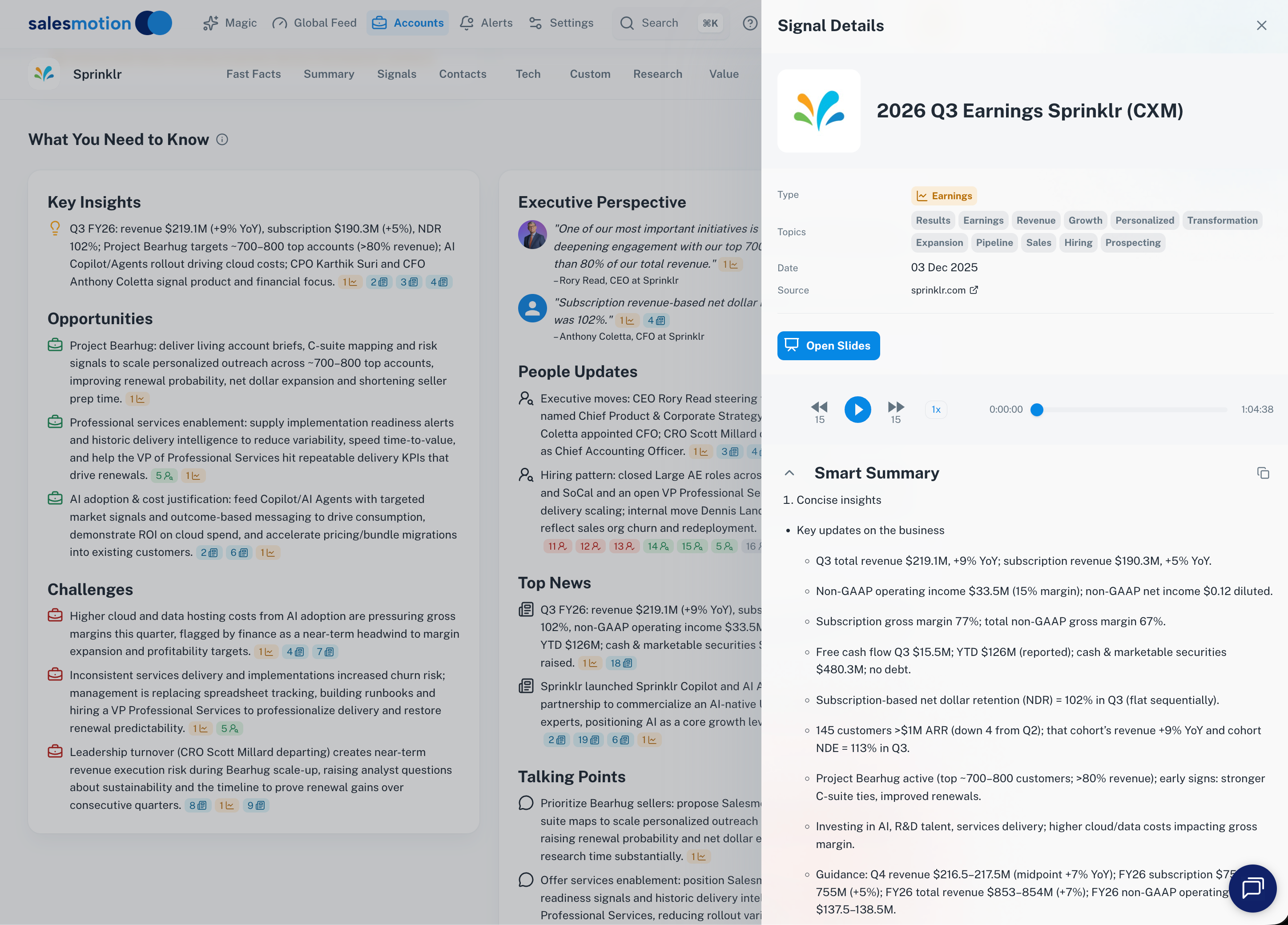 Earnings call insights surface exact CEO language about strategic priorities, giving reps a concrete hook for outreach.
3. Hiring and Growth Signals
Job postings are one of the most underused signal types in B2B sales. They reveal internal priorities before press releases do. A company quietly posting for five SDRs and a Director of Demand Generation is scaling its revenue engine. The signal is public, specific, and actionable.
| # | Signal | Strength | Why It Matters |
|---|---|---|---|
| 12 | Hiring velocity spike | High | A sudden increase in job postings in a specific department signals budget allocation and expansion. Track the rate of change, not just the count. |
| 13 | Job postings for roles your product supports | Medium-High | A company hiring a "Revenue Operations Manager" or "Sales Intelligence Analyst" is building infrastructure your solution fits into. The job description often reveals their requirements. |
| 14 | Geographic expansion | Medium | Opening offices in new regions signals market entry, which creates demand for new tools, processes, and vendor relationships. |
| 15 | Department-specific growth | Medium | Growing a specific function (security, data science, sales operations) reveals investment themes. If you sell to that function, the timing is right. |
| 16 | New product launch | Medium-High | When a company launches a new product line or enters a new market, it creates adjacent needs for sales tools, marketing infrastructure, and operational support. |
Example outreach (Hiring velocity): "I noticed [Company] has posted 14 sales roles this quarter, up from three last quarter. Teams scaling that fast usually hit a wall on [specific pain point]. Here is how one team at a similar growth stage handled it: [link]."
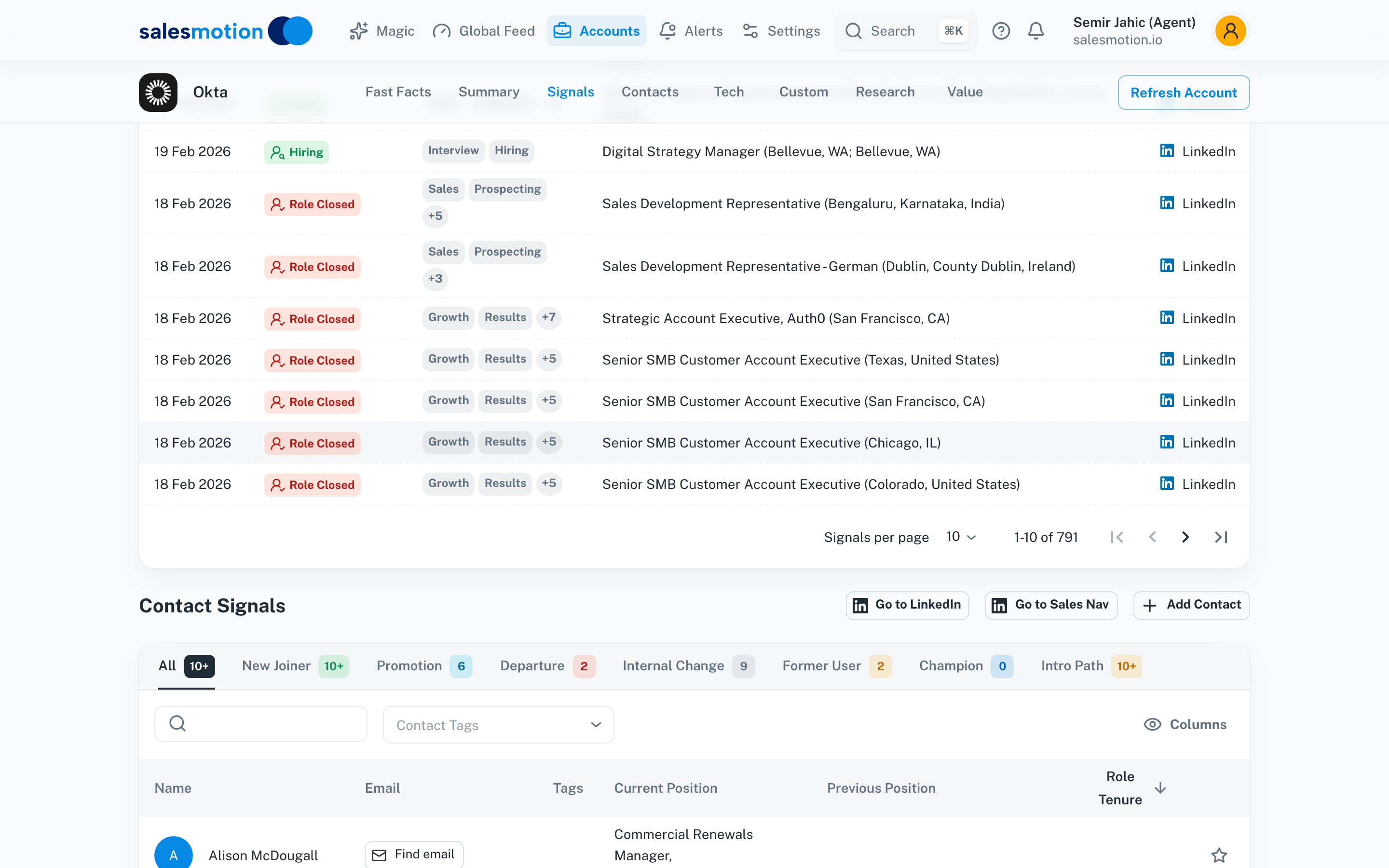 Hiring signals show exactly which roles a company is adding, the department, and the source, revealing budget allocation before it hits the news.
4. Digital Engagement and Intent Signals
Digital signals capture prospect behavior on your own properties (first-party) and across the broader web (third-party). They answer the question "who is actively researching solutions like ours right now?"
| # | Signal | Strength | Why It Matters |
|---|---|---|---|
| 17 | Pricing page visits (3+) | Very High | Repeated pricing page visits indicate active evaluation. This is one of the strongest first-party signals available. |
| 18 | Demo request or free trial signup | Very High | Direct, explicit intent. The prospect has raised their hand. Speed of response here is critical: leads contacted within five minutes are 21x more likely to qualify. |
| 19 | Case study download | High | A prospect downloading customer stories is building an internal business case. They are likely past initial research and into evaluation. |
| 20 | Third-party intent surge | Medium-High | Intent data from providers shows when a company is researching your category across the web. Intent surges decay fast, so act within days, not weeks. |
| 21 | Interactive product demo engagement | High | A prospect spending time in a self-service demo, clicking through features, and exploring specific workflows is showing hands-on evaluation behavior. |
| 22 | Multi-stakeholder engagement | Very High | When three or more people from the same account visit your website, download content, or attend webinars in the same two-week window, a buying committee is forming. |
| 23 | Webinar or event attendance | Medium | Registering for and attending educational events shows active learning behavior. The topic of the event reveals their current focus area. |
Example outreach (Multi-stakeholder engagement): "I noticed three people from [Company], including someone in [Department], explored our [specific product area] this week. When multiple team members are looking at the same solution, it usually means there is a real conversation happening internally. Would it help to set up a focused walkthrough for the group?"
Reading digital body language. Beyond tracking what pages a prospect visits, pay attention to how they engage. A prospect who spends 30 seconds on your homepage and bounces is not a lead. A prospect who spends five minutes on a case study, clicks to your integrations page, then returns to pricing is sending a different message entirely. Time on page, scroll depth, and navigation paths all add context to raw visit counts. When multiple high-value behaviors cluster within a short window, the signal strength multiplies.
One underused first-party source: chatbot logs and support interactions. When a potential customer asks your chatbot specific, detailed questions about features, limitations, or implementation, they are actively trying to overcome roadblocks to a purchase. Treat those conversations as mini sales conversations — the questions reveal exactly what information they need to move forward.
5. Competitive and Market Signals
Competitive signals reveal when a prospect is unhappy with their current solution, actively evaluating alternatives, or responding to market shifts that create urgency.
| # | Signal | Strength | Why It Matters |
|---|---|---|---|
| 24 | G2 or Capterra research activity | Medium-High | Active category research on review sites indicates formal evaluation. If the prospect is reading reviews in your category, they are building a shortlist. |
| 25 | Negative vendor reviews | High | When employees leave negative reviews about their current tool on G2, Glassdoor, or Reddit, dissatisfaction is public and actionable. |
| 26 | RFP or RFI posting | Very High | A formal procurement process in your category. These have the tightest timelines and highest conversion rates, but competition is also the highest. |
| 27 | Vendor contract expiration | High | Approaching renewal dates create natural evaluation windows. If you know a prospect's contract with a competitor expires in 90 days, you can time outreach perfectly. |
| 28 | Vendor consolidation initiative | High | Companies publicly rationalizing their tech stack are open to switching if you can consolidate multiple point solutions. |
Example outreach (Vendor consolidation): "I saw [Company] is consolidating your sales tech stack. A lot of teams in that process discover they are running four or five tools that one platform could replace. Here is how one team consolidated five research tools into one and cut account planning time by 30%: [link]."
6. Technology and Product Signals
Technology signals track changes in a company's tech stack, infrastructure decisions, and platform adoption patterns. They reveal operational priorities and integration opportunities.
| # | Signal | Strength | Why It Matters |
|---|---|---|---|
| 29 | Tech stack addition or removal | High | Installing a complementary tool signals investment in your category. Removing a tool signals dissatisfaction and an open budget line. |
| 30 | Cloud migration | Medium-High | Moving to AWS, Azure, or GCP signals infrastructure modernization, which cascades into adjacent tool needs. |
| 31 | Platform migration | High | Switching CRMs (e.g., moving to Salesforce or HubSpot) creates a 6 to 12 month window where the company is rethinking its entire tech stack. |
| 32 | Compliance certification pursuit | Medium | Companies pursuing SOC 2, ISO 27001, or HIPAA certification need supporting tools and processes. The certification timeline creates urgency. |
| 33 | Digital transformation initiative | High | A public commitment to modernize processes. These initiatives come with multi-year budgets and executive sponsorship, making them ideal entry points for enterprise sales. |
Example outreach (Platform migration): "I saw [Company] recently moved to [CRM]. Teams going through that transition typically rethink their entire sales intelligence stack at the same time. Here is a quick overview of how a similar team rebuilt their research workflow during their migration: [link]."
7. Conversation and Sales-Process Signals
These are signals that emerge during active sales conversations. They indicate where a prospect is in their decision process and how close they are to a purchase. Verbal cues are often more honest than anything a digital dashboard can show you, because they reveal the prospect's real-time thinking.
| # | Signal | Strength | Why It Matters |
|---|---|---|---|
| 34 | Pricing or terms inquiry | Very High | Directly asking about cost signals active budget evaluation. This is a bottom-of-funnel signal. |
| 35 | Integration or compatibility questions | High | Questions about how your product fits their tech stack mean they are envisioning implementation. |
| 36 | Timeline mention | Very High | "We need to make a decision before Q3" or "Our fiscal year starts in January" creates a concrete deadline for your sales process. |
| 37 | Internal champion introduces decision-makers | Very High | When your champion brings in their VP, CFO, or procurement, the deal is moving through the buying committee. |
| 38 | Security or legal review request | Very High | Procurement-stage activity. The company is doing due diligence before signing. |
| 39 | Customer reference request | High | Asking to speak with current customers signals late-stage evaluation. They are validating before committing. |
| 40 | Social proof questions | Medium-High | "Do you work with companies in our industry?" or "What results have similar teams seen?" means they are building internal justification. |
Recognizing verbal cues: future-pacing questions and ownership language. Two of the most reliable verbal signals are worth highlighting. First, future-pacing questions are when a prospect stops asking what your product does and starts asking how it would work for them: "How long would implementation take for a team our size?" or "What kind of training do you offer during onboarding?" These indicate they are mentally building a project plan.
Second, watch for ownership language. Early in the process, prospects say "your product" or "your platform." As intent grows, they shift to "we could use this" or "this would fix our workflow." That pronoun change from "your" to "our" is a small but powerful signal that the prospect has started internalizing your solution as part of their operations.

“Automatic account profile detail I can use to manage my territory. Using Salesmotion AI to generate value statements per persona, account, etc. Using Salesmotion to give me a starting point based on new hires, or news alerts is critical.”
Adam Wainwright
Head of Revenue, Cacheflow
If You Track Nothing Else: The 5 Signals to Start With
Forty signals is a lot. If your team is new to signal-based selling or you are building the business case for tooling, start here. These five signals have the highest conversion rates, the broadest applicability across industries, and the clearest connection to pipeline.
- Champion job changes — 3 to 5x conversion vs. cold outreach. Track every past customer and power user who changes companies.
- New executive hires (CRO, VP Sales, Head of RevOps) — 70% of their budget gets allocated in the first 100 days. Be in the conversation before they form a shortlist.
- Funding announcements — act within 48 hours for 4x higher conversion. Funded companies buy fast.
- Earnings call language — when a CEO says "sales transformation" or "commercial excellence," that is a public budget commitment. Use their own words in your outreach.
- Hiring velocity spikes — a company posting 10+ roles in a department you sell into is allocating budget right now. Job postings are free, public, and updated daily.
Master these five before expanding to the full 40. Each one alone can generate pipeline. Combined, they build a signal engine that compounds quarter over quarter.
How to Prioritize Signals: The 3-Tier Framework
Tracking 40 signal types without a prioritization framework leads to signal overload. The highest-performing teams organize signals into three tiers based on two dimensions: recency (how fresh is the signal?) and relevance (how closely does it match your ICP and solution?).
 The 3-tier framework: allocate rep time proportionally to signal strength and urgency.
Tier 1: Act Within 24 to 48 Hours
These signals have the shortest decay windows and the highest conversion potential.
- Champion job change into an ICP account
- Demo request or free trial signup
- Funding announcement (within the first 48 hours, conversion is 4x higher)
- Multiple stakeholders engaging with your content simultaneously
- Pricing or terms inquiry during an active conversation
- RFP/RFI posting in your category
- New executive hire with direct budget authority
Response: Personalized outreach from an AE or senior SDR. Reference the specific signal. Include a relevant case study or metric.
Tier 2: Engage Within One Week
Signals with strong conversion potential but slightly wider response windows.
- Earnings call language about your problem domain
- Hiring velocity spikes in relevant departments
- Third-party intent surge on your solution category
- Tech stack change or platform migration
- Case study downloads from your website
- Negative vendor reviews in your category
Response: Signal-personalized multi-touch sequence (email plus LinkedIn). Personalize the first touch with signal context. Include one supporting data point.
Tier 3: Monitor and Wait for Compounding
Weaker individual signals that become powerful when they stack with other indicators.
- Single website visit or content download
- Webinar registration (without attendance)
- Social media engagement (likes, comments, follows)
- Geographic expansion
- Broad industry hiring trends
- Compliance certification pursuit
Response: Add to a watch list. When two or more Tier 3 signals stack on the same account, escalate to Tier 2 and engage.
Signal Decay Rates: How Long You Have to Act
Every signal has a shelf life. Act too late and the signal loses its relevance, the buyer moves on, or a faster competitor captures the conversation. Here are the approximate decay windows by signal type:
| Signal Type | Decay Window | Why It Expires |
|---|---|---|
| Demo request / pricing inquiry | Hours | Buyer is actively comparing. The first vendor to respond wins 78% of the time. |
| Funding announcement | 48 to 72 hours | The news cycle moves fast. After the first wave of congratulatory messages, your outreach blends in. |
| Intent data surge | 3 to 7 days | Research behavior is fleeting. A topic surge from three weeks ago may reflect a decision already made. |
| Champion job change | 60 to 120 days | New leaders evaluate tools in their first quarter. After that, they are locked into what they inherited. |
| Earnings call language | 1 to 3 months | Strategic priorities mentioned on calls get acted on within the quarter. By next earnings, the initiative is either funded or deprioritized. |
| Hiring velocity spike | 2 to 4 weeks | The roles get filled, the budget gets allocated, and the evaluation window closes. |
| M&A activity | 6 to 18 months | Integration timelines are long, but the evaluation window for new tools peaks in the first 6 months post-close. |
Build these windows into your response playbooks. A Tier 1 signal with a 48-hour decay window that gets a response on day five is effectively a missed signal.

“We're no longer fishing. We know who the right customers are, and we can qualify them quickly. Salesmotion has had a direct impact on pipeline quality.”
Andrew Giordano
VP of Global Commercial Operations, Analytic Partners
Signal Stacking: Why Multi-Signal Accounts Convert at 5x
The real power of buying signals is not in any single indicator. It is in the compound effect when multiple signals fire on the same account.
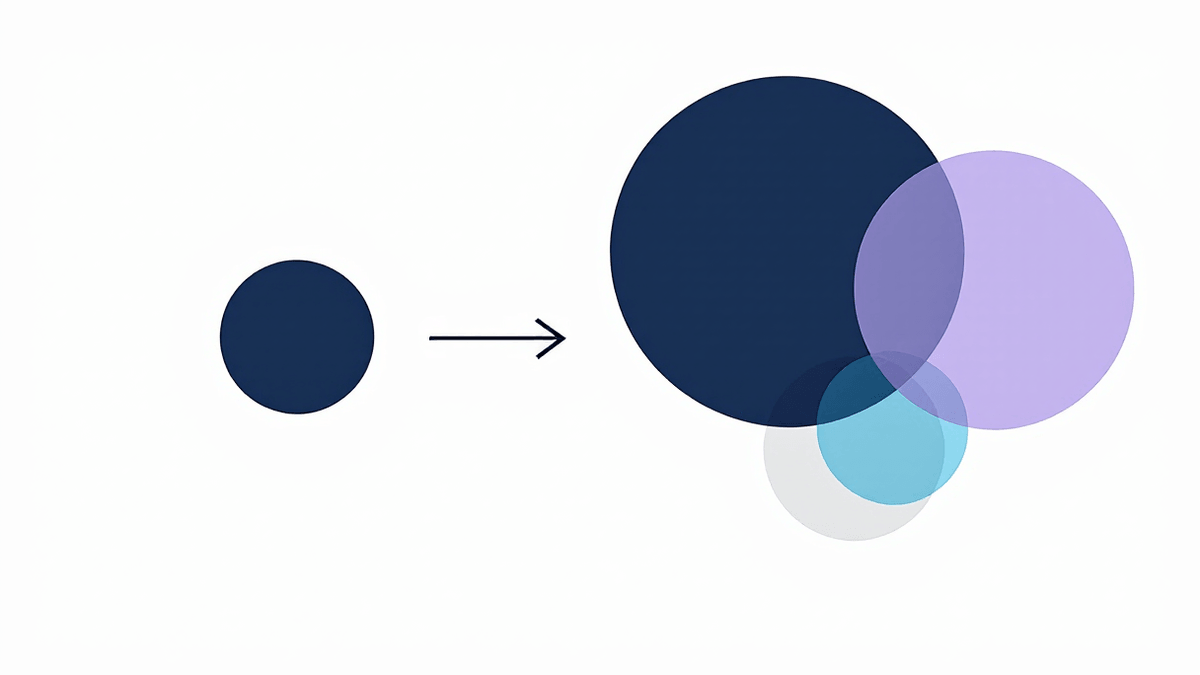 A single signal suggests interest. Stacked signals confirm a buying window. The difference in reply rates is 5 to 10x.
Consider two scenarios:
Scenario A: A target account downloads a whitepaper from your website. That is one signal, one data point, one reason to reach out. Reply rate: probably 5 to 8%.
Scenario B: That same account downloads a whitepaper, has a new VP of Sales who started three weeks ago, posted for a Revenue Operations Manager last month, and their CEO mentioned "sales transformation" on the last earnings call. Four signals, four entry points, four reasons to believe this account is entering a buying window. Reply rate: 25 to 40%.
The math is clear. According to Autobound research, multi-signal stacked outreach achieves response rates 5 to 10x higher than generic cold outreach. Here are five high-confidence signal stacks your team should watch for:
- Champion job change + Funding round + Hiring in your category = New leader with budget, mandate, and infrastructure investment. Highest confidence.
- Pricing page visits + Case study download + LinkedIn engagement = Building internal business case. Likely in late evaluation stage.
- Tech stack change + Relevant job posting + G2 research activity = Active vendor evaluation in progress. Time-sensitive.
- New CRO hire + Sales team hiring spike + Vendor dissatisfaction signals = Mandate to rebuild the revenue engine. Wide open for new tools.
- Earnings call mention + Digital transformation initiative + Cloud migration = Budget allocated, executive sponsorship, seeking vendors.
The implication for sales teams: stop treating signals as isolated triggers. Build workflows that detect when two or more signals converge on the same account, and escalate those accounts to the top of your priority list.
Depth matters as much as count. Two tools can both track "earnings calls" yet deliver opposite value: one notifies you a call happened, the other surfaces the CEO's exact words on rep productivity, ready to use that afternoon. The same gap shows up in hiring, a bare job count versus full job-spec text revealing a named-account build-out.
Building a Signal-Based Sales Workflow
Understanding signals is only valuable if your team has a repeatable process for turning them into pipeline. Here is the three-stage workflow that top-performing teams use.
Stage 1: Detect
Continuous monitoring across signal categories feeds a prioritized account list. The goal is not to surface every signal, but to surface the signals that match your ICP criteria and indicate a genuine buying window.
This requires three things:
- A signal source that covers multiple categories (intent data alone is not enough — see our buying signals software comparison for how the tool categories differ)
- Integration with your CRM so signals surface where reps already work
- Territory alignment so the right rep sees the right account
Manual signal tracking works for a book of 10 to 15 accounts. Beyond that, signals get missed. A rep covering 50 to 100 accounts cannot realistically monitor earnings calls, job postings, funding announcements, intent surges, and competitive moves across all of them. Automation is not optional at scale.
The differentiator most feeds miss is cross-account search. A chronological feed fails predictably: a rep gets busy for a week, misses it, and the signal is buried under noise they never scroll back to find. The alternative is to ask one question across the whole list. Which of my 1,000 accounts mentioned X in the last three months, named a competitor on an earnings call, or are hiring for a strategic-account book right now? That turns signals into a way to plan a quarter, not just react.
Stage 2: Research
When a high-priority signal fires, the rep needs context fast. Who are the key stakeholders? What did the latest earnings call reveal? What technology are they running? What is the competitive landscape within the account?
Here is what this looks like in practice. Tuesday morning, a signal fires: a mid-market SaaS company in your territory just posted a VP of Revenue Operations role. Your system surfaces additional context automatically: this is the third leadership change in the sales org in six months, the company's latest 10-Q reveals a 15% revenue decline, and a job posting from last week mentions "sales intelligence" in the desired qualifications. Three signals, one account, one clear story: this company is rebuilding its commercial engine and actively looking for tools like yours.
Your rep now has a choice. They can spend the next two hours on LinkedIn, SEC.gov, Crunchbase, and Google News piecing this together manually. Or they can have all of it synthesized in one account brief in minutes. Salesmotion does the second option, monitoring over 1,000 sources and delivering one-click account intelligence briefs that surface exactly this kind of compound signal. Teams using this approach at Analytic Partners saw qualified pipeline increase by 40% year-over-year, while cutting research time from three hours to 15 minutes per account.
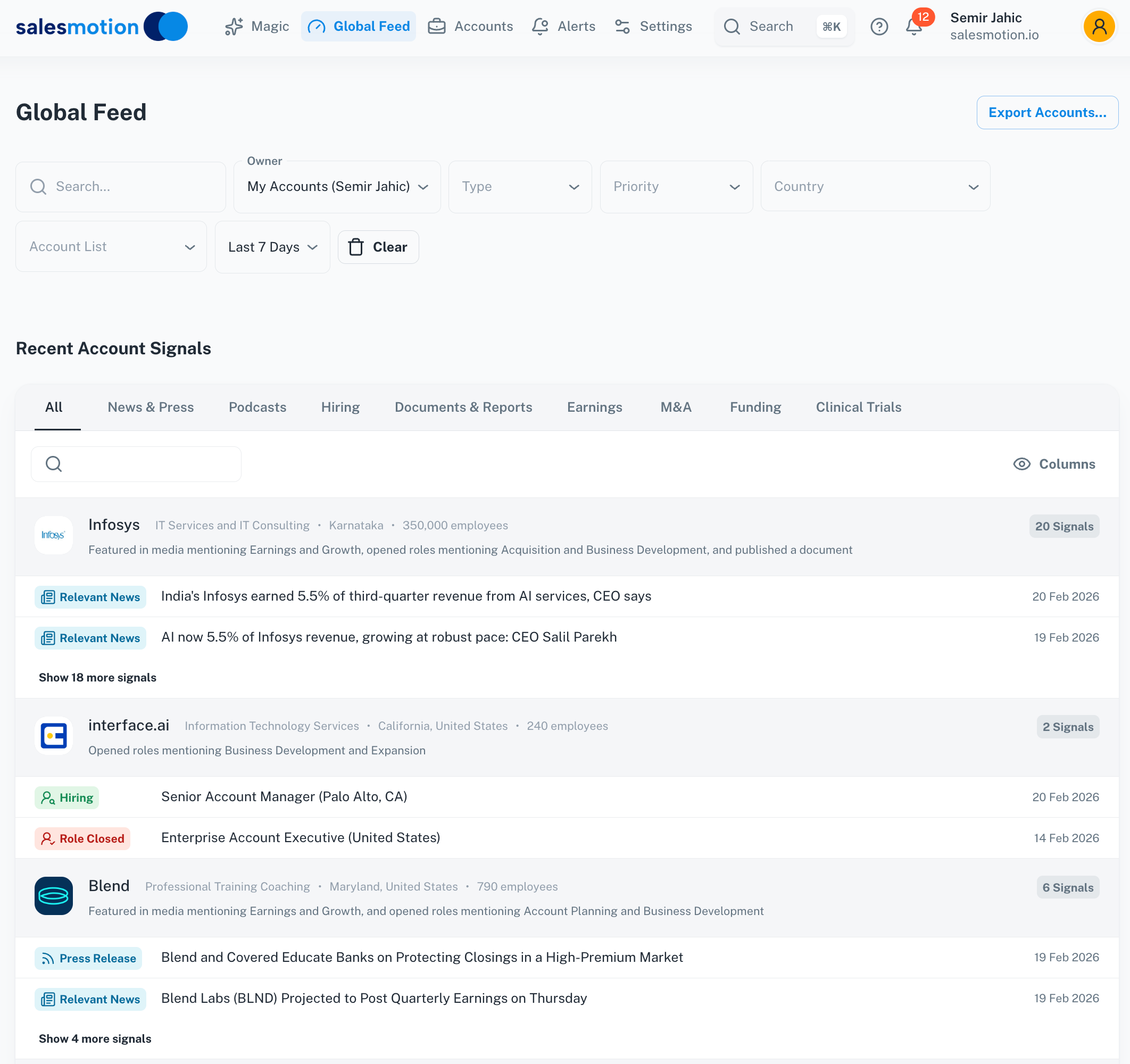 A real-time signal feed surfaces hiring, earnings, news, M&A, and funding signals across your entire territory, so reps act on the highest-value signals first.
Stage 3: Engage
Signal-informed outreach is categorically different from generic prospecting. Instead of "Hi, I noticed your company is growing," the rep leads with specific context tied to the signal.
Generic outreach: "Hi [Name], I wanted to reach out because I think our platform could help your sales team." Reply rate: 3%. The prospect deletes it before finishing the first sentence.
Signal-based outreach: "Hi [Name], I noticed [Company] posted for a VP of RevOps last week, and your 10-Q filing flagged declining sales productivity as a key risk factor. We helped a similar team going through the same kind of rebuild consolidate five research tools into one and cut account planning time by 30%. Worth 15 minutes to compare notes?" Reply rate: 25 to 35%. The prospect reads the whole thing because you clearly did your homework.
The difference is not just personalization. It is relevance. According to Emblaze research, sellers who align with the buyer's problem definition see win rates improve by 38%. Signal-based outreach enables this alignment because the rep is referencing real events, not guessing at pain points.
The pipeline impact compounds fast. At Frontify, the sales team saw a 42% increase in sales velocity after adopting signal-based workflows. The growth team's self-sourced meetings increased 400%. At Cacheflow, reps tripled their average deal size within six months. The difference was not just technology. It was the combination of automated signal detection, structured playbooks for each signal type, and reps who learned to translate signals into conversations that earn a second meeting.
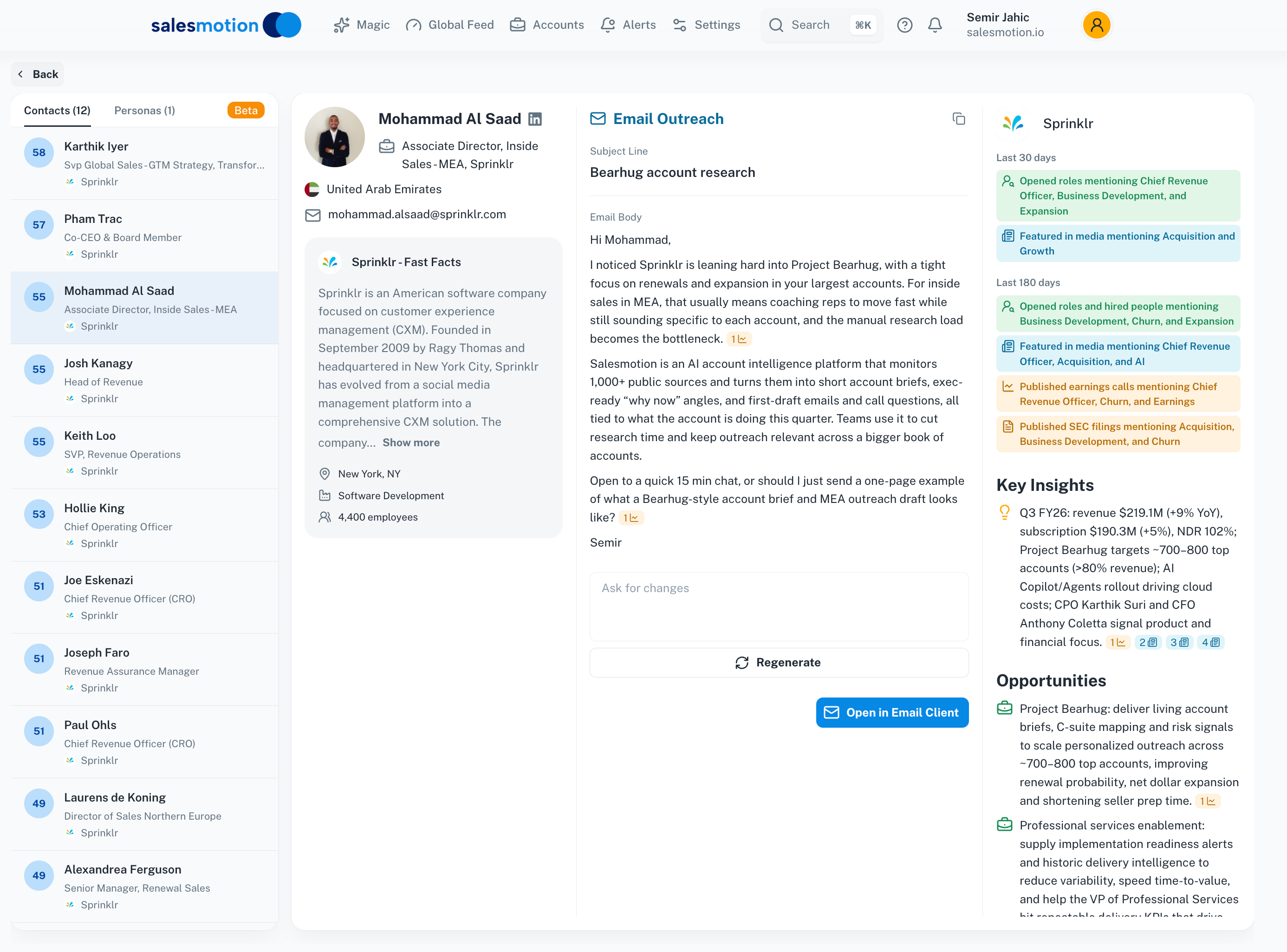 Signal-based outreach ties the message directly to real events at the account, resulting in reply rates 5 to 10x higher than generic templates.
Five Common Signal Mistakes (and How to Avoid Them)
Even teams that adopt signal-based selling make avoidable errors. Here are the five most common.
1. Treating All Signals Equally
Not every signal deserves a personalized email from your best AE. A single website visit is not the same as a champion job change plus a funding round. Use the three-tier framework above to allocate rep time proportionally to signal strength.
2. Responding Too Slowly
Signals decay, and the cost of delay is measurable. Intent data from three weeks ago is nearly worthless. A funding announcement loses urgency after the first 48 hours of coverage. A new executive's evaluation window closes within 90 to 120 days. If your average deal is worth $50K and your team misses just two Tier 1 signals per month because of slow response, that is $1.2M in potential pipeline your competitors are capturing instead. Build response time targets into your signal playbooks: Tier 1 signals get same-day or next-day response. Tier 2 signals get a response within the week.
3. Ignoring Negative Signals
Signal-based selling is not just about finding opportunities. It is also about avoiding wasted effort. Negative signals (recent layoffs in your buying department, a competitor contract just renewed, or a company in financial distress) should remove accounts from active outreach. Chasing a prospect who just signed a three-year contract with another vendor is not persistence. It is waste.
4. Using Signals for Volume Instead of Relevance
Signals are not fuel for spray-and-pray outreach. A signal gives you a reason to reach out, but the outreach still needs to be thoughtful, specific, and tied to a genuine pain point. "I saw you got funded, want a demo?" is lazy signal usage. "Your Series B announcement mentioned expanding into the enterprise segment. Here is how a team at a similar stage built their enterprise research workflow: [case study link]" is signal intelligence. Think sniper, not machine gun: teams that blasted 2,000 to 4,000 emails at a 2 to 3% conversion rate, with burnt sending domains to show for it, end up seeking the targeted alternative.
5. Tracking Signals Without a CRM Connection
Signals that live outside the CRM do not get acted on consistently. If your reps need to log into a separate dashboard to see signals, adoption will collapse within weeks. This is the shelfware trap, the biggest fear teams carry from past tooling: one team licensed roughly 80 users and had three daily actives; another saw only about 10% of reps ever touch the tool. A signal a rep never sees in their workflow dies. The best signal-based teams push signals directly into Salesforce, HubSpot, or their CRM of choice so alerts surface where reps already work. For more on this, see our guide to Salesforce integration for sales intelligence.
Industry-Specific Buying Signal Guides
Different industries have different buying rhythms, budget cycles, and procurement triggers. Dive deeper into buying signals for specific verticals:
- EdTech Buying Signals — academic calendars, E-Rate filings, bond measures, and LMS contract cycles
- FinTech Buying Signals — regulatory changes, funding rounds, banking partnerships, and geographic expansion
- Healthcare Buying Signals — EHR transitions, CMS mandates, value-based care initiatives, and hospital expansions
- HR Tech Buying Signals — workforce restructuring, HCM platform switches, compliance mandates, and leadership changes
- Manufacturing Buying Signals — facility expansions, automation investments, supply chain disruptions, and ESG initiatives
For life sciences, clinical-trial catalysts (Phase III transitions, results activity) sit six to nine months ahead of the formal RFP, and that lead time is decisive: cold RFP win rates tend to run under 20%, while relationships shaped early can clear 60%. See healthcare buying signals for the triggers worth tracking.
Key Takeaways
- Track signals across all seven categories. Leadership changes, financial events, hiring patterns, digital engagement, competitive moves, technology shifts, and conversation signals each reveal different facets of an account's buying readiness.
- Prioritize with the three-tier framework. Tier 1 signals (champion job changes, demo requests, funding) get immediate response. Tier 2 (earnings calls, intent surges, hiring spikes) get structured sequences. Tier 3 (single visits, social engagement) get monitored for stacking.
- Stack signals for maximum conversion. Multi-signal accounts convert at 5 to 10x the rate of cold outreach. Build workflows that detect when two or more signals converge on the same account.
- Speed determines signal value. Intent data decays within days. Executive evaluation windows close within 90 to 120 days. Leads contacted within five minutes are 21x more likely to qualify. Act fast on Tier 1 signals.
- Automate detection, humanize engagement. Manual signal tracking breaks beyond 15 accounts. Automate the monitoring, but make sure the outreach is thoughtful, specific, and tied to the signal context.
- Do not forget negative signals. Disqualifier signals (recent layoffs, renewed competitor contracts, financial distress) save your team from wasting hours on accounts that will not convert.
Frequently Asked Questions
What is the difference between buying signals and intent data?
Intent data is one type of buying signal that specifically tracks digital research behavior, such as content consumption and topic surges across publisher networks. Buying signals are a much broader category that includes leadership changes, earnings call language, funding rounds, hiring patterns, tech stack changes, competitive moves, and sales conversation indicators. The most effective strategies combine intent data with these other signal types. According to Autobound research, multi-signal outreach achieves response rates 5 to 10x higher than single-signal approaches.
How many buying signals should a sales team track?
Start with two to three high-impact signal types (champion job changes, intent data, and hiring patterns are the best starting points) and build from there. Tracking all 35+ signal types manually is impossible, which is why most mature teams invest in automated signal monitoring. The key is not tracking more signals, but tracking the right ones for your specific ICP and having a clear response playbook for each.
How quickly should sales teams respond to buying signals?
Speed varies by signal type, but faster is almost always better. For Tier 1 signals (demo requests, champion job changes, funding announcements), respond within 24 to 48 hours. Research shows that leads contacted within five minutes are 21x more likely to qualify, and 78% of buyers purchase from the first vendor to respond. For Tier 2 signals (earnings call insights, intent surges, hiring spikes), a well-crafted response within one week is appropriate. Tier 3 signals should be monitored until they stack.
Can small sales teams benefit from signal-based selling?
Yes, and they often benefit disproportionately. Small teams cannot afford to waste outreach on accounts with no active buying window. Signals help small teams focus their limited selling hours on accounts most likely to convert. At Cacheflow, a small sales team cut meeting prep time by 60% and tripled their average deal size by focusing on signal-qualified accounts. Start with one or two signal types and build process around them before expanding.
What is signal stacking and why does it matter?
Signal stacking is the practice of combining multiple signals on the same account to build a higher-confidence view of buying readiness. A single signal (like a website visit) might indicate casual interest. Three signals on the same account (website visit plus new CRO hire plus hiring spike in sales) indicate an active buying window. Stacked signals convert at dramatically higher rates because they reflect multiple independent data points all pointing toward the same conclusion: this account is ready to buy. The best sales teams build automated systems that flag accounts with two or more converging signals and escalate them to the top of the priority list.
What is the difference between explicit and implicit buying signals?
Explicit signals are direct, unambiguous actions where a prospect openly expresses interest: requesting a demo, asking for pricing, submitting an RFP, or inquiring about contract terms. Implicit signals are behavioral clues that suggest interest without a direct request: repeat pricing page visits, case study downloads, webinar attendance, or a hiring spike in the department you sell into. A single implicit signal might be noise, but a cluster of three or four on the same account within a two-week window often precedes an explicit signal. The most effective strategies track both types and use implicit patterns to anticipate explicit actions before they happen.
Can buying signals be misleading?
Yes, and acting on isolated signals without context is one of the most common mistakes in signal-based selling. A competitor's employee might browse your pricing page for competitive research. An analyst might download a whitepaper for personal interest with no company-wide buying intention. This is why clusters matter more than individual data points. When multiple people from the same account show interest across different channels within a short timeframe, that pattern is a far more reliable indicator of genuine intent than any single action. Always pair signal detection with good qualification: confirm the account's timeline, budget authority, and whether the signal aligns with a real business need.
What verbal cues during sales calls indicate strong buying intent?
The two most reliable verbal signals are future-pacing questions and ownership language. Future-pacing questions happen when a prospect shifts from asking what your product does to asking how it would work for them: "How long would implementation take?", "What kind of training does your team provide?", "Can this integrate with our existing CRM?" These questions mean the prospect is mentally building a project plan. Ownership language is the subtle shift from "your platform" to "we could use this" or "this would fix our workflow issue." When prospects start using "we" and "our" in the context of your solution, they have begun internalizing it as part of their operations.
How can you use buying signals for existing customers, not just new prospects?
Monitoring your current customer base for signals is critical for expansion and retention. When an existing customer goes through a leadership change, receives new funding, launches a new product line, or restructures a department, those events create upsell and cross-sell opportunities. On the defensive side, signals like declining product usage, a competitor contract evaluation, or a champion departure flag churn risk early enough for your account team to intervene. The same signal categories that drive new pipeline apply equally to protecting and growing revenue from accounts you already serve.
What is the difference between a buying signal and a lead score?
A lead score is a cumulative grade based on a prospect's demographic fit and overall engagement over time (e.g., +5 for a director title, +10 for opening five emails). A buying signal is a specific, high-intent event happening right now, like a demo request or three pricing page visits in one day. The two work together: signals are the inputs, and a scoring model is how you rank them. A strong fresh signal is often more urgent than a high accumulated lead score, because signals decay while scores accumulate.
How do you build a signal scoring model that actually works?
Score signals across three dimensions. First, signal type weight: assign a base score by category, with leadership changes and earnings call pain points at the top (80-100), hiring surges and funding rounds in the middle (60-80), and website visits or content downloads lower (20-40). Derive these weights from your own win/loss data, not industry averages. Second, recency decay: reduce a signal's value over time, for example halving it every 30 days, so stale signals do not inflate account scores. Third, an ICP fit multiplier: the same signal from a perfect-fit account should score higher than from a poor-fit account. The composite formula is: Account Score = Sum of (Signal Weight x Recency Factor x ICP Multiplier). Recalibrate quarterly using closed-won and closed-lost data, and subtract points for negative signals like champion departures or competitor contract renewals.
What buying signals indicate a deal is about to close?
Late-stage signals cluster around logistics, procurement, and consensus-building. The strongest close-proximity indicators are procurement or legal involvement (security questionnaires, SOC 2 requests, redlined contracts), multi-threaded engagement where economic buyers and technical evaluators are active simultaneously, customer reference requests, and requests for ROI calculators or executive summaries to build the internal business case. Behavioral patterns shift too: meeting frequency increases, response times shorten, and questions move from "What does it do?" to "How do we implement it?" When you spot these signals, stop selling and start enabling — provide procurement documentation proactively and make your champion's consensus-building job as easy as possible.
How do buying signals relate to MEDDIC or MEDDICC qualification frameworks?
Buying signals map directly onto MEDDIC. A new executive appointment informs Economic Buyer and Champion identification. Earnings call themes reveal the Identified Pain. Hiring surges and budget approvals signal the Decision Criteria and Decision Process. Competitive displacement events inform the Competition element. Signal data does not replace MEDDIC; it accelerates it by providing the raw evidence that populates each element of the framework before the first discovery call.
How do you handle conflicting signals from the same account?
Conflicting signals are common and informative. An account might show strong hiring signals (positive) while announcing a budget freeze (negative). That usually indicates departmental divergence: one group is growing while the company tightens overall spending. Rather than ignoring the conflict, use it as intelligence. Target the growing department and reference the tension in your outreach — for example, how similar teams delivered results for a scaling function without proportional cost increases. Conflicting signals often reveal the exact pain point you can solve.
How can sales teams start tracking buying signals without expensive tools?
You can start free. Set up Google Alerts for target companies paired with terms like "new funding," "executive hire," or "market expansion." Track job changes and hiring patterns manually on LinkedIn. Use SEC EDGAR for public company filings and Crunchbase's free tier for funding alerts. The catch is scale: checking six to eight sources per account works for a top-20 account list but collapses beyond that, because the monitoring time crowds out actual outreach. Start manual to build the signal-thinking habit, then automate detection once the approach proves itself on your priority accounts.