
In a nutshell, revenue intelligence is a technology-driven approach that uses AI to scan market signals and translate them into clear, actionable prompts for your sales team. Instead of reps digging for information manually, it automatically tells them which companies to engage and why they should do it right now.
TL;DR: Revenue intelligence platforms scan public sources for business signals such as funding, executive hires, earnings calls, and regulatory changes, explain why each one matters for your solution, and push that context into Slack, email, and the CRM. The point is a clear "why now" for every account. When you evaluate platforms for 2027, check four things: signal quality and breadth, the AI analysis, workflow integration, and ease of implementation.
Decoding Revenue Intelligence Beyond the Buzzwords
Imagine giving your sales team a real-time GPS for navigating the market. Instead of relying on an outdated paper map—think manual research and static cold lists—they get live updates on target accounts, pinpointing the best opportunities and showing the fastest path to a conversation. This is what revenue intelligence delivers.
It’s all about shifting B2B sales from a reactive to a proactive state. Rather than guessing which accounts might be ready to buy, your team gets definitive, data-backed reasons to reach out.
From Data Overload to Actionable Clarity
Modern sales teams are drowning in data but starving for genuine insight. Revenue intelligence was built to solve this exact problem by connecting scattered pieces of information to reveal a clear path to revenue.
At its heart, revenue intelligence answers the fundamental sales question: "Why should I reach out to this specific person at this specific company, right now?" It transforms generic outreach into timely, relevant conversations that actually book meetings.
To truly grasp what revenue intelligence is, it's helpful to understand how these platforms turn raw data into something useful. The concept borrows from broader fields, like business intelligence analytics for banking, but applies them with a laser focus on revenue-generating activities.
The Driving Force Behind Its Growth
The urgent need for sales leaders to cut through market noise and zero in on high-potential accounts is fueling massive growth in this space. The global revenue intelligence market, valued at $1.8 billion in 2024, is projected to skyrocket to $12.4 billion by 2032, driven by an impressive 27.1% compound annual growth rate. This rapid expansion, detailed in a recent report on the growth of the revenue intelligence industry, shows just how critical these platforms have become.
This technology directly addresses some of the most persistent challenges in B2B sales:
- Wasted Research Time: It automates the tedious work of tracking news, funding announcements, and new hires.
- Generic Outreach: It provides the critical "why now" trigger needed for personalized, relevant messaging.
- Poor Prioritization: It helps reps focus their energy on accounts that are showing clear buying signals.
For today's Chief Revenue Officers, this isn't just another tool; it’s a core capability for winning in competitive markets. While it's closely related to other data-driven strategies, it has its own unique focus. You can learn more about how different intelligence types compare by checking out our guide on the definition of sales intelligence. Ultimately, it’s about making every single sales action smarter.
See Salesmotion in action
Take a self-guided interactive tour — no signup required.
How Revenue Intelligence Platforms Actually Work
So, how do these platforms actually work? To understand what is revenue intelligence, it helps to look under the hood. This isn't black magic; it's a powerful system that turns mountains of raw, public data into real sales opportunities. The entire process boils down to a simple, repeatable cycle: find a signal, understand its meaning, and start a relevant conversation.
This visual shows the basic flow from research to outreach.
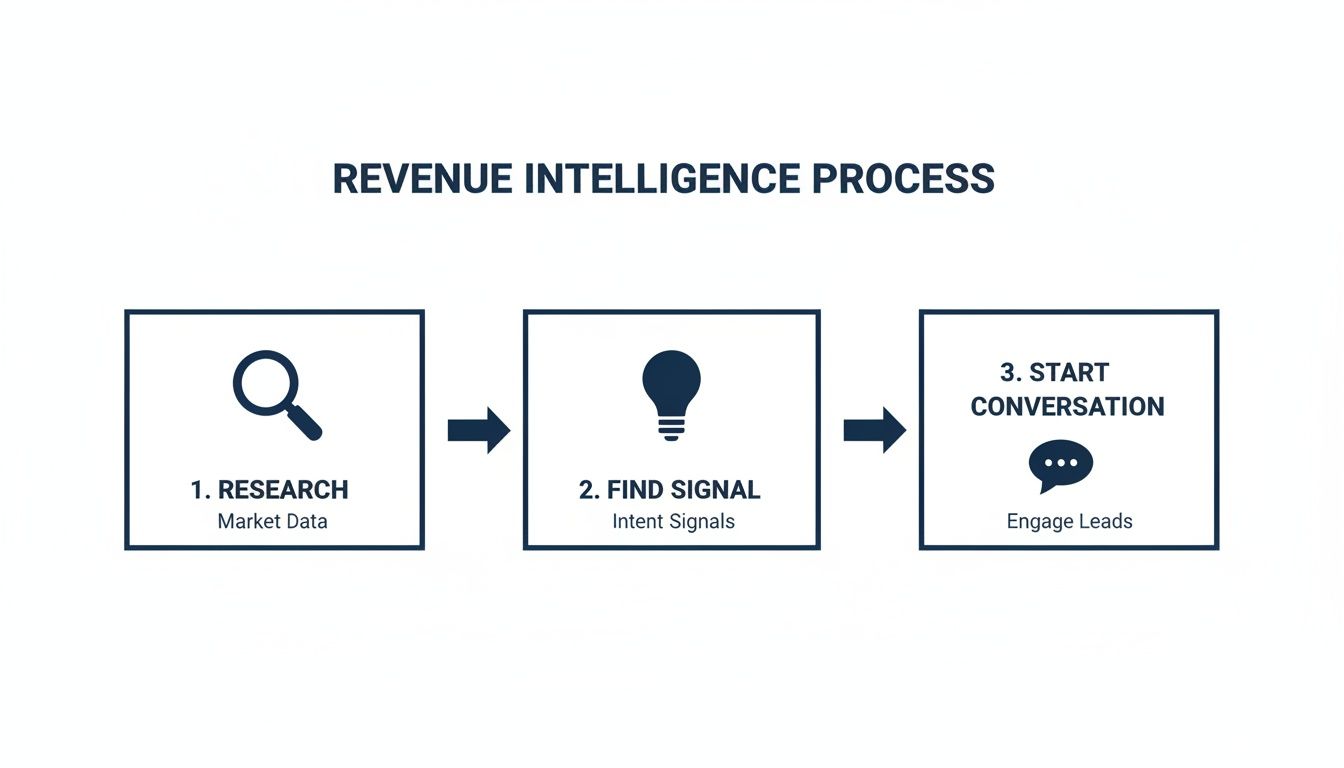
The goal here is to get sales teams out of the guesswork game and into a predictable rhythm built on timely, actionable information. Let’s break down how this engine really runs.
Step 1: The AI Scans the Market for Signals
At its core, a revenue intelligence platform is an automated research team that never sleeps. The AI is constantly scanning millions of public sources for important business signals that matter to your team.
These sources go way beyond simple news headlines and include a huge range of data points:
- Financial and Corporate Filings: Think earnings calls, funding announcements, and M&A activity.
- Media and Content: Press releases, industry publications, podcasts, and even video interviews.
- Company and Employee Activity: Key executive hires, team restructures, and big moves on LinkedIn.
- Regulatory Updates: New government policies or compliance rules that suddenly create a need.
This constant monitoring means your team is the first to know when something meaningful happens at a target account. They get real-time alerts instead of finding out weeks after the fact.
Step 2: AI Turns Data Into a Point of View
Once a signal is spotted, the real magic happens. This is the AI-powered analysis that connects the dots and answers the all-important question: "So what?" A news alert by itself is just noise, but a revenue intelligence platform gives it context.
It doesn't just tell you a target company hired a new CMO. It explains why that matters for your solution, turning a random piece of data into a compelling reason to reach out.
For example, the platform might see a new partnership announcement and immediately map out the key decision-makers involved. It synthesizes the information to suggest this new partnership will create a specific challenge that your product happens to solve, arming the rep with a sharp, relevant angle from the get-go.
Step 3: Insights Are Pushed Directly Into Your Workflow
This final step is arguably the most important for getting your team to actually use the tool and see results: workflow integration. Brilliant insights are useless if they’re buried in yet another dashboard that reps never log into. Real revenue intelligence delivers these insights straight into the tools your team already uses every single day.
These timely alerts and automated briefs get pushed directly to:
- Slack or Microsoft Teams: For instant notifications the team can jump on immediately.
- Email: So reps see opportunities right where they live—their inbox.
- CRM Systems: To automatically enrich account records with fresh context and trigger sales plays.
Let’s walk through a quick scenario. The platform flags that a target account in the biotech space just landed a major funding round for a new clinical trial. The system automatically pings the account executive on Slack, provides a list of the key scientists and executives leading the trial, and suggests an outreach angle focused on how your services can speed up their research.
This entire process happens in minutes, turning a public signal into a warm sales opportunity without any manual work.
So, what’s the real reason top-performing revenue teams are all in on revenue intelligence? It's not about chasing the latest tech trend. It's because these platforms solve some of the oldest, most frustrating problems in sales.
This is about finally moving away from gut feelings and equipping your team with a predictable system to find and win deals.
One of the biggest, most immediate wins is getting rid of the “manual research tax.” We all know what this is: the countless hours your reps burn every week digging through news sites, LinkedIn profiles, and industry reports, just trying to find a half-decent reason to reach out.
Revenue intelligence automates that entire slog. Instead of digging for data, reps get to do what they're paid for: building relationships and closing deals. This isn't a small shift—it frees up dozens of hours per rep every month and directly boosts productivity and morale.
Strengthen Your "Why Now" with Timely Triggers
In B2B sales, timing isn't just important—it's everything. A generic email sent at the wrong moment is just noise. But the right message delivered at the perfect time? That’s what opens doors.
Revenue intelligence gives your team the critical “why now” they need to turn cold, forgettable outreach into a timely, relevant conversation.
Imagine an IT services firm getting an instant alert the moment a target company announces a new office opening. That signal allows their sales team to be the first one in the door offering network infrastructure solutions, long before competitors even realize an opportunity exists.
By turning market signals into instant alerts, revenue intelligence empowers sales reps to connect their solution to a prospect’s immediate needs, dramatically increasing the chances of booking a meeting.
This proactive approach makes every interaction count. A biotech sales team could get an update on a prospect’s clinical trial progress and use it to propose a service that accelerates their research. Suddenly, they're not just another vendor—they're a strategic partner.
Build a Scalable System for Growth
Relying on a few “hero” reps who are naturally great at research and timing is not a strategy for growth. It’s a recipe for inconsistency. Revenue intelligence helps you build a repeatable account planning and outreach process that works for your entire team.
It shifts your organization from depending on individual luck to executing a predictable system for finding opportunities.
With automated insights, every single rep—from your seasoned veterans to your newest hires—gets access to the same high-quality information. This levels the playing field and ensures your best practices are applied consistently. This system also unlocks more powerful predictive capabilities, like lead scoring, where platforms use advanced analytics to surface the most promising accounts.
The impact is huge. For teams in specialized fields like biotech or enterprise software, this means turning signals from funding rounds and executive hires into instant, actionable sales plays. One report found that teams using these platforms reduce planning time and see revenue per rep jump by 25%, as AI pulls key data from earnings calls and press releases into clear 'why now' insights.
This ability to turn signals into sales plays is a core part of any modern revenue strategy. To go deeper on this specific topic, check out our guide on how deal intelligence transforms sales execution. By giving leaders a clear, data-driven framework, revenue intelligence helps you finally scale what works across the entire organization.

“The moment we turned on Salesmotion, it became essential. No more hours on LinkedIn or Google to figure out who we're talking to. It's just there, served up to you, so it's always 'go time.'”
Adam Wainwright
Head of Revenue, Cacheflow
Revenue Intelligence Use Cases in Action
Theory is one thing, but pipeline is another. To really understand what revenue intelligence is all about, you have to see it in action. This is where the abstract ideas of signals and AI-driven insights turn into actual meetings and closed-won deals.
Let's move past the buzzwords and look at how this actually works for sales teams on the ground. We’ll explore how different teams are using revenue intelligence to get ahead, shifting from being reactive to proactively creating their own opportunities.

Each of these examples follows a simple, repeatable framework your team can adopt right away:
- Signal: A real-world event or change happening at one of your target accounts.
- Insight: The AI’s analysis of what that signal actually means for your sales team.
- Action: The specific, perfectly timed outreach that turns that insight into a real conversation.
Use Case 1: Life Sciences and Healthcare
In the life sciences world, timing is everything. Imagine a sales team at a Contract Research Organization (CRO) trying to sell to emerging biotech firms. It’s nearly impossible to know exactly when they’ll need research services.
The Signal: A revenue intelligence platform fires off an alert. A mid-stage biotech company in their territory just locked down $50 million in Series B funding. The goal? To push a new drug through Phase II clinical trials.
The Insight: The AI does more than just forward the news article. It connects the dots, flagging that this specific type of trial demands complex data management and patient recruitment services—the CRO’s specialty. The system even pinpoints the newly hired Head of Clinical Operations as the key decision-maker to engage.
The Action: Armed with this context, the account executive skips the generic "congrats on the funding" email. Instead, they send a sharp, relevant message that references the specific demands of the trial and explains how the CRO’s expertise can de-risk the timeline from Phase II to commercialization. They book a meeting before most competitors even know the funding happened.
Use Case 2: B2B SaaS and Cybersecurity
For a SaaS vendor selling sophisticated cybersecurity tools, the biggest hurdle is cutting through the noise. Every company knows it needs security, but the "why you, why now?" is almost always missing from sales outreach.
The Signal: The platform flags a powerful combination of signals at a major financial institution on their target list. First, the company publicly announced a strategic pivot to a multi-cloud environment. Second, a new Chief Information Security Officer (CISO) was just hired from a competitor known for an aggressive cloud security posture.
The Insight: The AI synthesizes these two events into a compelling point of view. It predicts the new CISO will almost certainly audit the company's cloud security gaps within their first 90 days. It also highlights that the vendor’s solution specializes in multi-cloud threat detection, a known priority for this specific CISO.
This is where revenue intelligence shines. It connects seemingly separate events—a strategy shift and a leadership change—to create a compelling and urgent reason to engage.
The Action: The sales rep uses this insight to craft an entirely different kind of outreach. They reference the company's multi-cloud initiative and the new CISO’s background, positioning their solution as a proactive way to get ahead of the security challenges that will inevitably surface. This timely, informed approach lands a high-level discovery call.
In the high-stakes world of B2B SaaS, this approach is quickly becoming the new standard. The market, which was $3.8 billion in 2026, is projected to explode to $10.7 billion by 2035. For leaders in specialized fields like cybersecurity, AI-powered briefs can prep them for meetings in minutes, complete with stakeholder maps. The healthcare and fintech submarkets, which the same analysis projected at $280 million and $620 million respectively for 2025, reinforce this shift toward signal-based selling. You can explore more about these projections and the growth of revenue intelligence technology in recent industry analysis.
Use Case 3: Financial Services and Fintech
A fintech company selling regulatory compliance software needs to find firms at the exact moment they’re hit with new rules. Their entire sales cycle depends on these external triggers. This is a perfect scenario for leveraging insights from real-time data, a concept that shares DNA with what you can read about in our guide on what is intent data.
The Signal: A revenue intelligence tool alerts the team that a new anti-money laundering (AML) directive was just passed, with a compliance deadline only six months away. The alert also automatically serves up a filtered list of the mid-sized investment firms in their territory that will be most impacted.
The Insight: The platform's analysis goes deeper. It cross-references public filings and identifies which of these firms have recently been flagged for minor compliance issues. This makes them high-risk and, therefore, highly motivated to solve the problem now.
The Action: The sales team launches a hyper-targeted campaign aimed only at this high-risk segment. Their message isn't about the fear of non-compliance but the opportunity to build a more robust, future-proof compliance framework. By referencing the specific directive and the looming deadline, they position their solution as an urgent necessity—not just a nice-to-have—and quickly fill their pipeline with qualified leads.
Choosing the Right Revenue Intelligence Platform
Picking the right revenue intelligence tool can feel overwhelming. Every vendor promises the moon, and it's tough to tell what's real from what's just slick marketing. But getting this right isn't about finding the "best" solution—it's about finding the one that will actually make a difference for your team.
This is a practical guide for CROs and RevOps leaders who need to cut through the noise. To find a partner who gets your revenue goals, you need to vet potential platforms across four critical areas.
Evaluate Signal Quality and Breadth
The foundation of any good revenue intelligence platform is its data. Generic news alerts are a commodity anyone can get. What you need are the specific, often niche, signals that actually matter in your industry. Before you sign anything, you have to dig into where their data comes from.
Ask potential vendors these pointed questions:
- Source Coverage: Beyond standard press releases, do you monitor industry-specific publications, regulatory filings, or even podcasts relevant to my ideal customers?
- Data Freshness: How quickly do new signals pop up on my team's radar? Are we talking real-time, or is there a significant lag?
- Signal Customization: Can I filter the signals to focus only on what's relevant to my sales plays, like executive moves at target accounts or new funding for a specific vertical?
A platform's value is directly tied to the quality of its signals. If the data isn't sharp, the insights won't be either.
Assess the AI-Powered Analysis
The next test is what the platform does with all that data. A tool that just dumps a pile of raw news articles on your team is creating more work, not less. The whole point is to get to the "so what" faster. Your chosen platform's AI has to deliver crisp, actionable context.
The real power of a revenue intelligence platform lies in its ability to connect disparate signals and explain why they matter. It should transform a funding announcement into a strategic point of view for your sales team.
When you're looking at a platform's analytical capabilities, focus on how well it synthesizes information. Does it just tell you a company hired a new leader? Or does it also highlight that leader's past projects and known priorities, suggesting a clear angle for your outreach? That's the difference between simple data aggregation and true intelligence.
Prioritize Seamless Workflow Integration
Even the most brilliant insights are useless if your team has to log into yet another dashboard to find them. For a platform to actually get adopted, it has to fit into your team’s existing sales stack and daily habits. The path of least resistance always wins.
The platform must meet your reps where they already work. That means delivering alerts and automated briefs directly into the tools they use every single day, such as:
- Slack or Microsoft Teams for real-time notifications.
- Email for easy access right in their inbox.
- Your CRM to enrich account records and kick off automated sales plays.
This kind of integration isn't a "nice-to-have"—it's an absolute must for driving adoption and making sure your team can act on insights the moment they matter.
Confirm Ease of Implementation
Finally, think about speed to value. In today's market, you can't afford to wait six months for a complicated implementation to start paying off. The right platform should get you up and running fast, ideally with a pilot group, so you can prove its value from day one.
You can learn more about picking the right software in this comprehensive guide to revenue intelligence platforms. A straightforward setup means your team can start seeing results—like less research time and more relevant conversations—almost immediately.
“Automatic account profile detail I can use to manage my territory. Using Salesmotion AI to generate value statements per persona, account, etc. Using Salesmotion to give me a starting point based on new hires, or news alerts is critical.”
Adam Wainwright
Head of Revenue, Cacheflow
Getting Started: How to Implement Revenue Intelligence for Maximum Impact
A killer tool is worthless if your team doesn't actually use it. To ensure your investment in revenue intelligence pays off, you need a smart rollout plan. This isn't a "flip the switch and hope for the best" situation. It’s about building momentum, proving value early, and weaving a new, smarter way of selling into your team's everyday habits.
The real goal here is to make this platform an essential part of your sales motion—something your reps can't imagine working without. Let's walk through a proven playbook for getting it right.
Start with a Pilot Group of Champions
Forget the big, company-wide launch. Start small with a hand-picked pilot group. Find a few of your most motivated, coachable reps—the ones who are always eager to try new things and find a better way to hit their number. These are your champions.
This focused approach lets you iron out any wrinkles and build a solid foundation. Your pilot group becomes your internal success story. When you help them win first, you create a powerful narrative that pulls the rest of the team in.
Define Clear Success Metrics from Day One
Before you even kick off the pilot, you have to know what winning looks like. Sit down with your team and define specific, measurable metrics that connect directly to the problems you're trying to solve with what is revenue intelligence.
Don't settle for vague goals like "more pipeline." Get granular with metrics like:
- Time Savings: Track the hours saved per rep on manual account research.
- Meeting Conversion: Measure the lift in meetings booked from outreach based on intelligence signals.
- Pipeline Velocity: See how much faster deals sourced from these signals move through your pipeline.
When you have these metrics from the start, proving the platform's value becomes incredibly straightforward, making the case for a wider rollout a no-brainer.
The real key is to shift the conversation from abstract benefits to tangible results. When reps see their peers booking 20% more meetings because they're using the platform, adoption stops being a push and starts being a pull.
Create Simple, Signal-Based Playbooks
The quickest way to overwhelm a sales team is to dump a mountain of data on them with no instructions. To get your reps to act, you need simple, signal-based playbooks that give them a clear script for different types of insights.
For example, you could build a playbook for a "New Executive Hire" signal:
- Initial Outreach: Send a tailored connection request on LinkedIn, congratulating them on the new role.
- Follow-Up: A week later, send an email that highlights a common challenge their predecessor might have faced, and how your solution helps.
- Third Touch: Share a relevant case study or article that aligns with priorities you know are on their radar.
These playbooks take the guesswork out of the equation and give your reps the confidence to act on intelligence right away.
And finally, don't forget that leadership buy-in is absolutely critical. When sales leaders actively use the platform's insights in pipeline reviews and publicly celebrate the early wins, it sends a clear message. It shows that signal-driven selling is the new standard, turning your investment from just another tool into a real, lasting competitive advantage.
Frequently Asked Questions About Revenue Intelligence
As you start digging into what revenue intelligence is all about, a few practical questions always seem to pop up. Let's tackle some of the most common ones we hear from sales leaders and reps weighing this tech for their teams.
How Is This Different from Sales Intelligence or a CRM?
Here’s a simple way to think about it: your CRM is the filing cabinet where you store all your customer info. Traditional sales intelligence tools are like a library card—they give you access to a ton of general data, but you still have to sift through it all yourself.
Revenue intelligence is the proactive AI analyst who not only reads everything in that library but also connects it directly to your filing cabinet. It then tells you exactly which book to read and, more importantly, why it matters right now. It's designed to turn market signals into proactive sales plays, something your CRM and basic intel tools just don't do on their own.
Is Revenue Intelligence Only for Big Enterprise Teams?
Not at all. While massive enterprise teams get a lot of value from it, the core principles of signal-based selling are just as critical for growing companies. In fact, smaller, more agile teams can often implement and get value from revenue intelligence even faster.
The real key here is scalability. A good platform should work for a 10-person sales team trying to carve out its niche just as effectively as it does for a 1,000-person global sales organization. The fundamental benefit—cutting out manual research and nailing the "why now"—is universal.
What Is a Realistic ROI Timeline?
You can expect to see a return in two distinct phases. The first wave of ROI hits almost immediately, while the second builds up over a couple of quarters.
The most immediate gains come from efficiency and outreach relevance. Reps quickly get back hours every week they used to spend on research. You'll see a noticeable lift in response rates and meetings booked because every message is more timely.
The bigger impact on pipeline value and win rates follows. As your team consistently acts on signal-based plays, you’ll see a measurable jump in pipeline creation and deal velocity, usually within the first two to three months. This isn't just about reps being busier; it's about them being busy with the right accounts at the right time.
At Salesmotion, we turn real-world market signals into your next big opportunity. Our AI-powered platform gives your team the actionable "so what" behind every account update, helping you build pipeline and win timely conversations. Discover how Salesmotion can transform your revenue strategy.