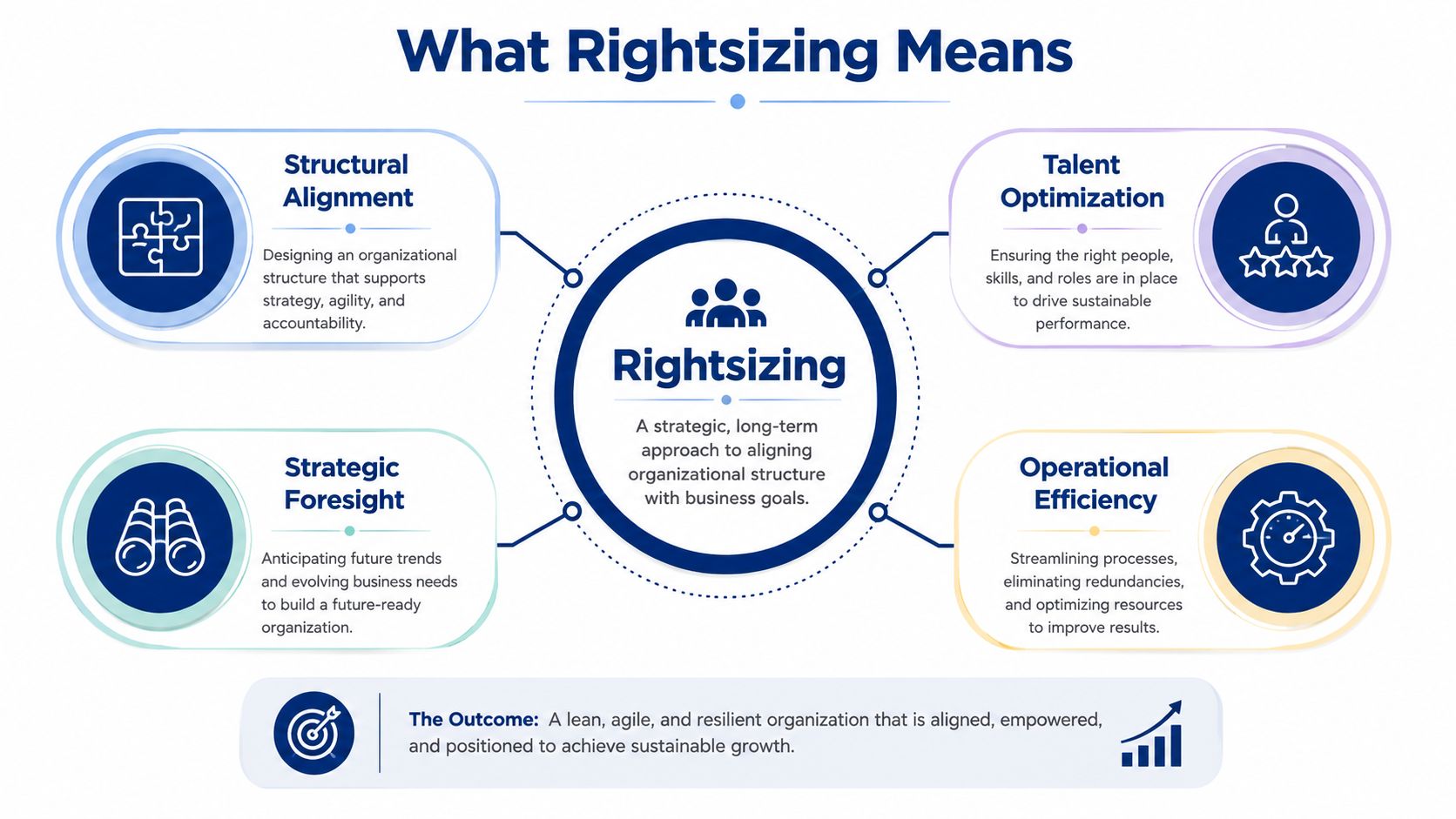
Rightsizing is the practice of adjusting an organization's workforce, structure, and resources to match current and future needs. It's not the same as downsizing, which is mostly about cutting headcount.
You've probably heard the term in a board update, an earnings call, or a quiet internal memo and wondered whether it meant layoffs, a reorg, or a strategic reset. If you sell into companies going through change, that distinction matters fast, because the word a company chooses usually tells you whether it's shrinking, rebalancing, or both.
What Rightsizing Means in Practice
A sales leader usually hears the word rightsizing in a tense moment. A key account announces a “strategic initiative,” a customer success leader gets moved, and suddenly you're trying to figure out whether the budget owner you know will still be in place next quarter.
Rightsizing means a company is changing its workforce, structure, and resources to fit current and future needs, not just trimming payroll. That is the cleanest working definition, and it is the one you should keep in mind when reading any announcement. The core signal is alignment, not just reduction, which is why the term often shows up when leaders want to signal a broader operational reset. As a practical HR distinction, contemporary references treat rightsizing as different from downsizing because it is tied to strategy, role criticality, and business outcomes, not just cost cutting. HR glossary definition of rightsizing
Rightsizing matters because it usually means resources are being reallocated. That can include removing some roles, redesigning others, or shifting focus toward areas like revenue, product, or automation. For a revenue team, that difference is everything, because a company can rightsize without shutting off buying activity, but it can also remove the very people who own your deal.
Practical rule: if the announcement talks about “efficiency,” “focus,” or “alignment,” assume the company is changing capacity, not just reducing cost.
The phrase also tends to show up when leaders want to sound intentional. That does not make the move good or bad by itself. It does mean the company believes the old shape is no longer the right one, which is why a thoughtful rep should treat the event as a change in buying behavior, account ownership, and internal politics, not just a staffing headline. If you want a practical companion to the talent side of that conversation, what is talent mapping is worth reading with this definition in mind.
See Salesmotion in action
Take a self-guided interactive tour — no signup required.
Rightsizing vs Downsizing vs Restructuring vs Redeployment
The vocabulary around workforce change gets sloppy in public announcements. Leaders do that on purpose, because the label shapes how investors, employees, and customers react.
| Term | Primary goal | Typical scope | What it usually signals to outsiders |
|---|---|---|---|
| Rightsizing | Align structure and resources with business needs | Workforce, roles, teams, and operating model | Strategic recalibration, often with both cuts and additions |
| Downsizing | Reduce cost through headcount reduction | Mostly jobs and payroll | A contraction move, usually read as a cost response |
| Restructuring | Change how the organization is arranged | Org design, reporting lines, units, and processes | Broader change that may or may not touch headcount |
| Redeployment | Move people into different roles | Internal transfers and role changes | A retention-oriented move, often meant to preserve skills |
Downsizing is the bluntest of the four. If a company is downsizing, it's usually trying to lower expense quickly, and outsiders should expect fewer people doing more work. That's very different from rightsizing, which can include adding talent in one part of the business while removing excess somewhere else. Strategic talent management strategy is the right lens when a company is using workforce moves to support a broader growth plan.
Restructuring is broader than both. A company can restructure a division, change reporting lines, or merge functions without reducing headcount. Redeployment sits inside that broader move and often means management still values the employee, just in a different seat.
A company that says “restructuring” is usually signaling form and process change. A company that says “rightsizing” is signaling a search for the right mix of people, roles, and spend.
For sales teams, the label matters because it tells you how disruptive the event may be. Downsizing often creates budget freezes and slower decisions. Redeployment can preserve relationships if the right people stay in place. Rightsizing is the messy middle, because it can do both at once. You need to read the language, not just the headline.

“We're no longer fishing. We know who the right customers are, and we can qualify them quickly. Salesmotion has had a direct impact on pipeline quality.”
Andrew Giordano
VP of Global Commercial Operations, Analytic Partners
Where the Term Came From and Why It Stuck
The modern business use of rightsizing became hard to ignore during the 2023 tech layoff wave. The New York Times reported that more than 260,000 people in the tech sector lost their jobs, and that scale made the term feel less like jargon and more like standard corporate language. The New York Times on rightsizing in the tech layoff wave
Companies like the word because it sounds strategic. “Layoffs” sounds reactive and painful. “Rightsizing” sounds like leaders are tuning the machine, not just swinging an axe. That framing matters to investors, especially when management wants to connect workforce changes to margins, focus, and future execution capacity.
The term also stuck because it fits a broader management idea that's been around for years: people and resources should match the work the business needs to do. In practice, that means a firm may cut some roles, keep others, and add new ones in growth areas. It's not a clean shrink-to-fit exercise; it's a recalibration.

The reason executives keep using the word is simple. It gives them a way to explain change as intentional. Whether that's true in a given case depends on what they do next, who gets moved, what gets funded, and whether the company hires back in the same areas a year later.
If the same roles come back quickly, the company didn't really solve the problem. It just deferred it.
That's why the word matters now more than ever. It signals that management believes the old workforce mix was wrong for the next phase of the business, even if the next phase still involves pain, confusion, and fewer people in some rooms.
Legal, People, and Pipeline Considerations
A rightsizing event isn't just a people story. It's a legal event, a morale event, and a revenue event all at once. If you sell into the company, you need to think about all three at the same time, because the buying committee can change before anyone updates the org chart.
In the US, mass layoffs can trigger WARN Act notice requirements, which generally mean 60-day notice before certain plant closings or mass layoffs. That timing matters because it gives you a window where buyers may still be employed but are already distracted, nervous, or looking ahead. It also means procurement, legal, and finance may be frozen while leaders decide who stays and who goes. WARN Act notice overview
Severance and support packages vary, but the negotiation logic is always the same, employees want clarity, employers want control, and leadership wants the transition to look orderly. If you're on the receiving end of a buyer-side change, a practical resource like should I sign a severance agreement can help you understand how people may be thinking when they're leaving a company.
The revenue risk is quieter than the HR headlines. A rep may lose the champion who owned budget, but the account still looks healthy on paper. That's why team mapping has to be current, not quarterly stale. If you want a structured way to think about those ownership shifts, managing the talent pipeline is a useful lens even outside HR.
Watch the middle layer closely. When a company removes managers, it often changes who approves, who influences, and who can move a deal forward.
One more thing, redeployment can preserve an account relationship, but only if the new role still has power. A buyer who moved into a side function may still like you, but they may no longer control budget. That's why rightsizing should always trigger an account map refresh, not just a sympathy email.
“We have very limited bandwidth, but Salesmotion was up and running in days. The template made it easy to load our accounts and embedding it in Salesforce was simple. It was one of the easiest rollouts we've done.”
Andrew Giordano
VP of Global Commercial Operations, Analytic Partners
The Metrics That Tell You If Rightsizing Worked
A rightsizing effort only earns the label if the company ends up healthier without weakening execution. You do not judge that from a press release. You judge it by watching whether the business gets leaner, keeps the right skills, and avoids turning a temporary fix into a future hiring scramble.
Deloitte's Human Capital Trends findings, as cited in the source brief, say 57% of companies using data-driven rightsizing improved operating margins within 18 months, compared with 23% using across-the-board cuts. The same source says 33% of rightsized positions are refilled within two years, which usually means the org change was more of a delay than a redesign. A separate discussion of the same theme appears in an HR glossary entry on rightsizing, and the pattern is consistent: the cut matters less than whether the business can run better afterward.
Start with margin movement. If margin improves and service quality holds, leadership probably made better tradeoffs than a blunt reduction would have allowed. If margin rises and the same functions start rehiring fast, the company likely pushed the problem into the next quarter instead of solving it.
Then look at skills mix. Cutting broad capacity while protecting scarce skills signals real recalibration. Cutting revenue-supporting roles and then struggling to rebuild pipeline tells a different story. That is a self-inflicted growth problem.
- Refill behavior: if the same roles return soon, the original change did not stick.
- Retained talent turnover: if strong performers leave after the change, confidence inside the company has cracked.
- Revenue-per-employee trend: if output per person weakens, the company may have cut into productive capacity instead of excess.
- Buyer-side continuity: if your contacts keep changing seats, deals slow down even when leadership says the restructuring is finished.
Sales leaders should also watch how hiring restarts. ATS behavior can show whether the company is carefully rebuilding or rushing to patch gaps, and understanding ATS in 2026 gives useful context for reading those hiring signals when the careers page starts moving again.
The best rightsizing programs do not just cut. They make the next org chart easier to run.
That is the test. If the company ends up with clearer ownership, steadier execution, and fewer reversals, rightsizing did its job. If the same team shape comes back through hiring, you were watching a pause, not a fix.
A Real-World Example of Rightsizing in the Wild
A 1,200-person SaaS company announces a “strategic rightsizing initiative” on its earnings call. It trims a modest slice of headcount, removes a layer of middle management, and says it will reinvest in AI and revenue operations roles. That language matters more than the exact wording, because it tells you the company thinks its problem is mix, not just spend.
In the next two weeks, three things happen. The head of a legacy product line updates LinkedIn, the careers page starts showing more roles tied to data and automation, and the company's public messaging shifts from broad expansion to focused efficiency. A revenue leader watching closely knows the buying center is likely changing, even before the first customer email lands.
That's the kind of case where outreach should be surgical. You don't pitch a generic “checking in” message. You reach out to the people who are likely absorbing extra work, the managers who now own more surface area, and the teams being asked to deliver more with less. If the company is adding AI and revenue ops, there may also be a fresh opening around process discipline, forecasting, and automation.
The smartest reps don't wait for a formal memo. They read the language in the earnings call, notice who is leaving or moving on LinkedIn, and compare that with the hiring pattern on the careers page. Then they adjust the account plan before the organization fully settles into the new shape.
When a company rightsizes, the buyer you knew may not disappear. They may just stop owning the decision you need.
That's why the public signal is useful. It tells you the company is entering a period where priorities, approval paths, and role ownership can all change at once. The rep who responds early has a much better shot at staying relevant than the rep who waits for the dust to clear.
How Revenue Leaders Should Spot Rightsizing Signals and Respond
Watch the places where companies reveal their real priorities. Earnings calls, SEC filings, press releases, hiring pages, and LinkedIn moves all tell part of the story. A rightsizing event usually shows up first in language, then in hiring, then in account ownership, so the first 48 hours matter more than people often realize.
Start with the signal, then answer one question, who inside the account is likely to own this change now? If the company is trimming middle management but hiring AI, data, or revenue operations roles, the conversation should move toward operational impact, not generic discovery. job posting analysis helps here because job ads often expose the direction faster than press releases do.
Use a direct, respectful opener when you reach out. Something like, “I saw the company is making structural changes around focus and execution. If it's helpful, I can share how teams in a similar transition protect revenue continuity while they sort out ownership and priorities.” That message works because it names the change without sounding predatory.
The contrarian point is important. Optimal size may be the wrong framing for 2025 and 2026. Many firms aren't trying to become smaller, they're trying to get the right skill mix, especially as AI and automation shift which roles create value.
Your next move should be simple. Refresh the account map, identify the new decision makers, and assume the old sequence is slower than it was last quarter. If a target account rightsizes, you either help them through the transition or you get stuck selling to a structure that no longer exists.
If you want a system for turning rightsizing signals into cleaner account plans and better-timed outreach, visit Salesmotion. It helps revenue teams catch the triggers behind org changes, understand what they mean, and act before the market has fully caught up.