
You sent a solid email to a partner at an IT services firm. The copy was clean. The value prop was reasonable. It still died in the inbox.
That usually isn't a writing problem. It's a timing problem, a targeting problem, or a relevance problem.
IT consulting sales prospecting is different from selling into a typical software company or manufacturer. These firms buy tools, data, and services to improve delivery for their own clients. If your outreach talks only about your product, you'll sound like every other vendor. If your outreach ties your value to faster client delivery, stronger presales work, cleaner handoffs, or better consultant productivity, you have a shot.
Why Generic Prospecting Fails with IT Consulting Firms
Generic prospecting fails because most consulting firms don't buy in a vacuum. They buy when something changes in their market, in a client account, or inside a practice. A broad message about efficiency or growth usually lands with a thud because it doesn't explain why this matters now.
That problem is getting worse. If every rep can generate “personalized” outreach at scale, differentiation shifts from generic personalization to timing, evidence, and business relevance, as noted in Salesforce's prospecting guidance. That point matters even more in consulting, where buyers are already flooded with polished outreach.
A lot of teams respond by increasing volume. That's understandable, but it misses the core issue. Volume can create more activity, not more traction. IT consulting buyers see through shallow personalization fast, especially when the seller clearly doesn't understand how the firm makes money.
The email isn't ignored because it's too short or too long. It's ignored because the buyer can't see a business event behind it.
Consulting firms buy for client outcomes
An IT services firm might evaluate your platform, but the actual question in their head is different:
- Will this help our consultants deliver better work
- Will this help presales teams scope faster
- Will this help us open or grow client accounts
- Will this fit the way our delivery teams work
That's why prospecting into this segment has to start with commercial context. A cloud consultancy launching a healthcare practice has different needs than a cybersecurity specialist expanding into the public sector. A regional implementation partner has different buying dynamics than a global systems integrator.
If you need a broader view of how these firms think, this guide on selling to IT services companies is a useful companion.
What works instead
The better model is simple:
| Approach | What happens |
|---|---|
| Generic volume outreach | You create activity but little urgency |
| Persona-only personalization | You sound informed, but not timely |
| Signal-based outreach | You give the buyer a concrete reason to engage now |
The strongest prospecting motion is built around account motion. A new partner program. A practice launch. A delivery hire cluster. A vertical-specific client win. Those are reasons to start a conversation.
That's the shift. Stop asking, “Who fits our ICP?” Start asking, “What changed at this firm that makes our offer relevant today?”
See Salesmotion in action
Take a self-guided interactive tour — no signup required.
Building Your Ideal Consulting Firm Profile
Before you chase signals, build a clean target model. Good IT consulting sales prospecting starts with account selection. If your list is loose, your signal tracking will be noisy and your reps will waste time on firms that will never buy.
Gong's guidance is directionally right here. It recommends building an ideal customer profile using attributes such as industry, revenue, employee count, and geography, then scoring prospects so reps focus first on the highest-fit accounts, as described in Gong's prospecting guide.
Use that structure, but adapt it for consulting firms.
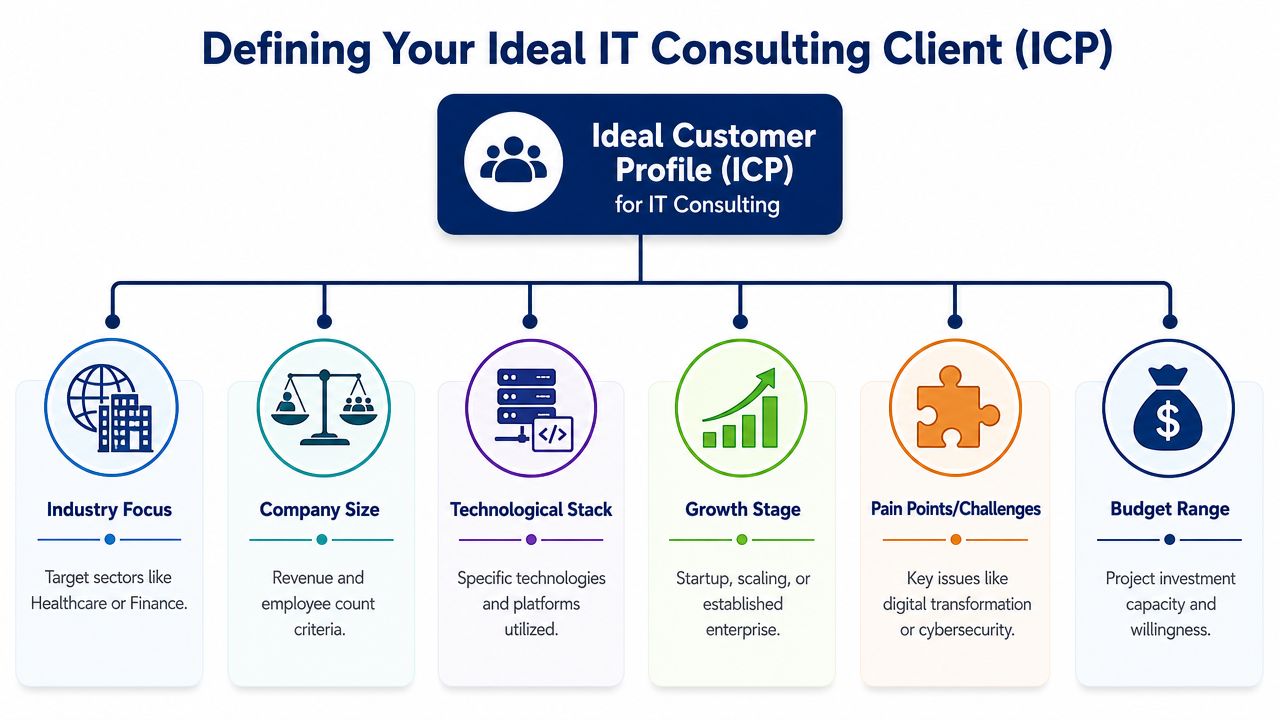
Start with firmographic fit
The first layer is basic, but it still matters.
- Revenue band helps you infer buying process complexity and budget discipline.
- Headcount helps you estimate whether they have dedicated enablement, alliances, presales, or RevOps support.
- Geographic presence tells you whether they sell locally, regionally, or globally.
- Delivery footprint matters if your product requires rollout across multiple offices or practices.
If you're selling a platform that supports large delivery teams, very small boutiques may love the idea and still never operationalize it. If you sell something highly technical and configurable, larger firms with solution engineering depth may be more realistic buyers.
Layer in consulting-specific filters
This is where most teams get sharper.
A better consulting ICP includes:
-
Verticals served
Financial services, healthcare, manufacturing, retail, public sector. This tells you where client pressure will come from. -
Practice areas
Cloud migration, data and AI, cybersecurity, ERP, application modernization, managed services. -
Partner ecosystem
Microsoft, AWS, Google Cloud, Salesforce, ServiceNow, SAP, Databricks, Snowflake, and others. Partner alignment often drives demand, co-selling, and integration needs. -
Service model
Advisory-led, implementation-led, managed services-led, or project-based specialist. -
Buyer maturity
Some firms want a polished UI. Others want data, workflows, and API access so they can embed intelligence into their own delivery motion.
A practical way to organize this is with a tiered list. Keep Tier 1 narrow and high conviction. Tier 2 can be broader but still aligned. Tier 3 is where you test emerging segments.
Score for fit before you score for timing
Don't mix these together.
Fit asks, “Should we care about this account at all?” Timing asks, “Should we act now?” If you collapse both into one model, reps chase noisy accounts because a single trigger fired.
Practical rule: Build the account list first. Then monitor that list for signals. Don't do it in reverse.
A simple worksheet helps teams stay consistent. If you need one, this ideal customer profile template is a good starting point.
Here's a usable scoring frame:
| ICP factor | Strong fit looks like |
|---|---|
| Company size | Large enough to operationalize the purchase |
| Practice alignment | Your offer maps to at least one active service line |
| Vertical overlap | They serve industries where your value is obvious |
| Partner relevance | They work with platforms your product complements |
| Technical maturity | They can adopt either UI or embedded workflow models |
That structure keeps prospecting disciplined. It also makes your messaging better, because you're no longer guessing what kind of consulting business you're talking to.

“Consolidation of prospect company information that I can use frequently to be way better informed when I'm doing my outbound, preparing for a meeting, or building relationships. Ease of use and Customer Support is excellent.”
Werner Schmidt
CEO & Co-Founder, Lative
Hunting for High-Intent Buying Signals
The best consulting opportunities rarely announce themselves as “looking for vendor.” They show up as change.
That's why signal-based prospecting matters so much here. IT consulting often sells into transformation cycles where urgency is created by leadership changes, restructuring, or expansion, not by explicit buying intent, as discussed by Consulting Success on consulting sales. If you sell into consulting firms, you should think the same way.
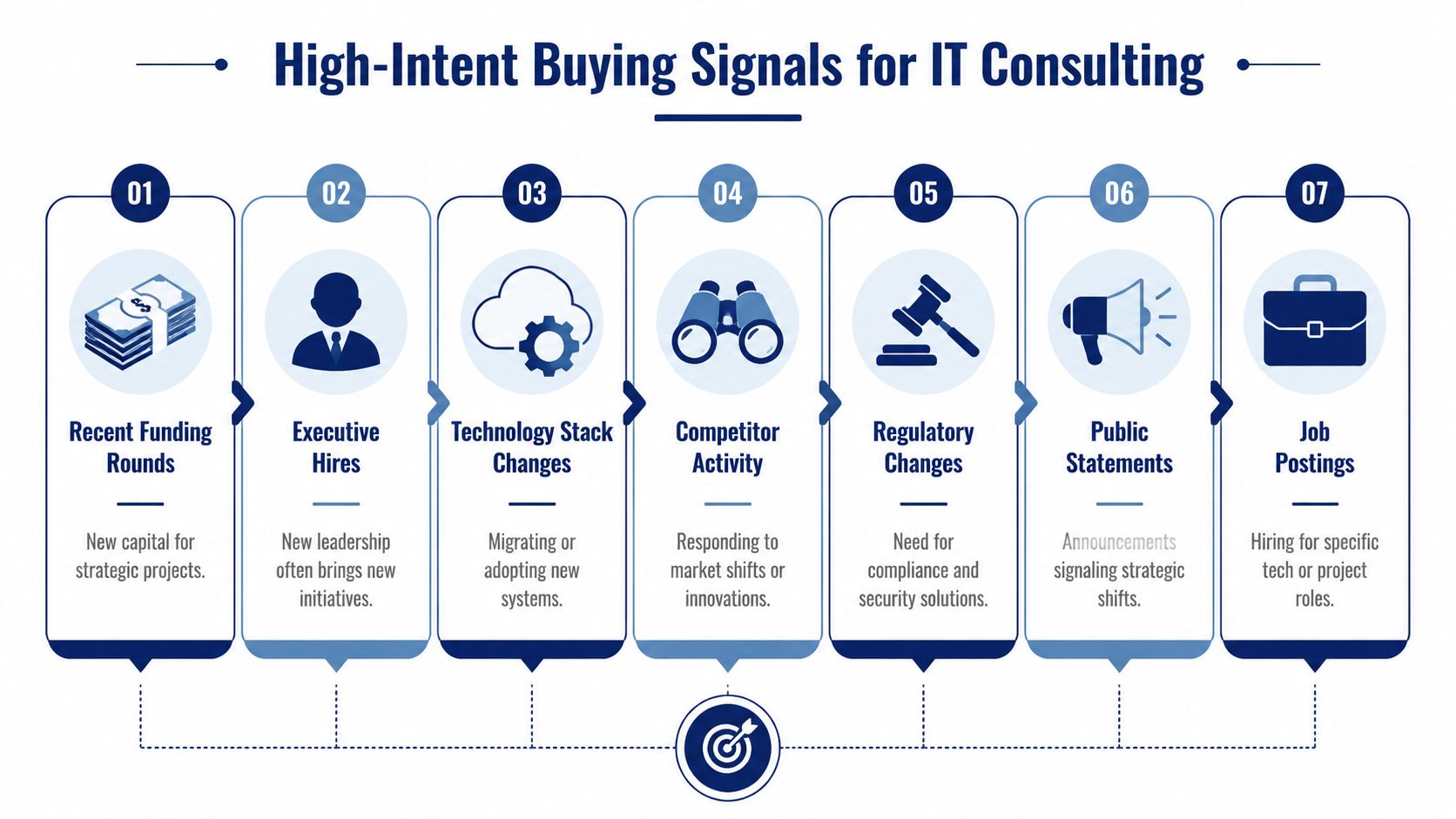
Signals that matter in consulting
The signal itself is never the point. The point is what it implies.
Here are some of the highest-value triggers for IT consulting sales prospecting:
-
New practice launch
If a firm launches a data, AI, cloud, or cybersecurity practice, it usually needs enablement, delivery support, better research, and new ways to standardize client work. -
RFP or major client win
A public win in healthcare, financial services, or another core vertical often means the firm is about to hire, build repeatable collateral, support consultants faster, and deepen platform relationships in that vertical. -
Partner program announcement
New alliances often create integration needs, co-sell motions, certification pressure, and demand for tools that make the partnership commercially useful. -
Executive hire
A new practice lead, alliance leader, or presales director often brings a fresh mandate. New leaders tend to reassess tooling and process gaps quickly. -
Job posting cluster
Multiple openings around one platform or service line usually signal active demand and delivery strain.
Read the commercial implication, not just the headline
A lot of reps stop at the event. Don't.
If a consultancy wins a major retail transformation project, your opening angle isn't “saw the news, congrats.” It's the implication. Are they going to need better account research for expansion into adjacent retailers? Faster consultant ramp-up? More structured discovery? Better partner coordination?
That's the work.
Here's a practical lens:
| Signal | What it usually means | Good outreach angle |
|---|---|---|
| Practice launch | New capability needs repeatable delivery | Help consultants ramp and standardize faster |
| Vertical win | Success in one sector creates expansion pressure | Help replicate playbooks across similar accounts |
| Alliance update | New ecosystem motion needs coordination | Help presales and alliances work from the same intelligence |
| Leadership change | New owner of a problem area | Offer a cleaner way to execute the new mandate |
Build a signal library by segment
Teams get better when they stop treating all accounts the same. Build a simple signal library by firm type.
For example:
- Global systems integrators care about large alliance ecosystems, delivery consistency, and embedded workflows.
- Mid-market consultancies care about speed, presales productivity, and focus by vertical.
- Specialist boutiques care about differentiation, expertise packaging, and making a small team look bigger.
That same discipline shows up in other markets too. If you sell into distributed operator networks, studying how a franchise lead generation company maps expansion signals to outreach can sharpen your own thinking around organizational triggers.
A useful operating habit is to tag every signal with a “so what” statement before any rep reaches out. If your team can't explain the implication in one sentence, the trigger isn't ready.
For a deeper breakdown of trigger categories and how to use them, this article on what buying signals are is worth reading.
If the signal doesn't change the buyer's priorities, it's just news. If it changes execution pressure, it's a prospecting opportunity.
Crafting Outreach That Actually Connects
Once you have the right account and the right trigger, the next mistake is obvious. Sellers still pitch the product instead of the client outcome.
That's a problem in every market, but it's fatal with consulting firms. They don't buy software, data, or services because a feature sounds nice. They buy because it helps their teams serve clients better, win more work, or deliver more consistently.

Zendesk reports that only 8.5% of outreach emails get a response, but multiple touches to the same contact can generate 2x more responses and lift response rates by 160% when a sequence is used, according to Zendesk's sales statistics roundup. That's why message quality and sequence discipline have to work together.
Multi-thread the account on purpose
Single-threaded outreach is fragile. One person leaves, ignores you, or forwards badly, and the thread dies.
In consulting firms, the right stakeholders often include:
- Practice lead for the business case and service-line relevance
- Presales or solution director for workflow fit and proposal impact
- VP of alliances or partner lead when your value ties to ecosystem execution
- Operations or enablement lead when adoption depends on process consistency
- Technical architect or innovation lead when the buyer cares about API access or embedded workflows
These people don't need the same message. They need the same story from different angles.
Use signal-led messaging
Here's the simplest rule in IT consulting sales prospecting:
Don't sell your tool. Sell what your tool helps their consultants do for clients.
A few examples make this concrete.
Example for a new practice launch
Weak message
“Congrats on launching your AI practice. We help firms streamline sales research and prospecting.”
Better message
“Noticed the AI practice launch. When firms add a new practice, presales and delivery teams usually need repeatable account context fast, especially before the playbooks are mature. We help teams give consultants cleaner account intelligence they can use in discovery and expansion conversations.”
The second version is stronger because it ties your offer to how the firm serves clients.
Example for an RFP or major client win
Weak message
“Saw your recent win. We'd love to show you our platform.”
Better message
“Saw the vertical win. Firms that break into a sector often need to turn one success into a repeatable motion across similar accounts. We help teams package account intelligence and outreach around that vertical so consultants and sellers can move faster on adjacent opportunities.”
Example for a partner announcement
Weak message
“Congrats on the new partnership. Our solution integrates with modern ecosystems.”
Better message
“Your new partner announcement stood out because alliances only create revenue when sellers, presales, and practice leaders can act on the same signals. We help teams spot relevant account movement and turn it into outreach and coordination, not just another dashboard.”
Keep the sequence tight
Richardson recommends 5 to 7 touches across email, phone, LinkedIn, and sometimes direct mail over roughly 2 to 3 weeks, with each message building on the last and concise opening outreach performing better than generic pitches, according to Richardson's prospecting guidance. That's a useful baseline for consulting-focused sequences.
A practical sequence might look like this:
- Email one with the signal and business implication
- LinkedIn touch referencing the same event without repeating the email
- Call focused on the operational impact behind the trigger
- Email two with a sharper use case for their role
- Second thread to a related stakeholder
- Call or voicemail tied to the likely initiative owner
- Final email with a low-friction next step
The mistake is making every touch say the same thing. Build the story. First touch identifies the trigger. Second touch frames the problem. Third touch narrows to a role-specific outcome.
The second door for technical buyers
Some IT services firms don't want another standalone interface. They want to embed intelligence into their own workflows, portals, or delivery systems.
That changes the sales motion.
If you're selling to a technical buyer inside an advanced consultancy, mention the API or headless path early when it's relevant. For these buyers, the product isn't just a UI. It's an input into their internal process. Salesmotion's API is a good example of that second door. A team can use the standard workflow, or they can consume the intelligence in their own systems if that better fits how they operate.
That message often lands well with architecture-minded buyers who care more about integration flexibility than another login.

“This is my singular place that very simply summarizes a company's top initiatives, strategies and connects them to my solution. Something I would spend hours researching manually, now it's automated.”
Derek Rosen
Director, Strategic Accounts, Guild Education
Automating Your Prospecting Playbook with Salesmotion
Manual prospecting breaks down fast in this segment. Reps can conduct thorough research on a handful of consulting firms, but they struggle to do it consistently across a real territory. The work is too uneven. One rep spots the practice launch. Another misses the partner announcement. A third sees the signal but can't turn it into usable outreach before the window closes.
That's where automation earns its keep.
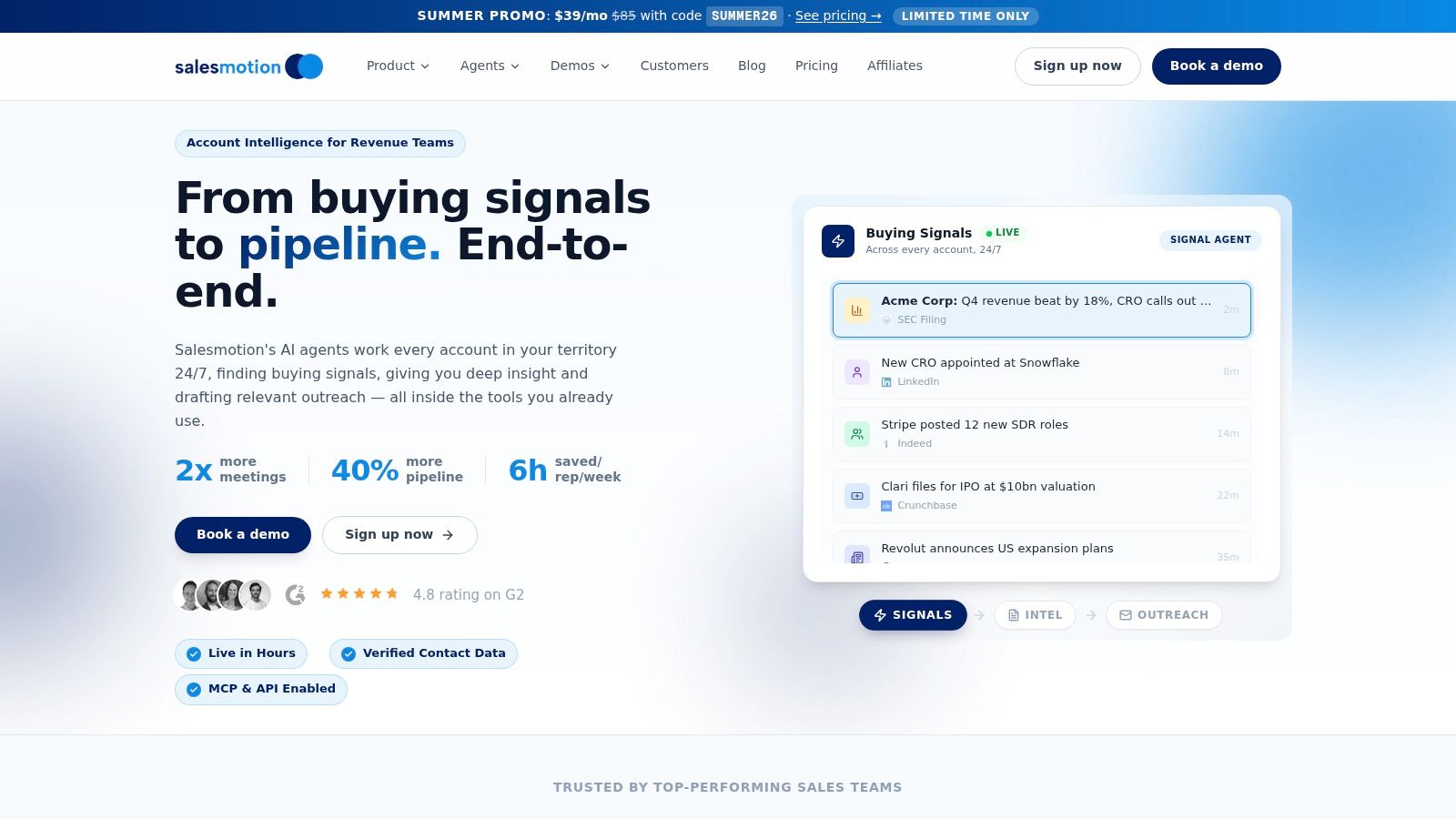
What should be automated
In a good prospecting system, three jobs happen continuously:
| Job | What the team needs |
|---|---|
| Account research | Structured briefs on the firm, practices, leaders, and priorities |
| Signal monitoring | Alerts when meaningful change happens |
| Outreach drafting | Ready-to-edit messaging tied to the signal and persona |
Those are exactly the jobs many teams still do manually in spreadsheets, browser tabs, and half-updated CRM notes.
How the workflow should run
The cleanest setup looks like this:
- Research first so reps understand the consulting firm's business model, practice mix, and likely stakeholders.
- Signal monitoring second so the team acts when something changes, not when someone finally remembers to check the account.
- Outreach generation third so the rep starts from real context instead of a blank page.
A fitting solution is a system such as Salesmotion's AI outreach workflow. It combines account research, signal detection, and draft outreach so reps can move from trigger to message without rebuilding context every time.
Why the API matters
The “second door” matters most here.
A lot of IT services firms are technical enough to ask a different question than standard SaaS buyers. They don't ask, “Can my team log in and use this?” They ask, “Can we embed this intelligence into our internal operating model?”
That's a meaningful distinction. If your buyer runs custom presales workflows, internal delivery portals, knowledge systems, or alliance dashboards, a standard UI may not be the best fit. A headless or API-based option gives you another route into the account.
Some consulting buyers want a product. Others want a capability they can plug into their own machine.
That's why the API isn't a side feature. In the right account, it's the commercial wedge. It lets you sell to a technical stakeholder who cares about composability, internal adoption, and workflow control.
The practical takeaway is simple. Don't force every consulting firm through the same buying path. Some will buy seats. Some will buy intelligence. Some will want both.
Measuring Success and Optimizing Your Approach
Prospecting without measurement turns into folklore. One rep swears partner signals work. Another says executive hires are better. A manager likes a sequence because it sounds sharp. None of that is enough.
Track the motion at the signal level.
More than 40% of salespeople say prospecting is the hardest part of the sales process, and a prospect often requires around nine contact attempts before responding, according to ITA Group's summary of prospecting benchmarks. The operational lesson is straightforward. Persistence needs a system, not a pep talk.
What to measure
Use a small scorecard:
-
Signal-to-meeting rate
Which trigger types create conversations? -
Meeting-to-pipeline rate
Which signals lead to real opportunities, not just polite calls? -
Pipeline by signal type
Separate practice launches, partner announcements, leadership changes, and client wins. -
Touches to first response
This shows whether reps are giving up too early or dragging weak accounts too long. -
Multi-thread coverage
Track whether the team is reaching only one contact or building account depth.
How to diagnose problems
A few examples:
| Symptom | Likely issue | Fix |
|---|---|---|
| Good open rates, few meetings | Message is interesting but not commercially relevant | Tighten the “why now” and client impact |
| Lots of first meetings, weak pipeline | Signals are noisy or low-stakes | Refine trigger quality and account fit |
| Reps stop after a few touches | Process discipline problem | Track attempt counts in CRM and coach to sequence completion |
| One persona engages, others don't | Single-threaded messaging | Add role-based variants for practice, presales, and alliances |
Optimize by account motion
The best teams learn which changes inside consulting firms matter most for their offer. They also learn which buyers respond to which angle.
A good prospecting program doesn't just create meetings. It teaches the team where urgency actually starts.
That makes optimization much more practical. Keep the signal types that repeatedly create pipeline. Drop the ones that generate activity without movement. Tighten your ICP when a pattern appears. Expand it carefully when a new one does.
If you want to operationalize this kind of signal-based prospecting, Salesmotion is one option to evaluate. It's built for teams that need structured account research, real-time signal monitoring, and outreach tied to actual account changes, with an API path for technical buyers who want to embed that intelligence into their own workflows.