Most ideal customer profile exercises produce a tidy document that gets filed away after a quarterly planning session. Your team lists firmographics, picks a few industries, and moves on. But a static description of your "dream account" tells you nothing about which of the thousands of matching companies you should call today.
That is the gap an ideal customer profile scoring rubric fills. Instead of a binary "fits / doesn't fit" decision, a scoring rubric assigns numeric values to each trait, then stacks those values to rank every account in your pipeline from Tier A to Tier C. The result is a prioritized target list where sales reps spend their time on accounts with the highest probability of closing, not just the biggest logos.
This guide gives you both: a step-by-step framework for building your own ICP scoring rubric (with three real B2B examples you can copy), plus the 12 best free ICP templates to document and operationalize the profile once it is built.
What Is an ICP Scoring Rubric?
An ICP scoring rubric is a structured framework that assigns point values to the attributes that define your best customers. Each criterion — industry, company size, tech stack, buying signals — receives a score based on how strongly it correlates with your closed-won deals. The scores are totaled to produce a single fit number for every account.
The rubric serves a different purpose than traditional lead scoring. Lead scoring typically grades individual contacts based on behavioral engagement (emails opened, pages visited). An ICP scoring rubric grades the account itself on structural fit, before any individual has engaged. Think of it as the filter that decides which doors you knock on, while lead scoring tells you who answered.
Why does this matter? According to Factors.ai research, organizations with rigorous ICP scoring see measurably higher win rates than competitors who rely on gut-feel qualification. When sales teams focus on Tier A accounts, cycle times shorten, average deal sizes increase, and the pipeline becomes more predictable.
Scoring Rubric vs. Lead Scoring
| ICP Scoring Rubric | Lead Scoring | |
|---|---|---|
| Unit | Account / company | Individual contact |
| Criteria | Firmographic, technographic, strategic fit | Behavioral engagement (clicks, downloads, form fills) |
| Timing | Applied before outreach | Updated as engagement happens |
| Owner | RevOps / Marketing Ops | Marketing Automation |
| Output | Account tier (A / B / C) | MQL threshold |
The two systems are complementary. An ICP scoring rubric identifies the right accounts; lead scoring surfaces the right people within those accounts.
Build and validate your ICP with real account data
Score and prioritize accounts against your ideal customer profile using live signals and firmographic data.
How to Build Your ICP Scoring Rubric in 5 Steps
Step 1: Analyze Your Closed-Won Deals
Start with data, not assumptions. Pull 50–100 closed-won deals from the last 12 months and tag each with firmographic and technographic attributes: industry, employee count, revenue range, tech stack, geography. Look for clusters. You will almost always find that 70–80% of your wins share 3–5 common traits.
Step 2: Define Your Scoring Categories
Most B2B rubrics use four categories:
- Firmographics — industry, company size, revenue, geography, business model
- Technographics — CRM, marketing automation, complementary tools, competitor products
- Behavioral signals — pricing page visits, content downloads, webinar attendance
- Trigger events — new funding, leadership changes, hiring surges, expansion announcements
Weight the categories based on which ones most strongly predict a closed-won outcome. If 90% of your wins are in three industries, industry should carry heavy weight. If tech stack matters less, reduce its share.
Step 3: Assign Point Values
Use a consistent scale. A 100-point total works well because it is intuitive (an 85/100 account is clearly better than a 40/100 account). Distribute points across your categories based on their predictive power.
Step 4: Set Tier Thresholds
Define what score earns each tier:
- Tier A (80–100): Pursue immediately. These accounts match your ICP on nearly every dimension.
- Tier B (50–79): Nurture. Good fit on some dimensions, missing on others. Worth marketing to but not the first call of the day.
- Tier C (0–49): Deprioritize. Poor structural fit. Do not invest outbound effort here.
Step 5: Validate Quarterly
A scoring rubric is only useful if it predicts outcomes. Every quarter, compare win rates, average deal sizes, and cycle times across tiers. If Tier A accounts are not converting meaningfully better than Tier B, your criteria or weights need adjustment. Top-performing teams see Tier A win rates 1.5–2x higher than Tier B, with 15–20% shorter cycle times.

“Salesmotion is instrumental in helping me prioritize net-new accounts, understand their strategic initiatives, and cover more ground. With a lot of green-field accounts, I'm heavily leaning on the AI insights to tier my accounts and focus my time. The platform is incredibly intuitive and easy to use.”
Rob Webster
Enterprise Account Executive, Synthesia
ICP Scoring Rubric Example 1: B2B SaaS Platform (100-Point Scale)
This example models a mid-market SaaS company selling a sales enablement tool to B2B teams with 100–2,500 employees.
Firmographics (40 points)
| Criterion | Ideal Match | Partial Match | Poor Match |
|---|---|---|---|
| Industry | Tech, Financial Services, Professional Services → 15 pts | Other B2B → 8 pts | B2C → 0 pts |
| Company size | 100–1,000 employees → 15 pts | 50–99 or 1,001–2,500 → 8 pts | Under 50 or over 2,500 → 3 pts |
| Geography | US / Canada → 10 pts | UK / EU → 7 pts | Other English-speaking → 5 pts |
Technographics (30 points)
| Criterion | Ideal Match | Partial Match | Poor Match |
|---|---|---|---|
| CRM | Salesforce or HubSpot → 15 pts | Other CRM → 8 pts | No CRM → 0 pts |
| Complementary tools | Outreach, Gong, or similar → 10 pts | Basic email tools → 5 pts | None → 0 pts |
| Competitor products | Using a competitor's tool → 5 pts | No incumbent → 3 pts | — |
Intent Signals (30 points)
| Criterion | Points |
|---|---|
| Pricing page visit | 10 pts |
| Case study download or webinar attendance | 8 pts |
| G2 / Gartner research activity | 7 pts |
| Recent funding round or expansion announcement | 5 pts |
| Tier Thresholds: A = 80–100 | B = 50–79 |
| --- | --- |
| Strategic fit (industry + use case match) | 3x |
| Authority (decision-maker access + budget confirmation) | 2x |
| Technical fit (existing stack compatibility) | 2x |
| Timing signals (active evaluation, budget cycle, trigger events) | 2x |
| Firmographic fit (size, geography, revenue) | 1x |
Total possible: 100 points
The multipliers reflect what enterprise sellers know intuitively: strategic fit and access to power matter more than company size alone. A Fortune 500 company that does not have a use case for your product (strategic fit = 2/10) scores lower than a mid-market company in a perfect-fit industry (strategic fit = 9/10), even though the Fortune 500 account looks more impressive on paper.
Scoring a Real Account
| Category | Raw Score | Weight | Weighted Score |
|---|---|---|---|
| Strategic fit | 8/10 | 3x | 24 |
| Authority | 6/10 | 2x | 12 |
| Technical fit | 7/10 | 2x | 14 |
| Timing signals | 9/10 | 2x | 18 |
| Firmographic fit | 7/10 | 1x | 7 |
| Total | 75/100 (Tier B+) |
This account is on the cusp of Tier A. The high timing score (active evaluation, recent trigger event) is a strong indicator. A rep might choose to treat it as Tier A based on the timing signals alone, which is where signal-based selling adds context that a static score cannot.
How to Validate Your ICP Scoring Rubric
Building the rubric is the first half. The second half is proving it works. Track these three metrics by tier:
Win rate by tier. Tier A accounts should convert at 1.5–2x the rate of Tier B. If the difference is marginal, your scoring criteria are not discriminating well enough. Revisit your weights or add criteria that better separate winners from losers. For detailed benchmarks, see our sales win rate analysis.
Average deal size by tier. Tier A accounts should produce meaningfully larger deals. If Tier B deals are the same size, the accounts in Tier A are not actually better — they are just different.
Cycle time by tier. Tier A deals should close 15–20% faster. If they do not, it may mean your rubric rewards fit but not readiness. Add more weight to timing signals and buying triggers to surface accounts that are not just a good fit but are actively in-market.

“There's been a big focus on hyper personalization and relevance in our outbounding efforts. Salesmotion has been a key partner in hitting our significantly increased meeting targets. What stands out is how simple it is. Reps can log in and get valuable account insights within 30 seconds to a minute.”
Joe DeFrance
VP of Sales, Incredible Health
Skip the spreadsheet
Salesmotion scores every account against your ICP automatically and tells you which ones to work first.
12 Free ICP Templates to Document and Activate Your Profile
Once your scoring rubric is built, you need a format to share it across the organization. These 12 templates range from collaborative whiteboards for team workshops to structured spreadsheets ready for your CRM.
1. Miro
Miro's digital whiteboard is ideal for cross-functional teams building an ICP collaboratively. The Miroverse community library has pre-built ICP templates for B2B, SaaS, and startup contexts that you can duplicate in one click. Particularly valuable for remote teams running workshops.
Best for: Remote workshops and cross-functional brainstorming Access: Free plan available; requires Miro account Website: Miro Ideal Customer Profile Templates
2. Notion Template Marketplace
Notion templates act as dynamic databases rather than static documents. You define properties for firmographics, pain points, and job roles, creating a linked source of truth that connects to your sales account plans and other GTM documents.
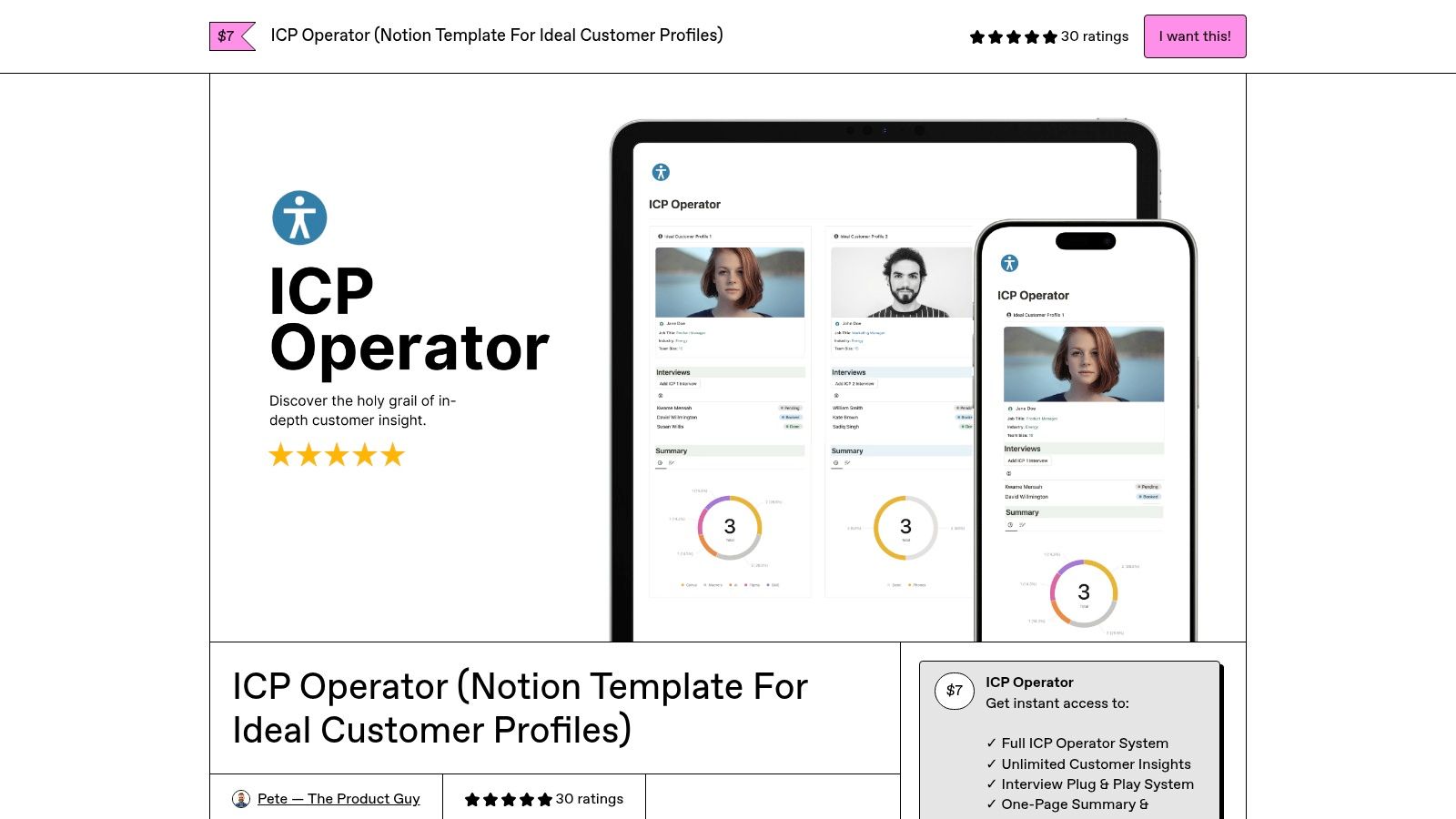 Notion's ICP template marketplace offers database-driven profiles.
Best for: Notion-centric GTM teams Access: Free and paid templates; requires Notion account Website: Notion ICP Templates
3. Asana
Asana turns your ICP into an actionable project with tasks, owners, and due dates. Define a customer pain point, then create a task for the marketing team to develop content addressing it.
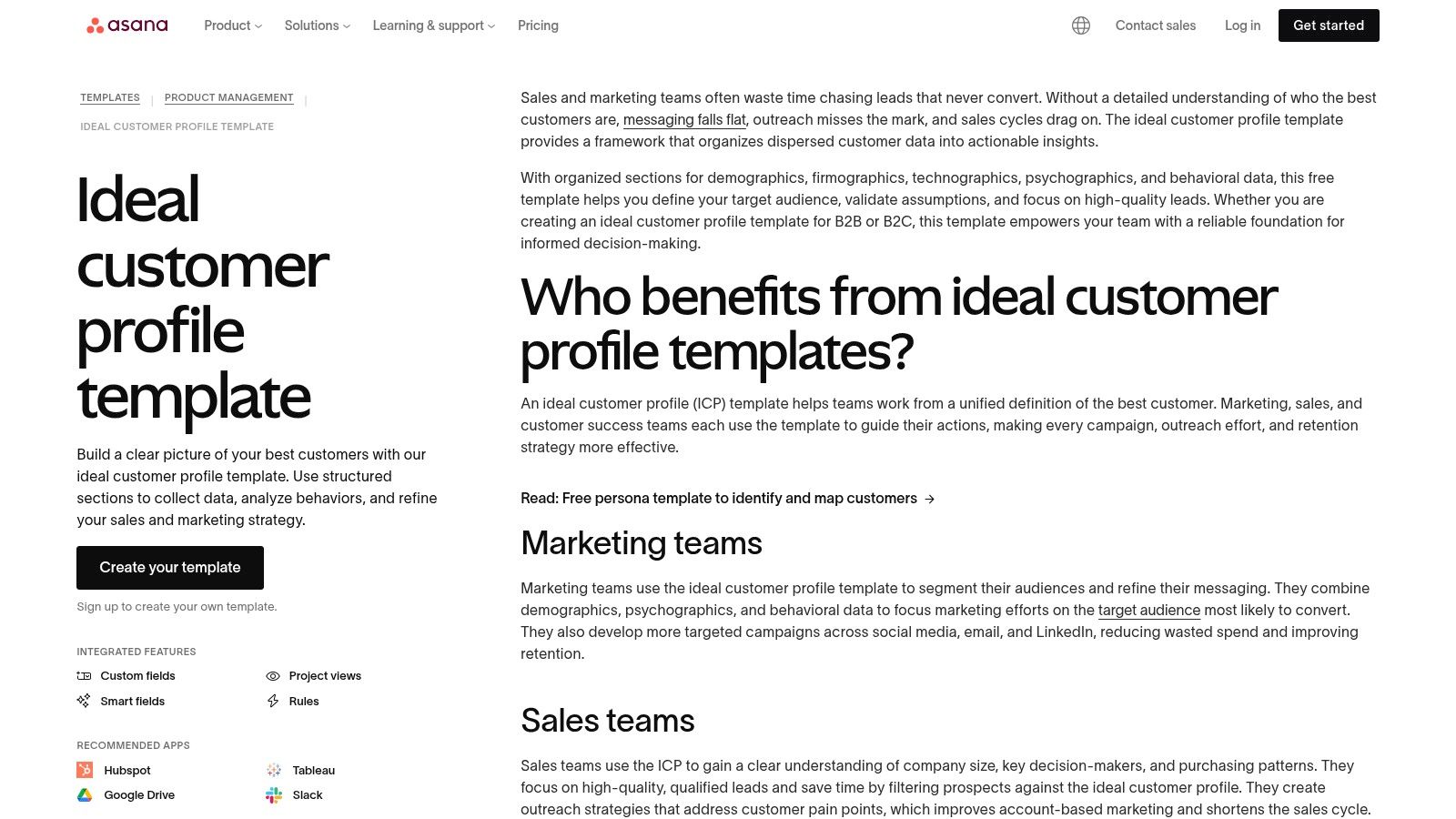 Asana's project-based template ties ICP insights to execution.
Best for: Teams that use Asana for project management Access: Free Basic plan; requires Asana account Website: Asana ICP Template
4. HubSpot ICP Ebook + Interactive Worksheet
A comprehensive guide combined with a fillable worksheet that walks you through building a data-driven profile. Clearly distinguishes between an ICP and buyer personas.
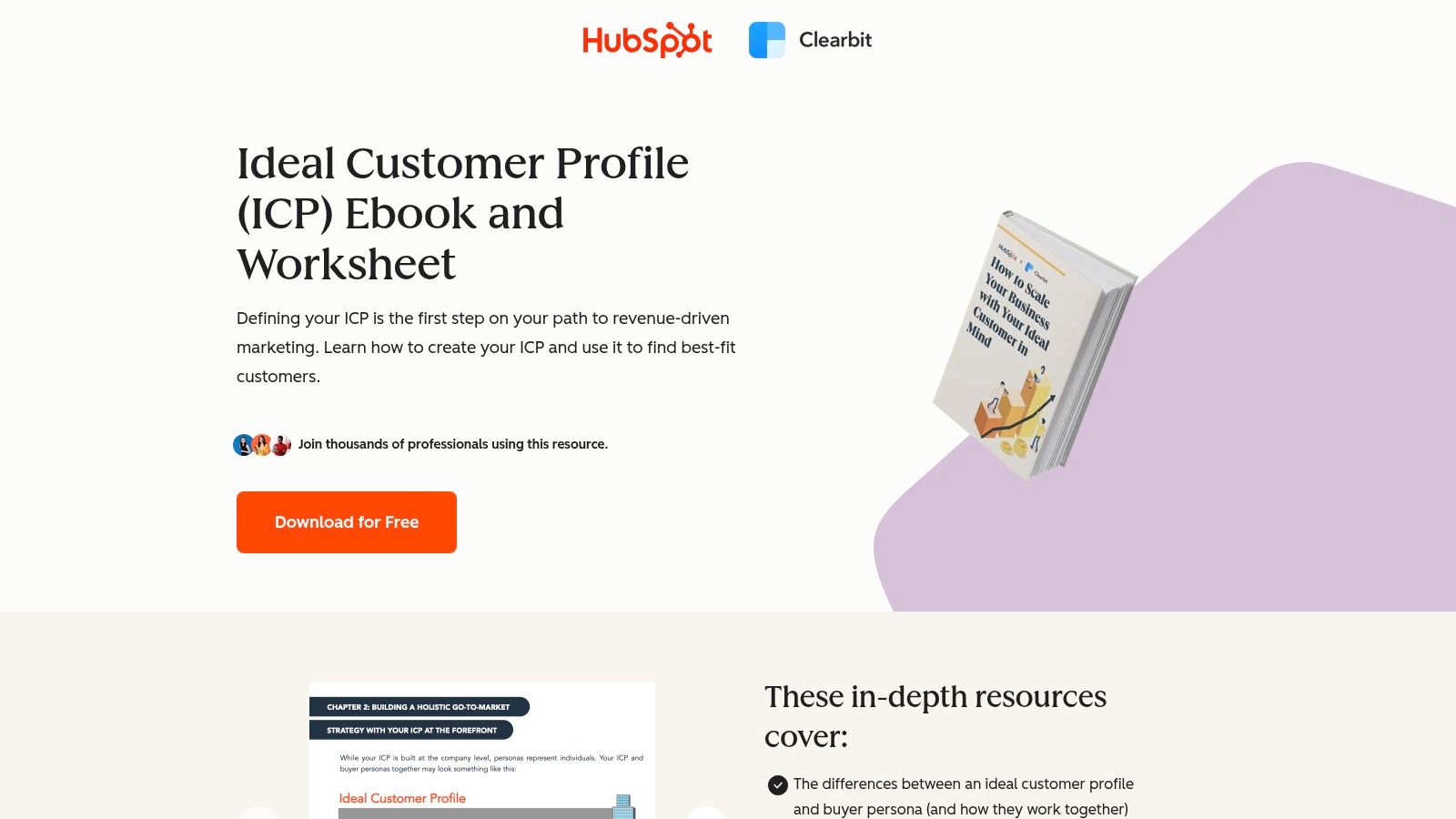 HubSpot's ebook covers ICP vs. buyer persona distinction in depth.
Best for: Teams needing structured education before building their ICP Access: Free download (gated behind lead capture form) Website: HubSpot ICP Ebook & Worksheet
5. HubSpot (8 Free Customer Profile Templates)
A downloadable pack of eight templates in PowerPoint and Google Docs formats. Includes long-form and short-form versions for different use cases.
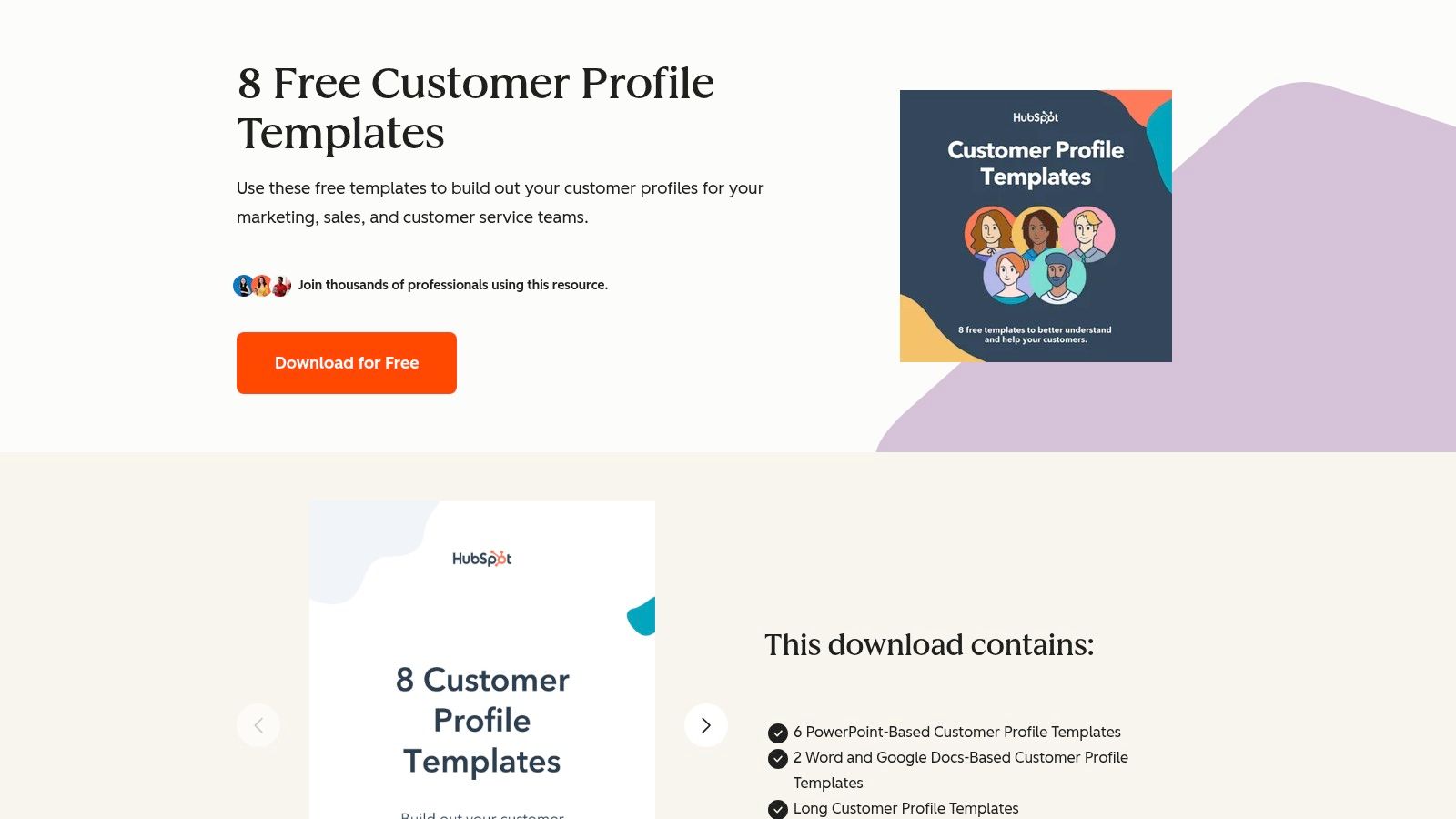 Eight editable templates in presentation and document formats.
Best for: Presentations and offline workflows Access: Free download (email required) Website: HubSpot Customer Profile Templates
6. Pipedrive
A sales-oriented ICP template focused on the firmographic and pain point data that reps need to qualify leads. Part of a larger library that includes competitor analysis worksheets.
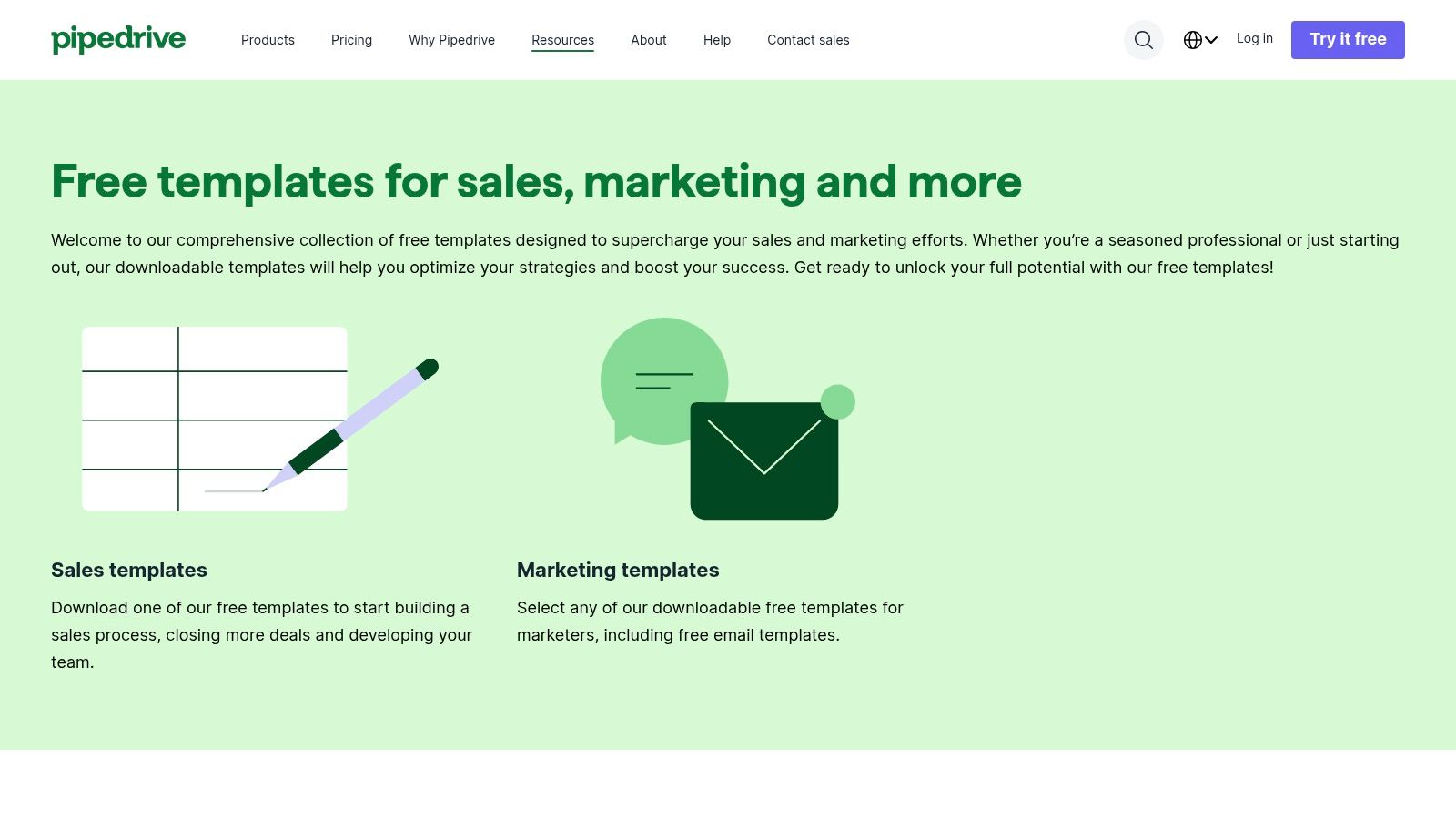 Pipedrive's template focuses on what SDRs and AEs need for qualification.
Best for: Sales teams and SDRs Access: Free (email required) Website: Pipedrive Free Sales Templates
7. Smartsheet (ICP Scorecard)
Smartsheet offers downloadable Excel and PowerPoint templates including a dedicated ICP scorecard. The scorecard format is particularly useful as a lightweight alternative to a full scoring rubric — perfect for teams just starting to quantify their ICP criteria.
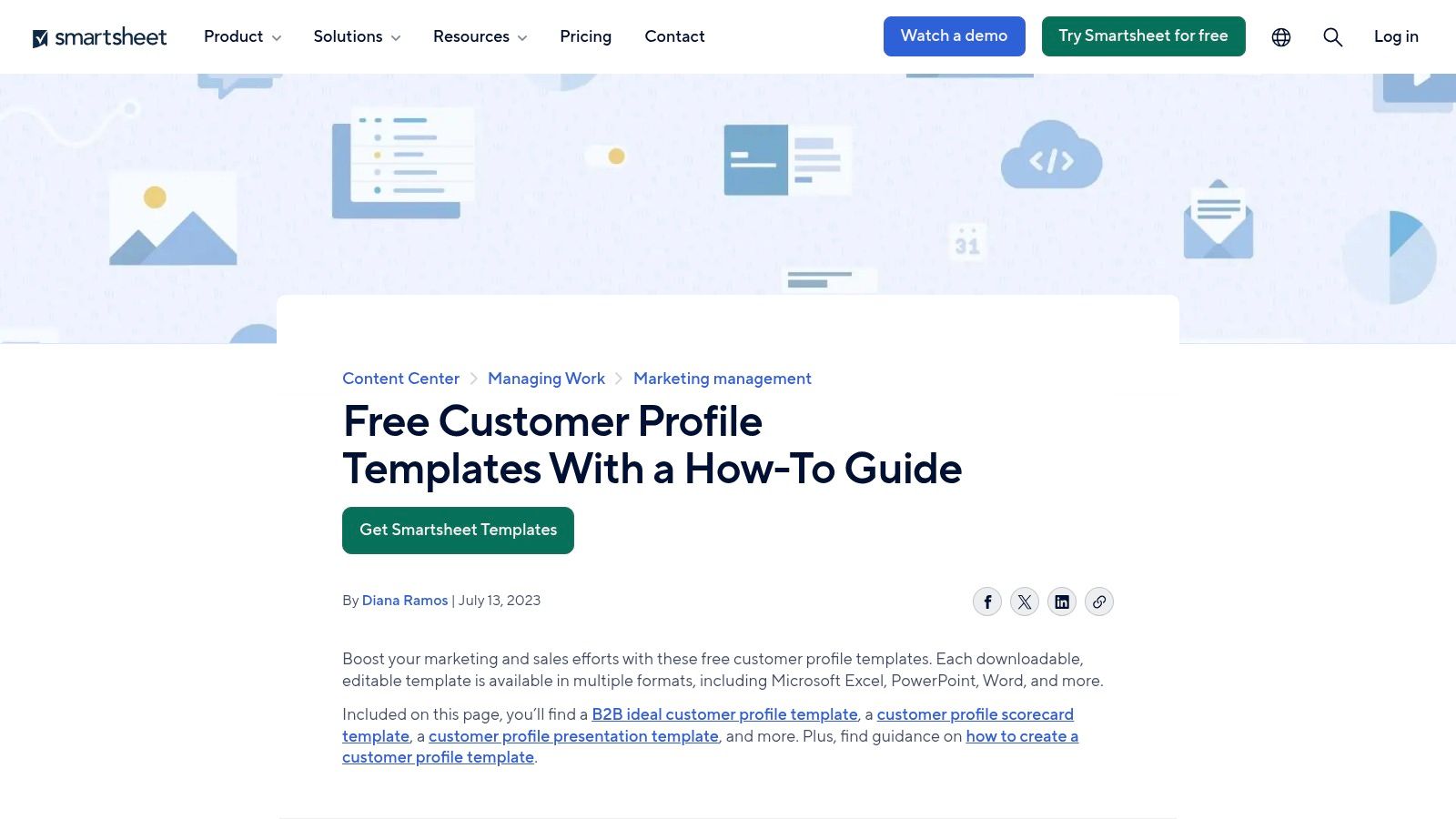 Smartsheet's ICP scorecard is a practical starting point for quantified scoring.
Best for: Spreadsheet-centric RevOps and analytics teams Access: Free download, no account required Website: Smartsheet Customer Profile Templates
8. Canva
Canva turns ICP and buyer persona research into polished, presentation-ready documents using drag-and-drop editing.
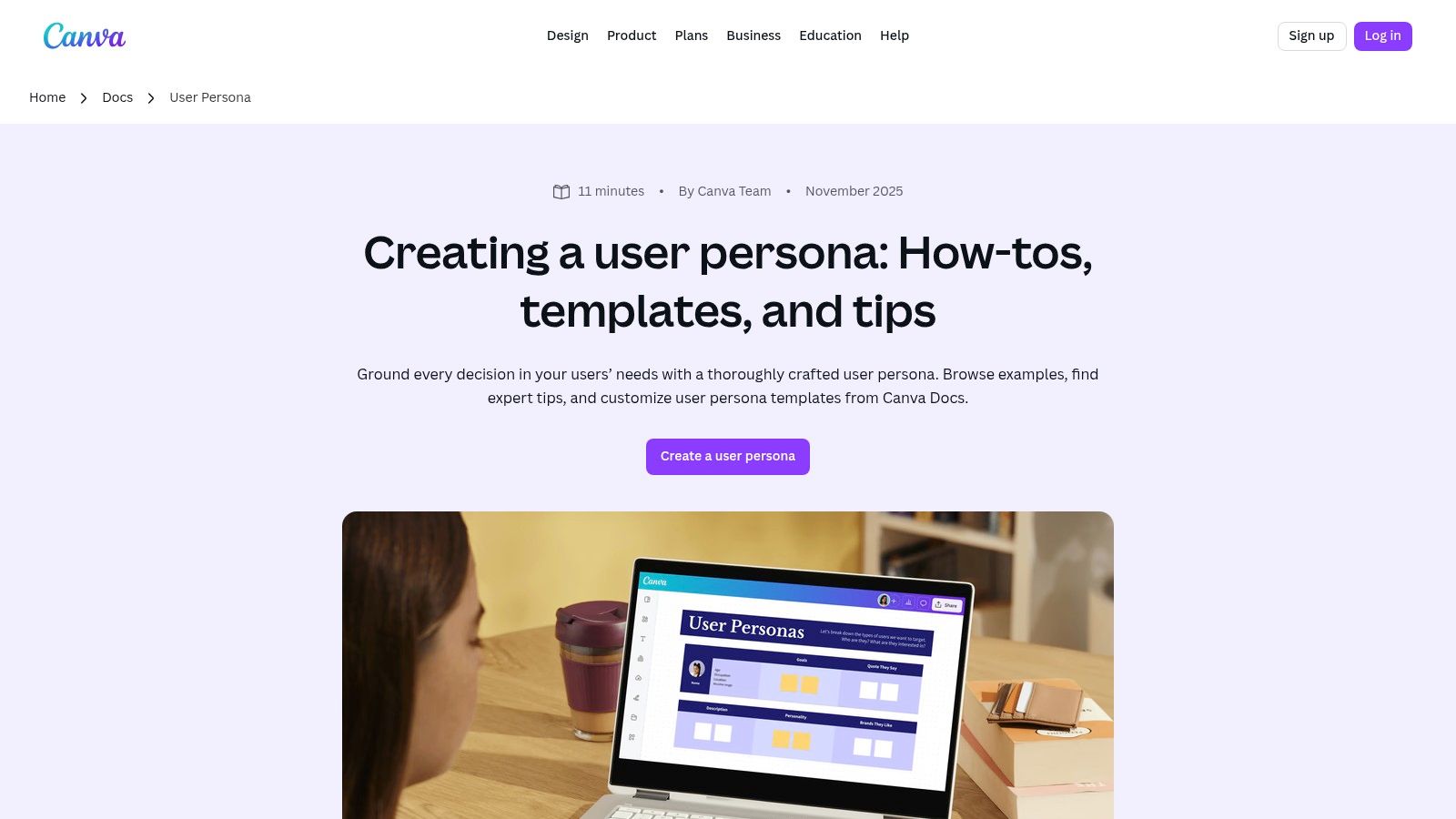 Canva's visual templates are ideal for stakeholder-facing ICP documents.
Best for: Marketing teams creating visual internal documents Access: Free tier available; premium features require Canva Pro Website: Canva User Persona Templates
9. Etsy
An unexpected but practical resource. Independent creators sell low-cost ($2–$15) ICP and buyer persona workbooks, many designed for Canva.
Best for: Budget-conscious teams needing presentation-ready templates Access: One-time purchase, instant digital download
10. Gumroad (ICP Operator — Notion Template)
A process-driven Notion workspace that transforms ICP building from a one-off task into an ongoing system. Includes interview management with suggested questions and visual summaries.
Best for: Startups running the full ICP discovery process in Notion Access: One-time purchase; requires Notion account Website: ICP Operator on Gumroad
11. NimbleGot (ICP & Messaging Lab)
A free Notion workspace that connects ICP definition directly to messaging experiments. Features a research log, JTBD panel, and messaging board.
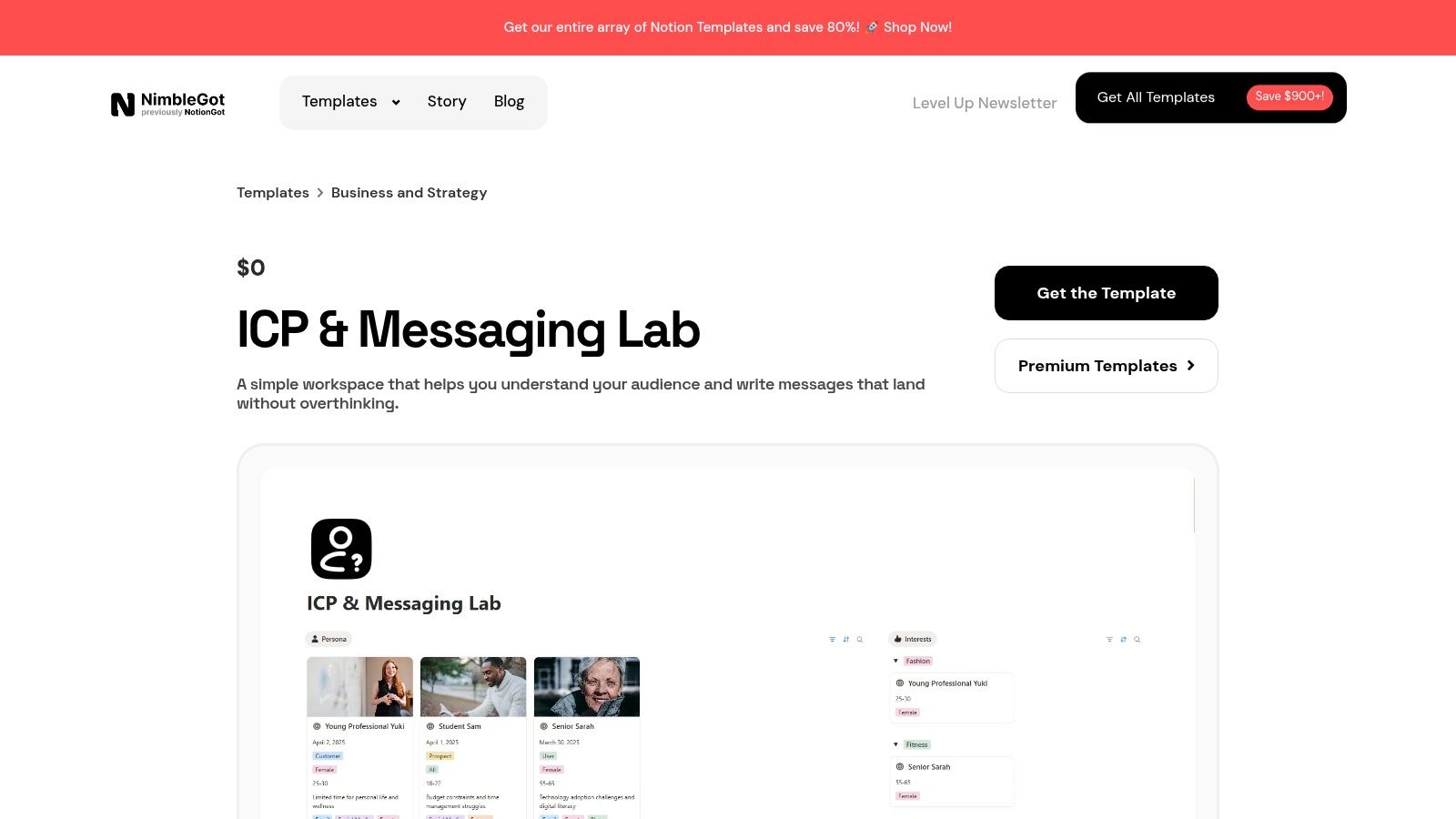 NimbleGot links ICP research directly to copywriting experiments.
Best for: Teams A/B testing messaging alongside ICP refinement Access: Free; requires Notion account Website: NimbleGot Free ICP & Messaging Lab
12. Salesforce
A comprehensive guide covering ICP fundamentals, the distinction between ICP and buyer personas, and practical activation advice. Not a template itself, but an essential primer.
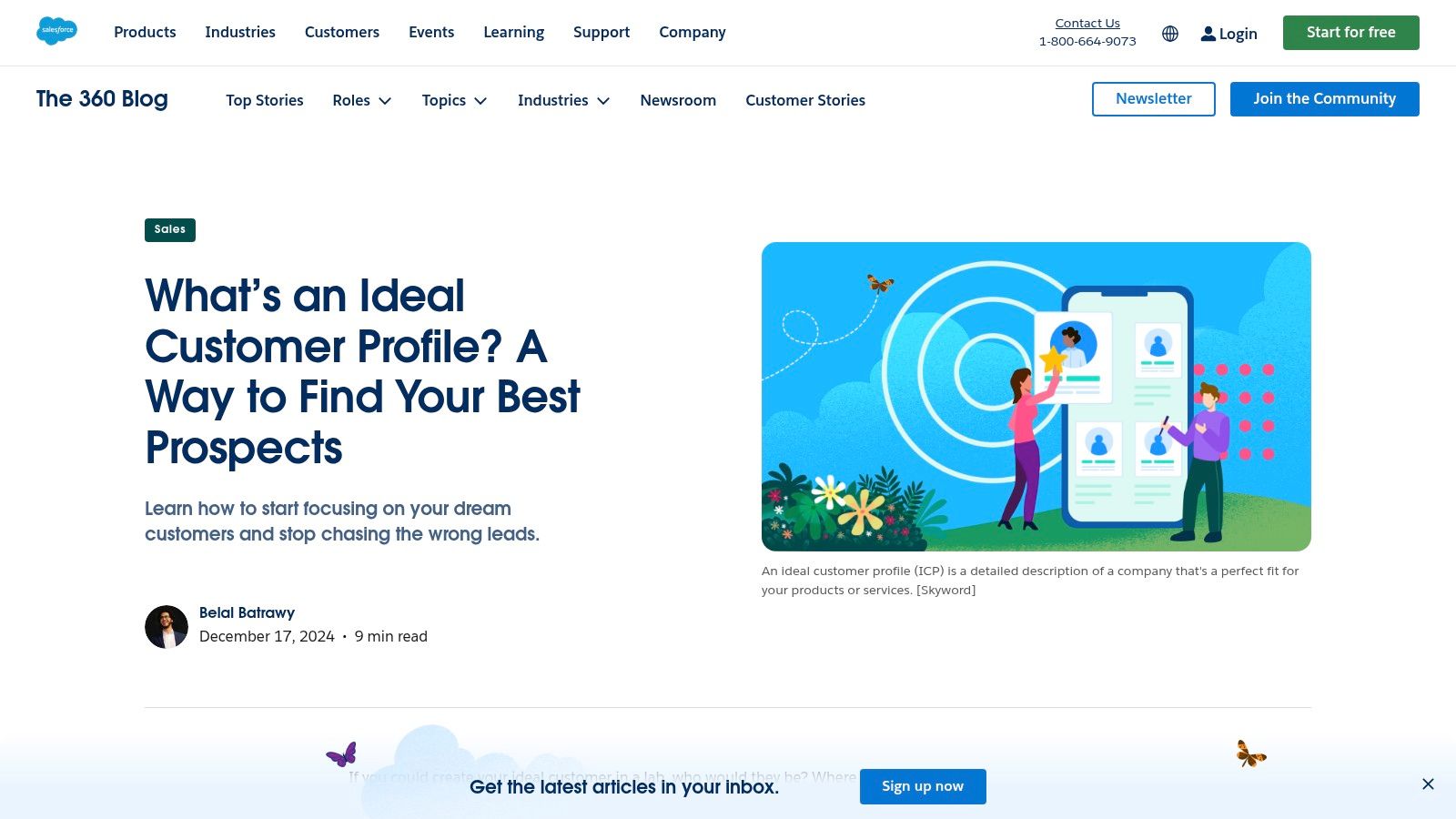 Salesforce's guide is an excellent training resource for GTM alignment.
Best for: Enterprise GTM leaders aligning cross-functional teams Access: Free, no sign-up required Website: Salesforce ICP Guide
ICP Templates Compared
| Tool | Format | Best For | Price |
|---|---|---|---|
| Miro | Online whiteboard | Remote workshops | Free plan |
| Notion Marketplace | Database templates | Notion-centric teams | Free & paid |
| Asana | Project template | Task-driven teams | Free plan |
| HubSpot (Ebook) | Guide + worksheet | Education + activation | Free (gated) |
| HubSpot (8 Templates) | PPT / Google Docs | Presentations | Free (gated) |
| Pipedrive | Downloadable file | Sales teams | Free (gated) |
| Smartsheet | Excel / PPT + scorecard | Spreadsheet teams | Free |
| Canva | Visual editor | Marketing teams | Free tier |
| Etsy | PDF / Canva files | Budget teams | $2–$15 |
| Gumroad (ICP Operator) | Notion workspace | Process-driven teams | Paid |
| NimbleGot | Notion workspace | Messaging experiments | Free |
| Salesforce | Web guide | Training + alignment | Free |
Key Takeaways
- An ICP without a scoring rubric is a wish list. A scoring rubric turns subjective fit judgments into a repeatable, data-backed prioritization system.
- Start with closed-won deal analysis. The attributes of your best customers are the foundation of every scoring criterion.
- Use the right level of complexity: a 100-point scale for data-rich teams, a tier model for smaller teams, and a weighted formula when certain criteria matter disproportionately.
- Validate quarterly. Tier A accounts should convert at 1.5–2x the rate of Tier B with 15–20% shorter cycle times. If they do not, adjust your weights.
- Choose a template format that matches your team's workflow — whiteboards for brainstorming, databases for daily use, spreadsheets for scoring, and slide decks for stakeholder alignment.
- Integrate buying signals and trigger events into your rubric to surface accounts that are not just a good fit but are actively ready for a conversation.
From Wish List to Prioritized Pipeline
Building an ideal customer profile scoring rubric transforms your ICP from a theoretical exercise into the most practical tool in your sales stack. When your team can look at an account and immediately see a score that reflects fit, intent, and timing, the guesswork disappears. Reps spend their mornings on Tier A accounts instead of alphabetically working through a territory list.
The templates in this guide give you the format. The scoring rubric framework gives you the engine. Combined, they create a system where every account in your pipeline has a clear priority level, every rep knows where to focus, and your account-based selling motion runs on data instead of intuition.
Frequently Asked Questions
What is an ideal customer profile scoring rubric?
An ICP scoring rubric is a quantified framework that assigns point values to the attributes defining your best-fit accounts — firmographics, technographics, behavioral signals, and timing indicators. Each prospect account is scored against these criteria and placed into a tier (A, B, or C) that determines how much outbound effort it receives.
How is ICP scoring different from lead scoring?
ICP scoring evaluates the account (company) on structural fit before any engagement happens. Lead scoring evaluates individual contacts based on behavioral signals like email opens and page visits. ICP scoring decides which companies to pursue; lead scoring decides which people within those companies are ready for outreach.
How many criteria should an ICP scoring rubric have?
Most effective rubrics use 8–15 criteria across four categories: firmographics, technographics, behavioral signals, and trigger events. Fewer than 8 criteria usually means you are not differentiating enough between accounts. More than 15 typically adds complexity without improving prediction accuracy.
How often should we update our scoring rubric?
Review your rubric quarterly by comparing win rates, deal sizes, and cycle times across tiers. If Tier A accounts are not meaningfully outperforming Tier B, adjust your criteria or weights. Major changes — entering a new market, launching a new product, or a shift in competitive landscape — should trigger an immediate review.
Can we use the same rubric for different products or segments?
You can share the framework but should adjust criteria and weights per segment. A mid-market product and an enterprise product likely have different ideal company sizes, tech stack requirements, and buying signals. Create a separate rubric for each major segment and prioritize them by revenue potential.
What tools can automate ICP scoring?
CRM platforms like Salesforce and HubSpot support basic scoring rules. Dedicated platforms like Salesmotion combine firmographic data, technographic intelligence, and real-time buying signals to automatically score and tier accounts, eliminating the manual spreadsheet work.
Ready to stop guessing which accounts to call first? Salesmotion automatically scores and prioritizes accounts using real-time buying signals, firmographic fit, and intent data — turning your ICP from a document into a live targeting engine. Book a demo to see your accounts ranked by actual readiness to buy.