Most sellers approach IT services firms the wrong way. They see giant logos, assume giant budgets, and lead with efficiency. That misses the commercial reality.
The global IT services market was valued at USD 1.43 trillion in 2025 and is projected to reach USD 2.64 trillion by 2034, implying a 7.10% CAGR according to Fortune Business Insights on the IT services market. Big market, obvious opportunity. But that scale creates a trap. Vendors assume firms like Capgemini, Infosys, Wipro, Tech Mahindra, and WNS will buy like software companies. They usually don't.
They buy like operators. They look at delivery risk, utilization, practice growth, client expansion, procurement control, and whether your tool can help them win or retain revenue. If your pitch is just "we save your team time," you're asking them to spend money so their people can work a bit faster. That's rarely enough.
The offers that get traction are tied to revenue creation. Better targeting. Better presales focus. Better account selection. Better timing. Better conversion on deals already in motion. One IT services customer we work with closed $570M in deals last year after bringing more trigger-led discipline to how they targeted accounts and prioritized outreach. The point isn't the logo. The point is the mechanism. Revenue teams in this sector respond when you help them turn noise into commercial action.
The Trillion-Dollar Industry That Runs on Pennies
IT services is a huge market with a small-margin operating model. If your pitch does not connect to revenue, deal quality, or client growth, it usually stalls.
That is the mistake sellers make with this vertical. They see global headcount, recognizable logos, and broad service lines, then assume there is room for another tool that saves a few hours a week. Inside the account, buyers are judging something else. They want to know whether your product helps them win work, package services more effectively, expand existing clients, or reduce risk in live pursuits.
Why efficiency pitches often stall
A standard SaaS message sounds reasonable on paper:
- Save time for your team
- Automate manual work
- Improve internal productivity
- Reduce admin burden
Those points matter, but they rarely carry the deal on their own in IT services. A services firm monetizes billable expertise, delivery confidence, and account growth. Buyers will ask whether the time saved turns into better pursuit selection, stronger proposals, faster expansion inside named accounts, or more revenue per seller and presales resource.
Practical rule: If your value story ends at "time saved," it probably dies in procurement.
Use efficiency as supporting evidence. Lead with commercial outcomes. A presales manager may care that your platform cuts research time. The budget owner is more likely to care that the same change lets the team focus on accounts with an active reason to buy, which is exactly the logic behind using professional services buying signals to prioritize outreach.
What buyers are really pressure-testing
In this sector, every purchase gets screened through a few hard questions.
| What they're assessing | What they mean |
|---|---|
| Revenue contribution | Will this help us create pipeline, improve win rates, expand accounts, or support larger deals? |
| Margin protection | Does this improve utilization, reduce wasted presales effort, or sharpen how we scope and deliver work? |
| Client impact | Will this strengthen delivery confidence, retention, or our position in strategic accounts? |
| Practice relevance | Does this help a vertical, geography, or capability team hit its own number? |
This is why generic productivity language underperforms. Buyers in IT services are usually carrying a number, supporting someone who is, or defending margin in a business where both are under pressure.
They buy through a commercial lens
Software companies often approve tools because they improve an internal workflow. IT services firms usually evaluate tools based on how they affect selling, scoping, delivery, and account expansion. That difference changes the whole sales motion.
A stronger opening sounds like this:
| Weak framing | Strong framing |
|---|---|
| We help your reps save time researching accounts | We help your team focus on accounts where a service conversation already has a credible reason to start |
| We automate outbound | We help sales and presales teams prioritize accounts showing active expansion, delivery, or leadership change signals |
| We improve productivity | We improve commercial focus so teams spend less effort on low-probability pursuits |
Large contract values do not make these firms easy buyers. They make them disciplined buyers. Sellers who understand that early can shape the conversation around top-line impact, which is where real traction starts.
See Salesmotion in action
Take a self-guided interactive tour — no signup required.
How IT Services Giants Actually Buy
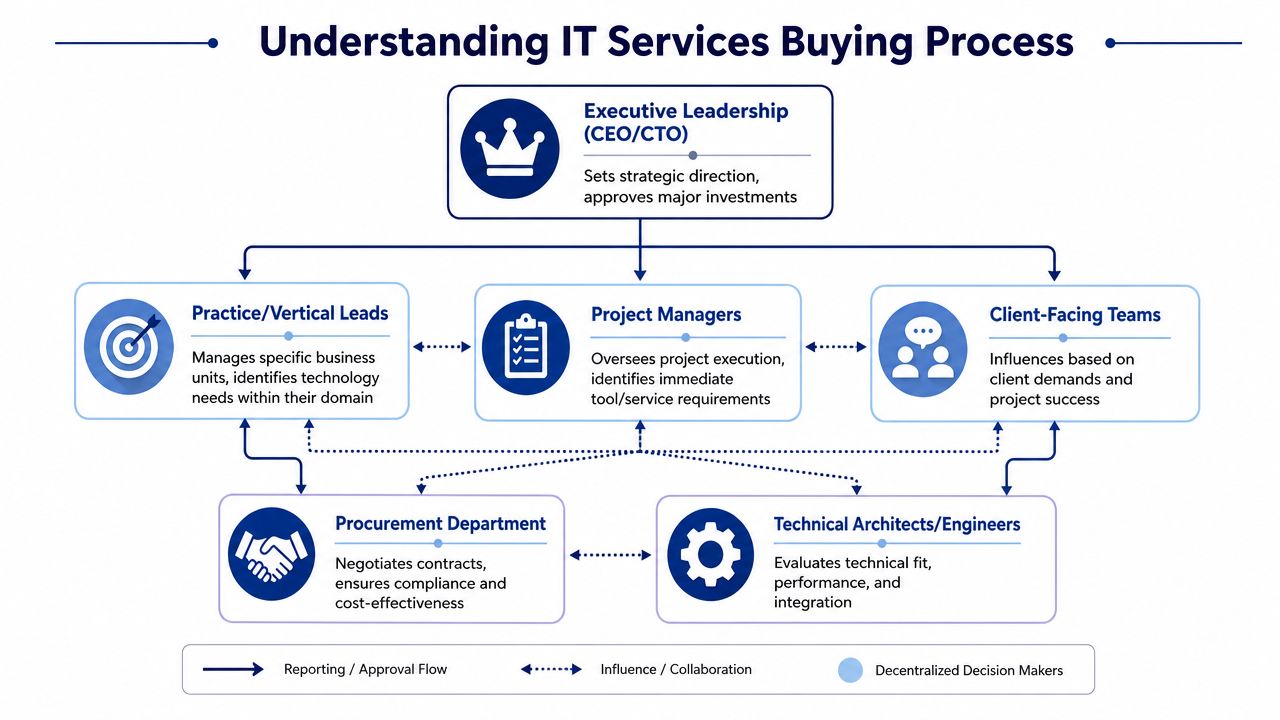
Buying power in large IT services firms is fragmented across vertical heads, practice leads, regional leaders, and procurement. That is why a deal can look alive in one meeting and stall in the next.
One sponsor is never enough here. The person who feels the pain is often not the person who can approve budget, and the person who owns budget may still need procurement, security, or a regional leader to sign off. If you sell as though there is a single buying center, you lose control of the deal early.
A cloud practice lead may want your product because it helps the team qualify and shape larger deals. A regional P&L owner may ask why that budget should come from their market. Procurement may question overlap with an existing sales or delivery tool. The technical team may support the use case but slow things down until integrations and user rollout are clear.
The cast of characters
The fastest way to read these accounts is by who owns revenue, who owns delivery, and who owns spend control.
Vertical heads carry an industry number. Banking, healthcare, telecom, retail. They care about whether your product helps their teams get into better accounts, expand existing clients, and support a stronger point of view in that market.
Practice leads own a capability business. Cloud, data, cybersecurity, AI, managed services. They will ask whether your product helps package offerings, improve pursuit quality, and create more billable work for the practice. That last point matters. In this sector, a tool that saves effort but does not help create revenue usually gets pushed down the list.
Presales managers often become the first real champion because they see the waste up close. They deal with poor qualification, repeated account research, weak handoffs, and proposal support spent on deals that should never have advanced.
Central procurement gets involved once the purchase reaches a threshold or touches a controlled category. Their job is to reduce vendor sprawl, contain contract risk, and test whether the business case survives scrutiny.
Why procurement gets pulled in early
These firms are large, but the economics are tighter than many sellers expect. Public market reporting and 2025 outlooks across the services sector showed continued pressure on utilization, pricing discipline, and margins. That pushes buying teams to ask a harder question than "Will people use it?" They ask, "Will this help us win more work, protect existing revenue, or improve delivery economics enough to matter?"
That is the buying sequence in many enterprise services accounts:
- An operating leader sees a use case
- A practice or region asks for a pilot
- Procurement tests whether another approved tool can cover it
- The deal slows if the commercial upside is vague
This is why efficiency-only messaging keeps running into friction. Saving time is helpful. Creating more qualified pipeline, better account expansion, or stronger presales coverage is easier to defend.
What works with each stakeholder
Different stakeholders need different proof, but the story has to stay commercially consistent.
- For vertical heads: show how the product helps teams target accounts with a real reason to buy, respond faster to client changes, and support account growth.
- For practice leads: tie the value to more service revenue, better pursuit selection, and stronger packaging of the practice's offers.
- For presales managers: make the operational pain concrete. Rework, duplicated research, poor timing, weak account context, and expensive support on low-probability deals.
- For procurement: define the scope tightly. Named users, clear workflow, clear overlap analysis, pilot terms, and a measurable business outcome.
Use multithreading early. Build your champion in the function that feels the pain, then line up the revenue owner who benefits and the operator who can validate rollout. Bring procurement in after the business case is sharp, not before.
For teams mapping those internal pressure points, this guide to professional services buying signals is useful because it connects external triggers to the stakeholders most likely to care.
Deals in this vertical usually stall because the seller proved usefulness to one team and never proved revenue impact to the rest.

“Salesmotion empowers me to cultivate a great buyer experience. I'm able to challenge prospects' thinking and be a trusted consultative seller. A major part of this is Salesmotion insights.”
Austin Friesen
Account Executive, FY25 #1 President's Club, Clari
Finding Your Why Now with Buying Signals
Cold outreach into a huge IT services firm fails for a simple reason. The account may be attractive, but there isn't a reason for them to care today.
You need a trigger. Not vague "interest." A concrete event that changes priorities.
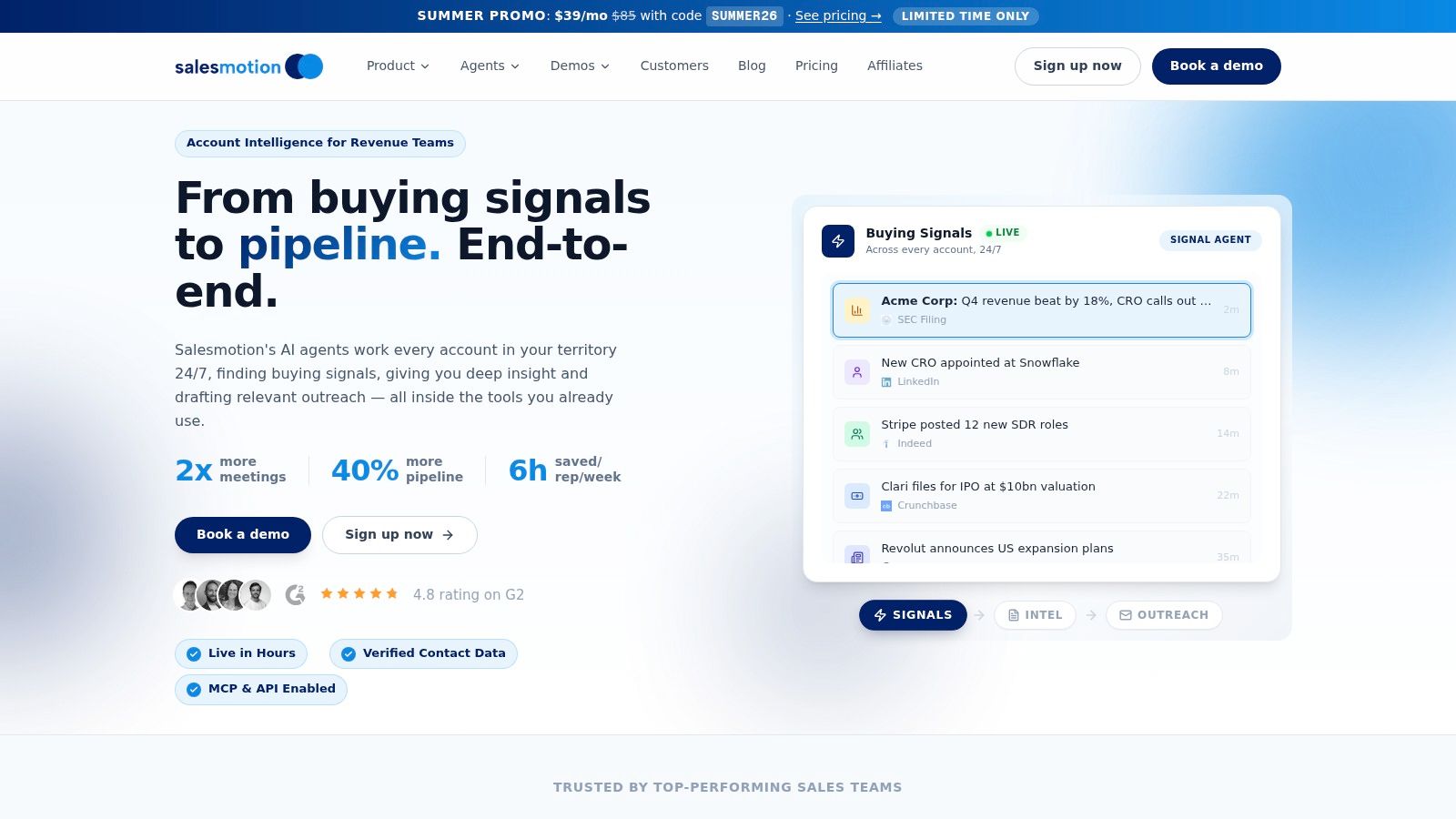
The most useful signals in this sector aren't random news mentions. They're commercial or operating changes that create fresh pressure on delivery, targeting, or practice growth.
The signals worth acting on
The best signals usually look like one of these patterns.
- A major client win: A new enterprise logo often creates immediate need around delivery readiness, account research, expansion mapping, or presales support.
- A new practice launch: If a firm launches a cloud modernization, AI, cybersecurity, or industry-specific offering, the team suddenly needs sharper targeting and messaging.
- Geographic expansion: New market entry creates pressure to prioritize local accounts, understand regional buyers, and avoid broad, generic prospecting.
- Leadership change in delivery or presales: New leaders often revisit process, tooling, and team discipline. They may inherit pipeline problems they want to fix quickly.
The mistake is stopping at "interesting news." The win comes from translating the event into a point of view.
Turn each signal into a sales action
In this scenario, teams either get sharper or stay noisy.
If an IT services company announces a new healthcare practice, don't send a message saying congratulations and ask for time. Send a note that connects the expansion to account selection, presales load, and the need to find live transformation triggers inside target healthcare accounts.
If they hire a new regional delivery leader, don't pitch broad automation. Lead with how new leaders often want better visibility into where commercial effort is being wasted and which accounts justify deeper pursuit.
A simple way to structure this is:
| Signal | What it usually means | What you should do |
|---|---|---|
| New client win | Delivery and expansion pressure just increased | Reach out with a view on account expansion, related buying centers, and adjacent opportunities |
| Practice area expansion | The team needs pipeline in a new offer area | Speak to targeting, market mapping, and faster identification of relevant accounts |
| Geographic expansion | New territory needs account prioritization | Focus on regional account intelligence and signal-led outreach |
| New presales or delivery leader | Process and tool choices may be reviewed | Position around discipline, visibility, and better resource focus |
For teams that want a deeper framework, this buying signals guide is useful because it helps separate general account activity from real reasons to engage.
A trigger isn't the pitch. It's the permission to make a relevant pitch.
One practical note. In this vertical, timing decays fast. A practice launch or leadership change is most useful when you reach out with a clear commercial implication, not after the market has already flooded the buyer with generic notes.
Building Your Land and Expand Game Plan
Trying to sell enterprise-wide into a global IT services firm from the outside is usually a waste of cycles. The organization is too distributed, too political, and too cautious for a top-down first deal unless there's already internal momentum.
A better play is to land inside one practice, one region, or one vertical where the pain is active and visible.

Start where the need is easiest to prove
Bain's analysis is useful here because it highlights a core truth about services businesses. They buy to improve service delivery, not just to consume software. That means vendors need to align with operating realities such as delivery quality, gross margins, and employee utilization, as discussed in Bain's analysis of underserved service markets.
That's exactly why the first deal should be narrow.
Pick a practice where one of these conditions is true:
- A new offer needs pipeline
- A team is wasting presales effort on weak-fit accounts
- A regional group needs better targeting discipline
- A leader has the authority to run a contained rollout
The first win shouldn't require organizational consensus across the whole company. It should require one sponsor with a visible problem and a reason to move.
What a good first engagement looks like
Don't frame the first deal as digital transformation for the entire account base. Frame it as a focused commercial improvement.
For example:
- Cloud practice pilot: Improve identification of accounts showing cloud migration, modernization, or partner ecosystem movement.
- Healthcare vertical rollout: Prioritize accounts with live regulatory, AI, or delivery triggers that justify a service conversation.
- Presales team deployment: Standardize account research and trigger detection before solutioning effort gets committed.
The internal story matters as much as the initial result. Your first buyer needs to be able to say, "This helped us focus on accounts we had a reason to pursue," not just, "The team liked the tool."
That creates the expansion path.
Expand sideways, not abstractly
Once one group gets value, don't jump straight to "global rollout." Expand to the next adjacent motion.
A simple sequence often looks like this:
- Land in one practice
- Prove relevance in a live commercial workflow
- Capture the internal language your sponsor uses to describe the value
- Take that language to a neighboring practice or region
- Standardize only after multiple groups can point to the same business case
If you're building a structured expansion motion after the initial win, this account expansion playbook is a useful model for identifying where momentum is strongest.
The key in selling to IT services companies is restraint. Don't oversell the first deal. Make it easy to buy, easy to use, and easy for an internal champion to defend.

“We have very limited bandwidth, but Salesmotion was up and running in days. The template made it easy to load our accounts and embedding it in Salesforce was simple. It was one of the easiest rollouts we've done.”
Andrew Giordano
VP of Global Commercial Operations, Analytic Partners
Your Trigger-Led Outreach Sequence in Action
Once you've identified the right practice and the right signal, the next question is simple. What do you send?
Generic personalization remains a common default, with the company name and perhaps the role mentioned before asking for a meeting. That's not relevance. That's formatting.
A stronger sequence starts with a specific commercial event and builds from it with purpose.
The before and after
Let's say a target account launches a new AI-focused healthcare practice.
A weak email sounds like this:
Hi [Name], I saw your company is growing in healthcare AI. We help enterprise teams improve sales productivity and would love to show you our platform. Are you open next week?
There's no point of view. No operational implication. No reason this person should care.
A better version sounds more like this:
Hi [Name], saw the launch of your AI healthcare practice. When firms build a new offer like this, presales teams usually get pulled into broad pursuit work before the market is qualified properly. We've been working on ways to surface account-level triggers that show where a healthcare AI conversation is most likely to land, so teams spend less effort on low-probability pursuits. If useful, I can share a few examples of the signals we'd prioritize first.
That message works because it does three things:
- References a real trigger
- Names a likely operating problem
- Offers a relevant next step instead of a generic demo
A practical sequence
Organizations with a clearly defined sales process see up to a 28% uplift in sales productivity, according to this review of defined sales process performance. For this vertical, that matters because outreach needs stage discipline, not just good copy.
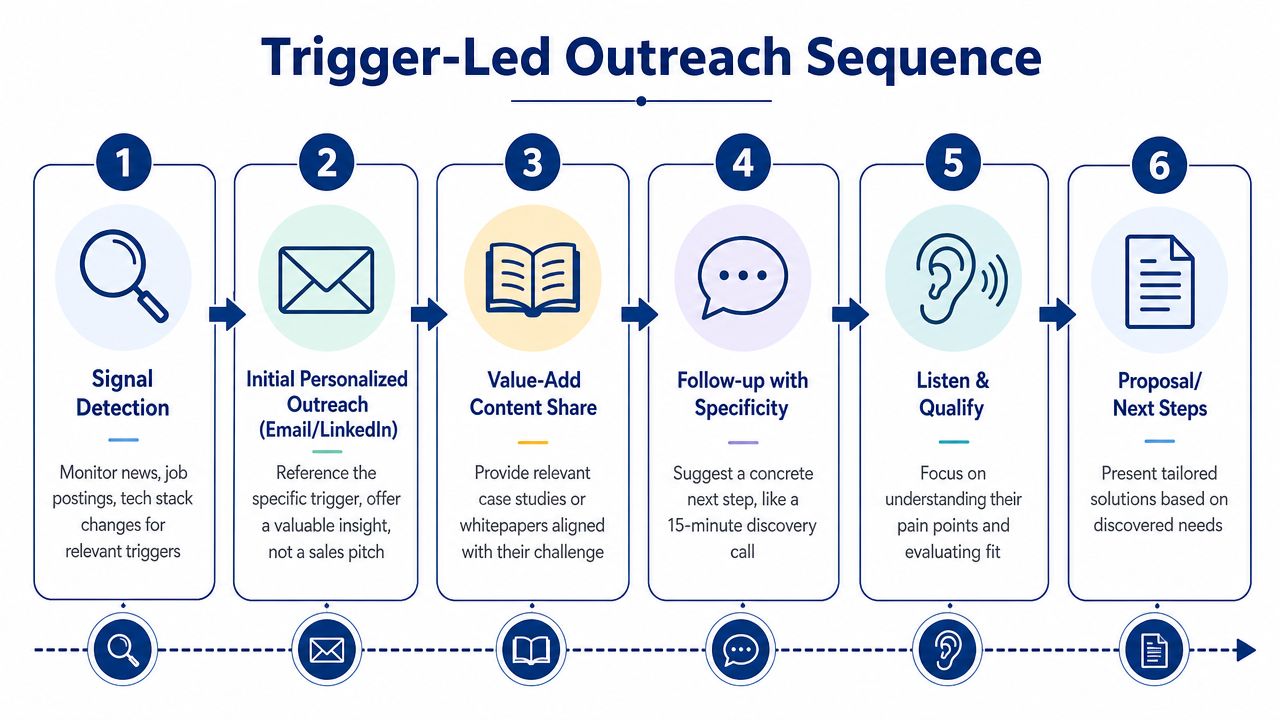
A workable sequence looks like this:
-
Trigger-based first touch
Email or LinkedIn note tied to the live event and one plausible commercial implication. -
Follow-up with a sharper hypothesis
Bring one level more specificity. Mention likely account selection issues, presales load, or expansion targeting. -
Share a lightweight artifact
This could be a short account view, a signal snapshot, or a proposed way to prioritize target accounts. One option teams use for this kind of workflow is Salesmotion, which combines account research, trigger monitoring, and sequence drafting around target accounts. -
Ask a narrow question
Not "Do you want a demo?" Ask whether the team is currently centralizing account selection for the new practice or leaving it distributed across sellers. -
Qualify based on operating fit
If the buyer only wants generic automation, you may not have a real opportunity. If they care about prioritization, coverage, and commercial discipline, keep going.
If you want examples of how teams structure this kind of sequence, these sales cadence templates can help.
Good outreach doesn't sound personalized. It sounds informed.
Proving Revenue Impact Not Just Efficiency
This section decides whether the deal moves forward or stalls.
The buyer asks for the business case. If the answer stays at saved hours, faster research, or less admin, the conversation gets downgraded to discretionary software spend. In IT services, that is a bad place to be. Margins are tight, utilization matters, and every new tool gets tested against one question: will this help us win more revenue, protect delivery economics, or both?
Build the business case around commercial outcomes
Frame the value the way they frame value with their own clients. Start with the commercial problem. Then connect your offer to an outcome a practice leader, presales leader, or regional seller can defend internally.
Applied to this vertical, the message should sound like this:
| Weak business case | Strong business case |
|---|---|
| We reduce account research time | We help teams focus research on accounts with a live reason to buy |
| We improve rep efficiency | We improve how presales and account teams prioritize coverage |
| We automate outreach | We help sellers enter conversations when new demand, expansion, or leadership change creates an opening |
That shift matters because better targeting changes pipeline quality. It also changes where scarce presales time gets spent, which has direct impact on pursuit capacity and revenue production.
A strong buyer will press on proof. Be ready for that.
Use their own commercial logic
These firms already know how to sell outcomes. Use the same structure back to them.
If a presales leader says the team burns cycles on broad pursuits, tie your case to earlier qualification and fewer low-probability bids. If a practice lead says a new offer needs traction, tie your case to selecting the right accounts and finding demand sooner. If procurement says budget is tight, keep the first step contained. One practice, one motion, one measurable revenue hypothesis.
The client example matters here. One IT services customer closed a large volume of business after putting trigger-led discipline into targeting. The point is not to claim your product created every dollar. The point is to show that disciplined account selection belongs inside a serious revenue engine.
Handle the common objections cleanly
A few objections show up again and again.
-
We can build this ourselves
Maybe they can. The question is whether they will maintain signal detection, prioritization logic, workflow design, and rep adoption with enough consistency to change commercial outcomes. -
This isn't in budget
Narrow the ask. Propose a pilot tied to one team and one revenue-facing use case, with clear success criteria before expansion. -
We already have sales tools
That is normal in this vertical. What matters is whether those tools help sellers act on a credible buying signal, or just create another layer of data for the team to sort through.
Keep the frame tight. Feature comparisons slow deals down. Commercial impact gives the buyer something they can defend in front of finance, procurement, and operating leadership.
Start Selling to IT Services the Right Way
Winning in this vertical doesn't come from a broader feature list. It comes from using a playbook that matches how these firms operate.
The pattern is straightforward.
Understand the operating model
These are large organizations with meaningful budgets, but they don't spend casually. Decisions are distributed. Procurement gets involved early. Internal buyers care about service delivery, practice growth, and whether a purchase can survive commercial scrutiny.
That means your deal strategy has to match the structure of the account. Multi-thread early. Expect conflicting incentives. Keep the first use case narrow enough that one sponsor can own it.
Find the trigger
The hardest part of selling to IT services companies isn't getting a contact. It's having a credible reason to start the conversation.
The signals that matter are the ones that change commercial reality. New client wins. Practice launches. Regional expansion. Leadership changes in delivery or presales. Those moments create pressure, and pressure creates urgency.
Without that why now, even strong messaging feels interruptive.
Prove the revenue story
This is an area often undersold. In this sector, a time-saving story rarely carries enough weight on its own. The stronger case is always tied to revenue creation, account prioritization, better use of presales effort, or faster identification of real demand.
Start with one practice. Prove the value in a live workflow. Use that result to expand sideways into adjacent teams. That's how these firms buy. Cautiously at first, then pragmatically once the internal evidence is there.
If you're serious about building this motion, Salesmotion is built for exactly that workflow. The platform researches target accounts, tracks live buying signals, and turns those signals into actionable outreach so reps can work from real context instead of guesswork. If you want to see how that looks on your target list, book a demo and the team will come prepared with your accounts already researched and active signals ready to discuss.