
Pipeline visibility is the ability to answer three questions about any deal without guessing: what is happening in the deal, what changed at the account, and what those changes do to deal health right now. A clean CRM covers the first question. The other two depend on signals from outside the CRM.
TL;DR: Pipeline visibility is a signal problem, not a CRM hygiene problem. Read six metrics together (pipeline coverage ratio, velocity, stage conversion, deal aging, engagement scoring, and forecast accuracy) and check them against external account signals such as executive moves, hiring changes, funding, and reorganizations. Fix the gaps across people, process, data, and technology, and add one question to every forecast call: what changed at the account?
You're probably living this right now.
It's Monday. The board wants the quarter forecast. Your sales managers say pipeline looks solid. Your CRM says stage progression is fine. Then three “committed” deals slip, one expansion goes quiet, and a rep tells you the buyer is “still interested” even though nobody at the account has replied in two weeks.
That's not a pipeline problem. That's a visibility problem.
Most revenue leaders don't lack dashboards. They lack confidence. They can see rows in Salesforce, HubSpot, or whatever CRM they run. What they can't see clearly is whether those rows reflect reality. Worse, they can't see the changes happening outside the CRM that determine whether a deal moves, stalls, or dies.
I've seen this pattern enough times to be blunt. A clean CRM is necessary, but it's nowhere close to sufficient. If your view of pipeline starts and ends with stage, amount, and close date, you're managing a lagging artifact of rep activity, not the live buying environment.
The End of Flying Blind
Monday, 8:00 a.m. The forecast call starts in an hour. Your CRM says coverage is fine, stage progression looks healthy, and the commit number holds together on paper. Then a manager mentions the buyer's champion left last week, a “late-stage” account just froze hiring, and procurement has gone quiet because budget approval slipped to next quarter.
That is how revenue teams miss the quarter with a full dashboard.
Flying blind does not mean you lack reports. It means your reports stop at rep-entered data while actual decision signals sit outside the CRM. The problem is not visibility into fields. The problem is visibility into change.
That distinction matters. A deal can look clean in Salesforce and still be deteriorating fast. A close date can stay untouched while the account loses urgency. A rep can log activity while the buying committee shrinks, a new CFO steps in, or a competitor gains ground. If your team cannot connect those external signals to deal health, your forecast is built on stale evidence.
This is why pipeline visibility belongs in the same conversation as revenue intelligence. You are not trying to collect cleaner records. You are trying to detect what is happening in the market, inside target accounts, and across active deals before the miss shows up in the forecast.
Why the old playbook breaks
Traditional pipeline management treats the CRM like the truth. It is a record of what your team entered, when they entered it, and how they classified the deal. Useful, yes. Sufficient, no.
Buyers do not make decisions inside your stage model. Priorities shift. Headcount gets cut. New executives reset initiatives. Legal review stalls because the internal sponsor lost influence. Those events change deal quality long before a rep updates the opportunity.
Poor visibility shows up as false confidence. The quarter looks stable until it suddenly does not.
What good leaders do differently
Strong revenue leaders inspect pipeline as a signal system, not a spreadsheet exercise. They push managers to test deal health against what is happening at the account, not just what is written in the notes.
They ask questions like:
- What changed at this account in the last 14 days?
- Does the buyer's situation still support this timeline, budget, and priority?
- Are we seeing signal strength improve or decay across stakeholders, activity quality, and account-level events?
- Which deals look healthy in CRM but weak in the market?
That shift changes forecasting fast. Managers stop debating opinions. Reps stop hiding behind stage names. Leadership gets a clearer read on which deals are real, which ones are slipping, and which accounts need immediate attention.
See Salesmotion in action
Take a self-guided interactive tour — no signup required.
What Pipeline Visibility Really Means
Pipeline visibility gets misdiagnosed all the time.
Sales leaders call it a CRM discipline problem because that is the part they can see. Fields are missing. Stages are sloppy. Close dates drift. Managers chase updates, and the pipeline review turns into admin work.
That is not the full problem. It is a signal problem.
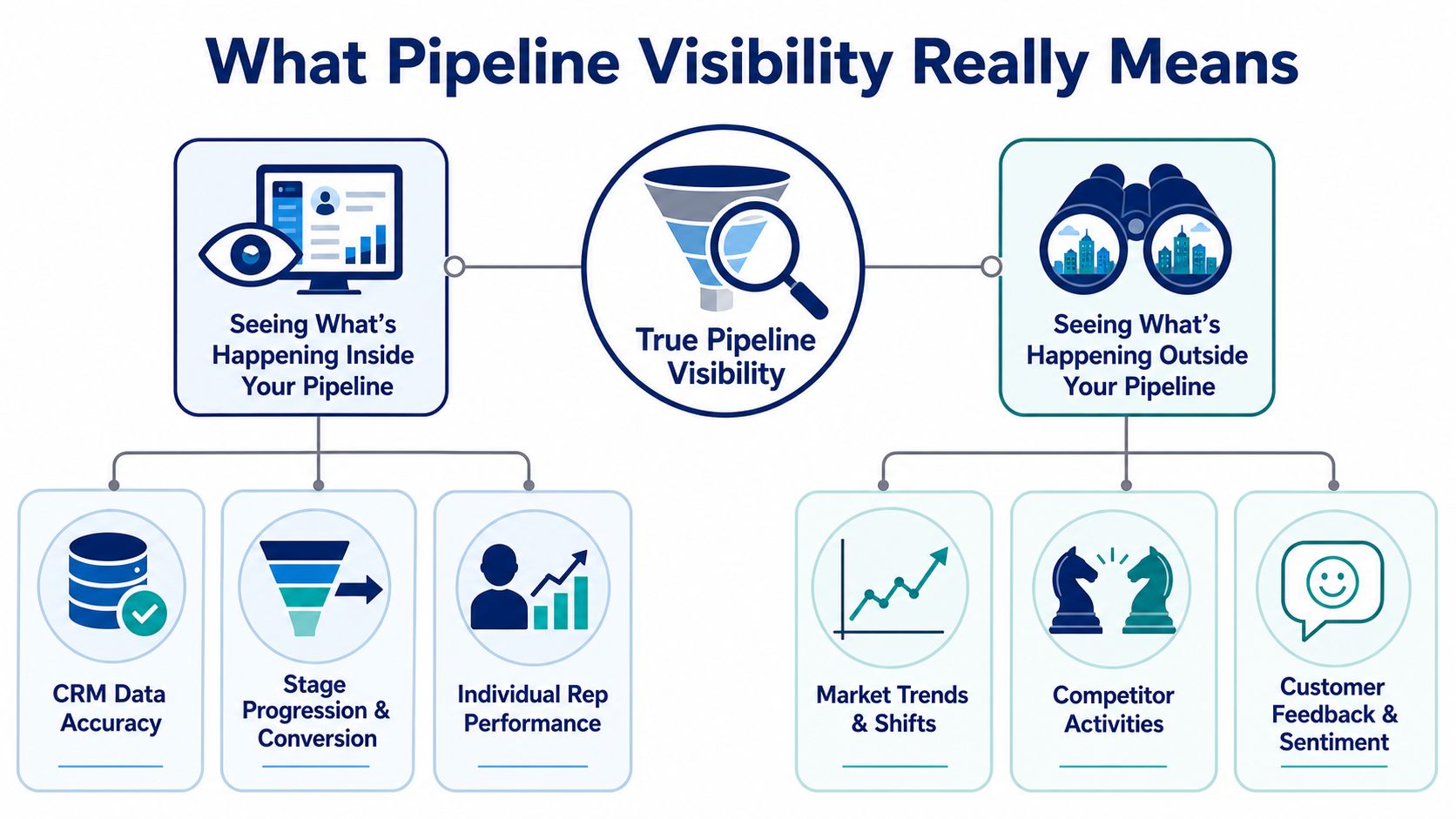
A clean CRM shows what your team recorded. Real visibility shows what is changing around the deal, whether the rep captured it or not. If a prospect freezes hiring, replaces a VP, or gets pressure from investors to cut spend, deal risk changes before stage movement shows up in Salesforce.
That is why pipeline visibility has two jobs.
First, you need a trustworthy read on what is happening inside the pipeline. Stage progression, deal size, activity quality, stakeholder coverage, close date movement, and manager judgment all matter.
Second, you need current account context from outside the pipeline. Hiring plans, funding, executive moves, earnings comments, product launches, reorgs, legal or procurement shifts, and competitive pressure explain why a deal is speeding up, stalling, or dying.
The gap between those two views is where bad forecasts are born.
A useful frame is how revenue intelligence connects sales activity, deal data, and buying signals. The goal is not more dashboards. The goal is a working view of buyer momentum.
Dashboard versus windshield
The CRM works like a dashboard. It shows internal readings. The market around the account works like the windshield. It shows what is coming.
You need both. A rep can log a strong meeting and keep the opportunity in late stage. If the buyer just lost budget approval or brought in a new executive with a different agenda, the dashboard still looks fine while the road ahead has changed.
Teams that rely on internal fields alone confuse record accuracy with commercial reality.
Lagging records and leading signals
Internal deal data usually trails the buyer. It reflects what happened after the call, after the update, after the manager review. External signals often appear first. They show pressure building before the opportunity gets pushed out.
Use that difference to your advantage.
| Signal type | What it shows | Common examples |
|---|---|---|
| Internal deal records | What the team has already captured in the opportunity | Stage, amount, next step, pushed close date, logged activity |
| External account signals | What is changing in the buyer's business before the CRM catches up | Executive hire, hiring freeze, funding event, earnings guidance, reorganization |
This is the standard. Pipeline visibility means you can answer three questions without guessing. What is happening in the deal. What changed at the account. What those changes do to deal health right now.
If your team can see the pipeline but cannot explain buyer momentum, you do not have visibility. You have a list of opportunities.

“Salesmotion empowers me to cultivate a great buyer experience. I'm able to challenge prospects' thinking and be a trusted consultative seller. A major part of this is Salesmotion insights.”
Austin Friesen
Account Executive, FY25 #1 President's Club, Clari
The High Cost of a Foggy Pipeline
Monday forecast call. Your dashboard says the quarter is on track. By Friday, three late-stage deals slip, one goes dark, and another stalls after a new executive changes priorities. Nothing broke in the CRM. Your team just missed the signals that mattered.
That is what a foggy pipeline costs. It wrecks forecast quality, burns rep time, and lowers deal quality at the same time.
Forecast damage gets attention first because everyone feels it. Managers rebuild the number every week because stage and close date no longer mean much. Finance stops trusting the commit. The CEO starts applying a haircut to every forecast. Board discussions shift from growth strategy to credibility.
The bigger problem is decision quality.
Leaders make resource calls based on what is visible. If the only visible inputs are internal fields and rep updates, they assign people to the wrong deals, at the wrong time, for the wrong reason. A pipeline can look full while the market around those accounts is already turning against you.
That leads to predictable mistakes:
- Top reps get pulled into false positives: They spend time trying to save deals that lost momentum weeks ago.
- SEs and executives join too late: The team reacts after budget, sponsorship, or account priorities have already changed.
- Managers run admin-heavy reviews: They inspect stage hygiene instead of pressure-testing deal risk.
- Coverage gets spread across weak accounts: Reps chase every open opportunity because the team cannot separate live demand from stale pipe.
This is not a CRM cleanliness issue. It is a signal intelligence failure.
A foggy pipeline also creates a hidden tax on every seller. Reps spend hours checking LinkedIn, company news, press releases, earnings calls, and job boards just to understand whether an account still deserves attention. The work is manual, inconsistent, and usually late. By the time they piece the story together, the buyer has already moved.
You should treat that as an operating problem, not a rep habit.
The answer is not another dashboard full of internal activity. The answer is a working view that combines deal data with outside signals, then makes the implication clear. Is this account gaining urgency, losing budget, changing leadership, or reorganizing around a new priority? If you cannot answer that quickly, your team is guessing. For a practical breakdown of the internal indicators that should sit alongside those signals, use these sales pipeline metrics that actually matter.
Teams lose deals because they show up with old assumptions after the account has already changed.
Morale drops fast in this environment. Reps get blamed for weak forecasting when the system never showed the underlying risk. Managers stop trusting inspection because clean fields keep masking bad deals. Coaching gets reduced to process enforcement, even though the actual failure sits upstream.
Clean process still matters. It just does not solve the root problem. If your pipeline view cannot connect account-level market changes to deal health, you are not managing pipeline. You are managing lagging records.
The Six Metrics of a Healthy Pipeline
A pipeline can look healthy in CRM and still be headed for a miss.
That happens when leaders score pipeline as a record-keeping exercise instead of a signal intelligence problem. Internal stage updates matter, but they are incomplete on their own. Real visibility comes from reading six metrics together, then checking whether external account signals support or contradict what the CRM says. For a more tactical breakdown, see these sales pipeline metrics that actually matter.
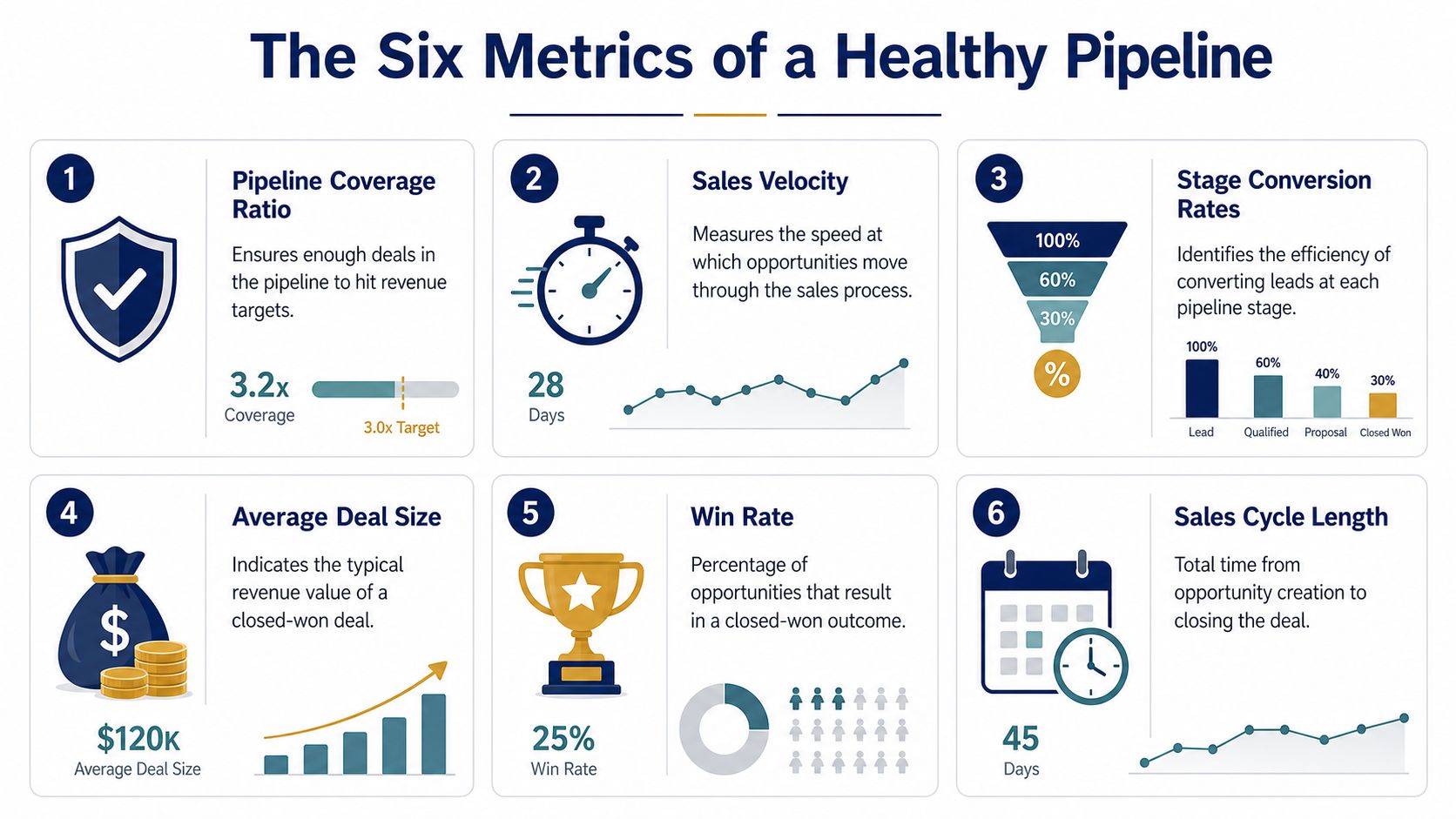
Keep the scorecard tight. Track pipeline coverage ratio, velocity, stage conversion, deal aging, engagement scoring, and forecast accuracy. Six metrics are enough if your team uses shared definitions and reviews them with discipline.
What each metric actually tells you
Pipeline coverage ratio
Coverage answers a basic question. Do you have enough qualified pipeline against target?
Leaders misuse this metric constantly. A full funnel looks reassuring, but volume without buyer momentum is just inventory. If accounts are freezing hiring, cutting teams, or changing executives, your stated coverage is weaker than it appears. Treat coverage as a starting point, not proof of health.
Velocity
Velocity shows how quickly deals move from one meaningful buying step to the next.
Watch the middle of the funnel closely. That is where weak deals lose urgency before the forecast reflects it. If velocity slows while target accounts are posting reorgs, delaying expansion, or shifting leadership, your pipeline is not just slow. It is losing relevance.
Stage conversion
Conversion rates show where deals advance and where they stall.
This metric gets more useful when you stop reading it as a pure sales process issue. If discovery converts but proposal-to-close drops, the problem may be pricing or stakeholder alignment. It may also be an external change the rep did not catch early enough, such as a new CFO, a budget reset, or a strategic shift inside the account.
The three metrics that expose false confidence
Deal aging
Aging is one of the clearest indicators of pipeline risk.
Deals sit too long for two reasons. The rep lost control, or the buyer is working through an internal process your team cannot see. External signals help you tell the difference. New job postings, funding announcements, layoffs, product launches, and executive exits often explain why a deal is stretching long before the rep says so.
Engagement scoring
Engagement scoring should measure recency, depth, and stakeholder breadth.
One active champion does not equal account commitment. You want evidence that finance, procurement, legal, security, and executive sponsors are involved when the deal size demands it. Then pressure-test that activity against market reality. Heavy email activity means less if the company just froze spend or replaced the executive who owned the initiative.
Forecast accuracy
Forecast accuracy is the credibility metric.
If the dashboard says the pipeline is healthy and the team still misses repeatedly, your operating model is broken. Either stage standards are weak, manager inspection is soft, or your team is blind to the account changes that move buying decisions.
Practical rule: never celebrate strong coverage when velocity is slowing, aging is rising, and external account signals are turning negative.
Read the combinations
Single metrics are easy to game. Combinations are harder to ignore.
- High coverage plus weak engagement: You have volume, not conviction.
- Good conversion plus poor forecast accuracy: Deals can move, but your calls on timing are unreliable.
- Strong engagement plus rising aging: The buyer is active, but approvals or priorities are stuck.
- Fast early velocity plus weak late conversion: Reps create interest but fail to build consensus.
- Healthy internal activity plus negative market signals: The CRM says green, but the account is flashing yellow.
That last combination is the one too many teams miss. A deal can have fresh notes, recent meetings, and a confident close date while the account is changing underneath it. Hiring slows. A sponsor leaves. Funding falls through. A new executive resets priorities. If your scorecard cannot absorb those signals, it will overstate pipeline health.
Use these six metrics as an operating system. Review them every week. Hold the definitions steady. Force every outlier to answer one hard question: what changed in the account that explains this number?

“We have very limited bandwidth, but Salesmotion was up and running in days. The template made it easy to load our accounts and embedding it in Salesforce was simple. It was one of the easiest rollouts we've done.”
Andrew Giordano
VP of Global Commercial Operations, Analytic Partners
Diagnosing Your Visibility Gaps
Monday morning. The forecast says two late-stage deals are on track. By Wednesday, one sponsor has left, one buyer has frozen hiring, and both deals are suddenly “at risk.” Nothing fundamental changed this week. Your team just learned the truth late.
That is the visibility problem.
Treat it like a CRM hygiene issue and you will clean fields while the pipeline stays foggy. Real diagnosis starts with a harder question. Are you missing internal deal movement, external account signals, or both?
Some gaps are operational. Managers accept weak inspection. Reps do manual research and log stale notes. Stage exits are loose. Other gaps are informational. The account changed outside your field of view, and your system had no way to catch it.
Start with the failure pattern
Weak visibility leaves fingerprints. Look for patterns, not isolated misses.
- The forecast moves late: The team is discovering buyer reality after the quarter has already absorbed the risk.
- Deals sit in stage with recycled close dates: The CRM records hope, not progress.
- Deal reviews depend on rep confidence: Managers are inspecting storytelling instead of evidence.
- Activity stays high while outcomes stay flat: The team is working, but not against the right problems in the account.
- Loss reasons arrive too late to act on: Budget shifts, leadership changes, procurement delays, and competitive pressure show up after the deal is gone.
Research drag is another giveaway. If reps spend hours hunting for account context and still miss the trigger that mattered, the issue is not effort. The issue is signal capture. This breakdown of how sales reps waste time on research shows what that failure looks like day to day.
Separate quiet deals from hidden movement
Leaders misclassify deals all the time.
Some quiet deals are dead. Some are moving through finance, security, legal, procurement, or executive approval without producing visible seller activity. If your inspection model only looks at meetings, emails, and CRM edits, you will call those deals wrong.
The fix is simple. Stop treating silence as the diagnosis. Treat it as a prompt to check for evidence of buyer-side motion and account-level change.
A deal with no recent meeting can still be healthy if approvals are advancing and the business case is intact. A deal with plenty of seller activity can still be weak if the champion lost influence, hiring slowed, or a new executive reset priorities. That is why pipeline visibility is a signal intelligence problem. CRM data shows what your team did. Visibility improves when you connect that to what the account is doing.
Find the root cause fast
Use this table in your next forecast review:
| Symptom | Likely root cause | What to inspect first |
|---|---|---|
| Forecast changes late | Process problem | Deal review cadence, exit criteria, manager rigor |
| Stages are outdated | Data problem | Field completeness, close date discipline, activity logging |
| Reps know too little about accounts | People problem | Research habits, account planning quality, coaching |
| Important account changes go unseen | Technology problem | External signal capture, alerting, system integration |
Do not stop at the first category you find. These failures stack. A rep can miss a stakeholder change because research is manual, then a manager can miss it again because inspection is weak, then the CRM can hide the issue because the stage definition says nothing about buying committee stability.
Ask questions that expose blind spots
Bad inspection asks for dates and confidence levels. Good inspection asks what changed.
Use questions like these:
- What changed in the account since the last review?
- Who entered or exited the buying group?
- What evidence shows internal buyer momentum right now?
- Which external event increased or reduced urgency?
- What happened inside the account when we were not in the room?
Those questions force the team to connect internal deal health to external signals. That is the standard. If a manager cannot explain the account context behind the deal status, the pipeline is not visible enough to forecast with confidence.
A quiet deal with verified internal progress is manageable. A quiet deal with no buyer motion and no account signal is a risk until proven otherwise.
A Framework for 20/20 Pipeline Vision
Monday morning. The CRM says the quarter is on track. By Thursday, two late-stage deals slip, one champion is gone, and a third account freezes spend after a board change nobody caught. That is not a CRM hygiene issue. It is a signal intelligence failure.
Fix it with four working parts: people, process, data, and technology. Keep all four aligned, or your pipeline review turns into guesswork with cleaner fields.
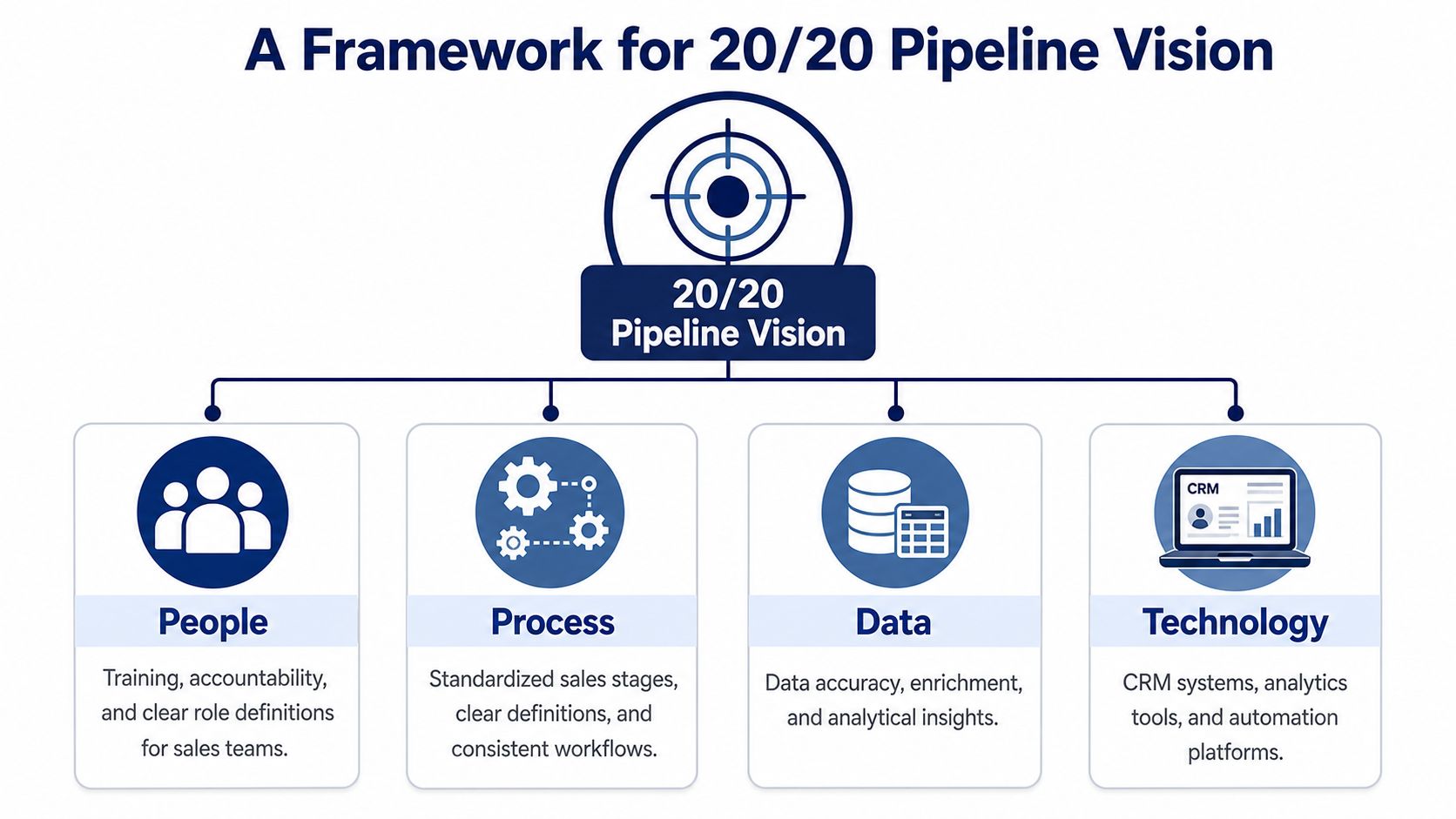
People
Start with rep behavior.
Reps need to work like account detectives, not note takers. A full activity log means very little if nobody can explain what changed inside the customer account and why that change affects the deal.
Coach three habits hard:
- Track buyer motion: Meetings, emails, and demos are seller actions. Buyer actions show whether the deal is advancing.
- Record stakeholder movement: New executives, missing approvers, quiet champions, and legal or procurement entries all change deal risk.
- Write next steps in account context: If the follow-up could be sent to any prospect in the pipeline, the rep has not done enough thinking.
Managers set the standard. If a frontline leader accepts vague answers, the whole team learns that confidence theater is good enough. It is not.
Process
Your review process should test deal truth under pressure.
That means every stage needs evidence. Every close date needs an event behind it. Every risk call needs account context, including signals from outside the CRM. If your team still runs reviews by reading fields out loud, fix that first.
Use a simple inspection structure:
| Review area | What to inspect |
|---|---|
| Stage | Which buyer action proves the deal belongs here |
| Timing | Which business event or buying milestone supports the date |
| Risk | Which internal or external change could stall the deal |
| Coverage | Which people, content, and executive support the account needs now |
Keep the language plain. Keep the bar high.
This is also where cadence discipline matters. If your follow-up motion does not adapt to account changes, your process stays blind between meetings. Build outreach around what is changing, using sales cadence templates for signal-based follow-up as a starting point.
Data
Pipeline visibility breaks when internal history and external reality live in separate places.
Internal data covers the basics: opportunities, activities, pricing history, product interest, stage movement, and win-loss patterns. External data gives you the missing story: hiring shifts, funding news, executive changes, strategic announcements, investor pressure, expansion moves, and restructuring.
The goal is not more data. The goal is usable signal.
That means your team can answer three questions fast. What changed at the account. Why it matters to this deal. What action the rep should take next. If your systems cannot support those answers, you do not have visibility. You have records.
Clean fields can make a weak pipeline look precise. Connected signals show whether it is real.
Technology
Technology should make signal detection routine, not heroic.
Your CRM should remain the system of record for opportunity truth. Your CPQ should remove pricing confusion. Your sales intelligence layer should capture market and account changes as they happen. Your analytics layer should show movement, risk, and forecast quality across the pipeline.
The architecture matters more than the vendor list. What matters is that external signals reach the rep and manager inside their normal workflow, then get tied back to active opportunities. If hiring spikes in a function you sell into, the account team should know. If a new executive arrives, open deals should be reviewed automatically. If investor commentary points to cost pressure, your forecast and messaging should change fast.
This is often misunderstood. Pipeline visibility is not a data cleanliness project with better dashboards. It is an intelligence system that connects market signals to deal health before the forecast breaks.
How to put the framework into motion
Roll this out like an operating change.
-
Choose one high-value motion
Start with the segment where blind spots are expensive, such as enterprise new logo or strategic accounts. -
Define proof for each stage
Spell out the buyer actions, account conditions, and risk triggers that qualify a deal for progression. -
Add signal checks to inspection
Require every reviewed deal to include recent external account changes, not just CRM updates. -
Route alerts where work happens
Push account changes into the tools reps and managers already use, including CRM, Slack, email, and meeting prep. -
Coach with real examples
Show what strong signal interpretation looks like in an actual deal review. Then make managers inspect to that standard every week.
Keep it simple. Train people to look for signal. Build process around evidence. Connect internal data with external context. Use technology to distribute the insight fast.
That is how you get 20/20 pipeline vision.
Actionable Plays You Can Run Today
You don't need a six-month transformation to improve pipeline visibility. You need a few plays that connect account signals to decisive action.
Signal-to-action plays
-
Executive move at a target account
If a new CRO, COO, or business unit leader joins, review every open opportunity and outbound sequence tied to that account. Update messaging around the executive's likely mandate. Early leadership transitions often reset priorities, budgets, and preferred vendors. -
Hiring spike in a function you serve
If the account starts hiring heavily in operations, security, revops, finance, or another relevant team, treat it as a capacity and change signal. Reframe outreach around the business problem implied by the hiring pattern, not just your product category. -
Funding, investor, or earnings update
If the company publicly signals expansion, efficiency pressure, or a strategic initiative, rewrite your next touch so it mirrors that language. Buyers respond when you sound like you understand their board-level agenda. -
Champion goes quiet but account activity changes elsewhere
Don't mark the deal dead immediately. Look for procurement movement, legal engagement, stakeholder additions, or organizational changes. Silence from one contact can mean the deal broadened, not vanished.
A lot of teams also struggle with turning these moments into outreach that lands. These sales cadence templates for timely follow-up are a useful starting point if your reps need help translating signals into sequences.
Manager plays for this week
If you lead managers, run these three moves now:
-
Add one external-signal question to every forecast call
Force the team to explain what changed at the account, not just in the opportunity record. -
Review your top deals for buyer evidence
Ask for proof of internal motion. Procurement, security, executive review, legal, budget sign-off. Something concrete. -
Flag deals with high rep activity but low account change
That's where busywork hides. Reps may be working hard on opportunities the buyer has already deprioritized.
The best pipeline review is the one that changes rep behavior before the quarter is lost.
Signal-based selling isn't complicated. It's disciplined. Watch what's changing. Connect it to active deals. Prioritize the accounts where timing is real. Then give reps context they can use immediately.
If your team is still stitching account research together by hand, you're wasting selling time and missing the moments that create real pipeline. Salesmotion helps revenue teams track the signals that matter, turn them into usable account context, and act fast with AI agents built for research, monitoring, and outbound execution.