Sales reps spend only 28% of their week selling, a benchmark that exposes a large and measurable loss of revenue capacity. Forrester found that just 23% of rep time goes to the highest-value work, direct engagement with prospects and customers, in Forrester's sales productivity analysis. The difference does not disappear into harmless administrative noise. It gets absorbed by manual prep, account review, CRM updates, note consolidation, and constant switching between tools.
For a CRO, that is not a workflow inconvenience. It is a capital allocation problem.
Every hour a quota-carrying rep spends assembling context by hand is an hour the business has already paid for at field-sales rates and then redirected into analyst work. Across a mid-sized team, that adds up quickly. The cost is not limited to salary waste. Pipeline creation slows, follow-up windows widen, account coverage drops, and rep judgment gets constrained by whatever information they had time to find. Our analysis of manual account research time across sales teams shows the same pattern. Research is rarely tracked as a standalone category, so leaders underestimate both the time drain and the revenue it displaces.
Preparation still matters. The strategic question is whether expensive frontline talent should be responsible for collecting, cleaning, and prioritizing account intelligence before every call. Across many organizations, that answer has remained "yes" by default. That default is costly, and it creates an opening for organizations that can automate the work and put those hours back into selling.
The Anatomy of Wasted Sales Research
Sales reps already spend a large share of their week away from live selling. The expensive part is not only the time spent gathering information. It is the opportunity cost created when quota-carrying talent is pulled into low-repeatability analyst work before every meaningful conversation.
A typical research cycle starts small and expands fast. A rep checks LinkedIn for role changes, scans the company site for a press release, searches recent news, opens the CRM for past activity, and skims old notes or a transcript to find a credible point of view. None of this is careless work. It is reasonable behavior inside an inefficient system.
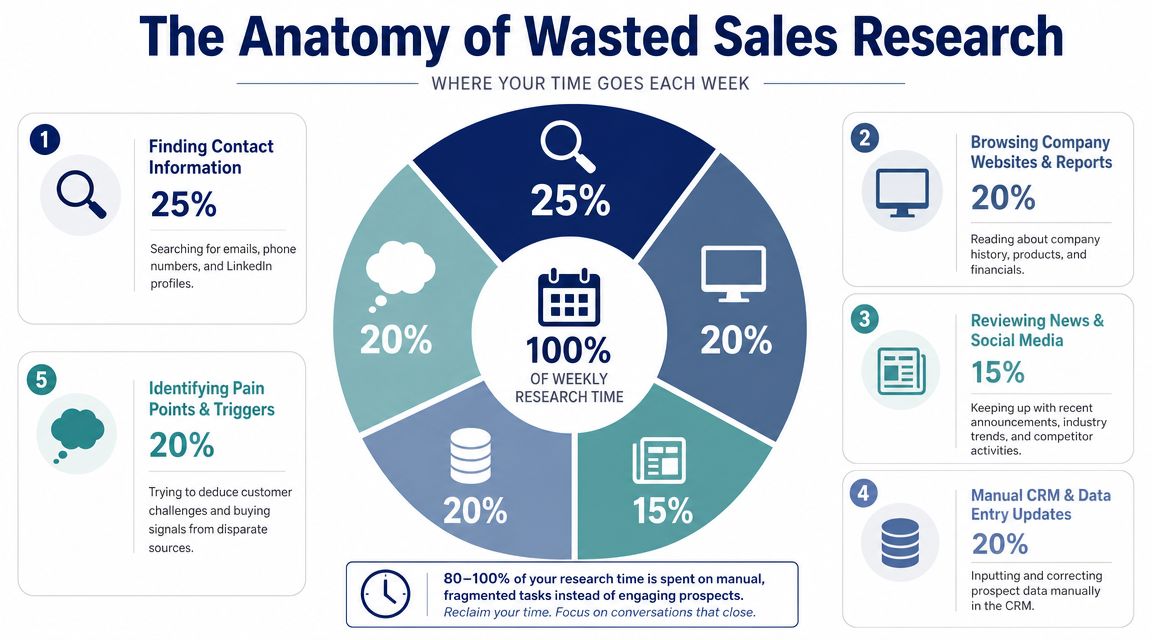
Where the hour actually goes
What looks like "prep" is usually a chain of separate tasks:
- Source hunting: finding current information across LinkedIn, company pages, news results, internal notes, and the CRM
- Context validation: checking whether the update is real, recent, and relevant enough to use
- Manual synthesis: translating scattered facts into a meeting brief, talk track, or outreach angle
- System cleanup: copying notes back into the CRM, a doc, or an email draft so the work is not lost
That sequence creates three distinct forms of waste.
Fragmentation is the most visible. Research lives across too many systems, so reps spend as much time switching contexts as they do finding insight. The cost is not just friction. Tool switching breaks judgment. Every new tab asks the rep to re-evaluate what matters, what is current, and what belongs in the message.
Manual synthesis is the more expensive failure point. Finding a funding announcement or executive hire does not create value by itself. Someone still has to decide whether the change affects priorities, map it to your solution, and convert it into a reason to engage. On many teams, that interpretation work happens from scratch for every account, even when the pattern is familiar.
Signal quality is weaker than teams assume. A large share of updates do not change sales strategy at all. Minor website copy edits, routine product page refreshes, social posts with no buying implication, and non-executive job changes rarely create a credible "why now" for outreach. Reps still read them because the system does not reliably separate buying signals from background activity.
Prioritization also breaks down. High-potential accounts and low-urgency accounts often receive the same level of manual research because the workflow has no built-in way to rank effort against revenue potential. That is a capacity problem, not a coaching issue. The team spends time evenly when the market rewards speed and selectivity.
One practical test makes the problem obvious. If a rep has to open five tabs to answer "why this account, why this person, why now," the research process is consuming selling capacity instead of improving it.
That pattern shows up clearly in this analysis of manual account research time across sales teams. The root issue is not rep discipline. The workflow asks frontline sellers to collect, filter, interpret, and store account intelligence by hand. At scale, that turns research from a productivity nuisance into a strategic liability.
See Salesmotion in action
Take a self-guided interactive tour — no signup required.
Calculating the Multi-Million Dollar Cost of Inefficiency
The conversation usually changes. “Research friction” sounds operational. Once you price it, it becomes a financial issue.
Here is a worked example: one hour of research per account, 50 accounts, two hours per week of research per account, 48 working weeks, and a loaded hourly cost of $72. Using those inputs, the annual research cost comes to $345,600 per rep. Scaled across a 50-rep team, that becomes $17 million in annual research time.
Those figures are an illustrative scenario, not a market benchmark. They are, however, a useful internal planning model for a CRO evaluating the cost of manual account research in their own team.
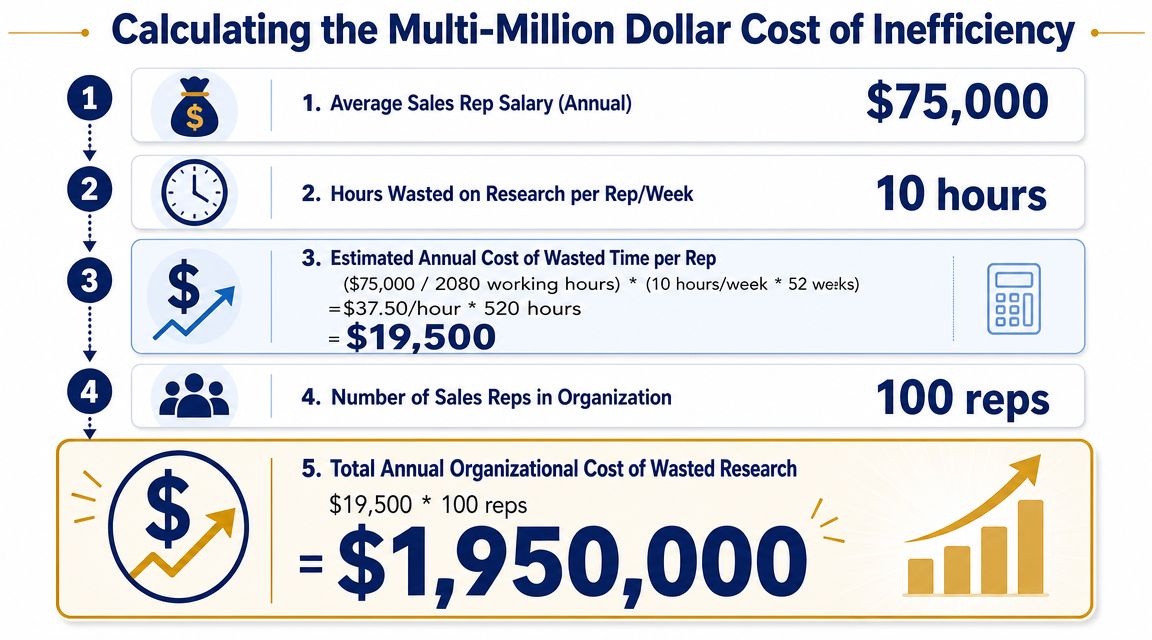
A simple finance view of the problem
Here's the logic revenue leaders should use:
| Cost element | What to measure | Why it matters |
|---|---|---|
| Rep time | Hours spent gathering and assembling account context | This is expensive labor applied to non-selling work |
| Account coverage | How many accounts require prep each week | Research scales with book size |
| Frequency | How often reps repeat the same workflow | Repeat work compounds quickly |
| Opportunity cost | What those hours could have gone to instead | The real loss is missed conversations, not just wasted activity |
The hard cost is only the first layer. The larger cost is opportunity cost.
If a rep spends substantial time preparing but still reaches out late, they lose twice. First, the labor cost is already sunk. Second, the account may have moved on, the buying window may have narrowed, or a competitor may have engaged first.
Why the business case gets stronger at scale
Small inefficiencies barely show up in a single rep's calendar. They become obvious when you aggregate across a team.
A CRO doesn't need perfect precision to act. They need a credible model. If your team reports that research consumes meaningful time every week, and your own benchmarks show limited customer-facing time, then manual research isn't an edge case. It's a capacity issue hidden in plain sight.
The key mistake is treating research as free because it happens inside salaried time. It isn't free. It displaces the only activity that produces revenue directly.
A useful next step is to build your own internal baseline. This guide to the real cost of manual account research is a good prompt for that exercise. The goal isn't to win an academic argument. It's to surface a line item you can manage.

“There's been a big focus on hyper personalization and relevance in our outbounding efforts. Salesmotion has been a key partner in hitting our significantly increased meeting targets. What stands out is how simple it is. Reps can log in and get valuable account insights within 30 seconds to a minute.”
Joe DeFrance
VP of Sales, Incredible Health
Why More Tools and Training Arent the Answer
The standard response to slow research is usually budget or coaching. Both can improve local symptoms. Neither changes the unit economics of the work.
If every rep still has to gather, verify, and synthesize account context by hand, the organization has designed a high-cost process and then asked managers to optimize around it. That is why added tooling often produces more activity without more throughput.
More tools usually increase the tax
A larger stack does not reduce research time when each new product adds another place to check, compare, and interpret. LinkedIn, CRM, email, call notes, news alerts, enrichment data, and internal docs already create a fragmented workflow. Another interface often adds one more partial signal, not a usable decision.
That pattern explains why sales teams abandon intelligence tools that create more friction than clarity. Adoption falls when the rep has to assemble the answer manually across multiple systems. In practice, many teams have not solved research. They have distributed it across more tabs.
The cost is managerial as well as individual. Once information is scattered, frontline leaders cannot easily inspect research quality, standardize prep, or see which inputs improve conversion. The result is an expensive stack with low process control.
Training improves judgment, not repetitive collection work
Training has real value in discovery, deal strategy, and negotiation. It is a weak answer to repetitive information gathering.
You can train a rep to read earnings commentary, interpret headcount shifts, or spot signs of an active initiative. But if every seller repeats the same sequence of searches before every meaningful outreach, the company is paying skilled employees to do production work. That is a design problem, not a capability gap.
The better frame comes from this discussion of rep selling time versus research time. The critical question is not the quantity of research. It is whether the right context reaches the rep early enough, in a usable format, to improve timing and message quality. High-value research identifies changes that create a reason to act. Low-value research consumes time without changing the next action.
What leaders should stop asking
Three management questions sound practical but usually keep the system inefficient:
- Can we train reps to prep faster? Marginally, yes. The manual workload remains.
- Should we add another enrichment or news tool? Only if it removes interpretation work from the rep, not if it delivers more raw inputs.
- Can managers enforce better account planning discipline? Only when the underlying account context is current, structured, and easy to review.
If the process requires every rep to build account intelligence from scratch, consistency stays low and cost stays high.
The business issue is operating model fit. Revenue teams need research delivered as a decision-ready input, not as scattered evidence that each rep has to process alone. That shift matters because the opportunity cost is larger than the labor cost. Every hour spent stitching together context is an hour not spent opening accounts, advancing deals, or reaching a buyer inside the window where change is still actionable.
The Shift to Autonomous Account Intelligence
Manual research is not just a workflow problem. At scale, it becomes a capital allocation problem. If account context reaches reps late, in raw form, or without a clear recommendation, the company pays twice. First in labor. Then in missed pipeline created by slow outreach, weaker message quality, and poor timing.
The operating model has to change. Reps should receive account intelligence as a decision-ready input, not build it from scratch in between calls, emails, and deal work.
That is the case for autonomous account intelligence.
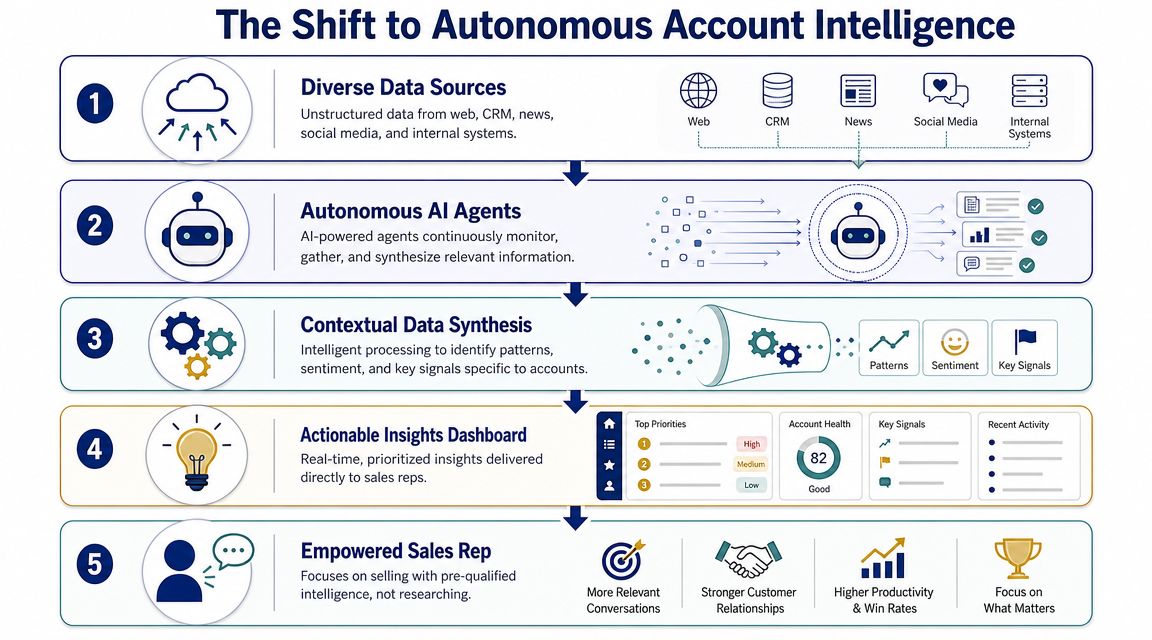
What autonomous account intelligence does
A useful autonomous system takes over four jobs that reps still perform manually in many sales orgs:
-
Monitoring sources continuously
It tracks public and internal inputs across accounts without requiring reps to check multiple tools and tabs throughout the week. -
Identifying meaningful changes
It filters routine activity from events that justify outreach, such as executive movement, new initiatives, budget signals, or changes in company momentum. -
Synthesizing context
It explains what changed, why it matters, and how it connects to the account instead of handing the rep a stack of links and notes. -
Preparing the next move
It delivers a usable brief, talking point, or outreach angle that a rep can review and act on quickly.
The strategic gain is speed to relevance. A rep who gets the right signal with context can contact the account while the trigger event is still fresh. A rep who has to assemble that picture manually often reaches the buyer after the window has narrowed or closed.
That difference changes pipeline economics. The value is not limited to hours saved. It comes from converting more rep time into high-quality touches during moments when a buyer is more likely to respond. Teams evaluating ways to reduce sales research time should measure both sides of the return: lower prep cost and higher output from the hours recovered.
How the three-agent model maps to the problem
Salesmotion describes its product as three AI agents, each aligned to a specific failure point in the research workflow.
- Research Agent builds structured account briefs from public sources, reducing manual gathering and note assembly.
- Signal Agent monitors ongoing changes and flags what matters, reducing the need for constant checking.
- Prospector Agent turns account context into outreach drafts tied to real signals, reducing the final translation step between research and action.
Many intelligence tools stop at information delivery. They surface an event, then hand the interpretation burden to the rep. The rep still has to decide whether the signal matters, how it fits the account, and what message to send.
The useful output is not more data. It is a clear point of view delivered early enough to change rep behavior.
The operational change leaders should want
In the manual model, every rep starts with a blank page and a different standard of quality. In an autonomous model, every rep starts with a current brief and a suggested action. That increases consistency across the team, which is one of the less obvious financial benefits. Better research quality at the median rep level often matters more than marginal improvement from top performers who were already doing the work well.
The seller's role becomes narrower and higher value. They review, validate, tailor, and engage. They spend less time searching and summarizing, and more time using judgment where it pays off most: in account selection, message refinement, and live buyer interaction.

“This is my singular place that very simply summarizes a company's top initiatives, strategies and connects them to my solution. Something I would spend hours researching manually, now it's automated.”
Derek Rosen
Director, Strategic Accounts, Guild Education
How Salesmotion Solves the Research Problem
The practical value shows up in the before-and-after workflow.
Before an autonomous workflow, a rep handles account prep like a mini consulting project. They gather company context, scan leadership movement, review recent updates, check internal history, then turn all of it into a usable brief. Output quality depends heavily on the individual rep. Some produce a crisp account thesis. Others create a pile of copied notes.
Afterward, the process changes from manual assembly to review and action.
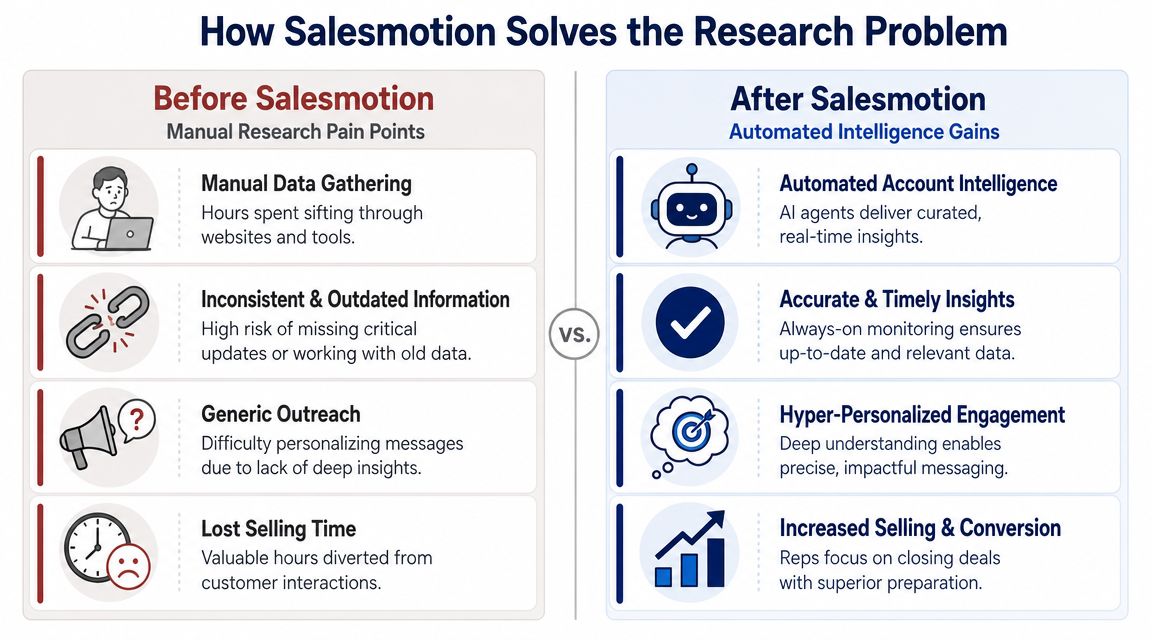
A practical before-and-after view
The brief mentions two customer-style examples. One prospect had a 10-person team researching 150 accounts weekly. Another spent two weeks per account. Those examples are part of the provided brief, not independently verified source material, so they're best used as illustrative operating scenarios rather than market-wide proof points.
The operational pattern is familiar:
- Before: reps gather raw information from multiple sources, decide what matters, and manually shape it into a brief.
- After: the system assembles a current account view, watches for changes, and gives the rep a direct angle for outreach or call prep.
One customer example in the brief says research went from two hours to 30 minutes per account, with better output. Again, that's a briefed example rather than a verified published statistic, but it captures the kind of improvement leaders are looking for: less prep time, more consistent context, and stronger execution.
Manual research vs autonomous agents
| Metric | Manual Process | Salesmotion Agents |
|---|---|---|
| Account prep | Rep gathers data from multiple sources | Research Agent assembles a structured brief |
| Trigger monitoring | Rep checks periodically and often misses timing | Signal Agent monitors continuously |
| Relevance | Rep must infer the “so what” alone | System surfaces context and suggested action |
| Outreach drafting | Rep translates notes into messaging manually | Prospector Agent turns intelligence into draft outreach |
| Consistency | Varies by rep skill and available time | Standardized output across accounts |
A setup like Salesmotion's research-time reduction workflow is useful when leaders want to remove repetitive prep without removing seller judgment. That distinction matters. You don't want reps outsourcing thinking. You want them outsourcing the collection and first-pass synthesis that currently slows them down.
What this changes for managers and reps
For managers, the gain is consistency. Every account can get a baseline level of research depth without depending on whether a rep had spare time that day.
For reps, the gain is speed with context. They still own the conversation. They just don't have to build the briefing pack from scratch every time.
For RevOps, this is the bigger prize. Once intelligence becomes systematized, you can operationalize prioritization, signal response, and account planning across the team instead of hoping top performers do it instinctively.
Reinvesting Your Team's Time into Revenue
The core issue in how sales reps waste time on research isn't that preparation is bad. It's that too much preparation is still manual, fragmented, and poorly prioritized.
That's why the headline metric matters so much. If reps spend only a small share of the week selling, every hour you remove from manual prep has outsized value. You're not just saving labor. You're expanding selling capacity without adding headcount.
There's also a strategic upside. Teams that rely on manual research tend to move unevenly. Some accounts get deep prep. Others get rushed outreach. Timing suffers. Message quality varies. Signal response becomes inconsistent. Once account intelligence is automated and continuously refreshed, teams can react faster and with a clearer point of view.
For a CRO, that changes the conversation from efficiency to deployment. Where should recovered time go?
- More live conversations: calls, meetings, demos, and follow-up.
- Better account prioritization: focus on accounts where a real trigger exists.
- Stronger deal progression: use context to advance active opportunities, not just start new ones.
The fastest way to make this real is simple. Audit a week of rep time. Count how often sellers leave their core workflow to hunt for context. Then calculate what that behavior costs you in selling capacity, response speed, and managerial consistency.
If your team is still building account intelligence by hand, it's worth taking a look at Salesmotion. It uses AI agents to monitor target accounts, build structured briefs, surface meaningful signals, and turn research into usable action so reps can spend more of their week selling.