Most revenue plans fail because the problem usually isn't strategy. It's translation. Teams can describe the market, name their segments, and set targets, then still miss the quarter because nobody turned live buyer signals into timely action.
That's backward. In a market where buying conditions shift week to week, a static revenue growth strategy is a liability. The better approach is evidence-led and operational. You watch for what changed, decide why it matters, and route the next move to the rep who should act on it.
Why Most Revenue Strategies Fail Before They Start
The common assumption is that revenue strategy breaks because goals are too aggressive. I don't buy that. Most plans break much earlier, when leadership confuses planning with execution.
You can have a sensible target, a clean territory map, and a decent sales process. If your team still needs to manually piece together hiring changes, investor updates, earnings mentions, and org shifts before they reach out, your strategy is already too slow. That lag is real. The gap in most revenue growth content is the lack of actionable guidance for converting silent signals into sales action, while reps still pay a 2 to 3 hour manual research tax and 68% of sales teams report poor signal-to-action conversion due to fragmented data in 2025, according to this analysis of high-impact growth strategies.
Static plans create false confidence
A board-ready plan can still hide a weak operating model. Sales leaders say they want alignment. What they need is a system that tells a rep, in plain English, what happened in an account and what to do next.
That's why “be data-driven” is still too vague. Data isn't the dashboard. Data is the trigger, the context, and the next action. If your reps see a signal on Monday and act on it next week, the window is gone.
Practical rule: If a frontline seller can't answer “why now?” in one sentence, you don't have a usable growth strategy.
Pricing is a good example. Too many companies treat pricing as a finance exercise instead of a growth lever tied to market conditions and buyer value. Founders who need a sharper view on packaging and monetization should study practical frameworks like SaaS pricing strategies for founders, because pricing decisions shape who you can win, how you position, and which segments justify more coverage.
The last mile is where revenue is won
The job of revenue leadership is closing the gap between signal and action. That means sales, marketing, and RevOps need to solve workflow issues, not just planning issues. If you're seeing friction in handoffs, data quality, or field execution, a closer look at common sales operations challenges is usually more useful than another annual planning offsite.
Here's the blunt version:
- Strategy without triggers becomes generic messaging.
- Signals without context become noise.
- Context without workflow dies in Slack, email, or meeting notes.
Teams that grow consistently don't just collect intelligence. They operationalize it.
See Salesmotion in action
Take a self-guided interactive tour — no signup required.
Diagnose Your Revenue Engine Health
Starting the wrong way, they look at closed revenue, compare it to target, and call that a diagnosis. That's not diagnosis. That's an autopsy.
A real revenue growth strategy starts with engine health. You need to know where momentum breaks before the number misses. Revenue is a lagging result. Your bottlenecks usually show up first in segment coverage, deal progression, expansion activity, and conversion quality.
To ground the audit, use a consistent method for measuring growth. A practical framework is to select a consistent measurement period, gather accurate current and prior revenue data, apply the formula ((Current Period Revenue – Preceding Period Revenue) / Preceding Period Revenue) × 100, then track trends over time, with attention to one-time events and benchmark comparisons, as outlined in this guide to calculating revenue growth rate.
Start with a narrow set of leading indicators
Don't drown the team in metrics. Pick the ones that tell you where the machine is leaking.
I'd review these first:
- Pipeline coverage by segment: Not total pipeline. Segment-level coverage. Enterprise and commercial rarely fail for the same reason.
- Sales cycle velocity: Watch where deals stall. Early discovery stall is different from procurement stall.
- Win rate by competitor and use case: A headline win rate hides positioning problems.
- Average contract value trend: Flat or shrinking ACV often signals weak packaging, poor qualification, or discount-led selling.
- Expansion pattern: If existing accounts aren't growing, your customer value story may be too narrow.
If you need a more rigorous view of what to track and how to define stages, this breakdown of sales pipeline metrics is worth using as a working reference for RevOps and frontline managers.
Run the audit in four passes
First, check acquisition. Are enough qualified opportunities entering the pipe from the right segments? If top-of-funnel looks healthy but conversion is weak, the issue isn't demand. It's targeting, messaging, or qualification.
Second, inspect progression. Pull a sample of opportunities that advanced fast and another sample that stalled. Compare trigger events, buying committee engagement, and sales activity quality. The difference usually tells you whether your team has a timing problem or a value articulation problem.
Good diagnosis sounds specific. “We lose momentum after discovery in upper mid-market accounts when no operational trigger exists” is useful. “Pipeline quality is mixed” is not.
Third, evaluate monetization. A lot of growth problems are really packaging problems. If reps can only sell one motion to every account, the team will over-discount or lose to “do nothing.” Here, enablement and pricing discipline directly affect growth. If you're trying to boost B2B revenue, don't just train reps on objection handling. Train them on matching offer structure to account context.
Fourth, check customer expansion and retention signals. Existing accounts should tell you where product value is deepening. New stakeholder hires, team growth, changed priorities, and budget shifts often point to whitespace before the customer asks for anything.
What a strong diagnosis produces
You want a short list of operational truths, such as:
- Where growth is already working
- Where conversion breaks
- Which segments deserve more investment
- Which offers need to be repackaged
- Which triggers should change rep behavior immediately
That's the point where a revenue growth strategy becomes usable. You stop debating abstract goals and start fixing the exact parts of the engine that block growth.

“The moment we turned on Salesmotion, it became essential. No more hours on LinkedIn or Google to figure out who we're talking to. It's just there, served up to you, so it's always 'go time.'”
Adam Wainwright
Head of Revenue, Cacheflow
Define Your Growth Levers and Target Segments
Most companies spread effort across too many bets. They chase new logos, launch adjacent products, test new verticals, and push expansion all at once. That's not a strategy. That's portfolio drift.
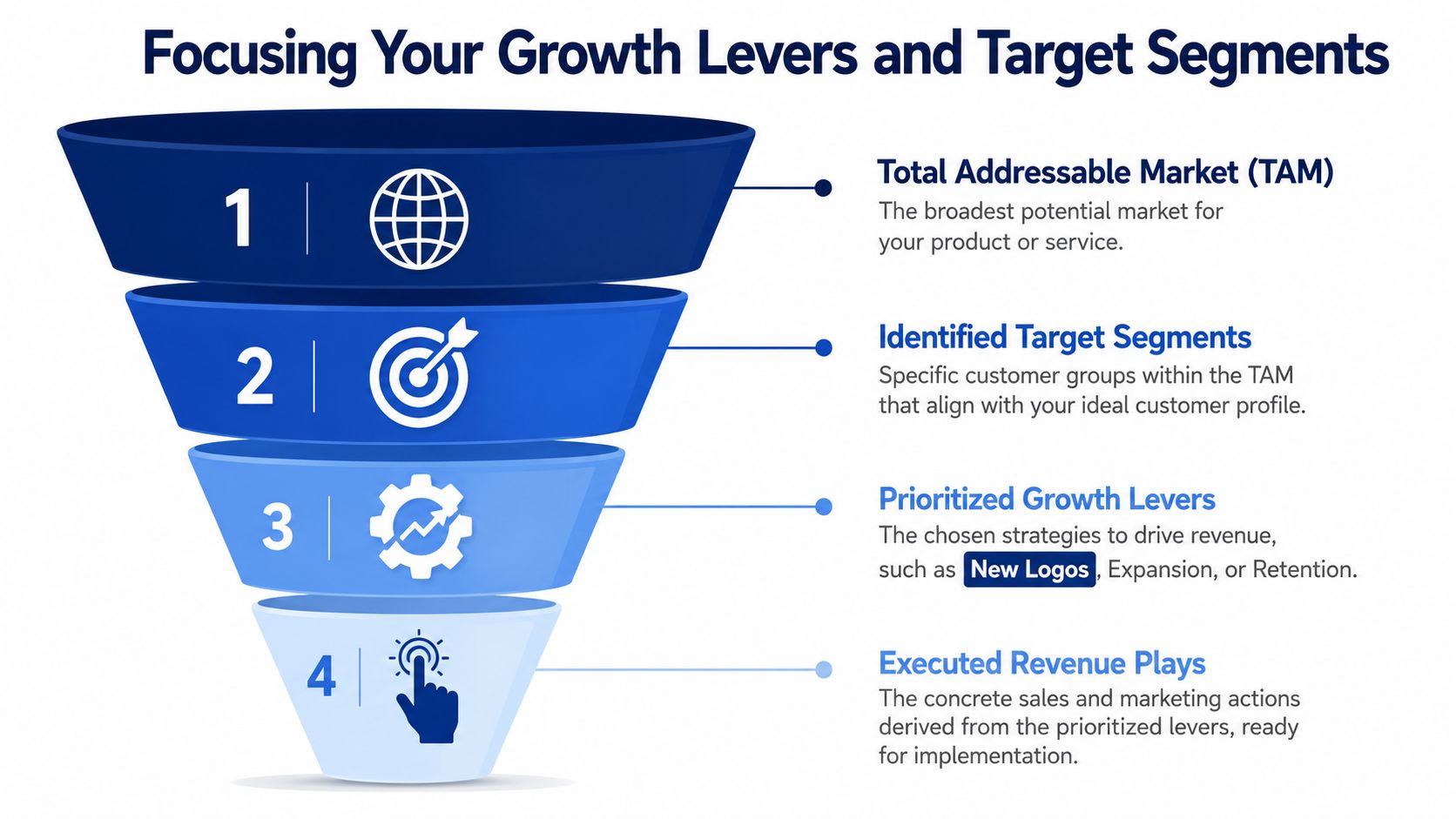
You need a small set of growth levers tied to segments where timing and relevance are on your side. I group them into four categories: new logos, new markets, new products, and expansion plus retention. Each one should be activated by evidence, not optimism.
Match the lever to the signal
New logos works when your current market still has room and the signals are clear. Competitor dissatisfaction, hiring tied to your use case, and public strategic initiatives all suggest active demand. Don't just assign more SDRs. Build a point of view around the change the buyer is already dealing with.
New markets makes sense when a cluster of similar accounts begins showing the same operating pattern. If you notice repeated executive hiring, compliance pressure, or product modernization signals in a vertical you don't fully cover, that's a better reason to expand than “we should probably go after healthcare.”
New products should follow observed customer pull. If multiple accounts are trying to solve adjacent problems using your core product in workaround fashion, that's a market clue. Product and sales should capture those patterns together.
Expansion and retention usually gives the cleanest path to efficient growth. Existing customers tell you where your value is already accepted. New team buildouts, internal reorgs, and budget visibility can all indicate where to deepen the relationship.
A signal-based account plan works best when the segment is clearly owned. That's why disciplined target account management matters. Without named accounts, signal response turns into random acts of prospecting.
Pricing sits underneath every lever
Most leadership teams underuse pricing because they treat it as risky. In reality, pricing is often the cleanest profitability lever in the business. A 1% price improvement can yield an 8.7% rise in operating profits, according to research cited in this overview of revenue growth strategies.
That doesn't mean raising prices blindly. It means aligning price to value, packaging to segment, and discounting to real competitive conditions.
Raise price when the account sees urgent value, not when finance wants margin.
Here's how I'd think about it in practice:
- For new logos: simplify entry. Reduce friction and make the first purchase easy to justify.
- For new markets: localize the offer. Different verticals often need different proof points and packaging.
- For new products: price around the use case, not internal feature bundles.
- For expansion: tie pricing to broader adoption or added business impact, so the customer sees a logical next step.
The right revenue growth strategy isn't just about where to hunt. It's about where your offer can win cleanly and profitably.
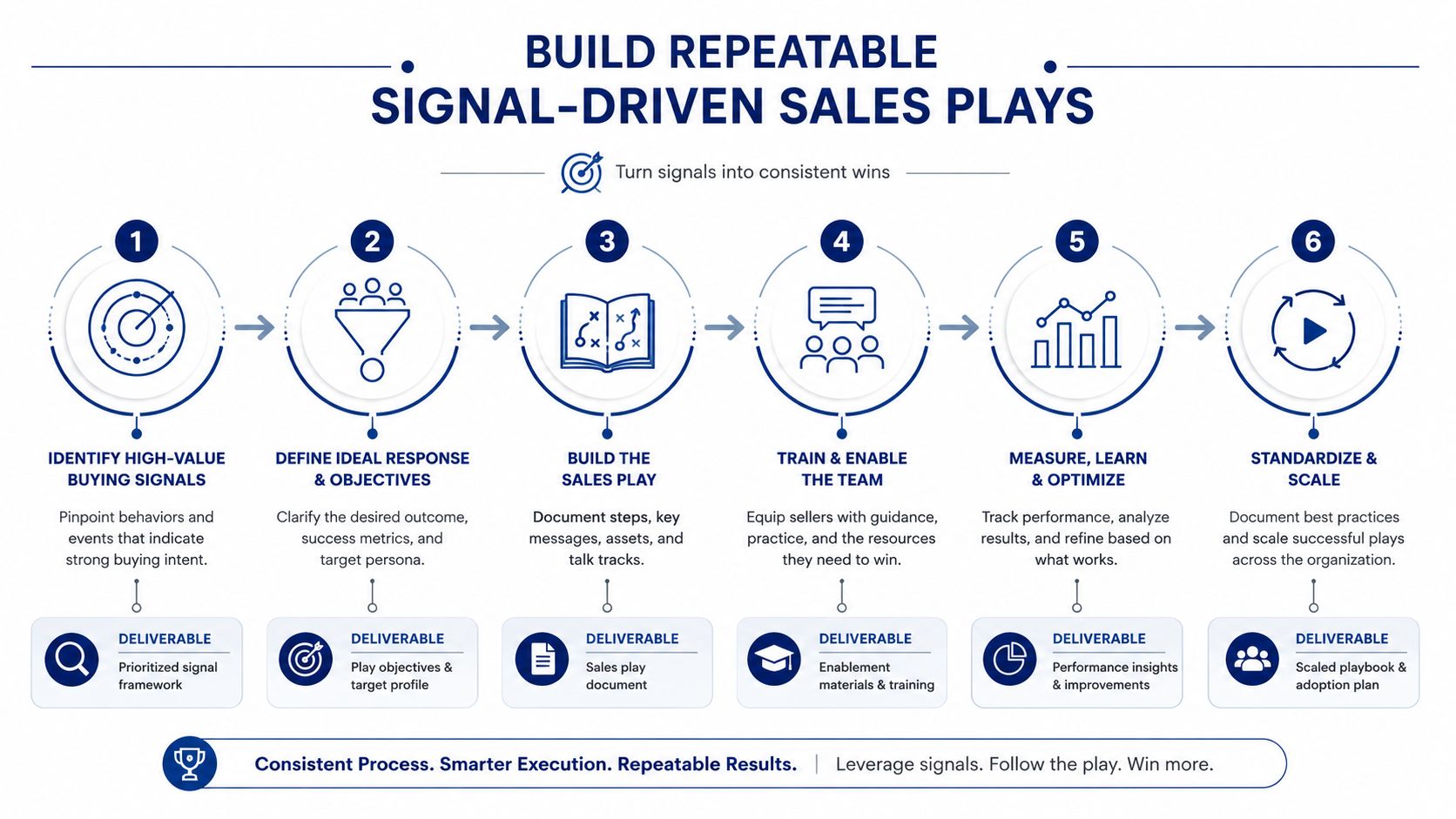
Build Repeatable Signal-Driven Sales Plays
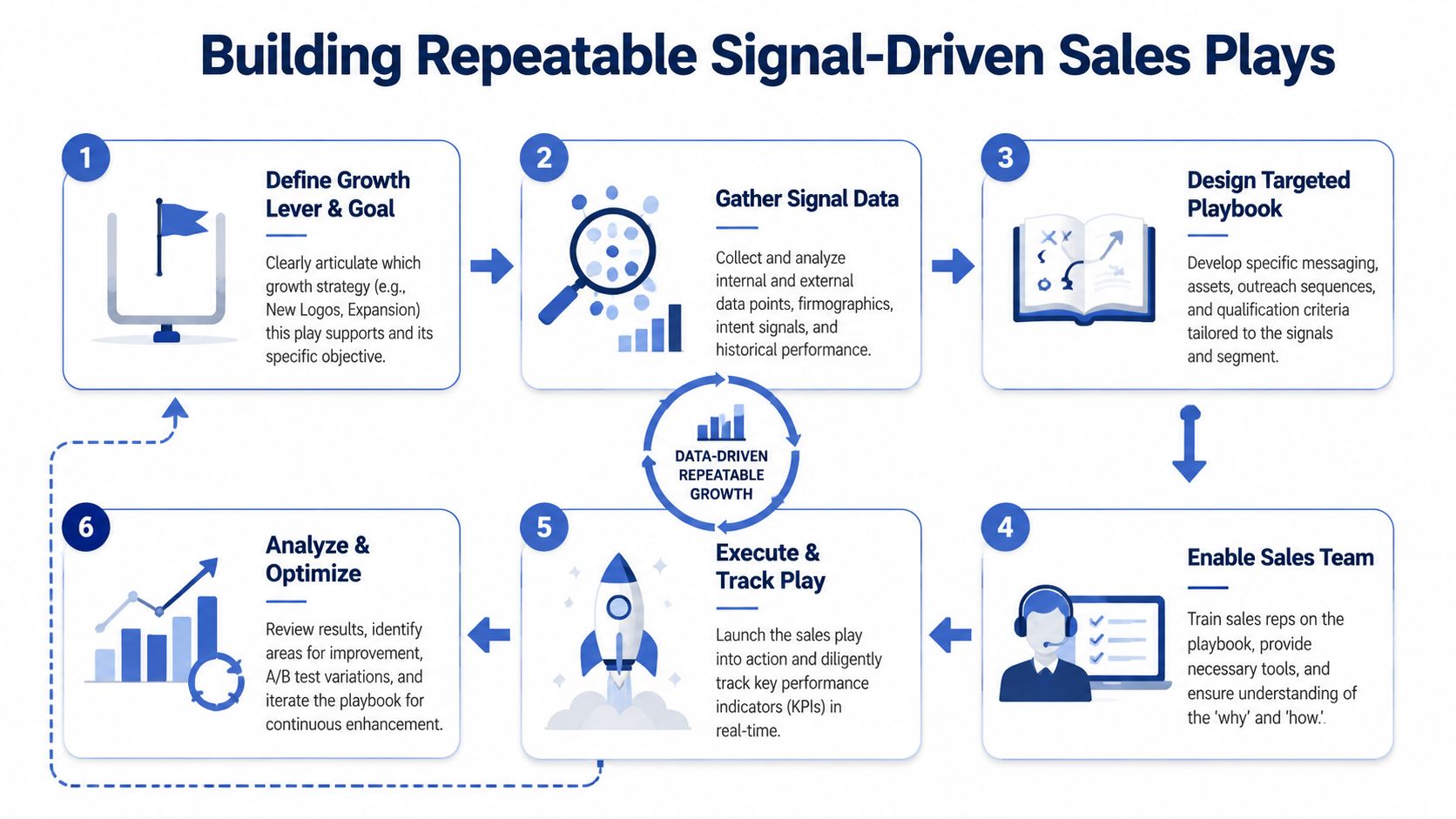
At this point, strategy stops being theory. Your chosen growth lever has to become a repeatable motion a rep can run on a Tuesday morning without waiting for leadership approval.
Generic sequences won't do it. A real play starts with a trigger, interprets the trigger, maps it to a likely business priority, and tells the seller who to contact and what to say.
Play one new executive arrival
A new executive changes the account. The mistake reps make is sending a congratulatory note with no point of view.
A better play looks like this:
| Element | Example |
|---|---|
| Trigger | New CIO or CRO joins target account |
| So what | New leaders reassess vendors, priorities, and team capability |
| Personas | Executive sponsor, direct reports, adjacent operators |
| Message angle | Help them make progress in the first operating cycle |
| Rep action | Reach out with a concise view of likely priorities and risks |
The outreach should sound like someone did the homework. Not “saw you joined.” More like: “You've likely inherited active initiatives, existing vendor commitments, and pressure to show progress fast. We help teams get visibility into account-level changes so they can prioritize outreach around real buying conditions.”
That works because it respects what the event means. The signal is not the message. The signal is the reason the message is relevant.
Play two funding or expansion event
When a company announces funding, office expansion, or a hiring ramp, sellers often assume the message is “you have budget.” That's lazy.
The better interpretation is operational strain. Headcount growth creates coordination problems, process gaps, and pressure on systems. A useful outreach angle speaks to scale readiness.
Use a simple build format for this play:
- Trigger event: Funding, geographic expansion, or large hiring push
- Business implication: Systems, process, and reporting complexity are about to increase
- Likely stakeholders: Finance, operations, revenue leadership, systems owners
- Offer framing: Help the team absorb growth without losing execution quality
- Next move: Send an insight-led email, then follow with a call referencing the same trigger
The best plays don't chase news. They interpret consequences.
This is why sales intelligence has become a serious category. The global sales intelligence market was valued at approximately USD 4.85 billion in 2025 and is projected to reach USD 12.45 billion by 2034, according to this market overview on sales intelligence definition and growth. That expansion reflects a simple truth. Teams need help turning raw market information into action.
Play three competitor mention or strategic shift
One of my favorite plays starts when a target account mentions a competitor, a transformation initiative, or a cost-control push in a public forum. Most reps either miss it or forward the note around without a response plan.
A stronger play has three parts:
- Interpret the mention. What pressure does it reveal?
- Reframe your offer. Which outcome matters now?
- Target the right people. Not every signal belongs with the same persona.
If a prospect publicly signals a focus on efficiency, don't lead with broad innovation language. Lead with operational clarity, workflow reduction, and faster decision-making.
If you want to see how this model works at the workflow level, signal-based selling is the discipline to build into your sales motion. One practical option is Salesmotion, which monitors account triggers across public sources, explains the “so what,” and routes context into seller workflows so reps can act without doing manual account research first.
The standard for a usable play
A repeatable play should answer five questions fast:
- What happened
- Why it matters
- Who should care
- What we say
- What the rep does next
If any one of those is missing, the play won't scale. It'll stay trapped with your best rep, and that's not a revenue system.
“Automatic account profile detail I can use to manage my territory. Using Salesmotion AI to generate value statements per persona, account, etc. Using Salesmotion to give me a starting point based on new hires, or news alerts is critical.”
Adam Wainwright
Head of Revenue, Cacheflow
Operationalize Your Strategy with Automation and KPIs
A signal-driven revenue growth strategy needs operating discipline. Otherwise you end up with smart ideas and inconsistent follow-through.
The workflow should be simple. Your CRM holds account ownership and opportunity context. Your sales engagement platform handles sequences and rep execution. Your intelligence layer watches for trigger events, adds context, and routes alerts into the systems reps already use. The goal is not more software. The goal is fewer decisions between signal detection and seller action.
Build the operating system first
You don't need a massive transformation project. You need a controlled rollout.
Start with one segment, one or two clear signals, and one manager who will coach the motion weekly. Route alerts to a named owner. Attach the recommended next step. Log whether the signal led to outreach, a meeting, pipeline creation, or expansion activity.
The growth target should fit company stage. A 30% to 50% annual growth rate is often considered strong for startups and high-growth companies, while mid-sized companies typically target 15% to 25%, according to these revenue growth benchmarks. Use benchmarks for context, not vanity. Your operating model has to support the target.
Track the right KPIs
Teams often over-measure activity and under-measure responsiveness. I'd rather know whether the team converted a relevant trigger into a useful conversation than how many generic emails they sent.
Focus on a short KPI set:
- Signal-to-outreach rate: Did the rep act on qualified signals?
- Signal-to-meeting conversion: Did relevant triggers produce conversations?
- Pipeline created from trigger events: Which signals create opportunities?
- Velocity by play type: Which plays move fastest once opened?
- Expansion pipeline from customer signals: Are existing accounts producing the expected next steps?
Sample 90-Day Rollout Plan
| Phase | Timeline | Key Actions | Primary Owner | Success Metric |
|---|---|---|---|---|
| Foundation | Days 1 to 30 | Define target segment, choose priority signals, confirm CRM ownership rules, document play criteria | RevOps Leader | Alerts route to correct reps with complete account context |
| Pilot | Days 31 to 60 | Launch signal alerts for one team, train managers on coaching, review outreach quality weekly | Sales Manager | Reps consistently act on qualified signals and messaging quality improves |
| Expansion | Days 61 to 90 | Add more accounts, refine play logic, standardize KPI review, align marketing support where needed | CRO or Revenue Leader | Pipeline from signal-led plays becomes visible and repeatable |
Clarify ownership or it stalls
One reason strategies die is that nobody owns the handoff. RevOps configures the workflow. Sales managers coach rep behavior. Reps execute. Marketing supports with assets when a play needs air cover. Leadership reviews outcomes and cuts what isn't working.
Automation should reduce thinking about process, not reduce thinking about buyers.
If you do this right, your team stops debating whether a signal matters. The system decides what qualifies, the manager coaches execution, and the rep spends time on outreach that has a legitimate reason to exist.
From Strategy to Habit
The strongest revenue engines don't rely on annual planning energy. They rely on daily habits. Teams notice what changed, interpret it fast, and act with relevance.
That's the shift most companies still haven't made. They treat revenue growth strategy like a document. It's not. It's a living operating model built on diagnosis, focused growth levers, repeatable plays, and disciplined measurement.
A static plan feels safe because it creates the appearance of control. But control comes from responsiveness. The team that wins isn't the one with the prettiest strategy deck. It's the one that can turn fresh account intelligence into timely, credible outreach before competitors do.
Keep the standard high:
- Diagnose with leading indicators, not just closed revenue
- Choose a few growth levers and tie them to clear signals
- Turn those signals into sales plays that managers can coach
- Measure response quality and pipeline impact, not just activity volume
That's how strategy becomes behavior. And once it becomes behavior, growth stops depending on heroics.
If your team wants a cleaner way to turn account changes into pipeline action, Salesmotion gives reps structured account research, real-time signal alerts, and personalized outreach prompts based on what's happening inside target accounts. It's a practical fit for revenue leaders who want less manual research and faster signal-to-action execution.