Imagine your sales team operating not with gut feelings, but with the clarity of a pilot in a high-tech cockpit. That’s the power of revenue intelligence software. It’s a system that automatically connects your internal data—emails, calls, CRM updates—with external business signals to show you what’s really driving your pipeline.
Beyond the Dashboard: What Is Revenue Intelligence?
At its heart, revenue intelligence software is the modern command center for any revenue team. It moves your organization beyond static dashboards and endless manual research by providing a complete, real-time picture of your entire revenue engine. Instead of reps wasting hours piecing together information, this technology does the heavy lifting for them.
Think of it as an autonomous team of digital researchers working for you 24/7. These platforms collect and analyze sales data to uncover insights about performance, market trends, and hidden risks or opportunities. This allows your team to stop guessing and start making data-driven decisions that move the needle.
The Shift from Gut Feel to Data-Driven Action
For years, selling has been a mix of art and science, often leaning heavily on a top rep’s intuition. While experience is invaluable, today's market demands more. Relying on guesswork leads to common problems that revenue intelligence platforms are built to solve.
Let's break down the core problems these platforms address and the positive outcomes they deliver.
What Revenue Intelligence Software Delivers
| Key Problem | What the Software Does | The Outcome |
|---|---|---|
| Inaccurate Forecasts | Analyzes real-time deal progression and buyer engagement data, not just a rep's opinion. | A precise, data-backed picture of what revenue you can actually expect to close. |
| Weak Customer Insights | Scans every interaction (calls, emails) to uncover what customers truly need and care about. | Reps can tailor their approach, messaging, and solutions to what will resonate with the buyer. |
| Low Sales Productivity | Automates administrative work like CRM data entry and activity logging. | Reps spend more time selling and less time on manual tasks that don't generate revenue. |
| Missed Opportunities | Uses AI to flag deals with the highest likelihood of closing and accounts showing buying signals. | Your team focuses its energy on the deals that matter most, not just the ones that make the most noise. |
Essentially, revenue intelligence takes the guesswork out of running a sales organization, replacing it with a structured, repeatable, and data-backed process.
Revenue intelligence uses technologies like AI and machine learning to automatically analyze data from different sources. This provides real-time insights into sales operations, customer interactions, and market trends, helping you drive measurable and predictable workflows.
Why Static Reports Are No Longer Enough
The fundamental problem with traditional CRM dashboards and spreadsheets is that they are reactive. They show you what happened yesterday or last week, but they can’t tell you what to do right now.
In contrast, revenue intelligence is proactive. While it has common ground with sales intelligence—which focuses on gathering lead and account data—revenue intelligence offers a broader, more strategic view. You can learn more in our guide defining sales intelligence and its role.
By continuously monitoring buying signals—like a key executive changing jobs or a prospect company announcing new funding—the software provides a powerful "why now" for your team. This allows reps to engage prospects at the perfect moment with a relevant message, dramatically increasing their chances of winning. It's the difference between looking in the rearview mirror and having a GPS that shows you the best route ahead.
Looking for pipeline generation tools?
Pipeline generation tools sell volume. Salesmotion sells precision — the right account, the right moment, the right message.
AI agents that work every account 24/7 so your reps know who to target, why now, and what to send. From $85/mo.
How Revenue Intelligence Software Actually Works
So, how does this technology function? Think of revenue intelligence software as a tireless team of digital researchers working around the clock. These platforms connect thousands of scattered data points into a clear, strategic picture that gives you a real edge.
The process begins with data collection. The software pulls information from two main areas: your internal systems and the vast world of the public internet. This means it’s analyzing your CRM records, call logs, and email threads while also scanning earnings call transcripts, SEC filings, press releases, social media, and executive job changes. The goal is to build a complete, 360-degree view of your target accounts.
The real magic happens during the analysis. Using AI, the platform sifts through this ocean of raw data, looking for meaningful patterns and connections. It transforms a list of disconnected facts into actionable intelligence, answering the most important question for any sales team: "So what?"
This simple, three-step process turns raw data into tangible business value.
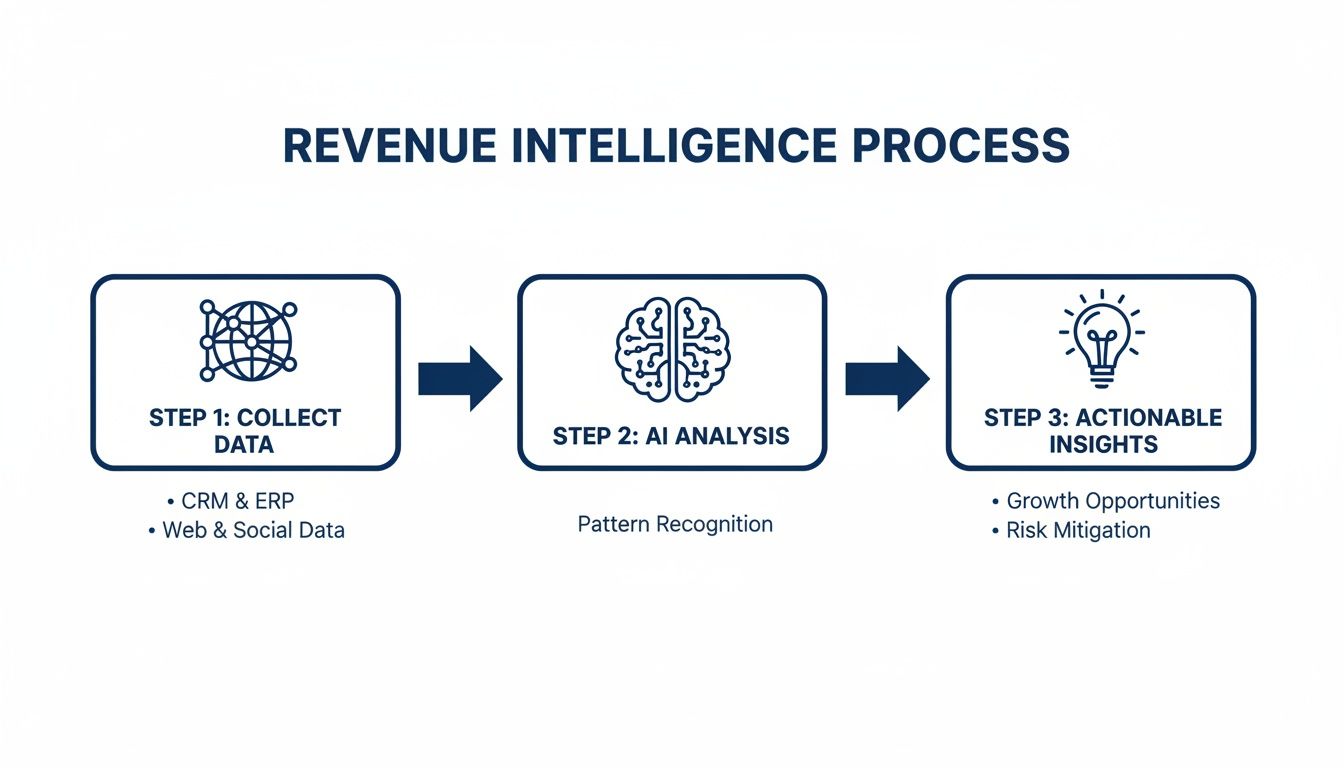
This flow shows how the system moves from collecting widespread data to applying AI analysis, ultimately producing the actionable insights that power modern sales teams.
Turning Raw Data Into Actionable Intelligence
Let's break down how this works with a plausible example. A platform like Salesmotion uses specialized AI Agents to automate this process, turning hours of manual work into real-time, actionable insights.
Each agent has a specific job:
-
The Research Agent: This is your team's dedicated analyst. It builds deep, structured account briefs by pulling from over 1,000 public sources. Instead of just providing a folder of news clips, it delivers an opinionated summary covering a company’s strategic initiatives, competitive landscape, and key stakeholder priorities. This is the kind of prep work that used to take a top rep hours, now done in minutes.
-
The Signal Agent: Think of this agent as a 24/7 watchdog for your most important accounts. It constantly monitors for specific, high-value triggers—like a new CRO hire, a Series C funding announcement, or a competitor's strategic shift mentioned in an earnings call. When a meaningful event happens, it sends an immediate alert to your team via Slack or your CRM, explaining exactly why it matters.
-
The Prospector Agent: This agent closes the loop by turning intelligence into action. It uses insights from the other two agents to help craft personalized, multi-step outreach. Every message is anchored to a real-time signal, ensuring outreach is always relevant and timely. For a deeper dive into the tools that make this possible, check out our guide on sales intelligence software.
This automated workflow is a key reason the revenue intelligence software market is projected to surge from $3,828.4 million in 2024 to $10,702.2 million by 2033. Teams using this technology are no longer just keeping up; they're setting the pace by turning a mountain of manual research into a streamlined flow of opportunities.
Delivering Insights Directly Into Your Workflow
The final, critical piece is delivery. A key function of revenue intelligence software is to push synthesized insights directly into the tools your team already uses every day.
The goal isn't to add another dashboard for your reps to check. It's to embed timely, contextual intelligence directly into their existing workflows—in their CRM, their email, or their Slack channels.
For example, when the Signal Agent detects that a target account just hired a new VP of Engineering, it doesn't just log it somewhere to be forgotten. It can automatically create a task in your CRM for the account executive, send a notification to a dedicated Slack channel, and provide the Prospector Agent with the context to draft a congratulatory outreach email. This seamless integration ensures insights are acted upon immediately, turning intelligence directly into pipeline.

“We're no longer fishing. We know who the right customers are, and we can qualify them quickly. Salesmotion has had a direct impact on pipeline quality.”
Andrew Giordano
VP of Global Commercial Operations, Analytic Partners
From Manual Research to Automated Wins
For any revenue leader, the difference between a high-performing team and an average one often comes down to one word: friction. The daily grind of manual tasks, inconsistent processes, and missed signals drags on your revenue engine. This is where revenue intelligence software changes the game, turning manual burdens into automated wins.

Let’s look at the practical, day-to-day shifts that happen when you move from traditional methods to an intelligent, automated approach. These positive changes solve core operational problems.
Before: The Manual Research Tax
In a typical sales organization, reps spend a shocking amount of time on non-selling activities. A huge portion of this is the "manual research tax"—the hours spent piecing together account information before a call. They bounce between news sites, LinkedIn profiles, and company blogs, hoping to find a relevant reason to connect. This process is not just slow; it's inconsistent. A top performer might spend two hours building a detailed account plan, while a new rep might only find a single, months-old press release, resulting in a team with different levels of preparedness.
After: The AI Research Agent
With revenue intelligence software, this entire process is automated. An AI Research Agent works 24/7, pulling data from thousands of sources like earnings calls, SEC filings, and job postings. It then synthesizes that information into a structured, opinionated brief. Instead of a pile of raw data, your rep gets a clear summary of a company’s strategic initiatives, competitive landscape, and key stakeholder priorities. The manual research tax is eliminated. Every rep, regardless of tenure, starts with the same deep level of insight, freeing them to focus purely on selling. You can read more about the power of automating sales research here.
Revenue intelligence doesn't just give reps data; it gives them a point of view. It synthesizes complex information and explains the "so what," turning hours of manual work into minutes of strategic review.
Before: The Weak "Why Now"
Without a systematic way to track account activity, most outreach relies on generic triggers. Reps send emails based on vague notions like, "I see your company is growing" or simply because an account is on their list. This approach lacks urgency and relevance, leading to poor response rates and wasted effort. Finding a compelling "why now" becomes a matter of pure luck, making pipeline generation unpredictable and difficult to scale.
After: Real-Time Signal Alerts
Revenue intelligence software solves this with a Signal Agent that acts as a 24/7 watchdog for your target accounts, monitoring for high-value events that create timely opportunities.
Consider these plausible transformations:
-
Weak Trigger: "I saw your company is in the logistics space."
- Automated Signal: Alert: Target account just announced a new office expansion in the Midwest, signaling a need for regional operational support.
-
Weak Trigger: "I wanted to connect about your software needs."
- Automated Signal: Alert: Target account's new CIO mentioned 'data consolidation' as a key priority in a recent podcast interview.
These real-time alerts give reps a powerful, concrete reason to engage. Outreach becomes anchored to real events, dramatically increasing its relevance and the odds of starting a meaningful conversation. It turns prospecting from a game of chance into a predictable, signal-driven process.
The ROI of Real-Time Intelligence in Action
Features are great, but results get budgets approved. The real story of revenue intelligence software is its direct, measurable impact on your bottom line. This isn't just about making your team more efficient; it's about generating a powerful return on investment (ROI) that you can take to your CFO.

The proof is in the real-world scenarios where intelligent alerts and automated research connect directly to hard metrics like higher conversion rates, shorter sales cycles, and bigger deal sizes.
Story 1: Winning a Strategic Deal with a Trigger Alert
Picture a mid-market SaaS company in a crowded space. One of their enterprise reps gets a real-time Slack alert from their Signal Agent: a key competitor just announced a major pricing change on their quarterly earnings call. The alert even links to the exact transcript timestamp. Without this tech, that intel might have taken weeks to surface. Armed with this timely insight, the rep immediately re-engages a high-value prospect in late-stage negotiations. She reframes her company’s value proposition around stable pricing and superior long-term ROI. The result? The prospect, concerned about the competitor's instability, fast-tracks the deal and signs a three-year contract. That’s a major win directly attributed to a single, automated signal.
Story 2: Slashing Prep Time and Boosting Win Rates
Now, consider an enterprise sales team at a global tech firm. Their reps were spending an average of four hours per week, per rep, on manual pre-call research. This "research tax" was not just killing productivity; it led to inconsistent prep and generic messaging. After implementing an AI Research Agent, the team gained instant access to automated, opinionated account briefs. These briefs synthesized everything from SEC filings to recent leadership moves, delivering a clear "so what" for each account. This change slashed deal prep time by an estimated 80%. More importantly, reps walked into every meeting with deep, strategic context, leading to a 15% increase in their win rate on competitive deals over just two quarters.
The core value is clear: revenue intelligence transforms real-world signals into measurable pipeline. By automating research and delivering timely alerts, teams scale personalization, win more timely conversations, and drive predictable growth.
This principle is being validated across the industry. For instance, the December 2025 merger of Clari and Salesloft created a massive integrated revenue platform. The combined entity demonstrated a composite enterprise ROI of 398% with a payback period under six months, highlighting the massive financial impact of unified revenue intelligence. Ultimately, a primary goal here is understanding and increasing customer lifetime value, a direct path to a healthier bottom line. You can explore the state of revenue intelligence and its market growth to see how these trends are reshaping sales.
These stories show the powerful ROI that organizations are achieving. Revenue intelligence software directly connects team actions to real outcomes, proving its worth through metrics that matter:
- Higher Conversion Rates: Timely, relevant outreach gets more replies and moves more deals down the funnel.
- Shorter Sales Cycles: Getting the "why now" right gives buyers the urgency to make faster decisions.
- Larger Deal Sizes: Deeper account knowledge helps spot cross-sell and upsell opportunities.
- Increased Rep Productivity: Automating grunt work frees reps to focus on what they do best—selling.
At the end of the day, the ROI isn't just about saving hours. It’s about building a smarter, more agile, and more competitive revenue engine.
“We have very limited bandwidth, but Salesmotion was up and running in days. The template made it easy to load our accounts and embedding it in Salesforce was simple. It was one of the easiest rollouts we've done.”
Andrew Giordano
VP of Global Commercial Operations, Analytic Partners
Choosing the Right Revenue Intelligence Partner
Selecting a partner for revenue intelligence software is a significant decision that goes beyond a feature checklist. The right platform will deliver real results that solve your team's most frustrating sales problems. To make the right choice, you need to cut through the marketing noise and ask the right questions. The goal isn't to buy another tool; you're investing in an automated system that helps your team win more deals.
Evaluate the Breadth and Quality of Data
The intelligence you get is only as good as the data behind it. A great platform pulls from a massive, diverse pool of sources to paint a complete picture of your target accounts.
When evaluating a solution, get specific about its data network. A top-tier provider should monitor thousands of sources, including:
- Financial Disclosures: Earnings call transcripts, SEC filings, and funding announcements.
- Company Communications: Press releases, company blogs, and official social media channels.
- Personnel Changes: Executive moves, new hires in key roles, and department shuffles.
- Third-Party Media: Podcast interviews, industry news, and expert commentary.
This breadth is crucial. A signal from one source might be interesting, but a pattern showing up across multiple sources is genuine intelligence.
The most effective revenue intelligence software synthesizes data from thousands of public and private sources. This separates platforms that offer simple alerts from those that provide deep, contextual insights.
Prioritize Contextual Analysis and the "So What"
Data without context is just noise. The most important thing a revenue intelligence platform can do is analyze that data and explain the "so what" behind every signal. It’s not enough for reps to know a company hired a new CRO; they need to understand why that matters now.
A platform with sophisticated AI, like the agent-based model at Salesmotion, doesn't just flag an event. It provides an opinionated analysis. For example, it can connect a new job posting for "cloud security engineers" with a recent mention of "data center consolidation" on an earnings call, then suggest a specific talk track for your reps. This analysis turns a simple notification into a strategic weapon.
Insist on Seamless Workflow Integration
Even the best insights are worthless if your team can’t access them easily. Modern revenue intelligence software must fit perfectly into the tools your team already lives in.
This means pushing alerts, briefs, and recommendations directly into:
- Your CRM: Automatically updating records, creating tasks, and enriching account data in platforms like Salesforce or HubSpot.
- Your Communication Hub: Sending real-time notifications straight into dedicated Slack or Microsoft Teams channels.
This seamless integration delivers intelligence at the point of action, reducing friction and making adoption natural. You can learn more about picking the right tools in our guide on choosing sales intelligence solutions. When insights show up where reps already work, they become a natural part of the workflow, ensuring your team gets full value from the platform.
Frequently Asked Questions
Here are direct, no-fluff answers to the most common questions about revenue intelligence software.
How Is Revenue Intelligence Different From A Standard CRM?
Think of your CRM as a digital filing cabinet. It’s great for storing customer information and tracking deal stages, but it relies on manual data entry, which often leads to incomplete records.
Revenue intelligence software is an intelligent layer on top of your CRM. It automatically captures and analyzes interactions from emails, calls, and meetings, then uses that intel to enrich your CRM records without manual work.
In short: a CRM tells you what is in your pipeline. A revenue intelligence platform tells you the why and how—analyzing deal health, flagging risks, and predicting outcomes based on real activity.
Will My Sales Team Actually Use This Software?
This is a critical question, and the answer comes down to workflow. Past tools often failed because they forced reps into yet another system. Modern revenue intelligence software avoids this problem.
The best platforms push insights directly into the tools your team already uses:
- Real-time alerts pop up in Slack or Microsoft Teams.
- Automated account briefs appear right inside your CRM records.
- Personalized outreach ideas are sent to your existing sales engagement tools.
Because the software brings insights to the reps—instead of making them go find them—adoption becomes natural. It reduces their busywork and helps them sell smarter, making it a tool they want to use.
How Long Does It Take To Implement A Revenue Intelligence Platform?
Forget the long rollouts of the past. Today’s top revenue intelligence platforms are designed for speed. A solution like Salesmotion can be up and running in days, not months.
The process typically involves connecting to your existing CRM and communication tools through secure, pre-built integrations. Once connected, the AI agents begin analyzing data and delivering insights almost immediately. The goal is a light-lift setup that starts delivering value from week one.
A key benefit of modern revenue intelligence software is its rapid time-to-value. The platform should start solving problems like manual research and weak outreach from the moment it’s activated, without a lengthy setup process.
How Do You Ensure The Data And Signals Are Accurate?
Data accuracy is paramount. A reliable revenue intelligence platform ensures this in two ways. First, it pulls information from a wide, credible set of sources—thousands of public documents like SEC filings and official press releases, not just random articles.
Second, it uses sophisticated AI to cross-reference and validate every signal. A single data point might be noise. But when multiple, independent sources point to the same event—like a new executive hire mentioned on LinkedIn, in a press release, and on a podcast—the system flags it as a high-confidence signal. This multi-source validation filters out noise and ensures your team acts on timely and trustworthy intel.
So, Where Do You Go From Here?
You’ve seen the difference between the old way—manual chaos, missed signals—and the new way: automated clarity. The purpose of revenue intelligence is to turn real-world business activity into a predictable pipeline. It's the answer to the "manual research tax" that consumes your team's time and the high cost of missed opportunities.
This isn't about another dashboard. It's about systematically eliminating the guesswork that tanks forecasts and leads to ineffective messaging. When you deploy smart agents to track what's happening at your target accounts, you give every rep the strategic insight of a top performer. Instead of burning hours digging for a reason to call, they spend their time in high-value conversations.
Think of revenue intelligence less as a software cost and more as a strategic investment in a smarter, faster, and more competitive revenue team. It's about turning account activity directly into growth.
Give Your Team the Advantage
Rather than hoping a rep stumbles upon a compelling "why now," this approach delivers timely, relevant triggers straight into your team’s daily workflow. It ensures every piece of outreach is tied to a real event, so your messaging stands out and connects. This is how you scale personalization without just throwing more people at the problem.
The next step is to arm your team with the intelligence they need to win more of the right conversations and build a pipeline that doesn't evaporate. By activating an intelligent, automated system, you can draw a straight line from your team's daily actions to measurable revenue. The path to a more predictable and powerful revenue engine starts here.
Ready to turn signals into pipeline? See how Salesmotion's AI agents can autonomously build intelligence and drive action for your team. Get started with Salesmotion.