Writing a compelling executive summary isn't just about shortening a long document. It's about capturing its core message and presenting it in a way that’s both concise and powerful. It needs to grab the reader, state the problem, lay out the key findings, and end with clear, actionable recommendations. The goal is simple: give a busy decision-maker everything they need in just a few minutes.
Why Most Executive Summaries Fail and How Yours Will Succeed

Let's be honest: most executive summaries are dense, boring, and get skimmed at best. They often end up as a laundry list of facts and figures, failing to tell a cohesive story. This is a huge missed opportunity. In a world of information overload, a crisp, persuasive summary is more critical than ever, especially for B2B revenue teams trying to cut through the noise.
The problem usually starts when the summary is treated as an afterthought—a chore to check off a list. The result is a document that's too long, too vague, or completely disconnected from what the reader actually cares about. Think of it this way: a detailed map gives you all the data, but a GPS tells you exactly where to turn. You need to be the GPS.
The Strategic Shift from Chore to Tool
Your executive summary isn't just a recap; it's your most powerful tool for grabbing a decision-maker's attention and shaping their next move. The key is to reframe its purpose entirely. It’s not about condensing information. It’s about translating intelligence into a clear, actionable "why now" that moves deals forward.
A great summary bridges the gap between raw data and strategic insight. For sales teams, this means connecting the dots between market signals—like a competitor’s new funding round or a target account’s recent earnings call—and a tangible opportunity for your prospect.
The real purpose of an executive summary is to turn information into strategic insight, giving the reader the tools to understand data and use it to make better decisions. It should tell them what they need to know, not just everything you know.
From Manual Pains to a Clear Solution
Many summaries fall flat because they’re built on tedious, manual research. Reps spend hours digging for context, and the final output reflects that scattered effort. It lacks a strong, central narrative.
This guide will show you how to write an executive summary that is the solution. A well-crafted summary doesn't just present findings; it presents a point of view. It positions your proposed action as the logical answer to a clearly defined problem. By doing this, your summary becomes an indispensable asset that commands attention, sparks urgency, and drives the conversations that matter.
To get you started, here's a quick breakdown of what every impactful executive summary needs. This isn't a rigid formula, but a guide to make sure you're hitting all the right notes.
The Core Components of an Effective Executive Summary
| Component | Purpose | What to Include |
|---|---|---|
| Opening Hook | Grab immediate attention and state the core problem. | A compelling statistic, a direct question, or a bold statement about the reader's main challenge. |
| Problem Statement | Clearly define the business pain or opportunity. | A concise 1-2 sentence explanation of the "why." What specific issue are you addressing? |
| Proposed Solution | Introduce your recommendation or offering. | A high-level overview of your solution, framed as the direct answer to the problem you just stated. |
| Key Findings & Support | Provide the evidence that backs up your recommendation. | Bullet points with the most critical data points, market insights, or research findings. Keep it brief. |
| Financial Implications | Quantify the impact in terms of cost, revenue, or ROI. | Specific numbers and projections. How will this affect the bottom line? |
| Call to Action | Tell the reader exactly what to do next. | A clear, direct next step, like "Approve the Q3 budget" or "Schedule a 30-minute deep-dive." |
Think of this table as your pre-flight checklist. Before you send that summary, a quick scan against these components will tell you if you've built a document designed to persuade, not just inform.
See Salesmotion in action
Take a self-guided interactive tour — no signup required.
Tailoring Your Message to the Decision Maker
An executive summary written for a Chief Revenue Officer has a completely different DNA than one for a Director of IT. One lives and breathes pipeline, bookings, and rep productivity; the other is laser-focused on system uptime, security compliance, and integration costs.
Sending them the same message is a guaranteed trip to the trash folder.
This is why audience analysis is the foundational step most people skip. Before you even think about writing, you have to know precisely who you're talking to, what they care about, and the level of detail they need. It’s the difference between a summary that lands with impact and one that gets deleted on sight.
Identify Your Audience and Their Priorities
First things first: pinpoint your reader. Are you writing for a front-line sales manager, a RevOps leader, or the economic buyer who holds the budget? Each persona has a unique set of pains, priorities, and metrics they’re held accountable for.
Once you know who you're talking to, you can map your key findings directly to their world.
Let's say you've uncovered intel about a competitor's aggressive hiring in a key territory. You wouldn't just state the fact; you'd frame it for the person reading it.
- For a Sales Manager: Frame it around team productivity and territory risk. The message is about the immediate threat to their team's patch and the need for a counter-strategy.
- For a RevOps Leader: Frame it around pipeline health and market penetration. Here, the focus shifts to data, trends, and the potential impact on future revenue forecasts.
You're not changing the facts. You're changing the emphasis to match what keeps your reader up at night. To really nail this, understanding what rhetoric in writing is and how to master it is a massive advantage.
Speak the Language of Your Reader
Every role and industry has its own dialect. A summary for a financial services executive should talk about risk mitigation and compliance. One for a B2B SaaS leader needs to hit on ARR growth and customer acquisition cost.
Using the wrong terminology instantly signals you haven’t done your homework. This is especially true when writing for the ultimate decision-maker, who needs to see a clear line between your insights and the high-level business outcomes they own.
A classic mistake is writing a summary that shows off how much you know. The real goal is to write a summary that shows you understand what they need to know. Make them the hero of the story; your insights are just the tools that help them win.
Think of it this way: your executive summary isn't just a document. It's a conversation starter, and it needs to be persuasive enough to earn you the next meeting.
The stakes are high. A 2023 Diligent study of corporate boards found that 70% of board members base decisions solely on summaries. They’ll flat-out ignore the full report if the summary isn't compelling enough. This just hammers home the need to connect your findings to clear, actionable recommendations.
By taking the time to analyze your audience upfront, you turn your executive summary from a generic report into a targeted, strategic tool—one that not only gets read but also drives the very decision you’re aiming for.

“Salesmotion has been a game-changer for me. I used to spend 12 hours a week on prospect research, now it's down to 4. Plus I'm finding stuff I was totally missing - podcasts, news mentions, the good bits.”
George Treschi
Account Executive, FY25 President's Club, Sigma
Structuring Your Summary for Maximum Impact
Now that you know who you're writing for, it's time to build a structure that delivers your message with force. A powerful executive summary doesn’t just list facts; it tells a compelling story. It follows a narrative arc that grabs the reader, lays out a challenge, offers a solution, and drives them toward a specific action.
Forget rigid, boring templates. Think of your structure as a strategic framework designed to guide a busy executive's thinking. The goal is to make your conclusion feel like their own—an inevitable outcome of the clear, logical path you've laid out.
Start With the Problem and a Powerful Hook
Every great story starts with a hook, and your summary is no different. You need to grab the reader's attention in the very first sentence. Don't waste time with gentle lead-ins like "This summary will cover..." Go straight for the jugular.
Start with the core business challenge or opportunity. This immediately frames the conversation around a high-stakes issue they already care about.
For instance, if you're summarizing account intelligence for your sales leader, you could open with:
"Apex Corp's Q3 earnings call revealed a 15% drop in their flagship product's market share, creating an immediate and urgent opening for our platform to displace their legacy solution."
This sentence does three things at once: it identifies the company, states the critical business problem (market share loss), and directly connects it to a sales opportunity. It creates instant relevance and makes the reader want to know more.
Present Key Findings as the Solution
Once you've hooked them with the problem, your key findings should be presented as the direct answer. This is where you introduce your evidence, but it has to be crisp and selective. Resist the temptation to dump every data point you uncovered.
Use bullet points to present your most impactful insights. This format is scannable and helps the reader quickly digest the important information.
Following our Apex Corp example, your findings might look like this:
- Executive Mandate: Their CEO mentioned "investing in operational efficiency" three times, signaling a top-down mandate that aligns with our core value proposition.
- Hiring Spikes: We’ve identified a 30% increase in hiring for "process automation" roles on LinkedIn over the past 60 days, indicating they are actively trying to solve this problem.
- Competitor Weakness: Their primary competitor lacks the integration capabilities our platform offers, a critical differentiator for an enterprise of their scale.
Each bullet point builds on the narrative, reinforcing the urgency and framing your solution as the logical next step. For a deeper look at how these insights fit into the bigger picture, check out our guide to sales account plans templates.
Weave in the Financial Justification
Executives think in numbers. To make your case compelling, you must connect your findings to a clear financial impact. Whether it's projected ROI, cost savings, or revenue gain, this part of the summary speaks directly to the bottom line.
This section needs to be concise but specific. Avoid vague statements like "improves efficiency." Instead, quantify the benefit.
Continuing with the Apex Corp scenario, you could add:
"Based on our analysis of similar enterprise clients, implementing our solution could reduce their operational overhead by an estimated $1.2M annually, delivering a full return on investment within nine months."
This single sentence transforms your summary from an interesting observation into a concrete business case.
Conclude With a Decisive Call to Action
The final—and most crucial—element is your call to action (CTA). Don't leave the reader guessing what you want them to do next. Your conclusion must be direct, clear, and actionable.
A weak CTA like "Let me know your thoughts" puts the burden back on the executive. A strong CTA removes friction and proposes a clear path forward.
For example:
"Recommendation: I will launch a targeted outreach sequence to their new VP of Operations this week, referencing these specific pain points. Please approve the proposed messaging by EOD Tuesday."
This CTA is specific, time-bound, and requires a simple "yes" or "no" decision. It makes it easy for the leader to act, which is exactly what you need to move the deal forward.
This process of researching, segmenting your audience, and framing your message is crucial for making an impact.
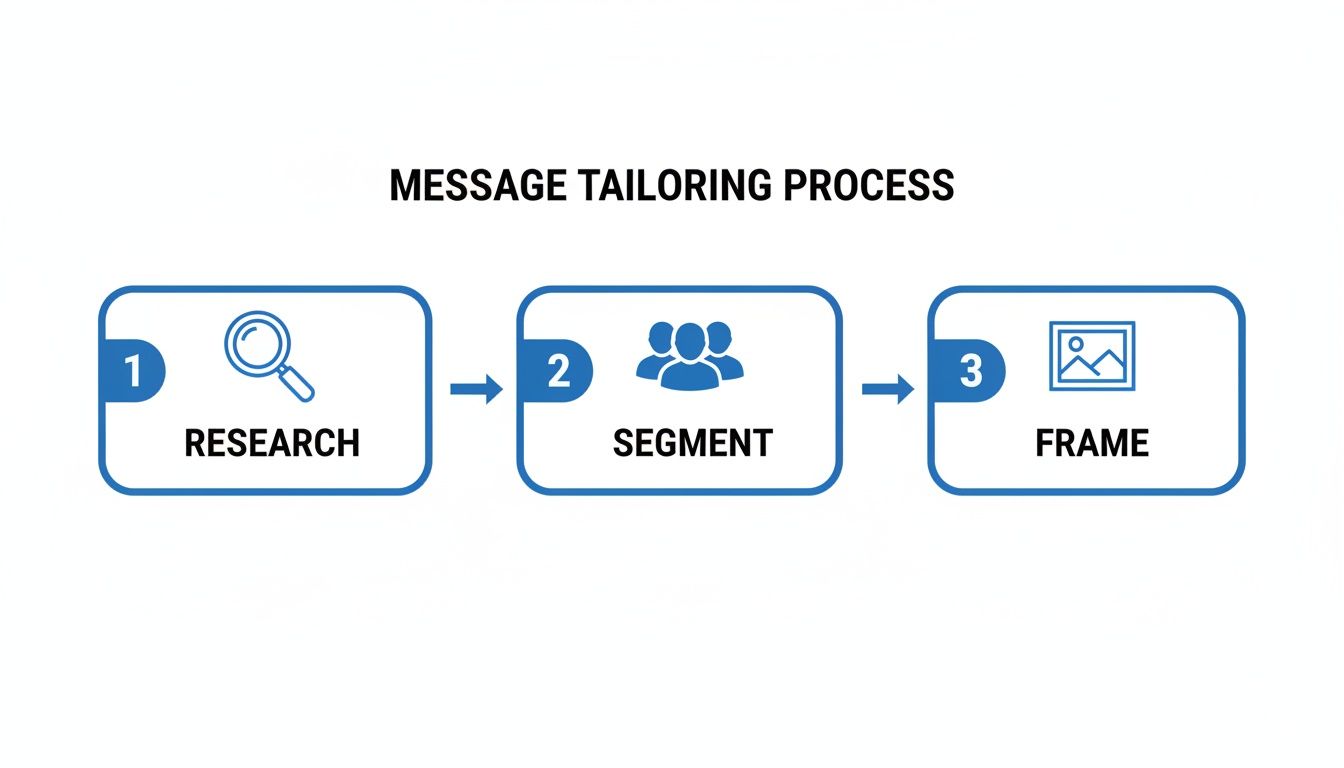
This visual underscores that effective summaries are the result of a deliberate process, not just quick writing.
An effective structure is all about making your point quickly and clearly. The table below breaks down some common pitfalls and how to avoid them.
Executive Summary Structure Do's and Don'ts
| Do This | Don't Do This |
|---|---|
| Start with the most critical takeaway (the "so what?") in the first sentence. | Begin with a generic introduction like "This report summarizes..." |
| Use bullet points and bold text to highlight key data and findings. | Write long, dense paragraphs that are hard to scan. |
| Quantify the business impact with specific numbers (e.g., $1.2M savings). | Use vague phrases like "significant improvements" or "cost-effective." |
| End with a clear, time-bound call to action. | Conclude with a passive question like "What are your thoughts?" |
| Keep the language direct, active, and focused on business outcomes. | Use jargon, acronyms, or overly formal language. |
| Tell a logical story: Problem > Evidence > Financial Impact > Action. | Present facts in a random, disconnected order. |
Ultimately, the structure of your summary should be a testament to its brevity and impact. According to data from business reporting experts, the best summaries are capped at just 5% of the full document's length. This practice respects an executive's most valuable asset: their time. By following this narrative structure, you ensure every word serves its purpose—to drive a decision.
Writing Techniques That Command Attention
A solid structure gets you organized, but it's your writing style that gets your summary read. Once you have the framework in place, it’s time to dial in the words themselves. The goal is to elevate your summary from a dry report to a persuasive document a busy executive can digest and act on in under five minutes.
This means every single word has to pull its weight. There's no room for filler, vague promises, or dense corporate jargon. The right techniques can transform a summary from merely informative to genuinely compelling.
Ditch Passive Voice for Active Authority
One of the fastest ways to inject power into your writing is to use an active voice. It's more direct, punchy, and authoritative. Passive voice often sounds weak and roundabout—the last thing you want when you're trying to drive a decision.
Let’s look at a quick comparison:
- Passive: "A decrease in market share was observed, and a new strategy will be implemented by the team."
- Active: "We observed a decrease in market share and will implement a new strategy."
The active version is shorter, clearer, and takes ownership. It puts the actor first, making your statements feel more dynamic and easier to understand. As you review each sentence, ask yourself, "Who is doing what?" If the answer is buried, rewrite it.
Translate Vague Statements into Concrete Metrics
Executives think in numbers, so your summary has to speak their language. Vague phrases like "improved efficiency" or "increased sales" are essentially meaningless without hard data to back them up. Your job is to swap these generalities for specific, metric-driven language.
Instead of this:
"Our solution will help improve team productivity and generate more leads."
Write this:
"Our solution reduces manual research time by 8 hours per rep, per week, and our data shows it can increase qualified lead volume by 22% in the first quarter."
The second example doesn't just promise value; it quantifies it. These concrete numbers build instant credibility and give the reader a clear picture of the potential business impact. It shifts the conversation from a hopeful promise to a tangible outcome.
For Sales Managers and CROs, mastering this means wielding data like a pro. Sharing well-researched stats—from financial projections to competitive advantages—is non-negotiable. This is backed by reports showing that 65% of revenue teams see these summaries as essential tools for strategic planning. You can explore more insights on crafting executive summaries from Coursera.
Cut the Jargon and Corporate Speak
Every industry has its own lexicon of buzzwords and acronyms, but an executive summary is the wrong place to show them off. Your reader is busy and probably not as deep in the weeds as you are. Using overly technical language or corporate jargon just creates a barrier to understanding.
Pro Tip: Read your summary out loud. If you stumble over a phrase or it sounds like something a robot would say, simplify it. Aim for clarity and professionalism, not robotic formality. The best summaries sound authoritative yet human.
For example, instead of saying, "We will leverage synergistic cross-functional alignments to operationalize key value-adds," just say, "Our marketing and sales teams will work together to launch the new product." It means the same thing, but it’s direct, clear, and respects the reader's time. Clear communication is the foundation for effective outbound lead generation, as it ensures your core message lands immediately.
Fine-Tune Your Professional Tone
Finally, let's talk about tone. You want to sound professional and authoritative without coming across as stiff or robotic. The key is to be confident but not arrogant, direct but not demanding.
Think of your tone as your professional voice on paper. It should reflect a deep understanding of the subject matter and a clear, confident point of view.
Here are a few ways to strike the right balance:
- Use strong verbs: Words like "drive," "accelerate," "reduce," and "create" convey action and confidence.
- State conclusions directly: Don't hedge with weak phrases like "It seems that" or "We tend to believe." State your findings and recommendations with conviction.
- Keep it focused on the reader: Frame your points around their challenges and goals. Using "you" and "your" makes the summary feel more like a broadcast and more like a direct conversation.
By mastering these writing techniques, you ensure your executive summary doesn't just get skimmed—it gets read, understood, and acted upon.

“The Business Development team gets 80 to 90 percent of what they need in 15 minutes. That is a complete shift in how our reps work.”
Andrew Giordano
VP of Global Commercial Operations, Analytic Partners
Executive Summary Examples for Sales Teams
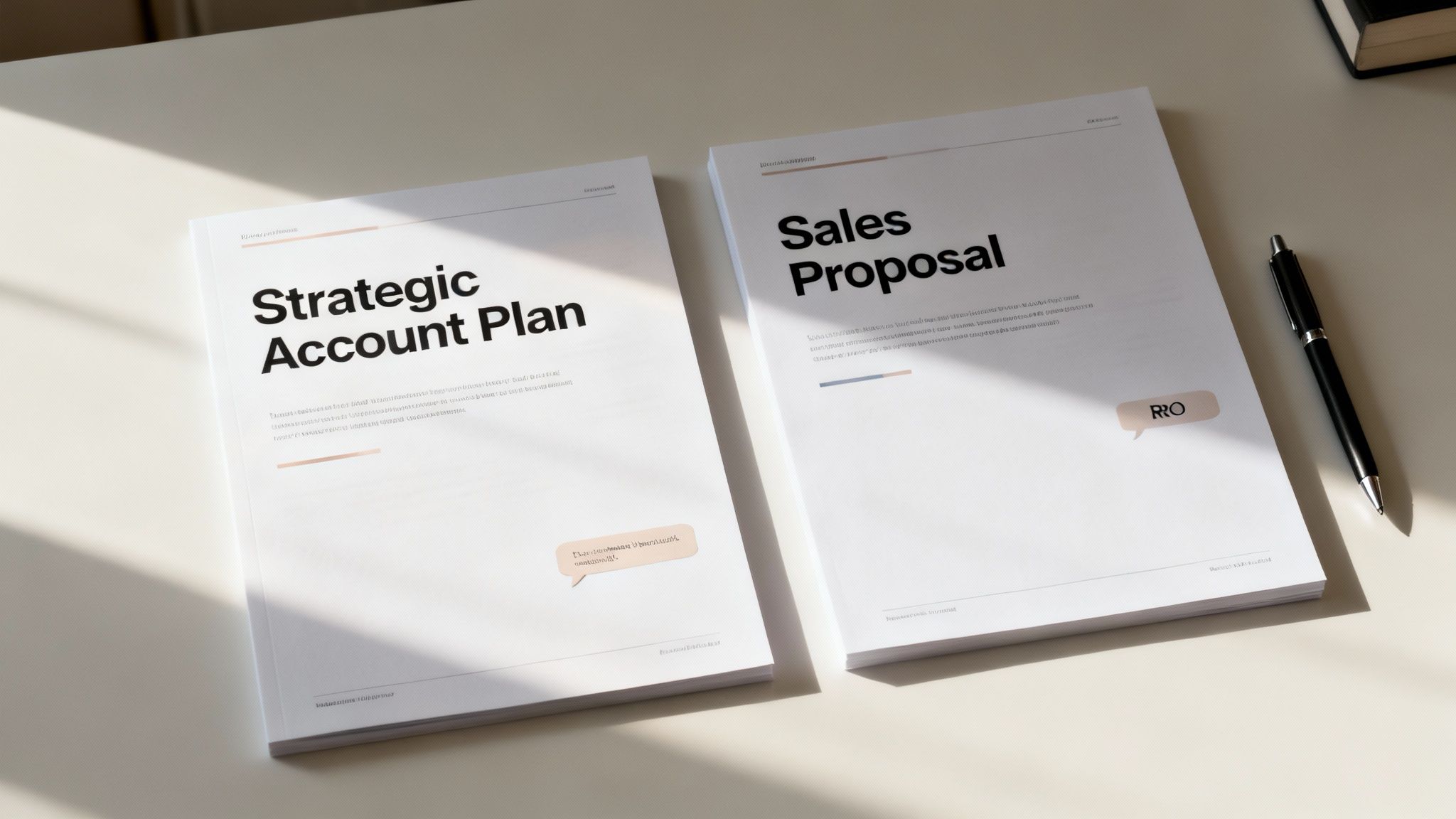
Theory is one thing, but seeing it work in the real world is another. The frameworks and tips we’ve covered really click when you apply them to actual sales documents. In many cases, a sharp executive summary is the only thing standing between a stalled deal and a signed contract.
Let's walk through two annotated examples built for B2B revenue teams. The first is for an internal strategic account plan, and the second is for a formal sales proposal you’d send to a prospect. You'll see how to turn raw intelligence into a clear, compelling call to action.
Example 1: Strategic Account Plan Summary
This first example is for an internal account plan. The job here isn’t to sell a product but to sell a strategy to your sales leader. You need to distill all your research and account signals into a persuasive case for a specific play—in this case, multi-threading into a key account called "Innovate Corp."
Your audience is a busy sales leader who needs a quick, data-backed reason to give you the green light.
Executive Summary: Innovate Corp Account Plan Q4
Challenge & Opportunity: Innovate Corp is a high-value account at risk of stalling. We’re single-threaded, and a new competitor is circling. But there’s a massive opportunity: their recent $50M Series B funding and the hiring of a new VP of Engineering, Jane Doe, gives us a critical window to multi-thread. We can align our platform with their new top-down mandate for "scaling infrastructure efficiency"—a key phrase from their funding announcement.
Key Supporting Intelligence:
- Executive Mandate: In a recent "Tech Forward" podcast, Jane Doe explicitly stated her top priority is to "reduce platform latency by 25%" before their big Q1 product launch. This maps directly to our core value prop.
- Hiring Signals: Their careers page has five new openings for "Cloud Operations Engineers," signaling they're investing heavily in the exact area we support.
- Competitive Gap: Their incumbent provider was conspicuously absent from the funding press release. This suggests they might be on the outs, creating an opening for us.
Proposed Action & Business Impact: We need to launch a targeted multi-threading campaign to engage Jane Doe and her new Cloud Ops team. The immediate goal is to land a discovery call focused on her latency reduction mandate, positioning our platform as the key to their successful launch. We project this will accelerate the deal cycle by 30-45 days and help us land a $75K pilot in Q1.
Next Step: Requesting approval by EOD Friday to launch the outreach sequence targeting Jane Doe, using the podcast insights as our primary hook.
Deconstructing the Account Plan Summary
This summary works because it’s a strategic brief, not a data dump. Every point is handpicked to build a rock-solid case for the proposed action.
- The Hook: It kicks off by stating the risk (stalled deal) and the opportunity (new funding, new hire). That’s instant relevance for any sales leader.
- Data-Driven Points: Instead of vague claims, it uses hard numbers ($50M, 25% latency reduction, five new roles) and direct quotes to build credibility.
- Clear "So What?": It connects the dots. The new hire isn't just a personnel change; she's an entry point with a publicly stated priority that perfectly aligns with what we sell.
- Quantified Impact: The plan doesn’t just ask for permission; it forecasts a specific business outcome—a faster deal cycle and a pilot project.
- Frictionless CTA: The next step is simple, specific, and time-bound. It makes it incredibly easy for a leader to say "yes." This kind of clear, actionable structure is central to the strategies found in our guide to sales playbook examples.
Example 2: Formal Sales Proposal Summary
Now for a client-facing example. This summary would sit on page one of a formal proposal for a prospect, "Global Logistics Inc." Its only job is to convince a busy decision-maker that the rest of the document is worth reading by hitting them with the problem, solution, and value right away.
Executive Summary Prepared for Global Logistics Inc.
Global Logistics is grappling with rising operational costs, with supply chain issues driving a 12% increase in overhead in the last six months. This proposal outlines how the RouteOptimize AI platform will directly address this by cutting your fuel expenditures by 15-20% and reducing delivery delays by up to 30%, all within the first quarter.
Understanding Your Challenge: From our conversations, your team highlighted three core challenges holding you back:
- Inefficient routes burning through fuel.
- A lack of real-time tracking that causes costly delays.
- High driver turnover tied to frustrating schedules.
Our Proposed Solution: We recommend a phased implementation of our RouteOptimize AI platform. This will give your team AI-powered route planning that adapts to live traffic and weather, a unified dashboard for logistics managers, and a simple mobile app for your drivers to ensure smooth adoption.
Expected Business Outcomes: Based on our work with logistics firms of your size, we project the following outcomes for Global Logistics:
- Annual Cost Savings: An estimated $450,000 in reduced fuel and overtime costs.
- Operational Efficiency: A 30% drop in late deliveries, boosting customer satisfaction.
- Return on Investment: A full ROI projected within seven months of going live.
Next Steps: We are confident the RouteOptimize AI platform is the right solution for your current challenges. We recommend scheduling a 45-minute implementation planning session with your operational stakeholders next week to finalize the project timeline.
Deconstructing the Sales Proposal Summary
This summary is all about proving you understand the prospect's world. If you want more inspiration on how different industries handle this, it’s worth checking out various project summary sample formats.
- Starts with Their Pain: The opening sentence leads with their problem (12% cost increase), immediately showing you listened and that you get it.
- Mirrors Their Language: It reflects the "three core challenges" they shared in discovery. This builds trust and proves the proposal isn't a generic template.
- Focuses on Outcomes, Not Features: The summary highlights what they get—cost savings, efficiency, ROI. The tech is only mentioned in the context of how it delivers those results.
- Sets a Clear Path Forward: The "Next Steps" section is a confident, low-friction call to action. It shifts the conversation from "if we should do this" to "when we should start."
By breaking down these examples, you can see how an executive summary becomes a powerful tool—whether you’re building an internal case or persuading a new customer to come aboard.
Key Takeaways
- An executive summary is not a document recap; it is a strategic tool that translates raw intelligence into a clear, actionable "why now" that moves deals forward.
- Structure every summary around four pillars: the hook (problem or opportunity), key findings backed by data, a proposed solution with quantified impact, and a frictionless next step.
- Use plain, direct language with strong verbs and avoid jargon, hedging phrases, or corporate buzzwords that dilute your message and lose the reader.
- Tailor the depth and detail to your audience: an internal account plan summary should sell a strategy to leadership, while a client-facing proposal summary should prove you understand the prospect's world.
- Always write your executive summary as a standalone document, because in most organizations it is the only page that decision-makers will read in full.
Your Questions, Answered
Once you've got the basics down for writing an executive summary, a few practical questions almost always come up. We've all been there—staring at a final draft, wondering about the small details that can make a huge difference. Let's tackle the common sticking points that pop up right before you hit send.
How Long Should an Executive Summary Be?
There's no magic number, but the golden rule is keep it brief. The best executive summaries are almost always one or two pages, max.
A better way to think about it is in proportion to the main document. A good benchmark is to aim for 5% to 10% of the total length of the full report. So, for a 10-page sales proposal, a single page is perfect. For a 50-page strategic plan, two pages might be just right.
The goal isn't to hit a specific word count; it's to respect the reader's time. If you can't make your point in under five minutes of reading, it’s probably too long.
Remember why you're writing it: to get a quick, informed decision. Anything longer defeats the purpose and risks being skipped.
What Is the Right Tone for an Executive Summary?
You're aiming for a tone that is professional, confident, and direct. You’re not writing a casual email, but you also don't want it to sound like a robot wrote it. The goal is to project expertise without coming off as arrogant.
Here are a few quick tips to strike the right balance:
- Use an active voice. It makes your writing punchier and clearer. Say "We recommend..." instead of "It is recommended that..."
- Be decisive. Cut weak language like "we think" or "it seems." You've done the research, so state your findings with conviction.
- Focus on the reader. Frame everything around their problems and the results they can expect. This makes the tone feel collaborative, not just transactional.
Can I Use an Executive Summary as a Standalone Document?
Absolutely. In fact, you should assume it will be.
In many fast-paced companies, the executive summary is the only part of your document that key decision-makers will read. That's why it’s so critical to write it as a self-contained piece. Someone should be able to read just the summary and walk away knowing the problem, your solution, the business case, and the next steps.
This isn't just a hunch; it's standard practice. A survey by the International Association of Business Communicators found that 85% of organizations rely heavily on executive summaries in their reporting. You can learn more by checking out the full report on executive summaries.
So, always write your summary as if it will be detached from the main report and forwarded around the company. It needs to make a complete and compelling case all on its own.
Frequently Asked Questions
Should I write the executive summary first or last?
Write it last. Even though it appears at the beginning of your document, the executive summary should be the final piece you draft. You need the full context of your research, analysis, and recommendations before you can distill them into a concise, compelling overview. Trying to write it first often leads to vague, placeholder language that misses the mark.
How do I write an executive summary when the data is incomplete?
Lead with what you know and be transparent about any gaps. State your strongest findings and recommendations confidently, then flag areas where further research is needed as explicit next steps. Decision-makers respect honesty far more than vague conclusions built on shaky data. Framing gaps as action items also moves the conversation forward.
What is the biggest mistake people make in executive summaries?
The most common mistake is treating the summary as a miniature version of the full document rather than a persuasive argument. Cramming in every detail dilutes the core message and overwhelms the reader. Focus instead on the two or three points that matter most and tie them directly to a recommended action.
How do I adjust the executive summary for different audiences?
Tailor the emphasis, not the structure. For a CFO, lead with financial impact and ROI projections. For a technical stakeholder, highlight implementation feasibility and integration points. For a sales leader, focus on pipeline acceleration and competitive positioning. The four-pillar framework stays the same; you simply shift which data points take center stage.
Tired of reps wasting hours on manual research instead of selling? Salesmotion is an AI-powered account intelligence platform that automates the grunt work. We turn market signals into actionable "why now" moments, so your team can focus on what they do best: winning deals. See how it works at https://salesmotion.io.