A lot of sales teams aren't stuck because reps lack effort. They're stuck because the workflow around the rep is slow.
A strong AE opens the day with good intent, then loses the morning to tabs. CRM notes. LinkedIn profiles. a company press release. a hiring page. maybe an earnings transcript. then Slack pings start, a manager asks for an update, and the rep still hasn't made the call that moves pipeline. That's the reality in a lot of revenue orgs. The problem isn't hustle. The problem is that too much selling time gets burned on research, stitching, and deciding what matters.
That's why sales acceleration software matters now. Not as another dashboard. Not as another sequence tool with a fresh UI. The useful shift is from software that stores activity to software that turns scattered signals into action a rep can use right away.
Why Your Sales Team Is Slower Than It Should Be
A familiar scene often plays out in sales teams. A rep gets assigned a strategic account on Monday morning. By lunch, they've read the website, checked recent news, scanned leadership profiles, opened the CRM, searched for prior emails, and maybe found a podcast appearance from the CIO. It feels productive. It also means half the day is gone before one relevant message goes out.
That's the manual research tax. It shows up everywhere, especially in teams that have bought plenty of tools but still expect reps to do the synthesis themselves. One system tracks engagement. Another stores contact data. A third logs calls. A fourth pushes alerts. The rep becomes the integration layer.
The result is predictable:
- Context is uneven: One rep does deep prep. Another sends a generic note because they're buried.
- Timing gets missed: A meaningful signal appears, but nobody acts while it's still useful.
- Managers get false confidence: The stack looks modern, while the workflow still runs on manual labor.
A lot of leaders recognize this pattern after reading examples of how sales reps waste time on research. The waste isn't abstract. It's daily, repetitive, and expensive in terms of attention.
Sales teams rarely lose speed because they lack information. They lose speed because nobody has turned information into a point of view.
Many “productivity” tools often slow teams down when they add another place to look. If a rep has to gather facts from ten sources and decide what matters on their own, the software hasn't accelerated anything. It has just digitized the mess.
The better model is simpler. The system should do the reading, connect the dots, and surface the reason to act now. When that happens, the rep spends time selling instead of preparing to sell.
Skip the comparison fatigue?
If you're shopping for a sales intelligence tool, here's the short version.
Salesmotion combines account intel, buying signals, verified contacts, and AI-drafted outreach in one tool. From $85/mo, live in an hour, no annual contract.
What Is Sales Acceleration Software Really
Most definitions of sales acceleration software are too broad to be useful. They turn into a shopping list of features. Email automation. lead scoring. analytics. CRM sync. All of that can be true, and still miss the point.
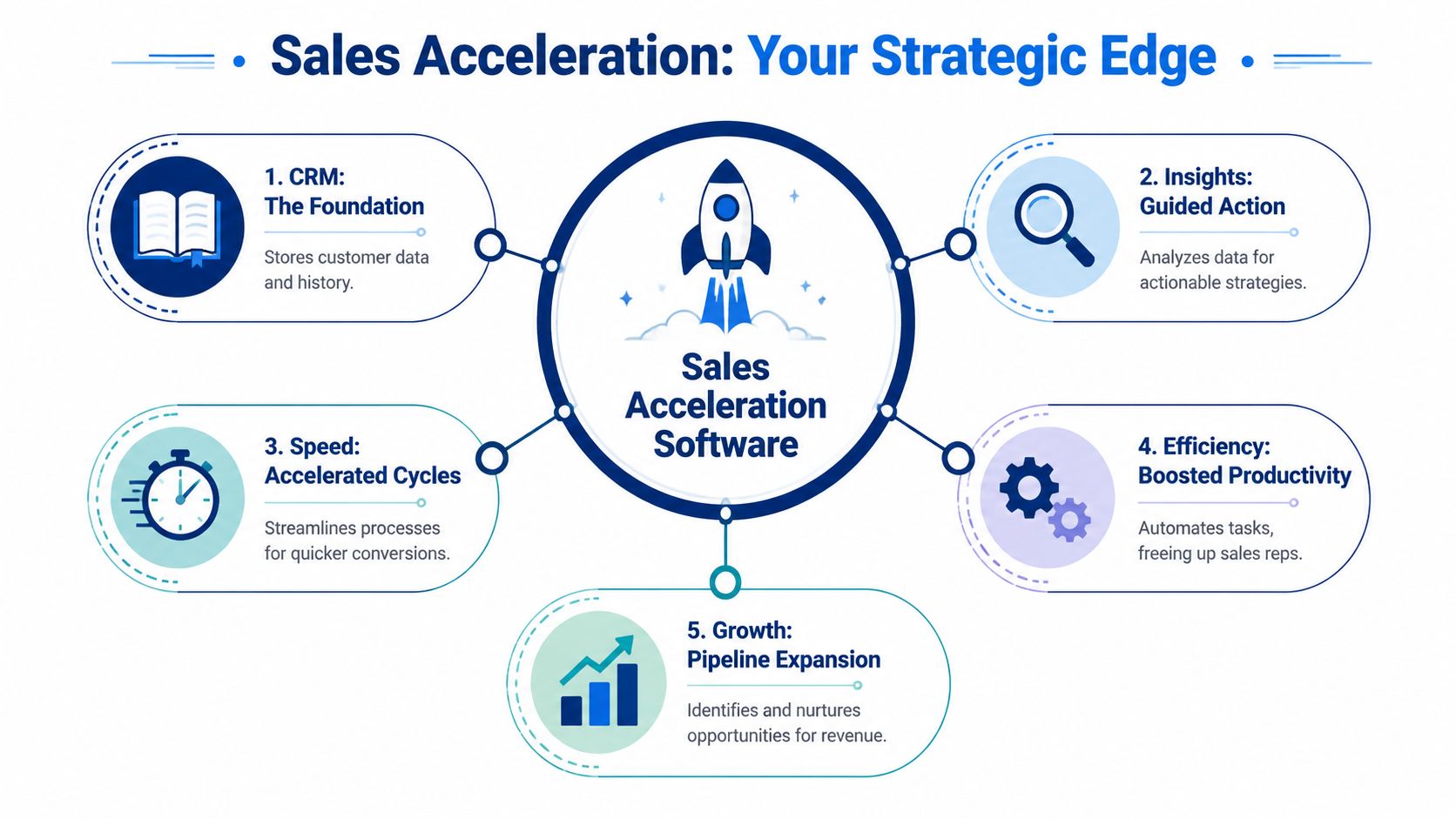
The cleanest way to think about it is this. Your CRM is a library. Sales acceleration software is the research assistant. The CRM stores records, history, and activity. The acceleration layer should read what matters, connect it with outside context, and hand the seller a short, usable brief with a next move.
That distinction matters because a lot of teams confuse data access with sales readiness. Having more records doesn't mean a rep knows why this account matters now, who to contact first, or what message will land.
It's built to close the gap between data and action
At its best, sales acceleration software removes the non-selling work that surrounds every deal. It helps reps see the signal behind the noise. It helps managers direct effort toward accounts with actual momentum. It helps RevOps reduce the number of manual handoffs in the process.
That's one reason adoption keeps growing. The global sales acceleration software market was valued at USD 1.7 billion in 2026 and is projected to reach USD 3.0 billion by 2033, with a 10% CAGR, according to Coherent Market Insights on sales acceleration software market growth. That projection points to a practical trend. Teams want ways to move leads through the funnel faster without adding more admin work.
For readers who want the adjacent category explained well, this breakdown of what sales intelligence means in practice helps clarify where intelligence ends and acceleration begins.
What good software does that basic tools don't
A basic tool tells you something happened. Better software tells you why it matters. The strongest platforms go one step further and suggest the move that fits the moment.
Here's the difference in plain terms:
| Workflow | What the rep gets |
|---|---|
| Toolbox model | Alerts, raw data, activity logs, lots of clicking |
| Acceleration model | Context, prioritization, recommended action, less prep time |
Practical rule: If the rep still has to do the detective work, the platform is support software, not acceleration software.
That's the core job. Shorten the path from signal to conversation. Not by flooding the rep with more inputs, but by reducing the amount of interpretation required before they can act.

“There's been a big focus on hyper personalization and relevance in our outbounding efforts. Salesmotion has been a key partner in hitting our significantly increased meeting targets. What stands out is how simple it is. Reps can log in and get valuable account insights within 30 seconds to a minute.”
Joe DeFrance
VP of Sales, Incredible Health
The Four Core Capabilities That Drive Growth
The useful platforms tend to share four capabilities. Not every vendor packages them the same way, but the business logic is consistent. They detect signals, personalize outreach, fit into the existing system of record, and help teams focus where momentum is strongest.
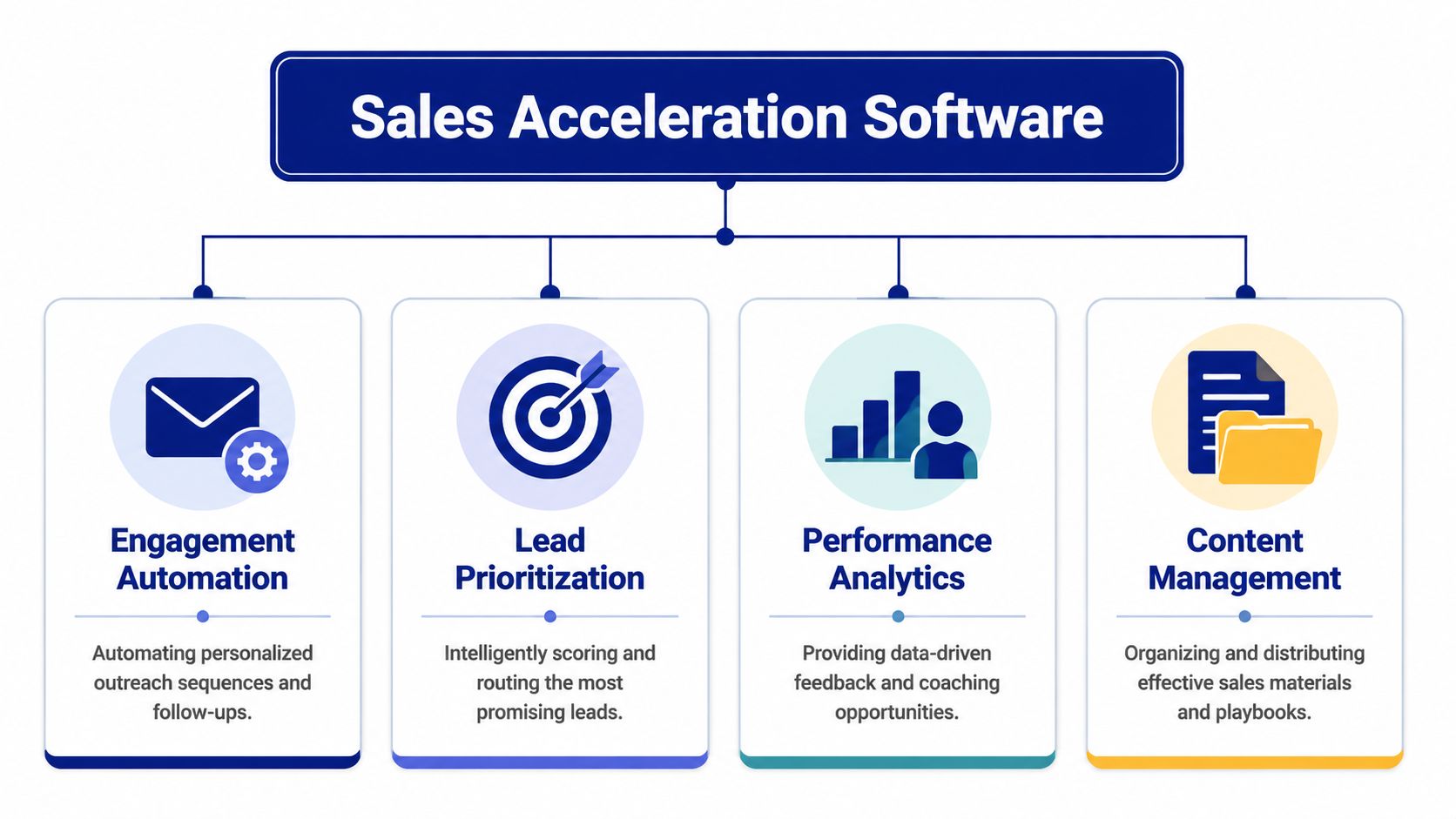
Signal detection and account intelligence
Many teams discern good software from noisy software in this context.
A weak platform pushes a stream of updates. New executive hire. product launch. office opening. earnings mention. That sounds useful until the rep has to interpret every alert alone. A stronger platform ties the signal to a commercial hypothesis. If a company is hiring heavily into a function you serve, the system should explain what that might mean for budget, urgency, or likely stakeholders.
Before, a rep might collect half a dozen snippets and still wonder what email to send. After, they see a concise brief that says: this account is investing in a priority area, this executive likely owns it, and this is the angle worth leading with.
Automated and personalized outreach
Automation is only useful when it improves relevance. Bad automation just scales generic messages faster.
The upside is real when outreach is anchored in live context. Sales acceleration software can help teams reach up to 48% more contacts daily and generate 15% more sales conversations through automated multichannel outreach, according to Chief Executive on sales acceleration and outreach performance. That matters because speed alone doesn't create meetings. Timely relevance does.
For teams exploring this part of the stack, this look at AI outreach workflows for modern sales teams is useful because it centers the workflow, not just the sequence builder.
A practical example: one rep sends “circling back” on day three because that's what the sequence says. Another sends a note tied to a recent hiring push, includes a point of view on the initiative behind it, and follows up on LinkedIn with the same context. Both are automated to a degree. Only one feels informed.
Seamless CRM integration
If the platform creates another silo, adoption drops.
Reps won't live in five systems all day, and managers shouldn't need separate reporting just to understand what's happening. The acceleration layer has to sit on top of the CRM and engagement stack cleanly. It should enrich the workflow, not reroute it.
The before and after is simple:
- Before integration works: Reps copy insights into notes, paste updates into CRM fields, and lose half the value through manual handoffs.
- After integration works: Intelligence appears where reps already work, and actions, notes, and next steps stay connected to the account record.
Analytics and prioritization
Not every account deserves the same effort on the same day. Great teams know this instinctively. Strong software makes that judgment easier and more consistent.
This is less about vanity reporting and more about directing scarce time. Which accounts are showing movement? Which contacts are responding? Which sequences create conversations instead of activity? Which opportunities are quiet for the wrong reasons?
The best prioritization systems don't just score leads. They explain why the account moved up the list.
That's the operational value. Managers can coach against evidence. Reps can stop spreading effort evenly. Pipeline gets built with more focus, not just more volume.
From Sales Pains to Pipeline Gains
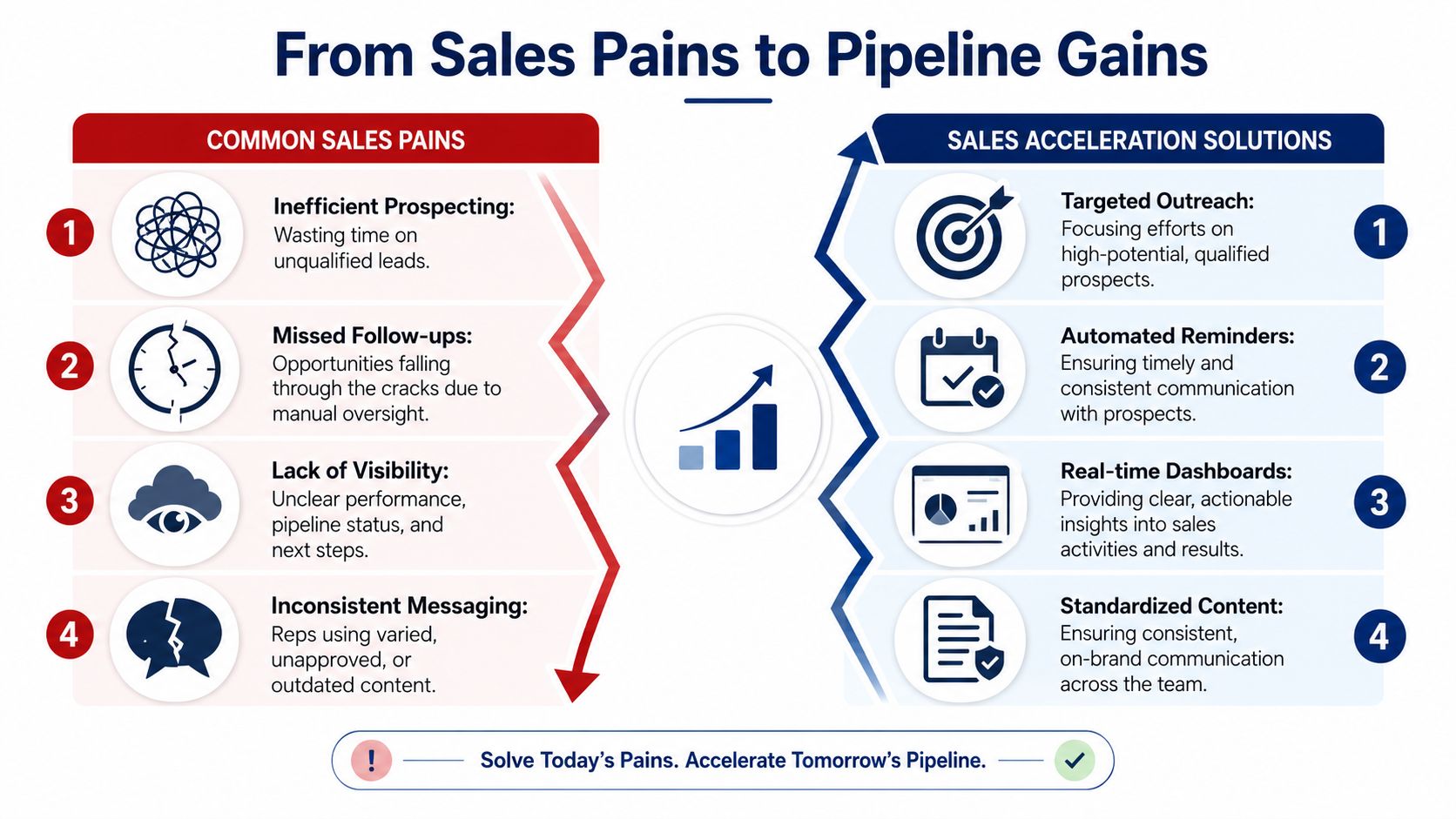
Most revenue leaders don't need another feature tour. They need relief from the recurring pains that slow teams down. The difference between average software and useful software is whether it removes friction or merely gives the friction a cleaner interface.
The cure for manual research drag
A lot of platforms promise intelligence, then hand reps a pile of sources to review. That still leaves the hard part with the seller. Someone has to read the earnings transcript, compare the org chart, scan hiring patterns, and decide what matters.
That's why the shift to agent-driven acceleration matters. As noted in Gynger's perspective on agent-driven sales acceleration, standard tools can hinder the sales cycle by dumping raw data on reps, while the emerging model lets AI do the synthesis. That directly addresses the 2 to 3 hours many reps spend building a brief versus the minutes an autonomous agent needs.
The gain isn't just time back. It's consistency. Every account can get the same level of preparation, instead of only the ones a top rep has time to research thoroughly.
The cure for weak why-now messaging
Generic outreach fails for an obvious reason. Buyers don't care that your sequence says it's time for touch number four. They respond when the message connects to a live business issue.
Signal interpretation demonstrates its value. A new executive appointment, a funding event, a competitor stumble, or a strategic initiative mentioned in public can all create legitimate reasons to engage. But only if the rep gets the context packaged in a way they can use.
A weak system says, “New VP hired.”
A strong system says, “New VP hired into a function tied to your value proposition. Reach out with a perspective on early-team buildout and operational visibility.”
That second version creates a point of view. The first is just trivia.
The cure for signal overload
Signal overload is one of the most common hidden problems in modern GTM stacks. Teams subscribe to alerts, feeds, dashboards, transcripts, and intent tools. Then nobody knows which signal deserves action today.
A useful acceleration platform filters and prioritizes. It reduces rather than expands the rep's decision burden.
Here's the practical difference:
| Pain | What doesn't work | What works |
|---|---|---|
| Too many alerts | Raw feeds pushed to everyone | Ranked signals tied to accounts and timing |
| Low message relevance | Templates with minor personalization | Messaging built from actual account context |
| Inconsistent planning | Each rep researches differently | Standardized briefs with clear talk tracks |
Raw information feels productive. Synthesized information creates movement.
The cure for admin disguised as enablement
This one frustrates managers because it often looks like progress. Reps are active. Systems are populated. Dashboards are full. But the team is doing work around the sale instead of work that advances the sale.
The right software reduces hidden admin. It should help a rep decide faster, message better, and follow up while timing still matters. If it asks the seller to maintain another workflow, classify another signal, or clean up another record by hand, it's adding drag.
Pipeline gains usually start there. Not with magic. With fewer wasted motions between insight and action.

“This is my singular place that very simply summarizes a company's top initiatives, strategies and connects them to my solution. Something I would spend hours researching manually, now it's automated.”
Derek Rosen
Director, Strategic Accounts, Guild Education
Putting It Into Practice Real World Use Cases
Theory is useful up to a point. The ultimate test is whether the workflow changes the rep's day in a noticeable way.

An enterprise AE working a complex account
An enterprise AE is targeting a large public company with a long buying cycle and multiple stakeholders. In the old workflow, the AE would spend the morning pulling together notes from prior calls, checking recent company announcements, reading leadership bios, and trying to infer what initiative could support a compelling first message to a division leader.
In the better workflow, an AI research layer assembles that account brief first. It pulls together recent public statements, hiring direction, executive changes, and strategic themes into a single view. The AE reads one concise brief instead of ten scattered inputs.
The difference shows up in the outreach. Instead of opening with a generic value proposition, the AE sends a note tied to a business initiative surfaced in public commentary and frames the email around a specific operational challenge the target account appears to be tackling. That changes the conversation from “we help companies like yours” to “you're likely working on this priority, and here's where teams usually hit friction.”
Strong enterprise outreach doesn't sound customized because of tokens. It sounds customized because the seller understands the account's current agenda.
A mid-market team reacting to a live market signal
A mid-market manager runs a team that needs timing more than perfect elegance. They win when reps respond fast with enough relevance to start a conversation.
A market signal hits. A competitor serving several target accounts gets negative press. In a manual setup, one or two reps might notice. A manager might mention it in Slack. A few sellers improvise outreach. Most of the opportunity disappears by the next day.
In a stronger setup, the signal gets flagged and interpreted immediately. The system identifies target accounts likely to care, surfaces the reason the event matters, and drafts outreach for the rep to review. The message isn't fear-based or opportunistic in a clumsy way. It acknowledges the risk now visible in the market and offers a concrete alternative path.
The rep still reviews and edits. That part matters. Good automation supports judgment. It doesn't replace it.
What the before and after really feels like
The before state feels busy. Tabs open. Notes everywhere. Good reps carrying too much context in their heads.
The after state feels calmer. The rep starts from a brief, not from a blank page. The manager coaches from actual signals, not just activity counts. The team spends less time figuring out whether to act and more time executing while the window is open.
That's what modern sales acceleration software should feel like in practice. Less searching. More selling.
How to Measure ROI and Choose the Right Platform
If you can't measure whether the platform changes selling behavior, the rollout will drift into opinion. The cleanest ROI conversation starts with process outcomes, not feature adoption.
Measure the movement that matters
A useful baseline includes sales cycle length, which IBM defines as the average time taken to close a deal from initial contact to final sale, with shorter cycles often signaling a more efficient process. IBM also notes that leading indicators such as activity volume and demo bookings help teams understand what's coming, while lagging indicators like revenue show what already happened, in its overview of sales metrics that help teams track efficiency and growth.
That gives you a grounded way to evaluate impact:
- Watch cycle length: If reps get to relevant conversations faster, this should improve over time.
- Track outbound conversion quality: Look at demo bookings and qualified meetings, not just sent emails.
- Review pipeline velocity: Focus on whether qualified opportunities are moving with less delay between stages.
- Separate leading from lagging metrics: Early wins often show up in activity quality before they show up in closed revenue.
For a more detailed framework, this guide on the ROI of sales intelligence tools is helpful because it pushes the conversation beyond surface-level usage stats.
Ask better vendor questions
The buying decision improves fast when you stop asking for feature tours and start asking for proof of reduced manual work.
Use questions like these:
- How does the platform turn raw account data into an opinionated point of view?
- Show me how a rep's manual research workload gets reduced, not shifted.
- Where does the rep receive insights, and how does that fit the CRM and engagement workflow?
- How does the system prioritize signals so reps don't drown in alerts?
- What does a manager see that helps with coaching and account focus?
Buy the platform that shortens the path from insight to action. Skip the one that just gives you more places to click.
That lens keeps the evaluation practical. You're not buying software to collect intelligence. You're buying software to help the team sell with more speed and better judgment.
Your Next Move Toward an Accelerated Sales Engine
The category is moving fast because the problem is real. One industry report projects the sales acceleration platforms software market at about USD 4 billion in 2026, with expectations to reach roughly USD 8 billion by 2028, alongside a 14.2% CAGR for 2026 to 2033, according to this industry outlook on sales acceleration platforms software. That projection matters less as a market headline and more as a signal of where revenue teams are placing their bets.
The winning approach isn't “give reps more tools.” It's “remove more non-selling work.” That's the shift from toolboxes to autonomous agents. A toolbox gives the rep components. An autonomous system gives the rep a usable answer.
If you lead sales, RevOps, or revenue strategy, do one practical audit this week. Pick a sample of active accounts and calculate how much time your team spends on manual research before first outreach or a major meeting. Then review the last few deals where a competitor got in first with a timely message. You'll usually find the same root issue. The signal existed, but your process was too slow to convert it into action.
That kind of audit often connects with broader operating discipline too. If you're thinking about sales acceleration inside a larger profitability lens, Baz Porter's guide to conscious profit acceleration is worth reading because it frames growth around smarter systems, not just more activity.
The future of selling belongs to teams that can detect change early, interpret it quickly, and act with relevance before the moment passes. That's what an accelerated sales engine really is.
If your team is tired of piecing together account context by hand, Salesmotion is worth a look. It uses AI agents to track account signals, build clear research briefs, and turn those signals into outreach your reps can effectively use, without adding another pile of manual work.