At its core, sales automation software is any tool that handles the repetitive, manual tasks that keep your sales team from what they do best: building relationships and closing deals.
But let’s be clear. This isn’t about just scheduling a few emails. Modern sales automation is a strategic system that uses data to surface opportunities and trigger actions, telling your reps exactly when to reach out and why.
Moving Past the Manual Sales Grind

Picture your top account executive burning hours every morning digging through news articles, LinkedIn profiles, and earnings reports. They’re hunting for a single, timely reason to engage a high-value account. This "manual research tax" is a massive drag on productivity that often results in generic outreach that gets ignored.
This is a familiar pain point for B2B revenue teams. Your CRM is great for holding information, but it's fundamentally passive. It acts like a digital filing cabinet, not a co-pilot that tells your reps what to do with the data right now. This forces your team into a reactive state, always playing catch-up instead of driving the conversation.
The Shift to Proactive Engagement
This is where sales automation flips the script. Instead of just storing data, it puts that data to work. Think of it as an intelligent assistant that constantly monitors your target accounts for critical buying signals, then taps your reps on the shoulder when it's the perfect moment to engage.
This shift from reactive data entry to proactive, signal-driven selling is a game-changer, and the market growth proves it. Research shows the sales automation software market is undergoing a fundamental transformation, with projections indicating a compound annual growth rate (CAGR) of 14.6% through 2033. This isn't just about new tools; it's a fundamental change in how complex B2B businesses turn real-world events into revenue.
By automating the tedious work of monitoring accounts and identifying triggers, you empower your reps to focus their energy on high-impact activities—like crafting the perfect message or leading a strategic discovery call.
The impact on performance is clear. When reps are armed with a credible "why now" for every interaction, their outreach becomes hyper-relevant and cuts through the noise. This directly addresses one of the biggest challenges in modern sales.
Improving this one area is a huge step toward boosting overall efficiency in sales. Ultimately, this technology gives your team its most valuable resource back: time.
Skip the comparison fatigue?
If you're shopping for a sales intelligence tool, here's the short version.
Salesmotion combines account intel, buying signals, verified contacts, and AI-drafted outreach in one tool. From $85/mo, live in an hour, no annual contract.
Core Capabilities That Transform Sales Workflows
Sales automation software is built on a simple promise: give your reps back their most valuable asset—time. These aren't just a random assortment of features. They're specific capabilities designed to transform how your team prospects, engages with buyers, and reports on their pipeline.
If a CRM is the library where all your customer data lives, sales automation is the expert librarian. It doesn’t just store the information; it finds the right book, opens it to the exact page your rep needs, and hands it over with a note explaining why it matters right now.
Smarter Prospecting and Prioritization
Modern sales automation is much more than just routing leads. It digs into your data to score and rank accounts based on your ideal customer profile (ICP) and—more importantly—real-time buying signals. Instead of giving every lead the same attention, the software points out which accounts are actually ready to buy.
For example, the software might flag a company that perfectly fits your ICP just as they announce a new round of funding. That account immediately jumps to the top of a rep's list with a clear, compelling reason to reach out, ensuring your team focuses on genuine opportunities, not just a random list.
Trigger-Based Automated Outreach
This is where the magic really happens. Forget generic email blasts. Powerful platforms let you build trigger-based outreach where a real-world event—like a target account hiring a new CIO or announcing an expansion—becomes the catalyst for a personalized, multi-step sequence.
Here’s a plausible example:
- The Trigger: A high-fit manufacturing company in your territory announces a new sustainability initiative on its website.
- The Action: The sales automation software instantly notifies the account executive who owns that account.
- The Outreach: The system automatically suggests a pre-built, three-step email and LinkedIn sequence designed for this specific trigger, which the rep can personalize in seconds and launch.
This approach ensures every message is timely and relevant, dramatically increasing your odds of getting a response.
Actionable Reporting and Analytics
Gut feelings don't build a predictable revenue engine, but data does. Good sales automation software delivers clear, actionable reports that show leaders what's working and what’s falling flat. It gets you past vanity metrics like "emails sent" and focuses on the outcomes that actually matter.
Great reporting answers the tough questions: Which outreach sequences are booking the most meetings? Which buying signals are tied to the fastest deals? Where are the biggest risks in our pipeline?
This is the kind of insight that lets you double down on what works and fix what’s broken. To truly escape the manual sales grind and systematize your process, it's worth exploring programmatic options, including powerful SaaS marketing automation tools that provide the backbone for a data-driven sales motion.

“The moment we turned on Salesmotion, it became essential. No more hours on LinkedIn or Google to figure out who we're talking to. It's just there, served up to you, so it's always 'go time.'”
Adam Wainwright
Head of Revenue, Cacheflow
Turning Signal Overload Into Actionable Intelligence
The biggest problem for most B2B sales teams isn't a lack of information. It's a flood of it.
Your reps are drowning in a constant stream of news alerts, social media updates, and random data points, struggling to figure out what actually matters. This "signal overload" leads directly to missed opportunities and painfully generic outreach because reps can't find a credible reason to engage right now.
This is where modern sales automation software completely changes the game. It acts as a powerful filter, using AI to sift through all that noise and pinpoint the signals that represent genuine, timely opportunities. The software provides the crucial "so what?" layer, turning a mess of raw data into focused account intelligence.
This process is about turning a chaotic flow of information into a structured, repeatable system for finding and winning deals.
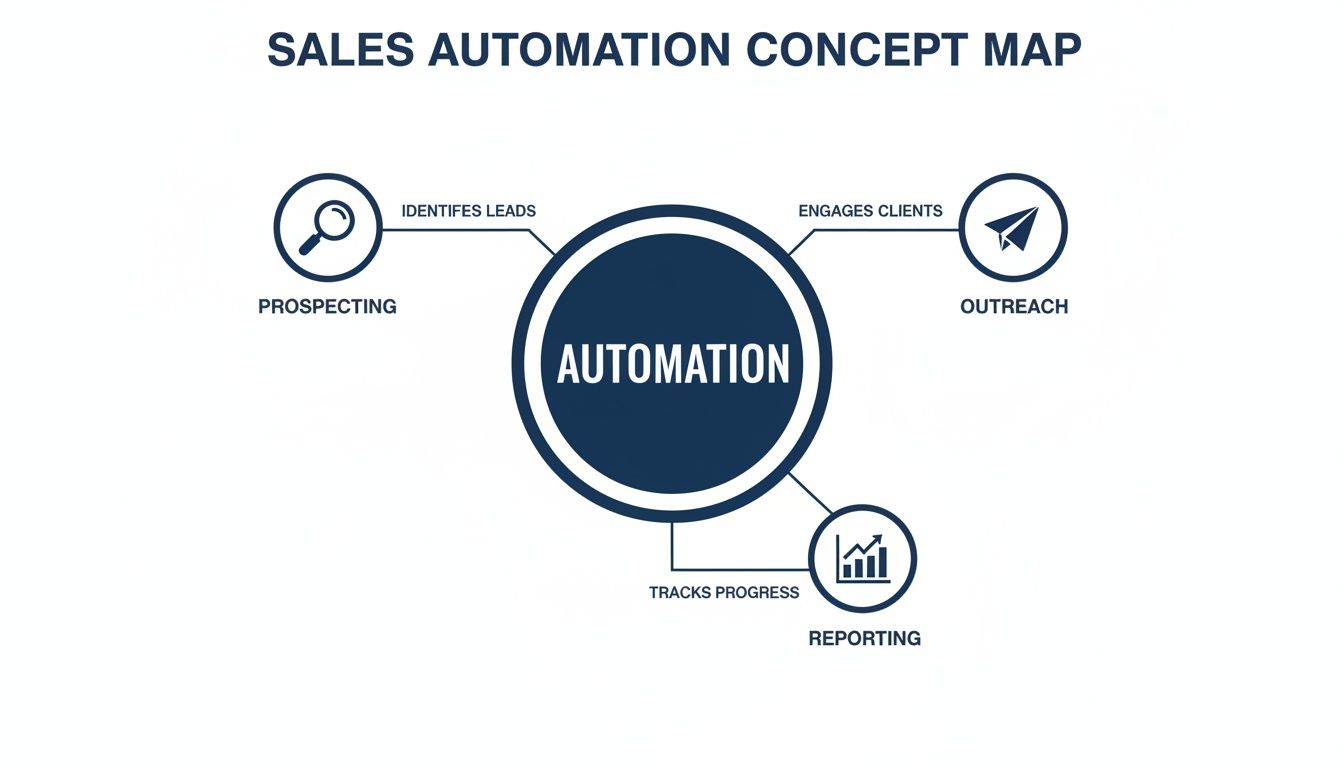
Instead of just reacting to whatever pops up, your team can proactively engage the right accounts based on specific, well-timed triggers.
From Raw Data to a Credible Why Now
Account intelligence is all about understanding the context behind the data. The right software doesn't just tell you that something happened; it explains why it matters to you and your customer. It pinpoints the exact moment an account flips from "maybe later" to "ready to talk."
Think about these common triggers that a platform like Salesmotion can automatically identify and interpret for your team:
- Executive Moves: A new CIO is hired, which almost always signals a potential shift in tech strategy and budget allocation.
- Funding Rounds: A target company secures a major investment, unlocking new capital for the exact kinds of projects you can support.
- Regulatory Shifts: New compliance rules create an urgent, non-negotiable need for solutions that help companies adapt.
- Product Launches: A major new product release often means they need to scale their infrastructure or services to support it.
These triggers provide a credible "why now" for every conversation. Your outreach instantly moves from a cold, easy-to-ignore interruption to a timely, relevant touchpoint that adds value from the first sentence.
It's for this exact reason that the market for these tools is exploding. According to research from GlobeNewswire, the global sales process automation software market is forecast to grow significantly, driven by the need for efficiency in complex industries like healthcare and financial services, where spotting critical triggers is essential to consultative selling.
By solving the painful problem of generic outreach, this software directly fixes a core weakness in most sales organizations. It gives reps a way to prioritize accounts intelligently and engage with a compelling, data-backed narrative every time. To go deeper, check out our guide on how to use buyer intent data to your advantage.
How Automation Drives Success in Complex B2B Industries
It’s one thing to talk about the benefits of sales automation software in theory. It's another to see it work in the real world. In complex B2B sales—where deals are large and sales cycles are long—getting the right information at the right time is everything.
This is where automation flips the script. It stops reps from guessing and reacting, and instead lets them build a proactive, signal-based strategy. The difference isn't just about being a little faster; it's about creating entirely new, higher-quality opportunities.
Let's look at how this plays out with some real, plausible examples.
A Scenario in Life Sciences
Imagine a sales rep selling manufacturing services to pharmaceutical companies. They have their eye on a promising biotech firm that’s working on a breakthrough drug.
-
Before Automation (The Manual Way): The rep might remember to check the biotech’s news feed once a month. By the time they see the company got positive clinical trial results, weeks have already passed. Their outreach is late, generic, and gets buried under dozens of other vendors saying the exact same thing.
-
After Automation (The Intelligent Way): The rep's sales automation platform is tracking this account. The moment those positive trial results are published, the system fires off an instant alert. It even includes an AI-generated brief explaining the "so what"—this success means the company will need to scale up manufacturing, and soon. The rep immediately sends a hyper-relevant message about scaling their next research phase, getting there first with the perfect solution.
This is the power of turning a faint signal into a clear opportunity. To go deeper, you can learn more about how to apply sales intelligence for life sciences and get a real competitive edge.
A Scenario in B2B SaaS
Now, picture an account executive selling enterprise-grade customer support software. They’re targeting a large company that’s currently locked in with a well-known competitor.
- Before Automation (The Slow Reaction): The AE stumbles on a few negative online reviews complaining about their competitor's support quality. They spend time manually gathering evidence, but by the time they build a solid case and reach out, the target account is already in deep talks with another vendor who moved faster.
In B2B sales, timing isn't just a factor; it's often the deciding factor. Automation ensures you are always acting on the most current and relevant information.
- After Automation (The Proactive Play): The sales automation tool is constantly scanning social media, review sites, and news outlets for competitor mentions. It detects a rising tide of complaints about customer service and automatically flags it for the AE. The system even suggests a value-focused outreach sequence that highlights their own company's superior support metrics. The AE launches a timely, evidence-backed campaign right when the prospect’s pain is at its peak.
“Automatic account profile detail I can use to manage my territory. Using Salesmotion AI to generate value statements per persona, account, etc. Using Salesmotion to give me a starting point based on new hires, or news alerts is critical.”
Adam Wainwright
Head of Revenue, Cacheflow
How to Choose and Implement the Right Software
Picking and rolling out new sales automation software can feel like a massive undertaking, but a structured approach can turn a daunting project into a strategic win. Don't get lost in long feature lists. Instead, start with your team’s biggest headaches.
Is your team burning hours on manual research? Is your outreach falling flat because it's missing a credible "why now?" Nailing down these specific problems first means you'll judge software on the problems it actually solves, not just the bells and whistles it offers.
Define Your Core Requirements
Before you sit through a single demo, map out your must-haves. A successful rollout hinges on how well the new tool fits into the way you already work.
-
Integration Capabilities: Your sales automation platform has to play nicely with your CRM. It’s the engine of your entire sales motion, and a bad integration creates data silos that force reps right back into mind-numbing manual work. When you're looking at options, consider the best CRM software to ensure your foundation is solid.
-
Usability and Adoption: The most powerful software on the planet is useless if your team refuses to use it. You're looking for a clean, intuitive interface that reps can pick up quickly without weeks of training. If it feels like another chore, it's going to be ignored.
The market for this technology is growing at a healthy 12.5% CAGR, which shows how much companies are pushing for more efficiency. Research from HTF Market Intelligence confirms this trend, highlighting that many organizations are expanding their tech stack to get smarter with signal-based scoring and turn triggers like executive moves into real outreach opportunities. You can read more on these market trends on htfmarketinsights.com.
Measure Success and Avoid Pitfalls
Once you're live, you have to measure what matters. Forget about tracking vanity metrics like calls made or emails sent. You need to focus on outcomes that actually drive revenue.
Focus on KPIs that reflect real business impact. Key metrics to watch include pipeline velocity, meeting conversion rates, and average deal size. These numbers will tell you if your investment is actually paying off.
One of the most common traps to avoid is bad data hygiene. Automation needs clean, accurate data to work. If your CRM is a wasteland of duplicates and old information, the software will just automate a mess. A full data cleanup before you go live isn't just a good idea—it's non-negotiable if you want to see a strong return on your investment.
The Future of Sales Is Automated, Relevant, and Human

Let's be direct: sales automation isn't about replacing your best salespeople. It's about augmenting them. The future of complex B2B sales lies in a powerful partnership between AI-driven efficiency and human-led strategic conversations.
When you use sales automation software to handle the 'what'—the data, the signals, and the endless manual tasks—you empower reps to finally master the 'how'. This frees them to build genuine trust, solve nuanced customer problems, and ultimately close bigger, more complex deals.
A Partnership for Predictable Growth
This symbiotic relationship is where predictable, scalable revenue growth is born. Think of it as giving every rep an expert research assistant who works 24/7, filtering out noise and flagging only the most timely and relevant opportunities.
The true value of automation is not in doing the work for the salesperson, but in freeing them to do the work that only a human can.
Tools that eliminate the "manual research tax" and deliver a credible 'why now' for every interaction are no longer a luxury. For teams looking to succeed in 2026 and beyond, they are the engine that powers a modern sales motion. An AI sales agent is a perfect example of how this technology amplifies human skill.
This allows your reps to move from being data analysts to strategic advisors. The software provides the intelligence; the salesperson provides the wisdom, empathy, and relationship-building skills that turn that intelligence into revenue. It’s the combination of automated relevance and human connection that wins deals.
Frequently Asked Questions
As you explore what sales automation can do, a few common questions always come up. Let's tackle them head-on so you can get your team aligned and pointed in the right direction.
How Is Sales Automation Software Different From A CRM?
It's easy to confuse these two, but they play very different roles. Think of your CRM as your system of record—it’s the database where all your customer information lives. It’s great for keeping things organized, but it’s fundamentally passive.
Sales automation software, on the other hand, is a system of action. It plugs into your CRM, takes all that data, and uses it to proactively kick off workflows, flag new opportunities, and surface buying signals in real time. Your CRM tells you who the customer is; automation tells you why you should talk to them right now.
Will Automation Create Robotic And Generic Messaging?
This is a common fear, but it’s based on an outdated idea of what automation does. The goal isn’t to blast out thousands of identical, soulless emails. It's the exact opposite.
Good automation uses account intelligence to give every interaction a powerful dose of context.
By automatically identifying key events—like a new funding round or an executive hire—the software gives your reps a specific, compelling reason to reach out. This allows them to craft personalized, human-centric messages at scale, making outreach more relevant, not more generic.
What Is The Typical ROI We Can Expect?
The return on investment from sales automation breaks down into two main buckets: making your team more efficient and making them more effective.
On the efficiency side, reps can reclaim significant portions of their day. Studies show that sales teams can reduce the time spent on manual account research by as much as 60%, freeing them up to focus on what they do best: building relationships and selling.
Then come the effectiveness gains. When your reps are armed with timely insights, they book more meetings, shorten sales cycles, and build a much healthier pipeline. These aren't just small tweaks—they're fundamental improvements that drive real, top-line revenue growth.
Ready to turn signals into revenue? Salesmotion is an AI-powered account intelligence platform that tracks what matters across your target accounts and turns real-world triggers into actionable sales opportunities. See how you can build a smarter pipeline and empower your team by visiting https://salesmotion.io.