Expansion revenue is the most underworked pipeline in B2B sales. According to McKinsey's analysis of 100+ B2B SaaS companies, top-quartile companies achieve 113% net revenue retention, meaning they grow 13% annually from existing customers alone, without closing a single new logo. Bottom-quartile companies sit at 98%, slowly shrinking. The difference is not product quality or customer satisfaction scores. It is whether the company systematically monitors and acts on expansion signals, or leaves growth to chance.
TL;DR: Most sales teams treat existing accounts as "managed" and focus new pipeline energy on new logos. This is a strategic mistake. Expansion revenue costs 3-5x less to close than new business, and the signals that indicate expansion readiness (hiring surges, new initiatives, leadership changes, earnings guidance, tech stack shifts) are publicly available. The teams that build a systematic signal monitoring practice for their installed base grow faster and more efficiently than those chasing only net-new logos.
Why Expansion Gets Deprioritized
The incentive structure in most sales organizations is biased toward new logos. New business gets the president's club trips, the gong rings, and the biggest accelerators. Expansion is treated as account management, customer success, or worse, assumed to happen automatically because the customer is already happy.
Here is what that bias costs:
- Expansion deals close at 2-3x the rate of new business. The trust is already established. The procurement process is familiar. The legal review is faster. According to a Bain & Company study, a 5% increase in customer retention produces more than a 25% increase in profit.
- Expansion ACV is typically higher. The customer already knows your platform. They are adding users, departments, or use cases, not evaluating from scratch. Average expansion deals are 30-40% larger than initial contracts because the risk objection is already resolved.
- Churn risk decreases with expansion. Customers who expand are 60-70% less likely to churn than those who remain flat. Every expansion is a retention event.
The problem is not that sales leaders do not understand this math. The problem is that expansion signals are harder to spot than new-logo signals, and most teams do not have a systematic process for monitoring them.
See Salesmotion on a real account
Book a 30-minute demo and see how your team saves hours on account research.
The Five Expansion Signals That Matter Most
Not all account activity signals expansion readiness. The key is distinguishing between signals that indicate growth (opportunity) and signals that indicate risk (churn). Here are the five expansion signals that most reliably predict upsell and cross-sell opportunities.
1. Hiring Surges in Departments You Serve
When an existing customer posts 5-10 new roles in a department that uses your solution, they are scaling that function. More people means more seats, more use cases, and more budget. This is the highest-confidence expansion signal because it directly correlates to headcount growth in your buyer's domain.
What to look for: Job postings for roles that match your buyer persona, especially in clusters (3+ related roles in a 30-day window). Also look for seniority escalation: if they are hiring a VP-level role in a department where your champion is a Director, a new decision-maker is entering the picture.
2. New Strategic Initiatives Announced Publicly
Earnings calls, press releases, and executive interviews often telegraph expansion opportunities months before the customer raises their hand. When the CEO announces a "digital transformation program" or "go-to-market expansion into APAC," the teams executing those initiatives will need more tools, more data, and more capability.
What to look for: Earnings call mentions of initiatives in your solution's domain, press releases about new business units or market expansions, and executive keynotes at industry conferences where the customer outlines their roadmap.
3. Leadership Changes in Key Departments
A new VP of Sales, a new CRO, or a new Head of Revenue Operations typically re-evaluates the tech stack within their first 90 days. For existing customers, this is a double-edged signal. It is an expansion opportunity if the new leader wants to go deeper with proven tools. It is a churn risk if they have existing vendor relationships they prefer.
What to look for: Leadership changes at the VP+ level in departments where you have existing users. Prioritize changes where the incoming leader comes from a company that does not use a competing solution, as they are more likely to expand with your platform.
4. Earnings Guidance and Financial Health Signals
A company beating earnings estimates and raising guidance has budget confidence. A company missing estimates and cutting guidance is tightening spend. Both are useful signals, but they drive different expansion motions:
- Positive guidance: Propose expansion proactively. "Your Q3 beat suggests the sales team is performing, and adding account intelligence to your APAC team could accelerate that momentum."
- Negative guidance: Propose consolidation. "Given the efficiency focus your CFO outlined, consolidating from five research tools to one could reduce your SG&A in sales operations."
5. Technology Stack Shifts
When an existing customer adopts a new CRM, switches marketing automation platforms, or implements a data warehouse, they are restructuring their technology ecosystem. Every tech shift creates integration opportunities and workflow gaps that your solution might fill.
What to look for: Job postings for platform-specific roles (e.g., "Salesforce Administrator" suggesting a CRM migration), press releases about technology partnerships, and vendor announcements that name your customer as a new client.

“Automatic account profile detail I can use to manage my territory. Using Salesmotion AI to generate value statements per persona, account, etc. Using Salesmotion to give me a starting point based on new hires, or news alerts is critical.”
Adam Wainwright
Head of Revenue, Cacheflow
Building a Systematic Expansion Monitoring Process
Knowing which signals to look for is step one. The harder problem is monitoring those signals across 50-200 existing accounts without it consuming your entire week. Here is a practical approach.
Tier Your Installed Base
Not every customer deserves the same monitoring intensity. Tier your accounts based on expansion potential:
| Tier | Criteria | Monitoring Cadence |
|---|---|---|
| Tier 1 (Top 20%) | Highest ACV, strong champion, multiple departments, positive usage trends | Weekly signal review |
| Tier 2 (Next 30%) | Moderate ACV, single department, renewal upcoming, moderate usage | Bi-weekly signal review |
| Tier 3 (Bottom 50%) | Smaller ACV, limited expansion potential, stable usage | Monthly signal review, automated alerts only |
Set Up Signal Monitoring
For each tier, define which signals trigger action:
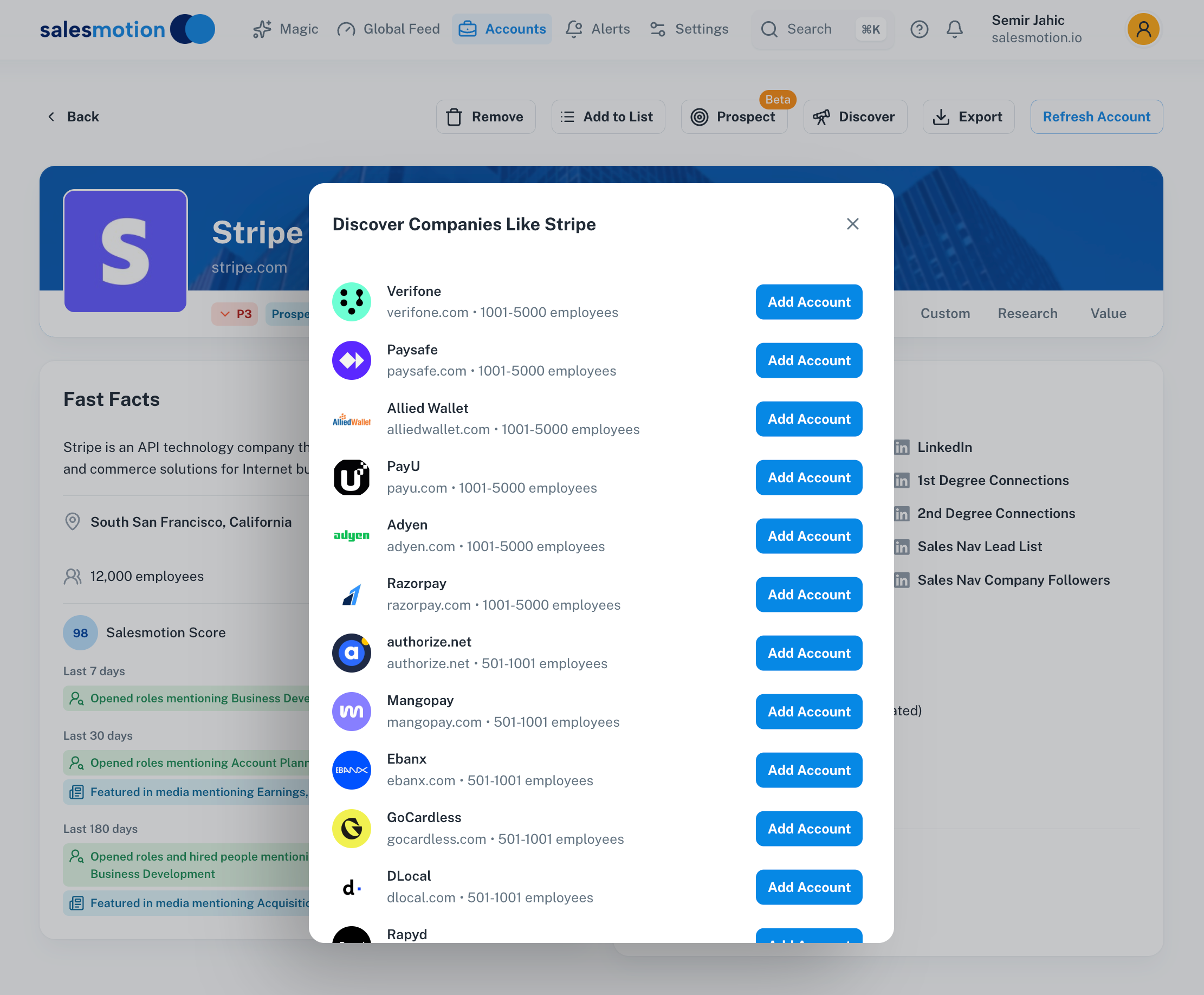 Discover Similar Companies helps you identify expansion patterns by finding accounts with characteristics that match your best existing customers.
The Discover Similar Companies feature is particularly powerful for expansion because it surfaces accounts in your installed base that share characteristics with your highest-ACV customers but have not yet expanded. If your top customer is using your platform across three departments and a similar-profile customer is only using it in one, that is a quantified expansion opportunity.
Multi-Thread Before You Need To
The biggest expansion killer is single-threading. When your only contact at an existing account leaves, gets promoted, or deprioritizes your platform, the entire relationship is at risk. Expansion requires relationships across multiple departments and seniority levels.
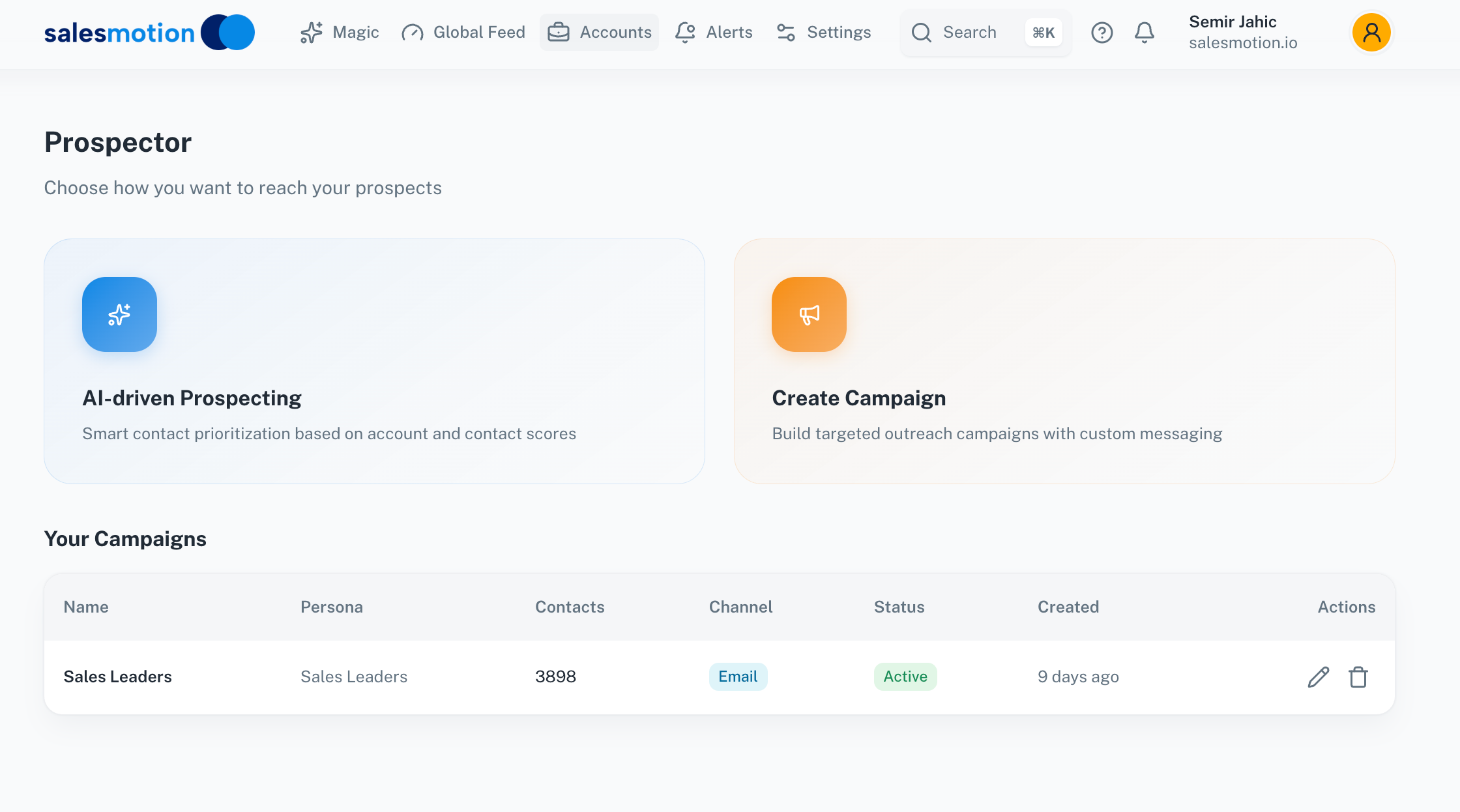 The Prospector helps AEs identify and engage new stakeholders within existing accounts, enabling multi-threaded relationships that protect and grow the account.
Proactive multi-threading means building relationships in adjacent departments before you have an active expansion deal. When the expansion signal fires, you already have a warm contact in the new department rather than starting cold inside an account where you are theoretically "already a customer."
The Expansion Conversation: Different From New Business
Expansion conversations follow different rules than new business conversations. Your existing customer already knows your product. They do not need a demo. They need a reason to invest more.
Here is an expansion conversation framework:
- Acknowledge the current relationship. "You've been using our platform for account research in your North America team for 18 months. Here is what we're seeing in your usage data."
- Share the signal. "I noticed your company just announced expansion into EMEA, and you've posted 8 new sales roles in London and Berlin."
- Connect the value. "The teams that expand with us into new regions typically see 30% faster ramp for new hires because the account intelligence is already built."
- Quantify the opportunity. "Based on your current usage, adding your EMEA team would deliver an estimated X hours of research time savings per week across those 8 new reps."
- Propose next steps. "Would it be helpful to review what a regional expansion looks like? I can share how Frontify scaled from North America to global with us."
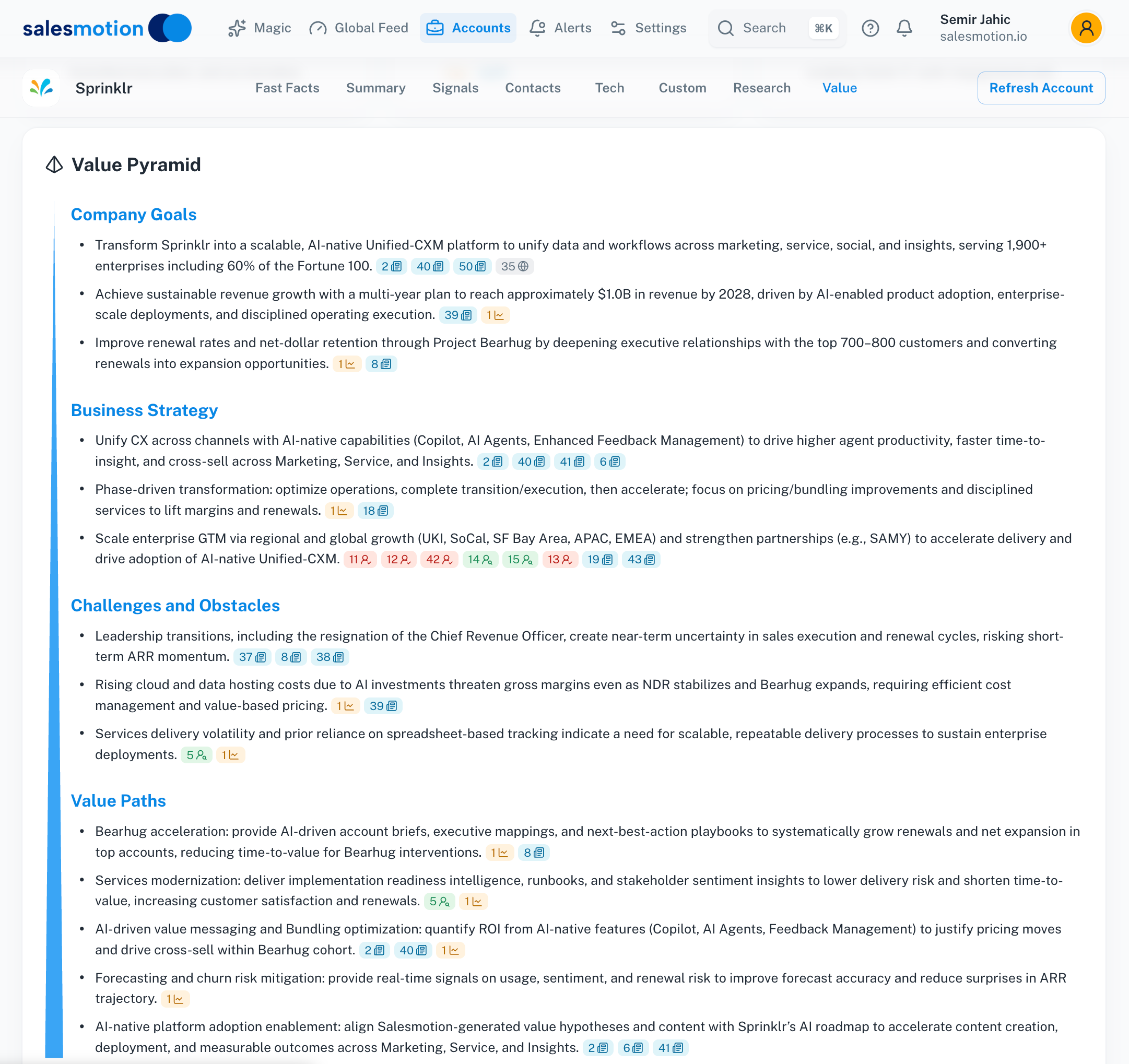 Use the Value Pyramid to frame expansion conversations around strategic outcomes, not feature additions. Show how deeper adoption moves the customer from operational efficiency to competitive advantage.
The key difference from new business: you have data. Usage patterns, engagement metrics, and results from their current deployment are your strongest proof points. Use them.

“We're no longer fishing. We know who the right customers are, and we can qualify them quickly. Salesmotion has had a direct impact on pipeline quality.”
Andrew Giordano
VP of Global Commercial Operations, Analytic Partners
Measuring Expansion Pipeline Health
You cannot manage what you do not measure. Here are the expansion metrics that matter:
| Metric | Target | Why It Matters |
|---|---|---|
| Net Revenue Retention (NRR) | 110%+ | The north star. Are you growing from your base? |
| Expansion pipeline coverage | 2x of expansion target | Sufficient pipeline to hit expansion goals |
| Signal-to-expansion conversion | 15-25% | What percentage of expansion signals convert to opportunities |
| Time from signal to outreach | <5 business days | Speed of response to expansion triggers |
| Multi-threading depth | 3+ contacts per Tier 1 account | Relationship resilience and visibility |
Teams using Salesmotion to monitor expansion signals report that systematic account intelligence across their installed base helps them identify opportunities that would otherwise surface only at renewal, if at all.
Key Takeaways
- Expansion revenue costs 3-5x less than new logos and closes at 2-3x the rate. Yet most sales teams underinvest in expansion because incentive structures favor new business.
- The five expansion signals that matter most: hiring surges, new strategic initiatives, leadership changes, earnings guidance shifts, and technology stack changes. Monitor these systematically across your installed base.
- Tier your accounts by expansion potential and match monitoring cadence to tier. Not every account needs weekly attention.
- Multi-thread proactively, before you have an active expansion deal. Single-threaded relationships are the biggest expansion killer.
- Expansion conversations are different from new business. Lead with usage data, share the signal, and quantify the opportunity using results from the customer's current deployment.
- Track NRR, expansion pipeline coverage, signal-to-expansion conversion, and time from signal to outreach as your core account expansion health metrics.
Frequently Asked Questions
What is the most reliable signal for account expansion?
Hiring surges in departments that use your solution are the most reliable expansion signal because they directly correlate to headcount growth in your buyer's domain. A cluster of 3-5 related job postings in a 30-day window signals budget, investment, and scaling intent. Combined with earnings guidance that mentions the initiative driving the hiring, this creates a high-confidence expansion opportunity. According to McKinsey, top-quartile B2B SaaS companies achieve 113% NRR by systematically acting on these growth signals.
How do you bring up expansion with an existing customer without being pushy?
Lead with the signal, not the ask. Instead of "we'd love to expand our footprint," say "I noticed your company announced EMEA expansion and posted 8 new sales roles. We've helped three similar teams reduce ramp time for new regional hires by 30%. Would it be useful to share what that looks like?" When you anchor the conversation in something the customer is already doing publicly, the expansion proposal feels like a relevant suggestion rather than an upsell pitch.
What is a good net revenue retention rate for B2B SaaS?
For B2B SaaS companies, 110%+ NRR is considered strong, meaning the company grows 10% annually from existing customers alone. According to McKinsey, top-quartile companies achieve 113% NRR while bottom-quartile companies sit at 98%. The gap between these two cohorts represents a massive compounding difference over 3-5 years. Companies with strong NRR can sustain growth even during periods of slower new-logo acquisition.
How do you prevent churn while pursuing expansion?
Churn prevention and expansion are not competing motions. They are reinforcing ones. Customers who expand are 60-70% less likely to churn than those who remain flat. The key is multi-threading: build relationships across multiple departments and seniority levels so that one contact's departure does not collapse the entire account. Monitor buying signals for both expansion indicators (hiring, growth initiatives) and risk indicators (leadership departures, negative earnings, competitor adoption). When you see risk signals, shift from expansion mode to protection mode before the renewal conversation.