
The professional services market hit $1.16 trillion in 2025, according to The Business Research Company, growing at 11.3% annually. But here is the insight most B2B sellers miss about professional services buying signals: consulting firms, law firms, and accounting practices buy technology for fundamentally different reasons, on different timelines, and through different decision-makers. A lateral partner hire at an AmLaw 100 firm triggers a six-figure e-discovery purchase within weeks. A Big Four advisory practice expansion might create a 12-month evaluation cycle for analytics platforms. Treating "professional services" as one segment means your outreach lands with the wrong message at the wrong time.
TL;DR: Professional services buying signals vary sharply by subsegment. Consulting firms signal through practice area expansion and new industry verticals. Law firms signal through lateral partner hires, litigation surges, and regulatory shifts. Accounting firms signal through advisory practice growth, audit client wins, and private equity investment. Tracking these subsegment-specific signals helps B2B sellers engage the right firms during active investment periods.
Why Professional Services Buying Signals Differ by Subsegment
Professional services firms are people businesses, but the parallels end there. A consulting firm's buying pattern looks nothing like a law firm's, and an accounting practice operates on a completely different technology cycle than either.
The buying committee structure varies dramatically. At consulting firms, practice leaders and managing directors control technology budgets for their engagements. At law firms, the CIO or Director of Legal Technology manages the stack, but individual partners can veto or champion tools for their practice group. At accounting firms, the IT committee typically requires firm-wide consensus, and the managing partner has final authority on significant purchases.
Technology spending reflects these differences. Law firms increased technology spending by 9.7% in 2025, the fastest growth the legal industry has likely ever experienced, according to the 2026 Thomson Reuters and Georgetown Law report. Consulting firms are allocating 35% of IT budgets to transformation initiatives, per Deloitte's 2025 Tech Spending Outlook. And accounting firms are investing in AI at a 42.5% compound annual growth rate through 2027, according to the 2025 Intuit QuickBooks Accountant Technology Survey.
Professional services firms also carry a multiplier effect. When a consulting firm adopts a tool, it may recommend that tool to its clients. When a law firm standardizes on a legal research platform, it influences corporate legal departments. This makes professional services firms both direct buyers and influential recommenders in the B2B ecosystem.
Consulting Firm Buying Signals
Consulting firms buy technology to deliver client engagements faster, expand into new markets, and differentiate their advisory offerings. The purchase cycle often starts with a practice expansion or a strategic hire, not a formal RFP.
Practice Area Expansion and New Industry Verticals
When a consulting firm announces a new practice (AI advisory, cybersecurity consulting, ESG strategy, digital transformation), it creates a cascade of technology needs. The new practice requires specialized research databases, analytics platforms, collaboration tools, and marketing infrastructure to establish credibility in the market.
Track practice announcements in trade publications like Consulting Magazine and in firm press releases. The signal is strongest when the firm names a practice leader and begins hiring for the new vertical simultaneously. McKinsey's QuantumBlack division, for example, now supports 70% of engagements with AI-driven insights, and that expansion required significant investment in data platforms, analytics tools, and AI infrastructure.
What to watch for:
- New practice area announcements paired with leadership appointments
- Job postings for consultants with industry-specific expertise (e.g., "healthcare analytics consultant")
- Conference sponsorships or thought leadership in a new domain
- Partnerships with industry-specific technology vendors
Partner Promotions and Senior Lateral Hires
Partner promotions at consulting firms signal internal confidence in a practice area's growth trajectory. When a firm promotes multiple directors to partner in a single practice, it is betting that the practice will generate enough revenue to justify the partnership economics.
Lateral senior hires from competitors are an even stronger signal. When Deloitte hires a team of managing directors from Accenture's supply chain practice, it needs tools to support that team's delivery methodology. The new hires will evaluate the firm's existing technology stack against what they used at their previous firm, often triggering a competitive evaluation within 90 days.
Client Win Announcements and Engagement Scaling
Major client wins drive immediate technology investment. When a consulting firm announces a large engagement with a Fortune 500 company, it may need new analytics capabilities, project management tools, or industry-specific databases. Track client win announcements in press releases, award submissions, and industry rankings.
The scaling signal is particularly telling. If a consulting firm goes from 2 partners in a practice area to 8 within a year, it is scaling delivery capacity. That scaling requires standardized tools, shared research platforms, and collaboration infrastructure that a 2-person team could manage ad hoc but an 8-person team cannot.

“The Business Development team gets 80 to 90 percent of what they need in 15 minutes. That is a complete shift in how our reps work.”
Andrew Giordano
VP of Global Commercial Operations, Analytic Partners
Law Firm Buying Signals
Law firm technology purchases have historically been conservative and consensus-driven. That is changing rapidly. Legal tech spending surged to record levels in 2025, with knowledge management budgets rising nearly 12% year over year, driven by generative AI adoption and the competitive pressure to deliver faster client outcomes.
Lateral Partner Hires
Lateral partner hiring hit a five-year high in 2025, with 3,009 partner hires across AmLaw 200 firms, up 10% from the prior year. Each lateral partner brings a book of business, client relationships, and specific practice needs that the acquiring firm must support with technology, marketing, and infrastructure.
The technology impact is immediate and significant. A lateral partner joining with a $5M book of litigation work needs e-discovery platforms, document review tools, and trial preparation systems. A partner bringing a data privacy practice needs compliance databases, incident response workflows, and regulatory tracking tools. In large law firms, a single lateral hire can drive six-figure technology purchases within the first quarter.
Where to find lateral hire signals:
- American Lawyer and Law.com lateral move coverage
- LinkedIn announcements from partners and firm marketing teams
- NALP lateral hiring reports and data releases
- Legal recruiter blogs and newsletters
Litigation Surges and Regulatory Changes
Litigation demand shifts create concentrated buying windows. When a new regulatory framework passes (data privacy legislation, ESG disclosure rules, AI governance standards), law firms that build practices around the new regulation invest heavily in research tools, compliance platforms, and client-facing technology.
Litigation led lateral partner hiring in 2025 at 26% of all moves, followed by corporate at 16%, according to NALP data. That litigation growth creates downstream technology demand: e-discovery, document review, legal analytics, trial preparation, and case management systems all see increased purchasing when litigation volumes rise.
Regulatory signals to track:
- Federal and state legislation creating new compliance requirements
- Major enforcement actions that signal regulatory priority shifts
- Class action filings in new or expanding categories
- International regulatory changes (GDPR enforcement, EU AI Act implementation)
Merger Activity Between Law Firms
When two law firms merge, the technology consolidation creates a buying window that lasts 18-24 months. Both firms operated on separate platforms for document management, billing, e-discovery, research, and client relationship management. The merged entity must standardize on one stack, often upgrading both in the process.
Smaller law firms acquired by larger ones typically adopt the acquirer's platform. But when similarly sized firms merge, the evaluation is competitive, and both incumbent vendors may lose to a third option that better fits the combined firm's needs.
Accounting and Audit Firm Buying Signals
The accounting sector is undergoing the most dramatic structural transformation of any professional services subsegment. Private equity has become a dominant force: by the end of 2025, more than half of the largest 30 U.S. accounting firms will have sold an ownership stake to private equity investors, up from zero in 2020. That capital infusion is accelerating technology adoption across the sector.
Advisory Practice Growth
Advisory services are the fastest-growing segment within accounting firms. Firms investing in Client Advisory Services reported a 17% median revenue increase in recent periods, with some firms projecting advisory revenue growth approaching 99% by 2025. When an accounting firm announces an expansion into cybersecurity advisory, data analytics, wealth management, or ESG reporting, it needs entirely new technology capabilities.
The Big Four exemplify this pattern at scale. Deloitte led with $67.2 billion in 2024 revenue, with consulting and advisory driving the growth engine. PwC, EY, and KPMG are following the same trajectory, each investing heavily in AI, blockchain, and data analytics across all service lines.
Advisory expansion signals to track:
- New advisory service line announcements (cybersecurity, data analytics, ESG)
- Hiring of non-traditional talent (data scientists, engineers, designers)
- Partnerships with technology vendors for specific advisory capabilities
- Private equity investment announcements (signaling capital for technology upgrades)
Audit Client Wins and Compliance Mandates
New audit clients, particularly large public companies, require the firm to deploy audit technology, data analytics tools, and collaboration platforms specific to the client's industry and regulatory environment. When an accounting firm wins a significant audit engagement, track the downstream technology needs that follow.
Regulatory changes also drive concentrated buying. New accounting standards (ESG disclosure requirements, cryptocurrency reporting rules, international financial reporting changes) require firms to build or buy tools that support compliance. For 95% of accounting firms, technology is now helping reduce time on compliance tasks while creating capacity for higher-value advisory work.
Tax Season Capacity and Talent Signals
The persistent shortage of qualified accounting professionals makes talent-related signals especially revealing. When an accounting firm increases its hiring for tax season by 30% or announces a major recruitment drive, it typically signals growth in client volume. That growth drives investment in automation tools, workflow management platforms, and AI-powered tax preparation systems.
Firms with highly integrated technology systems (75%+ integration across tools) were significantly more likely to experience strong revenue growth, at 78% compared to just 46% for firms with no integration. This data point means that firms announcing integration initiatives or "technology modernization" programs are signaling a multi-year buying cycle.

“All of the vendors that I've worked with, all of the onboarding that I have had to deal with, I will say, hands down, Salesmotion was the easiest that I have had.”
Lyndsay Thomson
Head of Sales Operations, Cytel
Cross-Segment Technology and M&A Signals
Some buying signals apply across all professional services subsegments, even if the specifics differ by firm type.
Technology Modernization Initiatives
Professional services firms are mid-stream in the largest technology upgrade cycle the industry has seen. Law firms are deploying generative AI for research and document drafting. Consulting firms are building AI-powered analytics for client delivery. Accounting firms are automating audit procedures and compliance workflows.
When a firm announces a "digital transformation initiative" or "technology modernization program," it is entering a multi-year buying cycle that typically involves cloud migration, AI tool evaluation, knowledge management upgrades, and collaboration platform consolidation. Track these announcements from firm CIOs and in publications like Legal IT Insider.
M&A and Private Equity Activity
Professional services M&A accelerated sharply in 2025, particularly in accounting and consulting. In a landmark deal, Blackstone acquired Citrin Cooperman for approximately $2 billion, making it the first accounting firm to change hands between two separate private equity firms. When two firms merge, they consolidate technology platforms, standardize processes, and often upgrade systems across both organizations.
Salesmotion tracks M&A activity alongside leadership changes and practice announcements, giving sales teams enriched account intelligence that connects deal activity to technology needs across all professional services subsegments.
Leadership Changes
A new managing partner, firm administrator, or CIO signals a strategic shift. New leaders evaluate the technology stack, bring preferred vendor relationships, and often have a mandate for change. In professional services, leadership transitions create longer evaluation periods than in SaaS or tech, but the eventual purchasing decisions are significant and often firm-wide.
How to Operationalize Subsegment-Specific Signals
The biggest mistake sellers make with professional services is running the same play across all subsegments. A message that resonates with a consulting firm's practice leader will fall flat with a law firm's Director of Legal Technology.
Build subsegment-specific playbooks. Create separate outreach sequences for consulting firms, law firms, and accounting practices. Each playbook should map signals to technology needs: lateral hires at law firms trigger e-discovery and research platform conversations, while advisory expansion at accounting firms triggers analytics and automation conversations.
Leverage industry publications by subsegment. American Lawyer and Law.com for legal. Consulting Magazine for consulting. Accounting Today and CPA Practice Advisor for accounting. Each publication covers signals the others miss.
Map the buying committee for each subsegment. At consulting firms, target practice leaders and managing directors. At law firms, target the CIO or Director of Legal Technology, with partner champions for practice-specific tools. At accounting firms, target the managing partner and IT committee chair.
Salesmotion helps professional services sales teams operationalize these signals by aggregating firm announcements, leadership changes, financial data, and hiring trends into enriched account briefs that update in real time, surfacing the subsegment-specific signals that matter most for each account.
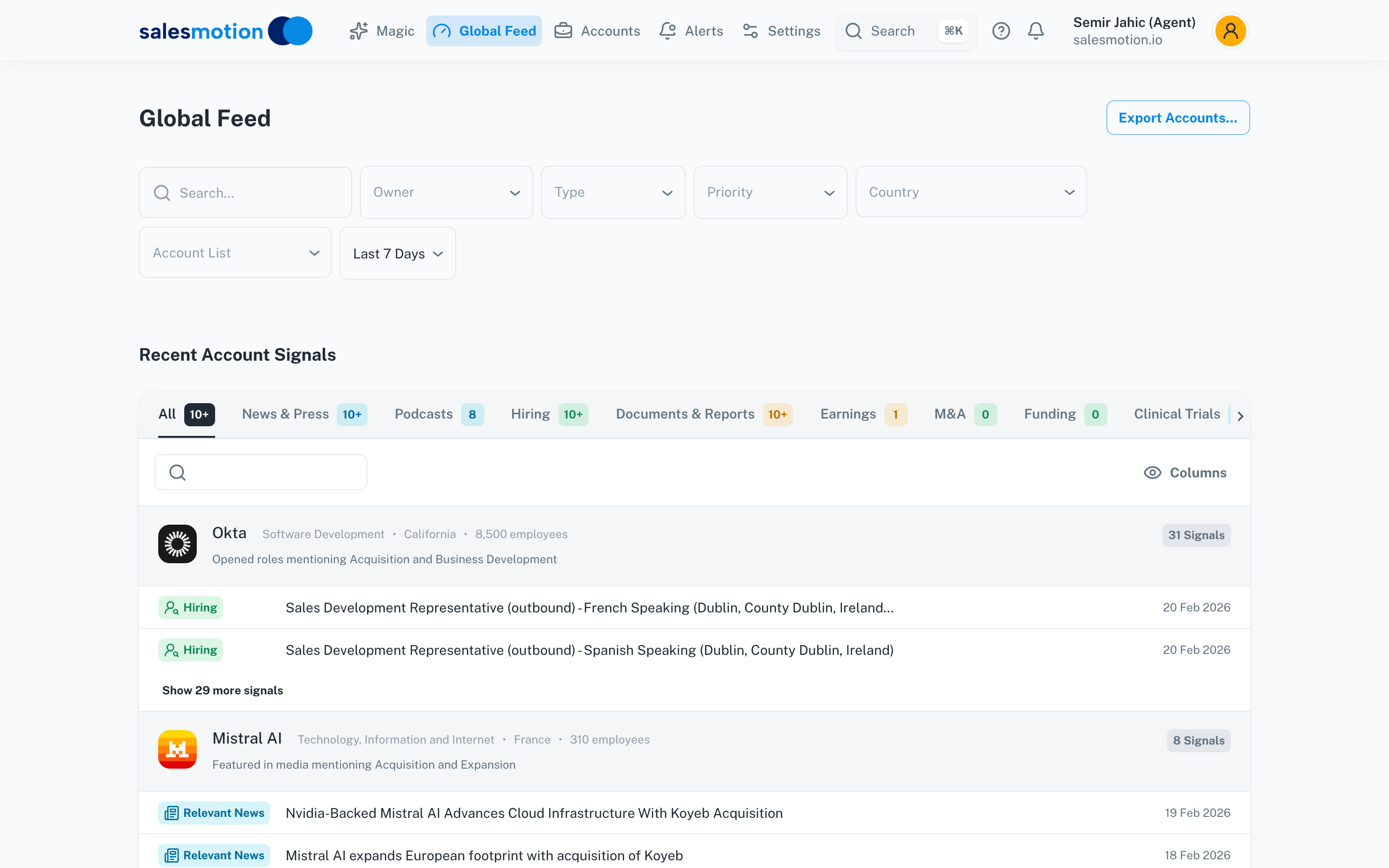 Salesmotion surfaces buying signals — hiring, earnings, news, M&A, funding — across your entire territory in a single feed, so reps act on the highest-value signals first.
Signal-Based Workflow: Professional Services Example
Trigger: An AmLaw 100 law firm announces a new data privacy practice and hires three lateral partners from a competitor. The same firm posts roles for legal technologists and data analysts. Meanwhile, a Big Four accounting firm announces a $100 million investment in AI advisory services.
Platform action: The account briefs for both firms update with the practice announcements, the lateral hires, the technology job postings, each firm's recent revenue performance, and the relevant technology leadership teams. Signals are categorized by subsegment, so the rep sees law-firm-specific context for the first account and accounting-firm-specific context for the second.
Rep action: For the law firm, the rep reaches out to the Director of Legal Technology, referencing the data privacy practice launch and the firm's need to build technology infrastructure for the lateral partners. For the accounting firm, the rep contacts the Head of Technology, referencing the AI investment and the advisory practice expansion. Each outreach is tailored to the subsegment's buying committee and technology needs.
Outcome: Both conversations address specific, funded initiatives. The law firm is investing in a new practice area and has hired the partners to lead it. The accounting firm has committed $100 million to AI services. In both cases, the rep's timing and subsegment-specific relevance set the conversation apart from generic vendor outreach.
For more on signal-based selling in specific verticals, explore our buying signals guide and our account intelligence glossary.
Key Takeaways
- Professional services is not one market. Consulting, legal, and accounting firms buy technology for different reasons, on different timelines, and through different decision-makers. Subsegment-specific plays outperform generic "professional services" outreach.
- Lateral partner hires create the strongest buying windows in law firms. With 3,009 partner hires across AmLaw 200 firms in 2025, each move triggers a 6-12 month technology evaluation and investment cycle.
- Consulting firm signals center on practice expansion and industry vertical launches. New practices require research databases, analytics platforms, and delivery tools that the firm did not previously need.
- Accounting firm signals are driven by advisory growth and private equity investment. More than half of the top 30 U.S. accounting firms now have PE backing, accelerating technology modernization budgets.
- Technology spending across professional services is at record levels. Law firm tech budgets grew 9.7%, accounting firms are investing in AI at a 42.5% CAGR, and consulting firms allocate 35% of IT budgets to transformation.
- Map the buying committee by subsegment. Practice leaders at consulting firms, CIOs at law firms, and managing partners at accounting firms each require different outreach strategies and value propositions.
Frequently Asked Questions
What are the strongest buying signals in professional services B2B sales?
The strongest signals vary by subsegment. For law firms, lateral partner hires and litigation surges are the most reliable predictors of technology investment. For consulting firms, practice area expansion and new industry vertical launches signal imminent tool purchases. For accounting firms, advisory practice growth and private equity investment announcements indicate multi-year technology buying cycles. Across all subsegments, M&A activity and leadership changes create firm-wide evaluation windows. A sales intelligence platform that tracks these signals by subsegment helps reps prioritize the highest-value opportunities.
Why are lateral partner hires such a strong buying signal at law firms?
Lateral partners bring a book of business, client relationships, and specific practice needs. The acquiring firm invests in technology, marketing, and infrastructure to support the new partner's practice and retain their clients. According to NALP, partner hiring hit a five-year high of 3,009 moves in 2025, up 10% from the prior year. In large law firms, a single lateral hire can drive six-figure technology purchases within the first quarter as the firm deploys e-discovery, research, and matter management tools for the new partner's practice area.
How do consulting firm buying patterns differ from law firm buying patterns?
Consulting firms buy technology to deliver client engagements and scale new practices. Purchases are driven by practice leaders and often tied to specific client delivery needs. The evaluation cycle is 3-6 months. Law firms buy technology for internal operations, research, and client service. Purchases flow through a CIO or Director of Legal Technology with partner input, and the evaluation cycle is 6-12 months. The key difference: consulting firm purchases are revenue-enabling (helping deliver client work), while law firm purchases are efficiency-enabling (helping lawyers work faster).
How is private equity changing buying signals at accounting firms?
Private equity has transformed the accounting sector's technology investment trajectory. With more than half of the top 30 U.S. firms now having PE backing, capital is flowing into technology modernization at rates the industry has never seen. PE-backed firms invest aggressively in advisory service expansion, AI automation, and integrated technology platforms to drive the margin improvements their investors expect. For sellers, a PE investment announcement at an accounting firm is one of the strongest buying signals in the sector, typically followed by 12-24 months of elevated technology spending.
What technology categories see the most demand from professional services firms?
The top categories vary by subsegment. Law firms are investing heavily in generative AI for research and document analysis, e-discovery platforms, and knowledge management systems, with tech spending growing 9.7% in 2025. Consulting firms prioritize data analytics platforms, collaboration tools, and AI-powered delivery capabilities. Accounting firms focus on audit automation, tax preparation AI, client advisory platforms, and integrated workflow systems. Across all segments, AI and cloud migration are the two technology themes driving the largest investment increases.