Let's get straight to it. The sales cycle is the repeatable process your sales team follows to move a prospect from initial contact to a closed deal. Think of it as a strategic map that guides a potential customer from "Who are you?" to "Where do I sign?"
What Is The Sales Cycle Really About?
Your sales cycle is the backbone of your revenue engine. It’s not a rigid, step-by-step checklist, but an adaptive framework for navigating a buyer’s often complex and non-linear decision-making journey. For most revenue leaders, a primary challenge is a sales cycle that keeps getting longer, burning resources and delaying growth.
In complex B2B sales—particularly for enterprise software and SaaS—sales cycles have stretched considerably. The average mid-market sales cycle now sits at 6.2 months, with enterprise deals often extending to 7-9 months. This isn't just an anecdotal feeling; data shows that sales cycles have lengthened by as much as 38% in recent years, placing a premium on efficiency.
Moving Beyond The Traditional Model
The old way of selling was static and seller-centric. It followed a one-size-fits-all process that largely ignored the buyer’s unique context and timing. Today's top-performing revenue teams have moved past this model, embracing a dynamic, signal-driven framework instead.
A well-defined sales cycle brings clarity, consistency, and predictability to your sales process. It helps you identify where deals slow down, measure performance, and apply the right strategies at the right time. Ultimately, it empowers you to close more deals, faster.
This shift marks a move from a reactive to a proactive sales posture. Instead of simply following a predefined sequence, modern reps use real-time insights to understand why and when to engage a prospect. This approach is powered by sales intelligence, which has become a must-have for any team looking to build sustainable momentum. You can explore this topic in-depth in our guide on what is sales intelligence.
The diagram below illustrates the evolution from a rigid, process-driven approach to a modern, signal-driven one.
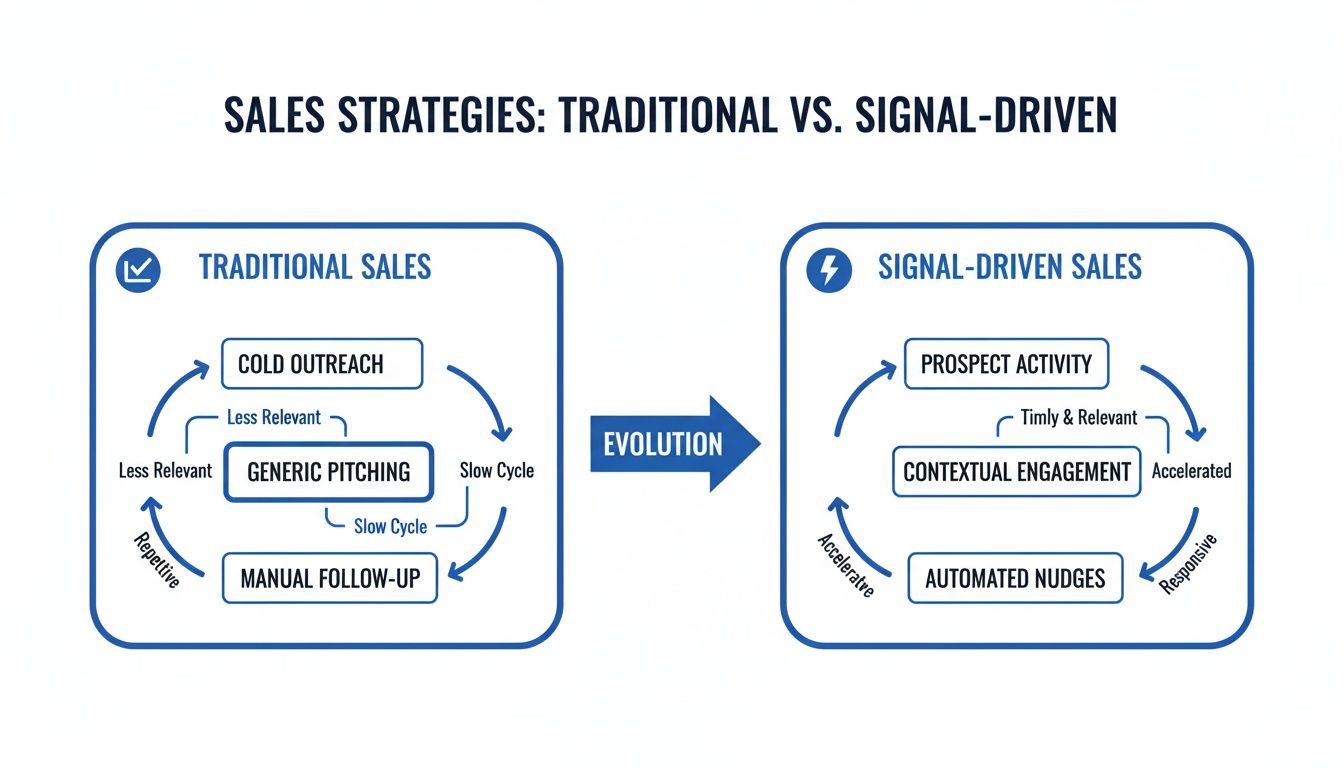
The key takeaway? Signal-driven selling replaces generic outreach with timely, hyper-relevant actions, making your sales team far more precise and effective.
Traditional vs. Signal-Driven Sales Cycle Approaches
What does this look like in practice? The difference is significant, impacting everything from prospecting to closing. A traditional cycle revolves around the seller's internal process, while a signal-driven cycle is tuned into the buyer's real-world triggers.
This table breaks down the core differences:
| Characteristic | Traditional Sales Cycle | Signal-Driven Sales Cycle |
|---|---|---|
| Approach | Linear and process-focused | Adaptive and buyer-focused |
| Triggers | Based on internal timelines and cadences | Based on real-time account signals (e.g., funding, hiring) |
| Outreach | Generic, one-size-fits-all messaging | Highly relevant with a clear "why now" |
| Efficiency | High manual research tax on reps | Automated intelligence and streamlined workflows |
Ultimately, understanding the sales cycle today means recognizing its evolution. It's no longer just a sequence of tasks. It's a strategic map that, when fueled by real-time intelligence, gets you—and your buyer—to your destination faster and more efficiently.
See Salesmotion in action
Take a self-guided interactive tour — no signup required.
Understanding The 7 Stages Of A Modern B2B Sales Cycle
To truly master the sales cycle, you must see it from both sides of the table. It’s not just a task list for your reps; it’s the journey your customer takes from "Who are you?" to "Where do I sign?"
Mapping this journey through distinct stages helps you build empathy, anticipate buyer needs, and guide the process with relevance and trust.
A modern B2B sales cycle typically consists of seven key stages. While the names may vary between companies, the buyer's mindset at each step is remarkably consistent. Let's walk through them, focusing on what’s happening from your buyer's perspective. You can also see how these stages fit into a broader framework in our guide to effective sales pipeline stages.
1. Prospecting
This is where it all begins. The objective is to identify potential customers who match your ideal customer profile (ICP). Reps use various methods—from cold outreach and social selling to following up on inbound leads—to build a list of target accounts and contacts.
- Rep's Goal: Identify and engage potential good-fit customers.
- Buyer's Mindset: "Who is this, and why are they contacting me now?" They are skeptical, busy, and constantly filtering out irrelevant noise.
2. Qualifying
Once contact is made, the next step is to determine if the prospect has a real, urgent problem you can solve. This involves asking intelligent questions to understand their budget, authority, need, and timeline (BANT) or a similar qualification framework. It’s about separating the window shoppers from the serious buyers.
Qualification isn't a one-sided interrogation. It's a mutual discovery process where both you and the buyer decide if there's enough value to justify continuing the conversation.
- Rep's Goal: Confirm the prospect is a qualified lead worth pursuing.
- Buyer's Mindset: "Is my problem big enough to fix? Is this person asking smart questions, or just reading from a script?"
3. Discovery
This is arguably the most critical stage of the entire cycle. A great discovery call goes deep to uncover the full story behind the buyer's pain points. It should feel less like an interview and more like a collaborative workshop where you diagnose the problem together.
- Rep's Goal: Uncover the deep-seated business pains and their tangible impact.
- Buyer's Mindset: "Does this salesperson really understand my world? Can they connect their solution to my specific challenges?"
4. Presentation
Armed with a deep understanding of their needs, you now present your solution. A powerful presentation isn't a feature dump. It's a tailored story that shows exactly how your product solves their specific problems and helps them achieve their goals.
- Rep's Goal: Demonstrate the value and ROI of your solution in the buyer's context.
- Buyer's Mindset: "This sounds interesting, but how does it actually work for us? Show me how this solves the pain we discussed, and prove it’s better than doing nothing."
5. Handling Objections
Objections are not a sign of failure; they are a sign of engagement. They show the buyer is seriously considering your offer. Common objections revolve around price, implementation, competitors, and timing. The key is to listen, validate their concern, and re-anchor the conversation on value.
- Rep's Goal: Address concerns and remove any roadblocks to moving forward.
- Buyer's Mindset: "I'm not totally convinced. What are the risks? What am I missing? Can I trust this will deliver the promised results?"
6. Closing
This is the moment of truth. The closing stage is about negotiating final terms, getting contracts signed, and securing the purchase. When you've executed the previous stages effectively, a smooth close is the natural result of the trust and value you've built.
- Rep's Goal: Finalize the agreement and secure the deal.
- Buyer's Mindset: "Are we making the right choice? Is this a partner we can count on for the long haul?"
7. Retention and Expansion
The sales cycle doesn't end when the contract is signed. The most successful companies know that retaining a customer is far more profitable than acquiring a new one. This final stage is about delivering a seamless onboarding experience, ensuring customer success, and identifying opportunities to upsell or cross-sell.
- Rep's Goal: Ensure customer success and drive long-term value.
- Buyer's Mindset: "Did we get the value we were promised? What’s next? How can we get even more from this partnership?"

“Salesmotion helps you spot signals from prospect accounts, news items / job hiring alerts etc that indicate that now is a good time to reach out with a well-crafted message.”
Rob Douglas
Director of Sales, icit business intelligence
How The Sales Cycle Varies Across Industries
Applying a “one-size-fits-all” sales cycle is a recipe for failure. The buyer's journey looks radically different depending on the industry you’re selling into. A deal’s timing, the key stakeholders, and their core motivations are all shaped by unique market pressures.
Consider a typical B2B SaaS sale. The cycle is often initiated by internal company signals—a new funding round, a key executive hire, or a major product launch. These events create a clear "why now" moment. For example, a sharp sales rep might see their target account just hired a new VP of Engineering and use that as the perfect opportunity to discuss improving their development pipeline.
But in other industries, like life sciences and healthcare, the rhythm is entirely different.

Life Sciences and Healthcare
Here, sales cycles are typically longer and more complex. They’re driven by external events like regulatory approvals, M&A activity, or clinical trial milestones. For a contract research organization (CRO), a biotech firm securing Series B funding to advance a drug through a Phase 2 trial is a massive buying signal.
The conversation isn't about features; it’s about aligning your services with a multi-year research and development roadmap. The buying committee is also different, often including scientists, clinical operations leaders, and procurement specialists, each with their own strict evaluation criteria.
IT Services and Consulting
In the world of IT services and large-scale consulting, the sales cycle is usually triggered by major corporate initiatives. When a company publicly announces a global digital transformation project or a commitment to cloud migration, it’s a clear signal for system integrators and strategic advisors.
These deals rarely close quickly. They involve deep discovery, lengthy proof-of-concept projects, and navigating complex procurement processes. The "why now" is tied directly to the customer's publicly stated strategic goals, making project wins and investment announcements key signals to monitor. This is why we focus on delivering powerful industry-specific intelligence.
The biggest differentiator between industries is the nature of the "trigger event." In some, it's an internal change like a new executive. In others, it's an external force like a new regulation. Knowing which signals matter most in your target vertical is the secret to timely and relevant outreach.
Financial Services and Manufacturing
The triggers that define the sales cycle in other verticals are just as distinct.
- Financial Services: In fintech and insurance, nothing creates urgency like a compliance deadline or a new regulatory framework. A new SEC rule, for instance, can instantly create budget and need for a new risk management solution. For fintech startups, executive changes and funding rounds are also powerful signals for outreach.
- Manufacturing and Industrials: For companies selling capital equipment or industrial software, triggers are often tied to physical operations. An announcement about a new plant expansion, a major investment in supply chain automation, or a push toward energy transition technology creates a clear window of opportunity.
These variations demonstrate why generic sales approaches fall flat. Market dynamics also differ geographically. For CROs in the energy sector, automating the monitoring of press releases can slash research time by 40-60%. Meanwhile, projections from Bain's 2026 outlook show North America’s B2B e-commerce CAGR hitting 10.2% through 2027, while the MEA region is expected to surge. Each trend creates unique opportunities.
Ultimately, a deep understanding of the sales cycle within your specific industry isn't just a nice-to-have; it's the foundation of effective, modern selling.
Diagnosing The Bottlenecks In Your Sales Cycle
Every sales leader has felt it: a promising deal has all the momentum in the world, and then... it stalls. That abrupt halt isn’t just bad luck; it’s a symptom of a hidden bottleneck in your sales cycle, something that’s killing your deal velocity and making your forecast unreliable.
Identifying these blockers is the critical first step toward building a predictable revenue engine. The challenge is that they often hide in plain sight, disguised as part of the daily sales grind.
The Manual Research Tax
One of the most expensive and overlooked bottlenecks is the manual research tax. This is the excessive time and energy your reps burn just trying to understand what’s happening at a target account. They spend hours sifting through news articles, LinkedIn profiles, and trade publications to piece together a coherent story before even drafting an email.
For example, a rep spends two hours prepping for a call with a VP at a target company. They review press releases but completely miss a recent podcast interview where that VP detailed their top priorities for the next quarter. The rep's outreach, though well-intentioned, lands wide of the mark.
Outreach Without A "Why Now"
This leads directly to the next major bottleneck: outreach that lacks a compelling "why now." When reps are bogged down by manual research, their messaging often defaults to generic value propositions. Their emails and calls sound like every other vendor's, failing to answer the prospect's most important question: "Why should I care about this right now?"
This lack of urgency is a deal-killer. Without a clear, timely trigger event to anchor the conversation—like a new funding round, a recent acquisition, or a strategic pivot—your outreach is just more noise in a crowded inbox.
A sales cycle stalls when its momentum relies on hope instead of being driven by real, timely business events. Identifying and acting on these trigger events is the key to creating urgency and maintaining deal velocity.
Inconsistent Account Planning
Finally, inconsistent account planning can sabotage even the most promising opportunities. When account plans are created once during a deal review and then left to gather dust, they become outdated and useless. A good account plan should be a living document, constantly updated with new intelligence as it emerges.
Without a system for capturing and acting on new signals, your team is flying blind. This undermines everything from multi-threading efforts to anticipating objections. To learn more about fixing these issues, explore strategies for sales process optimization and start building a stronger framework.
These challenges have a massive impact on the bottom line. Salesforce reports that only 28% of sales reps are hitting quota—a stark six-year low—as deals demand more touchpoints than ever. Yet, there's a clear path forward: over 90% of businesses now run dedicated sales enablement programs, which directly correlate with shorter, more successful sales cycles. As detailed in Bain's retail outlook, using the right tools and processes to fix bottlenecks is no longer a luxury. By reframing these frustrations as solvable problems, you can build a sales cycle that’s resilient, efficient, and built to win.

“Automatic account profile detail I can use to manage my territory. Using Salesmotion AI to generate value statements per persona, account, etc. Using Salesmotion to give me a starting point based on new hires, or news alerts is critical.”
Adam Wainwright
Head of Revenue, Cacheflow
How To Shorten Your Sales Cycle With Account Intelligence

Knowing where your sales cycle is breaking down is one thing. Actually fixing it is another. This is where account intelligence changes the game, moving your revenue team from reactive to proactive. It compresses your sales cycle by focusing on one thing: relevance at the right time.
Instead of letting deals stall due to slow manual research or generic messaging, account intelligence platforms build momentum. Think of them as your team's market radar, constantly scanning for the buying signals that create a genuine "why now." You stop guessing and start engaging with a clear, compelling reason.
Transition To Proactive Selling With Real-Time Signals
The single biggest killer of deal velocity is inertia. Proactive selling, powered by real-time signals, is the solution. It's the difference between cold calling a static list and reaching out the same day a target account announces an expansion project your solution can support.
Account intelligence platforms like Salesmotion monitor these real-world triggers across your target accounts. These aren't just news headlines; they are actionable events that open a window of opportunity.
Here’s how this proactive approach directly shortens your sales cycle:
- It creates a powerful "why now." You no longer lead with a generic pitch but with an insight tied to a fresh business event.
- It gets you to the right people, faster. A new executive hire is a signal to engage a key decision-maker before their calendar is full.
- It accelerates the initial stages. Relevant outreach gets a response, slashing the time deals spend stuck in prospecting and qualification.
Modern B2B selling is a race to relevance. Account intelligence gives your team a head start by turning raw data—like funding announcements, project wins, and executive moves—into crisp, actionable insights with the "so what" clearly spelled out.
This shift has a measurable impact. Recent B2B buying trends show the average sales cycle length dropped from 11.3 months to 10.1 months—a 10% reduction. Why? Because 49% of buyers say economic pressures are accelerating their decisions, and 62% are engaging sellers earlier in their process. You can explore more of these B2B buying behavior trends to see why early, relevant engagement is so critical.
Implement Signal-Driven Workflows That Win
Adopting account intelligence isn't about adding another tool; it’s about embedding smarter workflows into your team's daily rhythm. These practical applications turn raw insights into closed deals and directly address the bottlenecks that slow you down.
1. Always-on Account Monitoring
This workflow eliminates the "manual research tax" that consumes your reps' time. Instead of spending hours digging for information, the platform automatically tracks key signals across all your named accounts.
- Example: A rep gets a Slack alert that a target account in the life sciences space just received FDA approval for a new device. The alert includes context on how this opens up budget for commercialization services. The rep immediately reaches out with a tailored message, congratulating the team and offering support for their product launch. What might have been a months-long prospecting effort becomes a single, timely conversation.
2. Meeting Prep in Minutes
This workflow ensures every interaction is packed with value. Before a call, reps receive an automated brief with the account’s latest initiatives, potential risks, key stakeholders, and AI-generated talking points tied to their specific priorities.
- Example: An Account Executive has a discovery call in 30 minutes. Instead of scrambling, she reviews an automated brief. It highlights that the prospect’s company mentioned "supply chain optimization" in their latest earnings call. The brief provides specific talking points connecting her logistics software to that exact corporate priority, allowing her to lead a strategic conversation that resonates from the first minute.
3. Value-based Outbound
This workflow replaces generic outreach with highly personalized, value-driven messaging. By connecting a signal to a prospect’s likely pain point, reps can articulate a clear and compelling point of view.
- Example: An SDR is targeting a SaaS company that just announced a new integration partnership. Using an AI-generated talking point, he crafts an email that says, "Congrats on the new partnership! As you scale your ecosystem, ensuring seamless data flow between partners becomes critical. We help companies like yours avoid the integration debt that often slows growth."
By implementing these workflows, you provide your team with a clear roadmap to boost relevance at every stage. This not only improves sales velocity but also builds the trust and credibility needed to win more deals and fundamentally transform how you manage your entire sales cycle.
Your Playbook For A Faster Sales Cycle

A good strategy is useless without solid execution. Let's translate this into a simple, actionable playbook for your revenue team. The goal is to make signal-driven selling a daily habit, not a chore.
When you successfully weave account intelligence into your workflow, you stop just knowing what the sales cycle is and start actively controlling its speed. This playbook provides clear next steps for both reps and managers to build a repeatable process for winning deals faster.
The Sales Rep's Daily Checklist
For reps, success comes from consistently executing high-impact activities. Making account intelligence a core part of your daily workflow is the fastest way to boost relevance and accelerate deals.
Your Daily Routine:
- Morning Signal Review: Before anything else, spend 15 minutes scanning real-time alerts for your top-tier accounts. Look for trigger events—funding news, new executives, or project announcements that give you a fresh "why now."
- Automated Meeting Prep: Forget spending hours on prep. Use an automated brief to get up to speed in minutes. Zero in on the AI-generated talking points that directly connect your solution to the account's current focus.
- Signal-Based Outreach: Block out time specifically for outreach built around fresh signals. Ditch generic check-ins. Your messages should lead with timely, relevant insights that command attention.
A salesperson's most valuable asset is relevance. This playbook helps you weaponize it. By starting each day with fresh intelligence, you ensure every interaction is sharp, timely, and focused on what your buyer actually cares about.
The Sales Manager's Coaching Framework
As a sales manager, your job is to build a high-performance system, not just manage individual deals. This coaching framework will help you embed signal-driven selling into your team’s DNA, making it a core part of how you plan, coach, and win.
To truly shorten your sales cycle with account intelligence, it's essential to continuously optimize your sales process.
Your Weekly Coaching Rhythm:
- Pipeline Reviews with a Signal Focus: In pipeline reviews, ask questions like, "What was the trigger event that opened this deal?" and "What new signals this week can help us advance this opportunity?"
- One-on-One Call Coaching: Use your 1:1s to review a rep's signal-based outreach. Discuss which triggers are getting the best responses and how to sharpen the messaging for even better results.
- Territory and Account Planning: Help your team prioritize territories using signal scores and trend analysis. Focus your team’s energy on the accounts showing the strongest intent and activity.
By making signal-driven selling central to your coaching, you empower your team to be more strategic. This playbook isn't just about managing a sales cycle—it's about proactively shrinking it. It turns abstract ideas into concrete actions that build a more predictable and efficient revenue engine.
Frequently Asked Questions
When you're trying to master your sales cycle, a few key questions always come up. Here are the straight answers for revenue leaders focused on building a more predictable, efficient sales process.
What Is The Ideal Length For A B2B Sales Cycle?
There's no magic number. The "right" length for a sales cycle depends entirely on your industry, deal size, and product complexity.
A 3-6 month cycle is a solid benchmark for many B2B SaaS companies. However, for massive enterprise deals in regulated fields, a 9-12 month cycle is completely normal. The real goal isn't just speed; it's efficiency and predictability. Focus on metrics like time in each stage and stage-to-stage conversion rates. If you want to shorten the cycle, use account intelligence to find high-intent accounts and create a compelling "why now" that drives action.
How Can I Measure The Health Of My Sales Cycle?
Don't just track the average cycle length. The most revealing KPIs show where your process is flowing smoothly and where it’s getting stuck.
To diagnose the health of your cycle, monitor these metrics:
- Stage-to-Stage Conversion Rates: This shows you exactly where in the funnel deals are stalling.
- Sales Velocity: This metric measures how much revenue you're closing per day, offering a powerful gauge of overall efficiency.
- Time in Stage: Are opportunities collecting dust in qualification or getting stuck in negotiation? This metric will tell you.
- Win Rate: Of the opportunities you qualify, what percentage are you closing?
A healthy cycle has a consistent flow and predictable conversions. If your velocity is sluggish or deals keep stalling, it often points to weak qualification or messaging that lacks a strong "why now."
How Does AI Actually Shorten The Sales Cycle?
AI-powered account intelligence platforms attack this problem from three angles. First, they eliminate the "manual research tax" that forces reps to waste hours digging for basic account context.
Second, they deliver real-time "why now" triggers—like a new funding round, a surge in departmental hiring, or a new project launch. This allows your reps to engage at the exact moment of need with a highly relevant message, accelerating the critical early stages of the cycle.
Finally, by providing reps with automated briefs and strategic insights, AI helps them have smarter conversations and navigate objections with confidence. It compresses the middle and late stages of the deal by turning signal overload into a clear list of prioritized actions.
Ready to stop reacting and start proactively shortening your sales cycle? See how Salesmotion turns real-time account intelligence into revenue momentum. Book Your Demo Today.