Most advice about SWOT analysis gets sales teams stuck in the wrong mindset. It treats SWOT like a workshop artifact, something you fill out in a slide deck and forget by next quarter.
That's backwards.
SWOT analysis for sales accounts works when you use it as a targeting and messaging weapon. You're not building a school-project matrix. You're building a sharper point of view on a live account so your outreach sounds informed, relevant, and timed to what the buyer cares about.
The reps who win more often rarely have better templates. They have better context. They know where the account is already strong, where it's exposed, where growth is coming from, and what pressure is building around it. That changes the conversation from “Do you have this pain?” to “You're pushing on this initiative, and here's where the risk and upside sit.”
SWOT Analysis Is a Sales Weapon Not a Strategy Exercise
SWOT has been around for decades, and that's part of the problem. Too many reps hear the acronym and think “old framework, internal planning, not useful in live selling.” That's lazy thinking.
In sales, context wins attention. Buyers ignore generic outreach because generic outreach proves the rep hasn't done the work. A good SWOT gives you the business context behind the deal. It tells you where the account is winning, where it's vulnerable, what outside forces create opportunity, and what pressure can create urgency.
The payoff is not theoretical. Companies that perform structured, quarterly SWOT-style account reviews for their top 20% of accounts achieve on average 13–18% higher win rates in those accounts according to this sales SWOT analysis benchmark.
Generic pain-point selling is the real enemy
Most bad prospecting sounds the same:
- It starts from the seller's product instead of the buyer's business.
- It uses recycled pain points that could apply to any company in the market.
- It ignores timing, which is why even decent messaging lands flat.
- It misses executive relevance because it doesn't connect to strategic pressure.
That's why I push reps to stop asking, “What does our product do?” and start asking, “What is this account trying to protect, fix, or accelerate right now?”
If you know a prospect's strengths, you can align to momentum. If you know their weaknesses, you can expose operational drag. If you know their opportunities, you can tie your solution to growth. If you know their threats, you can create a valid reason to act now.
Practical rule: If your outreach could be sent to five competing accounts with only the company name changed, you don't have account strategy. You have spam with good formatting.
SWOT changes how a rep sounds in the room
A weak rep says, “We help companies improve efficiency.”
A prepared rep says, “You're expanding into a new market, hiring for operational coverage, and dealing with new competitive pressure. That usually creates friction between speed and control. Here's where we help.”
That second message earns the meeting because it reflects the buyer's world, not yours.
If you want a modern take on turning SWOT into an account advantage, read this breakdown of SWOT as a competitive edge in sales. The core idea is simple. A SWOT isn't a document to complete. It's a lens for deciding who to contact, what to say, and why now is credible.
See Salesmotion in action
Take a self-guided interactive tour — no signup required.
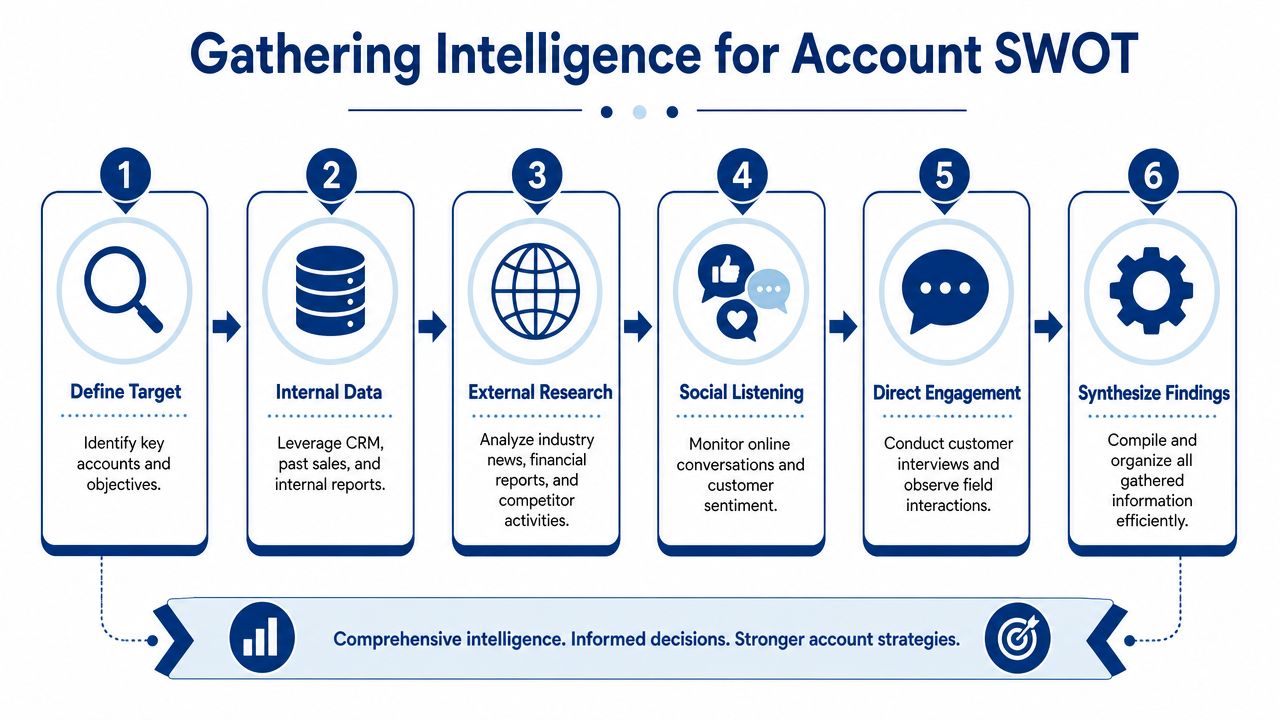
Gathering Your Intelligence Where to Find Real Signals
A useful SWOT is built on evidence. Not guesses. Not stale CRM notes. Not whatever your rep “feels” is happening in the account.
Guidance on SWOT is clear that it should be grounded in concrete data such as financial performance, market research, and competitor information, which in a sales context means using sources like earnings calls, job postings, and industry news. Adobe's overview makes that point directly in its SWOT analysis guidance.
Here's the process I want reps to follow.
Start with earnings calls and investor language
If the company is public, earnings calls are gold. Leadership tells you what matters because they have to. They talk about performance, priorities, margin pressure, expansion plans, operational bottlenecks, and competitive positioning.
Use them this way:
- For strengths: Look for what executives highlight repeatedly. Strong retention, market share gains, successful launches, supply chain resilience, expansion in a segment.
- For opportunities: Watch for strategic initiatives. New markets, product launches, partnerships, regional growth, digital transformation, cost optimization.
- For threats: Pay attention to cautionary language. Regulatory changes, pricing pressure, macro softness, competitive intensity, delayed buying patterns.
Don't just copy lines into your notes. Translate them into selling implications. If leadership keeps talking about expansion, your question becomes whether your solution helps them scale faster, govern better, or reduce execution risk.
Read job postings like a diagnosis, not a hiring ad
Most reps waste job-posting data because they treat it as surface-level hiring activity. Smart reps use it to spot capability gaps and investment priorities.
A company doesn't hire aggressively in an area unless something matters there.
Use job posts to identify:
| Signal | What it can mean in your SWOT |
|---|---|
| Hiring for specialists they don't currently show strength in | Likely weakness or capability gap |
| Repeated openings across one function | Strategic opportunity or execution pressure |
| New leadership roles | Organizational change and possible budget movement |
| Compliance, security, or operations roles | Threat response or risk mitigation priority |
If a prospect is hiring for data governance, RevOps, cloud migration, implementation, or regulatory operations, you've learned something important. They either lack internal capacity, they're scaling into complexity, or both.
Buyers rarely announce weaknesses directly. Their hiring plan often does it for them.
Use news and market coverage to create urgency
Press releases, trade publications, regulator updates, and competitor announcements help you fill the external side of the SWOT.
Watch for three things:
-
Competitor moves
A new product launch, aggressive expansion, or category repositioning can become a threat if it pressures your prospect to respond. -
Regulatory shifts
New compliance expectations, disclosure standards, or policy changes can create urgency even when buyers haven't fully operationalized the risk yet. -
Corporate events
Acquisitions, office expansion, executive changes, partnerships, and restructuring often signal both disruption and budget realignment.
A simple operating rhythm helps. Pick your named accounts, define what you're trying to learn, and prioritize by potential upside. If your team needs a cleaner way to focus effort before the research starts, use this account prioritization framework for outreach.

“The moment we turned on Salesmotion, it became essential. No more hours on LinkedIn or Google to figure out who we're talking to. It's just there, served up to you, so it's always 'go time.'”
Adam Wainwright
Head of Revenue, Cacheflow
Mapping the Battlefield Structuring Your Account SWOT
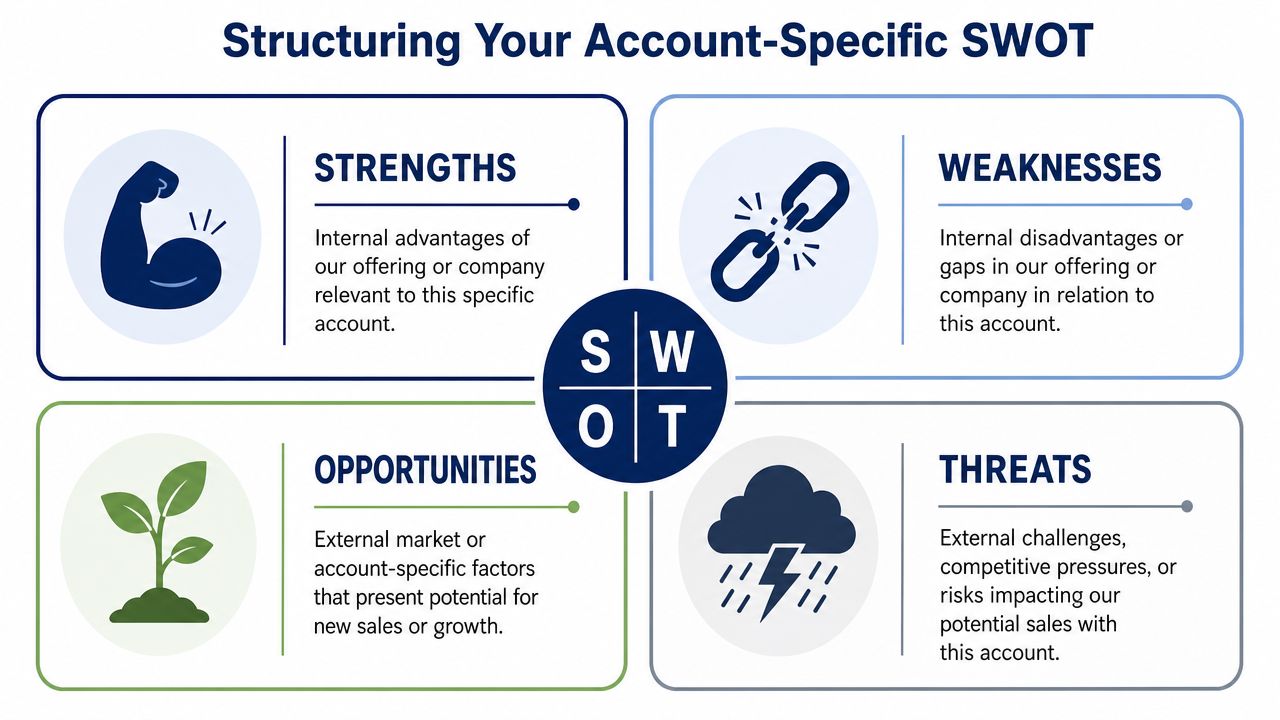
Once you've gathered signals, organize them properly. SWOT only becomes useful when each signal lands in the right quadrant and points toward a sales implication.
Kapta's explanation of SWOT gets the foundation right. It evaluates internal factors, strengths and weaknesses, and external factors, opportunities and threats, which is exactly how a sales team ties a value proposition to business context in this key account strategy article.
What each quadrant should mean in a sales account
For account planning, use the quadrants like this:
-
Strengths
Where the prospect is already winning. This tells you what they want to protect or scale. -
Weaknesses
Where execution, systems, talent, or coordination look exposed. This tells you where friction lives. -
Opportunities
External growth openings or strategic moves they can capitalize on. This shows where your solution can help accelerate results. -
Threats
External pressures that can force action. Competitive shifts, regulation, margin pressure, market changes, organizational upheaval.
A fictional example with GlobalLogistics Inc.
Let's make this concrete with a fictional target account, GlobalLogistics Inc.
Assume your team sells a platform that helps large logistics operators improve planning, visibility, and operational coordination.
Here's what you found:
Signals you collected
- The latest earnings call emphasizes strong regional expansion and improved customer retention.
- Job postings show repeated hiring for analytics operations and compliance roles.
- Industry coverage reports a new competitor entering one of GlobalLogistics Inc.’s core markets.
- Trade news suggests upcoming regulatory scrutiny around reporting and operational transparency.
That becomes an account-specific SWOT like this:
| Quadrant | What goes in | Sales interpretation |
|---|---|---|
| Strengths | Strong expansion momentum, retention, executive confidence | They care about scaling what's working |
| Weaknesses | Hiring for analytics and compliance capacity | Internal systems or talent may not be keeping up |
| Opportunities | New geographic growth, service expansion | You can support execution during scale |
| Threats | New competitor activity, regulatory pressure | There's a reason to act before risk compounds |
Turn raw signals into pointed messaging
The mistake reps make here is stopping at categorization. Don't do that. Every item needs a selling implication.
For GlobalLogistics Inc., that sounds like this:
-
Strength-led talk track
“You've built strong momentum in expansion. The challenge now is scaling operational consistency without slowing down execution.” -
Weakness-led talk track
“Your hiring pattern suggests the business is still building internal analytics and compliance muscle. That usually creates coordination gaps during growth.” -
Opportunity-led talk track
“Expansion creates a window to standardize planning and visibility before complexity hardens into process debt.” -
Threat-led talk track
“With a new competitor moving into a core market and regulation tightening, waiting usually gets more expensive.”
The best SWOT analysis for sales accounts doesn't describe the company. It sharpens your opinion about what the company needs next.
If you want your reps to capture this cleanly, they need a repeatable format. A structured account brief template for sales research helps because it forces them to connect evidence to action instead of dumping research into notes.
From Analysis to Action Building Your Account Plan
A filled-out SWOT is not the end of the work. It's the filter for deciding what matters enough to drive a real plan.
Salesforce's best-practice guidance says that after you fill the quadrants, you should select 3 to 5 high-impact issues and translate them into an action plan. That's what turns a descriptive SWOT into an operational playbook in this SWOT workflow guide.

Pick the few issues that can move the deal
Most reps overfill the matrix and underbuild the plan. They collect a dozen observations and treat them like equal truths. They aren't.
I want three filters applied to every SWOT item:
-
Relevance to your offer
Can your product or service credibly affect this issue? -
Executive importance
Would a VP, GM, or C-level leader care enough to spend time on it? -
Near-term usefulness
Can this insight support outreach, discovery, stakeholder mapping, or a business case now?
If an item fails those filters, cut it.
Convert SWOT items into sales moves
At this point, reps either become strategic or stay average. Every prioritized issue should map to a concrete action.
For the fictional GlobalLogistics Inc. example:
-
If expansion is the top opportunity
Build outreach around scale risk, consistency, and execution speed. Your first meeting should explore where growth is stressing current processes. -
If hiring reveals a weakness in analytics and compliance capacity
Target operations, transformation, or compliance leaders with a point of view on how teams manage complexity before new hires are fully productive. -
If competitive pressure is the biggest threat
Equip your champion with a differentiation narrative. Don't just pitch features. Arm them with a business argument. -
If regulation is heating up
Create urgency around preparedness, auditability, and timeline risk.
Here's a simple way to frame it:
| SWOT insight | Sales action |
|---|---|
| Strength they want to scale | Position your offer as an accelerator |
| Weakness they need to fix | Lead with operational friction and cost of delay |
| Opportunity they can pursue | Build a business case around upside |
| Threat they need to manage | Use urgency and risk reduction in outreach |
Build a plan your manager can inspect
A good account plan needs owners, dates, and message angles. Nothing vague. Nothing inspirational.
Your plan should answer:
- Who matters first inside the account
- What message each stakeholder gets
- Which signal supports that message
- What the next meeting should uncover
- What proof point or asset you'll use
A SWOT becomes useful when each insight has an owner, a message, and a next step.
If your team still builds account plans as static slides, fix that. A working sales account planning template should help reps move from research to action fast enough that the analysis still matters when they hit send.
“Automatic account profile detail I can use to manage my territory. Using Salesmotion AI to generate value statements per persona, account, etc. Using Salesmotion to give me a starting point based on new hires, or news alerts is critical.”
Adam Wainwright
Head of Revenue, Cacheflow
The Unfair Advantage Automating SWOT with Salesmotion
Manual SWOT work is powerful. It's also slow.
A thorough SWOT that includes competitive research and stakeholder input can easily take 1–2 hours per company, as noted in this SWOT example guide. For a rep covering a serious book of accounts, that creates a blunt tradeoff. Either do deep research on a handful of accounts or do shallow research on many.
That tradeoff is unnecessary now.
Manual SWOT breaks at scale
The old assumption is that good account planning must be manual because nuance matters. That's only partly true. Nuance matters. Manual collection doesn't.
What drains rep time is the repetitive part:
- Opening scattered sources to find the same kinds of signals again and again
- Summarizing raw information into usable account context
- Rechecking accounts to see what changed since last week
- Updating stale notes that no one trusts anyway
The result is predictable. Some strategic accounts get proper attention. Most don't. Relevance becomes uneven across the team.
What automation should do instead
A useful system should pull live account signals, organize them into SWOT logic, and keep the view current without asking reps to start from scratch every time.
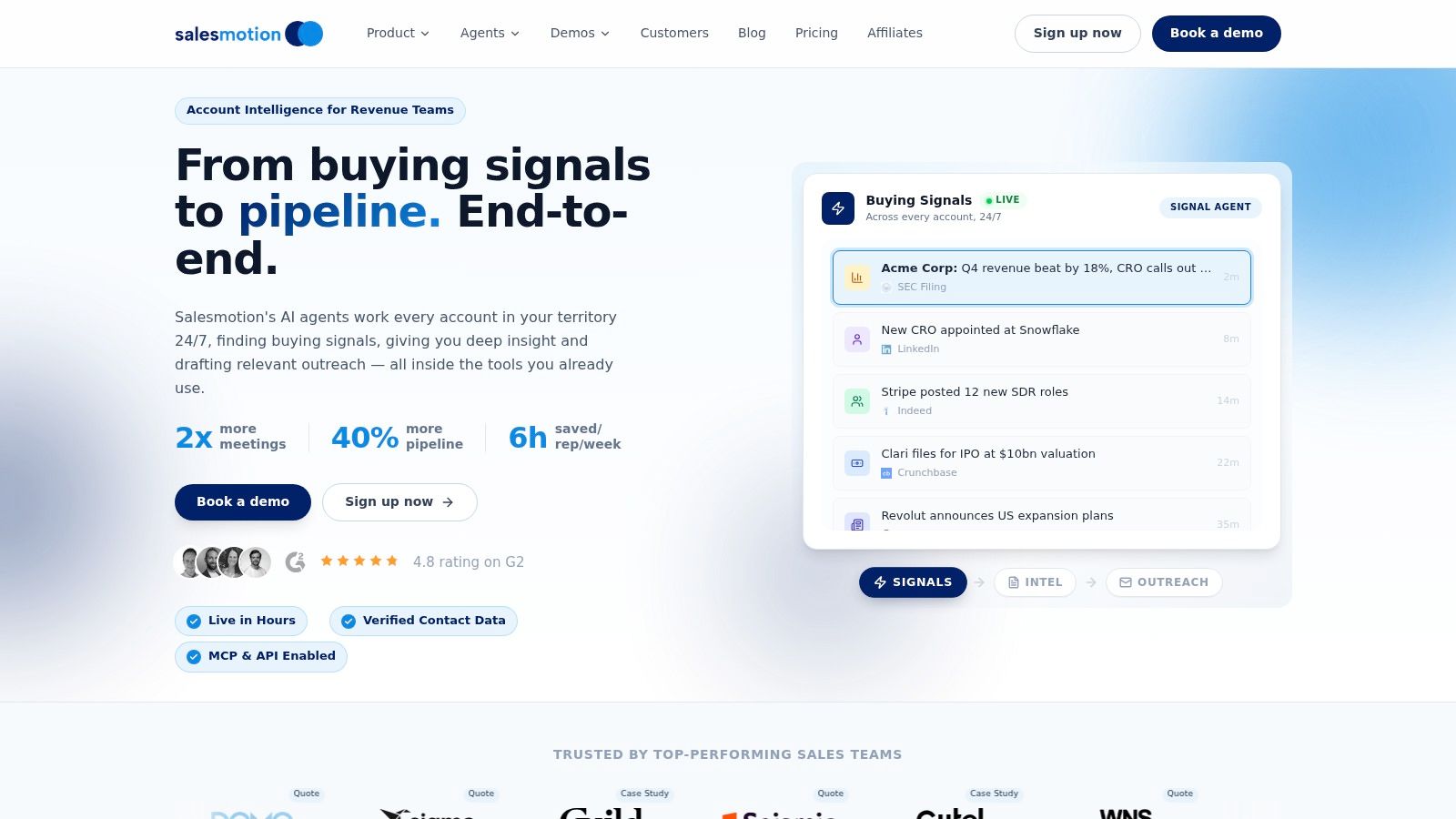
One option is Salesmotion, which generates AI-powered SWOT analyses for accounts automatically, pulling from 42+ sources and updating continuously. In practical terms, that means a rep can see strengths, weaknesses, opportunities, and threats shaped from sources like earnings activity, hiring, news, executive changes, and other market signals without manually stitching it all together.
That changes the rep's job in the right way. They stop acting like junior researchers and start acting like sellers.
Use automation to improve judgment, not replace it
I wouldn't hand account strategy entirely to software. That's not the point. The point is to eliminate low-value research labor so reps can spend time on message quality, stakeholder strategy, and deal movement.
The best use of automated SWOT is simple:
- Let the system gather and refresh context
- Let the rep validate what matters
- Let the manager coach the account plan
- Let the team act faster when a new signal appears
That's the advantage. Not a prettier dashboard. Faster, more consistent account understanding across the entire book.
Turn Account Intelligence Into Your Next Meeting
Selling without context wastes everyone's time. The buyer feels it first. The rep feels it later when the reply never comes, the meeting goes nowhere, or the deal stalls because there was never a real business case behind the outreach.
A strong SWOT analysis for sales accounts fixes that. It gives you a way to understand the account in business terms before you ask for time. You stop leading with generic pain. You start leading with the account's actual situation, its momentum, its gaps, its risks, and the changes that make action reasonable now.
That's why I still like SWOT. Not as classroom theory. As a forcing function for better sales thinking.
What to do on your next key account
Pick one account that matters and do the work properly.
- Review earnings language to identify what leadership is trying to grow or protect.
- Scan job postings to spot capability gaps, investment priorities, and hidden weaknesses.
- Check market news for competitor movement, regulatory shifts, and organizational change.
- Build the four quadrants with only the strongest points.
- Choose the few issues that deserve action and map them to outreach, stakeholder targets, and meeting goals.
If you do that well, your next message will sound more credible. Your next meeting will be sharper. Your discovery will improve because your questions will come from evidence, not guesswork.
Strong pipeline starts before the first email. It starts with a point of view the buyer recognizes as grounded in reality.
The reps who consistently open good opportunities aren't winging it. They know the account better, and they sound like it. That's the standard.
If your team wants to stop spending research time account by account, take a look at Salesmotion. It helps revenue teams turn live account signals into structured briefs, SWOT-style context, and actionable outreach so reps can focus more time on selling and less on stitching together scattered research.