A revenue leader usually notices the talent problem at the worst possible moment. A top AE resigns mid-quarter. A sales engineer gives notice right before a key rollout. A RevOps leader takes a recruiter call and suddenly the team is trying to replace a system owner, not just a headcount.
That’s when most companies discover they’ve been treating hiring like a ticket queue instead of a pipeline. A role opens, a requisition appears, recruiters scramble, managers panic, interview loops sprawl, and everybody calls it urgency when it’s really poor preparation.
Managing the talent pipeline fixes that. Not because it makes hiring easy, but because it makes it repeatable. The same discipline that helps commercial teams build predictable revenue also helps leadership teams build predictable hiring capacity. You define the profile, watch for signals, build coverage, nurture the right people, and move qualified talent through a process with clear stage ownership.
Key Takeaways
- Reactive hiring is the wrong operating model. Waiting until a role is empty compresses every trade-off into a few weeks and lowers the quality bar by default.
- Run hiring like a sales pipeline. Define the ICP for each role, watch for signals (job changes, funding events, layoffs at adjacent companies), build coverage, and move candidates through clearly owned stages.
- Signal-driven sourcing beats job-board scraping. The strongest sources of senior talent rarely apply — find them through funding announcements, leadership shifts at competitors, and product-launch tells, then reach out before they're shopping.
- Treat the talent pipeline as a leadership system. Monthly reviews on coverage by function, time-in-stage, and slate diversity turn hiring from urgency into capacity.
See Salesmotion in action
Take a self-guided interactive tour — no signup required.
Stop Hiring on Hard Mode
Reactive hiring feels normal because it’s common. It’s still the wrong operating model.
When a business waits until a critical role is empty, every bad trade-off gets compressed into a few weeks. The hiring manager lowers the bar on fit because the team needs help now. Recruiters over-index on whoever is active in market. Interviewers rush decisions, then reopen the role when confidence drops. The company spends more time explaining delays than preventing them.
That’s hiring on hard mode.
A strong talent pipeline changes the sequence. Instead of asking, “Who can start talking to us this week?” you ask, “Who have we already identified, learned from, and stayed in touch with?” That one shift changes quality, speed, and confidence.
There’s a business case for taking it seriously. Companies with strong talent pipelines and succession planning are 2.5x more likely to achieve superior revenue growth than peers, according to The Talent Pool’s summary of talent pipeline outcomes. That tracks with what experienced operators already know. Growth doesn’t break because strategy failed on a slide. It breaks because the company can’t staff the plan.
Talent is a revenue system
Revenue leaders already understand pipeline math. You don’t build next quarter’s number after the quarter starts. You build coverage before you need it. You monitor stage health. You qualify early. You don’t ask account executives to invent pipeline from scratch every time pressure rises.
Hiring should run the same way.
A modern talent pipeline has the same moving parts:
- Targeting: Define who fits the role beyond a job description.
- Coverage: Maintain enough qualified talent across critical functions.
- Signals: Track changes that indicate openness, readiness, or risk.
- Nurture: Stay relevant before there’s a live opening.
- Conversion: Move fast when timing lines up.
Practical rule: If a role is important enough to affect revenue, it’s important enough to have a pipeline before it opens.
That matters most in functions where one hire changes execution. RevOps is a good example. The role often sits at the intersection of systems, planning, forecasting, and accountability. If you want a clear view of what that seat owns, this breakdown of a revenue operations job description shows why backfi...io/blog/revenue-operations-job-description) shows why backfilling it reactively creates so much drag.
What doesn’t work
Three habits show up again and again in weak hiring environments:
- Posting-first thinking: Teams assume demand creates supply. It rarely does for high-impact roles.
- ATS complacency: A database of old applicants isn’t a managed pipeline unless someone segments, updates, and engages it.
- Manager-only urgency: Hiring managers often escalate late, then expect recruiting to recover lost time.
Managing the talent pipeline means treating talent the way strong go-to-market teams treat territory. You map it, monitor it, and work it continuously. Otherwise every departure becomes a fire drill, and fire drills are a terrible hiring strategy.

“Consolidation of prospect company information that I can use frequently to be way better informed when I'm doing my outbound, preparing for a meeting, or building relationships. Ease of use and Customer Support is excellent.”
Werner Schmidt
CEO & Co-Founder, Lative
Designing Your Talent Pipeline Framework
The best talent pipelines aren’t vague communities of “people we should know.” They have structure. They have stage definitions. They have owners. They have exit criteria.
That’s why I prefer to build them like a revenue funnel. Not because candidates are leads. They aren’t. The point is operational clarity. Everyone should know where a person sits in the pipeline, what changed, and what action comes next.
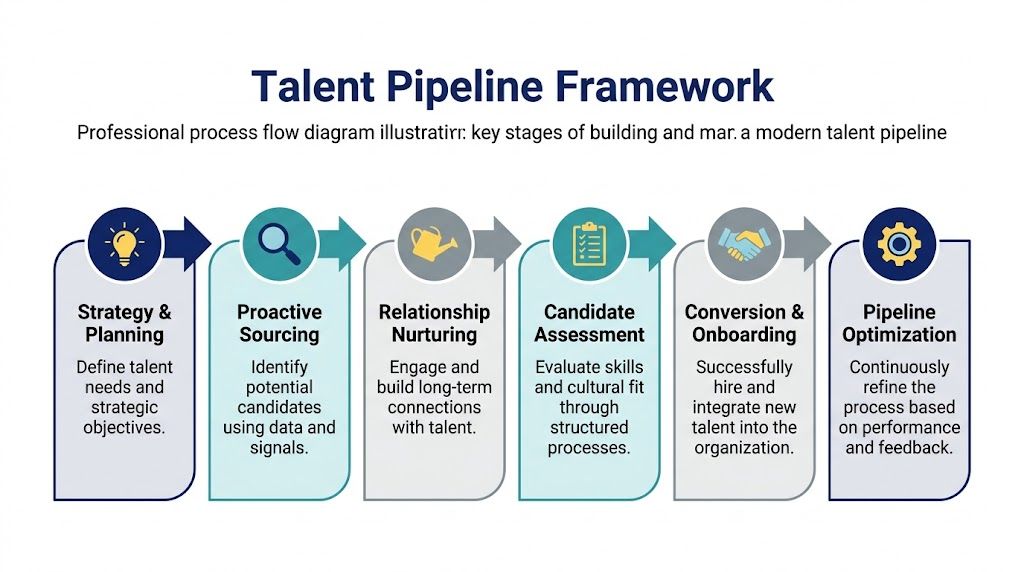
Build around four working stages
I use four practical stages for managing the talent pipeline.
| Stage | What it means | Entry criteria | Exit criteria |
|---|---|---|---|
| Awareness | People who fit your ideal candidate profile | Relevant background, skills, or trajectory identified | Basic fit confirmed and worth engaging |
| Engagement | People you’re actively building a relationship with | Initial contact, response, or warm intro | Mutual interest and useful context established |
| Consideration | Talent aligned to a likely role or future opening | Candidate goals, timing, and role fit are clearer | Candidate is ready for structured evaluation |
| Ready to hire | Vetted talent you can activate quickly | Strong fit, current context, decision-maker alignment | Enters active interview process for a live opening |
Teams often fail because they skip stage discipline. They lump everyone into one bucket and call it a pipeline. That creates noise, not optionality.
Define stage rules like a sales team would
A stage only works if the business can tell the difference between “interesting” and “actionable.”
For example:
- Awareness isn’t a list scrape. Someone belongs there because you can articulate why they match a target role family.
- Engagement isn’t a single InMail. It means there has been a real interaction, or at least enough context to personalize one.
- Consideration requires intent. You know what kind of move would interest the person, even if the timing isn’t immediate.
- Ready to hire means pre-work is done. The candidate shouldn’t need a fresh discovery call just to understand whether the role is relevant.
A pipeline without entry and exit rules turns into a contact database with optimistic labeling.
Assign owners early
Many frameworks fail here. Everyone supports hiring, but nobody owns pipeline health.
A clean operating model usually looks like this:
- Recruiting owns market coverage. They map target talent, maintain segmentation, run outreach, and keep records current.
- Hiring managers own role clarity. They define success in practical terms and participate in relationship-building before requisitions open.
- Functional leaders own future demand. They flag likely openings, succession risk, and capability gaps before they become urgent.
- People ops or TA ops owns process hygiene. They keep CRM rules, stage definitions, reporting, and SLAs consistent.
This mirrors how strong commercial teams work. Sales, SDRs, RevOps, and leadership don’t all do the same thing, but they do align around one pipeline model. If your hiring process feels fragmented, it usually means your responsibilities are too.
A useful reference point is how mature teams split planning and execution in a sales operations org structure. Talent pipeline management benefits from the same kind of role clarity.
Start with critical roles, not every role
You don’t need an enterprise-grade pipeline for every future vacancy. Start where disruption hurts most.
Focus first on roles that are:
- Revenue-linked: quota-carrying leaders, strategic account roles, sales engineering, RevOps
- Hard to replace: niche technical, leadership, or hybrid roles
- Frequently reopened: positions where your process has historically dragged
- Succession-sensitive: jobs where one exit creates organizational risk
The economics become visible here. Organizations with effective pipelines can reduce average time-to-fill from over 42 days to 29, cut cost-per-hire by up to 50%, and boost quality-of-hire retention to over 90% after one year, based on Juicebox’s talent pipeline management benchmarks.
Keep the framework simple enough to run
A framework should help managers act faster, not create ceremony. If your team needs a training manual to decide whether someone is warm, the model is too complicated.
The test is straightforward. Can a recruiter, hiring manager, and executive review the same pipeline and agree on:
- Who matters most
- What stage they’re in
- What should happen next
- Where the bottlenecks are
If the answer is yes, the framework is working.
Proactive Sourcing with Signal-Driven Outreach
The strongest candidates often aren’t applying. They’re shipping a big launch, inheriting a bigger team, cleaning up a messy territory, or deciding whether their current company still matches their ambition.
That’s why proactive sourcing works better when it behaves less like resume collection and more like signal detection.
Revenue teams already do this. They watch for buying signals, org changes, executive movement, hiring patterns, funding events, and new initiatives. Talent teams can do the same thing. The difference is that instead of asking, “Who might buy?” you’re asking, “Who might be open, ready, or worth knowing now?”

Career signals are the hiring equivalent of buying signals
A career signal is any observable change that suggests someone’s context is shifting.
Some are positive. A leader finishes a major project. A manager gets promoted and may soon need a broader platform. A rep outgrows a narrow territory. Some are destabilizing. A merger changes reporting lines. A reorg removes advancement paths. A company starts losing key executives.
None of these signals guarantee availability. That isn’t the point. The point is timing. Good outreach meets people when their context is changing, not when your requisition appears.
Common signals worth tracking include:
- Role progression stalls: Someone has held stretch-level responsibility for a while but title scope hasn’t caught up.
- Executive changes: A new CRO, VP, or GM often reshapes teams beneath them.
- Company disruption: Acquisitions, layoffs, strategy pivots, or public turbulence can change career risk fast.
- Milestone completion: Big launches, integrations, or market expansions often create a natural reflection point.
- Skill visibility: People who share thoughtful work publicly often signal both expertise and openness to conversation.
A useful mental model comes from sales intelligence. If your team already tracks job change signals for pipeline, the same logic applies in recruiting. Timing plus context beats volume.
Work your own database before the market
A lot of companies overlook their best sourcing asset. It isn’t an expensive tool. It’s the people they already met.
That matters because in 2025, 76% of employers globally report difficulty filling roles, and 44% of sourced hires in 2024 were rediscovered talent from internal databases, according to SocialTalent’s 2025 hiring reality check. If nearly half of sourced hires are coming from internal CRM or ATS history, teams that ignore rediscovery are wasting qualified demand they already created.
Outreach should sound like market awareness, not a pitch
The fastest way to ruin signal-based sourcing is to treat every signal like permission for a job pitch.
Don’t message someone because they changed jobs and ask if they want another one. Don’t mention a company event with no point of view. Don’t pretend personalization means naming the signal and attaching a calendar link.
Use the signal to start a relevant conversation.
Here’s a practical comparison:
| Weak outreach | Better outreach |
|---|---|
| “Saw your company was acquired. We’re hiring. Open to chat?” | “Saw the acquisition news. Those transitions usually change team design and priorities fast. If your remit is expanding, I’d be glad to compare notes on how similar leaders have navigated that move.” |
| “Congrats on the promotion. Interested in a VP role?” | “Congrats on the promotion. You’ve likely got a much wider operating scope now. I’d enjoy hearing what changed in the seat and what kind of platform becomes interesting after a move like that.” |
| “We have an opening that fits your background.” | “You’ve done a rare combination of field leadership and systems work. That blend is hard to find. I’d value a short conversation, even if timing isn’t right.” |
Better sourcing starts with relevance, not urgency.
Keep a simple signal-driven cadence
A basic cadence works well when it avoids pressure:
- Start with the trigger. Reference the event or context clearly.
- Add a point of view. Show that you understand why the moment matters.
- Lower the ask. Invite a conversation, not an application.
- Follow up with value. Share a useful observation, operator note, or market perspective.
- Log what you learn. Timing, motivations, constraints, and likely next windows matter more than a yes or no today.
Many teams achieve practical advantage through this approach. They stop waiting for active candidates and start building relationships with people whose trajectory already suggests future fit.

“This is my singular place that very simply summarizes a company's top initiatives, strategies and connects them to my solution. Something I would spend hours researching manually, now it's automated.”
Derek Rosen
Director, Strategic Accounts, Guild Education
Nurturing Talent Relationships for the Long Term
Most hiring teams can source. Far fewer can nurture.
That’s the middle of the funnel, and it’s usually where good candidates disappear. A recruiter has a strong intro call with someone who isn’t ready to move. The hiring manager says, “Great, keep in touch.” Nobody does. Six months later a role opens, the team goes back to the same person cold, and finds out they joined a competitor two months earlier.
That isn’t bad luck. It’s poor relationship management.

Treat silver medalists like future pipeline, not closed loss
The most underused segment in hiring is the near-miss candidate.
Think about a common scenario. You run a process for a regional sales leader. Two candidates are excellent. One wins because they have slightly better market context. The other loses, but not because they were weak. They weren’t the final choice that day.
Weak teams archive that person.
Strong teams classify them carefully. They note what role shape fits, what concerns came up, what impressed the panel, and what timing factors mattered. Then they stay in touch with intent.
Good nurture for silver medalists can include:
- Role-relevant updates: Not job blasts. Useful contact about market moves, leadership openings, or company changes that would matter to them.
- Occasional operator conversations: A hiring manager can check in without a live req if the relationship is real.
- Invitations that carry value: Small leadership roundtables, product briefings, or peer discussions work better than generic talent community emails.
- Context refreshes: Ask what has changed in their scope since the last conversation. People evolve quickly.
Nurture should give before it asks
The best outreach in a nurture motion sounds like peer engagement.
A good example is a revenue systems candidate who wasn’t ready to move during budget season. Instead of recycling the same “just checking in” note, send something useful: a point of view on territory planning, a leadership article that maps to their remit, or a thoughtful question about a systems change their company is likely handling.
That kind of follow-up does two things. It proves your team remembers who they are, and it keeps the relationship grounded in their career, not your requisition.
Here’s what tends to work better than teams expect:
- Small, personalized touches
- Reference their world: Mention a project type, GTM change, or leadership challenge they deal with.
- Keep the ask light: A short exchange is enough. Don’t force a formal call every time.
- Manager participation
- Use hiring leaders selectively: Candidates respond differently when a future peer or leader joins the relationship early.
- Avoid over-orchestration: One thoughtful note beats three automated reminders.
- Timed relevance
- Reach out around inflection points: New fiscal year, post-launch, after team changes, or after a promotion cycle often works well.
- Respect no-change periods: If someone tells you they won’t move before a product release or annual planning cycle, believe them.
Candidates don’t go cold because they dislike your company. They go cold because your team stops being relevant.
Internal talent belongs in the same pipeline mindset
External sourcing gets attention because it feels like acquisition. Internal movement matters just as much because it protects continuity.
Succession planning is one of the clearest examples. If you know a frontline manager, RevOps lead, or regional director could become a single point of failure, you should already be identifying internal successors, exposure gaps, and development needs.
That’s still managing the talent pipeline. The pipeline just happens to be inside the company.
The retention upside is meaningful. Effective succession planning can increase internal promotion rates by 20 to 30%, and referred employees are linked to 45% two-year retention compared with 20% from job boards, based on Phenom’s talent pipeline strategy benchmarks.
Build a simple nurture rhythm
You don’t need heavy marketing automation to run this well. You need consistency and segmentation.
A practical rhythm might look like this:
| Candidate type | Best nurture motion | Common mistake |
|---|---|---|
| Silver medalists | Quarterly personal check-in plus targeted role updates | Generic “keeping in touch” email |
| Passive top performers | Light-touch relationship building with relevant insights | Pitching a job too early |
| Former finalists | Re-engage around role changes or business inflection points | Assuming old interview notes are still current |
| Internal successors | Development conversations, mentorship, stretch assignments | Treating succession as a spreadsheet exercise |
What usually fails
A few patterns consistently undermine long-term talent relationships:
- Too much automation: Candidates can tell when every message was built from a sequence instead of judgment.
- No memory: If your notes don’t capture motivations, timing, and constraints, every restart feels careless.
- Only reaching out when you need something: That turns the entire process transactional.
Nurture is where companies separate themselves. Anyone can send outreach. Fewer teams can build a reputation as a place that stays thoughtful, organized, and worth talking to over time.
Converting Top Talent and Measuring What Matters
A pipeline only matters if it converts. Warm relationships are useful, but they’re not the goal. The goal is to fill important roles with the right people, faster and with less disruption, then prove the system is working.
Talent teams often lose executive confidence in this situation. They can describe activity. They can show ATS volume. They can list events, outreach, and top-of-funnel effort. But leadership usually wants a harder answer. Is the pipeline reducing hiring friction? Is it improving team output? Is it worth continued investment?
That’s the measurement problem.

Activate the pipeline without restarting discovery
When a live role opens, weak teams behave as if they’ve learned nothing from the pipeline. They ask candidates to repeat context, restart screening, and sit through generic process steps that should have been shortened.
Conversion gets easier when the handoff is tight.
A practical activation playbook looks like this:
-
Reconfirm timing first
Reach out to the most relevant candidates and verify whether their situation has changed. Don’t assume prior interest still exists. -
Share a role narrative, not just a job description
Explain why the role exists, what success looks like, what changed in the business, and why now is the right moment. -
Use prior knowledge to compress steps
If the team already understands a candidate’s background, spend interview time on live problem-solving and decision fit, not resume recap. -
Control interview sprawl
Extra interviews often reflect indecision, not rigor. -
Close like a revenue team
Know concerns early. Align compensation discussions, scope expectations, and stakeholder access before the offer stage.
Measure pipeline health the way operators do
The best hiring metrics are the ones leadership can act on. Vanity metrics create noise. Business metrics create decisions.
The U.S. Chamber Foundation points to a broader issue. Many organizations face a measurement crisis in talent management, lacking a systematic way to prove ROI. Revenue leaders need visibility into whether talent pipeline investments are reducing hiring costs or accelerating time-to-productivity, as discussed in its analysis of managing the talent pipeline and closing the skills gap.
That’s the right framing. Measure what helps you make better allocation choices.
The core metrics worth tracking
| Metric | What it tells you | What good usage looks like |
|---|---|---|
| Pipeline velocity | How quickly candidates move from engagement to active process | Spot stalled stages, manager delays, and unnecessary steps |
| Pool-to-hire ratio | Whether your pipeline contains real fit, not just names | Compare by role family, geography, and recruiter |
| Offer acceptance rate | Whether candidates trust the process and role | Review compensation alignment, decision speed, and candidate experience |
| Quality of hire | Whether hires perform and stick | Combine manager feedback, ramp quality, and retention signals |
| Source effectiveness | Which channels produce convertable talent | Shift effort away from low-yield volume sources |
| Internal fill health | Whether succession planning is reducing risk | Track readiness for roles where continuity matters most |
A useful parallel for commercial leaders is sales productivity. The same discipline that improves forecasting also improves hiring. This guide on how to measure sales productivity is relevant because both functions need stage-level visibility, not just end results.
What executives should ask for
If I’m reviewing talent pipeline performance with a leadership team, I want answers to questions like these:
- Which critical roles have active bench coverage right now?
- Where are candidates stalling in the process, and why?
- How many hires came from nurtured relationships versus fresh sourcing?
- Which managers convert strong candidates well, and which create friction?
- Are internal successors ready, or are they just named in a slide?
If you can’t explain why a role took too long to fill, you don’t have a pipeline problem alone. You have an operating problem.
What not to overvalue
Not every hiring dashboard metric deserves attention.
Be careful with:
- Applicant volume: More applicants often means weaker targeting.
- Raw outreach activity: A hundred low-context messages don’t equal one real relationship.
- Interview count: More interviews can signal confusion instead of quality control.
A healthy system shows up in fewer restarts, cleaner decision paths, stronger close rates, and hires who perform after the applause fades.
The Future Is Autonomous Talent Intelligence
Most companies still manage the talent pipeline with a lot of manual labor. Recruiters search, managers forward profiles, somebody remembers a strong finalist from last year, and a spreadsheet tries to hold together what should really be a living system.
That model doesn’t scale well.
The market is too dynamic, candidate context changes too fast, and signal volume is too high. People move roles, teams reorganize, priorities shift, and companies change strategy before a quarterly planning cycle is even finished. Manual tracking can support pockets of excellence, but it rarely creates durable coverage across a whole go-to-market org.
Manual effort is the bottleneck
This is the assumption worth challenging. Many teams still believe better hiring comes from more recruiter hustle alone.
It doesn’t.
It comes from better detection, better context, and better timing. The manual version of that work is expensive. Someone has to notice the trigger, interpret what it means, decide whether it matters, match it to the right role family, and draft outreach that sounds informed. That’s exactly the kind of repetitive, high-context work that modern systems should help with.
The future of managing the talent pipeline looks a lot like the future of pipeline generation in sales. Continuous monitoring. Better signal prioritization. More context at the moment of action. Less dependence on memory and heroic individual effort.
Intelligence should support candidates too
This shift also changes the candidate side of the market. As more professionals use tools to sharpen how they present their experience, teams need better judgment, not just more filters. That’s one reason it’s useful to understand resources like AI resume writing tools, which show how candidates are packaging career narratives with more sophistication than many hiring teams expect.
That doesn’t make signal-driven hiring less useful. It makes it more necessary. When resumes become easier to polish, context matters more. Actual career signals, relevant achievements, and sustained relationships become stronger indicators than formatting or keyword density.
What the next operating model looks like
The direction is clear:
- Signals are monitored continuously
- Candidate context is updated automatically
- Teams get prompted when timing improves
- Outreach starts from a real point of view
- Managers spend more time deciding and less time searching
The companies that win won’t be the ones with the biggest applicant flow. They’ll be the ones that treat talent intelligence like a strategic system.
Managing the talent pipeline has already moved beyond posting jobs and hoping the market responds. The next step is building an operation that notices change early, interprets it correctly, and helps humans act while timing is still on their side.
If your revenue team already believes in signal-based pipeline generation, it’s worth seeing how that same operating model can sharpen account intelligence and outreach. Salesmotion helps teams track real-world signals, turn them into actionable context, and move faster with better timing across target accounts.