A strategic talent management strategy aligns hiring, development, retention and succession with business goals, and concentrates effort on the critical roles that drive results. For 2027 planning, it should also turn talent movement, such as hiring patterns and leadership changes, into signals your revenue team can act on.
TL;DR: Start from the business objective, not headcount requests. Prioritize critical roles, track Time to Hire, treat onboarding as ramp design, tie retention and succession to live internal and external signals, and give every metric a named owner.
Most advice on talent management is too polite and too slow. It treats hiring, development, and retention like internal hygiene. Necessary, sure. Strategic, not always.
That mindset is a mistake. Your talent system shapes execution speed, leadership depth, product rollout quality, customer coverage, and how fast your revenue team can react when a market shifts. It also creates something most CROs overlook: competitive intelligence. Hiring patterns, internal mobility, leadership exits, role backfills, onboarding friction, and succession moves all signal what your company and your competitors are about to do next.
A modern strategic talent management strategy should do two jobs at once. First, it should build the workforce you need to hit business goals. Second, it should turn talent movement into decision-grade signals your commercial team can act on. If your HR team owns the process but your revenue leaders ignore the output, you're leaving insight on the table.
Why Your Talent Strategy Needs a Strategic Rethink
Most companies still talk about talent management like it's a support function. They discuss culture, engagement, and employee experience in isolation, then wonder why execution stalls when the business needs to move fast.
That framing is outdated. Talent strategy is operating strategy. If you can't move the right people into the right roles quickly, your GTM plan becomes a slide deck instead of a market advantage.
The strongest evidence is straightforward. According to a McKinsey Global Survey, three practices have an outsize impact on organizational performance: rapid allocation of talent, HR's involvement in fostering a positive employee experience, and a strategically minded HR team. The same survey notes that organizations that focus on these practices improve capacity building and hiring activities that align talent strategy with business strategy, according to McKinsey's talent management research.
What CROs should care about
A CRO doesn't need to run HR. But a CRO absolutely should care about whether the business can:
- Reassign talent quickly when a segment opens up or a territory underperforms
- Support employee experience well enough that top performers don't leave during a critical selling window
- Think strategically about talent instead of reacting to vacancies one req at a time
Those aren't people-team vanity projects. They're commercial assets.
Here's the uncomfortable reality. A competitor's new VP hire, a cluster of enterprise AEs added in one region, or a sudden spike in solutions architect openings can tell you more about their next move than a polished press release. The same is true inside your own company. When internal mobility stalls or critical managers start leaving, the revenue impact usually shows up later, not immediately.
Practical rule: If a talent signal changes execution capacity, leadership coverage, or buying committee access, it's not an HR detail. It's a revenue signal.
The old model breaks under speed
The old model assumes annual planning, static org charts, and long feedback loops. That doesn't hold up anymore. Growth teams now operate in shorter cycles. Product launches move faster. Territories change. Buying groups shift. Leaders get hired, promoted, or leave with immediate downstream effects.
A strong talent strategy helps you answer sharper questions:
| Question | Weak approach | Strategic approach |
|---|---|---|
| Where should we invest hiring? | Fill open roles as requests come in | Map hiring to business priorities and revenue motions |
| Which roles matter most? | Treat headcount evenly | Prioritize roles that change execution outcomes |
| When should we act on retention risk? | Wait for annual review cycles | Use signals and intervene early |
| How does talent inform sales? | Keep people data siloed | Translate org changes into market intelligence |
If you're still separating workforce planning from commercial planning, you're running two systems that should be one.
See Salesmotion in action
Take a self-guided interactive tour — no signup required.
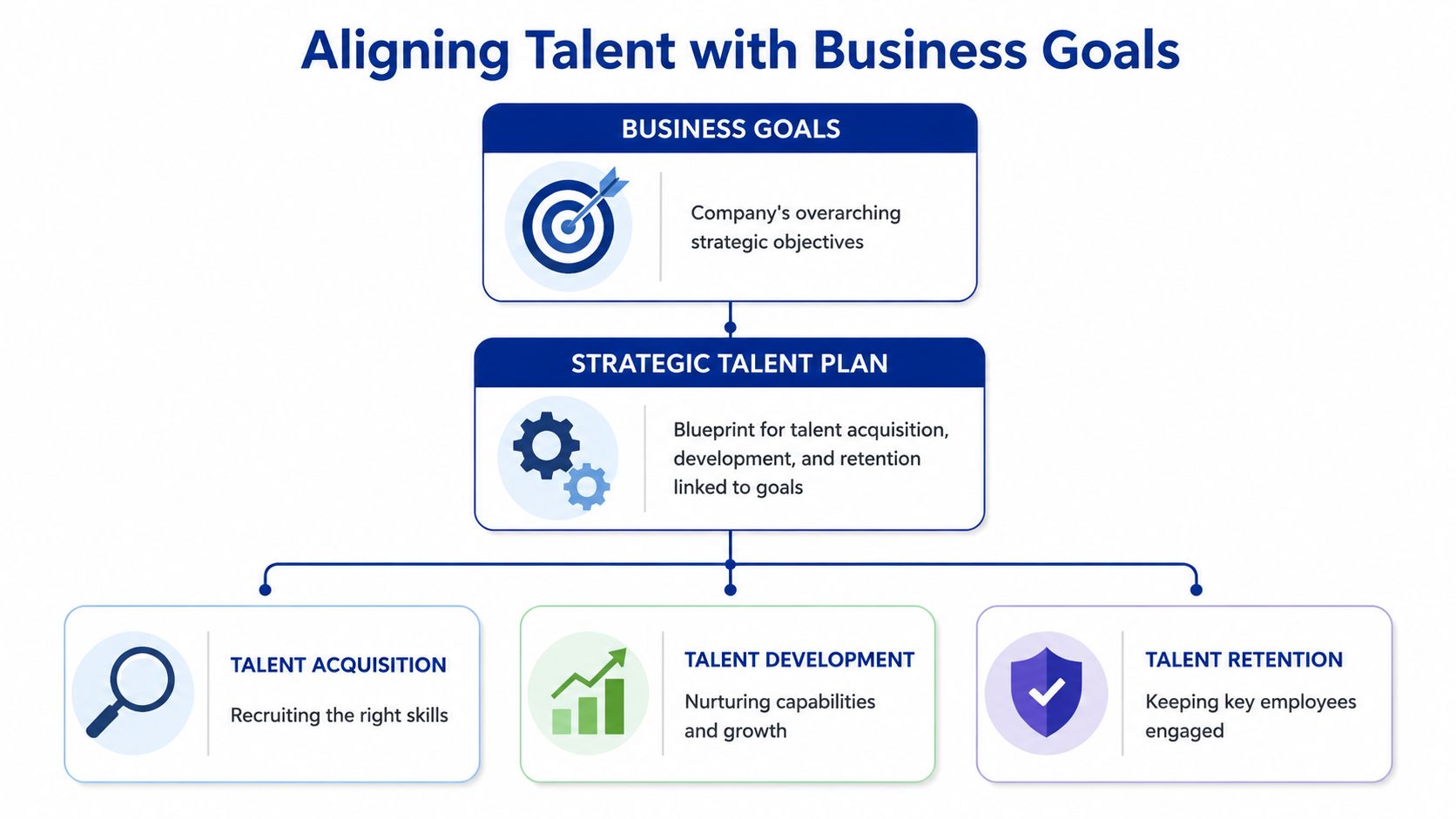
Align Talent with Business Goals First
Most talent plans fail before the first interview. The problem isn't sourcing. It's that leaders start with headcount requests instead of business objectives.
If the company goal is to win the enterprise segment, don't begin by asking how many people to hire. Start by asking what that motion requires. Enterprise revenue doesn't come from generic "sales talent." It depends on specific capabilities, role design, management quality, and cross-functional support.
Translate strategy into role architecture
Take a simple scenario. A SaaS company wants to expand into a new region and move upmarket. That isn't one hiring need. It's a coordinated talent design problem.
You likely need a mix of:
- Enterprise account executives who can manage long cycles and multi-threaded deals
- Solutions architects who can handle technical validation and risk reduction
- Regional marketing support that can generate credibility in the new market
- Customer success leaders who can retain and expand early lighthouse accounts
- Frontline managers who know how to coach enterprise motions, not just inspect pipeline
If even one of those layers is missing, the expansion slows down. Worse, leaders often overhire visible revenue roles and underinvest in the supporting roles that make those reps productive.
Build the talent blueprint before hiring starts
A useful operating sequence looks like this:
- Start with the commercial objective. Market entry, enterprise expansion, partner-led growth, or product launch.
- Define the motion required. New logo acquisition, expansion selling, technical selling, channel enablement, or retention-heavy growth.
- List the critical capabilities. Negotiation depth, deal orchestration, vertical fluency, technical credibility, leadership coaching, onboarding quality.
- Translate capabilities into role profiles. Not job titles alone. Real profiles with outcomes, decision rights, and collaboration points.
- Decide build versus buy. Some roles need external hiring. Others should come from internal mobility and development.
A lot of job descriptions are vague because the strategy behind them is vague. If your team needs a sharper template for role design, this breakdown of crafting the perfect revenue operations job description is useful because it forces clarity on outcomes, ownership, and fit.
The best talent plans don't begin with recruiting. They begin with a business bet and a clear view of who must execute it.
Use business goals to shape development and retention too
Alignment isn't only about acquisition. Once you've identified the roles and capabilities tied to the strategy, development and retention should follow the same map.
For example:
- Development should focus on ramping people into the capabilities the business needs next, not offering generic training libraries.
- Retention should prioritize the people whose exit would slow execution, break customer continuity, or weaken management's effectiveness.
- Succession should focus on roles that would create operational drag if left open.
This sounds obvious. It rarely happens with discipline.
A strategic talent management strategy works when every people decision answers one question: does this improve our ability to hit the business goal? If the answer is fuzzy, the investment is probably misplaced.

“The talking points are gold. If they're in Salesmotion, I know they're being discussed inside that business. That makes it easy to spark a real conversation, which is 90 percent of the battle.”
Andrew Giordano
VP of Global Commercial Operations, Analytic Partners
Focus Workforce Planning on Your Critical Roles
Most workforce planning is bloated. Companies build spreadsheets for the entire org, debate every role equally, and spread attention so thin that nothing important gets real protection.
That's backwards. A better model starts with a hard truth: only 10 to 15% of jobs are "critical roles" that drive future success, according to TBM Consulting Group's talent strategy perspective. The same source argues that leaders who ruthlessly prioritize resources for these roles, often identified through dynamic data signals, avoid the inefficient allocation that leaves success up to luck.

Stop planning for everyone the same way
Not every job deserves the same planning intensity. Critical roles are the ones that create disproportionate impact. In a growth-stage company, that might include enterprise sales managers, solutions consultants, product marketers for a flagship launch, implementation leads, or a regional GM opening a new market.
A non-critical role still matters. It just doesn't deserve the same level of executive scrutiny, succession depth, and intervention speed.
Here's a cleaner way to consider this:
| Workforce segment | Planning approach | Talent investment level |
|---|---|---|
| Critical roles | High-touch planning, active succession, live monitoring | Highest |
| Important support roles | Standard planning, role-specific enablement | Moderate |
| Repeatable roles | Process-driven hiring and onboarding | Efficient and scalable |
That model frees up leadership time. It also reduces noise.
How to identify critical roles without guessing
Static job descriptions don't do the job. Criticality changes as strategy changes.
Use signals like:
- Revenue dependency. Does the role directly affect pipeline quality, win rates, deal progression, or expansion?
- Execution bottlenecks. Does work stall when this seat is open?
- Scarcity. Is the skill set hard to replace internally or externally?
- Strategic timing. Is the role essential for a launch, new region, pricing shift, or enterprise push?
- Managerial impact. Does one strong hire improve the output of multiple teams?
A VP of Sales in a mature region may matter less than a first-line enterprise manager in a newly opened market. A senior recruiter focused on high-volume hiring may matter less than the recruiter who fills scarce technical sales roles. Role value is contextual.
For teams managing distributed work, clear operating rules matter because ambiguity hurts retention and execution in exactly the roles you can't afford to lose. This guide on effective policies for remote teams is a practical reference if you're tightening how critical roles work across locations.
Use competitor role patterns as commercial signals
This is where workforce planning gets interesting for revenue leaders. When a competitor suddenly hires for a cluster of roles, that move often signals strategy before strategy becomes public.
Examples you can act on qualitatively:
- A competitor adds several customer success leadership roles. They may be preparing for an expansion-heavy period or trying to protect churn.
- They backfill multiple enterprise sellers in one region. That can indicate turnover, territory redesign, or renewed market focus.
- They hire implementation specialists tied to a product line. That may point to expected delivery volume or a new launch.
Those patterns help sales teams prioritize accounts, shape messaging, and pressure-test assumptions. Internally, they also sharpen your own planning. If you don't know which roles matter most in your business, you won't recognize why those same roles matter in a competitor's.
If you're building a more disciplined handoff between planning and hiring, this piece on managing the talent pipeline is worth reviewing because pipeline quality matters far more when you're hiring for the vital few instead of the trivial many.
Ruthless prioritization isn't harsh. It's operationally honest.
Turn Sourcing and Onboarding into a Competitive Edge
A lot of hiring teams treat sourcing like a volume game and onboarding like administrative cleanup. That's lazy thinking.
Sourcing is market positioning. Onboarding is speed-to-impact. If you want your strategic talent management strategy to create an advantage, both functions need to run like revenue operations. Clear inputs. Tight handoffs. Measurable output.
Track the one hiring metric that exposes drag
You don't need a dashboard full of vanity metrics to know whether your hiring engine works. Start with Time to Hire.
A strategic talent management strategy should define and track Time to Hire, calculated as the total days from application to acceptance, because it directly measures recruitment funnel efficiency and candidate experience, according to iMocha's talent management metrics guide.
That metric matters because slow hiring does damage in several ways:
- Critical roles stay open longer, which slows territory coverage and team output
- Strong candidates lose interest, especially when competitors move faster
- Hiring managers create workarounds, often by pushing overloaded teams harder
- Planning gets distorted, because leaders start making decisions on stale assumptions
Fix the hiring machine before adding headcount
If Time to Hire is messy, don't paper over it by adding recruiters. Diagnose the operating friction.
A simple breakdown helps:
| Hiring stage | What usually goes wrong | What to fix |
|---|---|---|
| Application to screen | Poor role calibration | Tighten scorecards and must-have criteria |
| Screen to interview loop | Too many stakeholders | Reduce interview count and clarify decision rights |
| Final loop to offer | Weak alignment | Pre-close candidates earlier and align comp faster |
| Offer to acceptance | Slow approvals or poor candidate experience | Set response SLAs and improve communication |
Most delays aren't talent shortages. They're management failures.
Build sourcing that supports strategy, not just req closure
Strong sourcing doesn't start when a role opens. It starts when the business sets a priority. If you're moving upmarket, your talent brand should attract enterprise-grade sellers and technical support talent before you scramble to hire them.
That means your employer narrative should answer practical questions:
- What kind of selling motion are people joining?
- Who will coach them?
- How does the company support development?
- What kind of complexity will they handle?
- Why is this role a growth opportunity, not just a vacancy?
The same logic applies to onboarding. Winning the candidate is only half the job. If they join and spend weeks hunting for context, chasing access, and waiting on manager direction, your system just wasted a strong hire.
For companies scaling fast across multiple entities or regions, this resource on optimizing PEO onboarding efficiency is useful because it focuses on removing administrative drag that slows down productive starts.
A fast offer process gets talent in the door. A disciplined onboarding process gets value out of the hire.
Treat onboarding like ramp design
A new seller doesn't need welcome swag and a calendar full of generic sessions. They need a ramp path tied to actual performance milestones.
A better onboarding sequence includes:
- Role clarity on day one. Expected outcomes, territory logic, pipeline standards.
- Manager-led coaching early. Not just HR orientation.
- Exposure to real buyer context. Calls, objections, customer language, product use cases.
- Defined early wins. Meetings booked, discovery quality, account plans, internal certifications.
- Fast feedback loops. Fix confusion before it becomes underperformance.
If you lead an SDR or commercial team, this playbook on sales development rep training is a useful example of how structured ramping can improve readiness and consistency.
Sourcing wins attention. Onboarding converts it into execution.

“All of the vendors that I've worked with, all of the onboarding that I have had to deal with, I will say, hands down, Salesmotion was the easiest that I have had.”
Lyndsay Thomson
Head of Sales Operations, Cytel
Proactively Retain Talent with Signal-Based Succession Planning
Most retention strategies are too late. Companies run surveys, review compensation, talk about engagement, and then act after a resignation lands.
That's not a strategy. That's post-event administration.
The bigger failure is timing. Traditional retention programs rarely answer the question that matters most: when should we act? According to Paycom's talent management strategy perspective, traditional retention strategies fail because they don't integrate real-time, external signal triggers such as a new CRO hire or funding round. That leaves leaders unable to connect external triggers to internal turnover risk in time to do anything useful.
External signals often predict internal risk
Retention risk doesn't appear out of nowhere. It usually builds around moments of change.
Examples:
- A competitor hires a new revenue leader and starts rebuilding a regional team
- A former manager lands elsewhere and begins attracting former top performers
- A target account announces expansion, restructuring, or new funding and suddenly looks attractive to ambitious employees
- Your own company changes comp plans, territories, product focus, or leadership coverage
Each event changes the attractiveness of staying versus leaving for different employee groups. High performers don't resign randomly. They often move when a better narrative appears.
Succession planning needs live triggers
Most succession planning lives in annual talent reviews. That's too static for revenue-critical roles.
A stronger model combines internal indicators with external triggers.
| Signal type | What to watch | Why it matters |
|---|---|---|
| Internal performance signal | Drop in engagement, stalled progression, manager friction | Can indicate flight risk or role mismatch |
| Internal org signal | Leadership vacancy, redesign, promotion bottleneck | Exposes succession gaps |
| External market signal | Competitor hiring surge, executive moves, funding news | Raises poaching risk and changes talent flow |
| Customer-facing signal | Loss of account continuity or manager turnover | Threatens revenue relationships |
When these signals stack, leaders should move fast. That may mean a stay conversation, role redesign, development plan, manager intervention, or accelerated successor readiness.
Watch for clusters, not single events. One trigger may be noise. Several at once usually aren't.
Retention should protect execution, not just morale
A common weakness among companies is that they make retention a generic culture issue instead of an execution issue.
You should focus retention effort where loss creates downstream commercial damage:
- sellers with deep account knowledge
- managers who stabilize new teams
- technical talent that unblocks late-stage deals
- customer leaders who protect renewals and expansions
- internal successors for fragile leadership seats
That doesn't mean ignoring everyone else. It means acting like a strategist instead of a hall monitor.
Signal-based succession planning also improves promotion quality. When you know which roles are becoming vulnerable, you can start preparing internal talent before the vacancy becomes urgent. That protects continuity and sends a strong message to ambitious employees that the company has a credible path forward.
A strategic talent management strategy becomes much stronger when retention and succession aren't annual ceremonies. They need to function like an always-on monitoring system tied to moments that cause behavioral change.
Operationalize and Measure Your Talent Strategy
A strategy document won't save you. Governance will.
Most companies have enough talent ideas already. The gap is execution discipline. If ownership is blurry, metrics are inconsistent, and review cycles are irregular, the plan turns into HR theater.
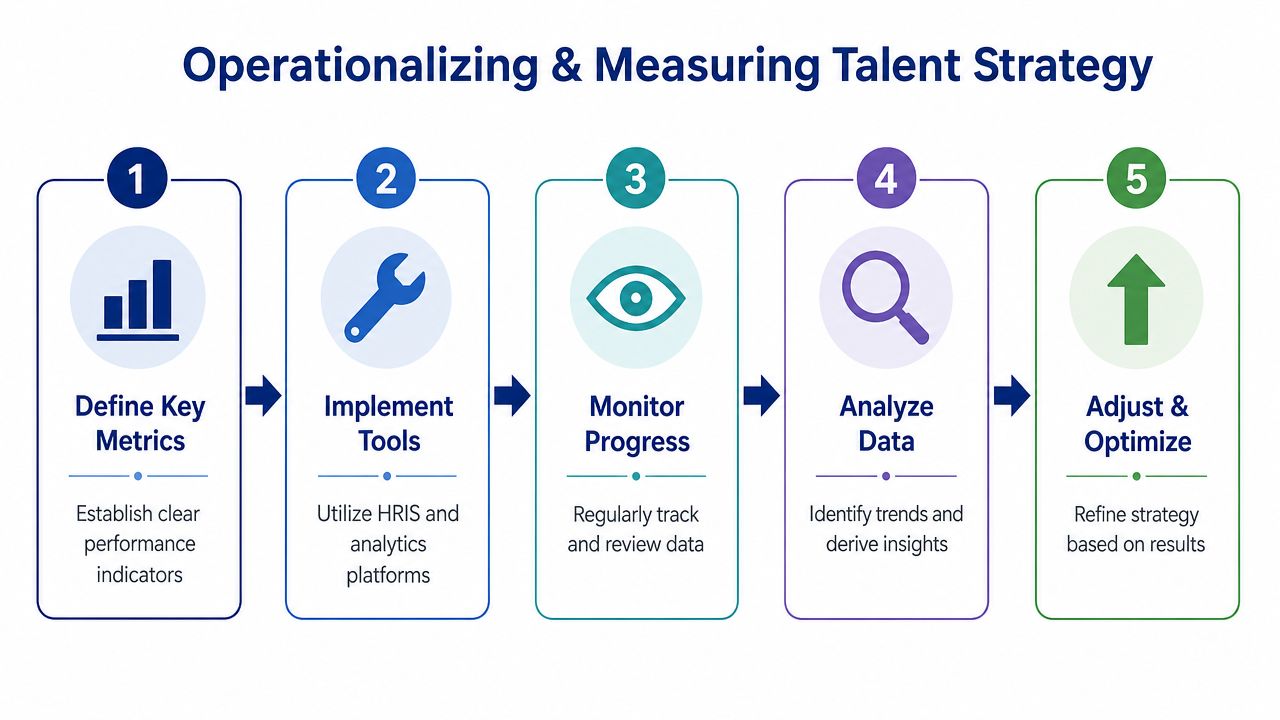
The cleanest operating model is a data-driven cycle. According to MIT Sloan's guidance on fixing talent management strategies, the methodology follows five steps: define criteria, collect data, analyze for bias, decide on interventions, and monitor results. Organizations that execute this framework outperform peers by 16% and retain 52% more top performers, based on that same source.
Put the cycle into business rhythm
That five-step model works because it forces repeatability.
Here is what good execution looks like in practice:
- Define criteria for hiring, promotion, succession, and critical-role identification so managers aren't freelancing.
- Collect data consistently across recruiting, onboarding, retention, and internal mobility.
- Analyze for bias and inefficiency so you can spot weak funnels, inconsistent decisions, or blocked progression.
- Decide interventions with named owners, deadlines, and expected outcomes.
- Monitor results on a fixed cadence so the system keeps learning.
This doesn't need to become bureaucratic. It needs to become normal.
Track a small set of metrics that matter
Once Time to Hire is in place, add a focused set of operating indicators tied to your actual strategy.
Use metrics such as:
- Critical role vacancy rate to expose where execution capacity is at risk
- Leadership pipeline strength to show whether successors are ready where the business is fragile
- High-performer retention to reveal whether your best people see a future with the company
- Onboarding progress milestones to catch slow ramp before it damages output
For distributed commercial teams, ownership clarity matters as much as the metric itself. This guide on remote sales reps is a practical reminder that distributed execution breaks down fast when expectations and management rhythms are loose.
Operating principle: If no one owns the metric, no one owns the outcome.
Assign ownership like an operator
Don't dump the whole system on HR. Split accountability across the business.
A simple model works:
| Area | Primary owner | Supporting owner |
|---|---|---|
| Critical role definition | CRO or business unit leader | HRBP |
| Hiring process health | Talent acquisition lead | Hiring managers |
| Onboarding quality | Functional manager | HR operations |
| Retention and succession | Executive leader | HRBP and direct managers |
| Reporting cadence | People analytics or ops lead | Executive team |
That's how you turn a strategic talent management strategy into an operating system instead of a workshop topic.
If your team wants to turn talent movement, hiring patterns, org changes, and executive shifts into usable pipeline signals, Salesmotion is built for that job. It helps revenue teams monitor what matters across target accounts, understand the "so what," and act while the signal is still fresh.