A rep on your team spots an open role at a target account, drops the company into a sequence, and sends the usual note: “Saw you're hiring for X. Thought this might be relevant.” The account doesn't reply. A week later, a competitor gets the meeting.
TL;DR: Job posting analysis means reading a target account's open roles for strategic intent, not just noting that it is hiring. Look at the skills, the verbs in the responsibilities, and clusters of related roles to infer the initiative behind them. Score the signal, verify it against company news and leadership changes, then write outreach that names the likely business problem.
That gap usually isn't about effort. It's about interpretation.
Teams often use job postings as a shallow trigger. They see hiring and assume interest. Strong teams treat job posting analysis as a way to decode strategic intent: what the company is building, what pressure it's under, where budget is moving, and which internal team is about to feel pain. That's the difference between adding noise to outreach and creating a real reason to talk.
Why Most Sales Teams Get Job Postings Wrong
The common mistake is simple. Reps treat a posting like a contact list update instead of a business signal.
A new “Head of Sales Operations” opening does not automatically mean the company wants your product. It might mean the current process is broken. It might mean the company is formalizing forecasting. It might mean leadership is centralizing tooling after a messy period of growth. Those are very different stories, and each one calls for a different outreach angle.
That's why basic monitoring isn't enough. Online job postings are among the most prevalent and rich data sources for labor market analysis, offering insights into in-demand skills, geographic hiring hotspots, and industry-specific demands that traditional surveys cannot capture, as noted in this breakdown of job posting data and trend analysis. The value isn't just that the role exists. The value is in the language around it.
What weak teams do
They usually follow a pattern like this:
- They anchor on the title only and ignore the actual requirements, reporting line, and project scope.
- They treat every opening equally whether it's a backfill, a net-new function, or a team build-out.
- They send generic outreach that proves they saw the posting but says nothing about the business context.
- They fail to connect roles together across departments, which means they miss the bigger initiative.
A single role can be misleading. A cluster of roles tells a story.
If a company is hiring one RevOps analyst, that's interesting. If it's hiring a RevOps analyst, a data engineer, and a sales enablement manager in the same window, that's a different picture. Now you may be looking at a go-to-market redesign, a systems cleanup, or a push for tighter commercial execution.
Practical rule: Don't ask, “Are they hiring?” Ask, “What change inside the business would require these exact hires right now?”
What strong teams do instead
Strong teams use job posting analysis to infer three things quickly:
| Signal type | What to look for | What it often means |
|---|---|---|
| Operational pain | Process language, system ownership, transformation work | Existing workflow is strained or failing |
| Strategic investment | New capabilities, specialist skill demands, new team formation | Budget is moving into a priority initiative |
| Organizational change | New leadership roles, reporting changes, cross-functional hiring | The company is restructuring how work gets done |
A lot of pipeline gets won. Not from being first to spot a posting, but from being first to explain what that posting means.
A recruiter sees an opening. A strong seller sees a buying environment forming.
See Salesmotion in action
Take a self-guided interactive tour — no signup required.
Decoding Signals Hidden in Job Descriptions
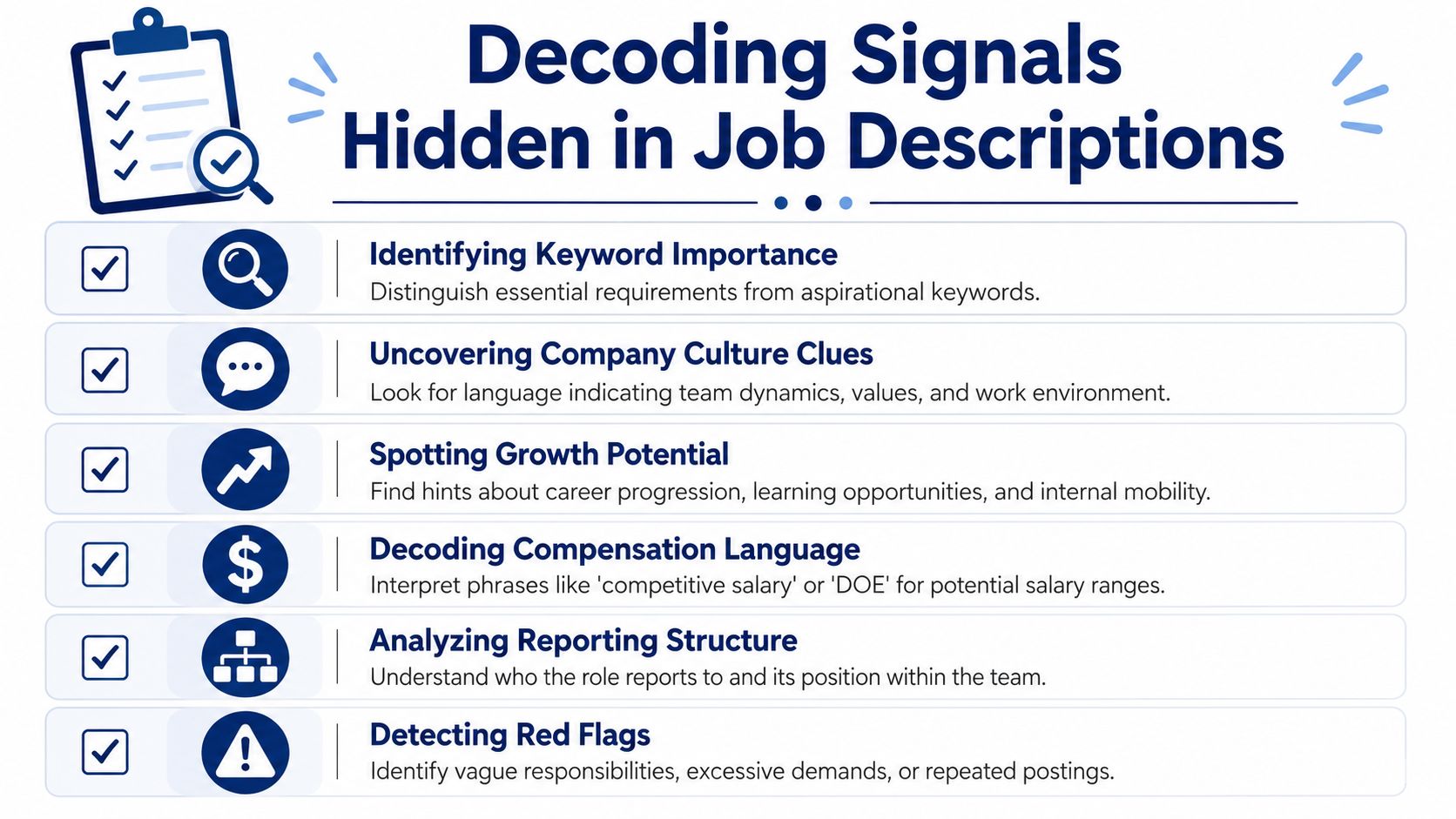
A rep sees “Sales Operations Manager” and fires off a generic note about improving forecasting. A stronger team reads the actual description, spots territory design, Salesforce governance, and compensation support, and realizes the company is rebuilding revenue operations, not filling a seat. That difference changes who you contact, what problem you lead with, and how much pipeline the account can produce.
The title starts the search. The description reveals the strategic shift.
Read the operating context before the title
Titles are inconsistent across companies. The useful signal sits in the work itself: what this person will own, what systems they touch, who they partner with, and what has to change for them to succeed.
A posting for “Software Engineer” is broad. A posting that asks for Python, cloud infrastructure, CI/CD ownership, and cost optimization points to a team that is scaling architecture and tightening cloud operations. That is a very different buying situation from a general engineering hire.
The same pattern shows up across go-to-market roles:
- BI Analyst with Tableau at a company known for another BI stack can signal evaluation, migration, or a second reporting environment taking shape
- Sales Operations Manager with Salesforce administration, territory design, and forecast governance usually means leadership wants tighter inspection and cleaner execution
- Customer Success leader with onboarding redesign and expansion ownership often points to a retention motion becoming a revenue motion
The job description gives you the problem statement in plain language if you read it like an operator.
Pay attention to verbs that imply change
Responsibilities tell you whether the company needs maintenance or transformation. That distinction matters because transformation projects create larger buying windows, more stakeholders, and clearer urgency.
I look closely at language like:
- Build a process, function, or reporting layer
- Stand up a new team or program
- Lead implementation, migration, or rollout work
- Own vendor selection, architecture, or redesign
- Standardize workflows across regions or business units
- Scale a motion, team, or operating model
- Partner cross-functionally with finance, IT, product, and operations
A role that exists to maintain current systems rarely carries that language. A role that exists to fix a bottleneck usually does.
One line can tell you a lot. “Maintain dashboards” suggests incremental work. “Build executive reporting across GTM from scratch” suggests an initiative with leadership attention, budget, and pressure to show results.
Separate support hiring from strategic hiring
Many teams lose the plot at this stage. They treat every opening as equal.
Read the “what success looks like” section and the collaboration section together. If the role owns migration work, process redesign, new tooling, or cross-functional rollout, the company is changing how it operates. If the role is focused on queue coverage, routine reporting, or replacing an individual contributor, the opportunity may be narrower.
That account-level read is much more useful than broad volume alone. The better approach is to connect each posting to the initiative behind it. This piece on hiring surges as a buying signal expands on that account view.
Red flags inside the text
Some descriptions are weak recruiting documents and weak commercial signals. I usually hold back when I see these patterns:
- Vague outcomes: long lists of duties with no measurable ownership
- Kitchen-sink requirements: every tool is listed, but no clear problem is defined
- Brand-first titles: creative naming that hides the actual function and makes the role harder to interpret
- Overwritten descriptions: lots of copy, little clarity on mandate, reporting line, or decision scope
Poorly written postings often reflect poor internal alignment. Sometimes that means there is no real project behind the role. Other times it means the company has the exact kind of operational mess your product can help fix. The difference is whether the description names a concrete business problem.
That is the core job here. Do not stop at “they are hiring.” Read until you can answer a better question: what strategic shift forced this role to exist now?

“The talking points are gold. If they're in Salesmotion, I know they're being discussed inside that business. That makes it easy to spark a real conversation, which is 90 percent of the battle.”
Andrew Giordano
VP of Global Commercial Operations, Analytic Partners
How to Prioritize Opportunities Like a Pro
Once you start reading postings properly, the next problem shows up fast. You find too many signals.
That's where teams fall back into bad habits. They either chase everything or ignore half of it. Neither works. You need a ranking system that turns interesting signals into focused action.
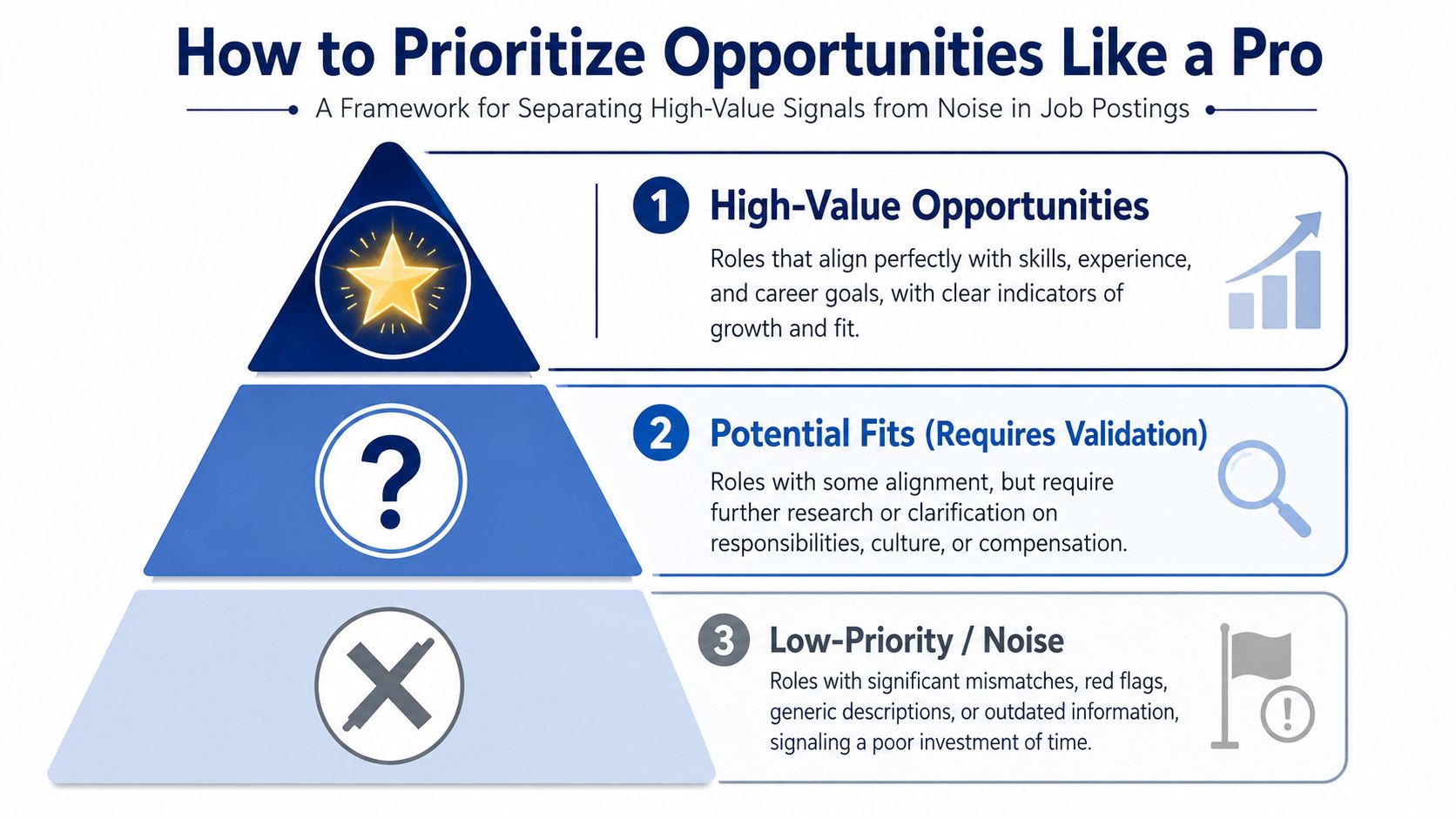
I like a simple model: Signal Strength Score. Not a fancy algorithm. Just a consistent way to separate “act now” from “watch this account” and “ignore it.”
Start with skills, not titles
This is the first filter because titles are messy. Companies use non-standard naming constantly, and two identical needs can show up under very different labels.
The stronger signal is skill demand. As Lightcast's job posting analytics guidance points out, the most actionable approach is to prioritize skills over titles, because skills like AWS or Kubernetes reveal demand more accurately than role names alone.
That changes how you score an account. A posting titled “Platform Engineer” may not tell you much. A posting asking for Kubernetes, Terraform, cloud security, and multi-region deployment tells you a lot.
A practical scoring model
Here's a simple way to qualify postings:
| Tier | What qualifies | Action |
|---|---|---|
| Act immediately | Clear skill match, build-out language, cross-functional ownership, multiple related roles | Research account and launch tailored outreach |
| Nurture and monitor | Partial skill match, ambiguous initiative, one isolated role with some relevance | Add to watchlist and wait for confirming signals |
| Low priority | Generic title, vague scope, weak product fit, likely backfill | Don't spend rep time yet |
I'd score each posting on a few dimensions:
-
Skill relevance
If the role requires the systems, workflows, or capabilities your product supports, that's your foundation. -
Seniority and authority
A VP, head, or director hire often carries more strategic weight than a junior executor. Not always, but usually. -
Initiative language
“Build,” “launch,” “transform,” and “standardize” carry more signal than “support” or “assist.” -
Team context
One role might be noise. A cluster often means internal commitment.
A useful shortcut for RevOps teams
You don't need perfect certainty to prioritize. You need enough confidence to decide where to spend scarce time.
Use a framework like this:
- High fit, high intent: move now
- High fit, low clarity: monitor for validation
- Low fit, high volume: resist the temptation
- Low fit, low intent: archive it
The biggest trap is overvaluing volume. More postings don't always mean a better opportunity. Sometimes the best account is the one with a small number of highly specific roles that line up exactly with your use case.
If the posting teaches you how the company works, score it higher. If it only tells you that they want more headcount, score it lower.
For teams building this into account selection, this guide on how to prioritize accounts for outreach is a useful companion to the scoring approach above.
Verifying Intent and Building Your Business Case
A job posting is evidence. It is not proof.
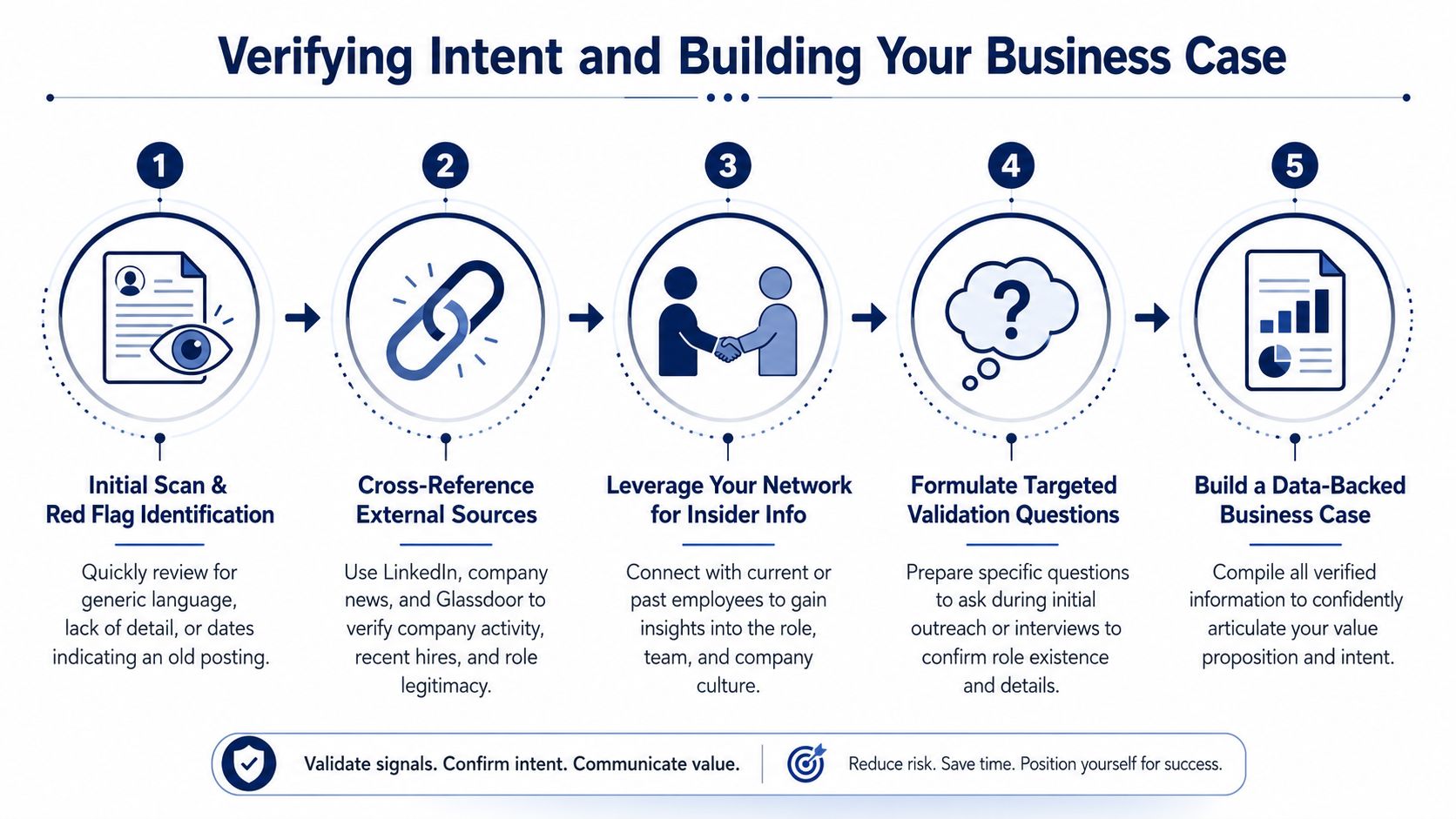
That distinction matters because plenty of teams waste time on stale listings, vague backfills, or roles that never turn into meaningful internal change. Good job posting analysis includes a verification step before anyone sends outreach.
Treat every posting like a hypothesis
The workflow is straightforward. Start with the posting, then ask whether the rest of the public record supports the same story.
That matters because analysts should cross-reference posting dates with company news such as earnings or funding to validate intent, since postings without recent supporting signals can be false positives, according to this recruiting metrics guidance on validating hiring signals.
A few examples:
- A company hiring several enterprise sellers after announcing a new market push makes sense.
- A cluster of engineering roles after a product launch is coherent.
- A sudden CRO search alongside fresh funding or leadership turnover is usually meaningful.
- A lonely operations role with no adjacent signals may be nothing more than normal replacement hiring.
Build a simple verification stack
I'd validate in layers.
First, check the posting date and whether similar roles are still live.
Second, compare the hiring pattern with recent company news, executive activity, and team changes.
Third, see whether the role language matches what the company says publicly about priorities.
Here's a simple validation table:
| Validation source | What you're looking for | Why it matters |
|---|---|---|
| Company news | Funding, earnings themes, new product launches, expansion plans | Confirms strategic context |
| Leadership activity | New execs, promoted leaders, public comments | Shows internal ownership and urgency |
| Role clustering | Multiple related postings across a function | Suggests a program, not a one-off hire |
| Timing | Fresh postings tied to fresh events | Reduces false positives |
Don't build an outreach angle from one document when you can build it from three connected signals.
Turn signal validation into a business case
Once the posting checks out, write the account story in plain language.
Something like this works well:
- Observed change: hiring for RevOps, enablement, and analytics
- Likely initiative: building a more disciplined GTM operating model
- Probable pain: fragmented data, inconsistent forecasting, slow inspection
- Why now: timing aligns with leadership or market event
- Message angle: help them accelerate the initiative with less manual work
That gives your rep a reason to contact the account that sounds grounded instead of speculative.
If you want to justify investment in this kind of workflow internally, this piece on the ROI of sales intelligence tools gives a practical framework for the operational side.

“All of the vendors that I've worked with, all of the onboarding that I have had to deal with, I will say, hands down, Salesmotion was the easiest that I have had.”
Lyndsay Thomson
Head of Sales Operations, Cytel
Crafting Outreach That Resonates and Gets Replies
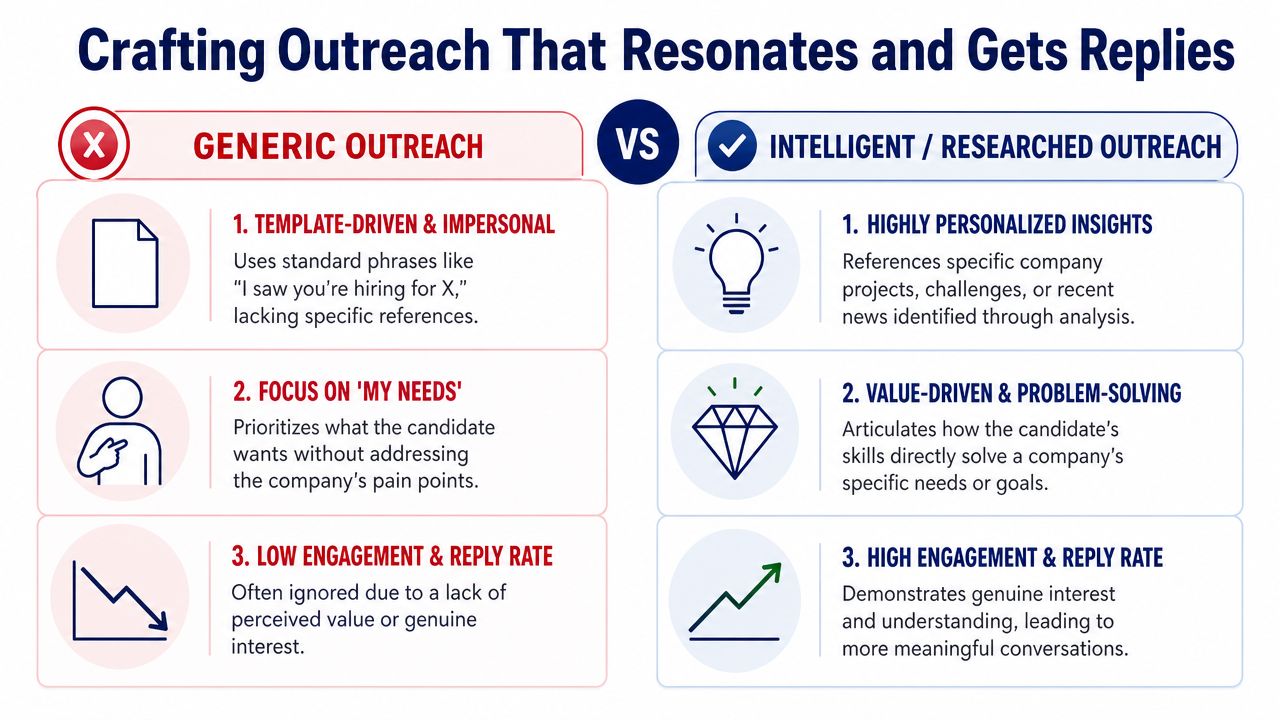
The worst outreach based on job postings sounds like surveillance. The best outreach sounds like understanding.
You can feel the difference immediately.
The weak version
“Hi Sarah, noticed you're hiring a Sales Operations Manager. We help companies streamline sales processes. Open to a quick chat?”
It's not offensive. It's just lazy. It proves the rep found the posting and nothing else.
The problem is that the buyer now has to do the work. They have to infer whether the sender understands the business issue, whether the timing is relevant, and whether the tool maps to the role. Most won't bother.
The version that earns a reply
A stronger note uses the posting as one piece of evidence, not the whole message.
For example:
Saw you're hiring a Sales Operations Manager to own forecasting, territory support, and Salesforce governance. That usually shows up when leadership wants more control over pipeline quality but the current process is still spreadsheet-heavy. If that's the case, the bigger challenge usually isn't reporting. It's getting a consistent operating rhythm across managers.
Or this:
Noticed the cluster of engineering openings alongside long-running open roles. When teams have multiple technical positions open and hiring drags past 45 days, those accounts often have urgent recruiting pressure and become strong candidates for ATS, CRM, or recruiting workflow improvements, as described in this talent intelligence guide for business development.
That second example works because it connects the hiring pattern to a business problem. It gives the buyer a reason to respond, even if they disagree.
A before-and-after pattern that works
Use this structure when you draft outreach:
-
Start with the observed signal
Mention the role, the team, or the pattern you saw. -
Add your interpretation
Explain what that likely means operationally. -
Connect it to a business problem
Focus on process friction, scale pressure, or execution risk. -
Offer a relevant next step
Make it easy to continue the conversation.
Here's the difference in table form:
| Generic outreach | Contextual outreach |
|---|---|
| “Saw you're hiring.” | “Saw you're building a function with specific ownership.” |
| “We help companies like yours.” | “This usually points to a known operational problem.” |
| “Would love to connect.” | “Worth comparing notes if this initiative is active.” |
Write like a human, not a sequence tool
Even good research can get buried under robotic phrasing. Tight writing matters here.
If you want a useful refresher on phrasing that sounds natural instead of synthetic, HumanizeAIText tips for impactful prose has a practical take on what makes a sentence land. The point isn't to sound clever. It's to sound specific, calm, and credible.
A few rules I use:
- Don't mention every fact you found. Pick the one that changes the meaning of the account.
- Don't overstate certainty. “Looks like” and “often signals” are stronger than pretending you know the internal plan.
- Don't lead with your product. Lead with their likely problem.
- Don't write a mini audit. Give them one sharp observation and one reason to talk.
For more message patterns built around real account triggers, these signal-based outreach examples are a strong reference point.
Automating and Scaling Your Analysis
A rep catches a new VP-level opening at a target account on Monday. By Friday, three more roles are live across adjacent teams, the company has posted a product update, and a competitor has already reached out with a point of view. That is what breaks manual analysis. The problem is not finding a single job post. It is connecting a series of hiring moves to the strategic shift behind them fast enough to act.
Small account lists can survive on rep discipline. Real coverage cannot. Once the list gets large, teams stop doing analysis and start doing spot checks. The best reps still piece together what the company is trying to build. Everyone else falls back to alerts, skims titles, and sends some version of “saw you're hiring.”
That costs pipeline in predictable ways:
- Coverage breaks down: high-priority accounts get reviewed, long-tail targets get ignored
- Interpretation varies by rep: one AE reads “Director of Revenue Systems” as a tooling cleanup, another recognizes a GTM operating model change
- Timing slips: by the time someone confirms the pattern, the account is already in active evaluation
- Context disappears: nobody remembers that this “new” role is the fourth hire in the same build-out over 60 days
Process helps, but process alone does not fix recall, speed, or pattern recognition at scale.
What to automate first
Start with the parts of the workflow that turn isolated postings into account-level intent. If automation only sends job alerts, it creates noise faster.
At minimum, automate:
-
Change detection at the account level
Monitor new roles, closed roles, team expansion, and repeated hiring around the same initiative. -
Structured extraction from job descriptions
Capture tools, reporting lines, success metrics, ownership language, and cross-functional dependencies. Those details usually reveal whether the company is filling a backfill role or standing up a new capability. -
Signal correlation across sources
Connect hiring patterns to funding, executive hires, product launches, market expansion, or public comments from leadership. -
Opportunity scoring
Rank accounts based on strategic significance, timing, and fit, then route only the strongest signals to sellers. -
Usable output for reps
Generate a short account brief with the likely initiative, evidence behind it, and a credible outreach angle.
Scale gets achievable when the system explains why a role matters, not just that it exists.
The advantage isn't more alerts. It's fewer, better alerts with the “so what” already attached.
Build a repeatable intelligence layer
This is a systems design problem. Strong teams treat job posting analysis as an intelligence workflow, not a research task. They capture signals, normalize them, tie them to account history, and make the result available where reps work.
If you want a useful model for that operating style, creating AI-enabled knowledge systems is a good reference. The same logic applies here. Store what you learned about the account last month, connect it to what changed this week, and surface the pattern before a rep writes outreach.
That is how teams move beyond “company is hiring” and into “company is restructuring support, adding enterprise motion, or replacing fragmented systems.” Competitors react to openings. You want your team reacting to the business decision behind those openings.
Job posting analysis creates an edge when it helps sellers see strategic change early and act on it consistently. Done manually, that edge comes and goes with individual rep effort. Automated well, it becomes part of your pipeline engine.
Many teams don't need more raw signals. They need a system that turns job postings, org changes, funding, leadership moves, and company news into clear action for reps. Salesmotion does exactly that with AI agents built for research, signal detection, and personalized outreach, so your team can spot the opportunity behind a hiring signal and move while competitors are still sending “noticed you're hiring” emails.