
Every year, enterprise sales organizations invest millions in intelligence tools designed to make their teams faster, sharper, and more effective. And every year, a staggering number of those tools end up abandoned. The core issue isn't the data or the algorithms. It's sales intelligence tool adoption, and it should be the first thing you evaluate, not the last. Because the best data in the world is worthless if nobody on your team actually uses it.
TL;DR: Most sales intelligence tools fail not because of bad data, but because of poor adoption. Complex interfaces, lack of CRM integration, and information overload are the primary killers. Teams that succeed choose tools designed for simplicity, embedded workflows, and proactive delivery of actionable insights.
How Big Is the Sales Intelligence Adoption Problem?
The numbers paint a clear picture. According to recent industry research, 55% of CRM implementations fail to meet their planned objectives, with user adoption cited as the number one cause. And sales intelligence platforms face even steeper odds. When you layer a standalone intelligence tool on top of an already crowded tech stack, you're asking reps to change their habits, learn a new interface, and trust a new data source, all while quota pressure never lets up.
The broader SaaS landscape tells a similar story. Nearly 70% of new users abandon software products within the first three months if they don't realize value quickly. For sales teams, that window is even shorter. Reps form opinions about a new tool within the first week. If it doesn't deliver obvious value in those early sessions, it gets relegated to the "I'll use it later" pile, which really means never.
This isn't a minor inconvenience. It's a budget problem, a productivity problem, and a trust problem. Every failed tool rollout makes your team more skeptical of the next one. It trains them to ignore new technology rather than embrace it.
Intelligence your reps actually use
Salesmotion delivers account intelligence inside the CRM your team already lives in — no new tab, no new habit. That's why adoption sticks.
Why Previous Tools Got Zero Adoption
When enterprise buyers describe why their previous sales intelligence tools failed, the same four themes come up repeatedly.
The Interface Was Too Complex
Many intelligence platforms are built for analysts, not sellers. They offer powerful data but require significant training to navigate. Dashboards with dozens of filters, cryptic scoring models, and nested menus create friction at every step. Reps who are already juggling an average of 10 different tools daily don't have the patience to learn yet another complex system, especially when they're not sure the payoff is worth it.
The result: a handful of power users adopt the tool while the rest of the team ignores it entirely.
No CRM Integration (or a Weak One)
Intelligence that lives in a separate tab gets ignored. This is one of the most consistent findings across adoption research, and it aligns with what buyers say in practice. If a rep has to leave Salesforce or HubSpot to access account insights, that extra click becomes a wall.
Poor integration is the second most common cause of tool abandonment, right behind low perceived ROI. Tools with strong integration scores achieve a 94% deployment success rate, compared to just 72% for tools with weak integration. The lesson is straightforward: if the intelligence isn't inside the workflow, it won't get used.
Data Dumps Instead of Actionable Insights
There's a critical difference between information and intelligence. Many platforms excel at aggregating data, pulling in firmographics, technographics, news mentions, and financial filings into one place. But aggregation without prioritization creates information overload, which is functionally the same as having no tool at all.
Enterprise buyers describe this as "drinking from a fire hose." They don't need more data. They need to know which accounts are showing buying signals right now, what changed since last week, and what to say in their next conversation. When a platform can't answer those questions within 60 seconds, adoption drops fast.
No Proactive Alerts
The most telling adoption pattern is this: tools that require reps to pull information get abandoned, while tools that push relevant insights to reps get used daily. The difference is fundamental. A pull-based tool depends on the rep remembering to check it, having time to check it, and knowing what to look for. A push-based tool meets reps where they already are, in their inbox, their CRM, or their Slack channel, with timely, relevant signals they can act on immediately.
This is why time to value matters so much for retention. Tools that deliver value within 14 days see 92% one-year retention rates. Tools that take more than 30 days to show value drop to 67%. Proactive alerts shorten time to value dramatically because they deliver useful output before the rep even has to do anything.

“All of the vendors that I've worked with, all of the onboarding that I have had to deal with, I will say, hands down, Salesmotion was the easiest that I have had.”
Lyndsay Thomson
Head of Sales Operations, Cytel
What Actually Drives Sales Tool Adoption?
Understanding why tools fail is only half the equation. The teams that achieve strong adoption share a few common traits in how they evaluate and select their tools.
Simplicity Over Power
The most adopted tools aren't necessarily the most feature-rich. They're the ones that are easy to use from day one. When your onboarding takes weeks of training sessions and a dedicated admin, you've already lost most of your sales team. The best intelligence tools let reps log in and get value within their first session, not after a certification program.
This principle extends beyond the interface. Simplicity also means clear, jargon-free insights. Instead of showing a composite "intent score" that requires a manual to interpret, show the rep that their target account just posted three new job openings in the exact department they sell to. Context that's immediately understandable drives action. Abstract scores don't.
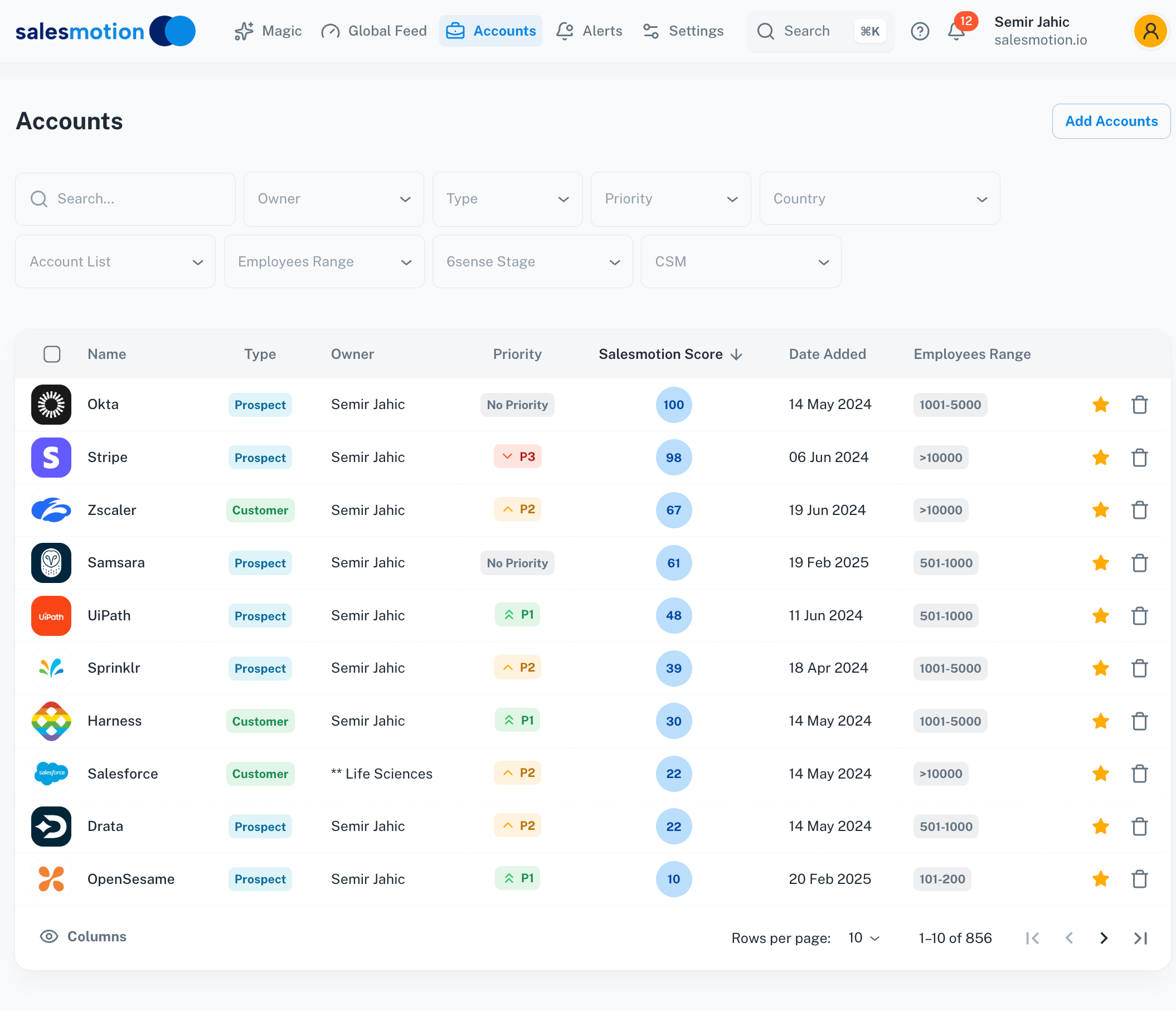 The interface that drives adoption: scored accounts, signal indicators, and priority ranking. Reps get value in 30 seconds, not 30 minutes.
Embedded in the Workflow
The sales tech stack problem isn't that teams lack tools. It's that those tools don't talk to each other. Average organizations now use between 130 and 300 SaaS applications, and 76% of sales leaders say their teams don't use all the tools available to them.
The tools that beat this pattern are the ones that embed directly into the systems reps already use. That means native Salesforce and HubSpot integration, not just a data sync, but surfacing insights inside account and contact records where reps are already working. It also means delivering alerts through channels the team already monitors, whether that's email, Slack, or Teams.
Proactive and Signal-Driven
The shift from pull-based to push-based intelligence is the single biggest factor in adoption. When a platform monitors your accounts continuously and surfaces changes that matter, leadership transitions, earnings announcements, hiring surges, competitive displacements, reps don't have to remember to "go check the tool." The tool comes to them.
Here's what that looks like in practice: A signal fires because your target account's CFO was just quoted in an earnings call discussing cost reduction in the exact area your product addresses. The platform pushes that signal to the rep's CRM activity feed and Slack channel, along with a suggested talking point. The rep sees it between meetings, opens the account record, reviews the context, and sends a relevant outreach email within five minutes. That's a workflow that gets used because it requires no extra effort and delivers clear value.
Fast, Supported Onboarding
Adoption doesn't happen in a vacuum. Even the simplest tool needs a smooth rollout. The teams that succeed invest in a structured but lightweight onboarding process: upload your account list, connect your CRM, and start seeing insights within days, not months. Cytel's sales operations team had their entire commercial team up and running within days, not weeks. Incredible Health's sales team reported reps getting value within 30 seconds to a minute of logging in. When implementation drags on for weeks, momentum dies. Reps move on, and getting them back is exponentially harder.
A Framework for Evaluating Adoption Risk
Before you sign a contract with any sales intelligence platform, run it through these five adoption checkpoints:
-
Time to first value: Can a rep get a useful insight within 30 minutes of first login? If the answer requires "after training" or "once data syncs," that's a red flag.
-
CRM depth: Does it embed inside your CRM with native components, or is it a link that opens a new tab? Embedded beats linked every time.
-
Alert model: Does the platform push signals proactively, or does it require reps to pull information? Push-based tools get 3 to 5 times higher daily active usage.
-
Insight clarity: Are the outputs actionable by a rep without interpretation, or do they require an analyst to decode? Look for plain-language insights, not raw data tables.
-
Admin burden: Does ongoing maintenance require a dedicated admin, or does the platform largely run itself after initial setup? Heavy admin requirements create a single point of failure for adoption.

“There's been a big focus on hyper personalization and relevance in our outbounding efforts. Salesmotion has been a key partner in hitting our significantly increased meeting targets. What stands out is how simple it is. Reps can log in and get valuable account insights within 30 seconds to a minute.”
Joe DeFrance
VP of Sales, Incredible Health
How to Protect Your Investment After Purchase
Selecting the right tool is step one. Protecting adoption over time requires ongoing attention.
Start with a champion group. Roll the tool out to 5 to 10 enthusiastic reps first. Let them find value, share wins, and become internal advocates before expanding to the full team. Peer endorsement is more powerful than any vendor demo.
Measure usage, not just licenses. Track daily active users, not seats provisioned. If usage drops below 60% in the first 90 days, intervene immediately. Ask the non-users what's blocking them and fix it. The 53% of SaaS licenses that go unused represent organizations that measured the wrong thing.
Connect adoption to outcomes. Show the team concrete wins: "This rep booked a meeting because a signal alerted them to a leadership change" or "This AE closed a deal faster because they walked into the conversation already knowing the prospect's top initiative." Stories like these, shared in team meetings or Slack, reinforce why the tool matters.
Reduce friction continuously. If reps have to take more than two clicks to get from a signal to an action, something is wrong. Audit the workflow quarterly and eliminate unnecessary steps.
Key Takeaways
- Adoption is the #1 risk when buying sales intelligence tools. 55% of CRM implementations fail, and standalone intelligence tools face even higher abandonment rates.
- Complex UI kills adoption. If reps can't get value within their first session, most will never come back.
- Integration is non-negotiable. Tools that don't embed natively in your CRM will be ignored, regardless of data quality.
- Push beats pull. Proactive, signal-driven alerts get 3 to 5 times higher usage than tools that require reps to log in and search.
- Time to value predicts retention. Tools that deliver value in under 14 days see 92% one-year retention, compared to 67% for tools that take over 30 days.
- Measure daily active usage, not licenses. Over half of SaaS licenses go unused. Track what reps actually do, not what you've paid for.
Frequently Asked Questions
What is the average adoption rate for sales intelligence tools?
While there's no single benchmark for sales intelligence specifically, broader SaaS data shows that core feature adoption averages just 24.5% across industries. CRM adoption rates hover around 26% on average. The best-performing sales organizations are 81% more likely to use their tools consistently, which suggests that adoption is a leadership and selection problem, not a technology inevitability.
How long should it take for a sales team to adopt a new intelligence tool?
Research shows that tools delivering value within 14 days retain 92% of users after one year. The practical goal should be to have reps actively using the tool within their first week. If your rollout plan measures onboarding in months rather than days, your adoption risk is significantly elevated. Look for platforms that can import your account list, connect to your CRM, and surface insights within the first few sessions.
What is the biggest predictor of whether a sales tool will be adopted?
Workflow integration. Tools embedded directly inside the CRM, where reps already spend their day, consistently outperform standalone platforms. When intelligence requires leaving the primary workflow, even by a single click, usage drops significantly. The second biggest predictor is whether the tool pushes insights proactively or requires reps to pull them manually.
How can sales leaders measure tool adoption effectively?
Focus on daily active users (DAU) and actions taken, not login counts or seats provisioned. A rep who logs in once a week to check a box isn't adopted. A rep who acts on three signals per day is. Also track downstream outcomes: meetings booked from signals, deals influenced by insights, and time saved on research. These metrics connect adoption to revenue impact, which sustains executive buy-in for the tool long-term.