
Alternatives

Top 5 Crayon Alternatives in 2026

Crayon's web tracking is deep but requires daily curation. Compare alternatives that automate the intelligence workflow end-to-end.

Book a demo
At a glance

How Crayon Alternatives Compare

Side-by-side comparison of the key capabilities that matter most.

FeatureSalesmotionKlue6senseZoomInfoCognism
Competitive TrackingCompetitor signals within broader account monitoringAI-curated battlecards & win/loss analysisCompetitive intent signals via ABM dataBasic competitor tracking add-onLimited competitive features
Account ResearchAI-generated briefs from 1,000+ sourcesFocused on competitor research onlyAccount-level intent scoringFirmographics, technographics & org chartsBasic company profiles
Buying Signals50+ signal types monitored 24/7Competitor-focused signals onlyAnonymous intent + predictive scoringProprietary intent signalsBombora intent data included
Automated AnalysisAI synthesizes signals into actionable briefsAI categorizes competitor changesAI predicts buying stagesBasic AI recommendationsAI-powered search and filtering
AI OutreachAI-drafted outreach anchored to real signalsNo outreach capabilitiesNo native outreach draftingZoomInfo Engage sequencingBasic email sequencing
CRM IntegrationNative Salesforce & HubSpotSalesforce, HubSpot, SlackSalesforce, HubSpot, MarketoSalesforce, HubSpot + 30+ integrationsSalesforce & HubSpot
Daily Curation RequiredNo — AI pre-analyzes and prioritizesYes — manual curation of battlecardsModerate — intent scores need interpretationLow — structured data, less curationLow — structured contact data
PricingFrom $85/mo (account-based, unlimited users on team plans)Custom enterprise pricingFrom ~$60,000/yearFrom ~$14,995/year per userFrom ~$15,000/year

Why teams explore Crayon alternatives

Crayon's competitive web tracking is incredibly thorough. It catches every competitor website change, pricing update, product launch, and marketing campaign shift — often within hours. The platform won three consecutive Product Marketing Alliance Pulse awards (2021-23) for good reason: when it comes to raw competitive data collection, Crayon is hard to beat.

But this depth creates a daily curation burden that many teams struggle to sustain. Someone — usually a product marketer or competitive intelligence analyst — has to sift through hundreds of updates each day to find the changes that actually matter for sales. Without that curation, reps are either overwhelmed by noise or they stop checking the tool entirely. Teams with dedicated CI resources thrive with Crayon; teams without them often see adoption decline within months.

Modern sales teams need intelligence that's pre-analyzed, prioritized, and delivered as actionable insights — not a firehose of raw competitor changes. The best Crayon alternatives in 2026 automate this analysis step, giving reps intelligence they can act on immediately without requiring a dedicated analyst to curate it. Here are five alternatives that take different approaches to solving this challenge.

Detailed Breakdown

Best Crayon Alternatives

An in-depth look at each platform, including features, pricing, and limitations.

1

Salesmotion

Our Pick
G2: 4.8/5

Purpose-built AI account intelligence platform that monitors 1,000+ data sources in real time. Delivers one-click account briefs, 50+ buying signal types, and AI-generated outreach anchored to verified research. Native Salesforce and HubSpot integration. Goes live in days, not months.

Unlike competitive intelligence tools that focus on tracking competitor moves, Salesmotion gives reps the complete account picture — financial signals, leadership changes, tech stack shifts, and earnings analysis — synthesized into actionable intelligence and ready-to-send outreach.

Best for:Sales teams that need real-time, full-stack account intelligence with buying signals, automated research, and CRM-integrated outreach

Key Features

  • 1,000+ real-time data sources monitored 24/7
  • 50+ buying signal types (leadership changes, funding, earnings, hiring, M&A)
  • One-click AI account briefs with source attribution
  • AI-powered outreach drafts anchored to real signals
  • Native Salesforce and HubSpot integration
  • Prospect module with verified contact data

Limitations

  • No competitive battlecard or win/loss analysis feature
  • Focused on account intelligence — not a competitive intelligence platform
  • Smaller contact database than dedicated data providers
Pricing: From $85/mo — flexible account-based pricing, unlimited users on team plans
2

Klue

G2: 4.7/5Visit site

Klue is Crayon's closest competitor and the other market leader in competitive enablement. Where Crayon emphasizes depth of web tracking, Klue is known for its polished battlecard experience and win/loss analysis capabilities. The platform uses AI to curate competitive intelligence into sales-ready formats, reducing some of the manual curation burden that Crayon users experience.

Klue's strength is making competitive intelligence consumable for sales reps rather than just product marketers. Its battlecards integrate directly into CRM and communication tools, surfacing relevant competitive insights in the moment reps need them. User satisfaction is exceptionally high at 94% on G2.

Best for:Teams wanting polished battlecards, win/loss analysis, and a sales-friendly competitive intelligence experience

Key Features

  • AI-curated competitive battlecards
  • Win/loss analysis with interview workflow
  • Real-time competitor website and news monitoring
  • CRM and Slack integrations for in-workflow delivery
  • Competitive intelligence dashboards and reports
  • Sales-friendly competitive alert system

Limitations

  • Focused narrowly on competitive intelligence — no account research or buying signals
  • No contact data or outreach capabilities
  • Expensive for teams that need CI as just one part of their intelligence stack
Pricing: Custom enterprise pricing, estimated $30,000-$60,000+/year (no public pricing)
3

6sense

G2: 4.3/5Visit site

6sense tackles the same timing problem Crayon addresses, but through buyer-intent prediction rather than competitor monitoring. Instead of tracking what competitors are doing, 6sense identifies which accounts are actively in-market by detecting anonymous buyer intent signals. For teams that found Crayon's competitive tracking valuable primarily for timing their outreach, 6sense offers a more direct path to identifying ready-to-buy accounts.

The trade-off is that 6sense is a full enterprise ABM platform with a price tag and implementation timeline to match. Teams typically need months to deploy and six-figure annual budgets. But for organizations that want to shift from reactive competitive positioning to proactive demand capture, 6sense is a category leader.

Best for:Enterprise ABM teams wanting intent-based account prioritization and orchestration rather than competitive tracking

Key Features

  • Anonymous buyer intent detection across the web
  • AI-predicted buying stage modeling
  • Account-based advertising platform
  • Revenue AI for pipeline forecasting
  • Salesforce, HubSpot, and Marketo integrations
  • Account matching and identification

Limitations

  • Very high price point — 2-3x the cost of dedicated CI tools
  • Months-long implementation with dedicated ops resources required
  • Intent signals are opaque — reps can't see underlying source data
Pricing: Custom enterprise pricing, typically from ~$60,000/year. Full implementations often $100,000+/year
4

ZoomInfo

G2: 4.5/5Visit site

ZoomInfo provides a different type of intelligence than Crayon — instead of competitor tracking, it delivers the contact data and company intelligence that sales reps need to reach the right buyers at the right time. For teams that used Crayon to understand the competitive landscape but then struggled to translate that into actual outreach, ZoomInfo bridges the gap with 321M+ contacts, org charts, and intent signals.

ZoomInfo also offers basic competitive tracking through its news monitoring features, though this is far less comprehensive than Crayon's dedicated web tracking. The primary value is giving reps a direct path from account identification to outreach.

Best for:Teams needing comprehensive contact data and company intelligence to complement or replace competitive tracking workflows

Key Features

  • 321M+ contacts with verified emails and direct dials
  • Org chart and reporting structure data
  • Technographic data showing installed technologies
  • Proprietary intent data from content consumption signals
  • ZoomInfo Engage for email sequencing and outreach
  • Advanced search and list building filters

Limitations

  • Competitive intelligence is rudimentary compared to Crayon or Klue
  • Per-seat pricing escalates quickly for larger teams
  • No automated battlecard or competitive analysis features
Pricing: Custom pricing starting around $14,995/year for a single user. Enterprise plans $25,000-$60,000+/year
5

Cognism

G2: 4.6/5Visit site

Cognism is a strong choice for European-focused teams that need high-quality contact data with intent signals. While it does not offer competitive intelligence features comparable to Crayon, it addresses a different part of the sales intelligence workflow: finding verified contacts at target accounts and timing outreach based on Bombora-powered intent data.

For teams that maintained Crayon alongside a separate contact data tool, Cognism can consolidate the prospecting side while a lighter-weight account intelligence platform like Salesmotion covers the research and signal monitoring that Crayon provided.

Best for:European sales teams needing GDPR-compliant contacts with intent data to time their outreach

Key Features

  • Phone-verified mobile numbers (Diamond Data) with 98% accuracy
  • GDPR-first data collection across EMEA and global markets
  • Bombora-powered intent data included in most plans
  • Sales trigger events and job change alerts
  • Chrome extension for LinkedIn prospecting
  • 400M+ B2B profiles with strong DACH and UK coverage

Limitations

  • No competitive intelligence or battlecard features whatsoever
  • Weaker North American data compared to ZoomInfo
  • No account research or AI-generated briefings
Pricing: Custom pricing per seat, typically from ~$15,000/year for small teams

Customer Story

How Frontify achieved 4x self-sourced revenue and 42% faster sales velocity

4x

self-sourced revenue

42%

faster sales velocity

35%

higher win rates

Read the full case study

Ready to see a better way to sell?

Salesmotion replaces hours of manual research with real-time account intelligence your reps can use today.

Product

See Salesmotion in Action

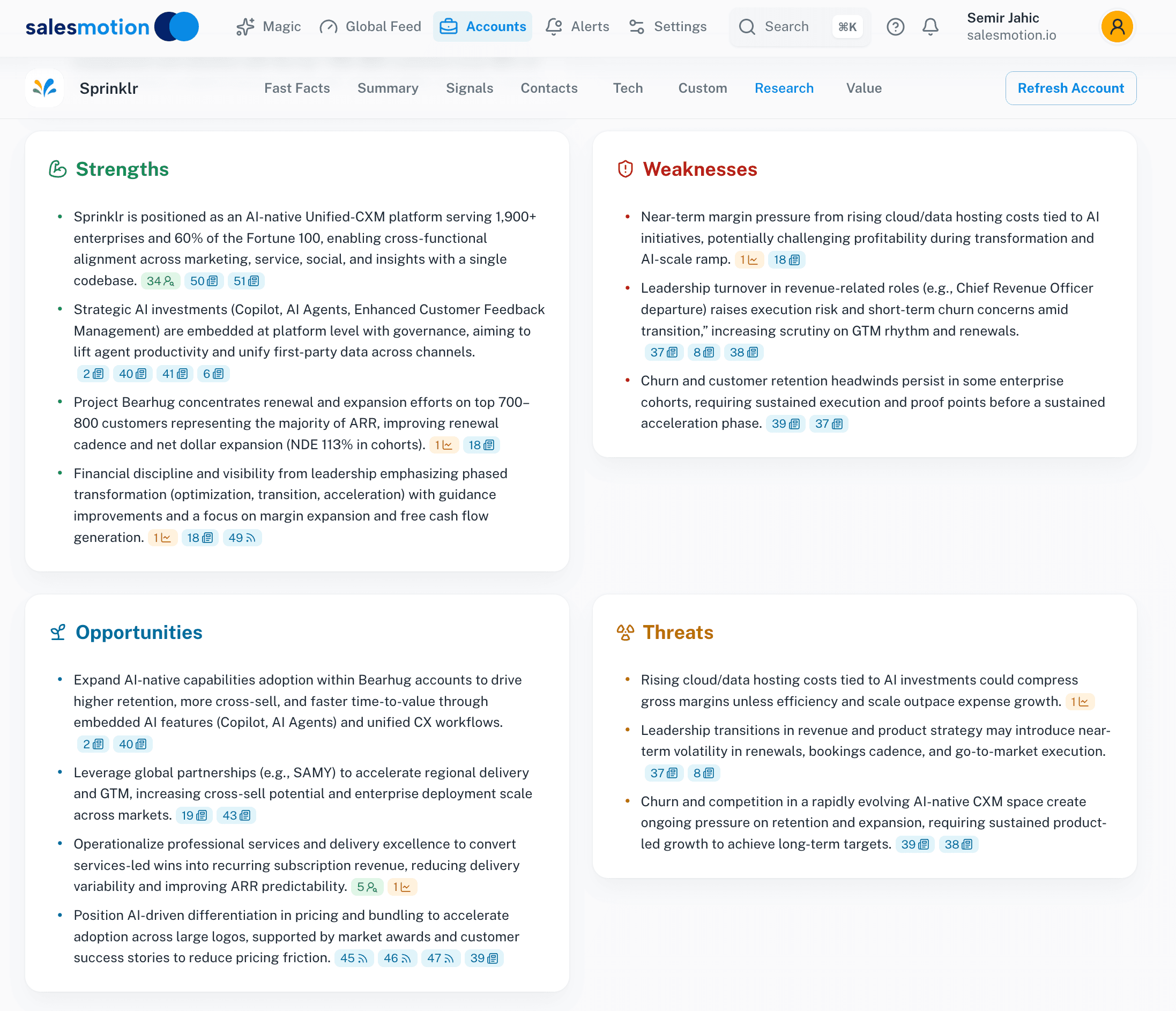
Salesmotion SWOT analysis view showing AI-generated competitive research for a target account
AI-generated SWOT analysis for every account in your territory.
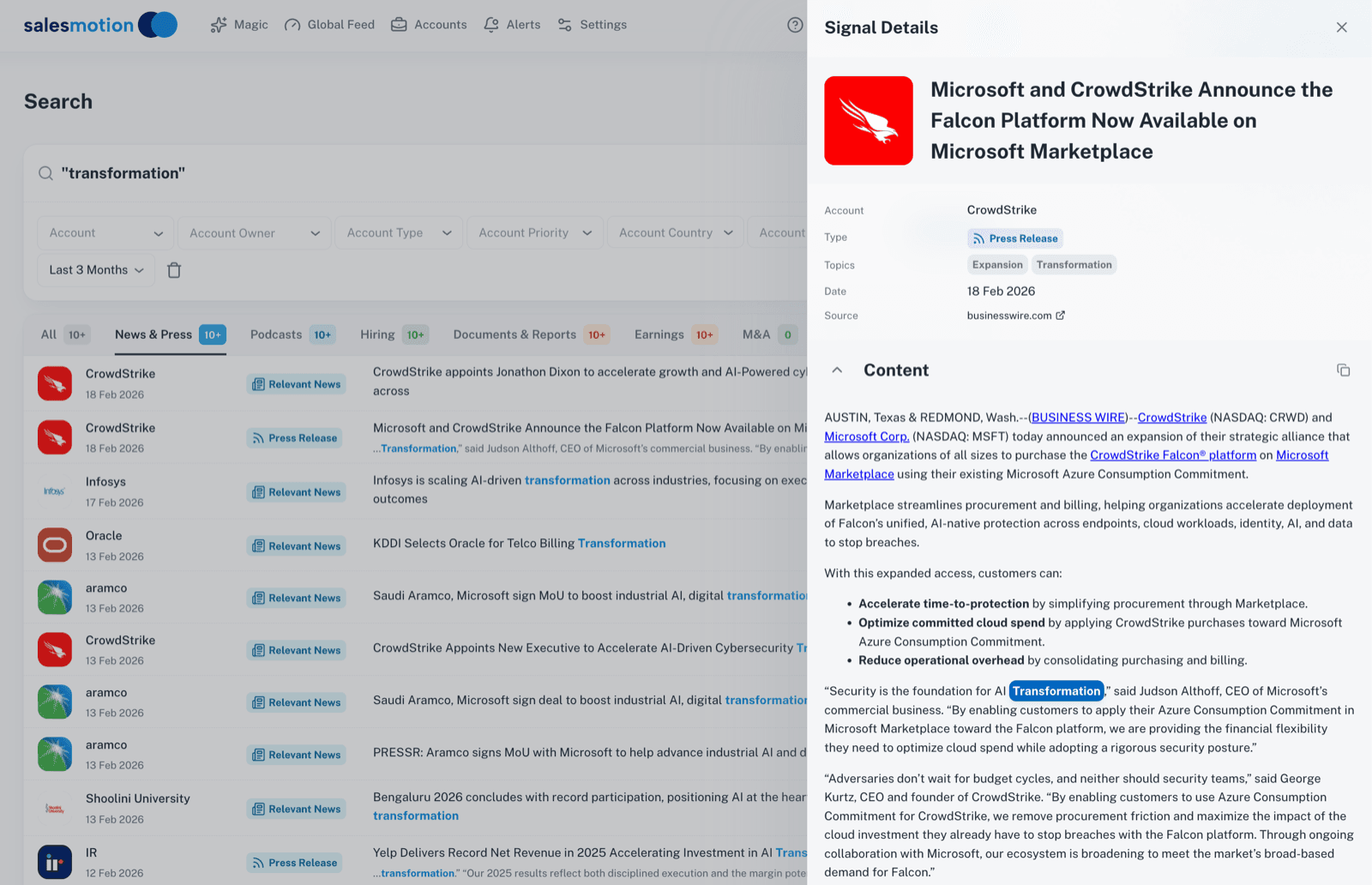
Salesmotion search showing detailed news intelligence for competitive monitoring
Track competitor moves, market shifts, and industry news in real time.
FAQ

Frequently Asked Questions

How much manual curation does Crayon actually require?

Crayon's web tracking is extremely thorough, which means it generates a high volume of updates daily. Most teams report needing at least one dedicated person (typically a product marketer or CI analyst) to spend 30-60 minutes each day reviewing, categorizing, and distributing relevant intelligence. Without this curation, sales reps are either overwhelmed by noise or ignore the tool. Tools like Salesmotion and Klue reduce this burden through AI-powered prioritization and pre-analyzed insights.

What is the difference between competitive intelligence and account intelligence?

Competitive intelligence (CI) focuses on tracking what your competitors are doing — website changes, pricing, product launches, messaging. Account intelligence focuses on understanding your target accounts — earnings, leadership changes, funding, tech investments, and business initiatives. CI helps you position against competitors during deals, while account intelligence helps you start better conversations, spot buying signals, and personalize every interaction. Most won deals require strong account context more than competitive battlecards.

Can I automate the intelligence curation that Crayon requires?

Partially within Crayon's own platform — its AI features have improved at categorizing and prioritizing updates. But the fundamental challenge remains: someone needs to translate competitor changes into sales-ready insights. Platforms like Salesmotion take a different approach entirely by pre-analyzing signals through AI and delivering ready-to-use account briefs and outreach drafts. This eliminates the curation step because the AI handles synthesis, not just collection.

Should I use Crayon alongside an account intelligence tool?

It depends on your competitive landscape. If you're in a highly competitive market where deals frequently come down to head-to-head comparisons, having dedicated CI from Crayon or Klue alongside account intelligence from Salesmotion gives your team the most complete picture. However, many teams find that Salesmotion's broader signal monitoring — which includes competitive signals like competitor mentions in earnings calls and tech stack changes — provides enough competitive context without the added cost and curation burden of a separate CI platform.

What is the most affordable Crayon alternative for competitive tracking?

For dedicated competitive intelligence on a budget, Klue's lower-tier packages may offer more affordable entry than Crayon's typical $25,000-$40,000/year pricing — though both are custom-quoted. For teams willing to broaden their approach from pure CI to full account intelligence, Salesmotion starts at $85/month with unlimited users on team plans and surfaces competitive signals as part of its broader 1,000+ source monitoring. Many mid-market teams find this approach more cost-effective than maintaining a dedicated CI platform.

Related Comparisons

Explore more head-to-head comparisons and alternatives guides.

Give every rep AI superpowers to build more pipeline.

Account intelligence, live signals, and AI-driven outreach — so your team spends less time researching and more time closing.