Alternatives

Top 5 Lusha Alternatives & Competitors in 2026

Lusha is a self-serve contact data platform with published pricing: Free (40 credits/mo); Starter $37.45/mo, Professional $52.45/mo (annual). Salesmotion is the alternative when you need account intelligence next to contact data: cited account briefs and 50+ buying signal types from $85/month, while Apollo.io, ZoomInfo, Cognism and Clay compete on data.

Semir JahicBy Semir JahicCEO & Co-Founder, SalesmotionLast reviewed

Top picks at a glance

  1. #1

    Salesmotion

    Best for: Teams ready to move beyond contact lookups to intelligence-driven selling with deep account context

  2. #2

    Apollo.io

    Best for: Teams that want contact data with built-in sales engagement at a published per-seat price

  3. #3

    ZoomInfo

    Best for: Enterprise sales teams that need a broad B2B data platform with an AI sales agent on top

At a glance

How Lusha Alternatives Compare

Side-by-side comparison of the key capabilities that matter most.

FeatureSalesmotionApollo.ioZoomInfoCognismClay
Contact Database200 contact credits a month on the Individual plan240M contacts, 30M companies500M+ contacts, 100M+ companiesPhone-verified mobiles, refreshed every 30 daysOwn people and company database plus 150+ providers
Account IntelligenceCited AI briefs from 1,000+ public sourcesAI Research and pre-meeting AI insightsCopilot deal briefs, org charts and company updatesAI company researchClaygent and Account Agents
Buying Signals50+ signal types monitored continuouslyIntent topics and buying intent filters on every planBuyer signals in Copilot; Streaming Intent add-onHiring, funding and job-change signals; Bombora intent on ProJob change, company news, social listening and web intent signals
Sales EngagementOutreach drafts anchored to signals, pushed to lemlistSequences and dialer built inCopilot personalized messaging; Engage add-onContact lists exported to CRMClay Sequencer; email via Clay or integrations
CRM IntegrationSalesforce & HubSpot (Enterprise plan)Salesforce, HubSpot, Outreach, Salesloft, MarketoSalesforce, HubSpot, Outreach, Salesloft, GongSalesforce, HubSpot, PipedriveNative CRM integrations on Growth and above
API and MCPREST API and MCP server (Claude, ChatGPT)Apollo MCP and API accessZoomInfo MCP and GTM.AI (API, CLI, MCP)MCP and API access on both packagesClay MCP for ChatGPT, Claude and Codex
Pricing$85/mo for individuals. Custom pricing for teams & enterprise.Free; $49–$119/user/mo (annual)Custom, consumption-basedCustom, quote-onlyFree; Launch $185/mo, Growth $495/mo
Rating (G2)4.8/54.7/54.5/54.6/54.9/5

Why teams look for Lusha alternatives

Lusha has built a loyal user base by making contact data simple and accessible. Its free plan makes it an easy starting point for individuals and small teams, and its pricing is published. It reports 515M+ verified contacts and 29M+ companies, with 26 buying signals refreshed weekly. For full pricing details, see our Lusha pricing breakdown.

The reasons teams look beyond Lusha have little to do with database size. They are usually one of three things: wanting deeper account research than a contact record provides, wanting sales engagement built into the same tool, or running into credit limits on phone-heavy prospecting, where a phone number costs five credits against one for an email. Lusha's self-serve plans also cover teams of up to 5 users, with larger teams routed to sales.

The best Lusha alternatives in 2026 offer different strengths: some provide large contact databases, others focus on AI-powered account research, and others combine data with built-in outreach. Here are the top five options to consider.

What buyers tell us

We held 55 sales and customer calls between August and October 2026. In 22 of them the question was not who to contact but which accounts to work this week, and when.

“I just feel like we have a lack of visibility into ... what accounts are actually hot”
Sales leader, healthcare technology
“one of the things I'm always trying to figure out is the right timing”
Owner, sales consultancy
“I'm looking more for surveillance on my accounts to pick up the stuff that I might miss.”
Regional sales manager, cybersecurity

Why Trust This Guide?

Semir Jahic, CEO & Co-Founder of Salesmotion

I'm Semir Jahic, CEO of Salesmotion. Before founding an account intelligence platform, I spent years in enterprise sales at Salesforce and led revenue teams at Clari. My team and I have evaluated dozens of sales tools firsthand. This guide is based on real experience, not vendor marketing. We work with sales teams at companies like Analytic Partners, Frontify, and Cytel.

Semir Jahic — CEO & Co-Founder, Salesmotion

Detailed Breakdown

Best Lusha Alternatives

An in-depth look at each platform, including features, pricing, and limitations.

1

Salesmotion

Our Pick
G2: 4.8/5 (26 reviews)

Salesmotion is the best Lusha alternative for teams that have the phone number and need the reason to call. It monitors 1,000+ public sources for 50+ buying signal types and writes cited account briefs, so reps know what a company is doing, why it might buy, and what to say when they reach the contact.

Salesmotion is the account intelligence and signal layer that sits alongside a contact database, not a replacement for one. The Individual plan includes 200 contact credits a month for verified emails and phone numbers, and many teams keep a dedicated contact tool next to it. A REST API and MCP server let your own AI agents call Salesmotion from Claude, ChatGPT and other assistants.

Best for:Teams ready to move beyond contact lookups to intelligence-driven selling with deep account context

Key Features

  • Three AI agents: Signal, Research and Outreach
  • Cited account briefs from 1,000+ public sources
  • 50+ buying signal types (leadership changes, funding, earnings, hiring)
  • Outreach drafts anchored to signals, pushed to lemlist
  • Salesforce and HubSpot integration (Enterprise plan)
  • REST API and MCP server for Claude, ChatGPT and other assistants
  • Monthly contract from $85/month for individuals

Limitations

  • Built as the account intelligence and signal layer, alongside your contact database and sequencer
  • Choose Lusha, Apollo.io or ZoomInfo if high-volume contact lookup is the main requirement
  • Choose Apollo.io if you want a free plan with sequencing built in
Pricing: $85/mo for individuals — flexible monthly billing. Custom pricing for teams and enterprise on request.
2

Apollo.io

G2: 4.7/5Visit site

Apollo.io is the natural step up from Lusha for teams that want contact data and sales engagement in the same tool. It pairs a database of 240M contacts and 30M companies with sequences, a dialer and waterfall enrichment. Both vendors run a free plan: Apollo's gives you 900 credits per seat per year and two sequences, and Lusha's gives you 40 credits a month.

For teams that like Lusha's self-serve model and want outreach in the same product, Apollo is a good middle ground, with intent topics, AI research and an AI assistant included.

Best for:Teams that want contact data with built-in sales engagement at a published per-seat price

Key Features

  • 240M contacts and 30M companies
  • Sequences, dialer and waterfall enrichment
  • AI Research, AI Assistant and pre-meeting AI insights
  • Intent topics and buying intent filters on every plan
  • Permanent free plan with 900 credits per seat per year and 2 sequences
  • Apollo MCP, API access and a Chrome extension

Limitations

  • Priced per seat; all seats on an account are on the same plan
  • Unused credits expire at the end of each billing cycle
  • A phone number costs 8 credits against 1 for an email
Pricing: Apollo publishes its pricing: a free tier, then Basic at $49, Professional at $79 and Organization at $119 per seat per month on annual billing (3-seat minimum on Organization). Monthly billing is $65 and $99 on Basic and Professional; Organization is annual only.
3

ZoomInfo

G2: 4.5/5Visit site

ZoomInfo is the enterprise data option, with verified data on 500M+ contacts and 100M+ companies, including 120M+ direct-dial phone numbers, plus org charts and technographics. It cites 300+ human researchers working on its data.

On top of the data ZoomInfo sells Copilot, which it describes as an AI sales agent, and GTM Studio for workflows triggered by buying signals. Paid plans are annual subscriptions quoted per organization. ZoomInfo Lite is a permanent free tier with 10 credits a month.

Best for:Enterprise sales teams that need a broad B2B data platform with an AI sales agent on top

Key Features

  • 500M+ contacts and 100M+ companies
  • 200M+ verified business emails and 120M+ direct-dial phone numbers
  • Org charts and technographics
  • ZoomInfo Copilot: buyer signals, deal briefs and personalized messaging
  • GTM Studio workflows triggered by buying signals
  • ZoomInfo Lite free tier with 10 credits a month

Limitations

  • No published prices; contracts are consumption-based and quoted
  • Paid plans are annual subscriptions; monthly billing is not standard
  • Streaming Intent and sales engagement (Engage) are add-ons to base plans
Pricing: ZoomInfo does not publish list pricing; contracts are quoted per organization; its own pricing page states that no specific dollar amounts are published because pricing is consumption-based. Vendr reports a median contract of $33,500 a year based on 1,576 purchases, with a range of $7,233–$156,053. ZoomInfo Lite is a permanent free tier with 10 credits a month.
4

Cognism

G2: 4.6/5Visit site

Cognism is the contact data alternative built for growth in Europe. It offers phone-verified mobiles, for which it claims up to 3x higher connect rates, and decision-maker data refreshed every 30 days, with a compliance-first posture that includes Do-Not-Call coverage across Europe.

Cognism also surfaces hiring, funding and job-change signals, and its Pro package adds intent data from Bombora. The trade-off against Lusha is the buying model: Cognism quotes each customer, where Lusha publishes its rate card.

Best for:Teams selling into European markets that need phone-verified contact data from a compliance-first provider

Key Features

  • Phone-verified mobile numbers
  • Decision-maker data refreshed every 30 days
  • Hiring, funding and job-change signals
  • Bombora intent data in the Pro package
  • AI company research and AI search
  • MCP and API access; exports to Salesforce, HubSpot and Pipedrive

Limitations

  • No published prices; packages are quoted
  • Intent data and on-demand mobile verification are in the Pro package
  • Built for prospecting into Europe; teams selling mainly into North America usually compare it with ZoomInfo or Apollo.io
Pricing: Cognism does not publish list pricing; contracts are quoted per organization; it sells Standard and Pro packages, each listed with 5 seats included, on a credit system where one credit reveals one contact.
5

Clay

G2: 4.9/5Visit site

Clay takes a different approach from Lusha. It combines its own people and company database with 150+ data providers, and lets you waterfall across them to find the best available data for each contact. You are not charged when an enrichment returns no result.

Clay is strongest for growth and Ops teams that want to build their own prospecting and research workflows, with Claygent, Account Agents and an MCP that brings Clay into ChatGPT, Claude and Codex. Every plan includes unlimited seats, and usage is metered in Actions and Data Credits.

Best for:Growth and RevOps teams that want multi-source enrichment and custom workflows

Key Features

  • Own people and company database plus 150+ data providers
  • Waterfall enrichment with no charge when an enrichment returns no result
  • Claygent and Account Agents
  • Job change, company news, social listening and web intent signals
  • Clay MCP for ChatGPT, Claude and Codex
  • Unlimited seats on every plan, including Free

Limitations

  • Usage is metered in Actions and Data Credits; Actions do not roll over
  • Phone enrichment starts on the Launch plan
  • Built for GTM engineers and Ops; reps reach it through MCP and Ops-built Functions
Pricing: Clay publishes its pricing: a free tier, Launch from $185/month and Growth from $495/month (about $167 and $446 on annual billing), then custom Enterprise on an annual commitment. Paid plans start with a 14-day trial, include unlimited seats, and meter usage in Actions and Data Credits. Clay introduced these plans in spring 2026; customers on the legacy Starter, Explorer and Pro plans can stay on them.

Customer Story

How Guild saves 30 minutes per account and 6+ hours weekly on research

30 min

saved per account

6+ hrs

saved per AE per week

$20M+

deal sizes supported

“It's not even just about saving time — it's about uncovering things we otherwise might not research. Salesmotion helps us connect Guild to what's already publicly important to the company.”

Derek Rosen

Derek Rosen

Director, Strategic Accounts, Guild Education

Read the full case study

Founder's Take

“Lusha gets the simplicity right. The pricing is on the page, the free plan is real, and a rep can have a phone number in seconds. It has also moved well beyond lookup, with company signals and scoring. The pattern I see is not that teams lack contact data. It is that they have good phone numbers and a thin reason to call. That is the gap we built Salesmotion for: research across earnings calls, filings and news, with every claim linked to its source, so the first sentence of the call is about the account.”
Semir Jahic

Semir Jahic

CEO & Co-Founder, Salesmotion

Summary

Key Takeaways

  1. 1Lusha is a self-serve contact data platform reporting 515M+ verified contacts, with a free plan of 40 credits a month and 26 buying signals refreshed weekly.
  2. 2Apollo.io is the natural step up for teams that want contact data and outreach together: 240M contacts plus built-in sequences and a dialer in the same seat.
  3. 3ZoomInfo is the enterprise data option with 500M+ contacts and 100M+ companies. ZoomInfo does not publish list pricing; contracts are quoted per organization; its own pricing page states that no specific dollar amounts are published because pricing is consumption-based. Vendr reports a median contract of $33,500 a year based on 1,576 purchases, with a range of $7,233–$156,053. ZoomInfo Lite is a permanent free tier with 10 credits a month.
  4. 4Cognism is built for prospecting into Europe, with phone-verified mobiles for which it claims up to 3x higher connect rates.
  5. 5Clay combines its own people and company database with 150+ data providers and waterfall enrichment, and suits teams with GTM engineering or Ops capacity.
  6. 6Salesmotion adds the account intelligence layer next to your contact data: cited account briefs, 50+ buying signal types and outreach drafts, from $85/month on a monthly contract.
An honest take

Where Salesmotion isn't the right fit

We'd rather you pick the right tool than the wrong one. Salesmotion isn't for everyone — here's when another option on this page is the smarter call.

  • You need a built-in email sequencer or dialer. Salesmotion is account intelligence, not a sending tool — it's built to sit alongside Outreach, Salesloft, or Apollo, not replace them.
  • You're buying purely for raw contact volume. Dedicated data vendors like ZoomInfo and Apollo carry larger raw contact databases.
  • You want a free-forever tier. Salesmotion starts at $85/mo for individuals — there's no free plan.
  • Your motion is pure high-volume SMB outbound. The depth pays off most on considered, higher-ACV deals where understanding the account actually changes the conversation.

Ready to see a better way to sell?

Salesmotion replaces hours of manual research with real-time account intelligence your reps can use today.

Product

See Salesmotion in Action

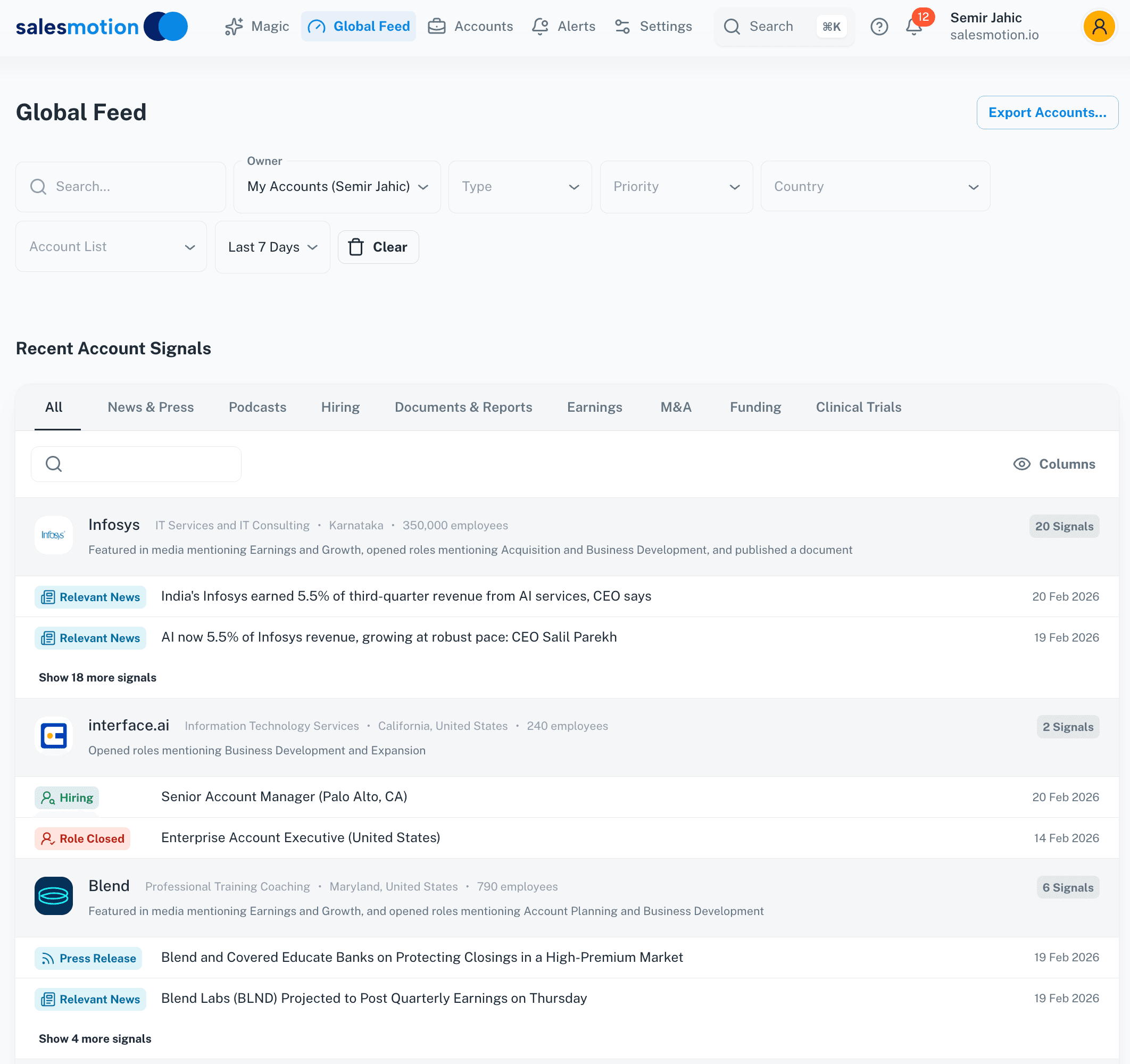
Salesmotion global signal feed showing real-time buying signals across monitored accounts
Real-time buying signals across your entire territory, with no manual research needed.
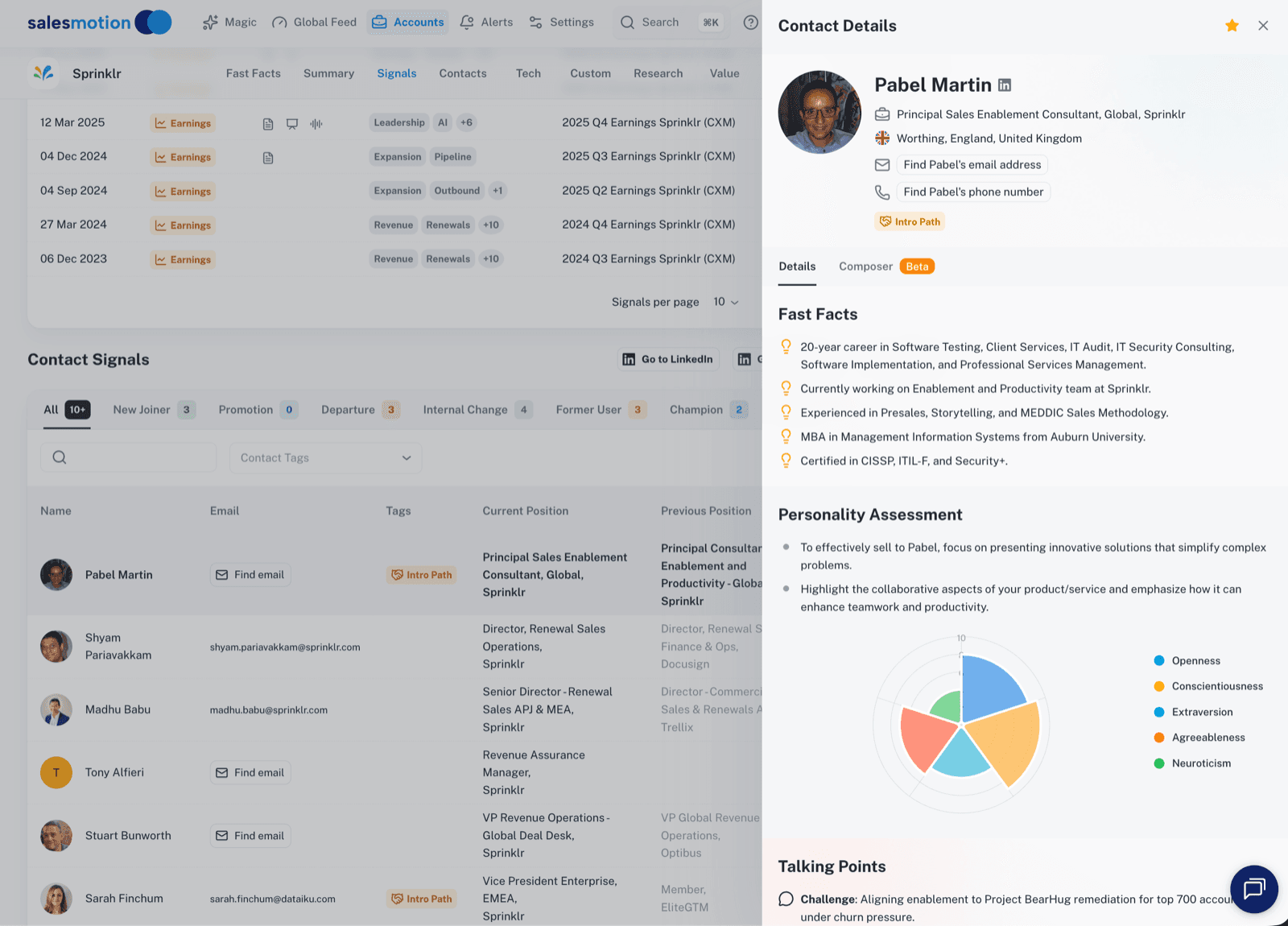
Salesmotion account contacts view showing contact data with full account context
Contacts shown with account intelligence and buying signals.
FAQ

Frequently Asked Questions

How much does Lusha cost?

Lusha publishes its pricing: a free plan with 40 credits a month, then Starter at $37.45, Professional at $52.45 and Premium at $299.95 per month on annual billing ($49.90, $69.90 and $399.90 billed monthly). Scale is quote-only. Revealing an email costs 1 credit and a phone number costs 5. Self-serve plans cover teams of up to 5 users, and larger teams are routed to sales.

What is the best free alternative to Lusha?

Apollo.io has the most generous free plan in this group: 900 credits per seat per year and two sequences, with no time limit. Lusha's own free plan gives 40 credits a month. ZoomInfo Lite is a permanent free tier with 10 credits a month, and Clay's free plan includes 500 Actions and 100 Data Credits a month with unlimited seats. Cognism offers a free data sample.

Is Lusha cheaper than Apollo.io?

At the entry tier, yes, on list price. Lusha publishes its pricing: a free plan with 40 credits a month, then Starter at $37.45, Professional at $52.45 and Premium at $299.95 per month on annual billing ($49.90, $69.90 and $399.90 billed monthly). Scale is quote-only. Apollo publishes its pricing: a free tier, then Basic at $49, Professional at $79 and Organization at $119 per seat per month on annual billing (3-seat minimum on Organization). Monthly billing is $65 and $99 on Basic and Professional; Organization is annual only. The plans include different things: Apollo bundles sequences and a dialer, while Lusha is priced around contact credits. Both have free plans, so you can test coverage in your own territory before paying.

How accurate is Lusha's phone data?

Lusha claims 98% email accuracy and 85% US and 86% global phone accuracy across its database. For phone-heavy outreach in Europe, Cognism offers phone-verified mobiles and claims up to 3x higher connect rates. ZoomInfo reports 120M+ direct-dial phone numbers. The practical test is to run a sample of your own target accounts through each provider.

What is the best Lusha alternative for account research?

Salesmotion is the best Lusha alternative for account research. Lusha is built around contact data and company signals, while Salesmotion writes cited account briefs from 1,000+ public sources and tracks 50+ buying signal types, so reps know why an account is worth contacting this week. It starts at $85/month on a monthly contract.

Can I use Lusha and Salesmotion together?

Yes, and it is a common combination. Lusha supplies emails and direct dials, and Salesmotion supplies the account context and timing: what changed at the company, who is affected and what to say. Salesmotion is designed to sit alongside a contact database rather than replace it.

Is there a cheaper alternative to Lusha for sales prospecting?

On published paid plans, no: Lusha's Starter tier has the lowest list price in this group. Lusha publishes its pricing: a free plan with 40 credits a month, then Starter at $37.45, Professional at $52.45 and Premium at $299.95 per month on annual billing ($49.90, $69.90 and $399.90 billed monthly). Scale is quote-only. Apollo.io lists Free; $49–$119/user/mo (annual) and Clay lists Free; Launch $185/mo, Growth $495/mo. The cheaper route is a free plan: Apollo.io's has no time limit, ZoomInfo Lite includes 10 credits a month and Clay has a free tier. ZoomInfo's paid plans and Cognism are quoted per organization, and Salesmotion is $85/mo on a monthly contract for account research instead of contact credits.

Who are Lusha's main competitors?

The Lusha competitors and alternatives compared on this page are Salesmotion, Apollo.io, ZoomInfo, Cognism and Clay. Each one is covered above with what it is best for, its published pricing and where it fits.

Need to make the case internally?The Salesmotion business case has the cost, the time math and named customer results on one page, with a short version you can paste into an email or a slide.Read the business case

Related Comparisons

Explore more head-to-head comparisons and alternatives guides.

Give every rep three AI agents to build more pipeline.

A Signal Agent, Research Agent, and Outreach Agent — working every day so your team spends less time researching and more time closing.