The average enterprise AE spends 20-30% of their week on account research, toggling between LinkedIn, Crunchbase, SEC filings, news sites, company websites, and ChatGPT. For a rep managing 50 named accounts, that's 2-4 hours daily just gathering context before a single email gets sent or call gets made. The math is brutal: if your team has 10 AEs each spending 3 hours per account on quarterly research, that's 1,500+ hours per quarter consumed by manual research instead of selling.
TL;DR: AI account research replaces the manual process of gathering information from 5+ disparate tools into a single, automated intelligence layer. Teams using Salesmotion report 85-90% reductions in research time per account while improving the quality and freshness of the intelligence they bring to every conversation. The shift isn't incremental. It's a structural change in how reps prepare for every interaction.
The Manual Research Problem (And Why It Persists)
Every sales methodology assumes reps will "do their homework" before engaging a prospect. Discovery frameworks require understanding the buyer's strategic priorities. Account planning templates demand stakeholder maps, competitive intelligence, and whitespace analysis. Coaching programs teach reps to reference specific business challenges in their outreach.
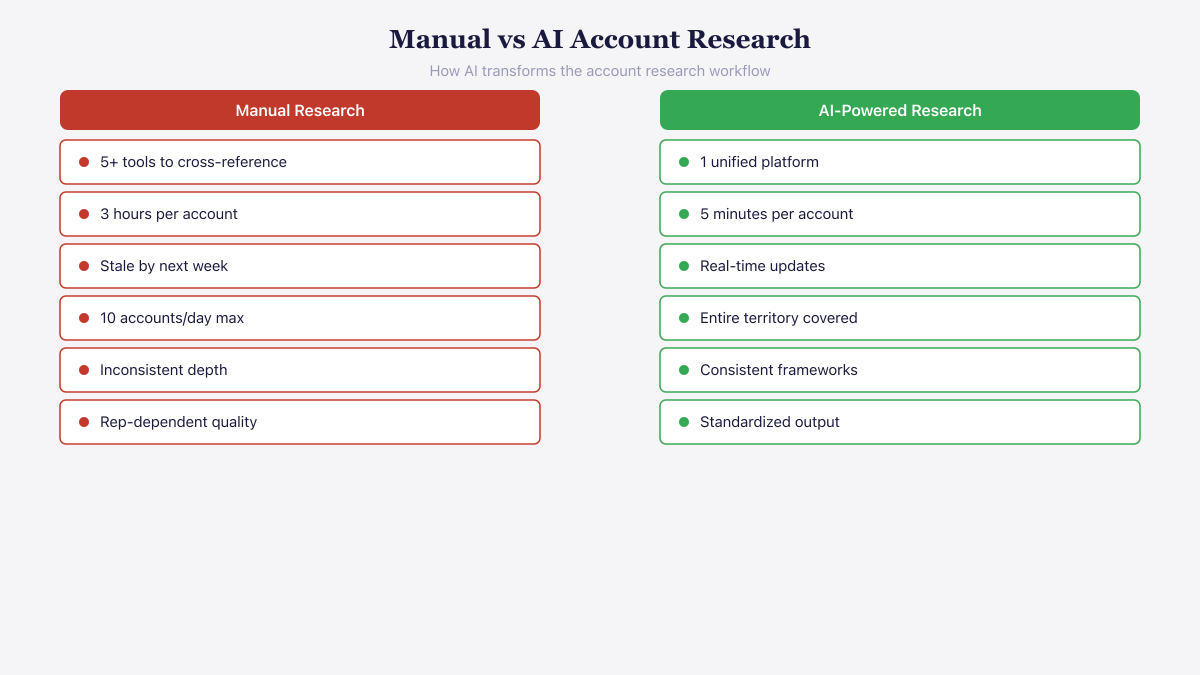 AI account research replaces 5+ manual tools with a single platform that stays current.
The problem isn't that reps don't know they should research. It's that the research process is fragmented across too many sources with too little time. For the full manual playbook, see our deep account research guide.
Here's what manual account research typically looks like:
| Source | What You Get | Time Required |
|---|---|---|
| Stakeholder roles, career moves, company updates | 15-20 min | |
| Company website | Products, leadership, investor relations | 10-15 min |
| SEC filings/earnings | Financial performance, strategic initiatives, risk factors | 20-30 min |
| News/press releases | Recent events, partnerships, product launches | 10-15 min |
| Crunchbase/PitchBook | Funding history, investors, growth trajectory | 5-10 min |
| G2/Gartner reviews | Tech stack, vendor evaluation activity, competitor presence | 10-15 min |
| ChatGPT/Perplexity | Synthesis and summarization | 10-20 min |
Total: 80-125 minutes per account. And the output is a collection of browser tabs, sticky notes, and fragmented context that exists only in the rep's head. It doesn't persist in the CRM. It doesn't update when the account changes. And it's not available to the next person who touches the account.
This is why most reps don't actually do thorough research. They skim LinkedIn for 5 minutes, scan the homepage, and enter the conversation with surface-level context. Not because they're lazy, but because the time investment doesn't scale.
An account executive at an HR software firm told us: "They're the ones who are doing five minutes of research when they should have been doing the two hours of research." The gap between those two numbers is the problem this post is about.
See Salesmotion on a real account
Book a 15-minute demo and see how your team saves hours on account research.
How AI Account Research Changes the Equation
AI account research platforms solve this problem by aggregating data from hundreds or thousands of sources, synthesizing it into structured account briefs, and keeping that intelligence current automatically.
Here's what that looks like in practice with Salesmotion: a target account's CRO mentions "consolidating our tech stack" on their Q3 earnings call. Salesmotion detects the signal, updates the account brief with the quote and context, and surfaces it as a prioritized alert. The rep opens the brief, sees the signal alongside the account's current vendor landscape and org chart, and sends a message referencing the exact initiative within minutes, not after a 3-hour research sprint. Analytic Partners' team cut research time by 85% and grew pipeline 40% working this way.
The core capabilities:
One-Click Account Briefs
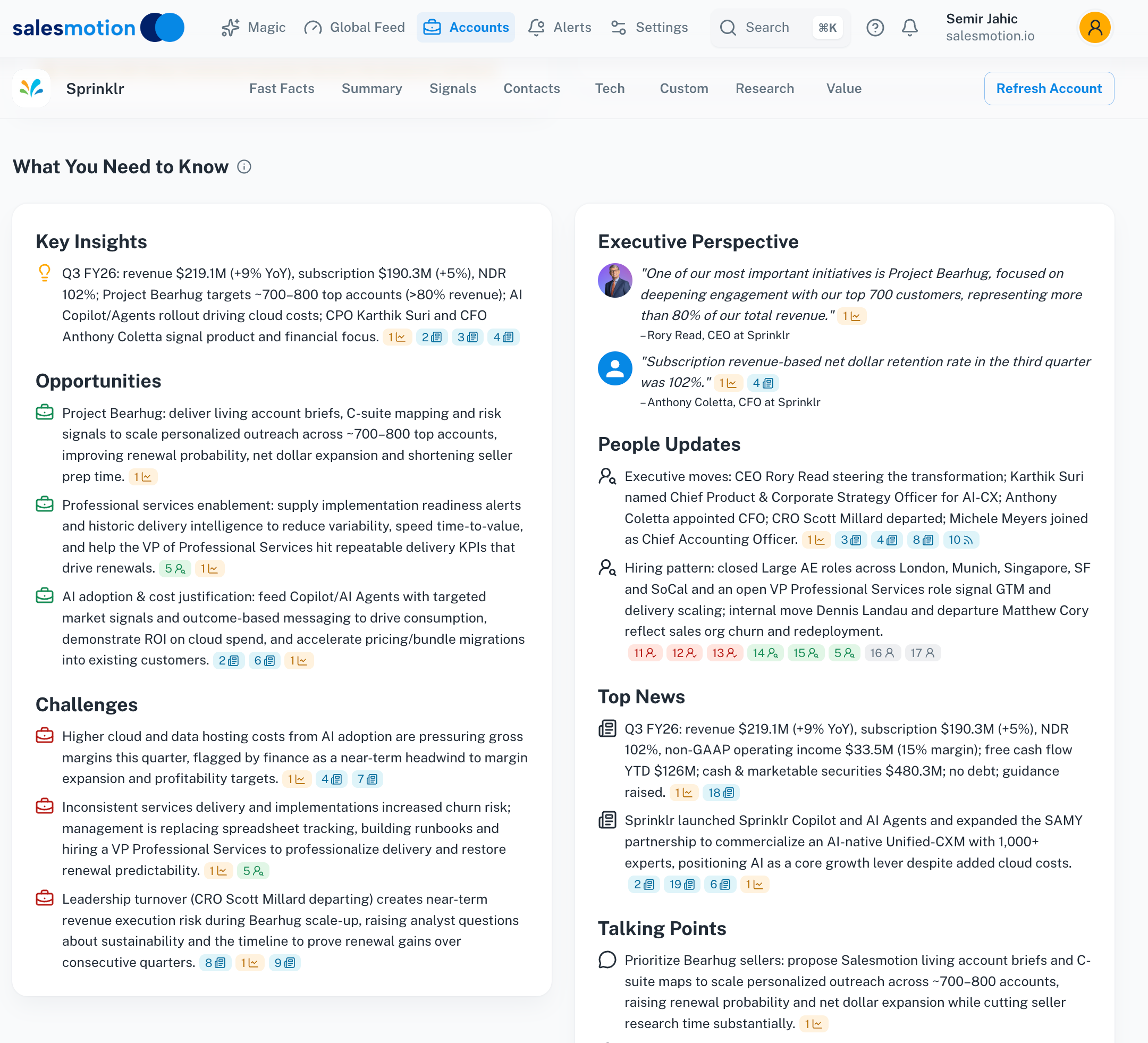 A single account brief replaces hours of manual research by aggregating company overview, strategic priorities, signals, and stakeholder data in one view.
Instead of manually visiting 5-7 sites, reps get a single, comprehensive brief that includes company overview, financial performance, strategic initiatives, leadership team, recent news, technology stack, and competitive landscape. The brief is generated in seconds, not hours.
Analytic Partners' team gets 80-90% of the insight they need for prospecting and meetings in 15 minutes, down from 3 hours of manual research. That reduction isn't from cutting corners. It's from automating the aggregation that consumed most of the time.
Continuous Signal Monitoring
Manual research gives you a point-in-time snapshot. AI-powered platforms monitor accounts continuously, detecting leadership changes, earnings call language, hiring patterns, funding events, and competitive moves as they happen. When a target account's CRO mentions "sales transformation" on an earnings call, the brief updates automatically.
This is the difference between knowing what an account looked like when you last researched it and knowing what's happening at the account right now. For enterprise sales cycles spanning 6-12 months, accounts change significantly between the first meeting and the close. Signals that fire mid-cycle can accelerate deals, flag risks, or open new opportunities.
A point I make often: a prompt is a one-off for one account. Your deal cycle is not two weeks, it is twelve months, and you want to know any time something changes.
AI-Generated Talking Points and Outreach
Beyond aggregation, AI platforms generate contextual talking points and outreach messages anchored to real account data. Instead of generic "I noticed your company is growing" messages, reps can reference specific strategic initiatives, leadership changes, or competitive dynamics that demonstrate genuine preparation.
The output isn't template-based. It's generated from the actual signals and context specific to each account, which is why teams report that AI-generated outreach consistently outperforms manually crafted messages in response rates.

“The Business Development team gets 80 to 90 percent of what they need in 15 minutes. That is a complete shift in how our reps work.”
Andrew Giordano
VP of Global Commercial Operations, Analytic Partners
AI Account Research vs. ChatGPT: The Critical Differences
When GPT-4 launched, many sales teams experimented with using ChatGPT for account research. Some still do. Here's why purpose-built AI research platforms deliver fundamentally different results.
| Capability | ChatGPT/Perplexity | Purpose-Built AI Research |
|---|---|---|
| Data freshness | Training cutoff + web search results | Real-time from 1,000+ live sources |
| Account monitoring | Manual, one prompt at a time | Automated across entire territory |
| CRM integration | None (copy-paste workflow) | Native Salesforce/HubSpot sync |
| Signal detection | Only when you ask | Continuous, proactive alerts |
| Verification | Hallucination risk, no citations | Cited sources, verified data |
| Scale | One account per session | Hundreds simultaneously |
| Persistence | No memory between sessions | Living briefs that update automatically |
ChatGPT is useful for ad-hoc synthesis of information you've already gathered. It's not a substitute for automated, continuous account intelligence across a territory of 50-500 accounts.
The practical test: can your current research process tell you, without manual effort, which 5 accounts in your territory showed a new buying signal this week? If the answer is no, you have an intelligence gap that ChatGPT alone won't solve. This is the problem Salesmotion was built to close: Cytel replaced 5 separate tools with one platform and cut research time in half across their entire team.
What Changes When Research Takes 5 Minutes Instead of 3 Hours
The time savings are the obvious benefit. The behavioral changes are the real ROI.
Reps Actually Prepare for Every Meeting
When research takes 3 hours, reps prepare thoroughly for important meetings and wing the rest. When research takes 5 minutes, preparation becomes the default for every interaction. Discovery calls improve because reps already know the account's strategic priorities. Follow-up emails reference specific context. QBR presentations reflect current intelligence.
Outreach Becomes Consultative, Not Transactional
Generic outreach ("I'd love to learn about your business") converts at 1-3%. Signal-informed outreach ("I noticed your CEO mentioned sales modernization on the Q4 call, and you've posted 4 new SDR roles this month. Here's how a similar company handled that scaling challenge") converts at 5-10x higher rates. The difference is context, and AI research provides it at scale.
Pipeline Quality Improves
When reps have intelligence about which accounts are showing buying signals and which aren't, they naturally prioritize higher-probability opportunities. The result isn't just more meetings. It's better-qualified meetings with accounts that have a real reason to buy now.
Frontify's team saw a 35% increase in win rates and a 31% reduction in sales cycle length after implementing AI-powered account research. Reps entered every conversation better prepared, asked better discovery questions, and progressed deals faster because they weren't starting from zero at every interaction.
New Hire Ramp Accelerates
Account research is one of the hardest skills for new reps to develop. Knowing where to look, what matters, and how to synthesize disparate information into a coherent account narrative takes months of experience. AI account briefs provide new hires with the same quality of account intelligence that tenured reps develop over years. Cytel found that AI-generated account briefs accelerated onboarding for new sales hires, serving as both a research tool and a learning mechanism.

“The AI templates were a surprise delight. We expected the data, but the pre-built email suggestions turned out to be much better than expected and a huge help, especially for newer reps.”
Sabina Malochleb-Bazaud
Senior Sales Operations Administrator, Cytel
How to Evaluate AI Account Research Tools
Not all AI research platforms deliver the same value. Here's what separates tools that change behavior from tools that become shelfware.
Data Source Breadth
Ask how many and which data sources the platform aggregates. Tools that pull only from public news and LinkedIn provide limited incremental value over manual research. Platforms that include earnings call transcripts, SEC filings, patent filings, job postings, technology install data, intent data, and industry-specific sources deliver intelligence reps can't assemble manually.
Output Quality
Request a sample brief for one of your actual target accounts. Compare it against what your best rep would produce with 2 hours of manual research. The AI output should be at least as comprehensive and more current.
CRM Integration
Intelligence that lives outside the CRM doesn't get used consistently. The research must surface inside Salesforce or HubSpot, where reps work. Manual export/import workflows guarantee low adoption.
Signal Freshness
Ask how frequently the platform checks for new information. Daily monitoring catches most signals. Weekly or monthly scans miss time-sensitive triggers like leadership changes and earnings announcements.
Time to Value
The best platforms deliver value within days, not months. Cacheflow went from contract signature to full utilization in 24 hours because the integration was native and the output was immediately useful. Long implementation cycles are a red flag for platforms that require significant configuration before delivering insights.
Key Takeaways
- Enterprise AEs spend 20-30% of their time on manual account research, toggling between 5+ tools to build context that doesn't persist in the CRM.
- AI account research platforms reduce per-account research time by 85-90% while improving intelligence quality and freshness through continuous monitoring.
- The behavioral impact matters more than the time savings: reps prepare for every meeting (not just important ones), outreach becomes consultative, pipeline quality improves, and new hire ramp accelerates.
- Purpose-built AI research platforms differ from ChatGPT in critical ways: real-time data, CRM integration, continuous monitoring, verified sources, and territory-scale coverage.
- Evaluate tools on data source breadth, output quality against your actual accounts, CRM integration depth, signal freshness, and time to value.
- The best approach is to start with the intelligence layer (automated research and signals) before investing in engagement automation. Every downstream tool performs better when the research is already done.
Frequently Asked Questions
How much time does AI account research actually save?
Based on verified case studies, teams report 50-90% reductions in per-account research time. Analytic Partners reduced research from 3 hours to 15 minutes per account (85% reduction). Cytel reduced research time by 50% across their entire sales team. The exact savings depend on how thoroughly your team currently researches accounts and how many sources they typically check.
Can AI account research replace human judgment?
No. AI excels at aggregating, synthesizing, and monitoring data across hundreds of sources at scale. Human judgment is still required to interpret signals in context, prioritize opportunities, build relationships, and make strategic decisions about account engagement. The best outcomes come from AI handling the data collection and synthesis while reps focus on strategy, relationship building, and consultative selling.
What data sources do AI research platforms use?
Comprehensive platforms pull from 1,000+ sources including: SEC filings and earnings call transcripts, news and press releases, job postings across major platforms, LinkedIn company and people data, technology install data, patent filings, industry reports, CRM data enrichment, website changes, and social media signals. The breadth of sources is what differentiates AI research from manual efforts, which typically cover 5-7 sources per account.
How does AI account research integrate with CRM?
The best platforms offer native Salesforce and HubSpot integrations that sync account briefs, signals, and stakeholder intelligence directly into CRM records. This means reps see the intelligence where they already work, without switching tools. Bi-directional sync ensures that CRM data enriches the AI analysis while AI insights update CRM fields automatically. Platforms that require manual data transfer or CSV exports consistently show lower adoption rates.