Selling to CISOs and security leaders requires a level of account research that most sales teams are not equipped to do. Security buyers are skeptical by profession. They evaluate every vendor through the lens of risk, compliance, and operational impact. A generic pitch about "protecting your organization" will get you ignored. Research that references their specific compliance framework, a recent breach disclosure, or a security architecture decision visible in their job postings will get you a conversation.
Account research for cybersecurity sales means understanding the threat landscape your prospect faces, the compliance frameworks they operate under, the security tools already in their stack, and the organizational signals that indicate they are actively investing in security capabilities. Many of these indicators overlap with the principles of signal-based selling, where timely events drive outreach rather than static lists.
TL;DR: Cybersecurity account research relies on SEC breach disclosures, compliance framework analysis, security job postings, conference presentations, and vendor stack intelligence. Build a 10-minute framework that identifies compliance gaps, recent security events, and technology investment signals. The strongest buying signals are breach disclosures, new CISO appointments, compliance deadline pressures, and security-specific hiring surges.
Why Cybersecurity Research Demands a Specialized Approach
Cybersecurity is unlike any other B2B sales environment. The buyers are technically sophisticated, deeply skeptical, and under constant pressure from regulators, boards, and threat actors.
Security events create immediate urgency. A breach disclosure, a ransomware incident, or a compliance audit finding can move a security purchase from "someday" to "this quarter." These events are increasingly public due to SEC reporting requirements, and they create a narrow window where security leaders have both budget approval and executive attention.
Compliance drives a large share of security spending. SOC 2, ISO 27001, HIPAA, PCI-DSS, NIST CSF, and CMMC requirements create non-discretionary purchasing needs. Understanding which frameworks your prospect is subject to, and where they are in their compliance journey, gives you the ability to time your outreach to audit cycles and certification renewals.
The vendor stack is crowded and visible. Security teams use dozens of tools across endpoint, network, identity, cloud, and application security. Job postings, conference talks, and even the compliance certifications listed on a company's trust page reveal what is in the stack. Knowing what tools a prospect already uses lets you position against specific gaps rather than pitching in the abstract.
CISOs buy from people they trust. The cybersecurity community is tight-knit. CISOs talk to each other at conferences, on private Slack channels, and through peer networks. Research that demonstrates genuine understanding of their security challenges, rather than surface-level awareness, earns credibility in a market where trust is the primary currency.
The Key Sources to Monitor for Cybersecurity Accounts
Effective account research for cybersecurity sales requires sources that are specific to the security domain.
SEC Breach Disclosures
Since December 2023, the SEC requires public companies to disclose material cybersecurity incidents within four business days via 8-K filings. These disclosures include:
- Nature and scope of the incident
- Material impact assessment
- Remediation steps taken or planned
An 8-K cybersecurity disclosure is one of the strongest buying signals in security sales. The company is under public scrutiny, has board-level attention on security, and is actively investing in remediation.
SOC Reports and Compliance Certifications
A company's trust page or security documentation often lists their compliance certifications. Track:
- SOC 2 Type I vs Type II: Type I means they are starting the compliance journey. Type II means they are maintaining it.
- ISO 27001 certification status: Recertification cycles create purchasing needs for security tools and processes.
- Industry-specific frameworks: HIPAA (healthcare), PCI-DSS (payments), FedRAMP (government), CMMC (defense)
Security Job Postings
Cybersecurity hiring patterns reveal specific technology investments:
- Security engineer roles mentioning specific tools (CrowdStrike, Splunk, Palo Alto) confirm vendor stack
- SIEM, SOAR, or XDR-specific roles signal active platform decisions
- GRC analyst postings indicate compliance program expansion
- First-ever CISO hire signals organizational maturation of security function
- Penetration tester or red team roles suggest security program sophistication
Conference Talks and Community Participation
Security leaders present at events like RSA Conference, Black Hat, DEF CON, BSides, and sector-specific conferences. Their talk topics reveal:
- Technology investment areas and architectural decisions
- Challenges they are actively working to solve
- Vendor relationships and technology preferences
NIST and Regulatory Guidance
NIST publishes cybersecurity frameworks, guidelines, and standards that drive security purchasing decisions across industries. New NIST publications, framework updates, and sector-specific guidance create compliance alignment needs that security teams must address.

“Salesmotion has been a game-changer for me. I used to spend 12 hours a week on prospect research, now it's down to 4. Plus I'm finding stuff I was totally missing - podcasts, news mentions, the good bits.”
George Treschi
Account Executive, FY25 President's Club, Sigma
The 10-Minute Research Framework for Cybersecurity
Minutes 1-3: Company Profile and Security Posture Identify the industry, size, and data sensitivity profile of the prospect. Check their trust page or security documentation for listed certifications and compliance frameworks. Note the CISO or Head of Security on LinkedIn.
Minutes 3-5: Recent Security Events and Compliance Status Search SEC EDGAR for 8-K cybersecurity disclosures. Check Have I Been Pwned or breach databases for known incidents. Review any press coverage of security events. Check if any compliance certifications are nearing renewal dates.
Minutes 5-7: Security Technology Stack Analyze job postings for security-specific tool mentions. Check BuiltWith for web security technology. Review their engineering blog or conference talks for architectural decisions. Note any vendor relationships mentioned in press releases.
Minutes 7-9: Leadership and Organizational Changes Check LinkedIn for new CISO, VP of Security, or Director of Security Engineering hires. Look for organizational signals like a new security team being built or a Chief Trust Officer role being created. Track board-level security committee announcements.
Minutes 9-10: Synthesize Your Angle Connect a security event, compliance requirement, or organizational signal to your solution. "You recently filed an 8-K for a data incident and your trust page shows you are pursuing SOC 2 Type II. Here is how we help security teams accelerate post-incident compliance" is specific, relevant, and respectful.
Salesmotion pulls SEC filings, leadership changes, news, and earnings signals into a single account view, making it straightforward to monitor cybersecurity prospects for the events that signal active purchasing. Instead of checking SEC EDGAR, LinkedIn, and trade publications separately, reps get a consolidated brief that highlights the signals that matter.
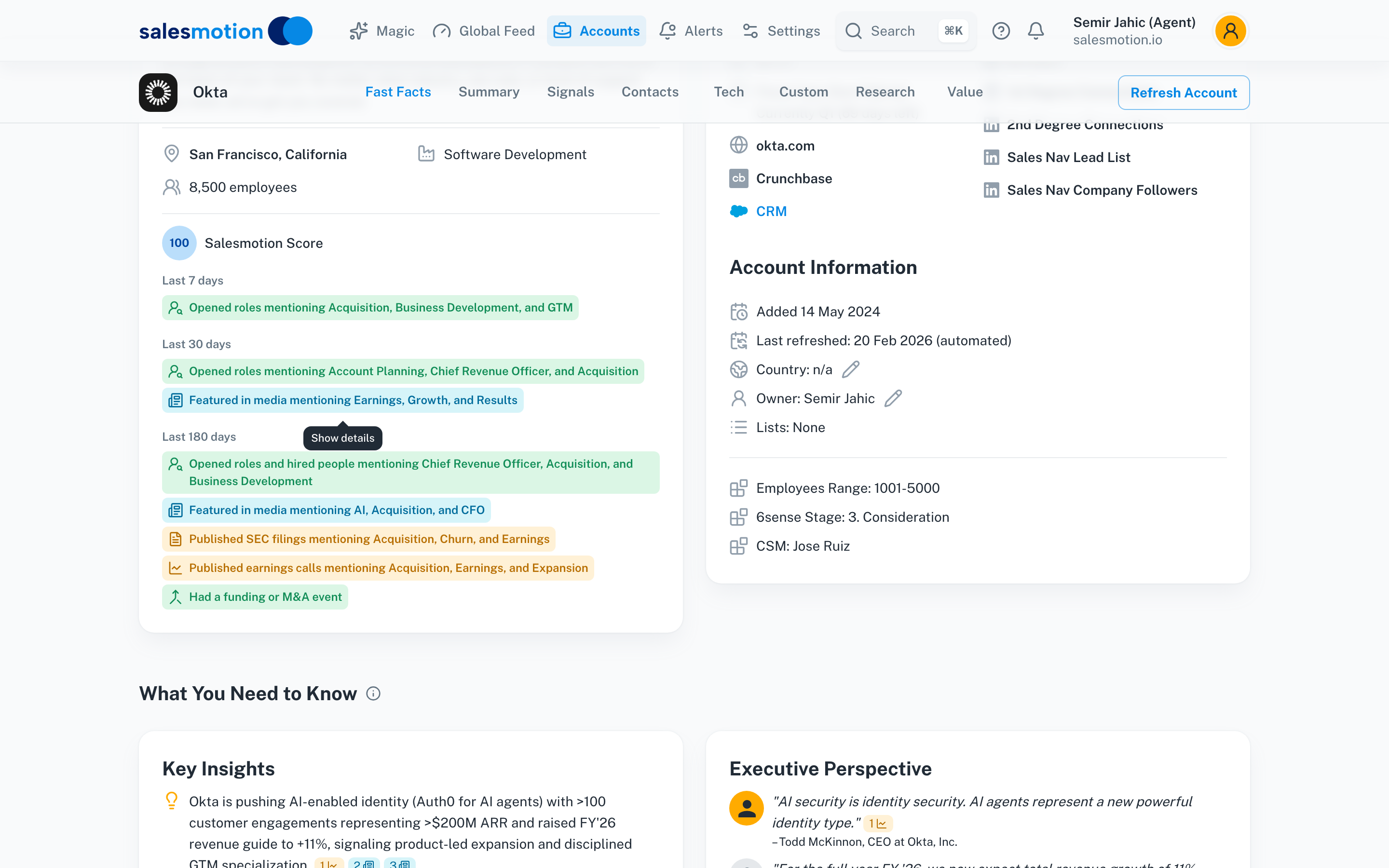 Salesmotion automates account research across 1,000+ sources — delivering key insights, executive commentary, opportunities, and competitive intelligence in a single brief.
Signals That Indicate Cybersecurity Purchase Readiness
The buying signals in cybersecurity are driven by incidents, compliance, and organizational maturity.
High-Intent Signals
- SEC 8-K cybersecurity disclosure: The strongest signal. Creates board-level urgency, budget availability, and specific technology requirements for remediation.
- New CISO or VP of Security hire: New security leaders evaluate and often replace vendors in their first 90 days. This is the most reliable personnel signal.
- Compliance certification deadline (SOC 2, ISO 27001, FedRAMP): Certification timelines create non-negotiable technology procurement deadlines.
- Regulatory enforcement action: GDPR fines, HIPAA violations, or PCI-DSS non-compliance findings trigger immediate security investment.
Medium-Intent Signals
- Security team hiring surge (3+ roles in 30 days): Indicates a funded initiative with active implementation.
- New compliance framework adoption: Moving from SOC 2 to ISO 27001 or adding FedRAMP certification signals market expansion and new security needs.
- Earnings call commentary about "cybersecurity investment" or "security posture": Public commitments create accountability.
Lower-Intent (Longer-Term) Signals
- Conference presentation on security architecture: Signals strategic thinking 6-12 months ahead of purchasing decisions.
- Bug bounty program launch: Indicates security program maturation.
- Cyber insurance renewal: Annual renewal cycles often trigger security capability reviews.

“The Business Development team gets 80 to 90 percent of what they need in 15 minutes. That is a complete shift in how our reps work.”
Andrew Giordano
VP of Global Commercial Operations, Analytic Partners
Tools Comparison: Researching Cybersecurity Accounts
| Approach | Coverage | Time per Account | Signal Freshness | Security Depth |
|---|---|---|---|---|
| Manual (SEC, job postings, trust pages, breach databases) | Comprehensive | 45-90 minutes | Real-time | Very high |
| General sales intelligence (ZoomInfo, LinkedIn) | Contact data, firmographics | 5-10 minutes | Daily | Low |
| Security-specific databases (SecurityScorecard, BitSight) | External risk ratings, breach data | 10-15 minutes | Weekly | High for risk posture |
| Salesmotion | SEC filings, leadership, news, strategic signals | Under 5 minutes | Continuous | High for event-driven signals |
The most effective approach combines automated signal monitoring for SEC disclosures, leadership changes, and strategic signals with targeted security-specific research on compliance posture and technology stack for active pipeline accounts.
For the complete guide to sales intelligence for cybersecurity, including workflows for selling to CISOs, security teams, and GRC organizations, explore our industry resource.
Key Takeaways
- Cybersecurity account research requires SEC breach disclosures, compliance framework analysis, security job postings, and conference presentation intelligence that general sales tools do not provide.
- Breach disclosures and compliance deadlines are the strongest buying signals in cybersecurity because they create non-discretionary budget and board-level urgency.
- Job postings reveal specific tool names in security stacks with higher reliability than any other source. Use them to understand what a prospect already uses and where gaps exist.
- New CISO appointments are the most reliable personnel signal. Security leaders evaluate vendors in their first 90 days.
- Build a 10-minute framework covering security posture, recent incidents, compliance status, technology stack, leadership changes, and a specific outreach angle.
- Layer automated account intelligence for territory monitoring with targeted security-specific research on priority accounts.
- For industry-specific frameworks in other verticals, see our guides to account research for healthcare and SaaS sales.
Frequently Asked Questions
How do you find out what security tools a company uses?
Job postings are the most reliable source. Security engineer and analyst postings routinely list specific tools as requirements (CrowdStrike, Splunk, Okta, Palo Alto Networks). Company trust pages and security documentation often mention compliance tools and frameworks. BuiltWith reveals web application security technology. Conference talks by the company's security leaders discuss architectural decisions and tool choices. Combining these sources gives you a high-confidence picture of the security stack.
What is the SEC cybersecurity disclosure rule and how does it affect sales?
Since December 2023, publicly traded companies must disclose material cybersecurity incidents via 8-K filings within four business days. These disclosures include the nature of the incident, material impact, and remediation plans. For security sales teams, 8-K disclosures are the strongest buying signal available because they indicate active budget allocation, board attention, and specific technology needs. Monitor SEC EDGAR for new 8-K filings with Item 1.05 (Cybersecurity Incidents).
How do you time outreach to CISOs effectively?
CISOs are most receptive during three windows: after a security incident (when budget and urgency align), during compliance certification cycles (when they need specific capabilities to pass audits), and in their first 90 days of a new role (when they are evaluating vendors). Annual budget planning (typically Q3-Q4) is another natural window. Avoid generic outreach during RSA Conference week when every vendor is competing for attention. Reference a specific signal rather than sending volume-based outreach.
What compliance frameworks create the most technology purchasing in cybersecurity?
SOC 2 Type II drives significant tool purchases for SaaS companies (logging, access control, vulnerability scanning). PCI-DSS requires specific technical controls for payment processing companies. FedRAMP certification demands extensive security infrastructure for companies selling to the US government. CMMC is creating a new wave of security investment across the defense industrial base. ISO 27001 recertification cycles create annual review and upgrade windows. The framework your prospect is subject to depends on their industry and customer base.