You open a QBR deck for a strategic account and realize the plan is already wrong.
The champion who pushed the deal internally has left. A new VP has joined from a competitor. The company just announced a restructuring. Your account team still has a neat quarterly document in CRM, but it's describing a business that no longer exists in the same form.
This is a central problem with AI for enterprise account planning. Many teams don't lack templates. They lack a system that keeps the plan current while the account keeps moving.
In complex enterprise deals, plans usually start as thoughtful work and end as admin. Someone builds the document, leadership reviews it, a few actions get logged, then the file sits still while the account changes every week. For deals that run 6 to 18 months, that gap is costly. It leads to bad timing, stale stakeholder maps, weak meeting prep, and pipeline reviews built on old assumptions.
The better model is a living account plan. Not a prettier document. A living intelligence layer that keeps monitoring the account, updates what matters, and helps reps act when there's a reason to engage.
Your Account Plans Are Stale The Day You Write Them
Most enterprise account plans fail for a simple reason. They're built as snapshots for accounts that behave like moving targets.
A rep spends hours researching the company, mapping the org, summarizing strategy, and documenting a pursuit plan. The manager asks for a clean narrative. RevOps wants consistency. Everyone does the work. Then a month later the account has shifted. A business unit leader leaves. Procurement gets involved earlier than expected. A competitor shows up in a hiring pattern. The original document stays frozen.
That's why so many strategic plans become historical records instead of selling tools.
What the stale plan looks like in practice
The signs are familiar:
- Outdated stakeholders: The economic buyer listed in the plan no longer owns the budget.
- Old priorities: The plan still reflects last quarter's initiatives, not the latest board or operating pressure.
- Weak timing: Reps know the account is important, but they don't know why now.
- Admin over action: The team updates slides for the review instead of updating their point of view on the account.
If your team is still relying on quarterly account-plan refreshes, the plan is usually stale before the quarter is over. A practical enterprise account planning template can help standardize thinking, but a template alone won't solve freshness.
Static planning breaks first on stakeholder change. The account rarely goes cold. Your map of the account does.
The author's brief mentions a WNS example where a large deal base was closed without structured targeting, then trigger-led discipline replaced manual work that used to take two weeks per account. The useful lesson isn't the headline. It's the operating change. Once teams move from occasional research to trigger-led monitoring, planning becomes part of pipeline generation, not a side exercise.
What a living plan changes
A living plan doesn't wait for QBR season. It updates when the account changes.
That means the system should continuously track role changes, company initiatives, public signals, competitor clues, and account activity. It should tell the rep what changed, why it matters, and what to do next. Without that, enterprise planning stays too slow for enterprise selling.
See Salesmotion in action
Take a self-guided interactive tour — no signup required.
From Static Documents to Living Intelligence Systems
Traditional account planning was built for a slower environment. Today's enterprise buying motion is too fluid for that model.
Teams still create plans in slides, docs, or CRM notes. They gather firmographic data, summarize initiatives, identify stakeholders, and produce a point-in-time strategy. The problem isn't that this work is useless. The problem is that it decays quickly.
The old model versus the operating model teams now need
A static document gives you one moment of clarity. A living intelligence system gives you current context and a way to act on it.
Draup reports that enterprise sales teams using AI-driven account planning can see up to a 30% reduction in research time, and the same source cites an Accenture study finding that 84% of sales teams using AI-driven account planning report significant improvements in their ability to work more effectively. That matters because enterprise planning has always been research-heavy before it becomes action-heavy.
Here's the difference in operating terms.
| Attribute | Traditional Planning (The Static Document) | AI-Powered Planning (The Living System) |
|---|---|---|
| Data freshness | Point-in-time snapshot | Continuously refreshed |
| Rep effort | Heavy manual research and synthesis | Machine-assisted drafting and monitoring |
| Stakeholder tracking | Updated only when someone remembers | Dynamic alerts on new hires, exits, and role changes |
| Competitive visibility | Sporadic and anecdotal | Ongoing monitoring across public signals |
| Meeting prep | Reps rebuild context before each call | Auto-generated briefs with recent developments |
| Strategic value | Review artifact | Daily execution tool |
| Team behavior | Reactive | Trigger-led |
Why the static document keeps failing
The static model creates three predictable problems.
First, reps spend too much time gathering context. Second, leadership reviews plans that are already aging. Third, the account team starts treating planning as a compliance task instead of a commercial advantage.
That's why the phrase AI for enterprise account planning matters when it's used correctly. It shouldn't mean “the model writes the document for me.” It should mean “the system keeps the account view current enough to support action.”
For teams building strategic coverage, key account plans still matter. They just need to operate more like live systems than quarterly files.
Practical rule: If the output of your account planning process is a document, you've only solved documentation. If the output is timely action, you've built an operating system.
What the living system actually does
A living system watches the account between formal reviews. It notices signals that humans miss or don't have time to chase. It refreshes the stakeholder map. It updates competitive context. It gives the rep a current brief before a call instead of forcing another hour of manual prep.
That's a meaningful shift in enterprise sales. The plan stops being something the rep submits. It becomes something the team works from.

“The account and contact signals are key for reaching out at important times, and the value-add messaging it creates unique to every contact helps save time and efficiency.”
Daniel Pitman
Mid-Market Account Executive, Black Swan Data
The Three Engines of an AI Planning System
The easiest way to make AI for enterprise account planning practical is to break it into three jobs your team already does manually. Research. Signals. Action.
When sales leaders talk vaguely about “using AI,” adoption usually stalls. Reps don't want abstract capability. They want fewer hours of digging, clearer reasons to engage, and help turning insight into outreach.
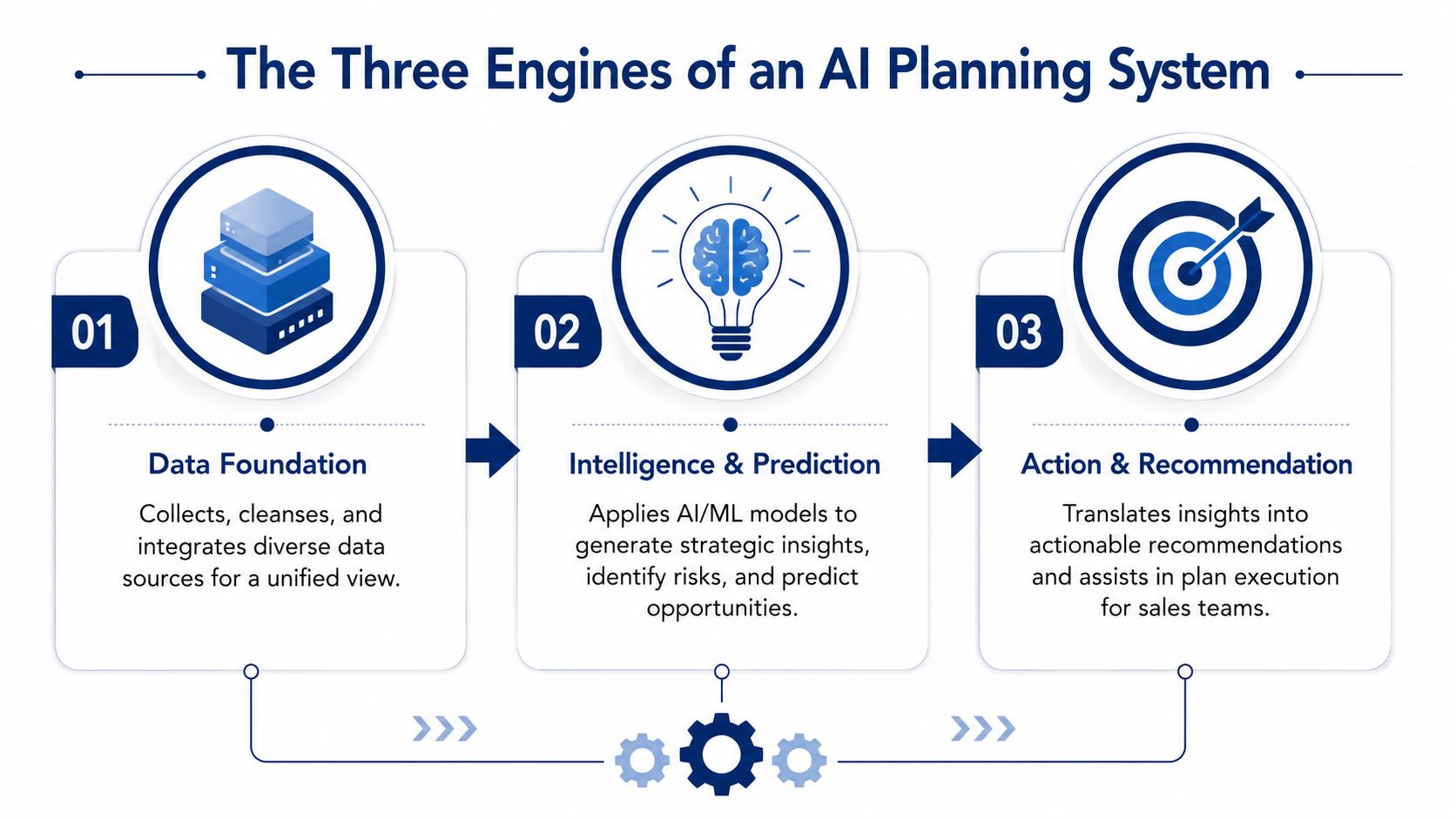
Research engine
The research engine builds and refreshes the account brief.
That includes public sources like earnings calls, SEC filings, company news, investor updates, leadership pages, job postings, and interviews. The goal isn't to dump links into a feed. The goal is to produce a structured view of the account: business priorities, recent changes, likely pressure points, stakeholder context, and areas worth exploring.
AWS shared in an October 2024 case study that its sales team launched an AI-powered account planning draft assistant built on Amazon Bedrock to generate draft content for key account plan sections. AWS said those sections previously required “hours of research across the internet” and multiple internal tools. That's an important signal to operators. Large enterprise sales organizations are formalizing this workflow internally.
A good research engine should produce:
- Company-level brief: Strategic priorities, current initiatives, and relevant business context.
- Stakeholder summary: Who matters, what likely changed, and where relationship risk exists.
- Competitive context: Clues from hiring, messaging, technology choices, and market activity.
- Meeting preparation inputs: Recent developments that change the angle of the conversation.
Signal engine
The signal engine is the always-on monitor.
It watches for events that can shift deal timing or account strategy. Executive hires, departures, new product launches, restructuring, expansion into a new market, changing job requirements, competitor mentions, and shifts in buying-center activity all belong here. The true value is not the raw event. It's the explanation of why the event matters.
A useful signal engine should answer three questions immediately:
- What changed
- Why it matters for this account
- What the rep should do next
Many tools fall short. They deliver news, not signal. Reps don't need more unread alerts. They need prioritised, contextualized triggers.
Action engine
The action engine turns intelligence into execution.
That can mean drafting an email based on a new stakeholder hire, generating a pre-meeting brief before an executive call, suggesting a multithreaded outreach sequence after a competitor clue appears, or flagging the manager to adjust coverage on the account.
One option in this category is AI agents for sales teams, where separate agents handle research, monitoring, and outreach support. The underlying principle is what matters: distinct jobs, clear inputs, visible outputs.
The system earns trust when a rep can see the source, understand the reasoning, and use the output without rewriting everything from scratch.
When these three engines work together, account planning stops being a quarterly write-up. It becomes a continuous workflow.
Turning AI Insights into Pipeline Opportunities
The point of AI for enterprise account planning isn't better notes. It's better timing and better conversations.
The strongest systems combine internal and external context. Varicent notes that the power comes from fusing heterogeneous signals like CRM data, product usage, intent data, and public disclosures, which helps teams spot risks or opportunities that would stay invisible inside any single system. That's the difference between interesting information and useful action.

Dynamic stakeholder mapping
This is usually the first use case that creates immediate value.
A strategic account plan says the CFO is the economic buyer and the VP of Operations is the champion. Then the VP leaves. A new executive comes in with a different background, different priorities, and often a different internal network. If nobody notices quickly, the rep keeps working an old path through the account.
A living system should catch the departure, identify the incoming leader, refresh the stakeholder map, and prompt the rep to re-open discovery. That can change the outreach from “following up on our prior discussion” to “I saw the leadership transition and pulled together a short perspective on where teams in your position typically reassess operations priorities.”
That's a better conversation because it's anchored in a real change.
Real-time competitive intelligence
Competitive risk often shows up in fragments before it shows up in the deal.
A target account mentions a competing initiative in an earnings call. A job posting asks for experience with a rival platform. A new executive has a history with a competitor. None of those signals guarantee a threat. Together, they tell you to tighten your point of view.
For many teams, buying signals in B2B sales are operationalized. The account team doesn't just log the signal. They change the sales motion. They tailor the meeting narrative, bring in the right specialist, and prepare for the objection before it appears in procurement.
Expansion and cross-sell triggers
Expansion usually doesn't start with a quota target. It starts with a change inside the customer.
A product launch can create new operational strain. A regional expansion can create compliance or systems complexity. M&A can create overlap, fragmentation, or a standardization need. Product-usage data might show low penetration in one division while public signals suggest that division is becoming more important.
That's where AI can do more than summarize. It can connect the external event to internal account reality and surface an expansion angle that is practical.
Automated pre-meeting briefs
Pre-meeting prep is one of the biggest hidden drains on enterprise selling.
A rep has an executive meeting in an hour. They open ten browser tabs, skim old notes, search LinkedIn, check recent news, and try to remember who said what on the last call. A living planning system should generate the brief automatically: account updates, stakeholder changes, active initiatives, potential objections, and recommended talking points.
Manager test: If your best reps still need to rebuild account context before every important meeting, your planning system isn't supporting execution.
The rep still owns judgment. But they're starting from a current brief, not from scratch.

“All of the vendors that I've worked with, all of the onboarding that I have had to deal with, I will say, hands down, Salesmotion was the easiest that I have had.”
Lyndsay Thomson
Head of Sales Operations, Cytel
Your Phased Rollout Plan for AI Account Planning
Most rollout plans fail because leaders try to transform planning, data quality, rep behavior, and pipeline measurement all at once. That's too much change for one motion.
A better path is phased adoption with a narrow operating scope at the start.
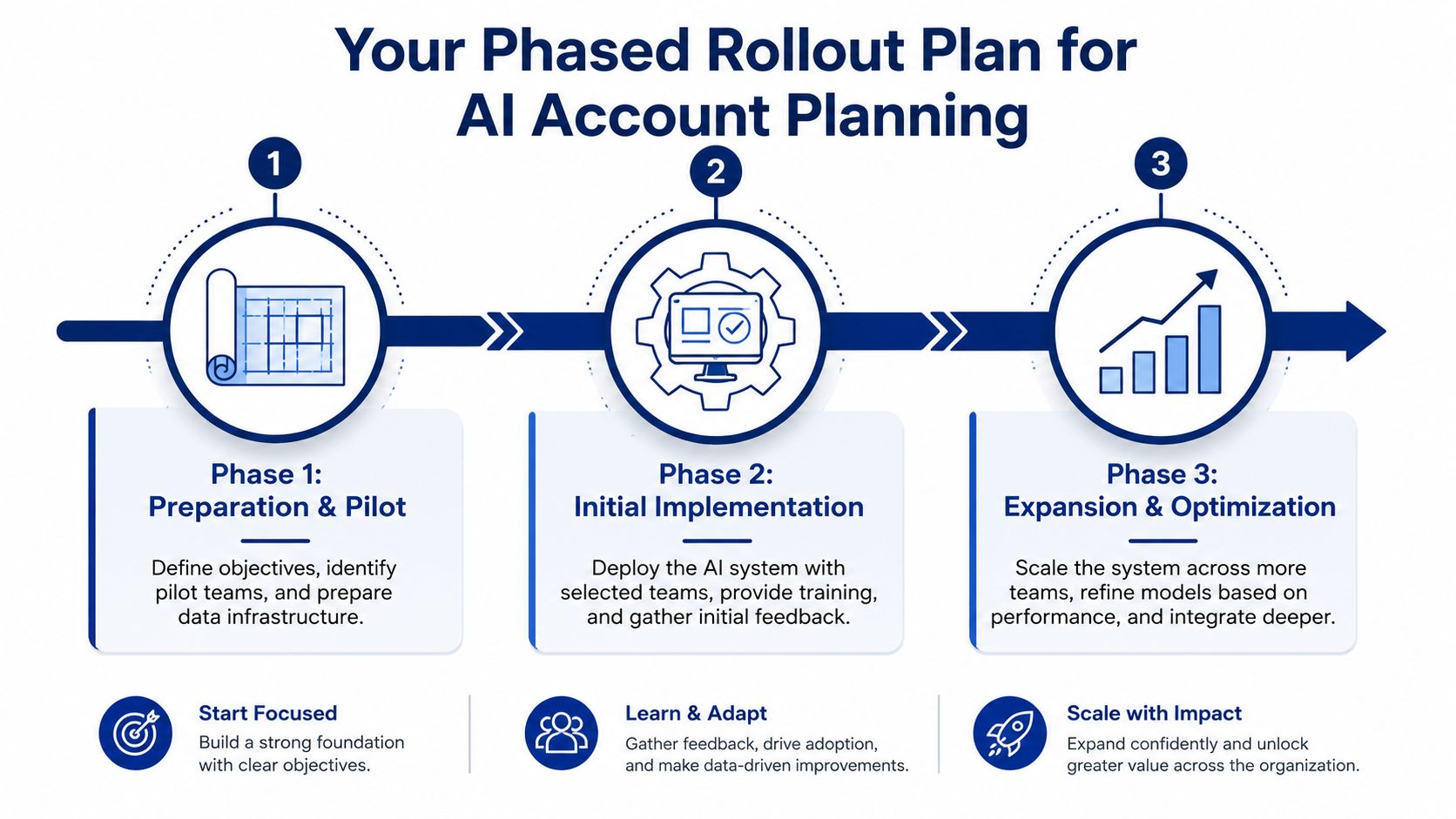
Phase 1 pilot and proof
Start with a small set of strategic accounts and a limited user group.
Pick reps who already run disciplined enterprise motions. They'll give you better feedback than a team still struggling with basic CRM hygiene. Focus the pilot on a few high-value workflows: stakeholder change alerts, pre-meeting briefs, and trigger-based outreach support.
Keep the success criteria commercial and observable. Good examples include whether reps act on surfaced signals, whether managers use the outputs in deal reviews, and whether the team can trace new conversations back to account triggers.
A strong pilot also needs source visibility. If reps can't see where the insight came from, trust drops fast.
Phase 2 workflow integration and enablement
Once the pilot produces usable output, integrate it into the team's rhythm.
That means building simple operating rules around different signal types. Leadership change should trigger stakeholder-map review. Competitor signal should trigger account strategy review. Expansion signal should trigger whitespace discussion and cross-functional alignment.
Use enablement to teach judgment, not just tool clicks:
- Define response plays: What should a rep do when a new executive joins, a competitor appears, or a strategic initiative surfaces?
- Create review cadences: Managers should discuss recent signals in pipeline reviews and account reviews.
- Embed into existing channels: Deliver alerts where reps already work, such as CRM, Slack, or email.
- Train on message quality: Reps should learn how to turn a signal into a relevant outreach angle, not just mention the event.
Phase 3 scale and optimization
At this point the work shifts from deployment to refinement.
You'll start seeing which signals are useful, which are noisy, which account types respond best, and where validation rules need tightening. RevOps should review signal categories, rep adoption patterns, and action rates. Sales leaders should look at whether account planning quality is improving in deal execution.
Rollout gets easier when the first use cases save time and create meetings. Reps adopt quickly when the system helps them this week, not in a theoretical future state.
Scaling doesn't mean turning on every feature. It means expanding the workflows your team has already proved they'll use.
Measuring Success Beyond Rep Productivity
Most AI business cases start with efficiency because it's easy to explain. Research takes time. AI saves time. That's useful, but it's not enough for an enterprise revenue decision.
The better question is whether AI for enterprise account planning improves pipeline quality.
DemandFarm highlights this gap clearly. Discerning buyers want to know how to prove AI-driven account planning improves pipeline quality, not just rep productivity. They also want to know which account triggers deserve action and how to benchmark signal-to-pipeline conversion rates.
What to measure first
Start with leading indicators that show whether the system is improving account execution.
- Signal-to-meeting conversion: Which triggers create conversations?
- Stakeholder coverage depth: Are reps identifying and engaging more of the buying group?
- Freshness of account intelligence: Are key plans being updated as accounts change?
- Manager usage: Are frontline leaders using the outputs in inspection and coaching?
These metrics tell you whether the system is entering the operating rhythm.
What matters later
Lagging indicators should tie back to revenue outcomes, not just workflow activity.
A mature measurement model usually looks at:
| KPI type | What to watch |
|---|---|
| Leading | Signal response rate, stakeholder additions, brief usage before meetings |
| Commercial | Meetings sourced from signals, opportunities influenced by account insights |
| Outcome | Pipeline progression on targeted accounts, expansion sourced from surfaced triggers |
The exact scorecard will vary by sales model, but the principle stays the same. Don't stop at “hours saved.” Measure whether better account intelligence improves account coverage, conversation quality, and revenue creation.
A planning system that saves time but doesn't shape pipeline behavior is an efficiency tool. A planning system that changes who reps contact, when they engage, and how they position is a revenue tool.
A practical measurement rule
Tie every major signal category to a downstream action and an outcome review.
If you can't tell whether leadership-change alerts, competitor signals, or expansion triggers are producing meetings or opportunities, you don't yet know which parts of the system are commercially valuable.
Choosing a Partner and Overcoming Adoption Hurdles
Vendor evaluation gets shallow fast in this category. Teams compare dashboards, summaries, and AI writing quality, then skip the harder implementation questions.
That's risky because account planning sits close to forecasting, strategic account coverage, and executive selling. If the system is unreliable, reps stop trusting it. If it's clunky, managers stop reinforcing it.
Questions that matter more than feature lists
The first question is data veracity.
Databahn points to a core issue: many AI systems still face hallucination risk, and a 2024 benchmark found leading models can generate fabricated citations and facts. In enterprise account planning, that's not a minor problem. A wrong stakeholder claim or fabricated source can damage credibility fast.
Ask vendors:
- How do you verify outputs: Can the rep trace an insight back to the source?
- Where is human review required: Which outputs should be validated before broad use?
- How are signals prioritized: What separates a meaningful trigger from noise?
- How does it fit workflow: Does it show up in CRM, Slack, email, and existing seller routines?
The trust problem is operational, not philosophical
Reps usually don't resist AI because they hate automation. They resist it because they've seen too many weak recommendations.
Trust grows when the tool behaves like a good analyst. It cites its source. It distinguishes fact from inference. It explains the “so what.” It helps the rep move faster without forcing blind acceptance.
A practical human-in-the-loop model often includes:
- Source-visible insights for account research and stakeholder updates
- Manager validation for high-stakes strategic claims
- Rep review before send for outreach drafts and meeting briefs
- Feedback loops so weak alerts get corrected over time
Change management talking points that actually help
Leaders should be direct with the team.
- This isn't replacing enterprise judgment: It's reducing manual research and keeping plans current.
- The rep still owns the account strategy: AI should improve the brief, not decide the deal.
- Source-backed outputs matter: If the system can't show its work, don't trust it blindly.
- Adoption should start with real seller pain: Meeting prep, stakeholder drift, and trigger monitoring are better starting points than broad mandates.
Teams adopt signal-based selling when the system helps them sound smarter in front of customers, not when leadership announces a transformation program.
The right partner should strengthen your operating model, not add another admin layer.
If your team is trying to move account planning from quarterly admin to continuous pipeline creation, Salesmotion is one option to evaluate. It uses AI agents to build account briefs, monitor live account signals, and turn those changes into actionable outreach context inside existing seller workflows.